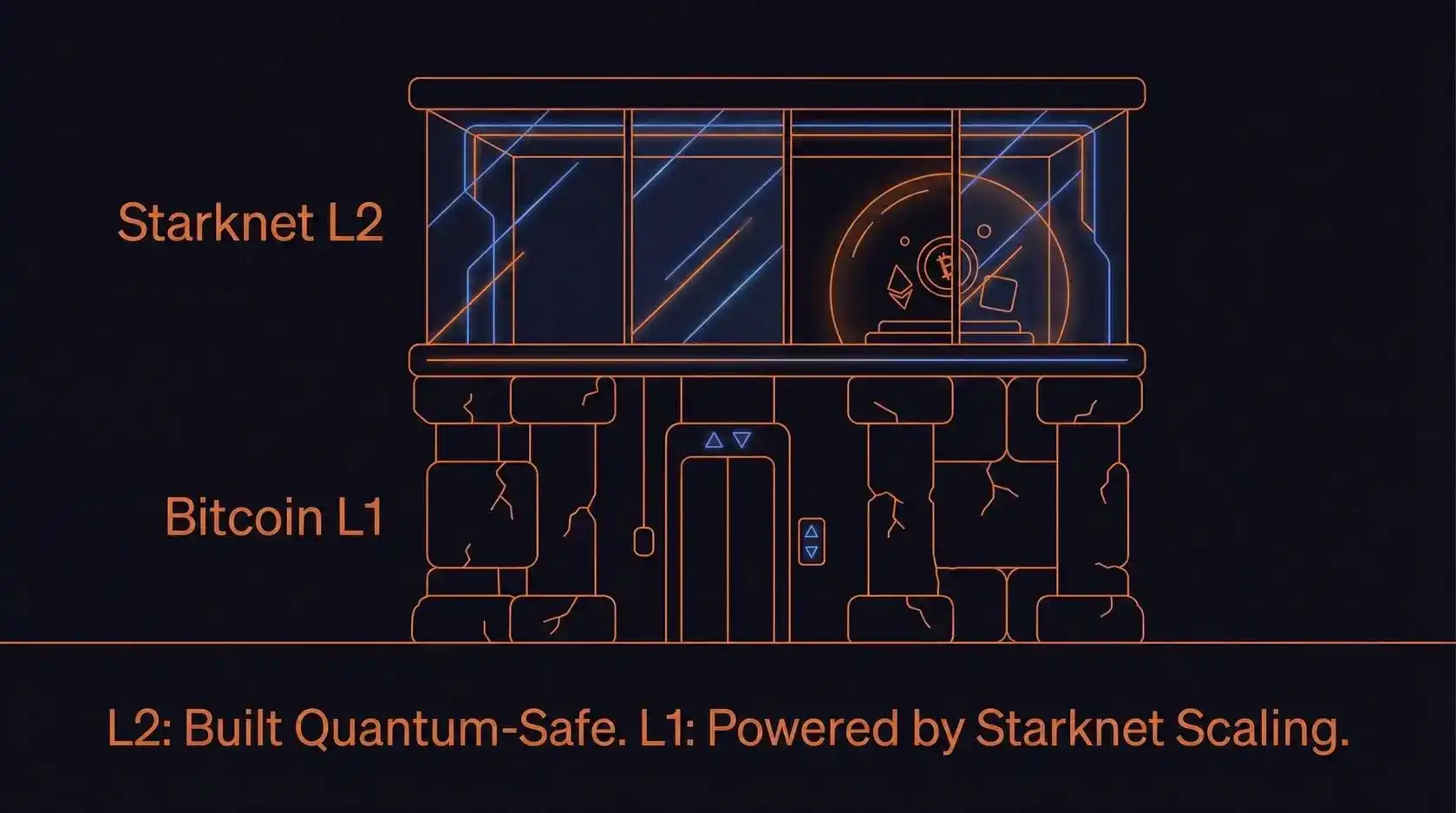
ZK-Driven Bitcoin Privacy Solution Officially Launches on Starknet

marsbitPublié le 2026-05-14Dernière mise à jour le 2026-05-14

Résumé

Starknet has launched strkBTC, a ZK-driven privacy solution for Bitcoin. It uses Starknet's zero-knowledge technology to shield transaction details and balances on the public ledger, addressing growing security concerns like targeted robberies and AI-powered wallet tracking. The system is designed to be compliance-ready, featuring view keys for authorized audits and third-party screening to prevent illicit funds. Future plans include confidential DeFi activities on Starknet, quantum-resistant cryptography, integration with BitVM for enhanced security, and a long-term goal of a trustless bridge via a Bitcoin OP_CAT soft fork. The initiative aims to make Bitcoin function as private digital cash while maintaining necessary accountability.

strkBTC officially launched on Starknet on May 12, leveraging Starknet's ZK technology to provide advanced shielding mechanisms while being fully compliant. This privacy solution addresses the growing demand for privacy protection and serves as a practical response to armed robberies and threats triggered by public ledger exposure of large Bitcoin holdings. As personal safety concerns for Bitcoin holders become increasingly severe, privacy protection is not just a technical innovation but potentially life-saving.

Damian Chen, Vice President of the Starknet Foundation, stated: "When criminals monitor public ledgers, use AI to track wallets, and attack others for cryptocurrency, privacy is no longer merely a noble ideal."

"Privacy is both a need and a right. We urgently need privacy solutions that can draw the curtains, meaning criminals can no longer peer through the window to plot against their targets."

Private Digital Cash, As It Was Meant to Be

Privacy pioneer and StarkWare CEO & Zcash co-founder Eli Ben-Sasson believes that strkBTC's momentum can transform into "private digital cash — as it was meant to be."

He stated that strkBTC represents a significant advancement of some of the ideals that drove the Zcash project. The strkBTC economy will allow users and institutions to hide balances, which is essential for protecting rights, ensuring security, and promoting adoption. In the future, users will also be able to participate in DeFi while maintaining full compliance and selective disclosure capabilities.

What Are strkBTC's Current Core Features?

  • Re-anonymization: A mechanism to bridge back to a new, unlinked Bitcoin address.
  • Compliance-Ready: Full auditability for tax and legal purposes through viewing key technology and integrated third-party asset screening to prevent prohibited or sanctioned assets from entering the privacy pool.

What Features Are Coming Soon?

  • Confidential DeFi: Shielded lending, trading, and yield generation on Starknet while preserving credible utility.

The Safety Mission: Privacy as Physical Security

Starknet has long been a leader in the privacy space, using the zero-knowledge STARK cryptography co-invented by Ben-Sasson.

STARK combines scalability with strong privacy guarantees, and strkBTC applies this technology to the most pressing issue facing Bitcoin holders today: Bitcoin-targeted crime.

This connection is no longer theoretical but actionable. In 2025, armed robberies and extortion cases targeting Bitcoin holders increased by 75%. The Starknet team has been closely monitoring this trend. According to recent estimates, AI-powered tools can now link public wallet addresses to real-world identities with up to 90% accuracy.

Chen pointed out that blockchain's default transparency has severe consequences in the absence of effective protection. For individuals, the risk is physical safety; for institutions, the issue is adoption. Many serious financial institutions cannot operate at scale when every balance, transfer, and treasury activity is publicly visible.

He added: "Bitcoin is the most sovereign money ever created, but it's also the least private money most people have ever used. For fifteen years, we've told ourselves the public ledger is a feature, but in 2026, it has become a map to our private lives."

"When people show up at someone's doorstep because they saw their wallet balance online, transparency is no longer a feature—it's exposure. That's why we built strkBTC, to address how the world has changed since 2008."

The situation in France has already become severe, with 41 cryptocurrency-related kidnapping cases recorded in the country this year. Recently, a French family was attacked after their crypto assets were identified through leaked datasets and public blockchain activity. The attackers weren't guessing; they knew precisely.

strkBTC is a direct response to the "$5 wrench attack"—where attackers use low-cost violence to force victims to hand over private keys or assets. It's for those who want to hold Bitcoin without broadcasting their entire financial life to anyone with an internet connection.

How strkBTC Works

At its core, strkBTC is a technical wrapper for Bitcoin designed to bring it into a shielded environment on Starknet, allowing users and institutions to protect balances and transaction history while retaining the ability to comply with audit, tax reporting, and legal requirements.

In practice, strkBTC allows the underlying value to enter "shielded mode," whereupon balances and transaction history are hidden from the public.

In stark contrast to older privacy protocols, it was not designed as an opaque black box but was built for regulatory disclosure under legitimate requirements. The system automatically generates viewing keys. When faced with a legitimate regulatory request, independent third-party compliance reviewers can use these keys to share limited and specific data with tax authorities, auditors, or other regulators. This compliant transaction model unlocks vast markets previously inaccessible to BTC due to compliance constraints. Simultaneously, ordinary users will have their own viewing keys, allowing them to unshield transactions for their own needs, while all information remains absolutely private to the public.

It is this compliance layer, guaranteed by designated third-party auditing entities, that activates many financial activities previously hindered by a lack of transactional confidentiality. These specifically include:

  • Private payroll: Paying employee salaries without exposing individual compensation or corporate cash flow movements.
  • Supplier payments: Making B2B transfers without revealing business relationships, pricing, or strategic trade flows.
  • Strategic capital deployment: Moving large positions without signaling intent to the market or attracting predatory observers.

The ultimate goal is to achieve superior usability: enabling Bitcoin to be used as private on-chain cash globally without forcing users into difficult choices between confidentiality and accountability.

A Collective Effort Toward Technical Sovereignty

The realization of strkBTC is the result of collaboration from a broad ecosystem of contributors, including Starknet core developers, alliance partners, wallet service providers, audit infrastructure providers, and liquidity providers dedicated to expanding Bitcoin's utility. Core project members like Eli Ben-Sasson and Chen emphasize that strkBTC, as a now fully operational technical wrapper, serves as an immediate bridge between Bitcoin and Layer2. Project leaders position it as a pragmatic and necessary tool. They know the world cannot wait for a "perfect" technical milestone, therefore prioritizing immediate utility that solves real-world pain points over theoretical purity.

Technical Roadmap

Looking ahead, strkBTC's technical development primarily includes the following directions:

  • Quantum Resistance Research: StarkWare is developing quantum-resistant cryptography for strkBTC. StarkWare Chief Product Officer Avihu Levy recently presented research on making Bitcoin quantum-resistant.
  • BitVM Integration: The project is actively moving towards a 1-of-N security model via BitVM. This model ensures the system remains secure even if only one participant is honest, significantly reducing the required trust assumptions.
  • Ultimate Goal: The long-term vision is to establish a fully trustless bridge powered by an OP_CAT soft fork, enabling Bitcoin to natively verify Starknet proofs.

Original Link

Cryptos en tendance

Questions liées

QWhat is the name of the new privacy solution for Bitcoin that launched on Starknet, and when did it launch?

AThe solution is called strkBTC, and it officially launched on Starknet on May 12.

QAccording to the article, what is the primary real-world problem that strkBTC aims to address for Bitcoin holders?

AIt primarily aims to address the increasing personal security threats, such as armed robberies and extortion, faced by Bitcoin holders whose wealth is exposed on the public blockchain ledger.

QWhat key feature ensures strkBTC's compliance with regulatory requirements like tax and legal audits?

AThe system generates viewing keys. These keys allow designated independent third-party compliance reviewers to share specific, limited data with authorities or auditors upon legitimate request, while keeping all information private from the general public.

QWhat are two of the future functionalities planned for strkBTC as mentioned in the article?

ATwo planned future functionalities are: 1) Confidential DeFi, enabling shielded lending, trading, and yield generation on Starknet, and 2) Integration with BitVM to move towards a more secure 1-of-N trust model.

QWho described strkBTC's potential as 'private digital cash the way it was always supposed to be' in the article?

AThis statement was made by Eli Ben-Sasson, a pioneer in privacy technology and the CEO of StarkWare and co-founder of Zcash.

Lectures associées

Une "déesse de la charité" de 3 millions d'abonnés entièrement créée par IA, un orphelinat factice, un "faux philanthrope" transnational s'effondre du jour au lendemain

**[Guide] Scandale : Une influenceuse australienne prétendant aider des orphelins avec 3 millions d'abonnés a été démasquée pour avoir utilisé l'IA afin de créer de fausses images et vidéos de son oeuvre caritative.** L'ABC révèle que Lily Jay, une influenceuse australienne convertie à l'islam avec près de 3 millions d'abonnés, a orchestré une vaste escroquerie caritative en utilisant l'intelligence artificielle. Sa fondation, le "Lily Jay Foundation", prétendait construire des mosquées, distribuer de la nourriture à Gaza et gérer un orphelinat en Ouganda. Cependant, l'enquête montre que des vidéos clés, notamment celle de l'inauguration de l'orphelinat où des enfants tiennent des sucettes, étaient intégralement générées par IA, avec des incohérences typiques comme des erreurs de texte sur les vêtements. Aucune trace de l'orphelinat "Ada Nur" ou de la boulangerie à Gaza n'a pu être vérifiée sur place. Un trophée "humanitaire" présenté en mai 2026 portait le filigrane invisible d'un générateur d'images AI. Le site web de la fondation admettait discrètement ne pas être un organisme de bienfaisance enregistré, échappant ainsi aux obligations de transparence financière. Opérant depuis Chypre et le Kosovo, Lily Jay (de son vrai nom Lily Jay Hinson) mène une vie luxueuse sur ses réseaux personnels. Après les questions de l'ABC, le site a modifié son contenu pour les visiteurs australiens, supprimant les options de don et les pages compromettantes, tout en les conservant pour le public international. Les experts alertent sur la dangerosité de ces escroqueries qui exploitent la générosité et la volonté de croire en de belles histoires. À l'ère du deepfake, la défense reste un questionnement critique : est-ce vrai ?

marsbitIl y a 4 mins

Une "déesse de la charité" de 3 millions d'abonnés entièrement créée par IA, un orphelinat factice, un "faux philanthrope" transnational s'effondre du jour au lendemain

marsbitIl y a 4 mins

L2 « recalibrage » : quand L1 devient son propre Rollup, quel est le destin final d’Ethereum ?

"L2 Recalibration": When L1 Becomes Its Own Rollup, What Is Ethereum's Endgame? In recent years, the proliferation of L2s (Rollups) has solved Ethereum's scalability issues but at the cost of fragmenting liquidity, user states, and the unified chain experience. This has prompted a fundamental reevaluation of the relationship between L1 and L2 within the Ethereum community. Ethereum's roadmap is evolving. The core challenge is no longer just creating more block space, but redefining the roles of L1, L2, execution, and settlement layers in a fragmented ecosystem. L1 is actively enhancing its own scalability (increasing Gas Limit, statelessness, zkEVM). Consequently, L2s can no longer rely solely on "cheaper, faster transactions" for long-term value. Their future role shifts towards providing differentiated features (privacy, custom governance, application-specific optimizations) that L1 cannot easily offer uniformly, while still contributing extra capacity. Interoperability is key to restoring a seamless user experience. The goal is not just cross-chain bridges but enabling different execution environments to trust each other's states faster and at lower cost. Initiatives like Open Intents Frameworks and the Ethereum Interoperability Layer (EIL) aim to make cross-L2 interactions feel like single-chain transactions. Crucially, shortening Ethereum's finality time (from minutes to seconds) is a major focus, as it directly benefits cross-chain applications by reducing the trust latency for state changes. A provocative idea from researcher Barnabé Monnot suggests that as proof systems (like zkEVM) mature on mainnet, L1 itself could become a form of "its own Rollup." Here, specialized nodes would execute transactions and generate validity proofs, while validators would verify these proofs instead of re-executing everything. This blurs the traditional L1/L2 hierarchy, making "Rollup" more of a general execution-verification architecture than a strict layer. The vision is a future where multiple L2s act as specialized execution domains (for DeFi, gaming, privacy, etc.) under a shared Ethereum security, settlement, and state framework—a system that is fragmented in execution but unified in trust and liquidity. In conclusion, Ethereum's endgame is not L2s replacing L1 or being made obsolete by a scaled L1. It is an ecosystem where L2s become a spectrum of execution environments with varying features, all capable of securely interoperating and sharing Ethereum's foundational security and liquidity. The next phase is about re-integrating what was fragmented back into a coherent, user-friendly "one chain" experience.

marsbitIl y a 5 mins

L2 « recalibrage » : quand L1 devient son propre Rollup, quel est le destin final d’Ethereum ?

marsbitIl y a 5 mins

Grayscale Dépose le Premier ETF sur Worldcoin auprès de la SEC sous le Symbole GWLD

La société Grayscale Investments a déposé une demande d'enregistrement Form S-1 auprès de la SEC américaine pour créer un nouveau fonds négocié en bourse (ETF) lié à la cryptomonnaie Worldcoin, sous le ticker GWLD sur Nasdaq. Ce fonds, établi le 10 juillet, offrirait aux investisseurs américains un accès régulé à Worldcoin (WLD), alors que les citoyens américains ne sont pas éligibles aux subventions utilisateurs du projet. Le dépôt intervient alors que le WLD a atteint son plus bas historique en mai 2026, avant de connaître une hausse de plus de 8% à l'annonce de l'ETF. Le dossier de Grayscale soulève également des questions importantes sur la tokenomique de Worldcoin, notamment la concentration des tokens (les 100 plus grands portefeuilles détiennent environ 90% de l'offre en circulation) et le déblocage continu de tokens par les initiés jusqu'en 2028, ce qui exercera une pression vendeuse. De plus, l'écosystème de Worldcoin, qui utilise des dispositifs biométriques de scan oculaire (Orbs), est confronté à des défis réglementaires spécifiques dans plusieurs juridictions. Malgré un calendrier incertain (l'introduction en bourse n'est pas attendue avant fin 2026) et l'approbation de la SEC encore en suspens, cette démarche illustre la volonté de Grayscale d'étendre son offre d'investissements cryptographiques régulés et de se positionner sur le marché émergent des ETF.

TheNewsCryptoIl y a 21 mins

Grayscale Dépose le Premier ETF sur Worldcoin auprès de la SEC sous le Symbole GWLD

TheNewsCryptoIl y a 21 mins

L'Éternel Fragment de l'Argent : Les Paiements Tiers N'ont Pas de Principe Premier

L'article examine les défis de l'industrie des paiements, en prenant l'exemple de la trajectoire de Stripe et de sa récente tentative de rachat de PayPal. Il souligne que le secteur reste hautement fragmenté, avec des acteurs locaux ou spécialisés résilients, et qu'il est structurellement subordonné au système bancaire traditionnel. Stripe, ayant manqué la fenêtre d'introduction en bourse pendant la pandémie, cherche désormais à étendre son écosystème via des acquisitions (comme PayPal pour sa clientèle grand public) et en investissant dans les stablecoins (OUSD) et les infrastructures de paiement pour agents autonomes (AI). Cependant, l'auteur note que les stablecoins ne sont pas encore une pratique courante et que l'économie des agents reste naissante. La thèse centrale est que le futur modèle économique pourrait résider dans les réseaux de compensation (clearing). En obtenant des licences bancaires et en développant des blockchains dédiées (comme Tempo pour Stripe), ces entreprises pourraient capturer une partie de la valeur en améliorant l'efficacité des règlements, potentiellement en marge du système bancaire traditionnel. En conclusion, la bataille dans les paiements tiers est comparée à une guerre de tranchées sans fin, où aucun acteur ne peut éliminer tous les autres par la seule taille. L'avenir passe par la diversification et l'innovation sur les infrastructures de compensation.

marsbitIl y a 29 mins

L'Éternel Fragment de l'Argent : Les Paiements Tiers N'ont Pas de Principe Premier

marsbitIl y a 29 mins

Trading

Spot

Articles tendance

Comment acheter ZK

Bienvenue sur HTX.com ! Nous vous permettons d'acheter ZKsync (ZK) de manière simple et pratique. Suivez notre guide étape par étape pour commencer votre parcours crypto.Étape 1 : Création de votre compte HTXUtilisez votre adresse e-mail ou votre numéro de téléphone pour ouvrir un compte sur HTX gratuitement. L'inscription se fait en toute simplicité et débloque toutes les fonctionnalités.Créer mon compteÉtape 2 : Choix du mode de paiement (rubrique Acheter des cryptosCarte de crédit/débit : utilisez votre carte Visa ou Mastercard pour acheter instantanément ZKsync (ZK).Solde :utilisez les fonds du solde de votre compte HTX pour trader en toute simplicité.Prestataire tiers :pour accroître la commodité d'utilisation, nous avons ajouté des modes de paiement populaires tels que Google Pay et Apple Pay.P2P :tradez directement avec d'autres utilisateurs sur HTX.OTC (de gré à gré) : nous offrons des services personnalisés et des taux de change compétitifs aux traders.Étape 3 : stockage de vos ZKsync (ZK)Après avoir acheté vos ZKsync (ZK), stockez-les sur votre compte HTX. Vous pouvez également les envoyer ailleurs via un transfert sur la blockchain ou les utiliser pour trader d'autres cryptos.Étape 4 : tradez des ZKsync (ZK)Tradez facilement ZKsync (ZK) sur le marché Spot de HTX. Il vous suffit d'accéder à votre compte, de sélectionner la paire de trading, d'exécuter vos trades et de les suivre en temps réel. Nous offrons une expérience conviviale aux débutants comme aux traders chevronnés.

288 vues totalesPublié le 2024.12.13Mis à jour le 2026.06.02

Comment acheter ZK

Discussions

Bienvenue dans la Communauté HTX. Ici, vous pouvez vous tenir informé(e) des derniers développements de la plateforme et accéder à des analyses de marché professionnelles. Les opinions des utilisateurs sur le prix de ZK (ZK) sont présentées ci-dessous.

活动图片