Why We No Longer Love Crypto

比推Publié le 2026-03-11Dernière mise à jour le 2026-03-11

Résumé

The article "Why We No Longer Passionate About Crypto" explores the growing sense of disillusionment among crypto veterans. Many who once found excitement in the space now feel stuck, particularly those not working on stablecoins, financial infrastructure, or DeFi. The author notes that the previous era—where developer-focused products thrived on vibes rather than revenue—ended about 18 months ago. The crypto market for non-financial applications is now seen as limited, with an estimated annual addressable market of only $200–300 million, leading many builders to feel they have few viable paths forward. The rise of AI has intensified this frustration, as it offers faster innovation and more tangible product development compared to crypto’s current constraints. The author outlines several unappealing options for those exploring crypto-AI intersections: tokenizing traditional AI products without real utility, building decentralized AI infrastructure (which lacks immediate feedback), or competing with giants in AI-focused stablecoin infrastructure. Despite this pessimism, the author concludes with a note of optimism: Crypto’s unique value lies in its ability to serve as "capital superconductor" for growth. The convergence of AI-driven product innovation and crypto’s programmable capital mechanisms could fuel a new generation of "agent-based companies," creating a renewed sense of purpose for those who remain.

Author: Kydo (@0xkydo)

Original Title: Why crypto is not that fun anymore

Compiled and Arranged: BitpushNews


These days, a tweet struck a chord. It revealed a shared, yet rarely mentioned sense of helplessness—many of us no longer enjoy working here (in crypto) anymore.
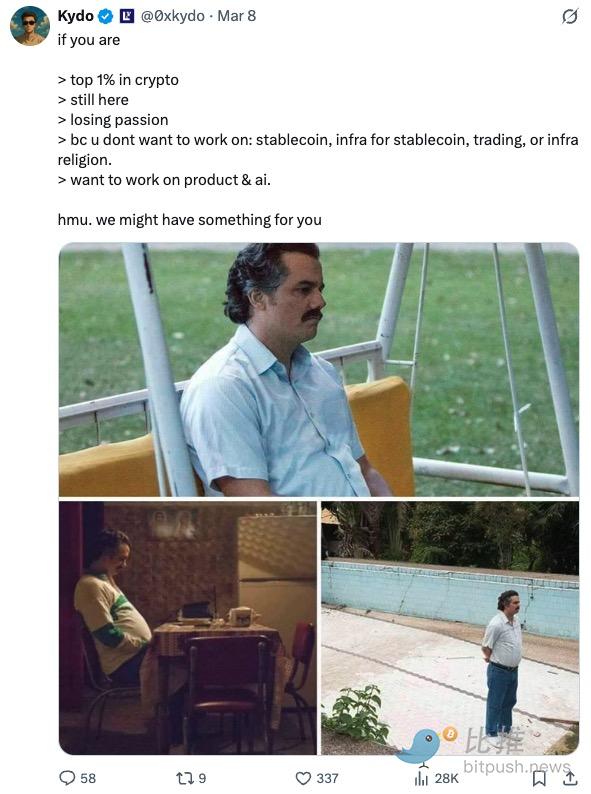
Tweet:

If you are

> in the top 1% of the crypto space

> still here

> but losing passion

> because you don't want to work on: stablecoins, stablecoin infrastructure, trading, or infrastructure-level "evangelism"

> want to build products and AI

Contact me. We might have something for you.

I want to elaborate.

If you are not working on stablecoins or are not someone extremely passionate about financial markets, you are likely not happy in the cryptocurrency space right now.

Worse, you are seeing the AI field developing at a pace and with an excitement that makes your daily work feel like standing still. I understand this all too well because that's exactly how I felt. That's why I wrote that tweet.

And the fact that it resonated with so many people (I've received 60 DMs so far) tells me that many of you feel the same way but haven't said it out loud.

So, let me say the "unsaid" things.

Selling to Crypto Developers is No Longer Viable

In the previous "meta," selling things to crypto developers worked. Back then, metrics were more important than revenue. Partner logos were more important than revenue. A "vibe" was more important than revenue. You were a cost center for others, and everyone was spending money.

That "meta" died about 18 months ago. We wish we had pivoted earlier.

There is also a growing consensus today: cryptocurrency is only suitable for finance. Haseeb from Dragonfly has said it, Kyle from Multicoin has said it, Toly from Solana has said it. Most of you think so too, even if you won't say it publicly.

I understand why people reach this conclusion. Most tokens are meme coins. They don't own anything and can't owe you anything because the only thing that can truly be "owned" is on-chain state, which is extremely limited.

This is also why crypto-native applications like trading and lending are currently the only two categories that can truly make money on-chain.

But many of us are not building in DeFi. Many of us build infrastructure to enable new use cases beyond DeFi.

Here's an uncomfortable truth: according to our analysis, the total addressable market for this kind of work is only about $200-300 million per year. This pie is to be divided among hundreds of institutions. The most successful companies can only achieve tens of millions in annual revenue. After years of maturation, this is the ceiling.

If you are building a venture-scale enterprise, this gives you a very clear set of choices. If you want to serve crypto developers, the market is small. So, you either put on a suit and sell your infrastructure to traditional finance; or, like many others, choose to pack up and switch to AI.

Many are switching to AI because they understand their strengths. They understand their team's expertise. They know their competitive advantage is not in long, complex B2B sales in traditional finance. This is why so many of you feel lost right now.
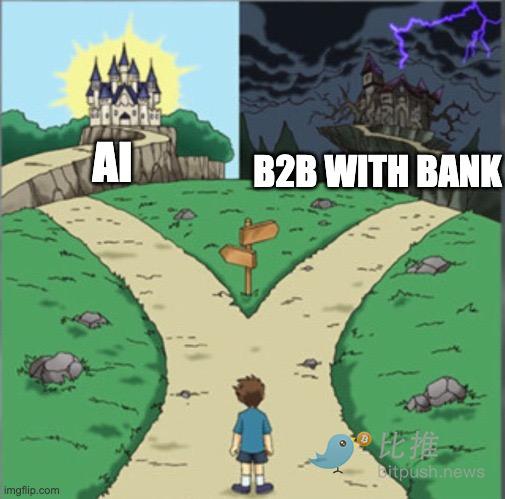
The Dead End of Crypto x AI

So you look at the only area that still feels vibrant—the intersection of crypto and AI—trying to find your footing. But the options laid out there aren't great either.

Option One: Traditional business + AI + issue a token. This token has no real utility, like most other tokens. You're essentially building a regular product and slapping a layer of financialization on top. It's frustrating because you've been playing this game for five years.

Option Two: Decentralized AI infrastructure. Privacy, security, verifiability: this is the missionary route, the old "meta." But I guess this doesn't interest many of you: not many want to embark on another long-term "building a religion" style endeavor with no immediate feedback, no revenue.

Option Three: Stablecoin infrastructure for AI agents. This is interesting from a business perspective, but extremely competitive. Circle, Stripe, and all the major stablecoin players are going all in. As a startup, going to war with them without any clear beachhead to capture is frustrating.

The Choices Faced, and Why People Are Leaving

So, these are the actual choices on the table today:

You can stay in the "religious realm" of crypto, building for a resilient, decentralized future.

You can put on a suit and join the big players to evangelize the gospel of stablecoins.

You can build a "shovel-selling" company for the stablecoin ecosystem.

You can stay in DeFi: trading, lending, and the financial plumbing of the internet.

Or, you can build a niche vertical product that, while not a billion-dollar venture target, actually makes money and satisfies real users.

Beyond that, you don't have better options. This is why you are likely to switch to AI. Honestly, I understand.

This is why cryptocurrency is no longer that fun.

The above is my diagnosis. This is the conclusion I reached after six months of feeling, analyzing, and stress-testing. If you came here for an honest take on "why crypto feels stuck," you've got it. You can close this article now. Go for a walk, touch some grass.

But I'll tell you this: I have never been so excited about the work I'm doing. The last time I felt this way was probably when I first heard about cryptocurrency and its potential. And it's not just me—everyone around me feels the same. So, if you want to hear the short version of what I believe in, read on.

Just know that from here on out, I'm selling my beliefs.

What I Truly Find Interesting

The question I've been trying to answer for the past six months is: How do you find a market large enough, with a clear business model rooted in crypto, and a product-oriented, non-financial solution that can be used by people both inside and outside the crypto space?

The answer I kept coming back to is: Cryptocurrency is a superconductor for capital. Capital fuels growth. The problem in the past was that we were fueling things that weren't growing—pouring gasoline on ice and expecting it to burn brighter.

AI has dramatically reduced the difficulty of starting and growing things—from a product perspective. Now one person can build what used to require a fifty-person team. The cost of creating a real product, a real business, is plummeting. These things are growing fast, with revenue, real users, and real feedback loops. They need fuel to accelerate. And cryptocurrency is the best fuel mechanism ever invented for this purpose.

This is the only interesting problem I see now: How do you take crypto's superpower—instant, global, programmable capital formation—and point it at things that are actually growing?

We think the answer is "agentic companies." To achieve this, you first need tokens to be able to "own" things, and coincidentally, we've spent the last five years building that foundation. Now, we're going to turn it into a product and achieve that goal.


Twitter:https://twitter.com/BitpushNewsCN

Bitpush TG Discussion Group:https://t.me/BitPushCommunity

Bitpush TG Subscription: https://t.me/bitpush

Original article link:https://www.bitpush.news/articles/7618924

Questions liées

QWhy does the author believe that many people in the crypto space are no longer enjoying their work?

AThe author believes that many are no longer enjoying their work because the focus has shifted heavily towards financial applications like stablecoins and trading, which may not align with their interests. Additionally, the rapid and exciting progress in AI makes their current work in crypto feel stagnant in comparison.

QWhat are the main options available for crypto developers today, according to the article?

AThe main options are: staying in the 'religious' crypto space for a decentralized future, selling infrastructure to traditional finance, building 'picks and shovels' for the stablecoin ecosystem, continuing in DeFi (trading and lending), or creating a niche product that generates real revenue but isn't a billion-dollar venture-scale business.

QWhat is the estimated annual market size for non-DeFi crypto infrastructure work mentioned in the article?

AThe estimated annual addressable market size for non-DeFi crypto infrastructure work is about $200-300 million, which is shared among hundreds of organizations, with the most successful companies generating tens of millions in annual revenue.

QWhat does the author identify as the core problem with previous attempts to fuel growth in crypto?

AThe author states that the core problem was that capital was being provided to things that weren't growing—'pouring gasoline on ice and expecting it to burn hotter'—instead of fueling things that are actually growing.

QWhat is the author's proposed solution to make crypto fun and impactful again?

AThe author's proposed solution is to leverage crypto's superpower as an instant, global, programmable capital formation mechanism and direct it towards things that are genuinely growing, specifically 'agentic companies,' by enabling tokens to 'own' things and using this foundation to build products.

Lectures associées

Hardware & Chips en exclusivité | Tang Wenbin de "Original Force Spirit Machine" rachète une entreprise de robots logistiques et reçoit des investissements de Zhipu, SenseTime, StepFun, entre autres

**Résumé exclusif de 36Kr : ForceAGI, une entreprise d'IA incarnée fondée par Tang Wenbin (co-fondateur de Megvii), lève des fonds et fusionne avec un robotiste logistique** L'entreprise d'intelligence artificielle incarnée **ForceAGI** a récemment conclu un nouveau tour de financement. Les investisseurs principaux sont des sociétés majeures de grands modèles linguistiques, notamment **Zhipu AI**, **Stepfun** et **SenseTime**. Des investisseurs industriels comme **Huaqin** et **SAIC Hengxu** ont également participé. Fondée en mars 2025 par **Tang Wenbin**, ancien co-fondateur et CTO de Megvii, ForceAGI développe des modèles génériques d'IA incarnée. Ce tour de financement marque un rapprochement notable entre d'anciens rivaux comme SenseTime et Megvii dans la course à l'IA incarnée. Parallèlement, **ForceAGI a fusionné par acquisition d'actions avec Atomix (anciennement Force Convergence)**, un spécialiste des robots logiques. Fondé sur une division des activités robotiques de Megvii dirigée par Tang Wenbin depuis 2016, Atomix est un acteur mondial des chariots à palettes, avec un chiffre d'affaires annuel approchant le milliard de RMB et plus de 500 projets clients. Cette fusion stratégique vise à briser "l'impasse des données" du secteur. Atomix fournira des **données opérationnelles réelles massives** issues de ses projets mondiaux pour entraîner les modèles de ForceAGI. En retour, les modèles d'IA incarnée de ForceAGI seront déployés pour superviser et collaborer avec les robots existants d'Atomix. ForceAGI s'appuie sur son modèle générique "DM0", qui utilise un **entraînement hybride** combinant données sémantiques internet, règles physiques de la conduite autonome et données d'opération robotique. Cette approche permettrait à DM0 de généraliser la compréhension des lois physiques et de s'adapter à divers matériels robotiques. Malgré sa taille modeste (2,4B de paramètres), il atteindrait une précision sub-millimétrique. Cette levée de fonds et fusion illustre une tendance émergente dans l'IA incarnée : la **convergence des acteurs** (fabricants de robots, détenteurs de données, développeurs de modèles, opérateurs de scénarios) pour créer une boucle vertueuse données-modèle-scénario et trouver la loi d'échelle (scaling law) propre au domaine.

marsbitIl y a 4 mins

Hardware & Chips en exclusivité | Tang Wenbin de "Original Force Spirit Machine" rachète une entreprise de robots logistiques et reçoit des investissements de Zhipu, SenseTime, StepFun, entre autres

marsbitIl y a 4 mins

Des "vieux titres" aux "nouvelles valeurs" : Comment l'IA réévalue-t-elle les anciennes infrastructures, de Dell à Nokia ?

**L'IA réévalue les infrastructures traditionnelles : Comment des sociétés comme Dell et Nokia retrouvent une nouvelle jeunesse** Il y a encore un an, des entreprises technologiques établies comme Dell, Nokia, Cisco, Corning ou Western Digital étaient perçues comme des valeurs à la croissance lente et aux perspectives limitées. Aujourd'hui, elles reviennent sur le devant de la scène, portées par la vague de l'intelligence artificielle (IA). Cette réévaluation s'explique par une transition clé : l'IA passe de la phase de modèles et de paramètres à celle du déploiement concret dans les centres de données. Ce déploiement massif nécessite des infrastructures complexes – serveurs, réseaux, stockage, connectivité, gestion de l'énergie – et une solide capacité d'intégration et de livraison. C'est précisément dans ces domaines que ces "vieux" acteurs disposent d'un avantage compétitif, grâce à des décennies d'expérience, de chaînes d'approvisionnement et de relations clients. L'article identifie trois catégories principales bénéficiant de cette dynamique : 1. **Serveurs et intégration système** : Dell et HPE excellent dans l'intégration des serveurs IA, de la puce au rack complet, et voient leurs commandes et revenus liés à l'IA exploser. 2. **Réseaux et connectivité** : Avec l'expansion des centres de données IA et la montée en puissance de l'IA en périphérie ("edge"), les besoins en interconnexion à haut débit et en infrastructures réseau (fibre, équipements télécoms, switching) deviennent critiques, profitant à des entreprises comme Corning, Nokia et Cisco. 3. **Stockage et gestion des données** : L'explosion des données générées par l'IA (entraînement, journaux, données froides) crée une forte demande pour des solutions de stockage de haute capacité et à bon rapport coût-efficacité, relançant l'intérêt pour les disques durs des leaders comme Western Digital et Seagate. Pour distinguer une réévaluation durable d'un simple effet de mode, trois critères sont essentiels : la concrétisation des commandes et des revenus liés à l'IA, la révision à la hausse des prévisions financières par les directions, et une amélioration de la qualité des bénéfices (marges). En conclusion, l'IA n'offre pas une seconde jeunesse à toutes les anciennes valeurs technologiques. Elle récompense celles qui, grâce à leurs atouts historiques en infrastructure, sont capables de traduire les nouveaux besoins de l'IA en commandes, revenus et profits tangibles, devenant ainsi des acteurs clés de la construction effective de l'écosystème IA.

marsbitIl y a 14 mins

Des "vieux titres" aux "nouvelles valeurs" : Comment l'IA réévalue-t-elle les anciennes infrastructures, de Dell à Nokia ?

marsbitIl y a 14 mins

Urgent ! Anthropic appelle à un arrêt mondial de la recherche en IA

Anthropic tire la sonnette d'alarme dans un article détaillé, alertant sur l'accélération de l'auto-évolution de l'IA. L'entreprise révèle que plus de 80% de son code est désormais écrit par son modèle Claude, une proportion qui était négligeable avant le lancement de Claude Code. La productivité des ingénieurs a été multipliée par huit. Les capacités de Claude progressent à un rythme exponentiel : la durée des tâches logicielles qu'il peut accomplir de manière autonome double tous les quatre mois. Sa réussite sur des problèmes de programmation complexes est passée de 26% à 76% en six mois. Claude est désormais utilisé pour la relecture de code, interceptant des boges avant leur déploiement. Dans la recherche, Claude dépasse les humains, optimisant du code 52 fois plus vite et menant des expériences d'alignement de l'IA avec une efficacité bien supérieure. Anthropic identifie trois futurs possibles : une stagnation des capacités, une accélération avec contrôle humain maintenu, ou une amélioration récursive autonome (RSI), où l'IA conçoit ses successeurs, offrant des bénéfices immenses mais aussi des risques d'emballement et de perte de contrôle. Face à cette tendance, Anthropic appelle à une réflexion collective sur la gouvernance et propose une pause dans la recherche si un mécanisme de vérification mutuelle entre laboratoires peut être établi. Cette mise en garde fait écho à des préoccupations similaires récemment exprimées par OpenAI, suggérant que le "point de singularité" pourrait arriver plus vite que prévu.

marsbitIl y a 43 mins

Urgent ! Anthropic appelle à un arrêt mondial de la recherche en IA

marsbitIl y a 43 mins

Trading

Spot
Futures

Articles tendance

Comment acheter FUN

Bienvenue sur HTX.com ! Nous vous permettons d'acheter FUNTOKEN (FUN) de manière simple et pratique. Suivez notre guide étape par étape pour commencer votre parcours crypto.Étape 1 : Création de votre compte HTXUtilisez votre adresse e-mail ou votre numéro de téléphone pour ouvrir un compte sur HTX gratuitement. L'inscription se fait en toute simplicité et débloque toutes les fonctionnalités.Créer mon compteÉtape 2 : Choix du mode de paiement (rubrique Acheter des cryptosCarte de crédit/débit : utilisez votre carte Visa ou Mastercard pour acheter instantanément FUNTOKEN (FUN).Solde :utilisez les fonds du solde de votre compte HTX pour trader en toute simplicité.Prestataire tiers :pour accroître la commodité d'utilisation, nous avons ajouté des modes de paiement populaires tels que Google Pay et Apple Pay.P2P :tradez directement avec d'autres utilisateurs sur HTX.OTC (de gré à gré) : nous offrons des services personnalisés et des taux de change compétitifs aux traders.Étape 3 : stockage de vos FUNTOKEN (FUN)Après avoir acheté vos FUNTOKEN (FUN), stockez-les sur votre compte HTX. Vous pouvez également les envoyer ailleurs via un transfert sur la blockchain ou les utiliser pour trader d'autres cryptos.Étape 4 : tradez des FUNTOKEN (FUN)Tradez facilement FUNTOKEN (FUN) sur le marché Spot de HTX. Il vous suffit d'accéder à votre compte, de sélectionner la paire de trading, d'exécuter vos trades et de les suivre en temps réel. Nous offrons une expérience conviviale aux débutants comme aux traders chevronnés.

1.8k vues totalesPublié le 2025.06.25Mis à jour le 2026.06.02

Comment acheter FUN

Discussions

Bienvenue dans la Communauté HTX. Ici, vous pouvez vous tenir informé(e) des derniers développements de la plateforme et accéder à des analyses de marché professionnelles. Les opinions des utilisateurs sur le prix de FUN (FUN) sont présentées ci-dessous.

活动图片