Why Base’s $15.2B trading boom raises questions about L2 tokens

ambcryptoPublié le 2026-02-10Dernière mise à jour le 2026-02-10

Résumé

Base is shifting its focus from creator rewards and social features to prioritize trading, as evidenced by the shutdown of its Creator Rewards program and Farcaster-powered social feed. The program, which distributed around $450,000 to 17,000 creators over seven months, is being discontinued to allow the platform to concentrate on tradable assets. This strategic pivot raises questions about the potential role of a native Base token, especially since discussions about its launch have quieted recently. The network's strong performance suggests a token may not be necessary. Over the past 30 days, Base-linked DEXs processed $15.2 billion in trading volume, with Aerodrome Finance (AERO) leading much of the activity. The network has also generated $190.6 million in cumulative fees and revenue, demonstrating its ability to monetize usage directly without relying on a token for growth. Coinbase's recent Super Bowl ad further indicates a focus on brand building and streamlined priorities. With trading volume and fees effectively serving the function a token typically would, a native Base token appears optional rather than essential.

The Base app is dropping creator rewards and moving its focus on trading, which says a lot about where Coinbase sees traction today.

But that raises an important question. What role, if any, will a native Base token play, especially since talk of launching one has gone noticeably quiet in recent months?

Putting trading first

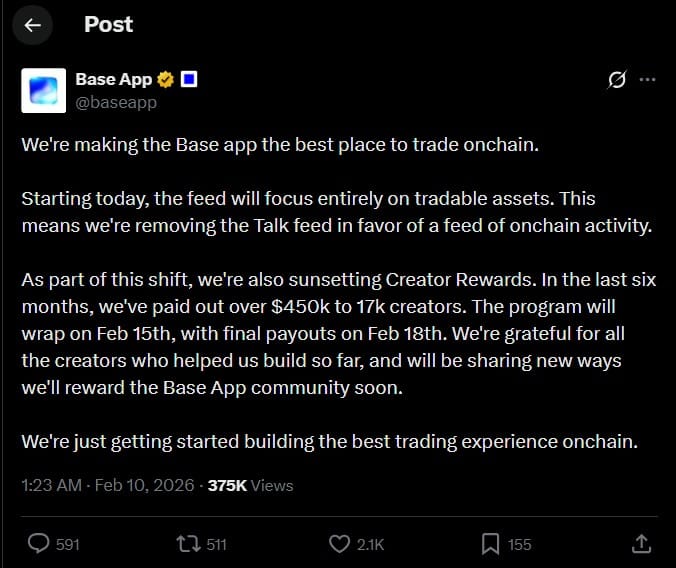
Coinbase is shutting down the app’s Creator Rewards program and its Farcaster-powered social feed, with its focus now on tradable assets. The Creator Rewards initiative, launched in July, was designed to encourage posts and engagement by paying users for activity.

In practice, the payouts were modest. Base says around $450,000 was shared among roughly 17,000 creators over seven months, averaging about $26 per person.

Source: X

According to creator Jesse Pollak, the decision came down to focus. As the app evolved, the team realized it worked best when it did fewer things well. He stated,

“…as we’ve rolled the app out, we’ve realized we need to do less, better. and by focusing on tradable assets, that’s exactly what we can do.”

The Creator Rewards program will officially end this week, with final payouts scheduled for the 18th of February. Pollak also noted that Base App was never an ideal home for Farcaster’s social feed, and expects most users to return to Farcaster’s native app.

Importantly, the changes do not affect Base’s Creator Coins feature, which remains active.

AMBCrypto previously reported that Coinbase was considering launching a native token called BASE, and that it was likely to happen this year. However, there’s not been much talk on that front since.

Do they really need a native token, though?

For now, it looks like they don’t.

Source: DeFiLlama

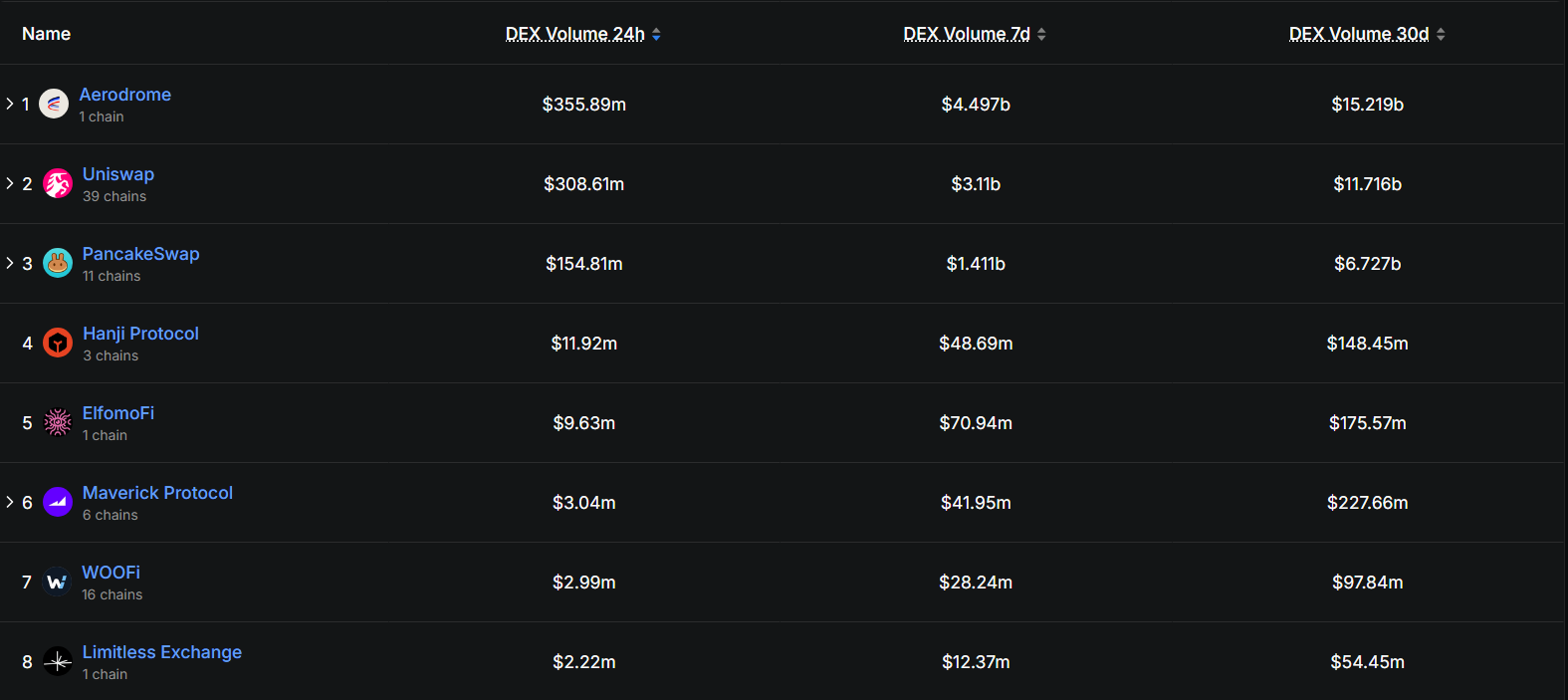
Over the past 30 days, Base-linked DEXs have processed $15.2 billion in trading volume, with Aerodrome Finance [AERO] alone accounting for the bulk of that activity. That puts them ahead of many multi-chain competitors.

Source: Token Terminal

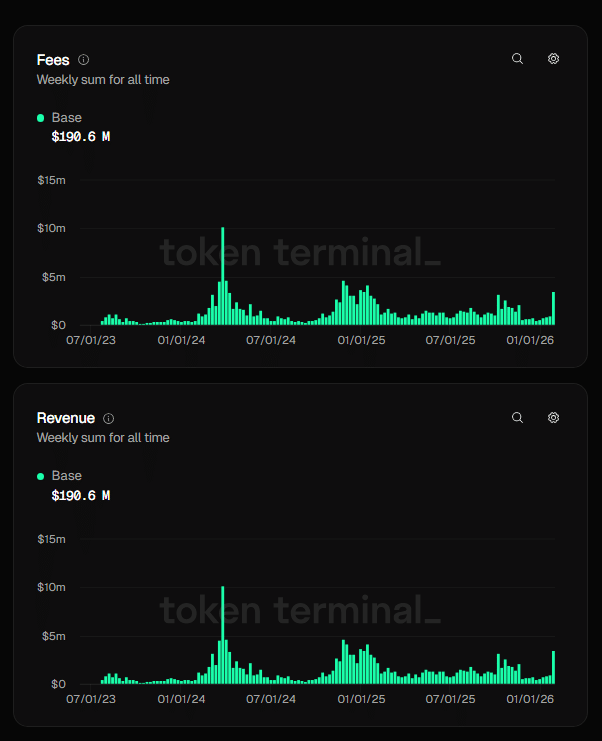
More importantly, the network is generating real money. Data per Token Terminal showed that Base has earned $190.6 million in cumulative fees and revenue to date, with steady weekly inflows.

Instead of relying on a token to bootstrap growth, Base is already monetizing usage directly.

Source: Twitter

In more recent news, this year’s Super Bowl featured just one major crypto ad, and it was from Coinbase. The streamlining of priorities makes sense as Coinbase seemingly looks to build a bigger brand.


Final Thoughts

  • Base is prioritizing trading and revenue, with volume and fees doing the work a token usually would.
  • With growth already monetized, a native Base token looks optional rather than necessary.
Next: Cardano: Why CME’s ADA futures sparked 3% drop instead of a rally
Share
  • Share
  • Tweet

Questions liées

QWhy is Base shutting down its Creator Rewards program and social feed?

ABase is shutting down these features to focus on doing fewer things well, specifically by concentrating on tradable assets, as the team realized the app works best with a more streamlined approach.

QHow much trading volume have Base-linked DEXs processed in the past 30 days?

ABase-linked DEXs have processed $15.2 billion in trading volume over the past 30 days, with Aerodrome Finance (AERO) accounting for the bulk of that activity.

QWhat is the current status of a potential native Base token launch?

ATalk of launching a native Base token has gone noticeably quiet in recent months, and with the network already generating significant revenue through fees, a token now seems optional rather than necessary.

QHow much revenue has Base generated from fees to date?

ABase has earned $190.6 million in cumulative fees and revenue to date, according to data from Token Terminal.

QWhat does Base's shift in focus and recent performance suggest about the need for a Layer 2 native token?

ABase's strong trading volume and revenue generation demonstrate that it can monetize usage directly without relying on a native token for growth, making a token launch appear optional rather than essential.

Lectures associées

Pourquoi le Bitcoin maintient 64 000 $ après la pause restrictive de la Fed

Le Bitcoin se stabilise autour de 64 000 $ après la décision de la Fed de maintenir ses taux d'intérêt dans la fourchette 3,50-3,75 %. Bien que perçu comme une pause, le vote a révélé des divisions internes, trois membres plaidant pour une hausse, signalant une attitude globalement restrictive. Cette position limite l'appétit pour les actifs risqués comme les cryptomonnaies. Le marché a réagi avec une volatilité modérée. Les FNB spot sur Bitcoin ont enregistré un afflux net de 32,1 millions de dollars, mettant fin à une série de sorties, tandis que les FNB Ethereum ont subi des sorties. Cela indique une rotation des capitaux vers l'actif principal. Les niveaux clés à surveiller pour le Bitcoin sont le support à 63 000-63 500 $ et la résistance autour de 66 000 $. Malgré la pression macroéconomique, le marché ne montre pas de signes de capitulation. Les fondamentaux du réseau Ethereum restent solides avec une file d'attente importante pour le staking. Le report du vote sur le CLARITY Act au Sénat américain a tempéré les attentes réglementaires immédiates. Pour la fin du mois, les données macro américaines (inflation, dépenses) guideront les senteurs. Le scénario de base prévoit une consolidation du Bitcoin entre 63 000 et 66 000 $. La résilience au-dessus de 63 000 $, le maintien de l'Ethereum au-dessus de 1 860 $ et la poursuite des entrées institutionnelles seront des facteurs déterminants pour une éventuelle reprise au second semestre.

cryptonews.ruIl y a 3 h

Pourquoi le Bitcoin maintient 64 000 $ après la pause restrictive de la Fed

cryptonews.ruIl y a 3 h

Parker Lewis explique pourquoi le bitcoin reste la meilleure monnaie

Parker Lewis, un analyste bitcoin renommé, a critiqué les stratégies marketing des entreprises qui se présentent comme des trésoreries crypto. Il estime que la vente d'actions privilégiées perpétuelles, présentées comme un "crédit numérique", déforme fondamentalement la nature du bitcoin. Il souligne que le bitcoin n'a pas de rendement fiduciaire intégré et que les promesses de dividendes reposent sur un modèle risqué nécessitant un afflux constant de nouveaux investisseurs. Lewis met en garde contre les risques de ces dérivés, notant que le marché des actions privilégiées perpétuelles (1 000 milliards de dollars) est minuscule comparé au marché du crédit mondial (300 000 milliards de dollars), car les institutions évitent ces risques qu'elles transfèrent aux particuliers. Il rejette également l'idée que la volatilité du bitcoin le rende impropre à la plupart des gens. Pour lui, cette volatilité est une conséquence naturelle de l'adoption massive d'un actif à offre fixe et inélastique. Il conseille d'acheter des bitcoins directement plutôt que des actions d'entreprises comme MicroStrategy. Détourner l'attention vers ces dérivés corporatifs fait oublier la vraie menace : la dépréciation rapide des monnaies fiduciaires. Lewis illustre cela avec son "indice du ribeye", montrant une inflation annuelle de 12 à 13% sur le prix d'un steak, bien supérieure aux chiffres officiels. La stratégie la plus sûre, selon lui, reste la possession directe de bitcoin et le contrôle de ses clés privées, pour se protéger des turbulences macroéconomiques, plutôt que de courir après des rendements corporatifs douteux qui amplifient les risques systémiques.

cryptonews.ruIl y a 3 h

Parker Lewis explique pourquoi le bitcoin reste la meilleure monnaie

cryptonews.ruIl y a 3 h

Trading

Spot
活动图片