Original | Odaily Planet Daily (@OdailyChina)
Author | Azuma (@azuma_eth)

Polymarket has once again found itself embroiled in controversy over fairness.
The incident originated from the prediction market "Will the U.S. invade Venezuela by...?". On January 4th, Polymarket intervened to add a clarification stating that "the previous U.S. operation to capture Venezuelan President Maduro does not meet the definition of an invasion." This announcement caused a sharp drop in the price of YES shares (betting that the U.S. would invade Venezuela before January 31st) in this market, directly impacting the actual interests of many users.
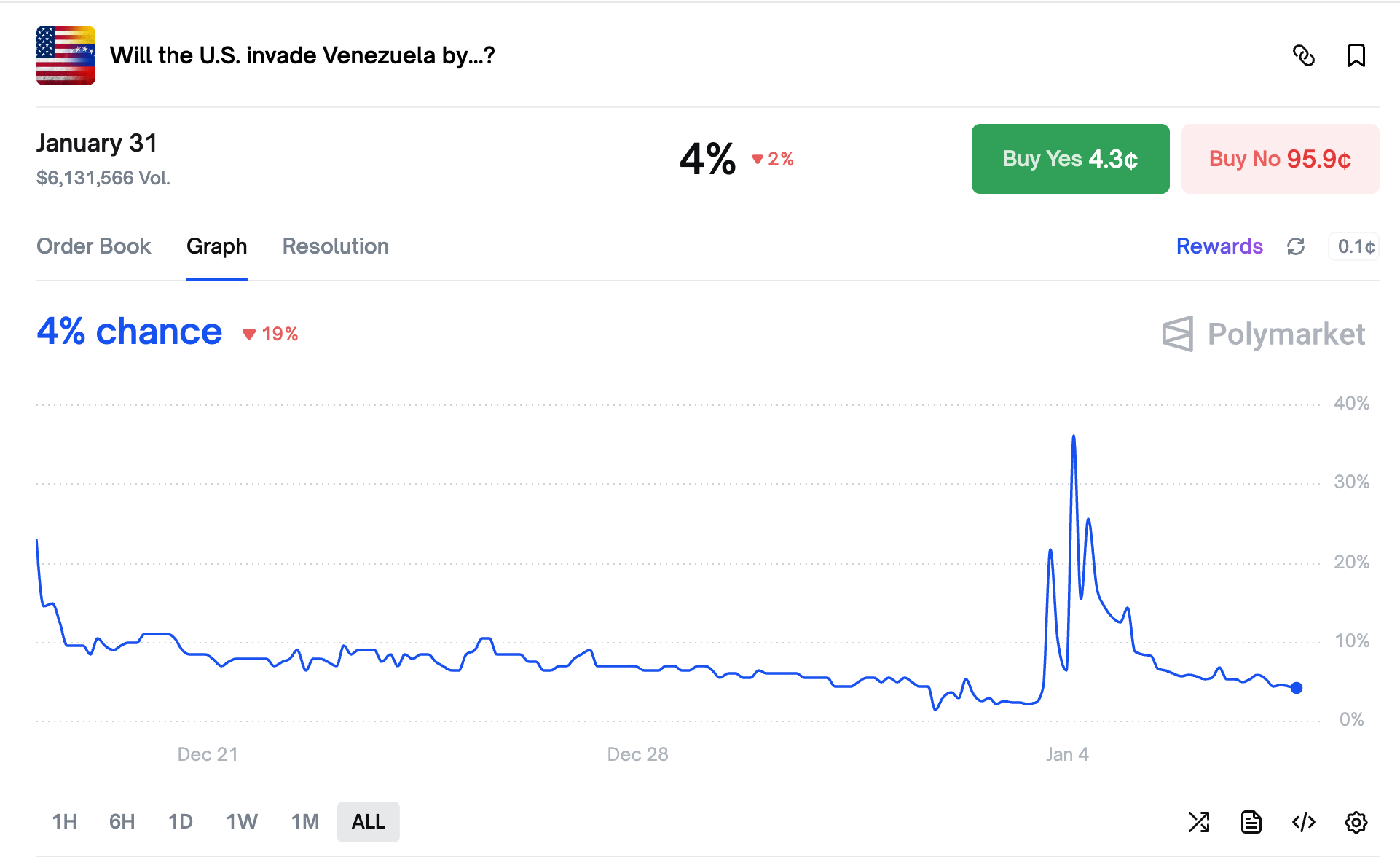
- Odaily Note: The chart shows the price trend of YES shares betting on January 31st, with the turning point being the time when Polymarket officially intervened to add the clarification.
This is not the first time Polymarket has faced similar controversies. Last year, in our articles "Polymarket Suffers Oracle Manipulation Attack, Can Whales Use Voting Power to 'Reverse Black and White'?" and "Polymarket Faces Another Truth Dispute: What Zelenskyy Wears Will Determine the Fate of $140 Million," we mentioned similar cases and briefly analyzed Polymarket's result resolution logic.
In the discussion of this incident, we found that although many readers know that Polymarket relies on the oracle protocol UMA for resolution, they are not clear about how this process operates. Therefore, Odaily is publishing another article to analyze its resolution mechanism and try to explore the ambiguous areas that could potentially cause result disputes.
Predetermined Rules and Supplementary Explanations
Firstly, any prediction market on Polymarket has a predetermined rule written at launch. This rule will clearly state the conditions for the outcome and the validity date, and will anticipate in advance how to judge in various unexpected situations.
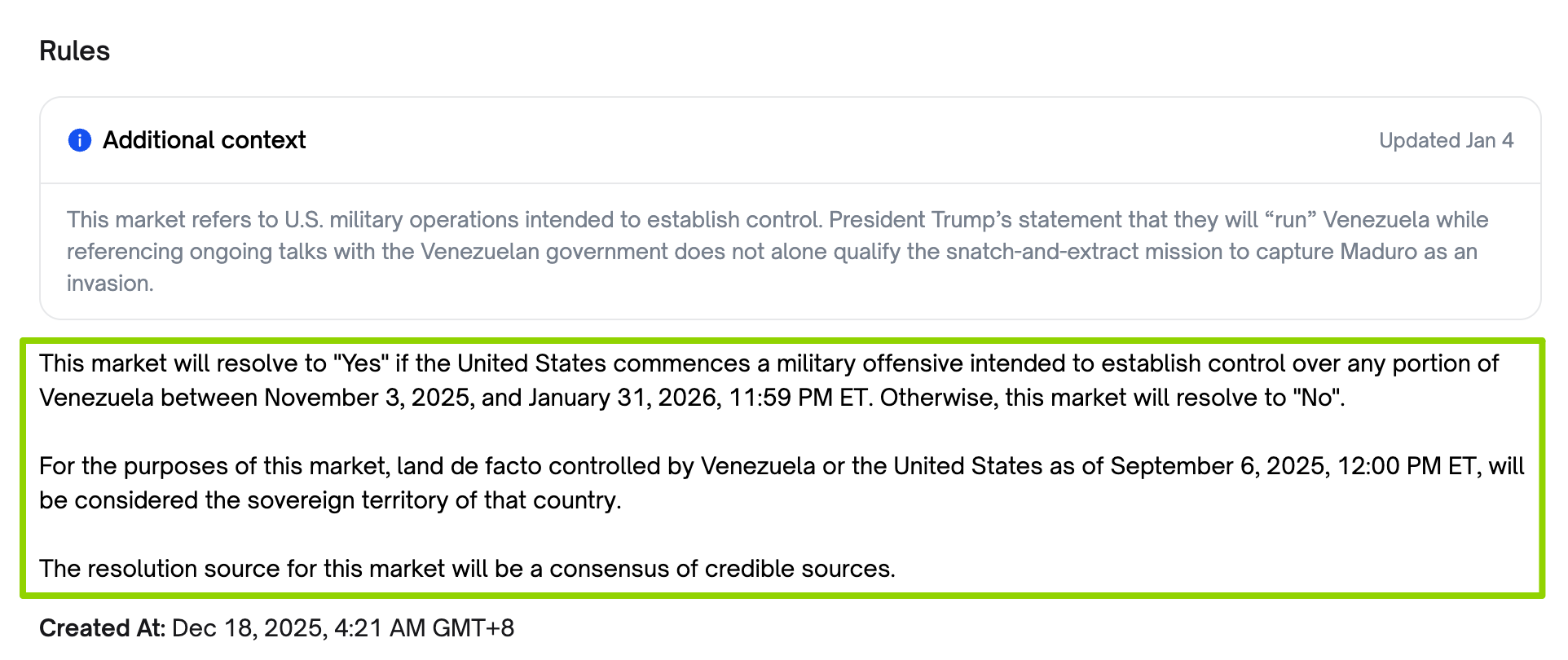
Taking the "Will the U.S. invade Venezuela by...?" market as an example. As shown above, the text under "Rules" is the predetermined rule for this market. The judgment conditions and validity date are — if the U.S. launches a military offensive aimed at controlling any part of Venezuelan territory between November 3, 2025, and January 31, 2026 (11:59 PM EST), the result will be resolved as YES; otherwise, it will be resolved as NO.
But even with anticipating various unexpected situations in advance, sometimes events develop in ways beyond expectation. For instance, in this incident, no one could have predicted that a country's president could be so suddenly captured by another force. Therefore, in very rare cases, Polymarket will personally intervene to provide supplementary explanations for some unexpected situations not anticipated at the market's creation, offering further clarification on the rules — the decision to clarify is not solely made unilaterally by Polymarket; users can actively request clarification in the #market-review channel of the Polymarket Discord if they have doubts.

Observant friends may have noticed that below the "Rules" in the image above, there is a fainter section labeled "Additional context," with a more recent update date (the predetermined rule was published on December 18th last year, this content was added on January 4th). This is precisely the content Polymarket intervened to explain this time. The specific content is — "This market concerns U.S. military action aimed at establishing control. President Trump, referring to ongoing negotiations with the Venezuelan government, stated he would 'manage' Venezuela, but this statement alone is not sufficient to characterize the 'capture and extraction' mission targeting Maduro as an invasion."
Simply put, Polymarket does not believe the U.S. capture of Maduro should be defined as an invasion of Venezuela, so it does not support resolving the outcome as YES based on this.
Let's not dwell on whether Polymarket's supplementary explanation is reasonable for now. What is more important to note here is that the validity period of this prediction market (January 31st) has not yet ended, meaning it has not yet entered the final resolution procedure. Emphasizing this point serves two purposes: first, to remind that all current disputes essentially stem from rule ambiguity, unrelated to the resolution环节; second, to illustrate that this dispute is not yet settled, and users' current losses are actually floating losses. Everything needs to wait for the final resolution to be completed.
So how is the final resolution process executed?
Resolution Procedure: Results Are Proposed by People
For any prediction market on Polymarket, during the final resolution procedure, someone needs to propose a result. Taking the previous market as an example again, the window to propose a result is right under "Rules" at "Propose resolution".

Of course, not just anyone can casually propose a result胡乱. UMA and Polymarket have designed two restrictions here: economic incentives and a whitelist requirement.
The economic incentive means that proposing a result requires depositing a sum of USDC as collateral (generally 750 USDC, higher for some markets). After submission, there is a challenge window (generally 2 hours). If no challenges are raised during this period, the result is deemed valid and will be used as the basis for the final resolution of the prediction market, and will not be changed again. The proposer can then receive a certain bonus (generally 5 USDC); otherwise, it enters a dispute phase, and the proposer risks losing the collateral (detailed below). Simply put, if one proposes a result胡乱 just to cause trouble, the risk far outweighs the reward.
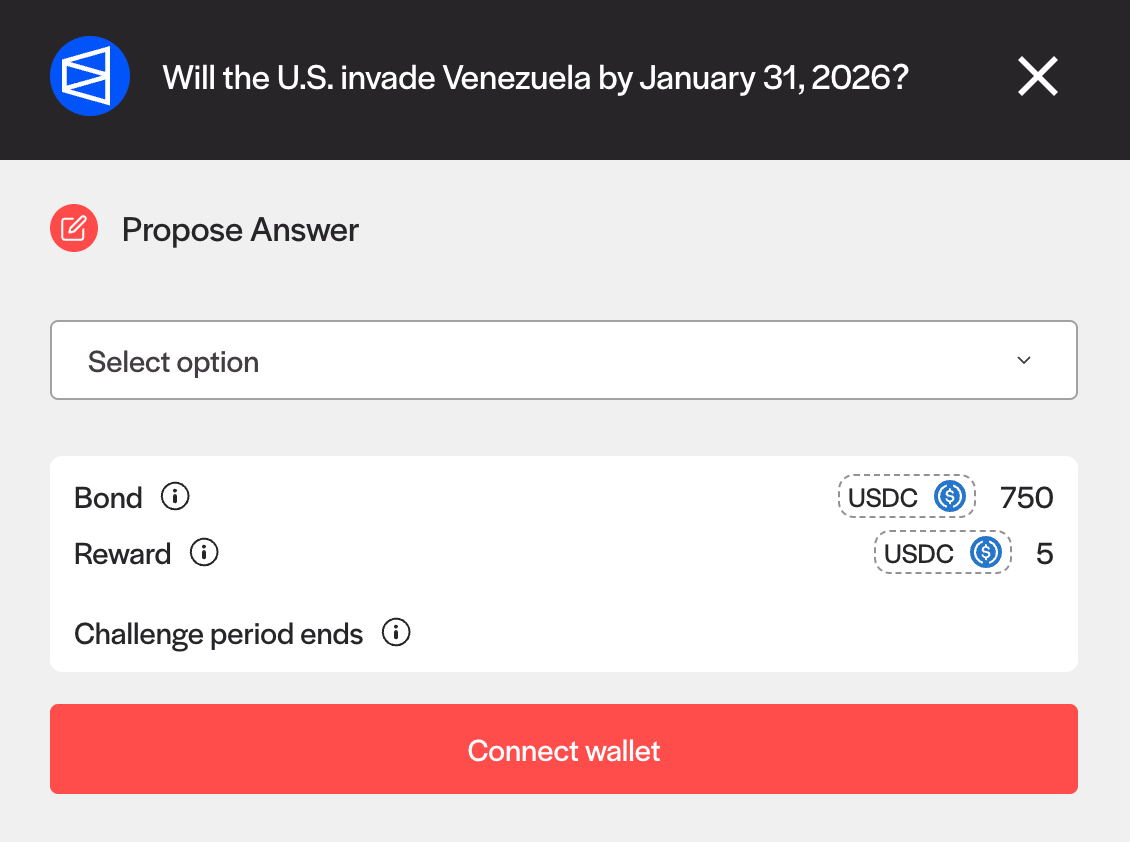
- Odaily Note: Clicking on "Propose resolution" from the market page shows the collateral requirement and bonus amount for proposing a result.
The whitelist restriction means that Polymarket initially allowed anyone to propose results, but later, to improve resolution efficiency, introduced a whitelist maintained jointly with Risk Labs in August last year. Afterwards, only whitelisted addresses were allowed to propose results. There are three ways to get on the whitelist: first, join the Risk Labs team; second, join the Polymarket team; third, have submitted over 20 proposals with an accuracy rate exceeding 95% in the past three months — all addresses can be queried through this contract. Initially, there were only 40 addresses, but the number has now expanded significantly.
Dispute Phase: Economic Interest Game
As mentioned in the previous part, if a proposed result receives no异议 during the challenge window, it is judged valid. This is the final outcome for the vast majority of prediction markets. However, in very few cases, if an objection is raised, how is the resolution made?
First, it needs to be said that, like proposing a result, raising an objection is not something that can be done casually either — the objector must pay an equal amount of USDC as collateral (generally still 750 USDC) to confront the proposer, meaning both parties must put an equal stake on the table. But unlike the proposer, the objector does not need to provide a complete result themselves, but only needs to point out a specific error in the proposer's result.
Once an objection is confirmed, the UMA community will debate it. This phase usually lasts 24-48 hours (voting occurs the next day, with at least 24 hours left for discussion each time). Anyone wishing to provide evidence for the relevant discussion can give their opinion in the #evidence-rationale and #voting-discussion channels of the UMA Discord server.
After the debate, UMA token holders will vote on the matter (this process takes about another 48 hours), and one of the following four outcomes may occur:
- Proposer Wins: The proposer retrieves their collateral, plus half of the objector's collateral as a bounty. The objector loses their collateral.
- Objector Wins: The objector retrieves their collateral, plus half of the proposer's collateral as a bounty. The proposer loses their collateral.
- Too Early: This result applies to proposals where the relevant event has not yet concluded, such as an ongoing sports game result. The objector gets a refund, plus half of the proposer's collateral as a bounty. The proposer loses their collateral.
- Draw (50:50): The rarest situation. In this case, the objector retrieves their collateral and receives half of the proposer's collateral as a bounty. The proposer loses their collateral.
Two points need attention in the above voting.
First, among the four potential outcomes, the objector profits in three cases, while the proposer profits in only one — this is intentional design by UMA, aiming to push for higher proposal accuracy through the imbalance of risk and reward between the two parties. Since the objector only needs to point out one flaw to win, the proposer must provide a result that is as accurate and compliant as possible.
The second point is that UMA's governance voting power holds absolute say over the final result. In other words, the prediction market spectacle worth tens of billions of dollars built by Polymarket is ultimately supported at its core by a protocol with an FDV of only $100 million.
Exploring the Ambiguous Zones
Combining the above analysis of Polymarket's resolution process with a review of historical real dispute cases, it is not difficult to find that there are certain ambiguous areas that can cause disputes in both the rule-setting and supplementary explanation phase during market operation and the final resolution process.
First, in the rule-setting and supplementary explanation phase, the essence of its ambiguity lies both in the fact that written rules sometimes cannot cover real-world variables, and in the fact that the same textual description can often be interpreted in different ways. For example, last year's incident of "whether Zelenskyy wore a suit," first, the rules did not specify whether a "military-style suit counts as a suit." Although Polymarket explained in a supplementary clarification that "reliable reports have not confirmed whether Zelenskyy wore a suit," it did not explain what constitutes a "reliable report." Ambiguities like these are destined to cause disputes.
If Polymarket itself, as the platform, could remain neutral, it might not anger the public every time, but the situation is hardly ideal. Polymarket's operating entity is based in the United States, which means the regulatory environment and political context it faces make it difficult to remain completely neutral on all issues involving geopolitics. For instance, in this case of "Will the U.S. invade Venezuela," when it comes to U.S. military and diplomatic actions themselves, rule interpretations tend to lean towards more conservative "non-militarized descriptions." This is not incomprehensible, but ultimately it is the users who suffer the losses.
As for the resolution process, the source of ambiguity points directly to the possibility of fraud in UMA voting. Although UMA has designed a reward and punishment game mechanism to constrain proposal behavior and improve result accuracy, this game mechanism can only constrain the economic interests within its system. When external profit space exists, the potential for malicious activity theoretically still remains. This is not baseless suspicion. In last year's "Ukrainian rare earths" incident, a UMA whale manipulated voting power to forcibly reverse black and white, resulting in bets worth $7 million being resolved with an incorrect outcome.
The existence of these ambiguities is the root cause of frequent质疑 about Polymarket's fairness and is also a structural issue that prediction markets need to solve. In fact, any prediction market involving complex real-world events will inevitably face the following triple dilemma — First, real-world events themselves often cannot be clearly binarized; geopolitics, military actions, and diplomatic games are inherently full of gray areas. Second, rules must be expressed in language, but language naturally has room for interpretation. Third, once a resolution mechanism introduces human or governance participation, interest博弈 becomes inevitable.
From the user's perspective, perhaps you need to realize early on — in prediction markets, what you are betting on is not "what will happen in the world," but "how the rules will ultimately be interpreted."







