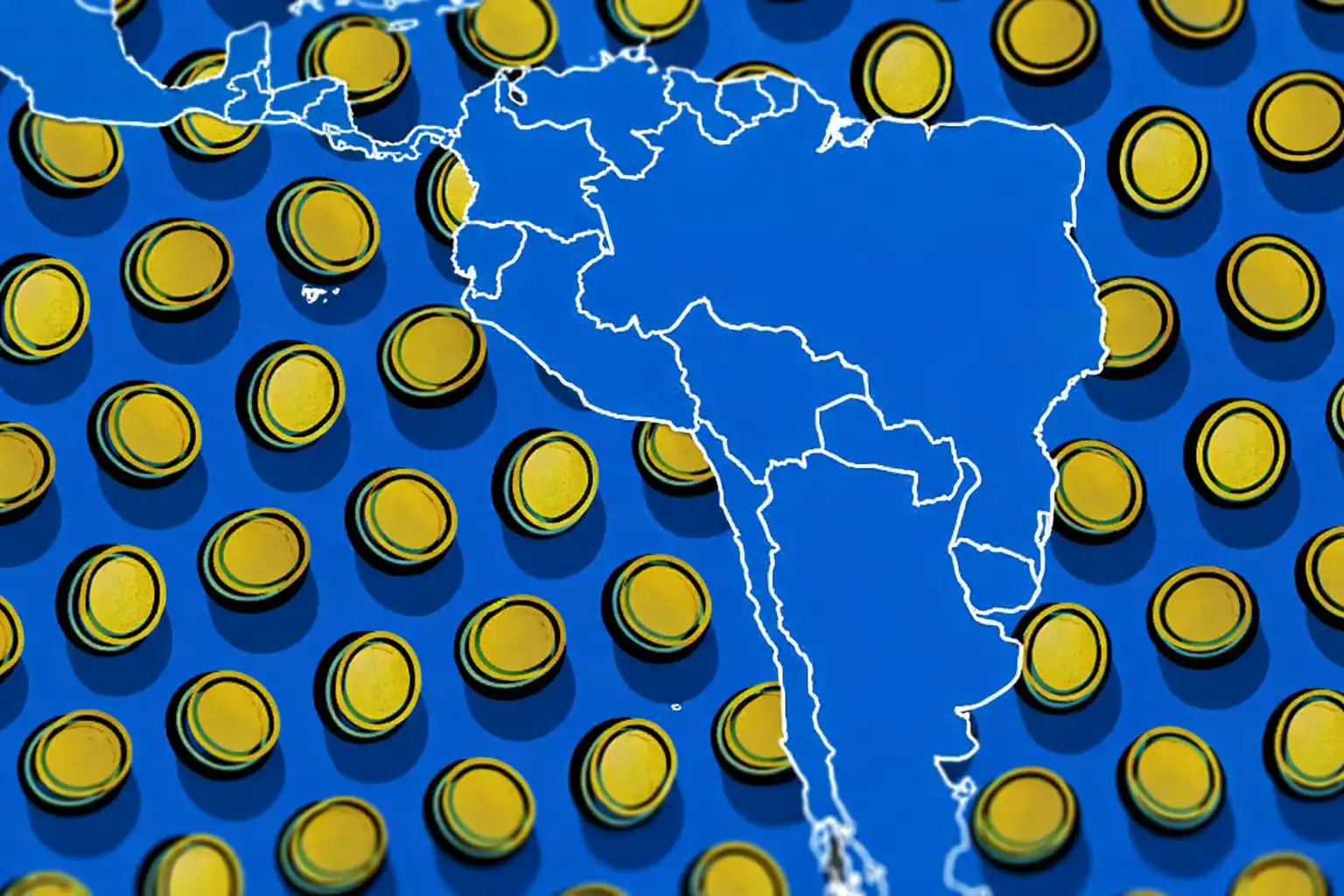
US Capital Bets Big on Latin America: Wagering Not on Growth, but on the 'Key Nodes' of the Financial System

marsbitPublié le 2026-03-19Dernière mise à jour le 2026-03-19

Résumé

U.S. capital is increasingly investing in Latin America, focusing not on traditional growth but on controlling key nodes in the financial system. The region’s financial friction—high inflation, costly cross-border payments, and underdeveloped banking infrastructure—has created strong demand for digital payment and dollarized solutions. Stablecoins like USDC and USDT are being used to facilitate low-cost remittances, hedge against currency devaluation, and enable faster enterprise transactions. For instance, in Argentina, users leverage stablecoins for arbitrage amid tight currency controls, while in Mexico, families receive remittances via WhatsApp in minutes at under 1% cost. Major players like Visa are acquiring local payment platforms, and venture firms like ARQ are building bridges between traditional banking and crypto-based systems. With high digital payment adoption but persistent gaps in cross-border and dollar services, Latin America offers both proven demand and growth potential. However, the market requires deep local expertise and regulatory navigation, making it a complex but high-value opportunity for those who can build scalable, compliant financial infrastructure.

Author: Zen, PANews

Stockbroker Ruben López from Buenos Aires spends a few minutes every morning completing a special "daily operation": he exchanges his Argentine pesos for US dollars at the official exchange rate, then immediately converts the dollars into the US dollar-pegged stablecoin USDC on a trading platform, and finally exchanges the stablecoin back to pesos using the parallel market exchange rate.

Coinciding with the approaching Argentine mid-term elections, Argentine President Javier Milei tightened foreign exchange controls to support the peso exchange rate. Yet, Ruben spends no more than 10 minutes each day to steadily earn an arbitrage profit of about 4%.

Meanwhile, Mexican immigrants living in the US open WhatsApp, send a few messages, attach the stablecoin USDC, and their families in Guanajuato can receive the funds settled in Mexican pesos on their phones within two minutes.

Over the past few years, Latin America, long regarded as a region of high volatility, high risk, and high uncertainty, is increasingly being seen by US payment giants, venture capital funds, and stablecoin startups as a crucial battleground for the next round of financial infrastructure restructuring.

In February 2026, Visa announced its acquisition of the Argentine payment platforms Prisma and Newpay from Advent International to strengthen its digital payment and infrastructure capabilities in Argentina. In March, ARQ, a Latin American financial application focused on stablecoins, disclosed the completion of a $70 million funding round with participation from Sequoia Capital and Founders Fund, among others. ARQ has built infrastructure connecting traditional banking networks with stablecoin-based payment systems, enabling users to hold and transact in foreign currencies.

Looking at these cases together, it's clear that US capital is not just focusing on a single high-growth company, but is preemptively occupying the key nodes in the restructuring of Latin America's financial system: whoever controls the payment entry points, clearing networks, account relationships, and dollarized store-of-value tools will have a better chance of gaining the initiative in the next phase of competition.

Financial Friction Pain Points Underpin Latin America's High-Growth Potential

The fundamental reason why Latin America has become a key market for fintech and stablecoin companies is that financial friction here is not an abstract concept, but a collection of real-world problems repeatedly confirmed by macroeconomic indicators, payment scenarios, and on-chain activity. The financial needs here are not singular but exhibit a clear hierarchical structure.

In economies with relatively controlled inflation, such as Brazil and Mexico, the most direct pain point for users is often not currency devaluation, but high payment costs, slow cross-border transfers, and inefficient account services. A World Bank report shows that in Q1 2025, the average global cost of sending $200 in remittances remained as high as 6.49%, with the average cost for digital channels also around 5%. In a typical US-Mexico remittance scenario, traditional channel fees are as high as 5%-7%. For such markets, the value of fintech is first manifested in making payments, clearing, and cross-border remittances cheaper, faster, and smoother.

On the other hand, in high-inflation economies like Argentina, the issue is not just payment efficiency, but how to preserve the value of capital itself. For users in high-inflation markets, fintech and stablecoins primarily solve not an experience optimization problem, but a value storage problem. That is, how to more conveniently hold relatively stable assets and conduct cross-border US dollar settlements with lower friction.

Besides inflation divergence and cross-border remittance costs, another notable feature of Latin American financial markets is that users have been extensively educated in recent years to embrace the digital payment system, but this still-imperfect system has not fully resolved cross-border, value preservation, and "dollarization" issues.

World Bank Global Findex and related public materials show that digital payment penetration rates are already at relatively high levels in many Latin American countries. Taking Brazil as an example, World Bank documents indicate that 70% of adults made digital payments in 2024; Argentina's related proportion under the previous Findex口径 had also reached about 72%. This indicates that many core markets in Latin America no longer need user education from scratch but have entered a stage of competition centered on efficiency, cost, and scenario depth.

Taking Brazil's Pix as an example, it has evolved from a transfer tool into a de facto social-level payment infrastructure. Public data compiled by the European Payments Council stated that as of March 2024, Pix had approximately 153 million individual users and 15 million business users; in 2023, it processed about 42 billion transactions with a value of approximately 17.2 trillion reais.

However, although local digital payment networks can function, they do not satisfy all user financial needs. For users in this market, local transfers can become increasingly smooth, but once it involves cross-border settlement, US dollar storage, hedging against local currency depreciation, or low-cost global payments and collections, the friction in the original system remains significant.

It is precisely here that stablecoins begin to transform from crypto assets into practical financial tools. A highly persuasive case is the US-Mexico remittance corridor. Research from Mizuho Bank shows that through platforms like Bitso's partnership with Félix Pago, the cost of remittances using stablecoins like USDT and USDC has dropped to below 1%. Currently, Bitso handles stablecoin flows of $6.5 billion for US-Mexico transactions, capturing 10% of the $63 billion annual US-Mexico remittance market.

This on-chain data already shows that Latin American users are not experimenting sporadically with stablecoins; they are using them as practical dollarization tools that combine cross-border US dollar liquidity and value storage functions. The International Monetary Fund (IMF) estimates that, as a percentage of GDP, "Latin America and the Caribbean" is one of the most significant for stablecoin usage globally, at approximately 7.7%.

Furthermore, the Chainalysis 2025 Latin America report shows that from July 2022 to June 2025, the cumulative crypto transaction volume in Latin America approached $1.5 trillion. Among these, Brazil is the largest regional market, receiving approximately $318.8 billion in crypto assets, Argentina about $93.9 billion, and Mexico about $71.2 billion. Regarding the proportion of stablecoin trading volume, the Chainalysis 2024 report indicates: Argentina's stablecoin trading volume share was 61.8%, Brazil's was 59.8%, both significantly higher than the global average of 44.7%.

Certainty and Growth Potential in Financial Markets

In Latin America, demand has already materialized, transactions are being formed, and data can be verified, but the digitization of payments, accounts, and fund management is still in an upward phase, with significant room for improvement in market penetration. Therefore, the market structure foundation determines that Latin America offers not just a growth story, but a rare combination of certainty and growth potential.

In terms of certainty, the aforementioned market-side data is sufficient to demonstrate that real demand exists. The growth potential stems from the medium to long-term trend of payment and account digitization.

McKinsey pointed out in its Latin American payments research that in its sample of Spanish-speaking countries, debit cards replaced cash as consumers' most preferred payment method within just two years, and mobile payments are also rapidly popularizing. Even though cash still holds a considerable share in many markets, consumer payment preferences have clearly shifted towards non-cash instruments.

From a more macro perspective, payment digitization is not just a convenience upgrade on the consumer side; it is also driving the restructuring of corporate fund processes. A report from the Inter-American Development Bank shows that the share of digital payments in offline consumption scenarios in Latin America increased from about 11% in 2020 to 30% in 2024. At the same time, over 70% of enterprises in Latin America and the Caribbean have already conducted digital procurement.

This indicates that digitization has not only penetrated personal transfers and payments but has also extended to corporate payment collections, reconciliation, fund pooling, and procurement management. For fintech companies, this brings a larger addressable market. For instance, Payoneer recently enhanced its local collection capabilities in Mexico, helping global sellers receive payments directly in Mexican pesos from local e-commerce platforms, reducing exchange costs; while Jeeves launched a stablecoin-supported corporate card for Latin American businesses, aiming to shorten cross-border settlement times from days to minutes.

The emergence of stablecoins further strengthens this combination of certainty and growth potential. For Latin America, the importance of stablecoins lies not primarily in their investment attributes, but in their role as a technological tool to address US dollar needs and cross-border settlement problems.

Remittance volumes remain persistently high, and cross-border payment costs exhibit long-term rigidity. This makes the integration of stablecoins with local payment rails more akin to filling a structural gap in the real financial system rather than providing a short-term speculative tool.

Stablecoin payment services have already begun initial implementation in Argentina. For example, Takenos, an Argentine fintech company backed by Variant Fund and Lattice Capital, announced that as of March this year, its Solana blockchain-based stablecoin solution had processed over $500 million in cross-border payments, serving 500,000 users across 20 Latin American countries, primarily for salary disbursements and corporate transactions.

Why Latin America is the New Bet for US Capital

Compared to the highly mature, giant-filled, and long-educated US market, many fintech and crypto finance sectors in Latin America are still in a phase where infrastructure is forming but the landscape is not yet finalized. For VCs, this usually represents a better entry point.

In recent years, financing in Latin America has continued to grow, with capital flowing more towards mature companies that have adapted to market changes and have more robust models. Local capital still tends to favor early stages, while foreign capital, represented by US investors, prefers to enter when companies are more mature and scalable, acting as an amplifier after the model is initially validated and expansibility becomes apparent.

Compared to Latin America, user education in the US was completed early, infrastructure is long mature, and the division of labor among leading platforms and existing financial institutions is more solidified. Latecomers can either only target very niche segments, face extremely high customer acquisition costs, or must wrestle market share from existing giants. In contrast, financial service boundaries in Latin America are being redefined; even if some segments already have leaders, overall penetration, product depth, and regional expansion are still ongoing.

Many fintech and crypto companies in the US face a more mature and crowded存量 financial system. What they are competing for is not just users, but payment entry points, account relationships, clearing paths, and regulatory definition power.

The repeated setbacks of the US crypto market structure bill in 2026 illustrate this point. The resistance comes both from ongoing disagreements within Congress over stablecoin yields, token classification, and regulatory jurisdiction, and from the banking system's wariness towards stablecoins, trust charters, and the deposit substitution effect.

But companies entering Latin America are helping the market leap from an inefficient old system to a new one. Users have stronger reasons to migrate, and the growth space comes more from new penetration and structural upgrades. These two scenarios have completely different capital pricing logics. The former is more like competing for存量, the latter more like capturing增量.

However, reward always coexists with risk. What truly attracts US financial institutions to Latin America is never low risk, but high value density. But the other side of high value density is often more complex regulation, foreign exchange, and macro environments.

For US financial institutions, the opportunity here does not lie in simply replicating domestic products, but in whether they can truly build payment, clearing, dollarized storage, and compliance capabilities into infrastructure within a high-friction market. But this path is also fraught with thorns. As Ripio CEO Sebastián Serrano said, "Financial services are highly localized." Therefore, even a crypto giant like Coinbase paused its services in Argentina due to various internal considerations.

Precisely because of this, Latin America is not an easy arbitrage game, but more like an endurance race with higher requirements for execution, risk control, license understanding, and localized operations.

In this race, we have already seen concrete现实切面: from street vendors in Rio de Janeiro displaying Pix QR codes for收款, to families in Mexico City receiving USDC remittances from Chicago via WhatsApp, to freelancers in Buenos Aires receiving salaries for remote work in USDT.

Whoever can transform these real, existing financial pain points into sustainable, replicable, and cross-regionally expandable service capabilities will be the ultimate winner.


Questions liées

QWhy is Latin America considered a key battleground for the next round of financial infrastructure restructuring by US payment giants, venture capital funds, and stablecoin startups?

ALatin America is seen as a key battleground due to its high financial friction, including issues like high payment costs, slow cross-border transfers, inefficient account services, and the need for dollar-denominated value storage in high-inflation economies. The region has a high digital payment adoption rate but the existing system hasn't fully solved cross-border, value preservation, and 'dollarization' problems, creating a significant opportunity for new financial infrastructure.

QWhat specific financial pain points in Latin America are creating opportunities for fintech and stablecoin companies?

AThe financial pain points are layered. In economies like Brazil and Mexico, the main issues are high costs for payments and cross-border remittances, and inefficient account services. In high-inflation economies like Argentina, the primary problem is the need for value preservation and convenient access to hold stable assets and conduct low-friction cross-border dollar settlements.

QHow do stablecoins function as a practical financial tool in Latin America, particularly in the US-Mexico remittance corridor?

AStablecoins like USDT and USDC are used as practical dollarization tools for cross-border dollar liquidity and value storage. In the US-Mexico remittance corridor, platforms using stablecoins have reduced transfer costs to under 1%, compared to 5%-7% for traditional channels. For example, Bitso processes $6.5 billion in stablecoin flows, capturing 10% of the $63 billion annual remittance market between the US and Mexico.

QWhat combination of market factors makes Latin America attractive to US capital, beyond just growth potential?

AUS capital is attracted by the combination of certainty and growth potential. Certainty comes from verified, real demand and existing transaction data. Growth potential comes from the ongoing upward trend in payment and account digitization, with significant room for increased market penetration. The region is in a phase of infrastructure formation where the competitive landscape is not yet finalized, offering a better entry point for venture capital compared to the saturated US market.

QWhat are the major risks and challenges for US financial institutions and companies operating in the Latin American market?

AThe major risks and challenges include complex regulatory environments, foreign exchange volatility, and macroeconomic instability. Success requires strong execution, risk management capabilities, a deep understanding of local licensing, and effective localized operations, rather than simply replicating products from the US market. It is a demanding endurance race, not a simple arbitrage opportunity.

Lectures associées

L'opportunisme raffiné de l'ancienne CTO d'OpenAI, Murati : Celui qui donne le couteau et tend la main le premier

Les preuves et témoignages du procès Musk contre Altman ont révélé le rôle complet de Mira Murati, ancienne CTO d'OpenAI, lors du coup d'État de novembre 2023 : elle fut à la fois la force motrice derrière la poussée vers le licenciement et la première à signer pour le retour d'Altman lorsque le vent a tourné. Dès septembre 2022, Murati avait transmis à Altman une liste de plaintes, critiquant sa fixation sur les revenus et son management erratique. En 2023, elle a fourni au cofondateur Ilya Sutskever captures d'écran, historiques Slack et documents internes, alimentant un mémo de 52 pages présenté au conseil d'administration. Son témoignage a également souligné un mensonge d'Altman sur une revue de sécurité IA. Ces éléments ont "grandement poussé" le conseil à licencier Altman le 16 novembre. Murati fut nommée PDG intérimaire et informa elle-même le PDG de Microsoft, Satya Nadella. Cependant, les 78 SMS échangés avec Altman après le licenciement montrent son double jeu : tout en relayant la fermeté du conseil, elle espérait secrètement que Nadella aiderait à renverser la décision. Dès qu'elle perçut la faiblesse du conseil, elle refusa de soutenir sa déclaration et informa Microsoft de sa probable démission. Elle fut la première à signer la pétition de 750 employés exigeant la démission du conseil et le retour d'Altman. L'ancienne administratrice Helen Toner a qualifié son comportement de "non coopératif" et "très négatif", refusant d'expliquer son rôle central dans le licenciement. Comme l'a résumé Toner, "elle attendait de voir de quel côté soufflait le vent, sans réaliser qu'elle était elle-même ce vent." Tout au long de la crise, Murati n'a défendu que ses propres intérêts.

marsbitIl y a 10 mins

L'opportunisme raffiné de l'ancienne CTO d'OpenAI, Murati : Celui qui donne le couteau et tend la main le premier

marsbitIl y a 10 mins

Facture de l’inférence IA en flèche, Shopify et Roblox mettent en garde : les économies réalisées grâce aux licenciements ne suffiront pas à payer la facture des puces

La saison des résultats du premier trimestre 2026 révèle un paradoxe financier pour les entreprises technologiques. Alors que l'IA permet des gains de productivité et une réduction des effectifs, ses coûts opérationnels – consommation de tokens et amortissement des GPU – grèvent désormais les marges de manière significative. Shopify illustre ce dilemme. Si l'IA génère plus de 50% du code et a permis 300 nouvelles fonctionnalités sans hausse des effectifs, les coûts des LLM (notamment via l'assistant Sidekick) pèsent sur la marge de ses solutions d'abonnement, malgré une croissance explosive de son utilisation. Chez Roblox, un quart de la révision à la baisse de sa marge prévisionnelle 2026 est directement attribué aux investissements en IA. La plateforme, qui exécute 1,5 million d'inférences par seconde, envisage de facturer les futures expériences IA avancées pour compenser ces coûts. À l'échelle du secteur, l'écart est frappant : les dépenses en capital IA d'Amazon, Meta, Microsoft et Google devraient atteindre 7250 milliards de dollars en 2026 (+77%). Les économies réalisées via les licenciements sont dépassées : chez Meta, les 24 milliards de dollars d'économies annuelles prévues ne compenseraient que 12% de l'amortissement supplémentaire lié à l'IA. Les grands gagnants sont les fournisseurs de modèles et de puces (OpenAI, Nvidia...), tandis que les entreprises applicatives doivent repenser leur modèle économique. Elles ne peuvent plus simplement financer la facture de l'IA par des réductions de coûts salariaux et doivent soit intégrer ces coûts dans leur stratégie commerciale (Shopify), soit les répercuter sur l'utilisateur final (Roblox).

marsbitIl y a 16 mins

Facture de l’inférence IA en flèche, Shopify et Roblox mettent en garde : les économies réalisées grâce aux licenciements ne suffiront pas à payer la facture des puces

marsbitIl y a 16 mins

Hook Summer est-il réellement arrivé ? Sato, Lo0p et FLOOD déclenchent un nouveau récit sur Uniswap v4

Avec le léger redressement du marché, les mémecoins sur Ethereum gagnent à nouveau en popularité. Après ASTEROID, des tokens comme sato, sat1, Lo0p et FLOOD, basés sur le protocole Hook d'Uniswap v4, attirent l'attention. Leur capitalisation varie de quelques millions à des dizaines de millions de dollars, apportant une liquidité concentrée à un marché cryptographique en manque de récits. **Hook : Des contrats intelligents "plug-in" pour Uniswap v4** Hook permet aux développeurs d'injecter une logique personnalisée à des étapes clés du cycle de vie d'un pool de liquidité (initialisation, ajout/retrait de liquidités, échange, etc.), faisant de l'AMM un système programmable. **Présentation des tokens représentatifs :** * **sato** : Mécanisme de frappe et de destruction via la courbe Uniswap v4. Achat = génération de nouveaux tokens et verrouillage d'ETH en réserve. Vente = échange contre ETH depuis la réserve et destruction des tokens. Capitalisation actuelle ~28M$. * **sat1** : Présenté comme une version "optimisée" de sato, a connu un pic de spéculation avant de décliner fortement. Capitalisation actuelle ~0.8M$. * **Lo0p** : Protocole de prêt AMM intégré. Les utilisateurs peuvent acheter et verrouiller LO0P comme garantie pour emprunter de l'ETH depuis les réserves du pool, sans impact direct sur le prix spot. Capitalisation actuelle ~0.96M$. * **FLOOD** : Les réserves générées par les achats sont déposées sur Aave v3 pour générer des intérêts, lesquels restent dans le pool et influencent potentiellement le prix. Capitalisation actuelle ~1.4M$. **Impact sur l'écosystème Uniswap et UNI** Ces innovations basées sur Hook pourraient, à long terme, attirer des utilisateurs et des liquidités vers Uniswap v4, renforçant les fondamentaux du token UNI (notamment avec l'activation du "fee switch" et le burn partiel des frais). Cependant, à court terme, ces tokens expérimentaux ne sont probablement pas un moteur direct pour le prix de UNI, qui reste soumis à la volatilité générale du marché, à la régulation et à d'autres facteurs. Le TVL d'Uniswap v4 (5,95B$) est encore inférieur à celui des versions V2/V3. **Remarque importante :** Ces tokens sont des expériences technologiques précoces et peuvent comporter des risques ou des bugs inconnus. Cette information ne constitue pas un conseil en investissement.

marsbitIl y a 27 mins

Hook Summer est-il réellement arrivé ? Sato, Lo0p et FLOOD déclenchent un nouveau récit sur Uniswap v4

marsbitIl y a 27 mins

L'été des Hook est vraiment arrivé ? sato, Lo0p, FLOOD déclenchent une nouvelle narration autour d'Uniswap v4

L'été des Hooks est-il arrivé ? Les jetons sato, sat1, Lo0p et FLOOD, basés sur le protocole Hook d'Uniswap v4, suscitent un vif intérêt sur le marché. Ces jetons, avec des capitalisations allant de quelques millions à plusieurs dizaines de millions de dollars, apportent une nouvelle dynamique de liquidité concentrée. Leur mécanisme repose sur les "Hooks", des contrats intelligents modulaires qui permettent d'injecter une logique personnalisée à des étapes clés des pools de liquidités (initialisation, ajout/retrait de liquidités, swaps, etc.). Sato, le premier lancé, a atteint une capitalisation de plus de 38 millions de dollars grâce à son mécanisme de frappe et de destruction lié à une courbe. Sat1, présenté comme une version optimisée, a connu un pic avant un déclin rapide. Lo0p intègre un mécanisme de prêt dans le pool AMM, permettant d'emprunter de l'ETH contre des jetons LO0P déposés en garantie. Quant à FLOOD, il place automatiquement les réserves du pool sur Aave pour générer des rendements qui soutiennent le prix du jeton. Si cette effervescence autour des Hooks contribue au développement à long terme de l'écosystème Uniswap et pourrait bénéficier au jeton UNI via l'activation du "fee switch", son impact à court terme sur le prix de UNI reste limité. Le TVL d'Uniswap v4 (595M$) est encore inférieur à celui des versions précédentes. Odaily rappelle que ces projets sont des expérimentations techniques précoces et comportent des risques.

Odaily星球日报Il y a 37 mins

L'été des Hook est vraiment arrivé ? sato, Lo0p, FLOOD déclenchent une nouvelle narration autour d'Uniswap v4

Odaily星球日报Il y a 37 mins

Le guide de l'IA du CEO de Y-Combinator : le futur appartient à ceux qui construisent des systèmes à intérêts composés

Le PDG de Y Combinator, Garry Tan, présente une nouvelle vision de l'IA personnelle : non pas un simple chatbot, mais un système d'exploitation qui capitalise sur les intérêts composés. L'idée centrale est de passer de l'utilisation ponctuelle de modèles d'IA à la construction d'un "second cerveau" structuré et évolutif. Ce système, qu'il a développé et open-sourcé (GBrain, OpenClaw), ingère et connecte automatiquement toutes les données de sa vie professionnelle : notes de réunions, livres, emails, contacts. Chaque interaction enrichit une base de connaissances de 100 000 pages, permettant un contexte riche pour les tâches futures. La clé réside dans la "skillification" : transformer les workflows répétitifs (ex : préparer une réunion, analyser un livre) en "compétences" (skills) autonomes et réutilisables. Une méta-compétence, "Skillify", permet même de créer de nouvelles compétences automatiquement. Ainsi, le système s'améliore de lui-même, chaque correction profitant à toutes les utilisations futures. Tan détaille des cas concrets : un "miroir de livre" qui résume un ouvrage et le relie à son expérience personnelle en 40 minutes, ou une préparation de réunion qui synthétise des mois de contexte sur un interlocuteur en deux minutes. L'argument est que l'avantage concurrentiel futur appartiendra à ceux qui sauront construire de tels systèmes d'IA personnels et composés, centrés sur leur contexte unique, plutôt qu'à ceux qui se contentent d'outils centralisés. Il invite à commencer modestement par une tâche concrète, à l'itérer, puis à la transformer en compétence réutilisable pour enclencher la courbe de capitalisation.

marsbitIl y a 50 mins

Le guide de l'IA du CEO de Y-Combinator : le futur appartient à ceux qui construisent des systèmes à intérêts composés

marsbitIl y a 50 mins

Trading

Spot
Futures

Articles tendance

Comment acheter ZEN

Bienvenue sur HTX.com ! Nous vous permettons d'acheter Horizen (ZEN) de manière simple et pratique. Suivez notre guide étape par étape pour commencer votre parcours crypto.Étape 1 : Création de votre compte HTXUtilisez votre adresse e-mail ou votre numéro de téléphone pour ouvrir un compte sur HTX gratuitement. L'inscription se fait en toute simplicité et débloque toutes les fonctionnalités.Créer mon compteÉtape 2 : Choix du mode de paiement (rubrique Acheter des cryptosCarte de crédit/débit : utilisez votre carte Visa ou Mastercard pour acheter instantanément Horizen (ZEN).Solde :utilisez les fonds du solde de votre compte HTX pour trader en toute simplicité.Prestataire tiers :pour accroître la commodité d'utilisation, nous avons ajouté des modes de paiement populaires tels que Google Pay et Apple Pay.P2P :tradez directement avec d'autres utilisateurs sur HTX.OTC (de gré à gré) : nous offrons des services personnalisés et des taux de change compétitifs aux traders.Étape 3 : stockage de vos Horizen (ZEN)Après avoir acheté vos Horizen (ZEN), stockez-les sur votre compte HTX. Vous pouvez également les envoyer ailleurs via un transfert sur la blockchain ou les utiliser pour trader d'autres cryptos.Étape 4 : tradez des Horizen (ZEN)Tradez facilement Horizen (ZEN) sur le marché Spot de HTX. Il vous suffit d'accéder à votre compte, de sélectionner la paire de trading, d'exécuter vos trades et de les suivre en temps réel. Nous offrons une expérience conviviale aux débutants comme aux traders chevronnés.

209 vues totalesPublié le 2024.12.12Mis à jour le 2025.03.21

Comment acheter ZEN

Discussions

Bienvenue dans la Communauté HTX. Ici, vous pouvez vous tenir informé(e) des derniers développements de la plateforme et accéder à des analyses de marché professionnelles. Les opinions des utilisateurs sur le prix de ZEN (ZEN) sont présentées ci-dessous.

活动图片












