Uniswap Innocent, Tornado Developer Jailed: Two Verdicts from the Same Judge

比推Publié le 2026-03-03Dernière mise à jour le 2026-03-03

Résumé

In a landmark ruling, a New York federal court dismissed a class-action lawsuit against Uniswap and its founder, Hayden Adams, holding that open-source developers are not liable for fraudulent tokens traded on their decentralized protocols. The judge, Katherine Polk Failla, compared the case to holding a car manufacturer responsible for crimes committed using its vehicles. This decision is seen as a significant victory for DeFi developers. However, the same judge previously presided over the case against Tornado Cash developer Roman Storm, who was convicted for operating an unlicensed money-transmitting business. The contrasting outcomes highlight a key distinction in regulatory attitude: decentralization is tolerated, but privacy tools that enable large-scale money laundering—especially for state actors like North Korean hackers—are not. The article argues that while Uniswap isn’t legally obligated to screen for scam tokens, there is an expectation for major platforms to take proactive measures to protect users. The piece concludes that operating within existing legal frameworks—such as implementing sanctions screening—may be essential for decentralized protocols to survive.

Author: Eric, Foresight News

Original Title: The Same Judge, Different Outcomes for Uniswap and Tornado


At 3 a.m. Beijing time on March 3, the class action lawsuit demanding that Uniswap and its founder Hayden Adams be held responsible for scam tokens on Uniswap was dismissed by the U.S. District Court for the Southern District of New York. Brian Nistler, General Counsel of the Uniswap Foundation, called it a "landmark ruling for DeFi."
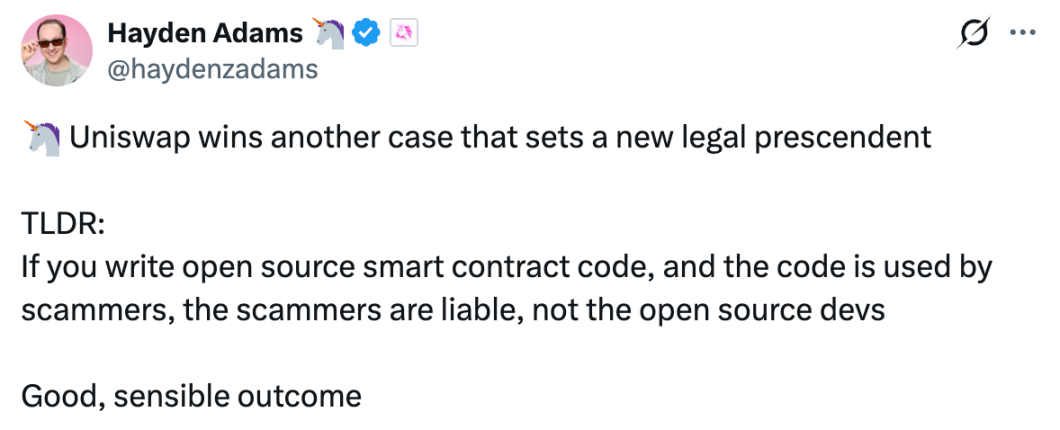
Hayden Adams also tweeted, "If you write open-source smart contract code and that code is used by scammers, the scammers are responsible, not the open-source developers. This is a reasonable and just outcome."

For Web3 developers, this is undoubtedly good news. But little known is that the judge who made this "just ruling" is the same person who, during the tenure of the former SEC chairman, found the developers of the mixer Tornado Cash guilty.

The Final Verdict

Nearly four years have passed since the class action lawsuit against Uniswap was filed and today's final resolution.

In April 2022, Uniswap users, represented by Nessa Risley, filed a class action lawsuit in court, accusing defendants Paradigm, a16z, Uniswap, and its founder Hayden Adams of violating federal securities laws by issuing and selling unregistered securities, including UNI, in the form of tokens on Uniswap. Additionally, the defendants failed to register Uniswap as an exchange or broker-dealer under applicable securities laws and did not provide investors with registration statements for the securities they issued and sold.

This lawsuit was initiated by the law firms Kim&Serritella and Barton, representing users who traded EtherumMax, Bezoge, MatrixSamurai, Alphawolf Finance, RocketBunny, and BoomBaby.io tokens on Uniswap between April 5, 2021, and April 4, 2022.

The phrase "unregistered securities" had extraordinary destructive power in the crypto industry at the time, but this lawsuit unexpectedly and quickly tilted in Uniswap's favor.

Presiding Judge Katherine Polk Failla, while agreeing that the so-called "scam tokens" were indeed securities, ruled that Uniswap did not need to be held responsible. Failla argued that Uniswap's decentralized nature meant the protocol had no control over which tokens were listed on the platform or who could interact with it. "The case is more like holding the developer of an autonomous vehicle responsible for traffic violations or bank robberies committed by third parties using the car."

Based on this, Failla dismissed the federal securities law charges in August 2023. The plaintiffs then appealed, and the Second Circuit Court of Appeals affirmed the dismissal of the federal part in 2025 but remanded the state law part for retrial.

Subsequently, the plaintiffs amended the complaint and sued again. This time, the losing investors accused Uniswap and other defendants of aiding and abetting fraud, making false statements, profiting from transactions involving scam tokens, and violating fraud laws in multiple states.

After another review by the same judge, Failla, the amended claims were dismissed again, with no further amendments allowed, bringing the case to a complete end.

The judge's reasoning this time was largely the same as before: Uniswap was unaware of the scam tokens, and even if it were aware, it did not provide substantial assistance. It also did not meet the definition of fraudulent behavior under any state law. Regarding unjust enrichment, Uniswap did not gain direct benefits, and the speculative indirect benefits from such scam activities expanding the user base were too tenuous.
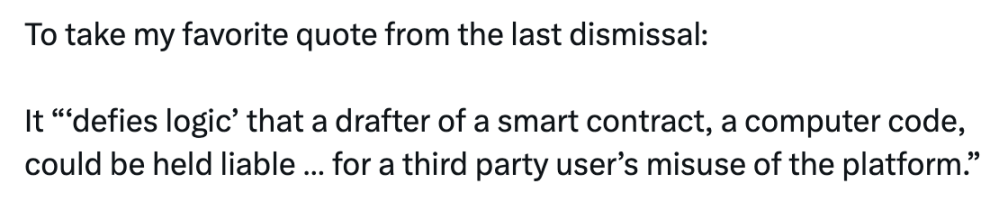
Brian Nistler stated in a tweet, quoting a line from the previous ruling, that it "defies logic" to hold the drafter of a smart contract responsible for the abusive actions of third-party users on the platform.

Tornado Cash's Different Outcome

Facing the same judge, Roman Storm of Tornado Cash met a different fate.

Tornado Cash was first added to the sanctions list by the U.S. Treasury Department's Office of Foreign Assets Control (OFAC) on August 8, 2022, accused of helping criminals, including North Korean hackers, launder over $7 billion. Two days after being added to the sanctions list, Dutch police arrested Alexey Pertsev, one of Tornado Cash's core developers.

On May 14, 2024, a Dutch court found Alexey Pertsev guilty of money laundering and sentenced him to 64 months in prison. The court ruled that Pertsev was aware that the platform he developed and operated was used for crime but did nothing to stop it, subjectively acquiescing to Tornado Cash being used as a money laundering tool. Alexey Pertsev is still appealing, but there have been no recent updates.

Seven months before Alexey Pertsev was found guilty, the U.S. Department of Justice sued two other developers, Roman Storm and Roman Semenov, in the Southern District of New York. Roman Storm was previously arrested in Washington State, while Roman Semenov remains at large.

Roman Storm in court

Although an appeal later determined that OFAC's sanctions against Tornado Cash were an overreach and invalid, Roman Storm still found himself in the defendant's seat last July. After a trial presided over by Judge Katherine Polk Failla, the jury found Roman Storm guilty of "conspiracy to operate an unlicensed money transmitting business," though sentencing has not yet been formally announced.
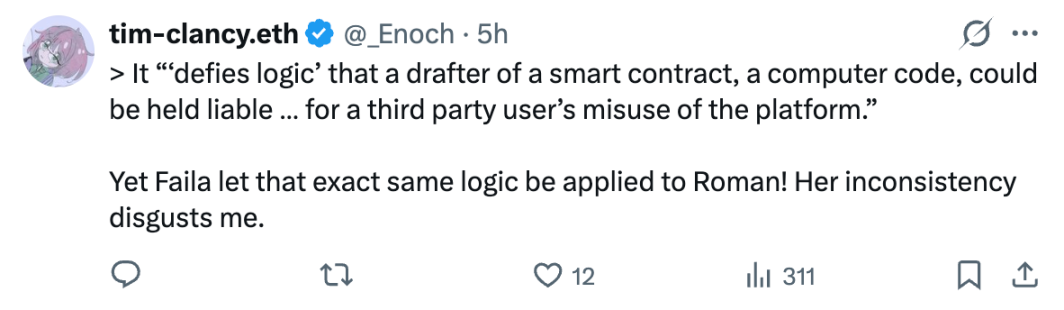
Under Brian Nistler's tweet celebrating Uniswap's victory, a comment by Sigil developer tim-clancy.eth criticizing Failla's contradictory rulings (the verdict against Roman Storm was actually made by a jury) received the most likes among all comments.

Decentralization Is Fine, but Privacy Is Not

I am not a professional lawyer, but setting aside political factors and from a simple emotional perspective, I can roughly understand why Uniswap and Tornado Cash had different outcomes.

The core reason is that Tornado Cash's developers should have been well aware that mixers would inevitably be used for money laundering. This clearly reveals regulators' stance: decentralization is acceptable, but it must be traceable. Tether faced similar challenges, which is why it later began cooperating with money laundering investigations and added freezing capabilities.

Perhaps Roman Storm, behind bars, would feel unjust upon learning of today's ruling. But he should realize that even in a crypto-friendly U.S. under Trump's administration, platforms aiding North Korean state-level hackers in money laundering cannot be tolerated. The power of crypto today is still insufficient to challenge national authority.

Web3 practitioners decry the injustice faced by Tornado Cash's developers while cheering Uniswap's victory. In our eyes, the two protocols are not fundamentally different; in fact, Tornado Cash even excels in privacy protection. Uniswap's addition of front-end blocking for sanctioned addresses in 2022 sparked some debate. Now, it seems that permissionless operation within the existing legal framework may be the only way for decentralized protocols to survive.

But that said, did Uniswap really have no responsibility at all in these scam incidents?

Strictly logically speaking, as the judge's analogy suggests, you cannot hold Mercedes responsible for a bank's losses just because a robber used their car to rob a bank. However, from a business perspective, we tend to believe that giants should provide protection within their capabilities. Current security tools can already identify a large number of potential scam projects in advance. For these established projects that have reaped the benefits of Web3's development, simple screening is not troublesome.

Doing their part to protect investors is not a mandatory obligation, but it is a responsibility that ordinary investors hope Uniswap and others will actively shoulder.


Twitter:https://twitter.com/BitpushNewsCN

Bitpush TG Discussion Group:https://t.me/BitPushCommunity

Bitpush TG Subscription: https://t.me/bitpush

Original link:https://www.bitpush.news/articles/7616264

Questions liées

QWhat was the outcome of the class action lawsuit against Uniswap and its founder Hayden Adams?

AThe class action lawsuit against Uniswap and Hayden Adams was dismissed by the court. The judge ruled that Uniswap, as a decentralized protocol, was not responsible for scam tokens on its platform, comparing it to holding the developer of an autonomous car liable for traffic violations or crimes committed by users.

QWho was the judge presiding over both the Uniswap and Tornado Cash cases, and what were the different outcomes?

AJudge Katherine Polk Failla presided over both cases. She dismissed the lawsuit against Uniswap, ruling the protocol was not liable for third-party misuse. However, in the Tornado Cash case, developer Roman Storm was convicted by a jury for conspiracy to operate an unlicensed money transmitting business.

QWhy did the judge rule that Uniswap was not liable for the scam tokens on its platform?

AThe judge ruled that Uniswap's decentralized nature meant it had no control over which tokens were listed or who interacted with the protocol. She stated that holding the smart contract developers responsible for third-party misuse was 'illogical' and compared it to blaming autonomous car developers for crimes committed using their vehicles.

QWhat was the core reason suggested in the article for the different legal outcomes for Uniswap and Tornado Cash?

AThe article suggests the core reason is that Tornado Cash's developers were aware their mixer would be used for money laundering, particularly by entities like North Korean hackers. The author states that while decentralization is acceptable to regulators, privacy tools that enable untraceable transactions, especially for sanctioned entities, are not tolerated.

QWhat does the article suggest is the 'only way to survive' for decentralized protocols under the current legal framework?

AThe article suggests that 'permissionlessness within the existing legal framework' is the only way for decentralized protocols to survive. This is exemplified by Uniswap's 2022 decision to add front-end blocking of sanctioned addresses, a move that balances decentralization with regulatory compliance.

Lectures associées

Révision à la hausse de 50 % des expéditions de TPU de Google

Récemment, plusieurs institutions étrangères ont discrètement révisé à la hausse leurs prévisions d'expédition des unités de traitement Tensor (TPU) de Google, ajustant l'estimation pour 2027 de 10 millions à 15 millions d'unités, soit une augmentation de 50%. Cette révision positive impacte directement toute la chaîne d'approvisionnement en infrastructure de calcul pour l'IA. Les composants clés tels que les moteurs optiques NPO (associés 1:1 aux TPU), les modules optiques 1.6T, les commutateurs optiques OCS, les alimentations serveur, la fibre optique & les connecteurs MPO, et surtout le refroidissement liquide, bénéficient de cette dynamique. Le refroidissement liquide entre dans une phase d'accélération cruciale, car les nouvelles TPU à haute puissance rendent le refroidissement par air obsolète. Les prévisions indiquent un déploiement massif à partir de 2026. Les fabricants chinois, avec leur rapidité d'itération et leur capacité de production, saisissent cette opportunité pour pénétrer la chaîne d'approvisionnement de Google, remodelant le paysage concurrentiel. Parallèlement, la fibre optique, essentielle pour les interconnexions dans les centres de données d'IA, voit sa logique transformée : la demande explose tandis que l'offre (dépendante d'un cycle de production long de 18-24 mois pour les préformes) est tendue, conduisant à des contrats à long terme et une stabilisation des prix. Les exportations chinoises de fibre devraient capturer une part significative de ce marché. En résumé, la hausse des prévisions pour les TPU de Google renforce la visibilité sur la croissance pour les deux prochaines années, déplaçant l'accent des investissements vers les infrastructures de soutien au calcul, dont le refroidissement liquide et la fibre optique sont des bénéficiaires majeurs, aux côtés des composants optiques et des alimentations serveur.

marsbitIl y a 24 mins

Révision à la hausse de 50 % des expéditions de TPU de Google

marsbitIl y a 24 mins

Une fois l'effervescence autour des cryptomonnaies retombée, que veut vraiment Wall Street ?

Lorsque la frénésie autour des cryptomonnaies s’est dissipée, Wall Street a clairement montré ce qu’elle cherchait vraiment : non pas des récits de décentralisation, mais une infrastructure financière contrôlable, génératrice de rendements et conforme à la réglementation, construite sur des registres distribués. Le mouvement est mené par des acteurs comme BlackRock et Securitize. Le fonds BUIDL de BlackRock, un fonds de bons du Trésor américains à court terme tokenisés, a atteint une taille stable de 25 à 28 milliards de dollars, devenant un actif refuge sur la chaîne. Securitize, valorisé à 12,5 milliards de dollars, s’apprête à être coté au NYSE, qui prévoit de construire avec lui un système de règlement et de compensation d’actions fonctionnant 24h/24 sur une blockchain. Parallèlement, des produits structurés comme le futur ETF BITA de BlackRock transforment la volatilité du Bitcoin en un revenu stable, en vendant systématiquement des options d’achat couvertes sur son propre ETF spot IBIT. Ce mécanisme convertit un actif spéculatif en un produit de revenu standardisé, attirant ainsi les investisseurs institutionnels prudents. Dans le domaine des paiements, les stablecoins sont repensés comme de purs outils de transaction. Des entreprises comme Stripe et Mastercard intègrent des stablecoins conformes (USDC, PYUSD) pour permettre des règlements transfrontaliers instantanés et réduire les fonds gelés dans le système bancaire traditionnel. La législation GENIUS de 2025 a conforté ce modèle en interdisant les dividendes sur les stablecoins et en renforçant la surveillance du blanchiment d'argent. En résumé, Wall Street adopte la technologie blockchain pour reproduire et améliorer ses propres systèmes : titres traditionnels tokenisés, produits de revenu dérivés, et réseaux de paiement efficaces. L’objectif n’est pas de remplacer la finance traditionnelle, mais de la rendre plus efficace, plus liquide et entièrement intégrée au crédit souverain du dollar.

marsbitIl y a 41 mins

Une fois l'effervescence autour des cryptomonnaies retombée, que veut vraiment Wall Street ?

marsbitIl y a 41 mins

S’attacher au char de SpaceX : comment Cursor a atteint 60 milliards de dollars

L'article retrace l'ascension fulgurante de Cursor, une licorne de l'IA pour la programmation, fondée par le jeune prodige Michael Truell et ses camarades du MIT. De ses débuts comme simple éditeur de code alternatif, Cursor a explosé en 2023 en intégrant l'IA, atteignant des revenus annuels de plusieurs milliards de dollars et des millions d'utilisateurs. Cette croissance s'est accompagnée de défis structurels. Cursor était initialement très dépendant des modèles d'Anthropic, un partenaire qui est ensuite devenu un concurrent direct avec le lancement de Claude Code. Pour survivre, Cursor a déclaré l'état d'urgence et accéléré le développement de son propre modèle, Composer. Cependant, développer un modèle de pointe nécessite une puissance de calcul colossale. Pour y parvenir, Cursor s'est tourné vers SpaceX d'Elon Musk au printemps 2025, formant un partenariat stratégique. En échange de l'accès aux supercalculateurs de SpaceX, Cursor contribue à améliorer les capacités de programmation de Grok, le modèle d'IA de Musk. Cet accord inclut une option d'acquisition potentielle de Cursor par SpaceX pour 600 milliards de dollars. L'article souligne les tensions entre l'ambition de Cursor de devenir une entreprise indépendante de classe mondiale et les réalités de la dépendance aux fournisseurs de modèles et à la guerre des puces. La culture interne exigeante, avec ses processus de recrutement controversés incluant des essais de travail non rémunérés, reflète cette intensité. L'histoire de Cursor pose une question centrale : deviendra-t-elle l'éditeur de code de référence de la nouvelle génération, ou sera-t-elle finalement absorbée comme une pièce dans l'échiquier stratégique des géants de l'IA ?

marsbitIl y a 43 mins

S’attacher au char de SpaceX : comment Cursor a atteint 60 milliards de dollars

marsbitIl y a 43 mins

Début de Warsh : le président de la Fed le plus au fait du Crypto de l'histoire apportera-t-il des surprises ou des chocs au marché ?

**Résumé :** Kevin Warsh, nouveau président de la Réserve fédérale américaine, s'apprête à tenir sa première conférence de presse monétaire. Sa nomination est historique : il est le premier président de la Fed à détenir personnellement des actifs numériques (investissements indirects dans Solana, dYdX, etc.), montrant une compréhension unique du secteur. Son dilemme est majeur : il doit faire face à une résurgence de l'inflation, qui exige une politique monétaire stricte (position "de faucon"), tout en répondant aux pressions politiques pour des baisses de taux. Parallèlement, son attitude envers les crypto-actifs diffère fondamentalement de celle de son prédécesseur. Il ne les considère pas comme de simples actifs spéculatifs, mais plutôt comme un "bon policier" pour la politique économique et une composante de la compétitivité américaine. Son impact potentiel sur le marché crypto s'articule autour de trois axes : 1. Un changement de paradigme réglementaire, passant de la prévention à l'intégration et à l'innovation. 2. Une reprixation des actifs liée aux taux d'intérêt, où sa clarté de communication pourrait réduire la prime d'incertitude. 3. Une légitimation accrue pouvant attirer les capitaux institutionnels traditionnels. Deux scénarios principaux sont envisagés pour sa première intervention : * **Scénario "Surprise"** : Un ton modéré ("de colombe") sur les taux combiné à des signaux favorables à l'innovation numérique pourrait booster le marché. * **Scénario "Choc"** : Un message excessivement restrictif sur les taux pourrait entraîner une vente généralisée des actifs risqués, y compris les cryptos. Bien qu'il ait dû vendre ses actifs crypto pour des raisons d'éthique, la compréhension intrinsèque de Warsh pour la technologie blockchain pourrait, à long terme, poser les bases d'une intégration plus structurelle des actifs numériques dans le système financier.

marsbitIl y a 11 h

Début de Warsh : le président de la Fed le plus au fait du Crypto de l'histoire apportera-t-il des surprises ou des chocs au marché ?

marsbitIl y a 11 h

Trading

Spot
Futures
活动图片