Uniswap Innocent, Tornado Developer Jailed: Two Verdicts from the Same Judge

比推Publié le 2026-03-03Dernière mise à jour le 2026-03-03

Résumé

In a landmark ruling, a New York federal court dismissed a class-action lawsuit against Uniswap and its founder, Hayden Adams, holding that open-source developers are not liable for fraudulent tokens traded on their decentralized protocols. The judge, Katherine Polk Failla, compared the case to holding a car manufacturer responsible for crimes committed using its vehicles. This decision is seen as a significant victory for DeFi developers. However, the same judge previously presided over the case against Tornado Cash developer Roman Storm, who was convicted for operating an unlicensed money-transmitting business. The contrasting outcomes highlight a key distinction in regulatory attitude: decentralization is tolerated, but privacy tools that enable large-scale money laundering—especially for state actors like North Korean hackers—are not. The article argues that while Uniswap isn’t legally obligated to screen for scam tokens, there is an expectation for major platforms to take proactive measures to protect users. The piece concludes that operating within existing legal frameworks—such as implementing sanctions screening—may be essential for decentralized protocols to survive.

Author: Eric, Foresight News

Original Title: The Same Judge, Different Outcomes for Uniswap and Tornado


At 3 a.m. Beijing time on March 3, the class action lawsuit demanding that Uniswap and its founder Hayden Adams be held responsible for scam tokens on Uniswap was dismissed by the U.S. District Court for the Southern District of New York. Brian Nistler, General Counsel of the Uniswap Foundation, called it a "landmark ruling for DeFi."
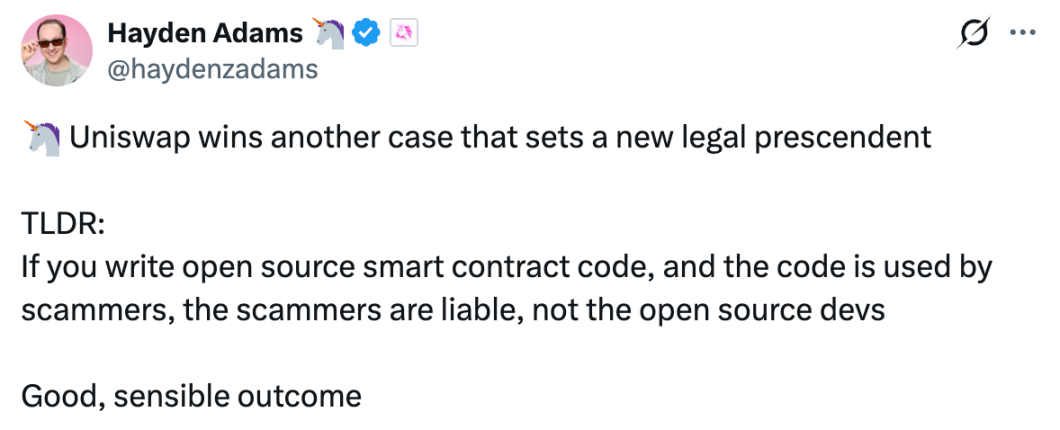
Hayden Adams also tweeted, "If you write open-source smart contract code and that code is used by scammers, the scammers are responsible, not the open-source developers. This is a reasonable and just outcome."

For Web3 developers, this is undoubtedly good news. But little known is that the judge who made this "just ruling" is the same person who, during the tenure of the former SEC chairman, found the developers of the mixer Tornado Cash guilty.

The Final Verdict

Nearly four years have passed since the class action lawsuit against Uniswap was filed and today's final resolution.

In April 2022, Uniswap users, represented by Nessa Risley, filed a class action lawsuit in court, accusing defendants Paradigm, a16z, Uniswap, and its founder Hayden Adams of violating federal securities laws by issuing and selling unregistered securities, including UNI, in the form of tokens on Uniswap. Additionally, the defendants failed to register Uniswap as an exchange or broker-dealer under applicable securities laws and did not provide investors with registration statements for the securities they issued and sold.

This lawsuit was initiated by the law firms Kim&Serritella and Barton, representing users who traded EtherumMax, Bezoge, MatrixSamurai, Alphawolf Finance, RocketBunny, and BoomBaby.io tokens on Uniswap between April 5, 2021, and April 4, 2022.

The phrase "unregistered securities" had extraordinary destructive power in the crypto industry at the time, but this lawsuit unexpectedly and quickly tilted in Uniswap's favor.

Presiding Judge Katherine Polk Failla, while agreeing that the so-called "scam tokens" were indeed securities, ruled that Uniswap did not need to be held responsible. Failla argued that Uniswap's decentralized nature meant the protocol had no control over which tokens were listed on the platform or who could interact with it. "The case is more like holding the developer of an autonomous vehicle responsible for traffic violations or bank robberies committed by third parties using the car."

Based on this, Failla dismissed the federal securities law charges in August 2023. The plaintiffs then appealed, and the Second Circuit Court of Appeals affirmed the dismissal of the federal part in 2025 but remanded the state law part for retrial.

Subsequently, the plaintiffs amended the complaint and sued again. This time, the losing investors accused Uniswap and other defendants of aiding and abetting fraud, making false statements, profiting from transactions involving scam tokens, and violating fraud laws in multiple states.

After another review by the same judge, Failla, the amended claims were dismissed again, with no further amendments allowed, bringing the case to a complete end.

The judge's reasoning this time was largely the same as before: Uniswap was unaware of the scam tokens, and even if it were aware, it did not provide substantial assistance. It also did not meet the definition of fraudulent behavior under any state law. Regarding unjust enrichment, Uniswap did not gain direct benefits, and the speculative indirect benefits from such scam activities expanding the user base were too tenuous.
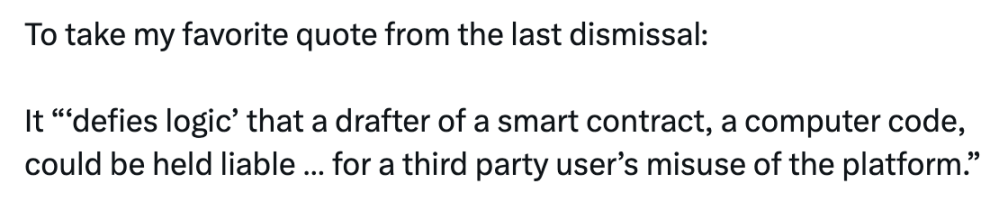
Brian Nistler stated in a tweet, quoting a line from the previous ruling, that it "defies logic" to hold the drafter of a smart contract responsible for the abusive actions of third-party users on the platform.

Tornado Cash's Different Outcome

Facing the same judge, Roman Storm of Tornado Cash met a different fate.

Tornado Cash was first added to the sanctions list by the U.S. Treasury Department's Office of Foreign Assets Control (OFAC) on August 8, 2022, accused of helping criminals, including North Korean hackers, launder over $7 billion. Two days after being added to the sanctions list, Dutch police arrested Alexey Pertsev, one of Tornado Cash's core developers.

On May 14, 2024, a Dutch court found Alexey Pertsev guilty of money laundering and sentenced him to 64 months in prison. The court ruled that Pertsev was aware that the platform he developed and operated was used for crime but did nothing to stop it, subjectively acquiescing to Tornado Cash being used as a money laundering tool. Alexey Pertsev is still appealing, but there have been no recent updates.

Seven months before Alexey Pertsev was found guilty, the U.S. Department of Justice sued two other developers, Roman Storm and Roman Semenov, in the Southern District of New York. Roman Storm was previously arrested in Washington State, while Roman Semenov remains at large.
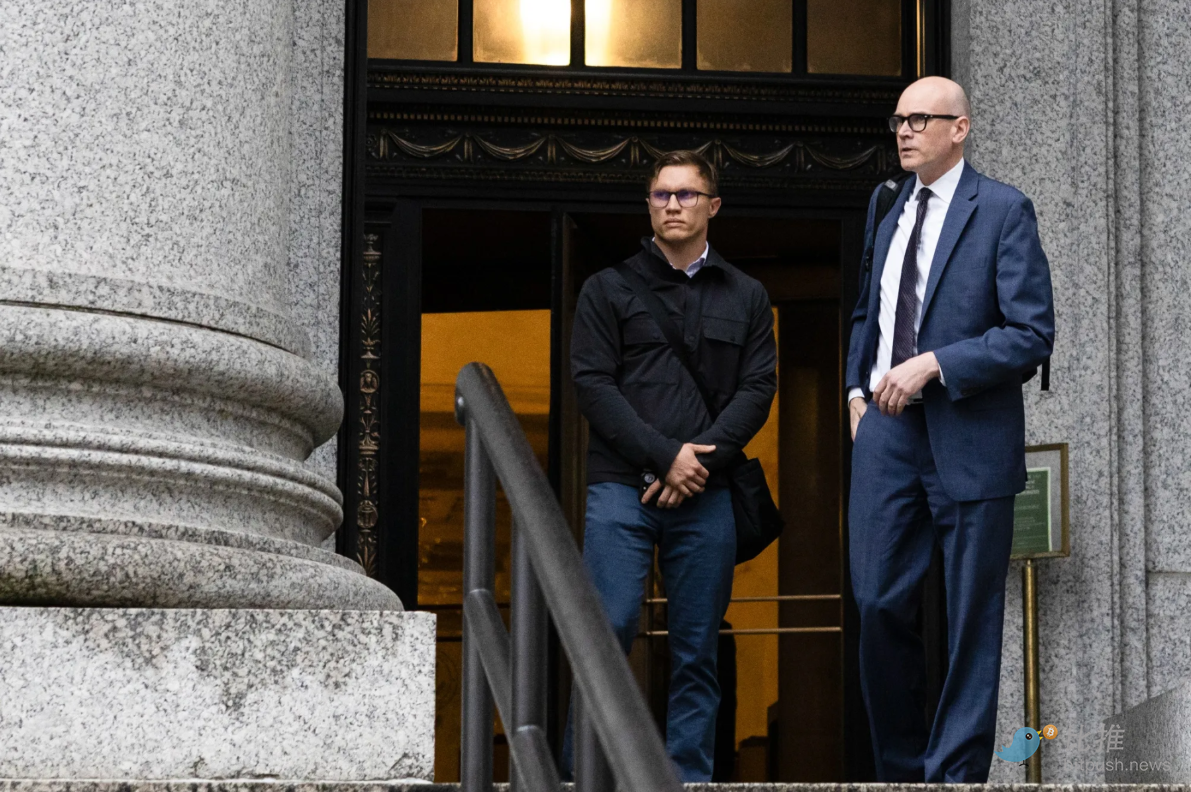
Roman Storm in court

Although an appeal later determined that OFAC's sanctions against Tornado Cash were an overreach and invalid, Roman Storm still found himself in the defendant's seat last July. After a trial presided over by Judge Katherine Polk Failla, the jury found Roman Storm guilty of "conspiracy to operate an unlicensed money transmitting business," though sentencing has not yet been formally announced.
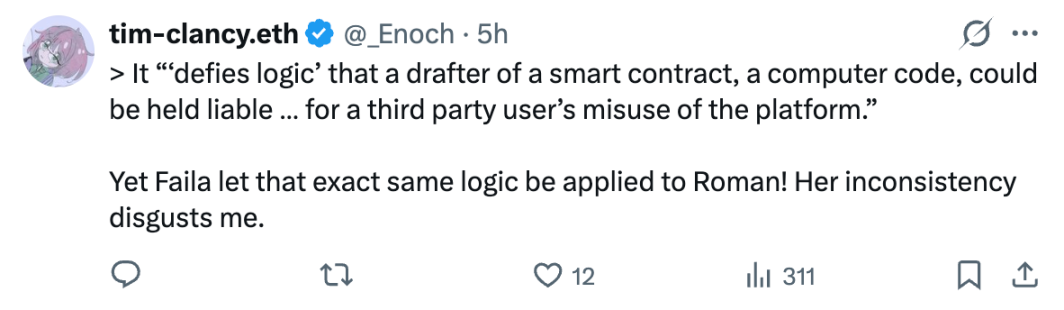
Under Brian Nistler's tweet celebrating Uniswap's victory, a comment by Sigil developer tim-clancy.eth criticizing Failla's contradictory rulings (the verdict against Roman Storm was actually made by a jury) received the most likes among all comments.

Decentralization Is Fine, but Privacy Is Not

I am not a professional lawyer, but setting aside political factors and from a simple emotional perspective, I can roughly understand why Uniswap and Tornado Cash had different outcomes.

The core reason is that Tornado Cash's developers should have been well aware that mixers would inevitably be used for money laundering. This clearly reveals regulators' stance: decentralization is acceptable, but it must be traceable. Tether faced similar challenges, which is why it later began cooperating with money laundering investigations and added freezing capabilities.

Perhaps Roman Storm, behind bars, would feel unjust upon learning of today's ruling. But he should realize that even in a crypto-friendly U.S. under Trump's administration, platforms aiding North Korean state-level hackers in money laundering cannot be tolerated. The power of crypto today is still insufficient to challenge national authority.

Web3 practitioners decry the injustice faced by Tornado Cash's developers while cheering Uniswap's victory. In our eyes, the two protocols are not fundamentally different; in fact, Tornado Cash even excels in privacy protection. Uniswap's addition of front-end blocking for sanctioned addresses in 2022 sparked some debate. Now, it seems that permissionless operation within the existing legal framework may be the only way for decentralized protocols to survive.

But that said, did Uniswap really have no responsibility at all in these scam incidents?

Strictly logically speaking, as the judge's analogy suggests, you cannot hold Mercedes responsible for a bank's losses just because a robber used their car to rob a bank. However, from a business perspective, we tend to believe that giants should provide protection within their capabilities. Current security tools can already identify a large number of potential scam projects in advance. For these established projects that have reaped the benefits of Web3's development, simple screening is not troublesome.

Doing their part to protect investors is not a mandatory obligation, but it is a responsibility that ordinary investors hope Uniswap and others will actively shoulder.


Twitter:https://twitter.com/BitpushNewsCN

Bitpush TG Discussion Group:https://t.me/BitPushCommunity

Bitpush TG Subscription: https://t.me/bitpush

Original link:https://www.bitpush.news/articles/7616264

Questions liées

QWhat was the outcome of the class action lawsuit against Uniswap and its founder Hayden Adams?

AThe class action lawsuit against Uniswap and Hayden Adams was dismissed by the court. The judge ruled that Uniswap, as a decentralized protocol, was not responsible for scam tokens on its platform, comparing it to holding the developer of an autonomous car liable for traffic violations or crimes committed by users.

QWho was the judge presiding over both the Uniswap and Tornado Cash cases, and what were the different outcomes?

AJudge Katherine Polk Failla presided over both cases. She dismissed the lawsuit against Uniswap, ruling the protocol was not liable for third-party misuse. However, in the Tornado Cash case, developer Roman Storm was convicted by a jury for conspiracy to operate an unlicensed money transmitting business.

QWhy did the judge rule that Uniswap was not liable for the scam tokens on its platform?

AThe judge ruled that Uniswap's decentralized nature meant it had no control over which tokens were listed or who interacted with the protocol. She stated that holding the smart contract developers responsible for third-party misuse was 'illogical' and compared it to blaming autonomous car developers for crimes committed using their vehicles.

QWhat was the core reason suggested in the article for the different legal outcomes for Uniswap and Tornado Cash?

AThe article suggests the core reason is that Tornado Cash's developers were aware their mixer would be used for money laundering, particularly by entities like North Korean hackers. The author states that while decentralization is acceptable to regulators, privacy tools that enable untraceable transactions, especially for sanctioned entities, are not tolerated.

QWhat does the article suggest is the 'only way to survive' for decentralized protocols under the current legal framework?

AThe article suggests that 'permissionlessness within the existing legal framework' is the only way for decentralized protocols to survive. This is exemplified by Uniswap's 2022 decision to add front-end blocking of sanctioned addresses, a move that balances decentralization with regulatory compliance.

Lectures associées

Le terroriste Dourov va-t-il bannir les fonctionnaires russes ?

Pavel Durov, fondateur de Telegram, a réagi publiquement après avoir été inscrit sur la liste russe des "terroristes et extrémistes". Il affirme que cette désignation fait suite à son refus de se plier aux exigences des autorités russes en matière de surveillance de masse et de censure dans l'application. Il a souligné l'ironie de l'interdiction qui lui est faite de "publier des informations sur Internet", lui dont la plateforme est l'un des plus grands messageries au monde. Sa remarque selon laquelle les responsables russes "ne semblent manifestement pas comprendre qui peut bannir qui sur Internet" a été largement reprise. Techniquement, l'administration de Telegram a le contrôle sur les chaînes présentes sur sa plateforme, y compris les comptes vérifiés des institutions et fonctionnaires russes qui continuent de l'utiliser malgré son blocage officiel dans le pays. Cela ouvre la possibilité que Durov impose des restrictions à ces canaux officiels. Cette situation survient alors que le gouvernement russe a ordonné aux fonctionnaires de migrer vers le messagerie national MAX d'ici 2030, une mesure que beaucoup contourneraient en utilisant toujours Telegram via des équipements séparés. Parallèlement, les alternatives pour les utilisateurs ordinaires se réduisent, avec des messageries comme BiP et KakaoTalk devenant récemment inaccessibles sans VPN. La situation rappelle un précédent en 2020, lorsque Roskomnadzor avait levé le blocage de Telegram, permettant aux canaux d'État de continuer à fonctionner. Désormais, la menace de restrictions pourrait venir de l'intérieur de la plateforme elle-même. La suite dépendra des actions potentielles de Durov et de la réaction des autorités russes.

cryptonews.ruIl y a 6 mins

Le terroriste Dourov va-t-il bannir les fonctionnaires russes ?

cryptonews.ruIl y a 6 mins

La société Strategy affiche une perte nette de 8,22 milliards de dollars au deuxième trimestre suite à la baisse du Bitcoin

La société Strategy, principal détenteur institutionnel de Bitcoin, a enregistré une perte nette de 8,22 milliards de dollars au deuxième trimestre, principalement due à une perte non réalisée de 8,32 milliards de dollars sur sa position en Bitcoin. Malgré cette perte comptable, l'entreprise a accru ses réserves de 25% depuis début 2024, détenant désormais 843 775 BTC. Strategy a également lancé un programme de monétisation, vendant pour 218,4 millions de dollars de Bitcoin, principalement en juillet, pour financer ses dividendes sur actions privilégiées. Parallèlement, elle a constitué une réserve de trésorerie de 3,75 milliards de dollars pour couvrir plus de deux ans d'obligations financières, se prémunissant ainsi contre la volatilité du marché. Les actions MSTR ont légèrement corrigé après la publication des résultats, reflétant la sensibilité de la société aux fluctuations du Bitcoin. L'analyse souligne que ces pertes trimestrielles importantes, similaires aux trimestres précédents, sont inhérentes à sa stratégie comptable. Le nouveau programme de vente régulier introduit une pression vendeuse sur le marché, transformant progressivement Strategy d'accumulateur net en vendeur périodique. La question centrale reste la soutenabilité de ce modèle si une baisse prolongée du Bitcoin épuisait la réserve de trésorerie au-delà de son horizon de deux ans.

cryptonews.ruIl y a 6 mins

La société Strategy affiche une perte nette de 8,22 milliards de dollars au deuxième trimestre suite à la baisse du Bitcoin

cryptonews.ruIl y a 6 mins

DeepSeek V4 version officielle est arrivée, les nouvelles capacités émergent, le combat pour le roi du rapport qualité-prix est lancé

DeepSeek a annoncé le lancement en version bêta publique de l'API DeepSeek-V4-Flash. Malgré une architecture nettement plus légère (284 milliards de paramètres totaux, 13 milliards activés contre 1600/49 pour la version Pro), cette nouvelle version démontre des performances en matière d'Agent (exécution autonome de tâches) qui rivalisent avec celles de la V4-Pro en version préliminaire d'il y a trois mois, selon des tests de référence. L'amélioration clé proviendrait principalement d'un "post-entraînement" avancé et d'optimisations au niveau du cadre d'exécution (Harness), suggérant que la qualité de l'entraînement et les méthodes l'emportent parfois sur la simple augmentation de la taille du modèle. Cette mise à jour stratégique positionne DeepSeek sur le marché en pleine croissance des Agents IA, en proposant une solution à haut rapport performances/coût. Le modèle prend également en charge le format d'API Responses d'OpenAI et est adapté pour des tâches de génération de code, marquant une volonté d'interopérabilité et de concurrence directe sur des terrains établis. Cette annonce intervient peu après un premier tour de table record de plus de 500 milliards de yuans pour DeepSeek, soulignant les attentes fortes quant à sa trajectoire technique et commerciale dans la course à l'IA, où la capacité Agent devient un critère déterminant.

marsbitIl y a 8 mins

DeepSeek V4 version officielle est arrivée, les nouvelles capacités émergent, le combat pour le roi du rapport qualité-prix est lancé

marsbitIl y a 8 mins

La société de cryptomonnaies Wintermute émet des déclarations pessimistes concernant la croissance attendue des altcoins ! Voici les détails

La société de crypto-monnaie Wintermute a émis une évaluation pessimiste concernant la croissance attendue des altcoins. Selon elle, le marché pourrait ne pas connaître un « season des altcoins » traditionnel où de nombreux projets prospèrent simultanément. Les données de Wintermute indiquent une concentration accrue du capital institutionnel : 72 % de son volume de trading OTC spot au premier semestre 2026 provenait de clients institutionnels, un record. Leurs investissements sont devenus plus sélectifs, se concentrant sur des tokens spécifiques après des hausses de prix, contrairement aux investisseurs particuliers dont l'intérêt persiste plus longtemps. Cette tendance suggère que seuls les projets avec des cas d'utilisation solides, une liquidité élevée et un intérêt institutionnel se distingueront dans le nouveau cycle. Des analyses de CryptoQuant et Kaiko confirment cette concentration : le volume des paires altcoins/Bitcoin est à son plus bas depuis 2021, et les 10 principaux altcoins (hors stablecoins) représentent environ 80,5 % de la capitalisation boursière totale des altcoins et 63 % de leur volume d'échanges, en hausse par rapport aux mois précédents. Les analystes concluent que dans un environnement où les investisseurs institutionnels sont plus prudents, un éventuel nouveau cycle haussier des altcoins pourrait être moins généralisé, avec des profits concentrés sur un nombre limité de projets prometteurs dotés de technologies avancées et d'écosystèmes robustes.

cryptonews.ruIl y a 16 mins

La société de cryptomonnaies Wintermute émet des déclarations pessimistes concernant la croissance attendue des altcoins ! Voici les détails

cryptonews.ruIl y a 16 mins

Trading

Spot
活动图片