Turning $50 into a Million by Age 18 Through Wallet Tracking

深潮Publié le 2025-12-30Dernière mise à jour le 2025-12-30

Résumé

At 18, the author turned $50 into over $1 million in less than a year using wallet tracking strategies after initially losing $80 in meme coin trades. Early mistakes included buying based on hype, narratives, or social media buzz, which often led to losses. The key shift was focusing on tracking "smart money" movements—wallets of insiders, KOLs, teams, market makers, or coordinated groups—rather than relying on subjective judgments. The author’s methods evolved over time: - Initially tracking influential KOLs’ wallets, turning $50 into $5,000 in a month. - Later monitoring coordinated groups (e.g., turning $4,000 into $600,000 on $ROCKY). - Advanced techniques included tracking new wallets, project team wallets, and market maker wallets for early entry (e.g., $BARRON and $HOOD trades yielding 50x returns). Strict rules were followed: no more than 5% of capital per trade, avoiding large positions to prevent being targeted, and maintaining emotional discipline. The author emphasizes that success came from replicable strategies, not luck, and advises understanding the motives and patterns of tracked entities. The journey is shared as inspiration, with gratitude to those indirectly involved and a focus on ethical, data-driven trading.

Written by: Ugo

Compiled by: Luffy, Foresight News

In February 2024, I entered the world of Meme coin trading with $80 and lost everything. I had this kind of disastrous experience twice.

It was at that time that I realized I hadn't figured out the way of this market at all and had been using the wrong methods.

Later, I re-entered the market with $50. This time, I used a wallet tracking strategy. In less than a year, by February 2025, that $50 had grown to over $1 million.

Early Pitfalls

My previous logic for buying Meme coins was simple: "This coin has a funny meme, good promotional content, and a clean-looking website. Just buy it."

Admittedly, this method could occasionally make some money, but most of the time, it was no different from pure gambling. You had no solid basis and couldn't find objective reasons to judge how high the price could specifically go.

If you want stable profits, you must find a way to get key information *before* the market moves, not just follow the hype after it pumps.

I was once addicted to all sorts of rumors on X and Telegram: "This coin will definitely hit a $100 million market cap this week, just you wait." I later learned that most people who post these things are paid shills, or they had already accumulated 15% of the token supply at low prices. You rush in excitedly, only to end up as the bag holder.

If your profit-taking targets aren't based on real information, then your actions are merely reacting to someone else's interests, not truly following market规律 (laws/patterns).

Turning the Tide with Wallet Tracking

I quickly realized a critical piece was missing from my previous approach. I would look at the operations of top traders and wonder, "How can he predict the market moves, but I can't?" So I had to find a solution.

And wallet tracking completely颠覆 (overturned) my understanding of trading. I stopped trying to guess market tops and bottoms, stopped chasing various narrative hotspots, and stopped being led by the nose by hype on X. Instead, I focused on just one thing: where is the smart money flowing?

The origin of any major market move isn't on social media, but in a small number of wallets. These wallets are either the project's initial wallets, large holding wallets, or early institutional wallets. Insiders, KOLs, industry big shots, market makers, newly created anonymous wallets... are all hidden in these addresses.

My success wasn't based on the luck of one single trade, but on repeatedly capturing replicable market patterns.

At that moment, I completely understood: I don't need to be smarter than the entire market, I don't need to incorporate any subjective judgment, and I don't need to pay attention to market炒作 (hype/speculation). I just need to closely watch the data, analyze fund movements, and then decisively execute my trading strategy.

From then on, my goal became extremely clear: build a trading system that reacts solely based on the movements of smart money, not on hearsay.

My Practical Wallet Tracking Methods

Watch KOL Wallets Closely

When I first started in February 2024, the wallet tracking method was actually very simple. Back then, almost no one frequently changed wallet addresses.

All you had to do was find the stealth wallet addresses of KOLs who truly had influence, and then follow their moves. That's it.

They accumulate at low prices → Pump aggressively → Price instantly pumps 10x.

Using this method, I turned $50 into $5,000 in the first month. Immediately in the second month, $5,000 became $30,000.

For example, on February 24th: A project team specifically launched a token for a certain KOL. This industry big shot quietly accumulated positions using multiple stealth wallets when the token's market cap was only $20,000. I followed his moves and bought in when the market cap reached $30,000. Subsequently, he aggressively promoted it in Telegram groups and on X, and the token's market cap instantly broke through $400,000. I took partial profits at this level.

Later that day, the market cap surged to $1 million, and I cashed out again. All calculated, my entry capital increased about 30 times in just a few hours.

My capital base was still very small at that time, so I didn't have to worry about liquidity issues at all and could exit cleanly.

Tracking Cabal Wallets

A few months later, I stopped focusing on individual KOLs and switched to tracking the wallet movements of cabals (pump groups). At that time, people were changing wallet addresses more and more frequently. Tracking the operational consensus of a group of people was much more reliable than looking at a single wallet. For example, 10 different people's wallets, all belonging to the same circle, were synchronizing the same operations.

This kind of signal gave me far more confidence than a single wallet could.

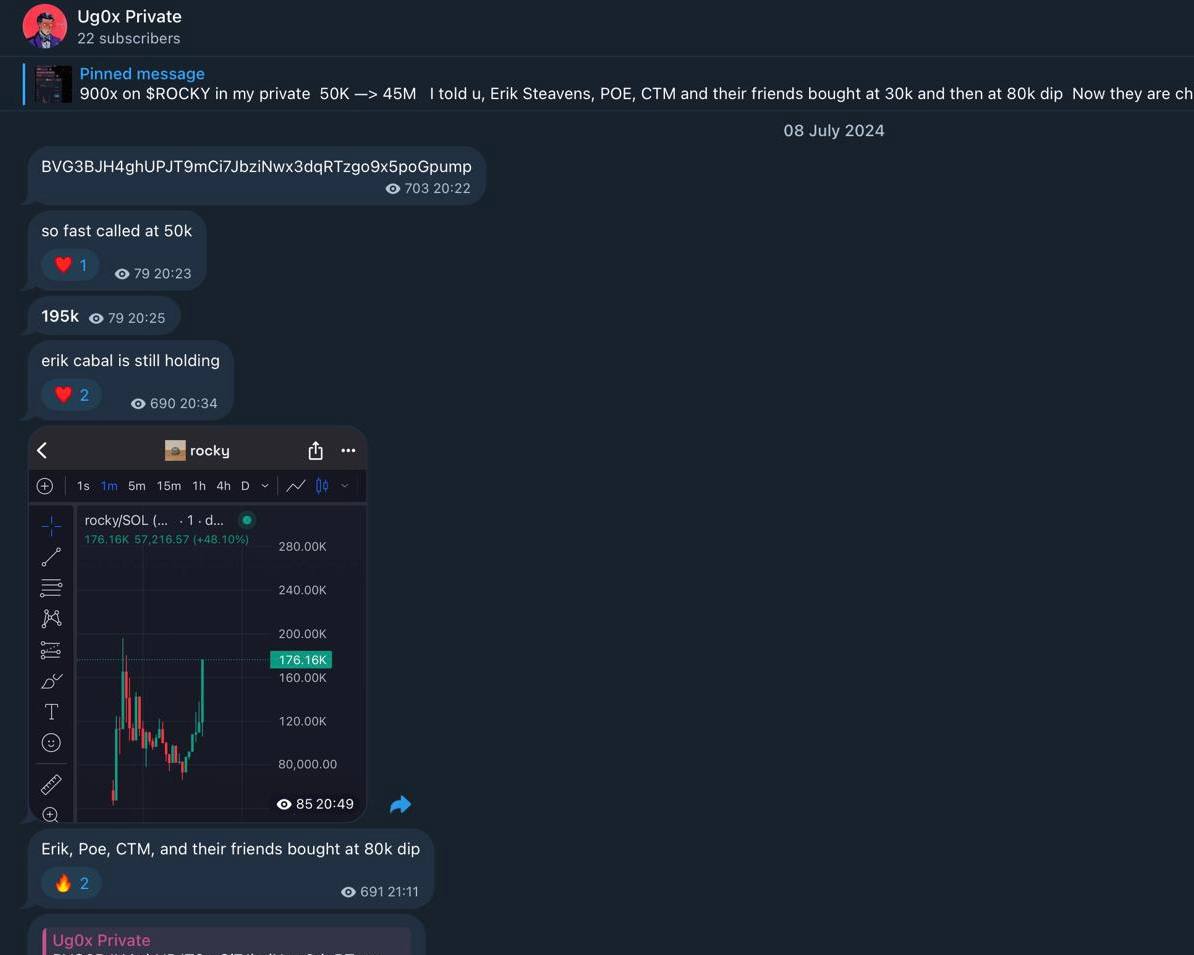
July 8, 2024, the operation around the $ROCKY token was a perfect case study. At that time, people like Erik Steavens, POE, DOGEN, and CTM were all quietly buying in the range of $10,000 to $80,000 market cap.

Seeing this signal, I knew it was no coincidence; they were definitely planning a pump.

I bought 2.8% of the circulating supply when the market cap was $40,000.

In the following days, this group of big shots联合发力 (joined forces) to pump the price, and the token's market cap soared to $45 million.

I took profits in batches between a $2 million and $10 million market cap, averaging an exit around $6 million.

In this trade, my entry capital increased 150 times. Although holding to the peak could have yielded 1100x, I strictly executed my exit plan. I was more than satisfied with making my first six-figure profit from this trade.
Tracking New Wallets, Project Wallets & Large Holding Wallets

By January 2025, the crypto market trading atmosphere was unprecedentedly hot, but wallet tracking was also becoming increasingly difficult. To continuously get first-hand insider information, I had to constantly optimize my methods and adapt.

The key to tracking these insiders' wallets was finding their new wallets that had just withdrawn funds from centralized exchanges like Binance. This meant accurately tracing fund transfer records and timestamps between multiple Binance addresses. This process was time-consuming but absolutely worth it.

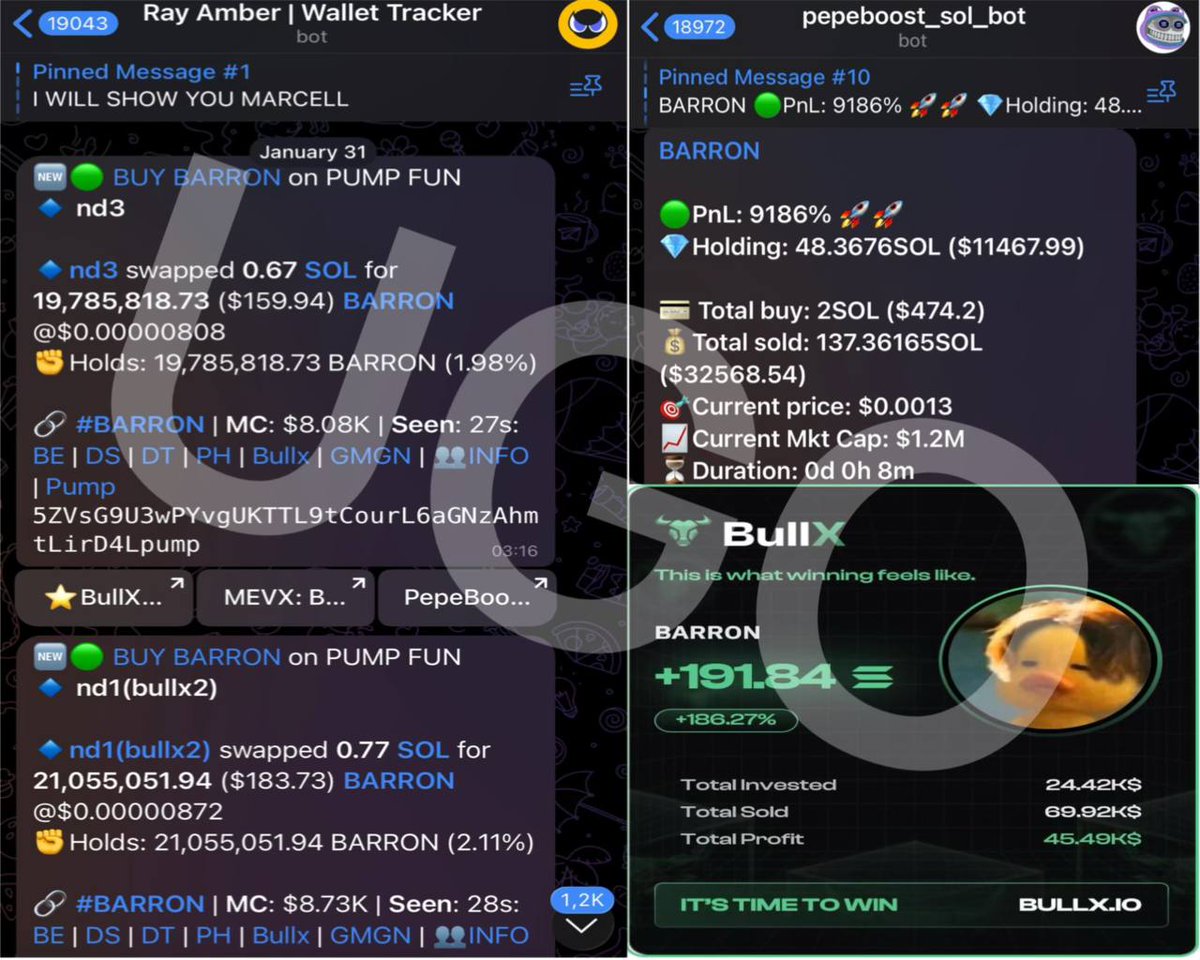
For example, I was closely tracking Marcell's wallet movements, so I could see his newly funded wallets every day. On January 31st, he personally launched and took a large position in the $BARRON token.

I built my position across 3 wallets in the market cap range of $15,000 to $25,000. About three minutes later, Marcell started posting to pump it. I quickly took profits and exited between a $1 million and $2.5 million market cap.

This was one of the fastest trades I ever executed: an initial investment of $1,300 eventually yielded over $110,000. (The trading platform BullX showed my buy amount as $24,000 because I later bought the dip in this wallet, maximizing the profit).
Tracking Market Maker Wallets

Market maker wallets are wallet addresses directly controlled by the token project team, primarily used to manipulate the token price for the benefit of the project team or the token itself.

Common manipulation tactics include: triggering stop-loss orders by placing big buy/sell orders, or dumping the price 30% in minutes to cause panic selling, allowing new investors to enter at low prices.

However, market makers often transfer tokens between wallets shortly after the token is launched. If these wallets aren't newly created or are easily identifiable, we can directly track the project team's movements and accurately capture every new token launch opportunity.

This is how I operated the $HOOD token trade on January 31, 2025.

This project team大概 (roughly) launches a new token every month. They completed their large position allocation when the market cap was pumped to around $2 million, and I bought in decisively at this level, getting in before the top KOLs started promoting it. A few hours later, I took profits between an $80 million and $120 million market cap, achieving roughly a 50x return on this trade.

Meanwhile, during the gap while managing the initial position profit-taking, I also used the market maker's large sell-offs to re-enter heavily, making 40% to 70%差价 (price difference/profit) in just a few minutes.

The total profit for this day was a whopping $152,000. Until the ASTER token trade in September of the same year, January 31st was my highest profit day.

My Ironclad Trading Rules

I always strictly adhere to capital management rules. For example, the capital投入 (input/allocated) to each trade never exceeds 5% of the total portfolio. I also flexibly adjust risk exposure based on the quality of the trading opportunity and my own level of confidence.

When trading with a wallet tracking strategy, you absolutely cannot use heavy leverage (or: take large positions). Once the target you are tracking discovers your presence, they can easily turn around and rug you.

You also need to learn to think from their perspective, understand their interests, operating habits, and rhythm control. This is how you minimize the risk of being rugged and achieve consistent, stable profits.

Of course, I strictly follow my own trading plan and never let emotions dictate decisions. I actually rarely have trouble with this because I started learning forex trading at age 14, and discipline is already deeply ingrained.

That said, I have also experienced several painful lessons of profit drawdowns. But these setbacks didn't crush me; instead, they became motivation for me to move forward. Driven by this unwillingness, I studied even harder, constantly refining my trading edge.

Finally

I am writing this article not to show off. On one hand, I want to use it as a diary to look back on my growth in 5 years. On the other hand, I also hope to inspire and help more people, letting everyone understand: as long as you are willing to主动求变 (actively seek change) and put in the effort, there is always a way to achieve your goals.

I must clarify one point: I never use these tracking techniques against friends or people around me. Everything I do is purely to understand the underlying logic of market operation and then go with the flow.

I am also very grateful to those I track, and to the project teams that truly work hard. I always trade with敬畏之心 (awe and respect), without any hostility. I am also sincerely grateful to all the friends I have met on this journey, they have given me so much help. Thank you all, and thank heaven's blessing.


Questions liées

QWhat was the key strategy the author used to turn $50 into over $1 million in less than a year?

AThe author used a wallet tracking strategy, focusing on following the money flow of 'smart money'—such as KOLs, insider groups, project teams, market makers, and large holders—instead of relying on social media hype or subjective judgments.

QWhat were the four main types of wallets the author tracked to identify profitable trading opportunities?

AThe author tracked four types of wallets: KOL wallets, conspiracy group (insider circle) wallets, new/project team/large holder wallets, and market maker wallets.

QHow did the author's approach to trading change after realizing the limitations of following social media hype?

AThe author stopped guessing market tops and bottoms, chasing narratives, or being influenced by social media trends. Instead, they focused solely on analyzing data and capital movements to execute trades based on the actions of informed investors.

QWhat was the author's strict rule regarding risk management in each trade?

AThe author never risked more than 5% of their total portfolio on a single trade and adjusted their risk exposure based on the quality of the opportunity and their confidence level.

QWhy did the author avoid using large positions when employing the wallet tracking strategy?

AThe author avoided large positions to prevent being noticed and targeted by the tracked entities, who could reverse their actions and exploit the follower's position.

Lectures associées

Pourquoi Strategy a-t-elle vendu 32 Bitcoins ? Le PDG révèle la vraie raison

Le PDG de Strategy, Phong Le, a expliqué que la vente récente de 32 Bitcoin par l'entreprise n'était pas motivée par des besoins de liquidité. Il a indiqué que cette transaction visait principalement à montrer au marché que la société était capable de vendre des BTC si nécessaire et à tester ses processus internes d'exécution. Cette vente modeste a été suivie, environ une semaine plus tard, par l'achat de plus de 1 500 BTC, le premier désinvestissement de Strategy depuis 2022. Le a insisté sur le fait que Strategy restait un acheteur net de Bitcoin, comme en témoignent ses importants achats récents. Il a précisé que la vente n'était pas requise pour financer les dividendes, ceux-ci étant couverts par d'autres activités de levée de capitaux. Il a reconnu que cette décision avait déçu certains investisseurs particuliers adhérant à une philosophie de "ne jamais vendre", mais a souligné que l'entreprise devait répondre aux intérêts d'un ensemble plus large de parties prenantes, notamment les actionnaires et les détenteurs de dette. En résumé, les deux raisons principales avancées pour la vente sont "d'immuniser" le marché en démontrant une capacité à vendre et de tester les procédures opérationnelles. Le PDG a conclu en affirmant que Strategy demeurait le plus grand détenteur et acheteur de Bitcoin au monde. Au moment de la publication, le BTC se négociait à 62 672 dollars.

bitcoinistIl y a 1 h

Pourquoi Strategy a-t-elle vendu 32 Bitcoins ? Le PDG révèle la vraie raison

bitcoinistIl y a 1 h

Le dernier grand acheteur d'Ethereum, jusqu'à quand pourra-t-il tenir ?

Alors que le marché des crypto-monnaies baisse, Bitcoin et Ethereum atteignent respectivement près de 60 000 $ et 1 500 $. Bitmine, le dernier acheteur majeur et persistant d'Ethereum, maintient des achats agressifs malgré des pertes latentes dépassant 10 milliards de dollars. Pour financer sa stratégie, Bitmine a émis des actions privilégiées perpétuelles rapportant 9,5% de dividendes annuels, levant environ 274 millions de dollars. Bitmine détient actuellement environ 5,66 millions d'ETH, soit plus de 90% de son objectif d'atteindre 5% de l'offre totale. Près de 85% de ses ETH sont mis en jeu (staking), générant un revenu annuel estimé entre 230 et 296 millions de dollars. Cependant, son prix d'acquisition moyen est d'environ 3 500 $, alors que l'ETH se négocie autour de 1 650 $, entraînant des pertes importantes. Le modèle de Bitmine repose sur l'utilisation des revenus du staking pour couvrir les dividendes. Pourtant, avec un rendement de staking de 3-4%, il ne pourra pas soutenir indéfiniment des dividendes de 9,5% si les émissions d'actions privilégiées augmentent. Une hausse du prix de l'ETH est donc essentielle pour la pérennité de ce modèle. Si Bitmine atteint son objectif de 5% et cesse d'acheter, la question se pose de savoir qui soutiendra le prix de l'ETH. Les ETF sur ETH connaissent des sorties de fonds nettes, et certaines institutions traditionnelles réduisent leur exposition. Les besoins d'achat institutionnels liés aux stablecoins ou aux actifs tokenisés (RWA) sont lents à se matérialiser. Les scénarios pour l'avenir d'ETH varient : une poursuite des achats de Bitmine pourrait maintenir un support, tandis qu'un ralentissement pourrait faire chuter le prix vers 1 000 $. Un scénario optimiste inclut l'inclusion dans l'indice Russell 1000 et une adoption réglementaire favorable. Finalement, la durabilité de la stratégie de Bitmine et l'émergence d'un nouvel acheteur marginal sont cruciales pour le prix d'Ethereum.

链捕手Il y a 5 h

Le dernier grand acheteur d'Ethereum, jusqu'à quand pourra-t-il tenir ?

链捕手Il y a 5 h

Trading

Spot
Futures

Articles tendance

Comment acheter BILL

Bienvenue sur HTX.com ! Nous vous permettons d'acheter Billions Network (BILL) de manière simple et pratique. Suivez notre guide étape par étape pour commencer votre parcours crypto.Étape 1 : Création de votre compte HTXUtilisez votre adresse e-mail ou votre numéro de téléphone pour ouvrir un compte sur HTX gratuitement. L'inscription se fait en toute simplicité et débloque toutes les fonctionnalités.Créer mon compteÉtape 2 : Choix du mode de paiement (rubrique Acheter des cryptosCarte de crédit/débit : utilisez votre carte Visa ou Mastercard pour acheter instantanément Billions Network (BILL).Solde :utilisez les fonds du solde de votre compte HTX pour trader en toute simplicité.Prestataire tiers :pour accroître la commodité d'utilisation, nous avons ajouté des modes de paiement populaires tels que Google Pay et Apple Pay.P2P :tradez directement avec d'autres utilisateurs sur HTX.OTC (de gré à gré) : nous offrons des services personnalisés et des taux de change compétitifs aux traders.Étape 3 : stockage de vos Billions Network (BILL)Après avoir acheté vos Billions Network (BILL), stockez-les sur votre compte HTX. Vous pouvez également les envoyer ailleurs via un transfert sur la blockchain ou les utiliser pour trader d'autres cryptos.Étape 4 : tradez des Billions Network (BILL)Tradez facilement Billions Network (BILL) sur le marché Spot de HTX. Il vous suffit d'accéder à votre compte, de sélectionner la paire de trading, d'exécuter vos trades et de les suivre en temps réel. Nous offrons une expérience conviviale aux débutants comme aux traders chevronnés.

246 vues totalesPublié le 2026.05.07Mis à jour le 2026.06.02

Comment acheter BILL

Qu'est ce que ATWO

I. Introduction au projetArena Two est une plateforme interactive décentralisée qui permet aux fans de jouer un rôle actif et tokenisé dans les résultats des événements en temps réel. Contrairement aux modèles de diffusion traditionnels qui réduisent les fans à des spectateurs passifs, Arena Two exploite la technologie blockchain pour permettre aux fans de voter directement en temps réel et d'influencer les résultats sur le terrain.II. Informations sur le tokenNom du token : ATWO (Arena Two)III. Liens connexesSite web : https://arenatwo.com/Explorateurs : https://basescan.org/token/0x499D35eBE6cEe9B2Ac35Fd003fcBbeeB9CFc7B32Twitter : https://x.com/arenatwoXNote : L'introduction du projet provient des documents publiés ou fournis par l'équipe officielle du projet, qui est à titre de référence uniquement et ne constitue pas un conseil en investissement. HTX ne prend pas la responsabilité des pertes directes ou indirectes qui en résultent.

172 vues totalesPublié le 2026.05.18Mis à jour le 2026.06.02

Qu'est ce que ATWO

Comment acheter ATWO

Bienvenue sur HTX.com ! Nous vous permettons d'acheter Arena Two (ATWO) de manière simple et pratique. Suivez notre guide étape par étape pour commencer votre parcours crypto.Étape 1 : Création de votre compte HTXUtilisez votre adresse e-mail ou votre numéro de téléphone pour ouvrir un compte sur HTX gratuitement. L'inscription se fait en toute simplicité et débloque toutes les fonctionnalités.Créer mon compteÉtape 2 : Choix du mode de paiement (rubrique Acheter des cryptosCarte de crédit/débit : utilisez votre carte Visa ou Mastercard pour acheter instantanément Arena Two (ATWO).Solde :utilisez les fonds du solde de votre compte HTX pour trader en toute simplicité.Prestataire tiers :pour accroître la commodité d'utilisation, nous avons ajouté des modes de paiement populaires tels que Google Pay et Apple Pay.P2P :tradez directement avec d'autres utilisateurs sur HTX.OTC (de gré à gré) : nous offrons des services personnalisés et des taux de change compétitifs aux traders.Étape 3 : stockage de vos Arena Two (ATWO)Après avoir acheté vos Arena Two (ATWO), stockez-les sur votre compte HTX. Vous pouvez également les envoyer ailleurs via un transfert sur la blockchain ou les utiliser pour trader d'autres cryptos.Étape 4 : tradez des Arena Two (ATWO)Tradez facilement Arena Two (ATWO) sur le marché Spot de HTX. Il vous suffit d'accéder à votre compte, de sélectionner la paire de trading, d'exécuter vos trades et de les suivre en temps réel. Nous offrons une expérience conviviale aux débutants comme aux traders chevronnés.

114 vues totalesPublié le 2026.05.18Mis à jour le 2026.06.02

Comment acheter ATWO

Discussions

Bienvenue dans la Communauté HTX. Ici, vous pouvez vous tenir informé(e) des derniers développements de la plateforme et accéder à des analyses de marché professionnelles. Les opinions des utilisateurs sur le prix de A (A) sont présentées ci-dessous.

活动图片