Tiger Research: The Next Bull Market, Waiting for the Wind

比推Publié le 2026-02-04Dernière mise à jour le 2026-02-04

Résumé

Tiger Research analyzes whether the crypto market is currently in a "crypto winter" and outlines the conditions for the next bull run. Unlike previous bear markets triggered by internal crises (Mt. Gox hack, ICO crackdown, FTX collapse), the current downturn is driven by external factors like macro policies and tariffs, while internal fundamentals remain intact. The market has structurally split into three layers: a regulated sector (stable, institutional), an unregulated sector (speculative, experimental), and shared infrastructure (e.g., stablecoins, oracles). ETF inflows remain confined to Bitcoin and do not trickle down to altcoins. The next bull market requires: 1) a "killer app" emerging from the unregulated sector (e.g., AI agents, InfoFi), and 2) favorable macro conditions like liquidity injections. The era of broad-based rallies is over; growth will be segmented between regulated stability and unregulated volatility.

Source: Tiger Research

Author: Ryan Yoon

Original Title: Is This a Crypto Winter? Post-Regulation Market Shift

Compiled and Edited by: BitpushNew


As the market enters a downward cycle, skepticism towards the crypto market is growing. The core question at hand is: Have we entered a "crypto bear market"?

Core Views

  • The evolution path of a crypto winter: Major event → Collapse of trust → Brain drain.

  • The particularity of this cycle: Past winters were triggered by internal problems; the current surge and crash are both driven by external factors. It is neither a "winter" nor a "spring".

  • Three-tier market structure post-regulation: The market has split into a compliant zone, a non-compliant zone, and shared infrastructure; the past "Trickle-down effect" has disappeared.

  • Limitations of ETF funds: Funds remain within Bitcoin and do not flow outside the compliant zone.

  • Prerequisites for the next bull market: The birth of a "killer app," coupled with a favorable macroeconomic environment.

1. How Did Past Crypto Winters Evolve?
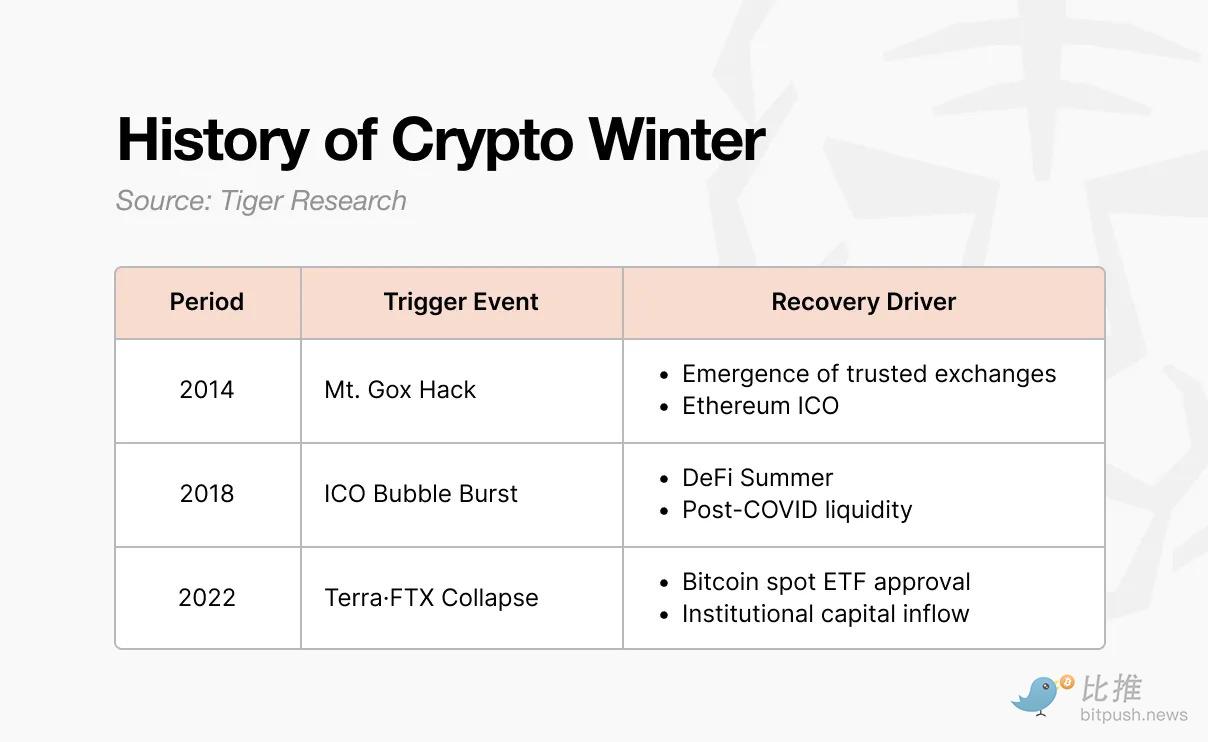
The first winter occurred in 2014. At that time, the Mt. Gox exchange handled 70% of global Bitcoin trading volume. Due to a hack, approximately 850,000 BTC vanished, leading to a complete collapse of market trust. Subsequently, various new exchanges with internal controls and audit functions emerged, and trust was slowly restored. Meanwhile, Ethereum was born through ICOs (Initial Coin Offerings), presenting a new vision and financing method for the industry.

This ICO model became the spark for the next bull market. When anyone could issue tokens and raise funds, the frenzy of 2017 was ignited. Projects raising billions with just a whitepaper were rampant, but most had no substance.

In 2018, South Korea, China, and the US successively introduced strict regulatory measures, the bubble burst, and the second winter arrived. This winter lasted until 2020. After the COVID-19 pandemic, liquidity began to pour in, and DeFi protocols like Uniswap, Compound, and Aave gained attention, leading to a return of funds.

The third winter was the most severe. The Terra-Luna collapse in 2022 triggered the successive failures of Celsius, Three Arrows Capital, and FTX. This was not just a simple price drop but a shake-up of the entire industry's structure. It wasn't until January 2024, when the U.S. Securities and Exchange Commission (SEC) approved the Bitcoin spot ETF, followed by the Bitcoin halving and Trump's pro-crypto policies, that funds began to flow in again.

2. The Pattern of Crypto Winters: Major Event → Collapse of Trust → Brain Drain

The first three winters all followed the same evolutionary logic: a major negative event triggered a collapse of the trust system, ultimately leading to a large-scale brain drain.

  • Starts with a major event: Whether it was the Mt.Gox hack, the ICO regulatory crackdown, or the Terra-Luna collapse and subsequent FTX bankruptcy, the scale and form varied, but the result was the same—the entire market was thrown into turmoil and panic.

  • Spreads to a collapse of trust: This shock quickly turned into a crisis of confidence. People who once discussed "what to build next" began to question whether crypto technology had real value. The collaborative atmosphere among builders disappeared, replaced by mutual blame.

  • Leads to brain drain: Doubts about the前景 led to an exodus of talent. The builders who had once created momentum in the blockchain space fell into pessimism. In 2014, they flowed into fintech and big tech companies; in 2018, they turned to traditional institutions and the AI field. They left here for places that seemed more certain.

3. Is This a Crypto Winter Now?

On the surface, some signs of past crypto winters are still clearly visible today:

  • Major events:

    • Trump memecoin: Its market cap once reached $27 billion in a single day, then plummeted by 90%.

    • The "10.10" liquidation event: The US announced 100% tariffs on China, triggering the largest liquidation wave in Binance's history ($19 billion).

  • Collapse of trust: Skepticism is spreading within the industry, and the focus of discussion has shifted from "building" to "blame-shifting."

  • Pressure of brain drain: The AI industry is growing rapidly, offering faster and more lucrative monetization paths than cryptocurrency.

However, it is difficult to define the current situation as a typical "crypto winter." Past winters erupted from within the industry—the Mt. Gox hack, ICOs going to zero, FTX blowing up—these were all cases of the industry destroying its own Great Wall.

The current situation is截然 different:

The approval of ETFs started the bull market, while tariff policies and interest rate changes drove the decline. External factors lifted the market, and external factors also dragged it down.
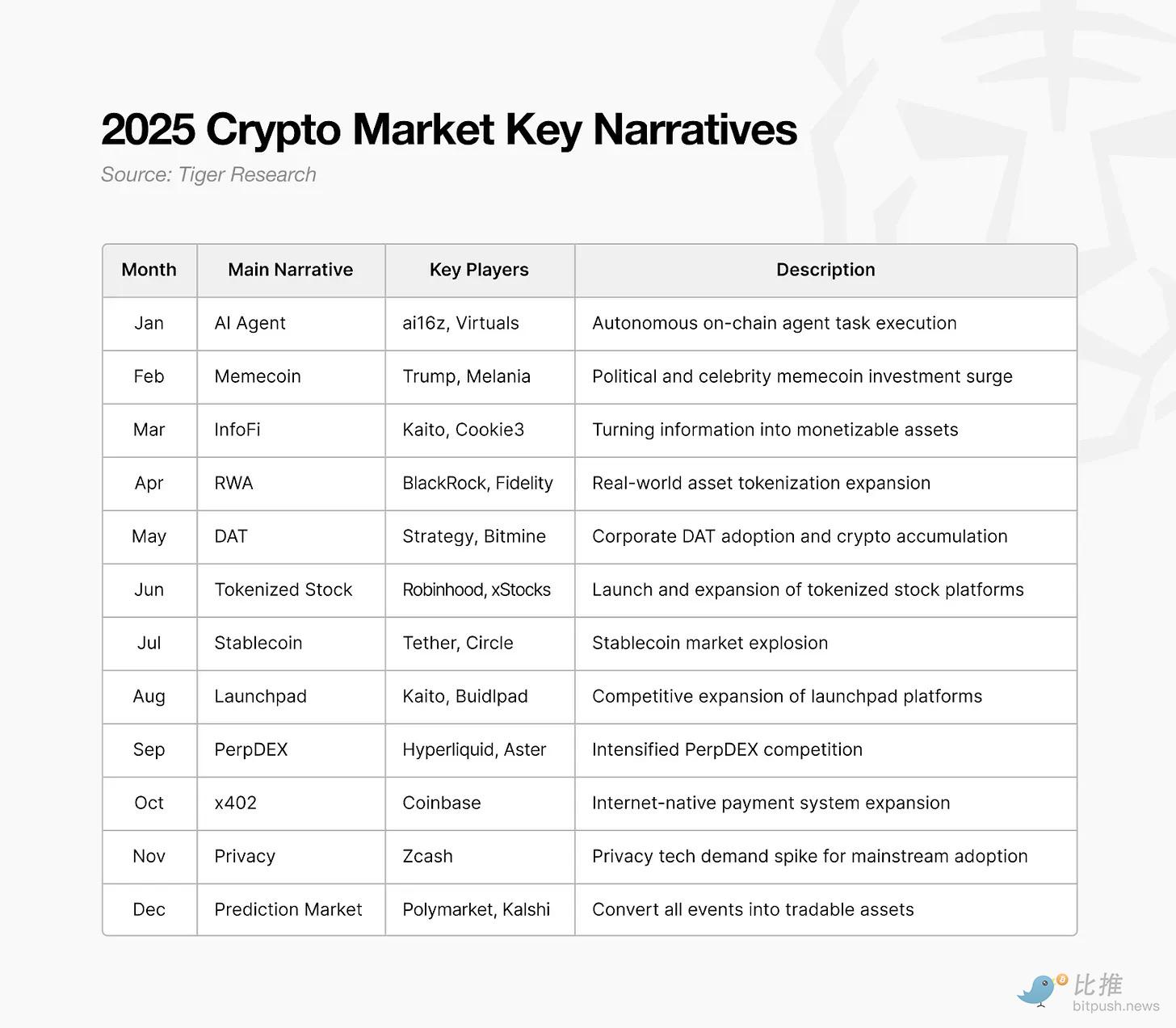
Builders have not left the field either:

New narratives such as RWA (Real World Assets), perpDEX (perpetual contract exchanges), prediction markets, InfoFi, and privacy protocols are emerging one after another and continue to iterate. Although they have not driven a full-market rally like DeFi did back then, they have not disappeared. The industry's fundamentals have not collapsed; only the external environment has changed.

Just as we did not personally create this "warm spring," there is currently no so-called "winter."

4. Fundamental Changes in Market Structure Post-Regulation

Behind this phenomenon lies the profound evolution of the market structure post-regulation. The market has now split into three levels: 1) The Compliant Zone, 2) The Non-Compliant Zone, and 3) Shared Infrastructure.
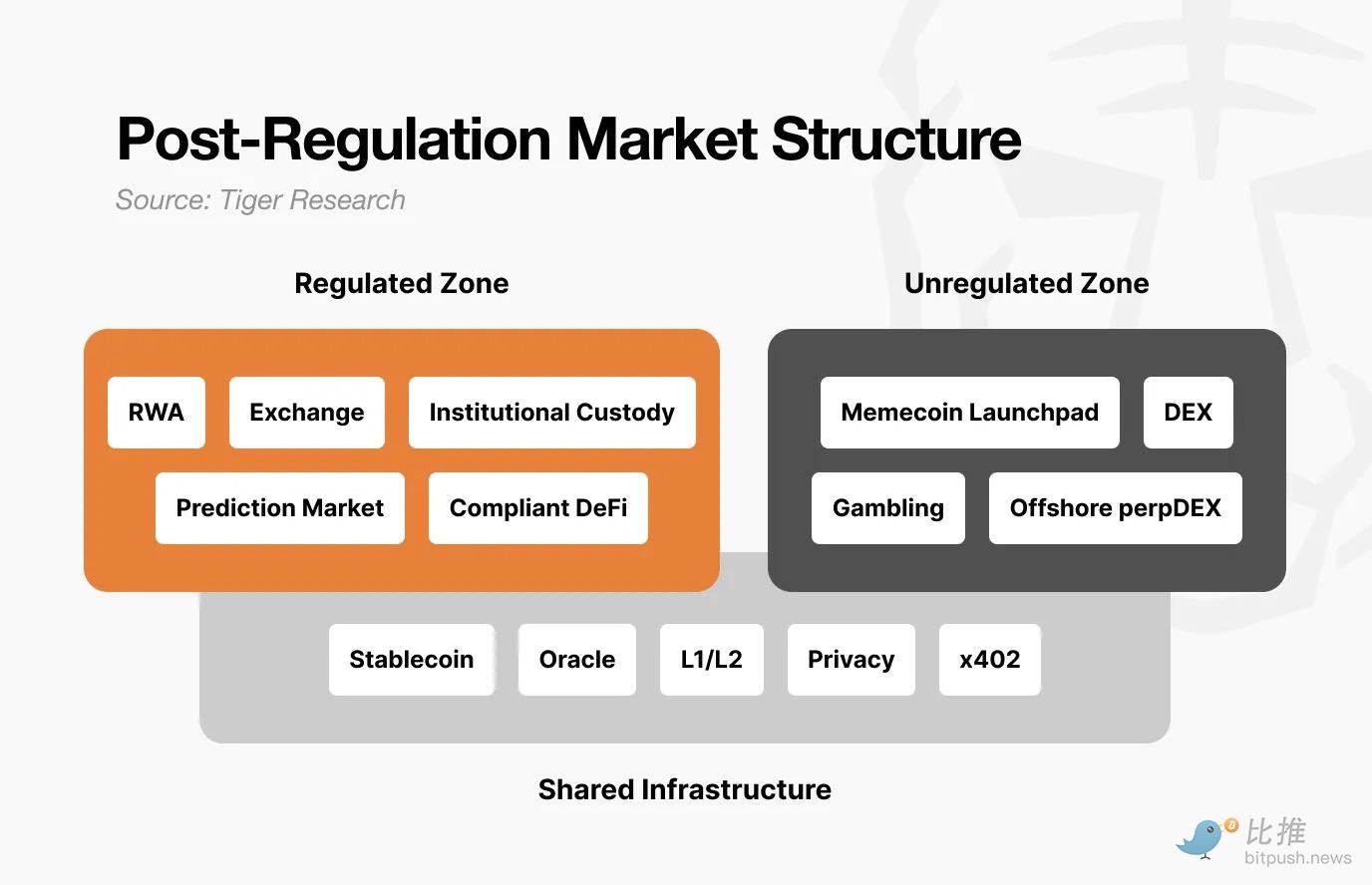
  • Compliant Zone: Includes RWA tokenization, licensed exchanges, institutional-grade custody, legal prediction markets, and compliant DeFi. These areas undergo audits, fulfill disclosure obligations, and are legally protected. Although growth is slower, the capital规模 is huge and stable.

    • Characteristics: After entering the compliant zone, it is difficult to expect the explosive 100x returns of the past. Volatility decreases, the上限 is limited, but the下限 is also guaranteed.

  • Non-Compliant Zone: This area will have an even stronger speculative色彩 in the future. Low barriers to entry, fast pace, surging 100x today and dropping 90% tomorrow will become the norm.

    • Significance: This space is not meaningless. The non-compliant zone is a cradle of creativity. Once a track is proven effective, it will migrate to the compliant zone (like DeFi back then and prediction markets now). It serves as an "experimental field," but itself will increasingly剥离 from compliant businesses.

  • Shared Infrastructure: Includes stablecoins and oracles. They serve both zones simultaneously. The same USDC can be used for institutional-grade RWA payments and for speculative trading on Pump.fun; oracles provide data verification for tokenized treasuries and support liquidations for anonymous DEXs.

This differentiation has changed the flow path of funds.

In the past, Bitcoin's rise would带动山寨币齐涨 through the "Trickle-down effect." Now it's different: institutional funds entering through ETFs stop dead within Bitcoin; funds in the compliant zone no longer flow to the non-compliant zone. Liquidity only stays where value is proven. Even Bitcoin itself, its属性 as a safe-haven asset has not yet been fully proven against risk assets.

5. Conditions for the Next Bull Market

The regulatory framework is being完善, and builders are still working hard. Two more conditions need to be met:

  1. A new "killer app" is born in the non-compliant zone: Something must emerge that can create全新 value, like the "DeFi Summer" of 2020. AI agents, InfoFi, and on-chain social are potential candidates, but they have not yet reached a scale that触动全局. The良性流动 of "non-compliant zone experiment → successful verification → migration to the compliant zone" must be formed again.

  2. Cooperation from the macroeconomic environment: Even if regulation is settled, builders are working hard, and infrastructure is perfect, if the macro environment is not supportive, the upside space is still limited. The 2020 DeFi boom erupted after the pandemic amid global massive liquidity injection; the post-ETF rise in 2024 also coincided with expectations of interest rate cuts. No matter how well the crypto industry does itself, it cannot control interest rates and liquidity. For the value built within the industry to gain widespread recognition, the macro environment must reverse.

A crypto season with "universal上涨" like in the past is unlikely to reappear. Because the market has彻底分裂. The compliant zone will grow steadily, while the non-compliant zone will continue to fluctuate剧烈.

The next bull market will eventually come, but it will not favor everyone.


Twitter:https://twitter.com/BitpushNewsCN

Bitpush TG Discussion Group:https://t.me/BitPushCommunity

Bitpush TG Subscription: https://t.me/bitpush

Original article link:https://www.bitpush.news/articles/7608772

Questions liées

QWhat are the three stages of evolution in a crypto winter according to the article?

AThe three stages are: 1) A significant negative event triggers the downturn, 2) This leads to a collapse of trust within the market, and 3) Ultimately results in a massive exodus of talent from the industry.

QHow does the current market downturn differ from previous crypto winters?

APrevious crypto winters were triggered by internal industry problems (e.g., Mt. Gox hack, ICO crackdown, FTX collapse). The current cycle is different because both the rally (driven by ETF approval) and the subsequent decline (driven by external factors like tariff policies and interest rates) were propelled by external factors, not internal industry failures.

QWhat are the three layers of the post-regulation market structure described in the article?

AThe market has split into three layers: 1) The Compliant Zone (e.g., tokenized RWA, licensed exchanges), 2) The Non-Compliant Zone (a space for speculation and experimentation), and 3) Shared Infrastructure (e.g., stablecoins, oracles that serve both zones).

QWhy has the 'trickle-down effect' of Bitcoin's price rally on altcoins disappeared?

AThe 'trickle-down effect' has disappeared because institutional capital entering through Bitcoin ETFs remains largely confined to Bitcoin itself within the Compliant Zone and does not flow into the Non-Compliant Zone where most altcoins reside. Liquidity now stays only in areas with proven value.

QWhat two conditions are necessary for the next crypto bull market to begin?

ATwo conditions are necessary: 1) A new 'killer app' must emerge from the Non-Compliant Zone, creating entirely new value (similar to DeFi Summer in 2020), and 2) There must be a favorable macroeconomic environment, such as lower interest rates and increased liquidity, which is outside the control of the crypto industry itself.

Lectures associées

Envoyer un message pour transférer des fonds ? Telegram prévoit d'intégrer un portefeuille crypto à ses 1 milliard d'utilisateurs cet été

L'été prochain, Telegram intégrera nativement un portefeuille crypto non-custodial, baptisé Gram, directement dans son application, accessible à plus d'un milliard d'utilisateurs. L'annonce faite par le fondateur Pavel Durov promet des transferts instantanés et sans frais de cryptomonnaies. Contrairement au bot @wallet existant, qui est géré par un tiers, ce nouveau portefeuille sera développé et contrôlé par Telegram, les utilisateurs conservant la maîtrise de leurs clés privées. La nouvelle a entraîné une hausse d'environ 8% du cours de GRAM (anciennement Toncoin). Toutefois, des questions techniques et un calendrier précis manquent, notamment sur la gestion des actifs au-delà du Gram et la mise en œuvre de la promesse de transactions sans frais. Cette initiative s'inscrit dans la stratégie "Make TON Great Again" de Durov, marquant le retour de Telegram sur le projet TON après son règlement avec la SEC en 2020. Cette stratégie contraste avec celles d'autres super-applications comme X Money de Musk (approche monétaire traditionnelle) ou Meta (exploration des stablecoins). Telegram parie ainsi sur la voie crypto-native, avec pour atouts sa base d'utilisateurs massive et son affinité avec la communauté blockchain, mais devra relever les défis de l'éducation des utilisateurs et de la régulation.

marsbitIl y a 14 mins

Envoyer un message pour transférer des fonds ? Telegram prévoit d'intégrer un portefeuille crypto à ses 1 milliard d'utilisateurs cet été

marsbitIl y a 14 mins

Finit le bon vieux temps ? Que traversent réellement les VC crypto ?

Le paysage du capital-risque (VC) spécialisé dans la cryptographie est en train de subir une transformation fondamentale. Des fonds majeurs comme Paradigm, qui a levé 1,2 milliard de dollars, et Framework Ventures élargissent désormais leurs investissements à l'IA, à la robotique et à d'autres technologies, éloignant la cryptographie du centre de leur stratégie. Ce changement reflète un schéma historique où les fonds spécialisés, ayant bâti un avantage informationnel initial, voient cet avantage disparaître une fois que la technologie se banalise et que les grands capitaux traditionnels entrent sur le marché. Le secteur évolue vers une structure en « haltère » : d'un côté, les grandes plates-formes de capital-risque généralistes (comme a16z, Sequoia) qui peuvent intégrer la cryptographie comme un segment vertical ; de l'autre, de petits fonds spécialisés nichés sur des fronts d'innovation très spécifiques. Les fonds de taille moyenne, purement axés sur la cryptographie, sont coincés dans une « zone de mort », leur taille ne leur permettant ni de générer des rendements suffisants uniquement avec des investissements en phase initiale, ni de rivaliser avec les géants pour les tours de table de croissance. Même les fonds qui affirment rester dans la cryptographie redéfinissent leur périmètre, se concentrant désormais sur l'infrastructure financière (stablecoins, marchés de prédiction) plutôt que sur une vision plus large. Cette évolution est également poussée par les investisseurs (LP) qui, après des pertes dans la cryptomonnaie, réorientent massivement leurs capitaux vers l'IA, forçant les gestionnaires de fonds à suivre cette tendance. Pour les startups cryptographiques, cela signifie qu'elles devront désormais rivaliser avec des projets d'autres secteurs, notamment l'IA, pour attirer l'attention des grands fonds généralistes. Parallèlement, les investissements à long terme dans les infrastructures de base, autrefois portés par des fonds spécialisés, pourraient se raréfier. À l'avenir, la cryptographie ne sera plus considérée comme une classe d'actifs à part entière mais comme une infrastructure sous-jacente, intégrée à divers produits financiers. Les fonds spécialisés survivront probablement dans des niches de pointe, tandis que le financement de croissance sera dominé par les acteurs généralistes.

Foresight NewsIl y a 45 mins

Finit le bon vieux temps ? Que traversent réellement les VC crypto ?

Foresight NewsIl y a 45 mins

À mesure que le consensus s'accélère, sur quoi parient les jeunes investisseurs ?

Dans le paysage actuel des investissements technologiques, la rapidité d’évolution des consensus oblige les jeunes investisseurs à s’adapter. L’IA quitte désormais l’écran pour s’intégrer au monde physique, avec un accent croissant sur l’intelligence embarquée, les robots et les systèmes industriels. Le défi n’est plus seulement de démontrer des capacités techniques, mais d’assurer une livraison fiable et scalable dans des environnements réels. Parallèlement, la valeur des grands modèles linguistiques ne se limite pas à leur performance initiale ; elle réside dans leur capacité à s’insérer durablement dans les flux de travail, créant ainsi une « roue de l’intelligence » auto-renforçante grâce aux données et retours utilisateurs. Face aux limites des données humaines, des approches comme l’apprentissage par renforcement et les modèles scientifiques fondamentaux émergent comme des pistes pour dépasser ces contraintes. Enfin, dans les domaines de pointe comme l’aérospatiale commerciale, l’informatique quantique ou l’énergie avancée, le capital doit faire preuve de patience. Ces secteurs requièrent des cycles de validation longs, une maîtrise des chaînes d’approvisionnement et une résilience face à l’incertitude. Les investisseurs doivent donc anticiper les besoins futurs et soutenir des équipes capables de naviguer dans ces écosystèmes complexes, en misant sur le long terme plutôt que sur des rendements immédiats.

marsbitIl y a 1 h

À mesure que le consensus s'accélère, sur quoi parient les jeunes investisseurs ?

marsbitIl y a 1 h

Trading

Spot
活动图片





