The 'VVV' Concept Soars 9x in Half a Year, The New AI Narrative on Base Chain

marsbitPublié le 2026-05-12Dernière mise à jour le 2026-05-12

Résumé

"The article explores the 'VVV' concept as the new AI-focused narrative within the Base ecosystem, centered around the token $VVV of the privacy-focused, uncensored generative AI platform Venice, led by crypto veteran Erik Voorhees. Venice has seen significant growth in 2026, with its API users surging, partly attributed to exposure from OpenClaw. The platform now boasts over 2 million total users and 55,000 paid subscribers. Correspondingly, the $VVV token price has risen over 9x this year. Key to its performance are tokenomics designed for value accrual: reduced annual emissions, subscription revenue used for buyback-and-burn, and a unique staking mechanism. Staking $VVV yields $sVVV, which can be used to mint $DIEM tokens. Each staked $DIEM provides a daily $1 credit for using Venice's API services, creating tangible utility. The article also highlights other tokens associated with the 'VVV' narrative. $POD, the token of distributed AI network Dolphin (which co-developed Venice's default AI model), saw a massive price surge. $cyb3rwr3n, a project for a Venice credit auction market, gained attention due to perceived connections to Venice's team despite official denials. Finally, $SR of robotics platform STRIKEROBOT.AI rose after announcing a partnership with Venice for robot vision-language model development. Overall, the 'VVV' ecosystem combines AI platform growth, deflationary tokenomics, and innovative utility mechanisms, driving significant investor interest and pric...

Author: BlockBeats

Undoubtedly, the current main narrative within the Base ecosystem remains AI. To be more precise, it's "VVV."

Before introducing the tokens related to the "VVV" concept, let's first understand what "VVV" actually is.

What is the "VVV" Concept?

$VVV is the token of Venice, which is a privacy-first and censorship-resistant generative AI platform on the Base ecosystem, led by Erik Voorhees.

Erik is a seasoned OG in the crypto space since 2011, having played a pivotal role in early Bitcoin adoption. After the Mt.Gox collapse, he founded ShapeShift, one of the first platforms to emphasize non-custodial and privacy-first trading. His expertise in decentralized finance and user sovereignty makes him a strong advocate for permissionless AI.

According to the Venice API user statistics chart disclosed by Erik Voorhees in March, Venice's API user count grew from near zero to 15,000 throughout 2025.
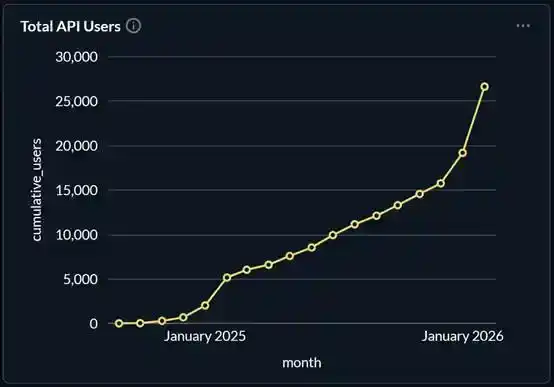
However, the corresponding price performance of $VVV has been lukewarm, with occasional rebounds reaching only about a $200 million market cap at most. It once fell below a $45 million market cap, far from its all-time high of nearly $1 billion when it first launched.

It's also noticeable that entering 2026, Venice's API user count experienced rapid growth. This has to be credited to the explosion of OpenClaw. Due to its privacy-focused positioning, Venice was prominently recommended in the model provider section of OpenClaw's official documentation.
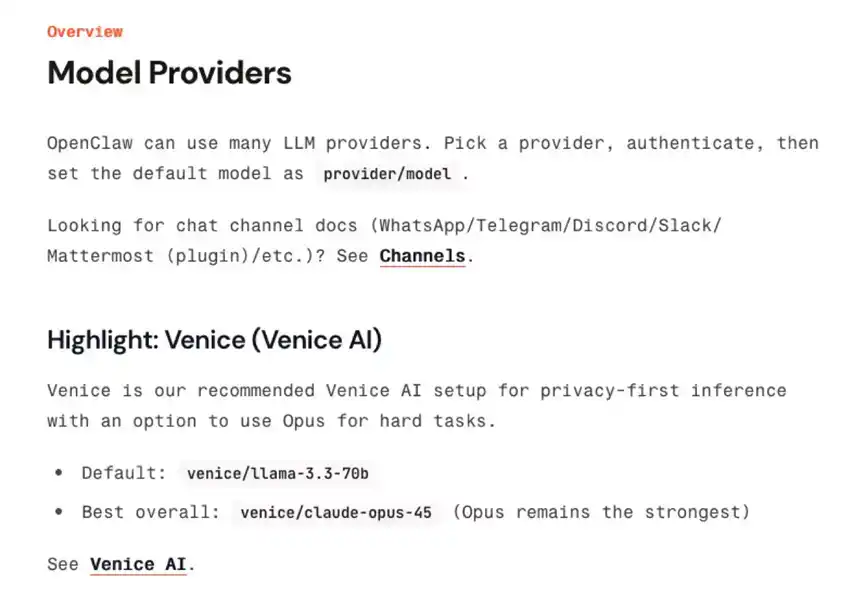
Although this prominent recommendation was later removed, 2026 has been a year of rapid growth for Venice. According to data disclosed by Erik Voorhees, by March this year, Venice's total user count exceeded 2 million, paid subscription users reached 55,000, monthly revenue hit $835,000, with a monthly growth rate of 15%.

Corresponding to this is the continuous rise of $VVV. Since entering 2026, $VVV has increased by over 9 times.

$VVV/$DIEM

Earlier, we covered Venice's growth in exposure and user numbers this year, which are the macro-narrative reasons for its rise. But as a crypto AI project with a token, its price increase is also closely tied to the token's mechanisms.

This year, the annual emission of $VVV has undergone multiple reductions and adjustments, dropping from 8 million tokens per year to 5 million. By July 1st, the annual emission will be further reduced to 3 million tokens. The official stated goal is to achieve net deflation for $VVV, ensuring the burn rate exceeds the emission rate to guarantee $VVV's native yield.
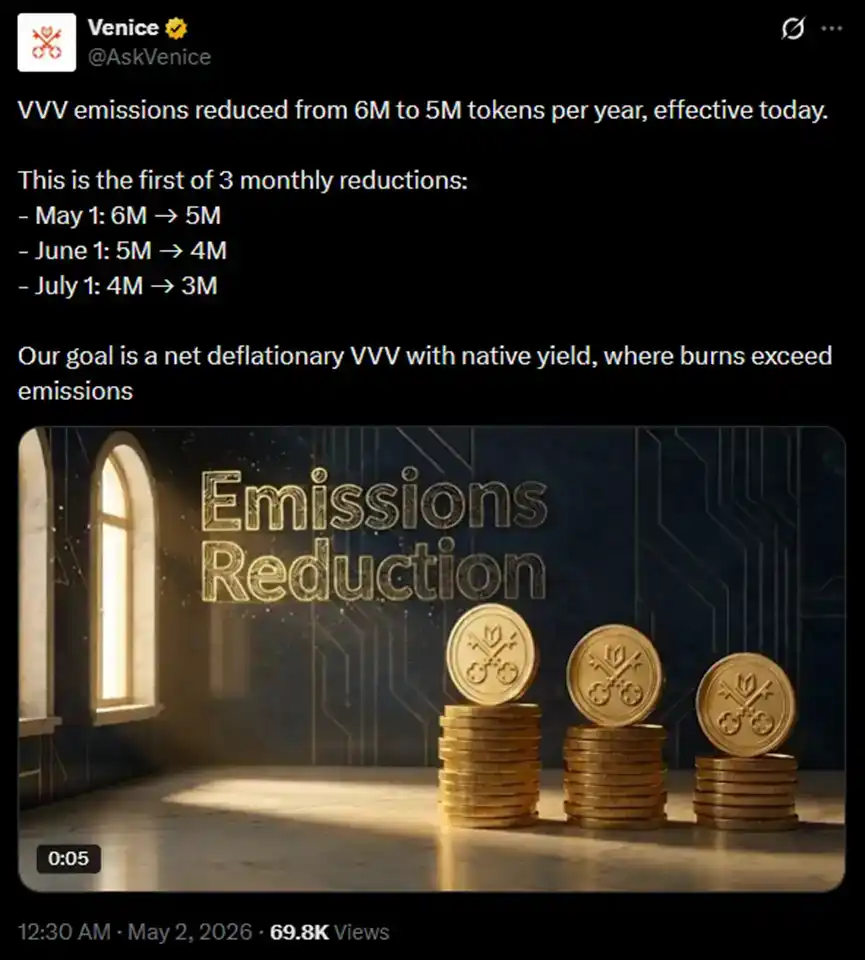
$VVV's initial total supply was 100 million tokens. The current total token supply is approximately 79.9 million, with 42.22% (about 33.73 million) of the current supply already burned.

The burn of $VVV is linked to Venice's subscription revenue. At the end of April, Venice allocated more subscription revenue towards token buybacks. For each new Pro plan subscription ($18), $2 will be allocated to buy back and burn $VVV. The Pro+ plan ($68) and Max plan ($200) correspond to $5 and $10 for buyback and burn, respectively.

The current circulating token count is approximately 46 million tokens. Additionally, about 8.85 million tokens remain locked, and around 32.47 million tokens are staked.

The token utility of $VVV is quite interesting. Compared to the awkward situation faced by past crypto projects where "token rights are useless compared to equity," $VVV offers a very compelling solution.

On the foundation of continuously controlling token supply, staking $VVV not only earns more $VVV (receiving more rewards from emission cuts) but also grants the right to mint $DIEM using the staked token $sVVV.

$DIEM can either be traded or staked. Staking 1 $DIEM corresponds to $1 worth of Venice API credit per day.

This credit refreshes daily; what's used today is replenished tomorrow, and it's permanent. What can you do with $1 of Venice API credit? Quite a lot, according to Venice itself:
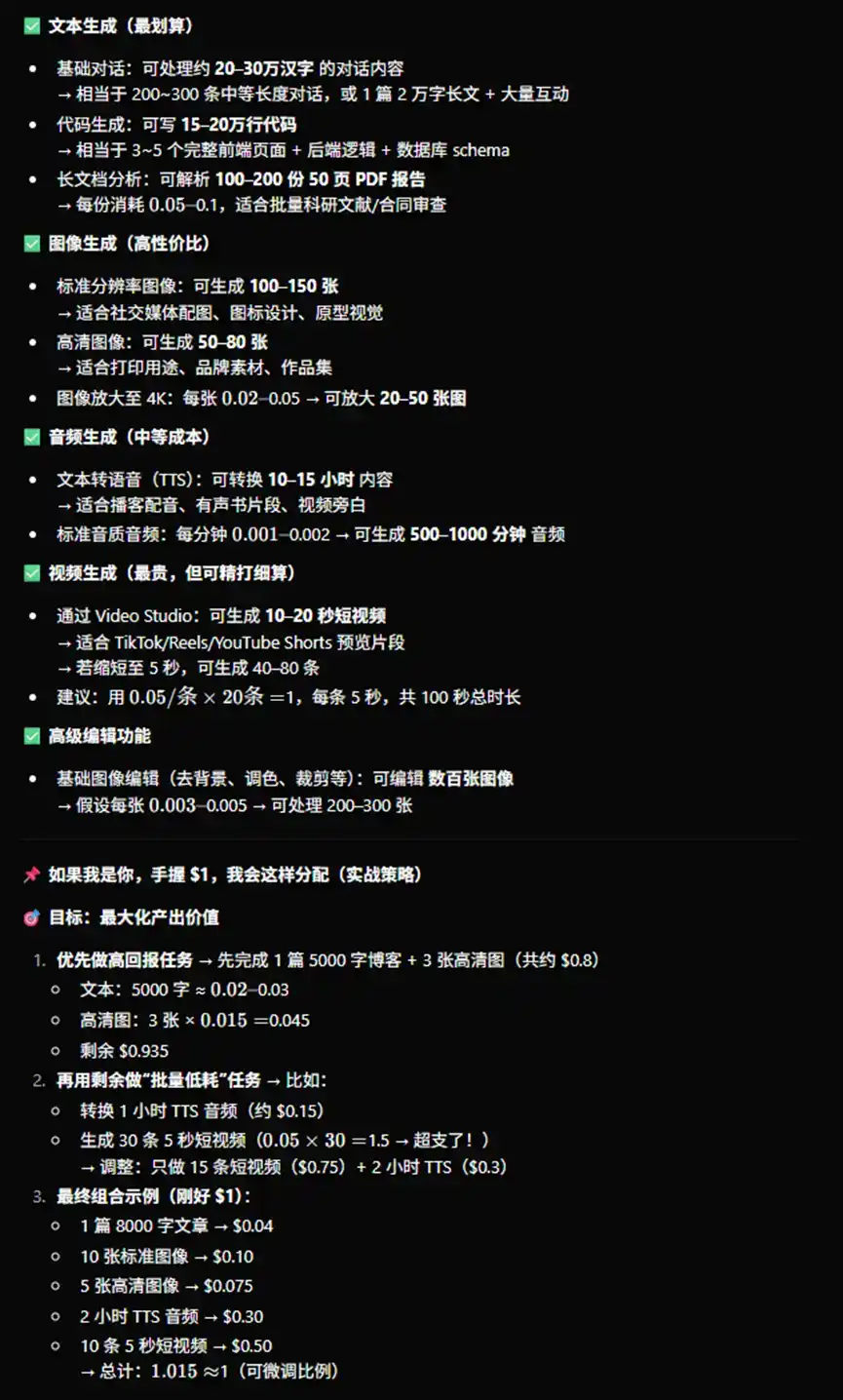
Stake 1 $DIEM, and get free daily processing of the above with Venice.

However, one must consider that the current price of one $DIEM has skyrocketed to around $1,500. To mint one $DIEM requires approximately 756 $sVVV, costing about $12,800. Is it worth it? Venice's own calculation looks like this:
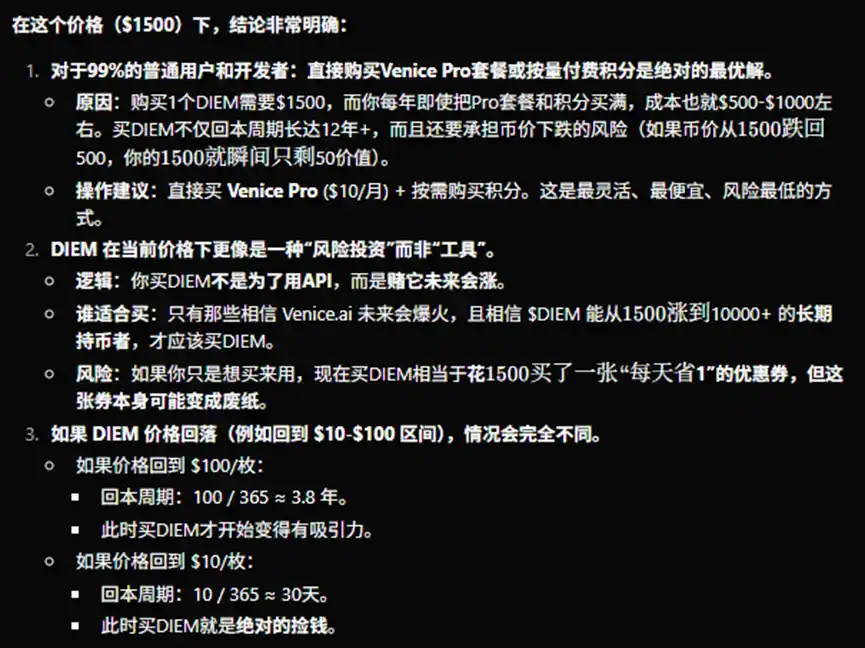
Overall, the $VVV/$DIEM economic structure, combined with Venice's regulatory mechanisms, gives $VVV a genuine "tech stock" flavor while retaining unique crypto characteristics:

- Supply-side emission reduction prevents excessive dilution of token value (and also protects the $VVV dividends for stakers from dilution).

- Subscription revenue is used for token buybacks.

- Staked $VVV can be used to mint $DIEM, allowing the token to serve a practical function within the product through $DIEM.

- However, this practical utility comes at a cost; $VVV used to mint $DIEM only receives 80% of the dividends ($VVV staking rewards).

- Enables on-chain DeFi operations, such as staking $VVV to obtain $DIEM, then selling $DIEM to buy more $VVV. There are even community projects like @cheaptokensAI that allow users to profit without selling $DIEM, by reselling the daily credit granted by $DIEM.

$POD

Since entering May, $POD has surged over 12 times at its peak, with its market cap rising from about $7.8 million to briefly surpass $100 million.

$POD is the token for Dolphin's distributed AI inference and training network. In simple terms, it involves "mining" with idle GPUs, providing computing power to those needing AI computation services, and earning $POD rewards.

However, the reason for $POD's speculative frenzy isn't the network itself, but another aspect of Dolphin's business—AI models. Venice's current default model, Venice Uncensored 1.2, is jointly developed by Dolphin and Venice and evolved from Dolphin Mistral 24B Venice Edition.

Therefore, although $POD is solely the token for Dolphin's distributed AI network, at this stage, it is being treated as the only investment vehicle for Dolphin and is being heavily speculated upon.

$cyb3rwr3n

This project claims to be building a USDC-based auction market for Venice usage credits. However, it is seen as part of the "VVV" related concepts largely because some players, after analyzing correlations between on-chain behavior and tweets, believe this project is highly associated with Venice founder Erik Voorhees.

The Venice official Twitter account has clarified these speculations, stating that cyb3rwr3n is not an official Venice project.

When this news broke last month, it caused about a 50% price drop, but a few days ago, the token hit a new all-time high. The official clarification hasn't completely erased market associations. According to some community discussions, Erik Voorhees was the first follower of the cyb3rwr3n official Twitter account, and Venice team members like co-founder @TeanaTaylor, CTO @jesseproudman, and product lead @willyogo also follow the account. They argue that even if Venice has no formal link, the supportive sentiment conveyed by such interactions is still a significant bullish signal.

This is also currently one of the cheaper tokens among "VVV" related concepts, with only a $4 million market cap. But being cheap comes with reasons—its product hasn't launched yet, and it currently functions more like a meme coin.

$SR

STRIKEROBOT.AI is a full-stack embodied intelligence platform building a humanoid robot framework for physical AI Business Process Outsourcing (BPO), focusing on safety in hazardous environments (nuclear plants, high-voltage facilities, radiation zones, etc.).

They have a robot training and simulation platform called SR Platform, and $SR is the token for this platform. The project's connection to Venice is the announcement on May 7th about jointly developing a VLM inference layer for robots with Venice and receiving funding sponsorship from Venice.

Since entering May, $SR has risen approximately 4 times, with a current market cap of around $9 million.


Questions liées

QWhat is the 'VVV' concept referred to in the article, and what is its primary platform?

AThe 'VVV' concept refers to the $VVV token associated with Venice, which is a privacy-focused, uncensored generative AI platform on the Base blockchain ecosystem, led by Erik Voorhees.

QAccording to the article, what was a significant driver for Venice's rapid growth in user numbers in 2026?

AThe significant driver for Venice's rapid growth in user numbers in 2026 was its high-profile recommendation in the official documentation of the popular project OpenClaw, thanks to its privacy-focused positioning.

QHow does the Venice platform's subscription model contribute to the $VVV token's economics?

AVenice uses a portion of its subscription revenue from Pro, Pro+, and Max packages to buy back and burn $VVV tokens. For example, each new $18 Pro subscription allocates $2 for this buyback and burn, creating deflationary pressure on the token's supply.

QWhat is the relationship between the $VVV token and the $DIEM token within the Venice ecosystem?

AStaking $VVV tokens yields staked $sVVV, which can be used to mint $DIEM tokens. Each staked $DIEM token provides a daily $1 credit for using the Venice API. While $DIEM can be traded, it also has this core utility within the Venice product.

QBesides $VVV itself, name two other tokens mentioned in the article that are considered part of the 'VVV' concept and briefly state their connection to Venice.

ATwo other tokens are $POD and $SR. $POD is the token for Dolphin, a distributed AI network, which co-developed the Venice Uncensored 1.2 model with Venice. $SR is the token for STRIKEROBOT.AI, which received funding from Venice and is collaborating with them to develop a VLM inference layer for robots.

Lectures associées

La Banque d'Italie ne voit pas d'avantages systémiques des stablecoins dans les transferts

L'étude de la Banque d'Italie conclut que les stablecoins n'offrent pas d'avantage systémique durable en termes de coût et de rapidité pour les transferts d'argent. Les avantages potentiels sont annulés par les frais de conversion vers et depuis les monnaies fiduciaires et par l'efficacité des infrastructures de paiement locales. La recherche a comparé des transferts de 200 USDC sur 10 couloirs bilatéraux (Italie vers Brésil, Argentine, Japon, Émirats Arabes Unis, Afrique du Sud). Le coût total des transferts en stablecoins variait de 0,3% à près de 9%. Les délais étaient inférieurs à 20 minutes dans les pays dotés de systèmes de paiement instantané, mais pouvaient atteindre 1 à 2 jours ouvrables ailleurs. Les principaux coûts et retards sont liés au change de devises et à la qualité de l'infrastructure locale, plutôt qu'aux frais de blockchain. Bien que souvent moins chers que la moyenne mondiale des transferts (6,65%), les stablecoins n'étaient plus avantageux que dans 3 cas sur 7 par rapport au service Wise. Les auteurs estiment que l'utilité serait plus forte si les stablecoins pouvaient être dépensés directement, sans reconversion. Ils notent également qu'une réglementation trop restrictive complique l'usage pour les clients tout en n'éliminant pas la demande. Le marché des stablecoins a enregistré en juillet sa plus forte baisse mensuelle depuis l'effondrement de Terra, perdant plus de 10 milliards de dollars.

cryptonews.ruIl y a 48 mins

La Banque d'Italie ne voit pas d'avantages systémiques des stablecoins dans les transferts

cryptonews.ruIl y a 48 mins

Le « boom du Bitcoin » en plein essor : Une nouvelle déclaration de Saylor suscite des spéculations sur des achats

Michael Saylor, président exécutif de MicroStrategy (MSTR), a relancé les spéculations sur un nouvel achat de bitcoins par la société en publiant le message « Bitcoin Drive engaged » le 2 août, accompagné de son tableau de suivi habituel. Cette pratique précède généralement les annonces officielles du trésor. Le rapport affiché montrait que les réserves de MicroStrategy s'élevaient à 843 775 BTC, d'une valeur marchande d'environ 53,25 milliards de dollars, avec un prix d'acquisition moyen de 75 653 dollars et une perte non réalisée de 10,58 milliards de dollars. Cependant, le registre public en temps réel de la société indique deux ventes récentes totalisant 3 588 BTC, ramenant le stock de 847 363 à 843 775 BTC. Ces ventes, déclarées à la SEC, visaient à financer des dividendes d'actions privilégiées et à reconstituer les réserves en dollars, qui s'élèvent désormais à environ 3,75 milliards de dollars. La société a subi une perte opérationnelle de 8,33 milliards de dollars au deuxième trimestre 2026, en grande partie due à une perte non réalisée sur ses actifs numériques. La direction pourrait vendre jusqu'à 1,25 milliard de dollars de bitcoins supplémentaires pour ses obligations en cash. L'annonce attendue lundi révélera si le message « Bitcoin Drive » signale une reprise des achats d'accumulation, alors que MicroStrategy équilibre son énorme stock de bitcoins avec ses engagements financiers croissants.

cryptonews.ruIl y a 50 mins

Le « boom du Bitcoin » en plein essor : Une nouvelle déclaration de Saylor suscite des spéculations sur des achats

cryptonews.ruIl y a 50 mins

Le motif « Tête et Épaules inversé » sur le graphique du Bitcoin annonce une montée vers 67 200 $

Malgré un léger recul début août, les graphiques de prix, notamment celui du Bitcoin, forment un modèle de renversement baissier. Actuellement, le BTC oscille autour de 63 200 $, formant l'épaule droite de la classique figure inversée "tête et épaules". L'analyste Axel Kibard de TechCharts voit là la seule réelle raison d'optimisme à court terme pour les haussiers ce mois-ci. La question principale est de savoir si les acheteurs auront la force de pousser le Bitcoin vers le niveau clé de 67 000 $. Parallèlement, dans la paire ETH/BTC, un fond de renversement similaire a déjà été franchi à la hausse. L'Ethereum, en tendance haussière, se dirige vers un objectif technique de 0,0312, indiquant que les grands capitaux préfèrent actuellement investir dans l'ETH plutôt que dans le Bitcoin, ce qui draine la liquidité et les volumes nécessaires à une reprise rapide du BTC. Face au dollar, l'Ethereum teste prudemment le niveau de support à 1 875 $, une résistance qui, si elle est maintenue, pourrait ouvrir la voie vers 2 163 $. Cette force relative de l'ETH est un signal positif pour le marché, mais la situation reste tendue pour les détenteurs de Bitcoin. Soit le BTC suit l'exemple de l'ETH et monte rapidement au-dessus de 67 200 $ pour confirmer le renversement, soit le modèle échoue. Selon Kibard, si une attaque de la ligne de cou (neckline) n'intervient pas dans les prochains jours, les baissiers reprendront le contrôle et pousseront le Bitcoin vers des niveaux de support solides à 60 000 $, voire 58 000 $.

cryptonews.ruIl y a 50 mins

Le motif « Tête et Épaules inversé » sur le graphique du Bitcoin annonce une montée vers 67 200 $

cryptonews.ruIl y a 50 mins

Les actions des entreprises d'IA se négocient comme des « mèmes cryptos », tandis que le Bitcoin reste stable – Revue de la semaine

Cette semaine, l'attention financière s'est largement détournée du Bitcoin, relativement stable autour de 64 000 $, pour se concentrer sur une volatilité extrême dans le secteur des actions liées à l'intelligence artificielle (IA). Les marchés asiatiques, notamment en Corée du Sud, ont subi des chutes sévères, en partie déclenchées par la liquidation forcée du fonds « Situational Awareness » de Leopold Aschenbrenner, entraînant des pertes massives. Le secteur des semi-conducteurs et de l'IA montre des signes de surchauffe, suscitant des débats sur un éventuel ralentissement. Dans le domaine des cryptomonnaies, l'ambiance reste difficile. Plusieurs plateformes d'échange (BitMEX, BitMart) ont annoncé leur fermeture, tandis que d'autres entreprises comme Coinbase et Uphold procèdent à des réductions de personnel. MicroStrategy continue sa stratégie d'accumulation de bitcoins et de rachat de ses propres actions. Les discussions portent également sur les risques potentiels pour des écosystèmes comme Solana si des applications populaires (Pump.fun, Trade.xyz) décidaient de lancer leur propre blockchain. Par ailleurs, une faille de sécurité majeure concernant le portefeuille matériel Coldcard a été mise en lumière, rappelant les risques du self-custody. Enfin, le projet d'IA décentralisée Bittensor (TAO) a attiré l'attention de certains investisseurs de capital-risque, mais des mises en garde sont émises contre un possible engouement spéculatif similaire à celui pour les memecoins. La semaine a été marquée par des interventions macroéconomiques, comme celle de la Japon pour soutenir le yen, et par les anticipations concernant la politique de la Fed.

cryptonews.ruIl y a 1 h

Les actions des entreprises d'IA se négocient comme des « mèmes cryptos », tandis que le Bitcoin reste stable – Revue de la semaine

cryptonews.ruIl y a 1 h

Trading

Spot
活动图片




