The Stablecoin Yield Debate: How It's Stalling U.S. Crypto Regulatory Legislation?

marsbitPublié le 2026-03-23Dernière mise à jour le 2026-03-23

Résumé

The debate over stablecoin yields has become a central obstacle to U.S. cryptocurrency regulatory legislation, stalling the Senate’s proposed CLARITY Act. The conflict centers on whether dollar-pegged stablecoins should function solely as payment tools or also offer yield-bearing features that compete with traditional bank deposits and money market funds. Banks argue that yield offerings could drain deposits—potentially up to $500 billion by 2028—undermining their lending capacity and harming local economies. They are pushing Congress to explicitly prohibit such returns. In contrast, crypto firms contend that limited incentives could help digital dollars compete with traditional payment systems and drive mainstream adoption. A Congressional Research Service report highlighted legal ambiguities in the earlier GENIUS bill, which banned direct issuer-yield payments but left room for intermediaries to distribute benefits. This regulatory gap has intensified the legislative standoff. With political deadlines tightening ahead of elections, the window for passing the bill is narrow—likely closing by late April or early May. If Congress fails to act, regulators may impose rules independently, such as the OCC’s proposed restrictions on indirect yield mechanisms. The outcome will shape not only the future of stablecoin yields but also broader crypto market structure, including asset classification and regulatory clarity. Failure could delay legal certainty, forcing the industry to ...

Written by: Oluwapelumi Adejumo

Compiled by: Saoirse, Foresight News

This legislative effort, backed by the President and aimed at establishing more comprehensive regulatory rules for the U.S. cryptocurrency market, is approaching a political deadline at the congressional level. Meanwhile, the banking industry is pressuring lawmakers and regulators to prohibit stablecoin companies from offering yields similar to bank deposit interest.

This contest has become one of the core unresolved issues on Washington's crypto agenda. The focus of the debate is: Should dollar-pegged stablecoins focus solely on payment and settlement functions, or can they add wealth management attributes that compete with bank accounts and money market funds?

The Senate's market structure bill, named the "CLARITY Act," has stalled due to a breakdown in negotiations surrounding so-called "stablecoin yields."

Industry insiders and lobbyists say that if the bill is to have a realistic chance of passage before the election year schedule tightens, the practical window for advancing the bill is from late April to early May.

Congressional Research Service Sharpens the Legal Dispute

The Congressional Research Service's (CRS) definition of this issue is narrower than the public debate suggests.

In a March 6th report, the CRS noted that the "GENIUS Act" prohibits stablecoin issuers from paying yields directly to users, but it does not fully clarify the legality of what it calls the "three-party model"—where intermediaries like exchanges stand between the issuer and the end-user.

The CRS stated that the bill does not explicitly define "holder," leaving room for debate on whether intermediaries could still pass on economic benefits to their customers. This ambiguity is precisely why the banking industry wants Congress to clarify this issue anew within the broader market structure bill.

Banks argue that even limited yield incentives could make stablecoins a strong competitor to bank deposits, impacting regional and community banks particularly hard.

However, crypto firms argue that incentives tied to payments, wallet usage, or network activity can help digital dollars compete with traditional payment channels and potentially elevate their status in mainstream finance.

This divergence also reflects differing perceptions of the future positioning of stablecoins.
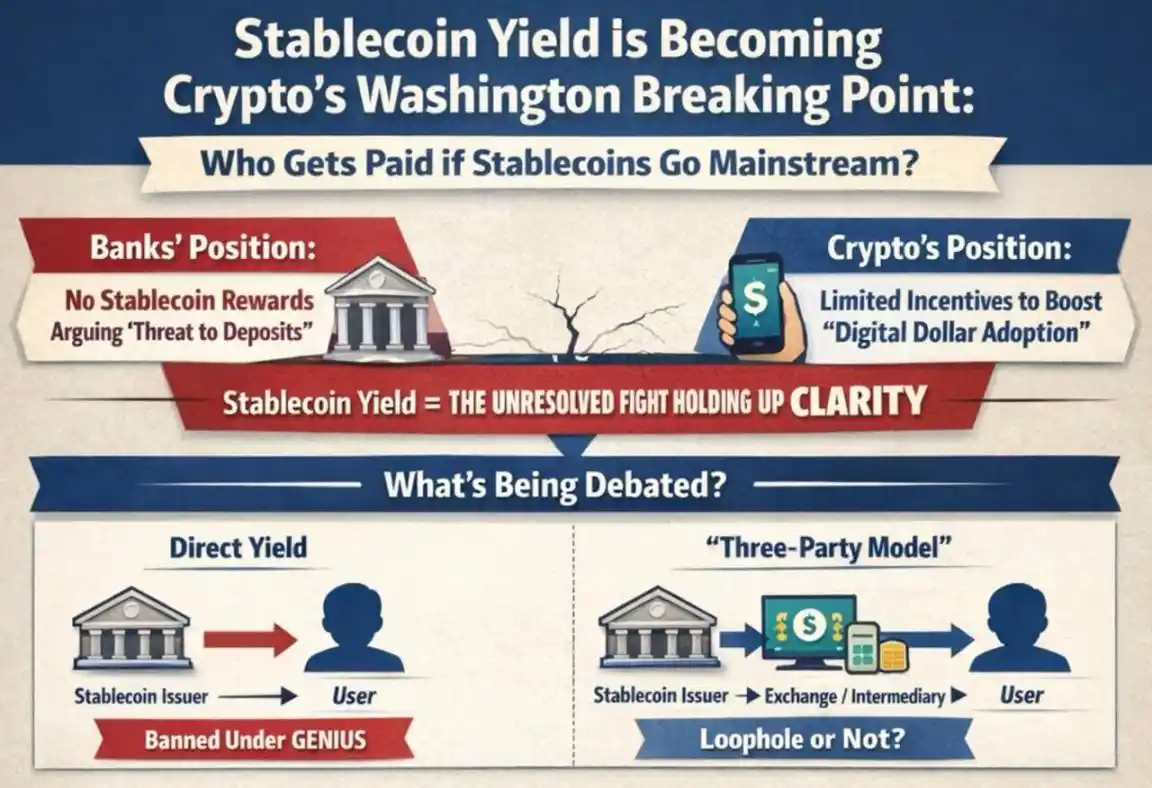
Infographic shows a serious divide between banks and crypto firms on the question of 'who should get stablecoin yields' as the use of digital dollars expands.

If lawmakers primarily view stablecoins as payment tools, the rationale for imposing stricter limits on related rewards becomes stronger. Conversely, if they see them as part of a major shift in how value flows on digital platforms, the argument for supporting limited incentives holds more ground.

Banking associations have urged lawmakers to close what they call a "regulatory loophole" before such reward mechanisms become more widespread. Banks claim that allowing rewards on idle balances would lead depositors to move funds out of banks, thereby weakening the core funding source for loans to families and businesses.

Standard Chartered estimated in January that stablecoins could drain about $500 billion in deposits from the U.S. banking system by the end of 2028, with small and medium-sized banks facing the most pressure.
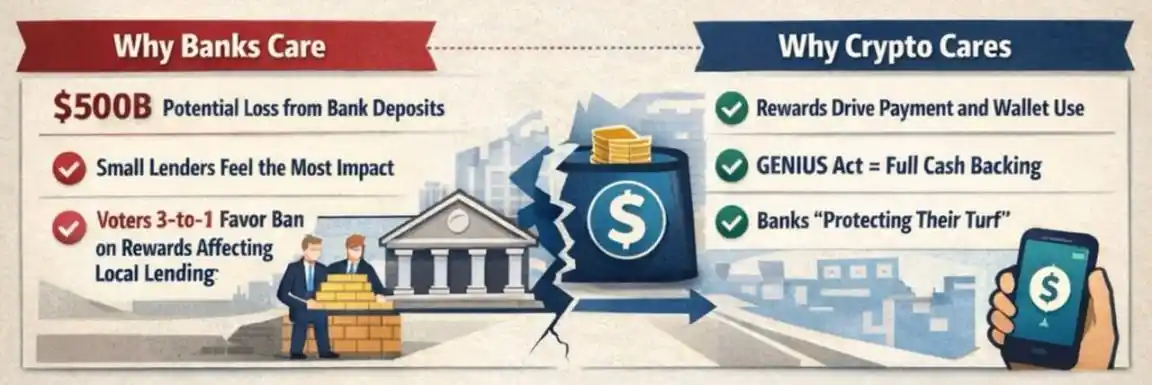
Infographic compares why banks and crypto care about the stablecoin bill, showing deposit outflows, impact on lenders, cash-back rewards, and bank protectionism.

Banks are also trying to demonstrate to lawmakers that their position has public support. The American Bankers Association recently released a poll result:

  • When the question mentioned that 'allowing stablecoin yields could reduce lendable funds for banks, affecting communities and economic growth,' respondents supported a congressional ban on stablecoin yields by a 3:1 ratio;
  • By a 6:1 ratio, they believed stablecoin-related legislation should be cautious to avoid disrupting the existing financial system, especially community banks.

But the crypto industry counters that banks are simply trying to protect their own funding models by restricting competition from digital dollars.

Industry figures, including Coinbase CEO Brian Armstrong, argue that under the "GENIUS Act," reserve requirements for stablecoin issuers are stricter than for banks—issued stablecoins must be fully backed by cash or cash equivalents.

Transaction Volume Size Raises the Stakes in Washington's Game

Market size has made this yield debate impossible to dismiss as a niche issue.

Boston Consulting Group estimated that the total circulation volume of stablecoins last year was about $62 trillion. After excluding bot trading, internal exchange flows, and other activities, real economic activity was only about $4.2 trillion.

The huge gap between surface trading volume and actual economic use also explains why the "yield" debate has become so critical.

If stablecoins remain primarily a settlement tool for trading and market structure, lawmakers find it easier to define them as payment instruments; but if yield mechanisms turn stablecoins into a widely used cash storage tool in user apps, the pressure on banks would rise rapidly.

To this end, the White House earlier this year tried to broker a compromise: allowing limited yields for specific scenarios like peer-to-peer payments, but prohibiting returns on idle funds. Crypto firms accepted this framework, but banks rejected it, causing Senate negotiations to completely stall.

Even if Congress does not act, regulators may step in to tighten yield models.

The Office of the Comptroller of the Currency (OCC), in a proposed rule implementing the "GENIUS Act," suggested that if a stablecoin issuer provides funds to an affiliate or third party, which then pays yields to stablecoin holders, it would be deemed a disguised payment of prohibited yields.

This means that if Congress cannot legislate a clear stance, the executive branch may draw boundaries itself through regulatory rules.

Congress is Running Out of Time

The current contest is divided into two tracks:

  • Congress debates whether to solve the problem with statute law;
  • Regulators define the boundaries of corporate behavior within the existing legal framework.

For the Senate bill, time itself is the greatest pressure.

Galaxy Digital Head of Research Alex Thorn wrote on social media:

If the CLARITY Act does not pass committee review by the end of April, the probability of passage in 2026 will be extremely low. The bill must reach the full Senate floor for a vote by early May. Legislative time is running out, and the probability of passage decreases with each passing day.

He also cautioned that even if the yield dispute is resolved, a breakthrough for the bill is hardly assured:

It is currently believed externally that the stablecoin yield dispute is holding up the CLARITY Act. But even if a compromise is reached on the yield issue, the bill would likely still face other obstacles.

These obstacles could include decentralized finance (DeFi) regulation, regulatory agency authority, or even ethical issues.

Before the midterm elections in November, crypto regulation is likely to become a larger political battleground. This makes the current stalemate more urgent—once delayed, the bill will face a more crowded political schedule and a more difficult legislative environment.

Prediction markets also reflect a shift in sentiment. In early January, Polymarket gave the bill an ~80% chance of passage; after recent setbacks (including Armstrong calling the current version unworkable), the probability has dropped to near 50%.

Kalshi data shows the probability of the bill passing before May is only 7%, and the probability of passing by the end of the year is 65%.

Bill Failure Would Cede More Decision-Making to Regulators and the Market

The impact of failure extends far beyond the yield debate. The core purpose of the CLARITY Act is to define whether crypto tokens are securities, commodities, or another category, providing a clear legal framework for market regulation.

If the bill is shelved, the entire industry will rely more heavily on regulatory guidance, interim rules, and future political changes.

This is also one reason the market is highly focused on the bill's fate. Bitwise Chief Investment Officer Matt Hougan said earlier this year that the CLARITY Act would codify the current crypto-friendly regulatory environment into law; otherwise, future administrations could reverse existing policies.

He wrote that if the bill fails, the crypto industry will enter a period of "proving itself," needing three years to make itself indispensable to ordinary people and traditional finance.

Under this logic, future industry growth would rely less on the expectation of "legislative landing" and more on whether products like stablecoins and asset tokenization can truly achieve mass adoption.

This presents the market with two截然不同的 paths:

  • Bill Passes → Investors price in the growth of stablecoins and tokenization early;
  • Bill Fails → Future growth relies more on actual adoption, while facing uncertainty from potential policy shifts in Washington.

Flowchart shows the countdown to a stablecoin decision in the Senate, with deadlines on March 6th and late April or early May leading to two paths: if Congress acts, it brings regulatory clarity and faster growth; if Congress fails to act, uncertainty follows.

At this stage, the next move is up to Washington. If senators can restart this market structure bill this spring, lawmakers can still personally define: to what extent stablecoins can pass value to users, and how much of a crypto regulatory framework can be written into statute law. If not, regulators are clearly prepared to draw at least some of the rules themselves.

Regardless of the outcome, this debate has long surpassed "whether stablecoins belong in the financial system," delving into: how stablecoins will operate within the system, and who will benefit from their development.


Questions liées

QWhat is the core issue that has stalled the progress of the CLARITY Act in the U.S. Senate?

AThe core issue stalling the CLARITY Act is the debate over 'stablecoin yields'—specifically, whether stablecoin companies should be allowed to offer interest-like rewards to users, which traditional banks argue creates unfair competition for deposits.

QAccording to the Congressional Research Service (CRS), what legal ambiguity exists in the GENIUS Act regarding stablecoin yields?

AThe CRS report pointed out that the GENIUS Act prohibits stablecoin issuers from paying yields directly to users but does not clearly define 'holder,' leaving a legal ambiguity that allows intermediaries (like exchanges) to potentially pass on economic benefits to end-users.

QWhy are U.S. banks lobbying against allowing stablecoin yields?

ABanks argue that allowing yields on stablecoins would lead to significant deposit outflows from the banking system, especially from community and regional banks, undermining their ability to lend to households and businesses and harming economic growth.

QWhat are the two potential paths for the U.S. crypto market if the CLARITY Act fails to pass?

AIf the CLARITY Act fails, the crypto market faces two paths: 1) Growth becomes more dependent on actual adoption and real-world utility (like payments and tokenization) rather than legislative certainty, and 2) Regulatory agencies may step in to set rules independently, creating a patchwork of guidance and increased policy uncertainty.

QWhat is the practical legislative deadline for the CLARITY Act to have a realistic chance of passage in an election year?

AThe practical window for the CLARITY Act to have a realistic chance of passage is from late April to early May. If it doesn't clear committee by the end of April, its chances in 2026 are considered extremely low due to the tightening election-year schedule.

Lectures associées

Pourquoi Nvidia emprunte-t-elle 200 milliards de dollars si elle n'a pas besoin d'argent ?

Résumé de l'article : Nvidia, qui dispose d'une trésorerie abondante (flux de trésorerie libre d'environ 48,6 milliards de dollars pour son dernier trimestre), prévoit d'émettre des obligations (notes senior) pour au moins 20 milliards de dollars. Contrairement à une lecture simpliste sur un besoin de liquidités, cette opération s'analyse plutôt comme une optimisation active de la structure financière. L'entreprise profite de sa solide notation de crédit (AA) et de conditions de marché favorables pour lever des fonds à long terme (jusqu'à 30 ans) à un coût faible. Cette dette servira à financer des investissements à long cycle comme les infrastructures de datacenters IA, la R&D, les paiements anticipés à la chaîne d'approvisionnement et les investissements stratégiques. Cette approche permet à Nvidia de poursuivre son expansion dans l'écosystème IA sans diluer les actionnaires (alternative à une augmentation de capital), tout en maintenant parallèlement un retour aux actionnaires via un important programme de rachats d'actions et une augmentation du dividende. Elle reflète une évolution vers une gestion du capital plus mature, typique des grandes plateformes technologiques, et s'inscrit dans une tendance où les géants de la tech utilisent la dette pour financer le cycle d'investissements lourds de l'IA. La réussite de cette stratégie dépendra de la capacité future de Nvidia à générer des rendements supérieurs au coût de sa dette et à maintenir sa forte génération de flux de trésorerie.

marsbitIl y a 3 mins

Pourquoi Nvidia emprunte-t-elle 200 milliards de dollars si elle n'a pas besoin d'argent ?

marsbitIl y a 3 mins

Liberland révoque son secrétaire à la technologie après une tentative présumée de prise de contrôle de la blockchain et du site web

Le congrès de Liberland a voté le renvoi du secrétaire à la Technologie, Dorian Stern Vukotić, selon une résolution officielle de ce projet de micronation. Il est accusé d'avoir supprimé les protections multisignatures sur le compte administrateur Sudo, tenté de détourner le domaine Liberland.org, bloqué le président Vít Jedlička du vote et lancé des jetons non autorisés. Cette affaire sert d'étude de cas sur les risques de gouvernance dans la blockchain, qui dépassent les simples contrats intelligents. Elle implique le contrôle des permissions, des noms de domaine, des droits de vote et des comptes administrateurs. Ceci rappelle que pour de nombreux projets crypto, la décentralisation réelle doit être vérifiée au-delà des déclarations, car un petit nombre d'acteurs peut contrôler des fonctions clés. L'article précise que Liberland est un projet de micronation et non un État souverain largement reconnu. Pour les observateurs, il est conseillé de suivre les enregistrements sur l'explorateur blockchain, les votes ultérieurs et les éventuelles mises à jour juridiques ou liées au registre des domaines. Dans le contexte plus large, cette histoire s'inscrit dans une tendance où l'infrastructure, la sécurité et la gouvernance deviennent aussi importantes que l'évolution des prix. Elle illustre la nécessité pour les traders de comprendre les systèmes et les risques sous-jacents. Le traitement éditorial doit se baser sur les sources vérifiées, expliquer les risques pratiques et éviter les conclusions prématurées, en présentant cela comme un signal d'information à suivre.

bitcoinistIl y a 35 mins

Liberland révoque son secrétaire à la technologie après une tentative présumée de prise de contrôle de la blockchain et du site web

bitcoinistIl y a 35 mins

Comment bien mener une recherche : cultiver les compétences qui peuvent être réellement « pratiquées délibérément »

Personne ne vous a jamais vraiment appris à faire de la recherche. On vous donne un bureau, un problème choisi par d'autres, et des instructions vagues pour "produire quelque chose de nouveau". Ainsi, la plupart des gens rétroconçoient le métier à partir de ce qu'ils voient (articles, posts), apprenant à *sembler* chercheurs plutôt qu'à en *devenir*. Les véritables compétences en recherche sont un empilement de micro-compétences, presque toutes cultivables par la pratique délibérée. **Choisir ses propres problèmes.** Nous absorbons souvent des problèmes (du superviseur, des tendances) sans en comprendre le raisonnement sous-jacent, nous plaçant en retard face à des concurrents nombreux. John Schulman recommande de choisir un résultat que l'on souhaite réellement atteindre et de raisonner à rebours pour concevoir les expériences. Cette approche mène à l'originalité. Le "bon goût" est un muscle : prédire les résultats d'expériences, deviner les conclusions d'articles à partir des méthodes, noter quelles avancées resteront pertinentes, puis vérifier. **Améliorer ses sources.** S'alimenter aux mêmes sources (arXiv, discussions) génère les mêmes idées que tout le monde. Les archives anciennes sont sous-estimées : les idées clés (MoE, LSTM) sont souvent des réinventions. Lire des textes fondateurs comme "The Bitter Lesson" de Sutton ou le discours de Shannon sur la pensée créative est crucial. La **largeur** (neurosciences, conception de mécanismes, statistiques, architecture matérielle) est aussi importante que la profondeur. Lisez les **articles eux-mêmes**, surtout les annexes et les sections sur les limites. **Tout noter.** L'écriture révèle les failles des idées qui semblaient matures. C'est le mécanisme de défense le moins cher contre l'auto-tromperie, un point souligné par Feynman. Darwin notait systématiquement les faits contredisant sa théorie, craignant que sa mémoire ne les efface. Tenez un journal : hypothèses, paramètres, attentes, résultats, connaissances révisées. Relire ses notes d'il y a un mois est une leçon d'humilité sans égale.

marsbitIl y a 1 h

Comment bien mener une recherche : cultiver les compétences qui peuvent être réellement « pratiquées délibérément »

marsbitIl y a 1 h

Le prix de Backpack bondit de plus de 150 % en deux semaines

L'article traite de la forte hausse du jeton BP de l'échange Backpack, dont le prix a été multiplié par plus de 2,5 depuis début juin pour atteindre environ 0,475 USD. Cette performance est principalement attribuée au lancement de Backpack Securities, une plateforme de courtage en actions américaines régulée qui permet également la tokenisation d'actifs traditionnels comme les actions. L'introduction du produit tokenisé SPCX, adossé à des actions SpaceX, a généré un volume de transactions important et illustre la stratégie de Backpack : créer un pont entre les marchés traditionnels et la finance décentralisée (DeFi) sur Solana. Le modèle économique du jeton BP, avec une émission totale de 10 milliards d'unités, est également mis en avant. Il se distingue par une distribution initiale entièrement réservée à la communauté via des airdrops, et par un mécanisme de "conversion en actions" : les utilisateurs qui stakent leurs BP pendant au moins un an obtiennent le droit de les convertir en actions de la société lors d'une future introduction en bourse (IPO). Actuellement, environ 66% des jetons en circulation sont stakés. En résumé, la récente valorisation de BP semble davantage portée par l'expansion concrète de ses services (courtage et tokenisation d'actifs réels) et par les utilités à long terme de son jeton, que par une simple spéculation à court terme.

marsbitIl y a 1 h

Le prix de Backpack bondit de plus de 150 % en deux semaines

marsbitIl y a 1 h

Entrée totale dans l'ère de l'IA : Alipay mise sur la conversation, WeChat maintient le social

En mai 2026, Alipay annonce avoir traité plus de 300 millions de paiements via IA. Peu après, WeChat ouvre l'accès à l'IA pour ses mini-programmes, suscitant des débats sur la confidentialité du code source. Ces annonces marquent deux visions divergentes de l'intégration de l'IA. Alipay teste "Project Treasure", une version redéfinie centrée sur l'interface conversationnelle. L'utilisateur formule une demande complexe (ex: commander un taxi et un café) en une phrase, et l'IA exécute toutes les étapes en arrière-plan. Après un échec avec une application autonome, Alipay a opté pour une transition en douceur au sein de son application existante, visant à "changer l'oiseau sans vider la cage". Pour les services non adaptés, l'IA utilise une technique de "lecture d'écran" pour simuler les actions utilisateur. WeChat adopte une approche plus prudente et intégrée. Son agent IA sera étroitement lié aux fonctionnalités sociales (chats, comptes officiels, Chaînes) plutôt que d'avoir une interface dédiée. L'IA agit comme un assistant contextuel au sein des conversations de groupe, préservant l'expérience sociale centrale. Pour comprendre les mini-programmes, WeChat propose deux modes aux développeurs : l'analyse du code source ("Mode automatique") ou la création d'interfaces standardisées ("Mode développement"), deux options exigeantes. La divergence est cruciale pour l'écosystème des mini-programmes. La solution "lecture d'écran" d'Alipay intègre passivement tous les services, poussant peut-être les commerçants à s'adapter. L'exigence d'accès au code source par WeChat pourrait défavoriser les petits développeurs, risquant de centraliser l'écosystème. Alipay a également lancé "Token Pay" et "AI Wallet" pour les micro-paiements automatisés, validant une boucle économique fermée pour les agents IA. En définitive, Alipay repense l'entrée vers les services par la conversation, tandis que WeChat cherche à rendre l'IA invisible au sein des interactions sociales. Leur compétition ne porte plus sur les portefeuilles, mais sur qui deviendra l'assistant privilégié auquel l'utilisateur confiera la phrase "Aide-moi".

marsbitIl y a 2 h

Entrée totale dans l'ère de l'IA : Alipay mise sur la conversation, WeChat maintient le social

marsbitIl y a 2 h

Trading

Spot
Futures
活动图片