The 'Final Battle' of Crypto Treasuries: The Myth of Buying the Dip Is Collapsing

比推Publié le 2025-12-08Dernière mise à jour le 2025-12-08

Résumé

Amid a recent crypto market downturn, crypto treasury companies—previously major buyers that fueled market rallies—have significantly slowed or halted their purchases, despite prices reaching potential bottom. This inaction is not due to depleted funds or panic but stems from a structural paralysis in their funding mechanisms, which rely heavily on stock premiums. These companies, exemplified by industry leader Strategy, primarily fund crypto acquisitions through convertible notes and At-The-Market (ATM) equity offerings. The ATM mechanism allows issuing new shares at a premium to net asset value (NAV) to raise capital for buying more crypto. However, when their stock price falls below the NAV per share (mNAV < 1), selling shares becomes dilutive and economically unfeasible, effectively locking their "ammunition." Strategy, for instance, still has over $30 billion in ATM capacity but cannot utilize it while trading at a discount. Other crypto treasury firms face similar constraints. Many have mNAV ratios below 1, rendering their ATM plans unusable. While some, like BitMine (a major Ethereum holder), continue buying using cash reserves, overall effective purchasing power is limited. The sector is shifting focus from leveraged accumulation to earning yield through staking (e.g., Ethereum staking yields ~8%) to cover interest costs and ensure survival. This reflects a broader move away from "infinite bullet" theories dependent on perpetual premiums, underscoring that these com...

During the brief uptrend that began in April, crypto treasury companies, as the main force of market accumulation, provided a continuous stream of ammunition for the market. However, when both the crypto market and stock prices fell simultaneously, these crypto treasury companies seemed to collectively fall silent.

When prices hit a阶段性 bottom, it should theoretically be the perfect time for these treasury companies to buy the dip. But the reality is that buying activity has slowed or even stalled. The reason behind this collective silence is not simply because "ammunition" was exhausted at high points or due to panic, but rather because the highly premium-dependent financing mechanism has become mechanically paralyzed during the downturn, leading to a situation where "funds are available but unusable."

Hundreds of Billions in "Ammunition" Locked Up

To understand why these DAT companies are facing the dilemma of "having money but being unable to use it," we need to conduct an in-depth analysis of the sources of ammunition for crypto treasury companies.

Taking Strategy, the first listed crypto treasury company, as an example, its funding has primarily come from two sources: "convertible notes," which involve borrowing money at very low interest rates to buy cryptocurrencies, and the At-The-Market (ATM) issuance mechanism, where Strategy can sell additional shares when its stock price trades at a premium to the value of its held crypto assets, using the proceeds to buy more Bitcoin.

Before 2025, Strategy's main funding source was "convertible notes." As of February 2025, Strategy had raised $8.2 billion through convertible notes to purchase additional Bitcoin. Starting in 2024, Strategy began large-scale use of its At-The-Market (ATM) equity program. This issuance method is more flexible: when the stock price is higher than the market value of the held crypto assets, the company can issue additional shares at market price to raise funds for purchasing more crypto assets. In Q3 2024, Strategy announced a $21 billion ATM equity offering program, and in May 2025, it established a second $21 billion ATM program. To date, the total remaining capacity of these programs is still $30.2 billion.
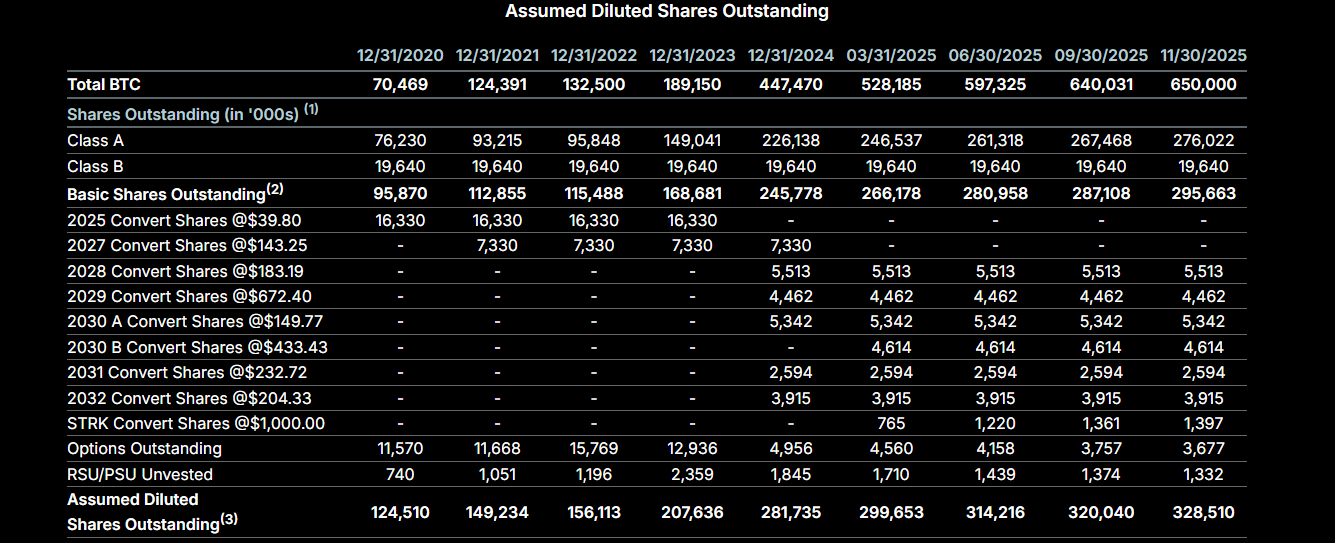
However, these capacities are not cash; they are quotas for the sale of Class A preferred shares and common shares. For Strategy to convert these quotas into cash, it needs to sell these shares on the market. When the stock price is at a premium (e.g., the stock price is $200, and each share represents $100 worth of Bitcoin), selling shares allows Strategy to exchange the newly issued shares for $200 in cash, which can then be used to buy $200 worth of Bitcoin, thereby increasing the Bitcoin backing per share. This was the logic behind Strategy's "perpetual motion machine" of seemingly infinite ammunition. However, when Strategy's mNAV (mNAV = market capitalization / value of held coins) falls below 1, the situation reverses. Selling shares now means selling at a discount. Since November, Strategy's mNAV has remained below 1 for an extended period. This is why, despite having a large number of shares available for sale recently, Strategy has been unable to use them to purchase Bitcoin.

Furthermore, not only has Strategy been unable to raise funds to buy the dip recently, but it also chose to raise $1.44 billion by selling shares at a discount to establish a dividend reserve pool to support preferred share dividend payments and existing debt interest payments.

As the standard template for crypto treasuries, Strategy's mechanism has been adopted by most treasury companies. Therefore, we can see that when crypto assets fall, the reason these treasury companies fail to enter the market to buy the dip is not unwillingness but rather because their stock prices have fallen too much, effectively "locking" their ammunition depots.

Nominal Firepower Ample, Actually "Guns Without Bullets"

So, besides Strategy, how much purchasing power do other companies have? After all, there are now hundreds of crypto treasury companies in the market.

From the current market perspective, although there are many crypto treasury companies, their potential for future purchases is not very large. There are mainly two situations. One type consists of companies that were originally crypto asset holding enterprises. Their crypto asset holdings mainly come from their existing holdings rather than new purchases financed by debt issuance. Their ability and motivation to raise funds through debt are not strong. For example, Cantor Equity Partners (CEP), ranked third in Bitcoin holdings, has an mNAV of 1.28. Its Bitcoin holdings primarily resulted from a merger with Twenty One Capital, and it has had no purchase records since July.

The other type consists of strategy companies similar to Strategy. However, due to the recent severe decline in stock prices, their mNAV ratios have generally fallen below 1. The ATM capacities of these companies are also effectively locked and cannot be utilized until their stock prices recover above 1.

Beyond issuing debt and selling stock, there is another, more direct "ammunition depot": cash reserves. Taking BitMine, the largest DAT company for Ethereum, as an example, although its mNAV is also below 1, the company has maintained its purchase plan recently. According to data from December 1st, BitMine stated it still has $882 million in unencumbered cash on its books. BitMine Chairman Tom Lee recently stated, "We believe Ethereum's price has bottomed. BitMine has resumed accumulating, purchasing nearly 100,000 ETH last week, double the amount of the previous two weeks." BitMine's ATM capacity is also substantial. In July 2025, the total capacity of its program was increased to $24.5 billion, and it currently has nearly $20 billion remaining.
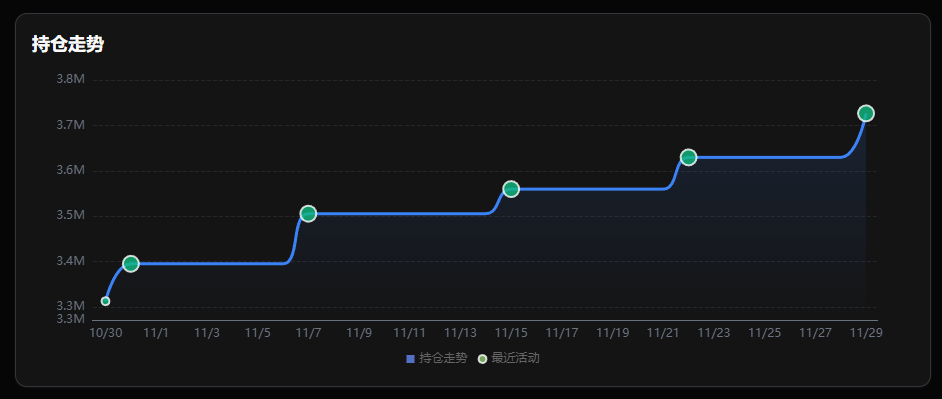
BitMine Holdings Change

Additionally, CleanSpark proposed issuing $1.15 billion in convertible bonds before the end of the year to purchase Bitcoin. The Japanese listed company Metaplanet has been a relatively active Bitcoin treasury company recently, raising over $400 million through Bitcoin-collateralized loans or share issuance since November to purchase Bitcoin.

In terms of total volume, the "nominal ammunition" (cash + ATM capacity) on the books of various companies amounts to tens of billions of dollars, far exceeding the previous bull market. However, in terms of "effective firepower," the actual number of bullets that can be fired has decreased.

Shifting from "Leveraged Expansion" to "Yield Generation for Survival"

Besides having their ammunition locked, these crypto treasury companies are also exploring new investment strategies. During the market uptrend, most companies' strategy was straightforward: buy relentlessly, obtain more financing as the price of coins and stocks rose, and then continue buying. As the situation reversed, many companies not only found it harder to raise funds but also faced the challenge of paying interest on previously issued bonds and covering operational costs.

Consequently, many companies are turning their attention to "crypto yield"—participating in crypto asset network staking activities to obtain relatively stable staking rewards. These rewards can then be used to pay the interest on their financing and operational costs.

For instance, BitMine plans to launch MAVAN (a US-based validator network) in Q1 2026 to initiate ETH staking. This is expected to generate approximately $340 million in annualized revenue for BitMine. Similar approaches are seen with Upexi, Sol Strategies, and other Solana network treasury companies, which can achieve around 8% annualized yield.

It is foreseeable that as long as mNAV cannot return above 1.0, hoarding cash to meet debt maturities will become the main theme for treasury companies. This trend also directly influences asset selection. Since Bitcoin lacks native high yield, the accumulation by pure Bitcoin treasuries is slowing down. In contrast, Ethereum treasuries, which can generate cash flow through staking to cover interest costs, have maintained more resilient accumulation speeds.

This shift in asset preference is essentially a compromise by treasury companies in the face of liquidity difficulties. When the channel for obtaining cheap funds through stock price premiums is closed, finding yield-generating assets becomes their only lifeline for maintaining a healthy balance sheet.

Ultimately, the "infinite ammunition" was merely an illusion built on stock price premiums during a positive cycle. When the flywheel locks up due to trading at a discount, the market must face a stark reality: these treasury companies have always been amplifiers of trends, not saviors against them. Only when the market sentiment recovers first can the funding valves be reopened.


Twitter:https://twitter.com/BitpushNewsCN

Bitpush TG Discussion Group:https://t.me/BitPushCommunity

Bitpush TG Subscription: https://t.me/bitpush

Original link:https://www.bitpush.news/articles/7593906

Questions liées

QWhy have crypto treasury companies like Strategy slowed down or stopped buying cryptocurrencies during the recent market downturn, despite having large available funds?

AThey have slowed or stopped buying because their funding mechanism relies heavily on stock issuance at a premium to their net asset value (mNAV > 1). When their stock price falls below the value of their crypto holdings (mNAV < 1), selling stock to raise cash becomes dilutive and economically unfeasible, effectively locking their 'ammunition'.

QWhat are the two primary funding sources for Strategy, the leading crypto treasury company, and which one became less effective in the downturn?

AStrategy's two primary funding sources are 'convertible notes' (low-interest debt) and 'At-The-Market' (ATM) equity offerings. The ATM mechanism became less effective during the downturn because it requires the stock to trade at a premium to the net asset value (mNAV > 1) to work profitably, which was not the case.

QWhat is mNAV and why is it a critical metric for crypto treasury companies?

AmNAV (market NAV) is the ratio of a company's market capitalization to the value of its cryptocurrency holdings. It is critical because a value above 1 indicates the stock is trading at a premium, allowing the company to profitably issue new shares via ATM offerings to fund more crypto purchases. A value below 1 makes such issuance dilutive and impractical.

QHow are some crypto treasury companies adapting their strategy from pure accumulation to generating yield?

ACompanies are shifting towards generating crypto-native yield, such as through staking cryptocurrencies like Ethereum or Solana. This provides a steady income stream to help cover interest payments on their debt and operational costs, especially when their primary funding mechanism (ATM offerings) is impaired.

QWhich crypto treasury company was cited as an example of one that continued buying during the downturn, and what was its advantage?

ABitMine, the largest Ethereum treasury company, continued buying. Its advantage was a significant reserve of unencumbered cash ($882 million), which allowed it to purchase assets independently of the impaired ATM equity issuance mechanism that other companies relied on.

Lectures associées

Des puces optiques en pleine expansion de production collective

La demande de puces photoniques connaît une croissance exponentielle, stimulée par les besoins en interconnexion optique des centres de données d'IA. Une course mondiale aux capacités de production est engagée. Aux États-Unis, Coherent étend sa ligne de production de semi-conducteurs InP de 6 pouces au Texas, soutenue par un financement et un investissement stratégique de Nvidia. Nokia développe ses capacités de test et d'emballage avancés en Pennsylvanie. Le japonais JX Advanced Metals prévoit d'augmenter sa production de substrats InP par 7 à 10 fois. En Europe, IQE et Tower Semiconductor ont conclu un accord d'approvisionnement à long terme pour les plaquettes InP, illustrant la tendance à l'intégration hétérogène des composants InP performants dans les plateformes silicium-optique matures. En Chine, l'expansion est rapide. Suzhou TFC Optical Communication (Solstice) investit 12 milliards de dollars dans un projet d'expansion. San'an Photonics possède une capacité de production mensuelle de 2 750 plaquettes pour les puces InP. Yunnan Germanium a lancé un projet pour augmenter la production de tranches de monocristal InP. La chaîne d'approvisionnement chinoise se consolide de la matière première au module. Malgré les débats sur les délais de déploiement du CPO (Co-Packaged Optics), l'augmentation globale de la consommation de contenu optique (moteurs photoniques, lasers) est incontestable, tirée par la demande croissante de bande passante dans l'IA. Le paysage futur impliquera probablement plusieurs architectures (silicium-optique, VCSEL, MicroLED) coexistant pour différentes distances et besoins. Cette frénésie d'expansion mondiale, des États-Unis et du Japon à l'Europe et la Chine, représente un pari collectif de l'industrie des semi-conducteurs sur l'avenir photonique de l'informatique à haute performance.

marsbitIl y a 36 mins

Des puces optiques en pleine expansion de production collective

marsbitIl y a 36 mins

Les stablecoins trouvent enfin un rendement réel : Détails de la réassurance en chaîne Re | Discussion avec Karan Saroya, fondateur de Re

Le projet Re est une plateforme de réassurance décentralisée qui connecte les stablecoins à l'industrie traditionnelle de l'assurance. Elle collecte des stablecoins (actuellement 1700 milliards de dollars en circulation) et les utilise comme garantie pour fournir du capital à des compagnies d'assurance américaines. En échange, les assureurs paient des primes dont les bénéfices sont reversés aux déposants sur la blockchain, générant un rendement annuel réel estimé entre 12% et 14%. Le modèle exploite un effet de levier réglementaire : 1 dollar de garantie permet de soutenir 5 à 7 dollars de primes d'assurance. Cette efficacité opérationnelle, couplée à l'automatisation par contrats intelligents, permet à Re de concurrencer les géants traditionnels du secteur avec une équipe réduite. Les déposants reçoivent des jetons représentatifs (receipt tokens) qu'ils peuvent ensuite utiliser dans le DeFi (ex: Morpho, Fluid) pour du "looping" et potentiellement augmenter leurs rendements. Re a également émis un jeton de gouvernance, RE, inspiré du modèle historique de Lloyd's of London, permettant de contrôler l'allocation du capital central. En résumé, Re crée une nouvelle source de rendement non corrélée aux marchés crypto ou actions, en canalisant les stablecoins vers l'économie réelle via la réassurance, tout en démocratisant l'accès à cette classe d'actifs auparavant réservée aux grands investisseurs institutionnels.

链捕手Il y a 1 h

Les stablecoins trouvent enfin un rendement réel : Détails de la réassurance en chaîne Re | Discussion avec Karan Saroya, fondateur de Re

链捕手Il y a 1 h

1996 ou 1999 ? Le premier test de Walsh est 'comment voir l'IA'

L’arrivée de Jerome Warsh à la tête de la Fed est confrontée à une question fondamentale : **comment interpréter le boom actuel de l’IA** ? Deux scénarios historiques s’affrontent. Le premier, inspiré de 1996 sous Alan Greenspan, suggère que les gains de productivité conteniront l’inflation, permettant à la Fed de rester patiente. Le second, évoquant 1999, craint que des attentes trop optimistes ne provoquent une surchauffe, exigeant un resserrement monétaire précoce. Warsh penche vers le scénario de 1996, affirmant qu’une croissance tirée par la productivité est à « embrasser ». Il redoute qu’une réaction prématurée de la Fed n’étouffe une expansion bénéfique. Cependant, le contexte actuel – tensions commerciales, déficits budgétaires, reflux de la mondialisation – est bien plus inflationniste que celui des années 1990, réduisant la marge de manœuvre. La position de Warsh est contestée, notamment par Austan Goolsbee de la Fed de Chicago. Selon lui, un boom anticipé par tous peut inciter à une dépense prématurée, alimentant l’inflation avant même que les gains de productivité ne se matérialisent. La flambée des coûts des data centers et des composants en serait un signe. En réponse, d’autres, comme Christopher Waller, notent que les contraintes de crédit des ménages pourraient limiter cet effet de « anticipation des dépenses ». Enfin, Warsh souhaite réduire le « forward guidance » (guidage prospectif), un outil hérité de 1999. Mais si l’économie suit le scénario de 1999, il pourrait être contraint de l’utiliser pour éviter des turbulences sur les marchés. Ainsi, **la première grande épreuve de Warsh consistera à trancher : sommes-nous en 1996 ou en 1999 ?** Sa réponse définira l’orientation de la politique monétaire et marquera son mandat.

marsbitIl y a 3 h

1996 ou 1999 ? Le premier test de Walsh est 'comment voir l'IA'

marsbitIl y a 3 h

Rapport du premier trimestre 2026 d'Ethereum : Baisse des frais, nombre d'utilisateurs et volume de transactions à des niveaux historiques

**Rapport du T1 2026 sur Ethereum : Baisse des frais, mais nombre d'utilisateurs et volume de transactions atteignent des records** Le premier trimestre 2026 présente une dynamique clé pour Ethereum : l'utilisation explose tandis que les revenus liés aux frais baissent. Le nombre d'utilisateurs actifs mensuels (+85,9% en glissement annuel), le nombre de transactions (+81,5%) et le débit du réseau ont tous atteint des sommets historiques. En revanche, les frais totaux sur le réseau principal se sont effondrés de 81,9% sur un an. Ce paradoxe s'explique par la stratégie délibérée d'Ethereum de privilégier la croissance à court terme en réduisant le coût de l'espace bloc grâce aux mises à niveau comme Fusaka (capacité de données augmentée). C'est l'effet Jevons : la baisse des coûts libère une nouvelle demande. Le rapport souligne également un pivot narratif majeur : Ethereum consolide son rôle de couche de règlement financier mondial pour les actifs tokenisés. Il domine ce marché naissant, détenant des parts majoritaires dans les stablecoins (61,8%), les fonds tokenisés (73%), les matières premières tokenisées (84%) et les prêts DeFi (79,2%) parmi les cinq principales blockchains. L'entrée en force d'institutions comme BlackRock, JPMorgan et Fidelity, avec des produits concrets, valide cette tendance. Ainsi, Ethereum sacrifie une capture de valeur à court terme (frais, TVL, capitalisation baisse) pour renforcer ses effets de réseau et sa position d'infrastructure neutre et ouverte, pariant sur une croissance à long terme alimentée par la tokenisation massive de la finance traditionnelle.

marsbitIl y a 4 h

Rapport du premier trimestre 2026 d'Ethereum : Baisse des frais, nombre d'utilisateurs et volume de transactions à des niveaux historiques

marsbitIl y a 4 h

Premier entretien en podcast du PDG d'Intel, Lip-Bu Tan : « Notre objectif est une multiplication par 10 en 5-10 ans », en misant sur l'emballage avancé, les substrats en verre et le diamant synthétique

Le PDG d'Intel, Lip-Bu Tan, a exposé sa vision ambitieuse de transformer l'entreprise avec pour objectif de multiplier par 10 la valeur pour les actionnaires dans les 5 à 10 prochaines années. Lors d'un podcast, il a détaillé sa stratégie axée sur trois piliers technologiques pour dépasser les limites physiques de la miniaturisation : l'emballage avancé (EMIB), les nouveaux matériaux de substrat comme le verre, et les semi-conducteurs de nouvelle génération (GaN, SiC, InP, diamant synthétique). Il souligne la reprise de la demande en CPU pour l'IA, notamment l'inférence et les agents intelligents, modifiant le ratio CPU/GPU dans les serveurs. Tan défend également la division de fonderie d'Intel, essentielle pour la sécurité de la chaîne d'approvisionnement américaine, en se concentrant sur la confiance client, le rendement et les délais. Il révèle le projet Terafab en collaboration avec Elon Musk pour construire des capacités de fabrication de semi-conducteurs. Selon lui, le plus grand malentendu des investisseurs est de sous-estimer le potentiel d'Intel, encore en phase de "rampement". Il prévoit que le véritable potentiel de l'entreprise, au-delà du PC, dans l'informatique en périphérie, l'IA physique et les agents IA, sera pleinement reconnu vers 2030-2032.

marsbitIl y a 4 h

Premier entretien en podcast du PDG d'Intel, Lip-Bu Tan : « Notre objectif est une multiplication par 10 en 5-10 ans », en misant sur l'emballage avancé, les substrats en verre et le diamant synthétique

marsbitIl y a 4 h

Trading

Spot
Futures
活动图片