Stole $2 Million from pump.fun, Sentenced to 6 Years in Prison, He Chose to 'Self-Destruct'

marsbitPublié le 2026-03-06Dernière mise à jour le 2026-03-06

Résumé

In May 2024, pump.fun was exploited for approximately $2 million worth of SOL and meme coins. The attacker, Jarett Dunn (also known as Stacc), a former employee, was later sentenced to six years in prison. Two days prior to the sentencing, he leaked internal Telegram chats from his time at the company, claiming to be a whistleblower exposing misconduct. However, the leaked messages did not reveal deliberate malicious activities such as market manipulation or fee misconduct by pump.fun. Instead, Dunn highlighted issues like the team's failure to implement KYC/AML measures for live streaming features, which he had warned about, and what he perceived as irresponsible attitudes toward known "Ruggers" (developers who abandon projects after fundraising). Some messages also illustrated the company's early-stage disorganization, including rushed contracts under investor pressure. Dunn, a talented programmer diagnosed with paranoid schizophrenia at age 20, had joined pump.fun just six weeks before the attack. His mother had recently died, and he had been off medication for months. After the exploit, he was arrested near pump.fun’s London office and underwent mental health treatment. He later attempted to withdraw his guilty plea and expressed homelessness in social media posts. The leak included private phone numbers of pump.fun co-founders, raising privacy concerns. The overall narrative portrays a troubled individual whose actions were influenced by personal trauma and mental hea...

In May 2024, pump.fun was hacked, with the attacker stealing approximately $2 million worth of SOL and a large number of meme coins. At the time, the attacker claimed they would airdrop these funds randomly to players on Solana, once dubbed the "Robin Hood of the crypto world."

Jarett Dunn (online alias Stacc), the attacker, is a former pump.fun employee. Last December, he was sentenced to 6 years in prison by a judge in London.
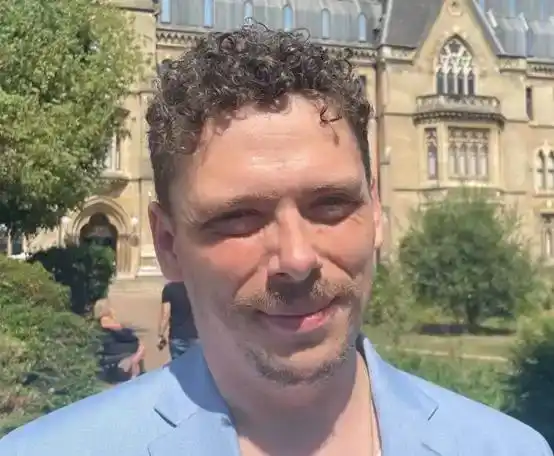
Two days ago, he exposed a large number of Telegram chat records from his time at pump.fun.

So I spent a lot of time going through these chat logs one by one. Honestly, after reading them, I was confused because these records did not contain the kind of intentional malicious content I had imagined, such as the pump.fun team manipulating liquidity or secretly collecting user fees. There was also no content suggesting major personal moral issues with founder alon or other team members.

But in Jarett Dunn's tweet, he called himself a whistleblower and viewed his exposure as a form of "righteous self-destruction." Someone expressed the same doubt in his comments, to which he replied:
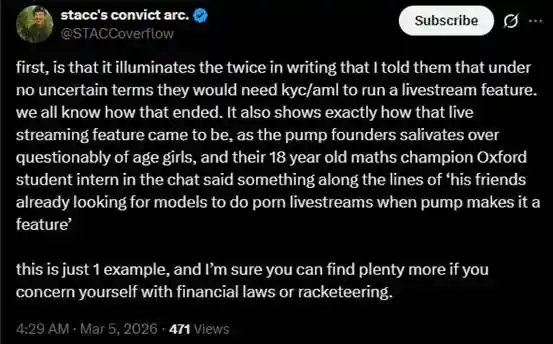
"These records show that I told them twice they must complete the KYC/AML process to enable livestreaming on the platform, (but they ignored it) and then we all know how things ended up (referring to the chaotic and unrestrained livestreaming scene on pump.fun in its early days)."

If this accusation has some merit, the next one is a bit more of a leap:

"An employee said something like this in the group: his friend was already looking for models to do porn as soon as pump.fun's livestreaming went live."

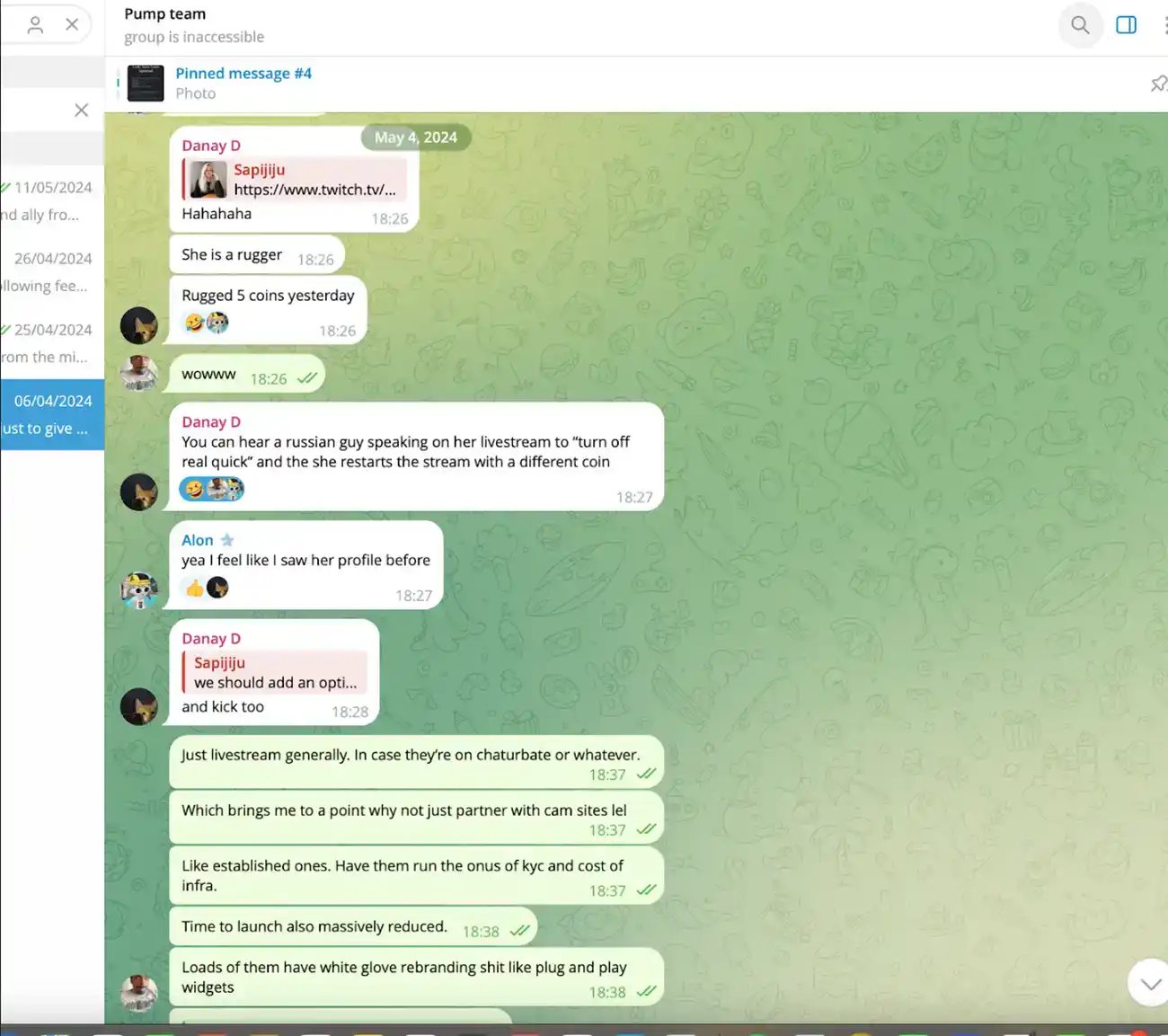
The chat record corresponding to this accusation is as follows. First, pump.fun co-founder Sapijiju shared a Twitch streamer in the pump.fun company group, saying another Twitch streamer had launched a token through pump.fun. An employee stated that this streamer was a Rugger (someone who performs a rug pull) and had rugged 5 tokens the day before.
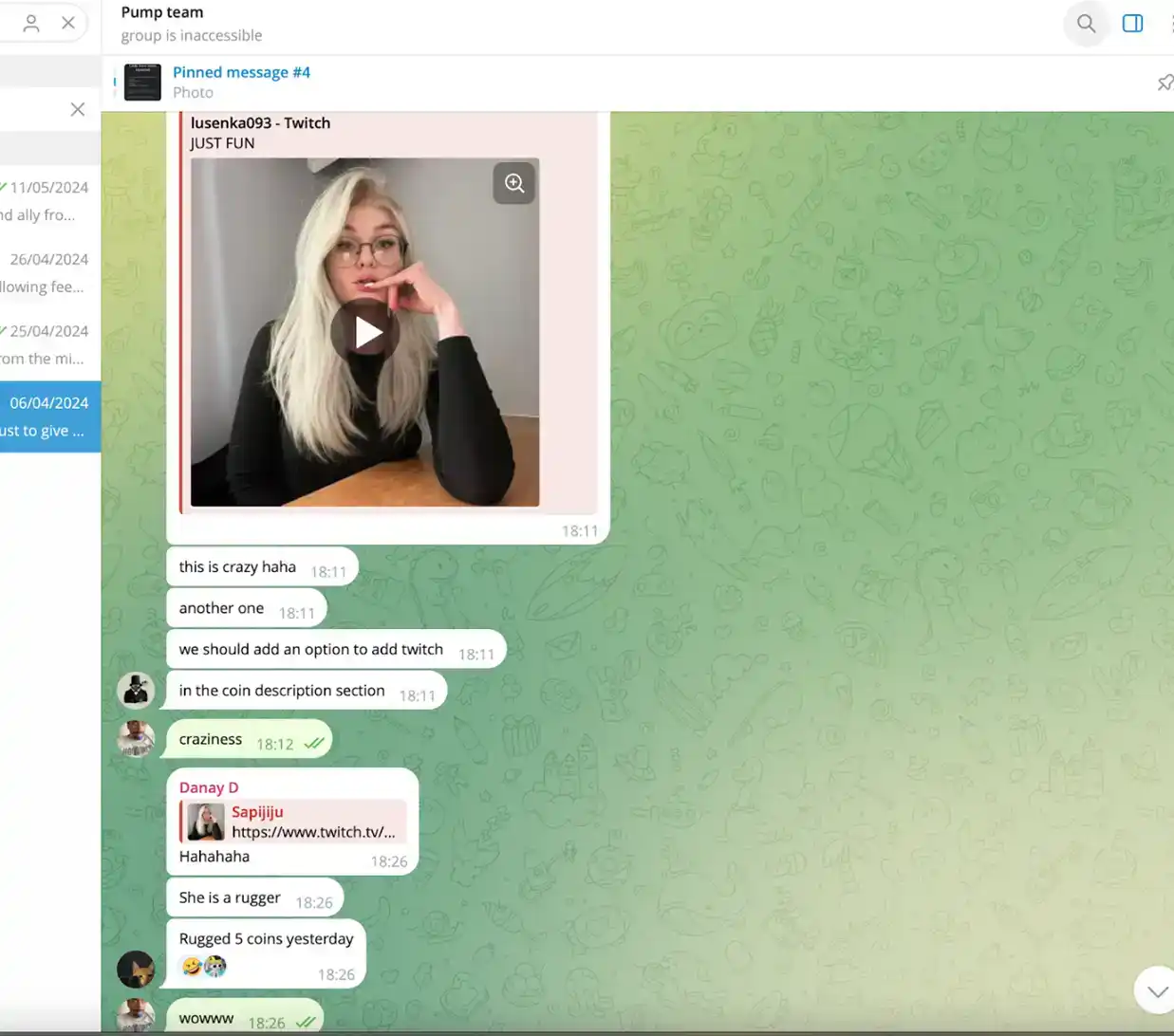
Then this employee said his friend was looking for "models" (to do the same thing). In context, this seems more like a joke. However, Jarett Dunn's suggestion was indeed interspersed, where he took the opportunity to express that partnering with a livestreaming platform would be better, as it would avoid KYC responsibilities and significantly shorten the time needed for pump.fun to launch its livestreaming feature.
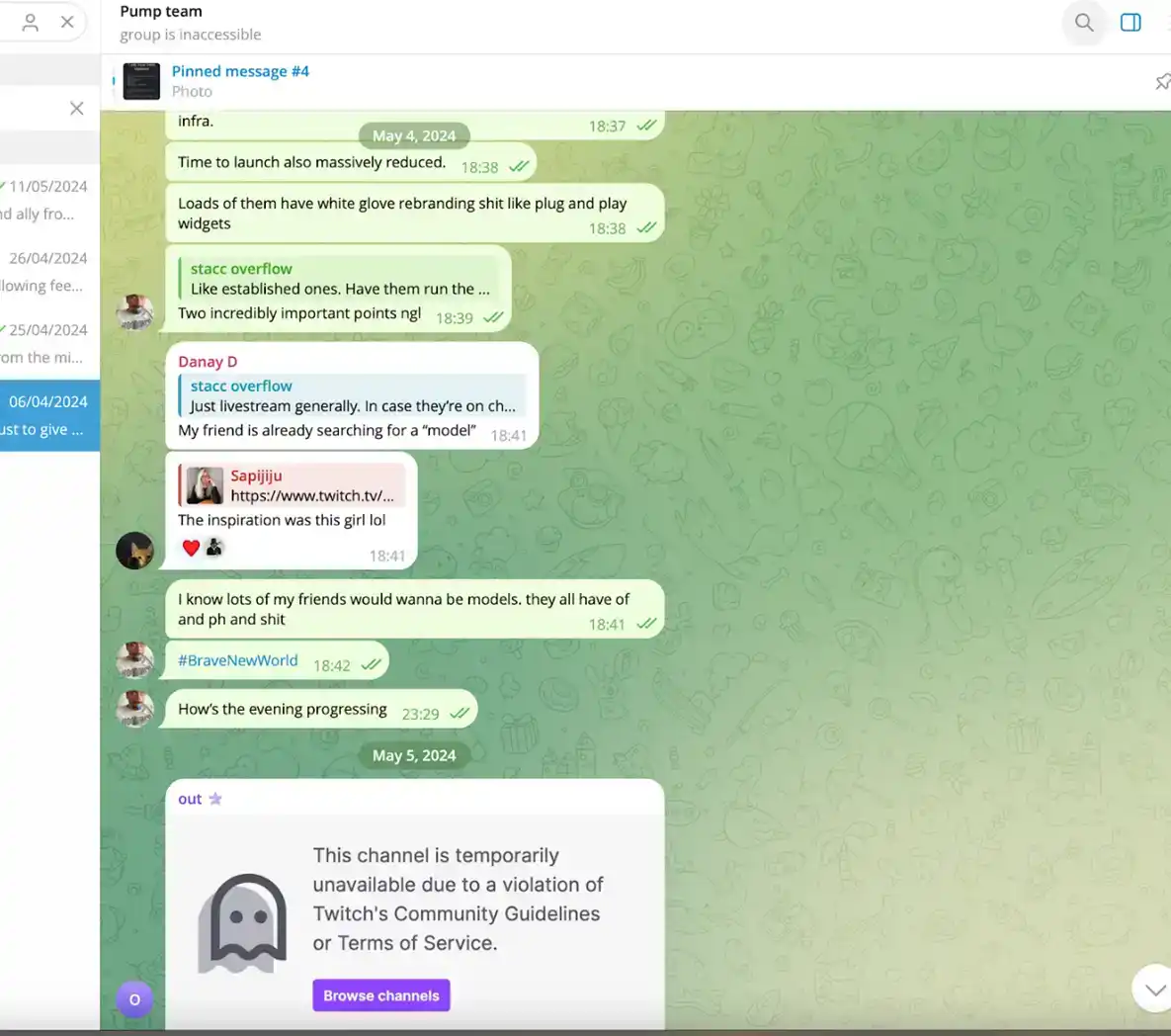
The more significant accusation here should be that the entire team, knowing this was a serial Rugger, still maintained a casual, joking attitude. alon, as a co-founder, stated in the records that he "felt like he had seen her profile before," and then nothing more came of it.
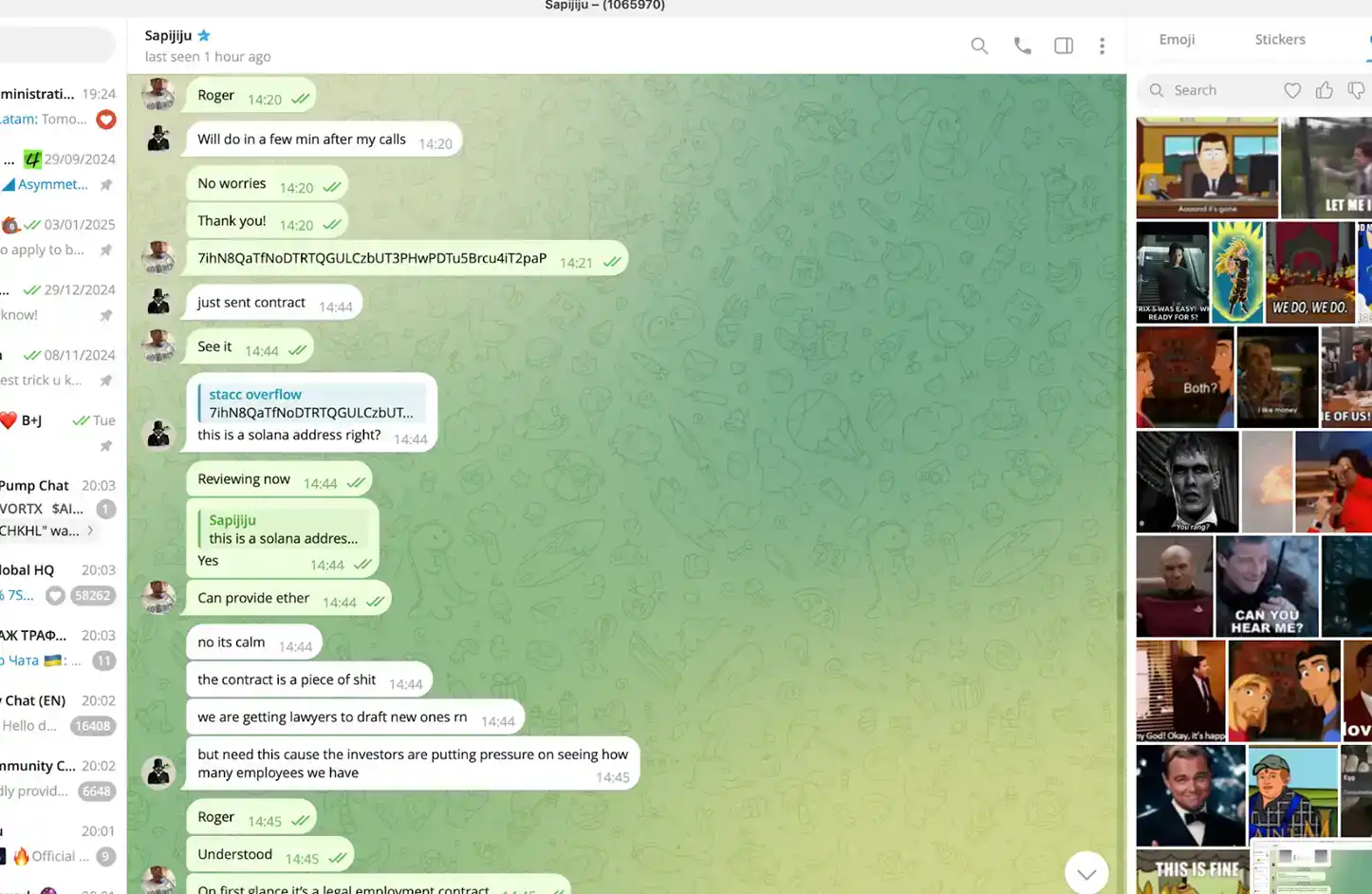
Some other records show the early "makeshift" nature of pump.fun. For example, creating a contract they themselves felt was "a piece of shit" just to handle investor pressure (needing to show investors how many employees the company had), while also looking for lawyers to draft a new one. For a then "young" pump.fun, it's hard to call this a black mark:
The most "explosive" part of the records disclosed by Jarett Dunn might be the release of the phone numbers associated with the Telegram accounts of alon and Sapijiju. Since this involves privacy, screenshots of this part will not be included in this article.

So, what kind of deep grudge is this? From the records, I cannot find the beginning of the enmity between Jarett Dunn and pump.fun, but he is a talented programmer who was also diagnosed with paranoid schizophrenia at the age of 20.

Two years ago, when he attacked pump.fun, his mother had recently passed away. At this time, he had only been with pump.fun for 6 weeks.

Four days after the attack, he was arrested at a hotel located just 90 meters from pump.fun's office in London; he was staying there. After his arrest, he was immediately deemed unfit for questioning by the police and sent to a hospital for a two-week mental health treatment, having been off his medication for months.

At his sentencing hearing two months after pleading guilty, he tried to withdraw his plea, a sudden change that made his legal team quit.

In September 2023, he wrote in a tweet, "I'm homeless, planning to sleep in the park, fighting the bugs I created with 5G."

Yet in the records, pump.fun reimbursed his flight tickets for him to fly from Canada to the UK. Was he happy and fulfilled back then?

Faced with such a complex, life-troubled programmer, I can only sigh at the vicissitudes of life.


Questions liées

QWho was the individual responsible for the $2 million hack of pump.fun and what was his sentence?

AJarett Dunn (also known as Stacc), a former pump.fun employee, was responsible for the hack. He was sentenced to 6 years in prison by a judge in London.

QWhat was the main reason Jarett Dunn gave for his 'whistleblower' act of leaking internal chats?

AHe claimed that he had twice warned the pump.fun team that they needed to complete KYC/AML procedures before launching a live-streaming feature, but they ignored him, which he implied led to the platform's early chaos.

QWhat personal circumstances were mentioned that may have contributed to Jarett Dunn's actions?

AHe was diagnosed with paranoid schizophrenia at age 20, his mother had recently passed away just before the attack, and he had been off his prescribed medication for several months.

QAccording to the article, what was the nature of the most 'explosive' information leaked by Dunn?

AThe most sensitive information leaked was the personal phone numbers associated with the Telegram accounts of pump.fun's co-founders, Alon and Sapijiju.

QHow did the author of the article characterize the internal chat logs that were leaked?

AThe author was initially confused because the logs did not contain evidence of intentional malicious acts like market manipulation or stealing user fees. Instead, they showed a 'ragtag' or immature early-stage startup culture with some questionable jokes and attitudes, but not major ethical scandals.

Lectures associées

Circle atteint une étape importante en matière de régulation, obtenant une licence d'activité fiduciaire du Département des Services Financiers de l'État de New York (NYDFS)

Circle, une société de services financiers et de stablecoins, a atteint une étape importante en obtenant une licence d'activité fiduciaire limitée du Département des services financiers de l'État de New York (NYDFS). Cette licence permet à Circle d'élargir ses activités dans l'État, notamment en offrant des services de garde d'actifs, en émettant des stablecoins approuvés par l'État et en gérant les réserves qui les soutiennent. La société est enregistrée en tant que fiduciaire à champ d'activité limité, tandis que sa division financière détient déjà une licence BitLicense. Circle devient ainsi l'une des entreprises les plus réglementées du secteur des cryptomonnaies. Le cofondateur et PDG Jeremy Allaire a salué cette réalisation, soulignant que la licence était un objectif de longue date pour Circle, offrant une clarté réglementaire. Il a qualifié le NYDFS d'autorité internationale fixant les normes pour les actifs numériques et a affirmé que cette licence positionnait le stablecoin USDC de Circle au sein d'un système solide et respecté. Cette approbation fait suite à l'autorisation précédente de l'OCC pour la création de Circle National Trust, plaçant les activités de stablecoins de la société sous supervision fédérale et visant un nouveau standard de transparence et de gouvernance.

cryptonews.ruIl y a 33 mins

Circle atteint une étape importante en matière de régulation, obtenant une licence d'activité fiduciaire du Département des Services Financiers de l'État de New York (NYDFS)

cryptonews.ruIl y a 33 mins

Cryptomonnaie à prix réduit : le bitcoin pourrait devenir moins cher en Russie que sur le marché mondial

À partir du 1er septembre 2026, la Russie doit mettre en œuvre une loi encadrant les crypto-monnaies, créant un écosystème licencié avec des plateformes d'échange officielles. Cependant, cette réglementation pourrait entraîner une décote des actifs numériques, comme le Bitcoin, sur le marché russe par rapport aux cours mondiaux. Cette situation serait principalement causée par les risques liés aux sanctions internationales, des vérifications strictes de l'origine des fonds (KYC/AML) et des capacités limitées à transférer les actifs à l'étranger. L'infrastructure régulée russe pourrait être "marquée" comme risquée par les services internationaux de conformité, réduisant la liquidité et la valeur des actifs qui y transitent. De plus, une offre excédentaire pourrait être générée par l'activité des mineurs nationaux contraints de vendre localement. Bien qu'une différence de prix théorique puisse créer une opportunité d'arbitrage, celle-ci serait difficile, voire impossible, à exploiter. Les procédures de conformité, les commissions, les risques réglementaires et la persistance des marqueurs de risque liés à l'historique des transactions sur la blockchain annuleraient très probablement tout profit potentiel. En conséquence, le marché russe pourrait bien devenir une zone de discount pour les crypto-actifs, sans que cette décote ne soit aisément monétisable par les traders.

cryptonews.ruIl y a 35 mins

Cryptomonnaie à prix réduit : le bitcoin pourrait devenir moins cher en Russie que sur le marché mondial

cryptonews.ruIl y a 35 mins

Peter Schiff affirme que le plan STRC de Strategy nuit aux actionnaires de MSTR

La pression des vendeurs sur les actions de MicroStrategy (MSTR) s'est accentuée après la publication des résultats du Q2 2024 et les critiques de Peter Schiff. L'économiste a attaqué l'objectif déclaré de la société de maintenir le cours de ses actions privilégiées (STRC) proche de 100 dollars, affirmant que cette priorité nuit aux actionnaires ordinaires de MSTR en créant un conflit d'intérêts. MicroStrategy décrit l'objectif de stabilité du STRC comme un pilier de sa stratégie de "capital-crédit numérique", conçue pour stabiliser sa structure financière et financer l'acquisition de bitcoin. Les actions privilégiées STRC, qui versent un dividende variable actuel de 12%, visent à offrir une source de financement complémentaire. La société a renforcé ses réserves de trésorerie (environ 3,75 milliards de dollars) pour couvrir ces dividendes et a procédé à des rachats de STRC. Les avis des investisseurs sont partagés. Schiff, critique du bitcoin, redoute une dilution au détriment des actionnaires ordinaires. D'autres analystes, comme Grayscale Research, estiment que la vente de bitcoins par MicroStrategy et la recapitalisation récente ont au contraire réduit les risques financiers et renforcé la confiance. Le prochain défi pour MicroStrategy sera de concilier ses achats de bitcoin, ses obligations de dividendes privilégiés, les rachats d'actions et la performance de ses actions ordinaires MSTR. Les décisions futures de vente de bitcoin ou d'ajustement des réserves révéleront si le soutien au STRC consolide la structure du capital ou valide les craintes concernant les actionnaires ordinaires.

cryptonews.ruIl y a 35 mins

Peter Schiff affirme que le plan STRC de Strategy nuit aux actionnaires de MSTR

cryptonews.ruIl y a 35 mins

Trading

Spot
活动图片