Solana Users Beware: Your SOL Is Being Quietly Harvested in These Ways

marsbitPublié le 2026-01-07Dernière mise à jour le 2026-01-07

Résumé

A recent article titled "Payment for Order Flow on Solana" has exposed exploitative practices in Solana’s fee market, drawing widespread attention. Similar to traditional finance PFOF models—like Robinhood’s zero-commission trading—Solana applications are leveraging information asymmetry to extract hidden fees from users. Front-end apps and wallets control transaction routing, execution, and fee structures, creating multiple avenues for rent-seeking. These include selling user order flow to market makers, enabling toxic MEV strategies like sandwich attacks, and inflating priority fees and tips. Users—especially retail—are often overcharged due to fear of transaction failure, even when the network isn’t congested. Data shows significant fee disparities: for instance, Axiom users pay median priority fees 200x higher than those paid by high-frequency traders. Much of these excess fees are believed to be captured by the applications themselves, often through kickback arrangements with landing services like Jito. To address these issues, Solana is proposing protocol-level upgrades such as Multiple Concurrent Proposers (MCP) to reduce monopolistic control, Priority Ordering to ensure fair transaction ordering, and a Dynamic Base Fee mechanism to return fee pricing power to the protocol and users. These changes aim to create a more transparent and equitable market structure, essential for Solana’s long-term growth and credibility.

Earlier this year, an article titled "Payment for Order Flow on Solana" exposed a dark corner of Solana's fee market, sparking a phenomenon-level discussion on English Twitter.

PFOF (Payment for Order Flow) is already a mature business model in traditional finance. Robinhood used this model to play the "zero-commission trading" trump card, quickly breaking through from many established brokers. This strategy not only made Robinhood immensely profitable but also forced industry giants like Charles Schwab and E-Trade to follow suit, changing the landscape of the US retail brokerage business.

In 2021 alone, Robinhood raked in nearly $1 billion in revenue through PFOF, accounting for half of its total revenue that year; even by 2025, its quarterly PFOF revenue remains in the hundreds of millions of dollars. This shows the immense profitability behind this business model.

In traditional markets, market makers have a strong preference for retail orders. The reason is simple: retail orders are generally considered "non-toxic"—they are often based on emotion or immediate needs and do not contain precise predictions of future price movements. Market makers can take these orders, steadily profit from the bid-ask spread, and not worry about being the counterparty to informed traders (like large institutions).

Based on this demand, brokers (like Robinhood) package their users' order flow and sell it in bulk to market maker giants like Citadel, receiving huge kickbacks in return.

Regulations in traditional financial markets offer some protection for retail investors. The SEC's Regulation National Market System (Reg NMS) mandates that even orders sold in packages must be executed at a price no worse than the best available market price.

However, in the unregulated on-chain world, applications are exploiting information asymmetry to induce users to pay priority fees and tips far exceeding the actual on-chain requirements, and quietly pocket these premiums. This behavior essentially levies a lucrative "stealth tax" on unsuspecting users.

Monetizing Traffic

For applications that control major user entry points, the methods for monetizing traffic are far more numerous than you might imagine.

Front-end applications and wallets can decide where a transaction goes, how it gets executed, and even how quickly it lands on-chain. Every "checkpoint" in a transaction's lifecycle hides business opportunities to extract every last bit of value from the user.

"Selling" Users to Market Makers

Just like Robinhood, applications on Solana can sell "access" to market makers.

RFQ (Request for Quote) is a direct manifestation of this logic. Unlike traditional AMMs, RFQ allows users (or applications) to request quotes directly from specific market makers and execute trades. On Solana, aggregators like Jupiter have integrated this model (JupiterZ). In this system, the application side can charge these market makers a connection fee, or more directly, sell packaged retail order flow in bulk. As on-chain spreads continue to narrow, the author expects this "selling users" business to become increasingly common.

Furthermore, a certain alliance of interests is forming between DEXs and aggregators. Prop AMMs (Proprietary AMMs) and DEXs are highly dependent on the traffic brought by aggregators, and aggregators are fully capable of charging these liquidity providers and returning part of the profits as "rebates" to the front-end applications.

For example, when the Phantom wallet routes a user's transaction to Jupiter, the underlying liquidity provider (like HumidiFi or Meteora) might pay Jupiter to secure the right to execute this trade. After receiving this "conduit fee," Jupiter then rebates a portion of it back to Phantom.

Although this speculation has not been publicly confirmed, the author believes that, driven by profit, this kind of "profit-sharing under-the-table rule" within the industry chain is an almost natural phenomenon.

Bloodsucking Market Orders

When a user clicks "Confirm" and signs in their wallet, the transaction is essentially a "Market Order" with a slippage parameter.

For the application side, there are two paths to handle this order:

Benign Path: Sell the "Backrun" (trailing arbitrage) opportunity generated by the transaction to professional trading firms and share the profits. A Backrun refers to when a user's buy order on DEX1 pushes up the token price on DEX1, and an arbitrage bot紧随其后 (immediately after, within the same block) buys on DEX2 (without affecting the user's purchase price on DEX1) and sells on DEX1.

Malicious Path: Assist sandwich attackers (sandwich arbitrageurs) in attacking their own users, pushing up the user's execution price.

Even taking the benign path doesn't mean the application side has a conscience. To maximize the value of "trailing arbitrage," the application side has an incentive to deliberately slow down the transaction's landing speed on-chain. Driven by profit, the application side might also intentionally route users to pools with poorer liquidity, artificially creating larger price fluctuations and arbitrage space.

Reports indicate that some well-known front-end applications on Solana are engaged in the aforementioned operations.

Who Took Your Tip?

If the above methods involve some technical threshold, then the black-box operations on "transaction fees" can be called "not even pretending."

On Solana, the fees paid by users actually consist of two parts:

- Priority Fee: This is a protocol-level fee, paid directly to validators.

- Transaction Tip: This is a transfer of SOL to any address, typically paid to "Landing Services" like Jito. The service provider then decides how much to give to the validator and how much to rebate back to the application side.

Why are Landing Services needed? Because communication on the Solana network is extremely complex during congestion, and ordinary transaction broadcasting can easily fail. Landing Services act as a "VIP channel," promising users successful on-chain landing through specialized optimized pathways.

Solana's complex builder market and fragmented routing system have given rise to this special role, also creating perfect rent-seeking opportunities for the application side. Applications often induce users to pay high tips to "guarantee" transaction success, and then split this premium with the landing service.

Transaction Traffic and Fee Landscape

Let's look at some data. During the week of December 1 to 8, 2025, the Solana network generated 450 million transactions.

Among them, Jito's landing service processed 80 million transactions, dominating the market (93.5% builder market share). The vast majority of these transactions were Swaps, oracle updates, and market maker operations related to trading.

In this huge pool of traffic, users often pay high fees to "go fast." But is all this money really used for acceleration?

Not entirely. Data shows that low-activity wallets (typically retail users) pay ridiculously high priority fees. Considering that blocks were not full at the time, these users were clearly overcharged.

The application side exploits users' fear of "transaction failure" to induce them to set extremely high tips, and then, through agreements with landing services, pockets this premium.

Negative Example: Axiom

To more直观地 (intuitively) demonstrate this "harvesting" model, the author conducted an in-depth case study on the leading Solana application, Axiom.

Axiom generates the highest transaction fees on the entire network, not only because it has many users but also because it charges the most exorbitantly.

Data shows that the median (p50) priority fee paid by Axiom users is as high as 1,005,000 lamports. In contrast, high-frequency trading wallets pay only about 5,000 to 6,000 lamports. This is a 200-fold difference.
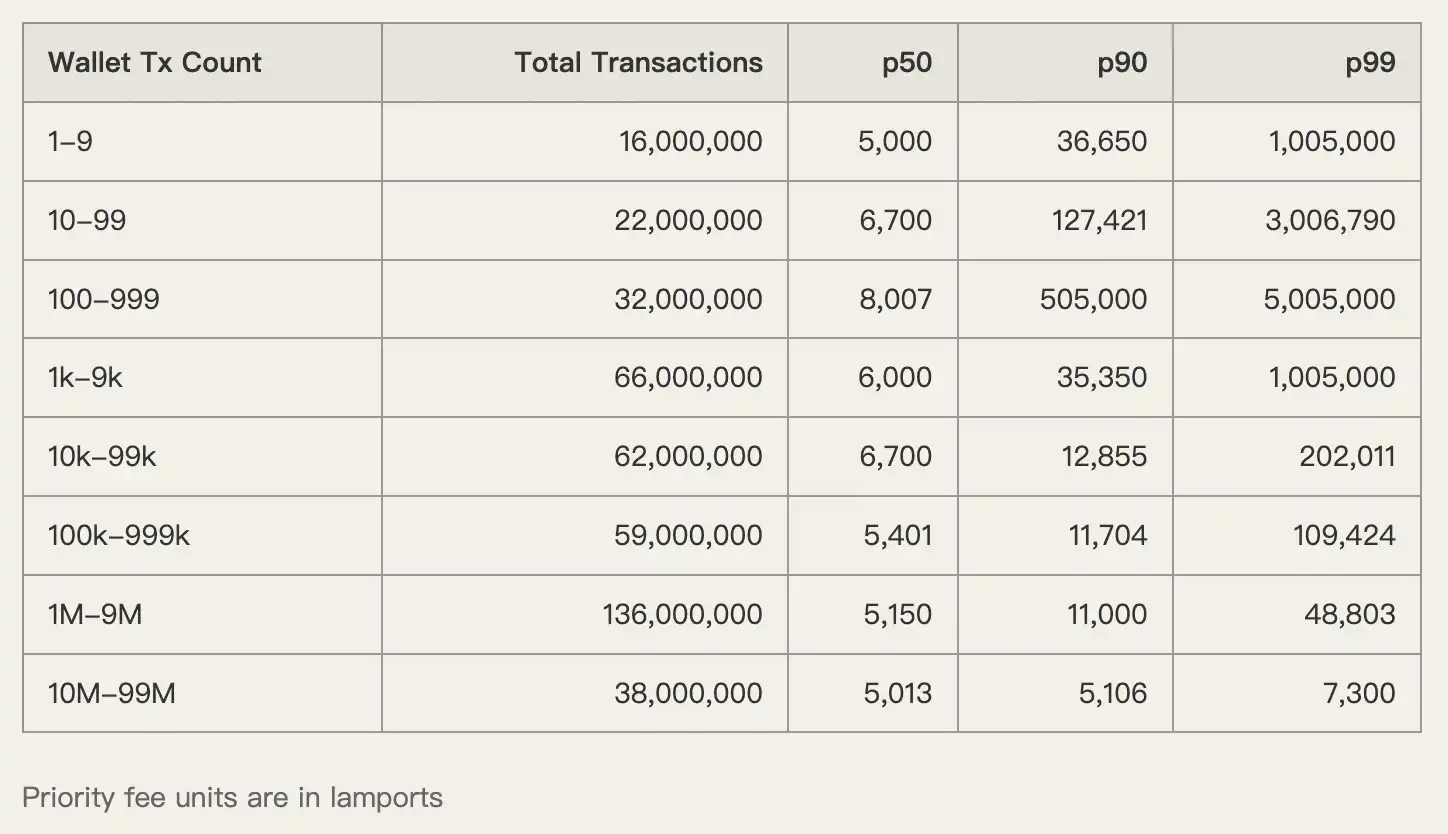
The situation is similar with Tips.

Axiom users pay tips on landing services like Nozomi and Zero Slot that far exceed the market average. The application side takes advantage of users' extreme sensitivity to "speed" and, without any negative feedback, completes this double charging of users.
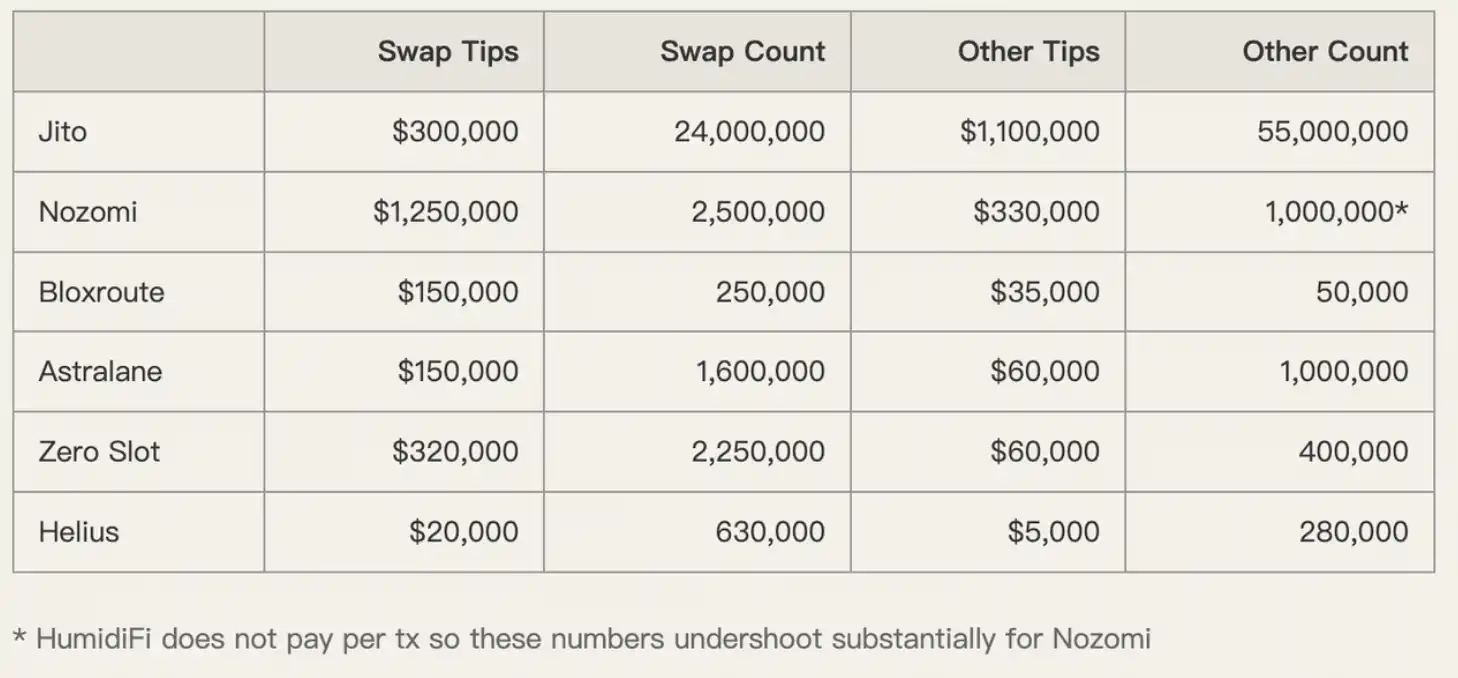
The author speculates bluntly: "The vast majority of transaction fees paid by Axiom users ultimately end up back in the pockets of the Axiom team."

Recapturing Fee Pricing Power

The severe misalignment between user incentives and application incentives is the root cause of the current chaos. Users don't know what a reasonable fee is, and the application side is happy to maintain this chaos.

To break this situation, we need to start with the underlying market structure. The anticipated introduction of Multiple Concurrent Proposers (MCP) and Priority Ordering mechanism around 2026, along with the widely proposed dynamic base fee mechanism, might be the ultimate solution.

Multiple Concurrent Proposers (MCP)

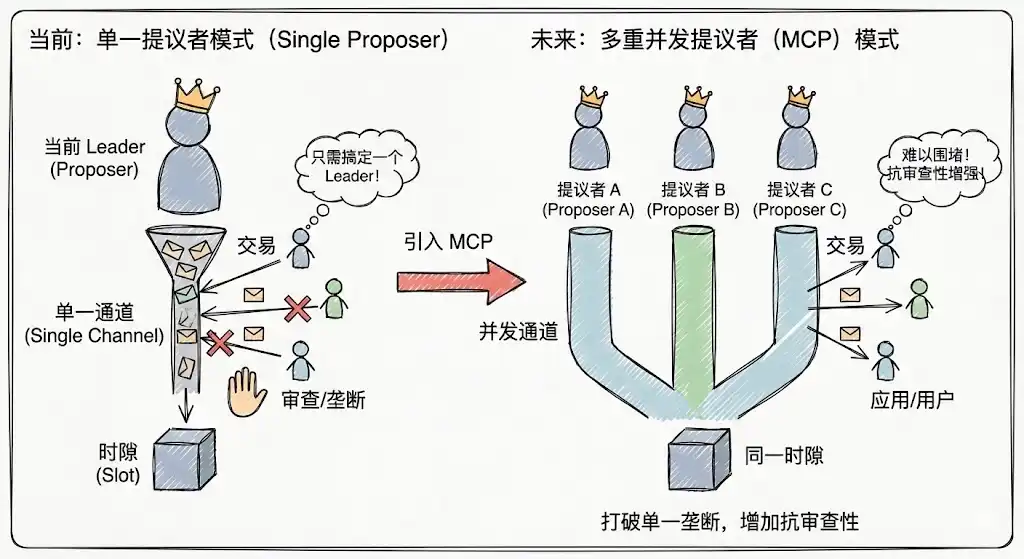
Solana's current single proposer model is prone to forming temporary monopolies. The application side only needs to deal with the current Leader to control transaction packaging rights for a short time. Introducing MCP means multiple proposers work concurrently per slot, significantly increasing the cost of attacks and monopolization, enhancing anti-censorship, and making it harder for the application side to corner users by controlling a single node.
Priority Ordering Mechanism

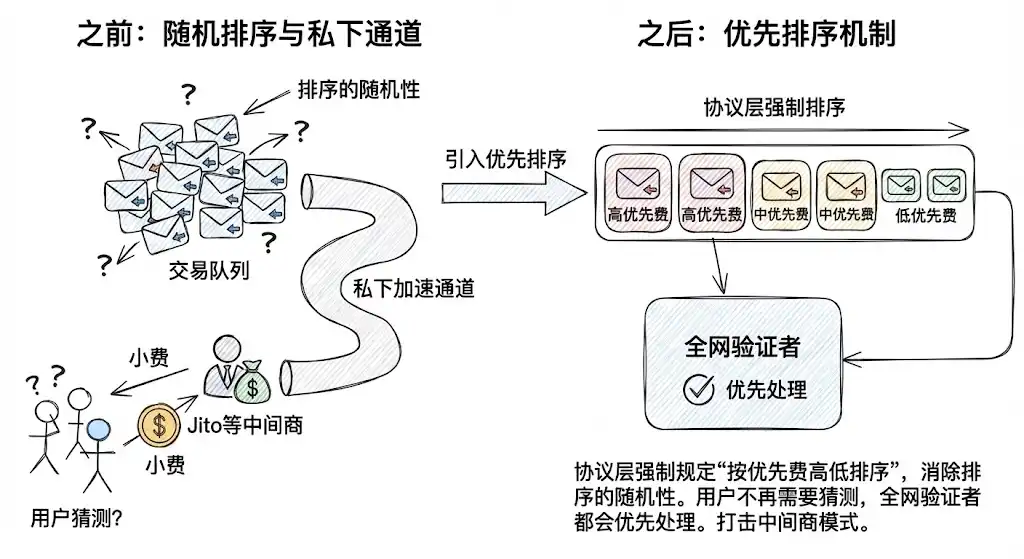
Mandating "sorting by priority fee height" at the protocol layer eliminates sorting randomness (Jitter). This weakens the user's need to rely solely on private acceleration channels like Jito just to "guarantee" transaction success. For ordinary transactions, users no longer need to guess how much tip to give; as long as they pay within the protocol, all network validators will prioritize processing based on deterministic rules.
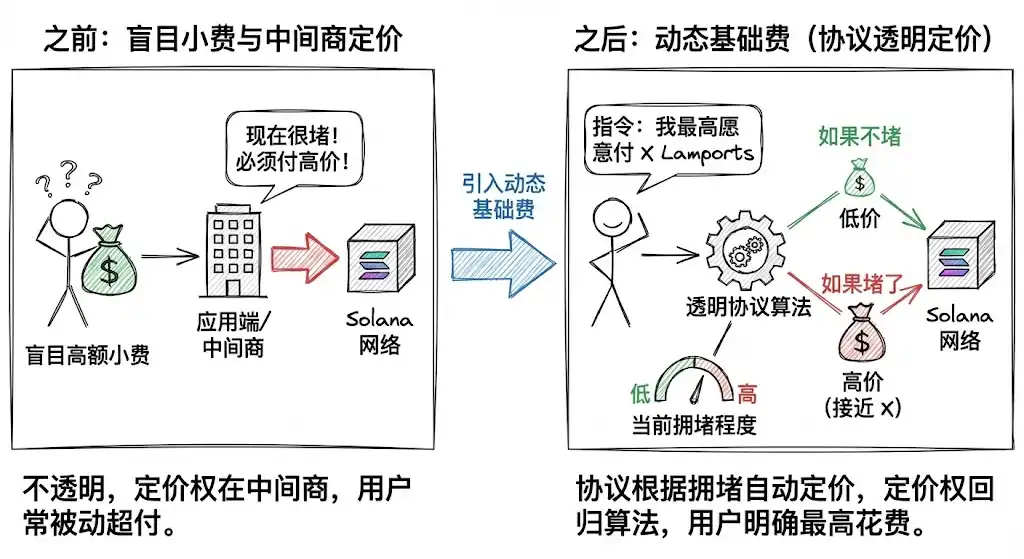
Dynamic Base Fee

This is the most critical step. Solana is trying to introduce a concept similar to Ethereum's Dynamic Base Fee.

Users no longer blindly give tips but explicitly instruct the protocol: "I am willing to pay a maximum of X Lamports for this transaction to land on-chain."

The protocol automatically prices based on current congestion levels. If it's not congested, it charges a low price; only if it's congested does it charge a high price. This mechanism takes the pricing power of fees away from the application side and middlemen and returns it to the transparent protocol algorithm.
Memes brought prosperity to Solana but also left behind a浮躁的逐利基因 (floating, profit-chasing gene). For Solana to truly realize the vision of ICM (Internet Commodity Market), it cannot let applications controlling front-end traffic and protocols controlling infrastructure act in collusion and do whatever they want.

As the saying goes, "clean the house before inviting guests." Only through underlying technological architecture upgrades, using technical means to eradicate the soil for rent-seeking, and developing a fair, transparent market structure that prioritizes user welfare, can Solana truly possess the confidence to integrate and compete with the traditional financial system.


Questions liées

QWhat is Payment for Order Flow (PFOF) and how is it being applied on Solana?

APayment for Order Flow (PFOF) is a business model where brokers (or, in Solana's case, front-end applications) sell their users' order flow to market makers for a fee. On Solana, applications can sell access to their users, often through mechanisms like RFQ (Request for Quote), where orders are routed to specific market makers. This allows applications to earn connection fees or sell bulk retail order flow, similar to how Robinhood operates in traditional finance.

QHow do front-end applications on Solana potentially exploit users through transaction fees?

AFront-end applications on Solana can exploit users by inducing them to pay excessive priority fees and tips, far beyond what is necessary for on-chain processing. They may intentionally slow down transactions to maximize backrun arbitrage value, route users to less liquid pools to create larger price swings, or collude with landing services to pocket the excess fees users pay for 'guaranteed' transaction inclusion.

QWhat role do 'landing services' like Jito play in the Solana fee market?

ALanding services like Jito act as 'VIP channels' on Solana, offering optimized pathways to ensure transactions are included in blocks, especially during network congestion. They receive tips from users and decide how much to rebate to the application that routed the transaction. This creates a rent-seeking opportunity where applications and landing services can share the溢价 (premium) paid by users.

QWhat data evidence suggests that Axiom users are being overcharged for transactions?

AData shows that Axiom users pay a median (p50) priority fee of 1,005,000 lamports, which is about 200 times higher than the 5,000-6,000 lamports paid by high-frequency trading wallets. Additionally, Axiom users pay tips on landing services like Nozomi and Zero Slot that are significantly above market averages, indicating systematic overcharging with the excess fees likely flowing back to the Axiom team.

QWhat proposed Solana protocol upgrades aim to address the current fee market issues?

AKey proposed upgrades include Multiple Concurrent Proposers (MCP) to prevent temporary monopolies and increase anti-censorship, Priority Ordering to enforce deterministic transaction sorting based on fees and reduce reliance on private acceleration channels, and a Dynamic Base Fee mechanism to transparently price transactions based on network congestion, returning fee定价权 (pricing power) to the protocol algorithm rather than applications and middlemen.

Lectures associées

Trading

Spot
Futures

Articles tendance

Qu'est ce que SOLANA

HarryPotterWifHatMyroWynn10Inu,$solana : Une plongée dans le projet de monnaie meme tendance Introduction Dans le paysage en constante évolution des cryptomonnaies, des projets innovants émergent continuellement, capturant l'imagination des investisseurs et des passionnés. L'un de ces projets est HarryPotterWifHatMyroWynn10Inu,$solana, une monnaie meme qui commence à se tailler une place au sein de la communauté crypto. Cet article vise à vous fournir un aperçu complet du projet, en éclaircissant son objectif, son architecture, son créateur, ses investisseurs et ses jalons notables tout au long du parcours. Qu'est-ce que HarryPotterWifHatMyroWynn10Inu,$solana ? Aperçu HarryPotterWifHatMyroWynn10Inu,$solana est un projet de monnaie meme structuré sur la blockchain Solana – une plateforme reconnue pour sa scalabilité et sa rapidité. Voulant apporter joie et créativité dans l'espace crypto, ce projet sert non seulement de jeton de trading mais aussi de catalyseur pour la génération et le partage de contenu meme. La communauté au cœur de ce projet est encouragée à participer activement, fournissant un écosystème dynamique où créativité et collaboration prospèrent. Objectifs À son essence, le projet vise à favoriser un environnement où les passionnés de memes peuvent se regrouper, partager et créer du contenu meme novateur. Cette approche axée sur le récit infuse de l'excitation au sein de la communauté, stimulant l'engagement tout en mettant en lumière les fonctionnalités robustes inhérentes à la blockchain Solana. En construisant un projet axé sur la communauté, HarryPotterWifHatMyroWynn10Inu,$solana souhaite également explorer l'impact social des monnaies numériques comme moyen d'expression. Qui est le créateur de HarryPotterWifHatMyroWynn10Inu,$solana ? L'identité du créateur derrière HarryPotterWifHatMyroWynn10Inu,$solana demeure entourée de mystère. Le projet a été structuré de manière à ce que la propriété ait été renoncée ; par conséquent, il prospère en tant qu'initiative dirigée par la communauté. Cette décentralisation favorise la transparence et la participation démocratique parmi tous les intervenants concernés. Une telle approche est de plus en plus populaire dans le monde des monnaies meme, où l'engagement communautaire règne en maître. Qui sont les investisseurs de HarryPotterWifHatMyroWynn10Inu,$solana ? À ce jour, il n'y a pas d'informations publiquement disponibles concernant les investisseurs ou fondations spécifiques soutenant HarryPotterWifHatMyroWynn10Inu,$solana. L'absence d'investisseurs connus souligne encore plus l'éthos communautaire du projet, qui reste indépendant des cadres financiers traditionnels. Cette indépendance permet au projet de développer son identité sans pressions externes, comptant plutôt sur l'intérêt collectif de sa base d'utilisateurs. Comment fonctionne HarryPotterWifHatMyroWynn10Inu,$solana ? Modèle économique Le projet utilise un modèle économique unique qui sous-tend sa fonctionnalité et l'engagement des utilisateurs. Les transactions au sein de HarryPotterWifHatMyroWynn10Inu,$solana sont conçues pour être bénéfiques pour toutes les parties impliquées. Chaque échange entraîne des frais, qui sont ensuite redistribués parmi les détenteurs actuels tout en augmentant simultanément la réserve de liquidités. Les composants clés de ce modèle incluent : Mécanisme de réflexion : Une partie des frais de transaction est renvoyée aux détenteurs, favorisant un investissement à long terme dans le jeton. Acquisition de pool de liquidité : Des fonds sont alloués pour améliorer la liquidité, garantissant que les opérations d'achat et de vente peuvent être exécutées en douceur. Mécanismes de brûlage : Une partie des jetons peut être brûlée pour créer de la rareté, augmentant potentiellement la valeur à mesure que la demande augmente. Cette conception encourage un écosystème auto-suffisant qui s'épanouit grâce aux interactions et aux investissements communautaires. Engagement communautaire <pau cœur de harrypotterwifhatmyrowynn10inu,$solana se trouve la valeur attribuée à l'engagement communautaire. en permettant aux utilisateurs participer au développement du projet par le biais diverses activités, telles que création memes et des promotions, favorise un écosystème dynamique où créativité peut prospérer. Chronologie de HarryPotterWifHatMyroWynn10Inu,$solana La trajectoire de HarryPotterWifHatMyroWynn10Inu,$solana présente plusieurs événements notables qui ont façonné son statut actuel au sein de la communauté crypto : Création : La date spécifique de création reste non divulguée, mais l'origine du projet est ancrée dans la culture meme qui imprègne l'ère numérique. Prenant en charge par la communauté : Suite à la renonciation de la propriété par son créateur, le projet a fait la transition vers un modèle dirigé par la communauté, permettant à tous les participants d'avoir un intérêt dans son succès. Audit et collection NFT : Dans un effort pour renforcer sa crédibilité, le projet a effectué un audit complet, tout en lançant simultanément une collection NFT qui incarne son ethos axé sur les memes. Partenariats et développement : Le projet est actuellement en train de chercher des partenariats potentiels avec d'autres jetons et d'organiser le développement d'un site web unique et des options de merchandising basées sur ses memes légendaires. Points clés En résumé, HarryPotterWifHatMyroWynn10Inu,$solana se positionne comme un acteur remarquable dans le secteur des monnaies meme de la cryptomonnaie. Voici quelques points clés à retenir : Initiative dirigée par la communauté : Le projet prospère grâce à un effort collaboratif, encourageant les contributions actives de ses membres tout en s'éloignant des revendications de propriété. Modèle économique innovant : En utilisant des mécanismes de réflexion, d'acquisition de liquidité et de brûlage, il crée un environnement financier robuste et engageant pour les utilisateurs. Engagement NFT et merchandising : Avec le lancement d'une collection NFT, le projet cherche à approfondir l'engagement au sein de sa communauté, renforçant le lien entre la culture meme et la monnaie numérique. Exploration des partenariats : L'initiative n'est pas stagnante - le développement en cours et les partenariats potentiels indiquent une approche tournée vers l'avenir visant une croissance soutenue. Conclusion Alors que HarryPotterWifHatMyroWynn10Inu,$solana continue de gagner en traction dans le paysage des cryptomonnaies, son mélange unique d'engagement communautaire, de structures économiques innovantes et d'intégration de la culture meme dessine son chemin potentiel à suivre. Même avec le mystère qui entoure ses origines et ses affiliations d'investisseur, le projet capture une histoire intrigante qui parle à l'essence de l'innovation décentralisée. Dans un monde où les cryptomonnaies sont souvent perçues à travers un prisme purement financier, HarryPotterWifHatMyroWynn10Inu,$solana démontre que le mouvement crypto intègre créativité, communauté et collaboration. Que vous soyez un investisseur chevronné ou un nouvel arrivant, le parcours qui se déploie de ce projet de monnaie meme constitue certainement une étude de cas engageante digne d'attention.

999 vues totalesPublié le 2024.04.04Mis à jour le 2024.12.03

Qu'est ce que SOLANA

Qu'est ce que SOLANA 2.0

BarbieCrashBandicootRFK777Inu, $SOLANA 2.0 : Un Nouveau Acteur dans le Paysage Crypto Introduction à BarbieCrashBandicootRFK777Inu, $SOLANA 2.0 Dans le paysage en constante évolution des cryptomonnaies, de nouveaux entrants captent continuellement l'attention des investisseurs et des passionnés. Parmi ces projets émergents se trouve BarbieCrashBandicootRFK777Inu, représenté par le symbole de cryptomonnaie $SOLANA 2.0. Cette initiative unique combine des éléments de glamour, d'aventure et de culture des memes, cherchant à défier les attentes dans une arène hautement compétitive. Avec des aspirations de croissance et d'innovation, ce projet capture l'esprit d'un outsider luttant contre des géants établis. Qu'est-ce que BarbieCrashBandicootRFK777Inu, $SOLANA 2.0 ? Au cœur de BarbieCrashBandicootRFK777Inu se trouve un projet de cryptomonnaie qui s'inspire de diverses références culturelles emblématiques. En intégrant l'élégance et le charme associés à Barbie, l'énergie dynamique de Crash Bandicoot et la volonté acharnée représentée par RFK, le projet vise à offrir une expérience multifacette dans le monde des cryptomonnaies. L'objectif principal du projet BarbieCrashBandicootRFK777Inu est de fusionner ces éléments disparates en un écosystème cohérent qui attire un large public. En embrassant la fantaisie de la culture des memes tout en restant ancré dans les principes de décentralisation et d'autonomisation financière, le projet s'est positionné comme une option séduisante tant pour les investisseurs chevronnés que pour les nouveaux venus dans le monde crypto. Qui est le Créateur de BarbieCrashBandicootRFK777Inu, $SOLANA 2.0 ? Malgré l'intérêt croissant pour BarbieCrashBandicootRFK777Inu, les informations concernant son créateur restent largement inconnues. L'anonymat de son fondateur ou de son équipe de développement soulève des questions sur la structure et la gouvernance du projet. Dans le monde des cryptomonnaies, il n'est pas rare que des projets fonctionnent sans créateurs au visage public. Ce manque d'informations pourrait dissuader certains investisseurs potentiels, tandis que d'autres pourraient y voir une opportunité d'embrasser l'esprit de décentralisation qui sous-tend de nombreuses initiatives en cryptomonnaie. Qui sont les Investisseurs de BarbieCrashBandicootRFK777Inu, $SOLANA 2.0 ? À ce jour, il y a peu d'informations disponibles sur les fondations d'investissement ou les organisations soutenant BarbieCrashBandicootRFK777Inu. Le manque de soutien d'investissement détaillé du projet met en évidence la nature indépendante de nombreuses cryptomonnaies. Dans ce cas, il reste à voir si le financement du projet proviendra d'un soutien communautaire de base ou du soutien d'entités financières plus importantes. Comment Fonctionne BarbieCrashBandicootRFK777Inu, $SOLANA 2.0 ? BarbieCrashBandicootRFK777Inu est conçu avec un certain nombre de fonctionnalités qui contribuent à son unicité dans l'espace crypto saturé. Bien que des détails techniques spécifiques restent confidentiels, le projet devrait incorporer des fonctionnalités destinées à améliorer l'engagement des utilisateurs et à favoriser la croissance de la communauté. La combinaison d'influences variées – de la mode et de l'aventure aux jeux – encourage une atmosphère inclusive qui répond à des intérêts divers. De plus, les liens du projet avec l'écosystème $SOLANA 2.0 suggèrent des avantages technologiques potentiels. Cela pourrait inclure des vitesses de transaction innovantes, une évolutivité et un rapport coût-efficacité, en accord avec les capacités techniques de la blockchain Solana. Les fondateurs du projet semblent s'appuyer sur cette fondation technologique pour créer une expérience communautaire durable et une offre de produits substantielle. Chronologie de BarbieCrashBandicootRFK777Inu, $SOLANA 2.0 Le parcours de BarbieCrashBandicootRFK777Inu contient plusieurs jalons clés, offrant un aperçu du développement du projet jusqu'à présent : Conceptualisation du Projet : Des idées initiales ont émergé autour de la fusion du glamour, de l'aventure et de la culture des memes, fournissant le cadre pour le concept unique du projet. Création du Token : Le jeton symbolique $SOLANA 2.0 a été établi, conçu pour incarné les aspirations du projet et attirer l'intérêt des investisseurs potentiels. Développement du Projet : Actuellement, le projet est en cours de développement, avec un accent sur le défi aux acteurs établis dans l'espace crypto et la fourniture d'offres innovantes. Ces jalons reflètent la trajectoire de croissance du projet tout en mettant en évidence son engagement envers le développement d'une expérience pionnière en cryptomonnaie. Points Clés Sur BarbieCrashBandicootRFK777Inu, $SOLANA 2.0 Concept Unique : BarbieCrashBandicootRFK777Inu se distingue en fusionnant des éléments de glamour, d'aventure et de culture des memes en un seul projet de cryptomonnaie. Esprit d'Outsider : Le projet adopte une persona d'outsider, visant à défier les projets de cryptomonnaies établis et à se tailler une niche dans l'industrie. Phase de Développement : Des efforts de développement actifs sont en cours, avec l'intention de fournir des offres fraîches et innovantes en accord avec les attentes de la communauté et des investisseurs. Conclusion BarbieCrashBandicootRFK777Inu, représenté par le symbole $SOLANA 2.0, est un nouvel entrant intrigant dans le marché des cryptomonnaies. Son mélange unique de références culturelles et sa vision ambitieuse peuvent résonner avec ceux qui recherchent des valeurs de projet alternatives dans le paysage crypto. Bien que le statut inconnu de son créateur et de ses investisseurs puisse susciter des interrogations, l'accent mis par le projet sur le charme et l'aventure présente un récit captivant qui élargit les frontières de ce que les cryptomonnaies peuvent incarner. À mesure que le projet continue de se développer, il sera intéressant d'observer son évolution au sein du paysage crypto plus large et comment il se positionne parmi ses concurrents. Pour ceux qui sont impliqués, BarbieCrashBandicootRFK777Inu pourrait bien offrir des expériences surprenantes qui redéfinissent l'engagement avec les actifs numériques. Pour l'instant, alors que le projet progresse, son parcours se dresse comme un rappel que l'innovation dans l'espace crypto ne connaît pas de limites, offrant tout, de l'excitation et du divertissement à la possibilité d'autonomisation financière.

185 vues totalesPublié le 2024.04.05Mis à jour le 2024.12.03

Qu'est ce que SOLANA 2.0

Comment acheter SOL

Bienvenue sur HTX.com ! Nous vous permettons d'acheter Solana (SOL) de manière simple et pratique. Suivez notre guide étape par étape pour commencer votre parcours crypto.Étape 1 : Création de votre compte HTXUtilisez votre adresse e-mail ou votre numéro de téléphone pour ouvrir un compte sur HTX gratuitement. L'inscription se fait en toute simplicité et débloque toutes les fonctionnalités.Créer mon compteÉtape 2 : Choix du mode de paiement (rubrique Acheter des cryptosCarte de crédit/débit : utilisez votre carte Visa ou Mastercard pour acheter instantanément Solana (SOL).Solde :utilisez les fonds du solde de votre compte HTX pour trader en toute simplicité.Prestataire tiers :pour accroître la commodité d'utilisation, nous avons ajouté des modes de paiement populaires tels que Google Pay et Apple Pay.P2P :tradez directement avec d'autres utilisateurs sur HTX.OTC (de gré à gré) : nous offrons des services personnalisés et des taux de change compétitifs aux traders.Étape 3 : stockage de vos Solana (SOL)Après avoir acheté vos Solana (SOL), stockez-les sur votre compte HTX. Vous pouvez également les envoyer ailleurs via un transfert sur la blockchain ou les utiliser pour trader d'autres cryptos.Étape 4 : tradez des Solana (SOL)Tradez facilement Solana (SOL) sur le marché Spot de HTX. Il vous suffit d'accéder à votre compte, de sélectionner la paire de trading, d'exécuter vos trades et de les suivre en temps réel. Nous offrons une expérience conviviale aux débutants comme aux traders chevronnés.

1.9k vues totalesPublié le 2024.12.12Mis à jour le 2025.03.21

Comment acheter SOL

Discussions

Bienvenue dans la Communauté HTX. Ici, vous pouvez vous tenir informé(e) des derniers développements de la plateforme et accéder à des analyses de marché professionnelles. Les opinions des utilisateurs sur le prix de SOL (SOL) sont présentées ci-dessous.

活动图片