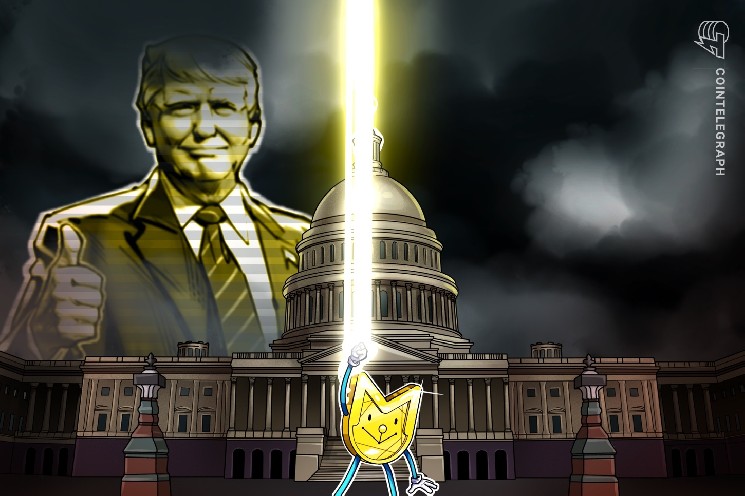
Senator Warren Launches New Probe Targeting Tether And Commerce Secretary Lutnick

bitcoinistPublié le 2026-05-01Dernière mise à jour le 2026-05-01

Senator Elizabeth Warren, one of the most prominent crypto skeptics in Washington, is now focusing her scrutiny on Tether and the man leading the Department of Commerce.

In a new probe framed around alleged national security concerns, Warren and Senator Ron Wyden have asked Commerce Secretary Howard Lutnick to respond to reports that Tether provided a loan connected to a foreign stablecoin arrangement involving a trust that benefits Lutnick’s four children.

Senators Probe Lutnick’s Link To Tether

The issue, according to Bloomberg reporting and the letter sent by the senators, centers on the timing of Lutnick’s Cantor Fitzgerald divestiture and a subsequent credit filing in New York.

The lawmakers point out that Bloomberg reported Lutnick sold his Cantor Fitzgerald stake to his children the day after divesting it, following his previous ownership of what was described as a “multi-billion dollar position.”

Then, one day later—October 7,2025—a credit document was filed in New York indicating that Tether lent an undisclosed amount to a trust called “Dynasty Trust A.” The letter states that Lutnick’s four children are the beneficiaries of that trust.

Warren and Wyden argue the arrangement, if accurate, would raise serious questions about the relationship between Lutnick and the crypto company and about whether Tether could have influenced policy decisions made by a Cabinet secretary.

In their letter, the senators say they want to be sure Tether did not seek to bribe or exert control or influence over Lutnick. They also suggest that the reported loan may have helped provide capital for Lutnick’s sons to purchase his Cantor Fitzgerald stake, while Tether, in return, gained an interest in assets held by the children through the trust.

‘Favorable Treatment’ In The GENIUS Act?

The senators’ concern is not limited to corporate connections alone. The letter describes Tether as being viewed by critics as a “dream currency” for money laundering and says the Department of Justice (DOJ) was reportedly investigating Tether over possible violations of sanctions and anti-money laundering rules.

Against that backdrop, the lawmakers say the reported loan becomes even more troubling given Lutnick’s close relationship with Tether before his nomination and what the letter calls the favorable treatment Tether received in the GENIUS Act, the country’s first stablecoin bill signed by President Trump last July.

In seeking answers, the lawmakers ask Lutnick to address eight specific questions by May 13. Among the questions, they ask whether he was aware that Tether provided a loan to Dynasty Trust A, describing that trust as one for the benefit of his four children, and, if so, to explain his role in procuring, soliciting, and/or negotiating the loan.

They also ask whether the loan financed the divestiture of his Cantor Fitzgerald stake and to provide the size and terms of the loan, along with a copy of the credit document.

The senators further ask whether Lutnick agreed—either explicitly or implicitly—to use his position as Commerce Secretary to benefit Tether in exchange for a loan that facilitated his children’s acquisition of his Cantor stake.

They also request information about other sources of financing for the divestiture, including what other funding provided capital to Dynasty Trust A or any related legal entities involved in the divestiture, aside from Tether.

The daily chart shows the total digital asset market cap at $2.5 trillion as of Thursday. Source: TOTAL on TradingView.com

Featured image from OpenArt, chart from TradingView.com
Lectures associées

Peter Schiff estime que Michael Saylor pourrait vendre encore plus de bitcoins

Peter Schiff estime que Michael Saylor pourrait devoir vendre davantage de bitcoins et d'actions de sa société, MicroStrategy (MSTR), si celle-ci veut relever le cours de ses actions privilégiées (STRC) à l'objectif de 100$. Actuellement, les STRC se négocient sous les 95$, malgré les rachats d'actions financés par la vente d'actifs. Début août, MicroStrategy a vendu 1 637 bitcoins pour 102 millions de dollars et a utilisé ces fonds pour racheter environ 1,15 million d'actions STRC. La société a également cédé 6,59 millions d'actions MSTR pour 653,1 millions de dollars, portant ses réserves en dollars à environ 4,65 milliards. Schiff soutient que de nouvelles ventes de bitcoins et d'actions MSTR pour soutenir le cours des STRC exerceraient une pression supplémentaire sur le bitcoin, qui perdrait alors encore face à l'or. Selon lui, la récente faiblesse du bitcoin est liée à la hausse du prix de l'or, qui a dépassé les 4 300$, tandis que le bitcoin est tombé autour de 62 000$. L'économiste prévoit une nouvelle appréciation de l'or, ce qui pèserait davantage sur le bitcoin. Cependant, des données récentes du marché du travail américain, plus faibles, ont renforcé les anticipations d'un assouplissement de la politique de la Fed, ce qui pourrait offrir un soutien temporaire aux actifs risqués comme les cryptomonnaies.

cryptonews.ruIl y a 2 mins

Peter Schiff estime que Michael Saylor pourrait vendre encore plus de bitcoins

cryptonews.ruIl y a 2 mins

Sur les réseaux sociaux, on "enterre" le Bitcoin. Que signifie cela pour le cours de la cryptomonnaie ?

Les discussions sur la « mort » du Bitcoin se multiplient sur les réseaux sociaux (X, Reddit, Telegram), selon la plateforme d'analyse Santiment. Cette vague de pessimisme, marquée par des termes comme "mort", "fini" ou "c'est la fin", est souvent interprétée comme un signal contraire : historiquement, de tels pics de négativité ont précédé des renversements de tendance du marché. Les experts estiment que ce sentiment reflète l'impatience et le découragement des petits investisseurs face à une phase de faiblesse prolongée, les amenant à voir un échec inévitable. Cependant, Santiment note que lorsque ce discours funèbre émerge alors que le Bitcoin maintient des niveaux clés, les acteurs forts ("strong hands") continuent d'accumuler, créant une opportunité pour les acheteurs patients. Actuellement (14 août), le marché évolue dans un contexte de "peur" (indice à 29), avec une faible volatilité, des volumes d'échanges au plus bas depuis 2019 et des sorties massives de capitaux des ETF Bitcoin (plus de 4,7 milliards de dollars depuis janvier). Le cours du Bitcoin, en baisse d'environ 30% depuis le début de l'année et de 50% depuis son record d'octobre dernier, stagne dans un étroit corridor entre 60 000 et 66 000 dollars depuis juin. Ce pessimisme ambiant persiste malgré le fait que des phases similaires aient, par le passé, souvent marqué un point d'épuisement des ventes avant un rebond.

cryptonews.ruIl y a 3 mins

Sur les réseaux sociaux, on "enterre" le Bitcoin. Que signifie cela pour le cours de la cryptomonnaie ?

cryptonews.ruIl y a 3 mins

Trading

Spot
活动图片