Self-Directed Insider Trading: How He Manipulated Prediction Markets to Pay for His Bugatti?

比推Publié le 2026-03-11Dernière mise à jour le 2026-03-11

Résumé

A prominent X user, @Euanker, has accused former kickboxing champion Andrew Tate of orchestrating an elaborate insider trading scheme on the prediction market platform Polymarket. The allegations claim that Tate controlled at least seven accounts to profit from markets predicting his own weekly tweet activity, earning a total of $52,286. On-chain evidence reveals a consistent funding path: deposits from exchanges like Duelbits and Bybit were bridged via a specific address, then used to place bets on Polymarket. Profits were ultimately funneled to a Gnosis Safe wallet controlled by Tate, which holds over $1.3 million in assets. The betting patterns closely aligned with Tate’s actual tweet activity, indicating manipulation. Andrew Tate, a controversial influencer known for his luxury lifestyle and previous involvement in meme coin promotions, is alleged to have used this scheme to fund expenses like his rented Bugatti. The incident highlights significant regulatory gaps in prediction markets, where outcomes controlled by a single individual create inherent insider risks. Polymarket, which approves all markets on its platform, faces scrutiny over its lack of safeguards against such manipulation.

Author: Ma He, Foresight News

Original Title: Funding a Bugatti with Polymarket? Someone is Playing 'Self-Directed' Insider Trading


On March 10, X user @Euanker posted an exposé alleging that renowned combat sports champion Andrew Tate was involved in insider trading on Polymarket, profiting by manipulating markets related to the quantity of his personal tweets. Euanker pointed out that Tate created and controlled at least 7 Polymarket accounts, accumulating profits of $52,286 across six 'Weekly Tweet Count Prediction' markets. These markets essentially depend on Tate's own actions, with the exposé bluntly stating his aim was to 'raise funds for a rented Bugatti sports car.'
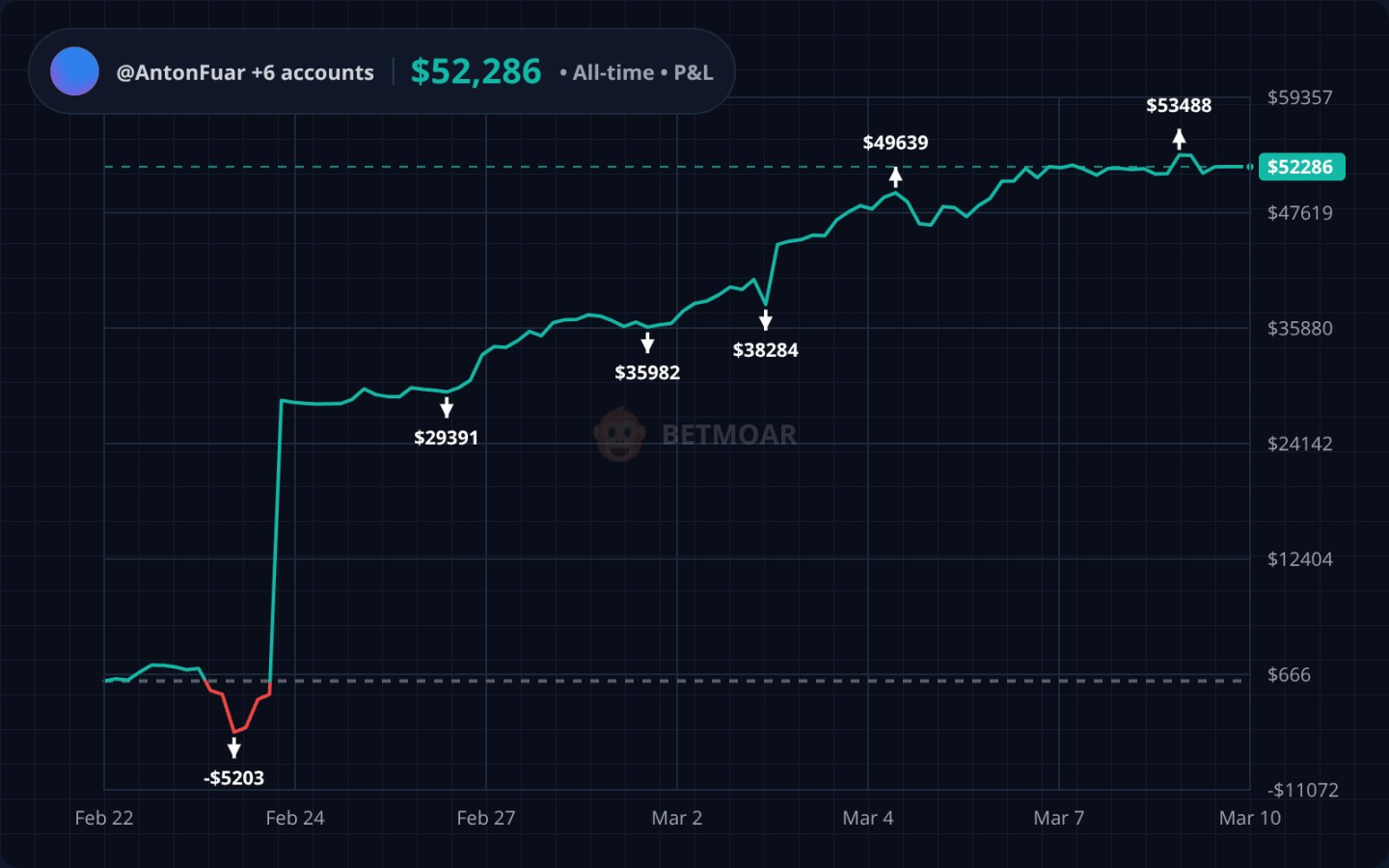
Interestingly, this exposé included detailed on-chain evidence and profit charts, allowing us a glimpse into the specifics of this insider trading.

Detailed Explanation of On-Chain Address Records: Identical Deposit Paths

The evidence provided by Euanker shows that the 7 Polymarket accounts (@Tornados, @eterboh5, @Mellisacars, @AntonFuar, @wondernot, @Lindayko, @Counteryeg) were highly consistent in their deposit exchanges, fund paths, and betting habits. The first 5 accounts have been fully linked through on-chain transactions, with the subsequent 2 also showing the same pattern.

The core tracking starts with the @Counteryeg account.
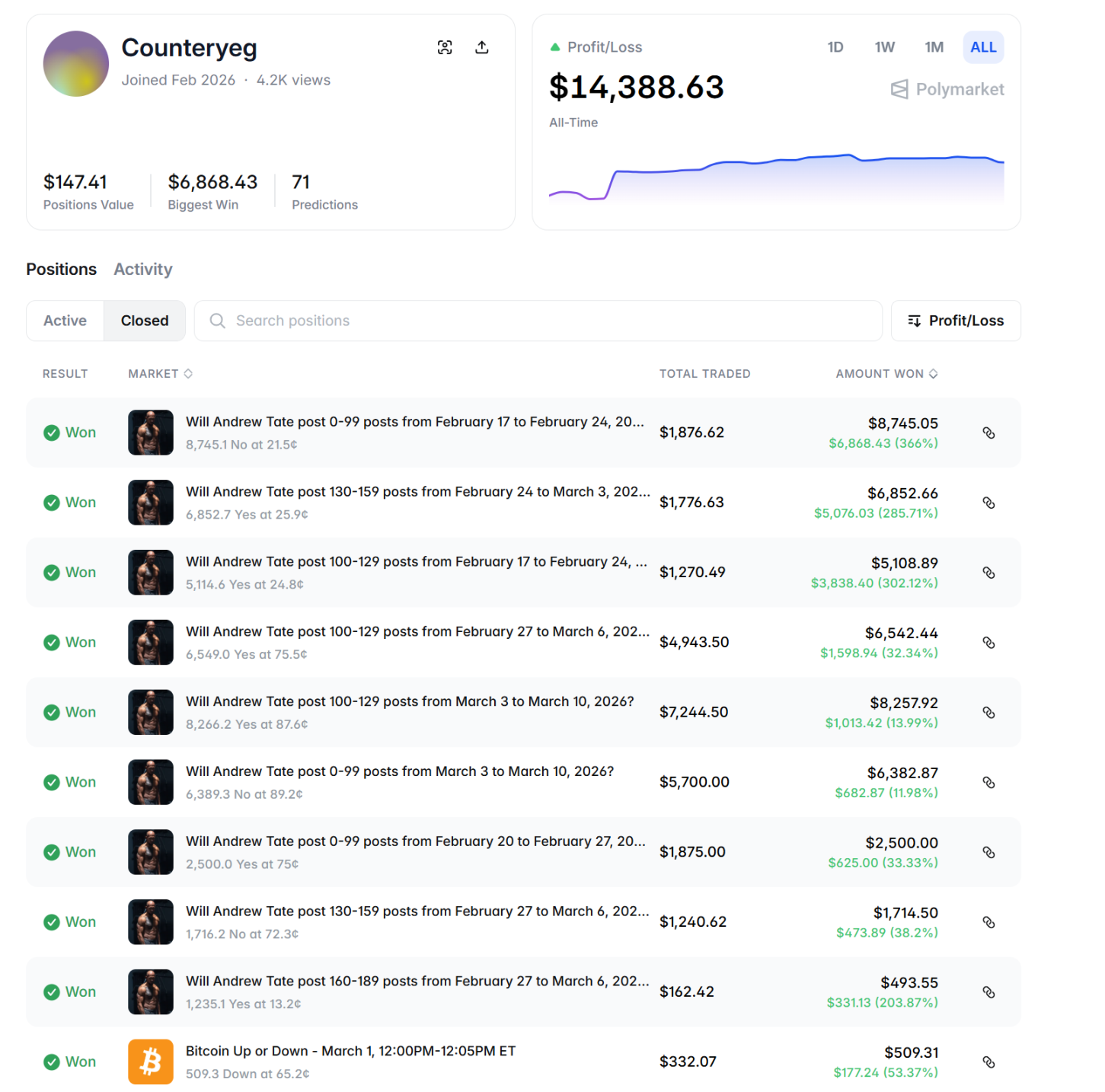

Its fund flow points to the bridging address 0xdae2844d5b3070aafb3638b80fa17e562d840dde. This address frequently conducted cross-chain transfers of USDC and USDC.e in the past week, primarily involving the Polygon and Ethereum networks. These funds were then transferred to the intermediary address 0x9D950Fb9D5F37a128bA0d4B82844DE96697fD83d.

Data from Arkham Intelligence for this address shows that in the past week, it received large USDC deposits from exchanges like Duelbits (a gambling platform), Changelly, and Bybit, accounting for 20%, 42%, and 26% respectively. Typical transactions include a 4000 USDC deposit from Duelbits, a 5700 USDC bridge withdrawal, and multiple transfers of 2500~6000 USDC to the upstream bridging address. The cumulative transaction volume of the address shows that the stablecoin flow rhythm highly coincides with Polymarket betting windows, presenting a unified pattern of 'large deposit first, precise betting second, profit aggregation after'.
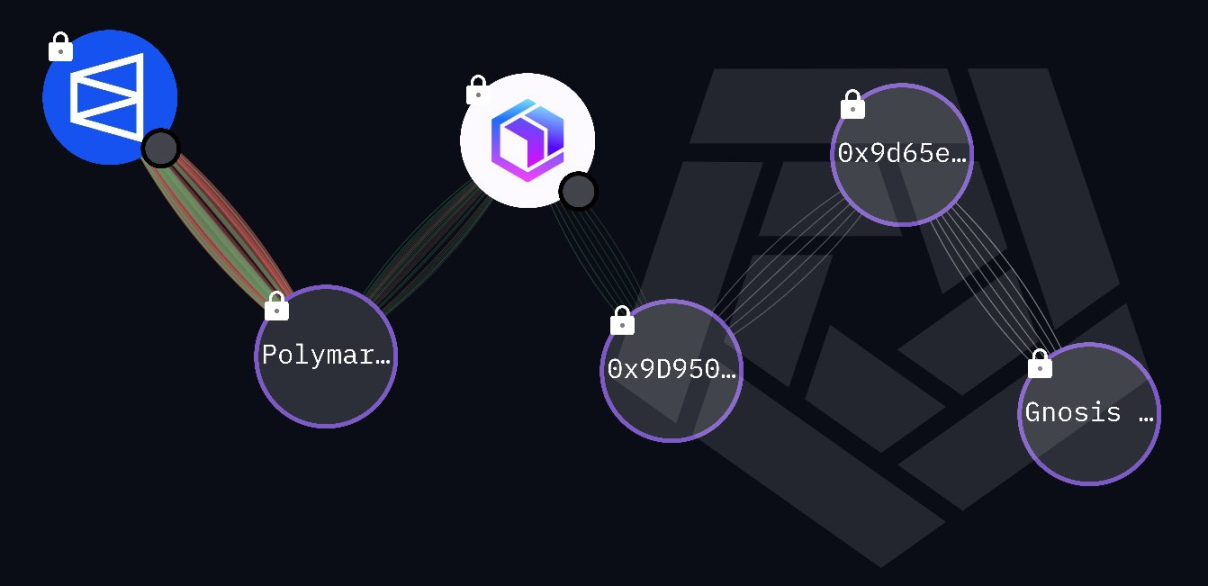
The final fund chain points to a Gnosis Safe multi-signature address (confirmed by the exposé and transaction graph as belonging to Tate). Arkham records show this Safe holds over $1.3 million in assets, with recent large USDT/USDC withdrawal operations.

The entire chain forms a closed loop: exchange deposit → bridging address transfer → Polymarket betting → profit aggregation to Tate's controlled Gnosis Safe.

The fund flow chart attached by Euanker clearly marks the Polymarket icon and the Gnosis Safe endpoint. A profit chart of the 7 accounts further corroborates, showing a rapid climb from an initial loss of $5,203 on February 22 to a cumulative peak of $52,286 on March 10, with multiple instances synchronized with Tate's public tweet timings. This level of consistency far exceeds coincidence. The identical combination of exchanges, same USDC bridging scale, and operational patterns precisely matching market settlement times constitute the core on-chain basis for the exposé's insider trading allegations.

From Luxury Cars and Mansions to Meme Coins, Fans Become Tools for Monetizing Influence

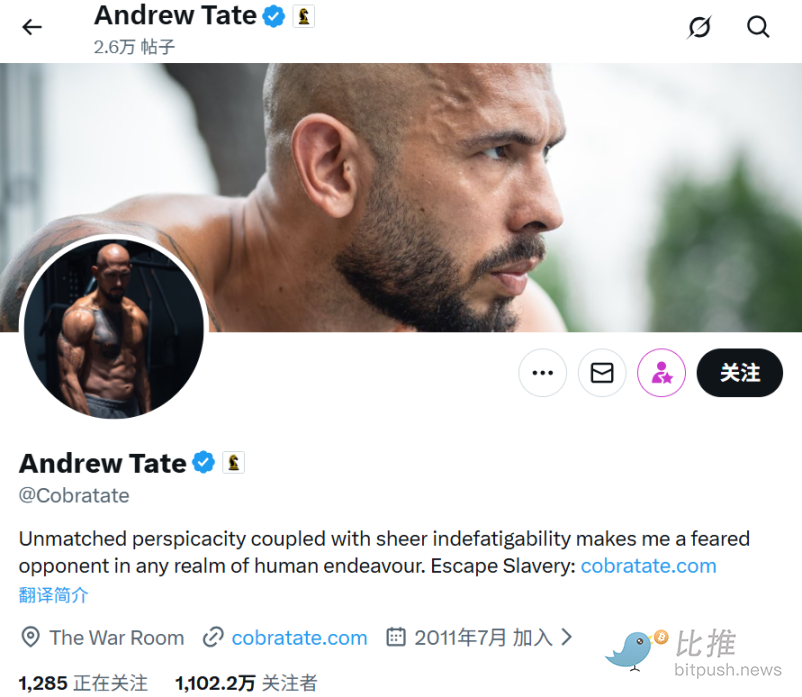
Andrew Tate (full name Emory Andrew Tate III), born in 1986, is a public figure, businessman, and former professional fighter with dual US and UK citizenship. Tate began his professional kickboxing career in 2005, winning multiple championships in the late 2000s to early 2010s, including the ISKA British Full-Contact Cruiserweight Championship (2009) and the ISKA World Championship (2011), claiming to be a four-time world champion. He is about 1.91 meters tall, with the nicknames 'Cobra Tate' or 'Top G'.

Andrew Tate has long presented a luxurious lifestyle; his名下 (owned) or rented multiple Bugatti sports cars and numerous mansions have long been the core of his personal brand. The term 'rented Bugatti' in the exposé恰好吻合 (perfectly matches) Tate's publicly flaunted pattern of luxury consumption.

He has repeatedly showcased high-end assets on social platforms, using this to reinforce his 'alpha male' persona and attract young male fans globally. After retiring, he shifted to online business and content creation, launching paid course platforms (like Hustler's University and War Room), teaching topics like wealth building, entrepreneurship, and mindset training, primarily attracting young male audiences.

Starting in 2022, he and his brother Tristan were arrested in Romania, facing charges of human trafficking, rape, and forming a criminal organization (related to recruiting women using the 'loverboy' method to produce adult content); the case is still ongoing. After the Romanian travel ban was lifted in late 2025, the two returned to the US. Currently, he also faces a UK civil lawsuit (four women alleging sexual violence and coercion), which has been moved up to Summer 2026. He denies all criminal and civil charges, calling them a political witch hunt against him.

Upon entering the crypto space, Tate further monetized his influence. He has issued multiple meme coins, the most representative being the DADDY series directly tied to his personal IP, achieving rapid monetization through fan-driven hype. Bubblemaps exposed that he had promoted over 10 shitcoins within 24 hours; after Bubblemaps revealed the insider information about DADDY token supply, Andrew subsequently blocked Bubblemaps.

These operations form a complete闭环 (closed loop) with this Polymarket incident: first, gather traffic with controversial statements and lifestyle, then directly extract funds from fans' wallets through prediction markets or meme coins. Whether it's luxury cars and mansions or meme coin issuance, the essence is the same monetization logic—converting personal fame into quantifiable cash flow.

This exposé once again reminds the crypto industry that prediction markets and the meme coin ecosystem under celebrity influence still have significant governance gaps. This incident points directly to structural deficiencies in Polymarket's market creation review process. For example, markets like 'Andrew Tate's Weekly Tweet Count' are created without effective门槛 (thresholds) to verify whether the market has objectivity or is susceptible to manipulation risk. The core value of prediction markets lies in aggregating分散 (dispersed) information for price discovery, but when the subject is entirely controlled by a single entity, information asymmetry is放大至极端 (amplified to an extreme). Tate could simply adjust his tweet frequency to influence market outcomes, while retail investors bet based on public information, unaware of the internal manipulation.
Previously, the author wrote an article titled 'He Made $300,000 Counting Musk's Tweets'. The prediction market tracked Elon Musk's tweet count; Musk himself is the world's richest man, a hard tech entrepreneur with no motive to profit from insider trading, while Andrew Tate might not be. Polymarket currently does not allow any individual user to directly create prediction markets. All markets are ultimately created by Polymarket's market team. If Polymarket does not strengthen market审查 (review), similar allegations are likely to continue to发酵 (ferment).


Twitter:https://twitter.com/BitpushNewsCN

Bitpush TG Discussion Group:https://t.me/BitPushCommunity

Bitpush TG Subscription: https://t.me/bitpush

Original article link:https://www.bitpush.news/articles/7618832

Questions liées

QWhat is Andrew Tate accused of doing on Polymarket according to the article?

AAndrew Tate is accused of engaging in insider trading on Polymarket by manipulating prediction markets related to the number of his own tweets. He allegedly controlled at least 7 Polymarket accounts to profit from these markets, earning a total of $52,286.

QHow did the exposé by user @Euanker provide evidence of Tate's alleged manipulation?

A@Euanker provided detailed on-chain evidence and profit charts showing that the 7 Polymarket accounts had identical deposit paths, funding sources from exchanges like Duelbits and Bybit, and a unified pattern of fund flow that ultimately led to a Gnosis Safe wallet controlled by Tate.

QWhat is the significance of the 'weekly tweet count prediction' markets in this case?

AThe 'weekly tweet count prediction' markets were significant because they were based entirely on Andrew Tate's own behavior, allowing him to manipulate the outcome by controlling the number of tweets he posted, thus creating an unfair advantage and profiting from insider knowledge.

QHow does this incident highlight a potential issue with Polymarket's governance?

AThe incident exposes a structural weakness in Polymarket's market creation and review process, as markets dependent on a single individual's actions lack objectivity and are susceptible to manipulation, undermining the platform's core purpose of price discovery through dispersed information.

QWhat other methods has Andrew Tate used to monetize his influence, as mentioned in the article?

AAndrew Tate has monetized his influence through luxury lifestyle branding, paid online courses like Hustler's University, and by promoting and issuing meme coins such as the DADDY series, leveraging his fan base for financial gain.

Lectures associées

Entretien avec les cofondateurs de CoreWeave, « action liée à Nvidia » : La demande d'IA semble s'intensifier chaque jour

Interview des dirigeants de CoreWeave : La demande d'IA semble « s'intensifier » quotidiennement CoreWeave, leader des services cloud de nouvelle génération (neocloud), a récemment partagé ses perspectives sur le marché de l'infrastructure IA. Ses dirigeants, Brannin McBee et Nick Robbins, soulignent que la demande ne faiblit pas ; au contraire, elle s'accentue chaque jour, portée par l'essor des agents IA, du raisonnement et des applications d'inférence en entreprise. Ils observent un changement structurel : le goulot d'étranglement ne se limite plus aux GPU. L'attention se porte désormais sur des défis d'infrastructure plus larges : la disponibilité des centres de données (powered shells), l'approvisionnement en CPU, en mémoire HBM, en stockage, ainsi que les capacités d'exécution de la chaîne logistique. CoreWeave, qui sert des clients majeurs comme OpenAI, Anthropic et Meta, constate une demande croissante pour les CPU (notamment les futurs Vera CPU de NVIDIA) et le stockage, nécessitant une refonte des conceptions de data centers. La différenciation de CoreWeave réside dans son excellence opérationnelle, sa rapidité de déploiement et ses performances validées par des tiers. Son modèle commercial, basé sur des contrats à long terme, lui permet de protéger ses marges en répercutant les coûts des composants comme la mémoire HBM. Le déploiement à grande échelle des nouvelles plates-formes comme Vera Rubin (VR) devrait suivre un calendrier similaire à celui des systèmes GB200, avec une accélération majeure attendue en 2027. En résumé, la course à l'infrastructure IA évolue d'une simple acquisition de puces vers une capacité globale à livrer des systèmes complexes de manière fiable et à grande échelle.

marsbitIl y a 20 mins

Entretien avec les cofondateurs de CoreWeave, « action liée à Nvidia » : La demande d'IA semble s'intensifier chaque jour

marsbitIl y a 20 mins

Manus : le plan de rachat se précise, les investisseurs chinois prêts à débourser 2 milliards de dollars pour racheter leurs parts, la voie vers une introduction à Hong Kong se dessine

Selon des informations rapportées par The Information, les investisseurs chinois précoces de Manus, dont Tencent, Sequoia China et ZhenFund, prévoient de racheter la société pour 20 milliards de dollars US, soit le même montant que celui payé par Meta lors de son acquisition en décembre dernier. Cette initiative fait suite à l'interdiction, en avril, de l'acquisition par Meta par les autorités chinoises de contrôle des investissements étrangers. Dans le cadre de ce rachat, Manus envisagerait de restructurer son organisation en créant une entreprise à capitaux mixtes (joint-venture) en Chine, une architecture perçue comme une préparation à une future introduction en bourse à Hong Kong. Les investisseurs chinois injecteraient des fonds en dollars. Malgré la courte période sous la tutelle de Meta, les performances de Manus ont connu une croissance significative, son taux de revenus annualisés étant passé d'environ 1 milliard de dollars à entre 4 et 5 milliards de dollars. D'un point de vue financier, cette inversion de transaction pourrait avantager les premiers investisseurs, leur permettant de reprendre des parts à un coût inférieur à la valorisation actuelle, tout en ouvrant la voie à une indépendance et une potentielle IPO. Les termes définitifs du rachat, incluant les proportions d'investissement et la structure de la joint-venture, restent en cours de négociation. Ce cas pourrait servir de référence pour les startups chinoises d'IA confrontées à des questions de conformité dans les fusions et acquisitions transfrontalières.

marsbitIl y a 31 mins

Manus : le plan de rachat se précise, les investisseurs chinois prêts à débourser 2 milliards de dollars pour racheter leurs parts, la voie vers une introduction à Hong Kong se dessine

marsbitIl y a 31 mins

STRC en décrochage de 11 %, le mécanisme perpétuel de Strategy est-il toujours opérationnel ?

Le titre préférentiel STRC de MicroStrategy est en situation de « décrochage » prolongé, affichant un écart de plus de 11% par rapport à sa valeur nominale cible de 100 dollars. Ce produit, conçu comme un titre à revenu stable autour de cette valeur, est le moteur essentiel de la « roue financière » de l'entreprise, lui permettant de lever des fonds sans diluer les actionnaires ordinaires pour acheter du Bitcoin. Cependant, ce mécanisme repose sur le maintien du prix du STRC près de 100 dollars. Malgré une augmentation du dividende à 11.5% et une fréquence de paiement accrue, la dépréciation persiste. Les causes incluent des liquidations forcées de positions à effet de levier, mais surtout une inquiétude fondamentale du marché quant à la solidité financière de MicroStrategy. Un récent rapport de JPMorgan a soulevé des questions sur la capacité de l'entreprise à honorer ses obligations de dividendes avec sa trésorerie actuelle. Bien que MicroStrategy affirme que ses réserves de Bitcoin couvriraient des décennies de paiements, la vente symbolique de 32 BTC début juin a ébranlé la confiance. Le marché craint désormais que l'entreprise ne doive vendre davantage de Bitcoin si ses capacités de financement via le STRC s'affaiblissent. En conclusion, la pression persistante sur le STRC reflète une réévaluation des risques du modèle de MicroStrategy. Si cette tendance se poursuit, elle pourrait non seulement paralyser son principal outil de levée de fonds, mais aussi transformer son rôle historique d'acheteur net majeur de Bitcoin en une source potentielle de ventes, avec des conséquences significatives pour le marché.

链捕手Il y a 37 mins

STRC en décrochage de 11 %, le mécanisme perpétuel de Strategy est-il toujours opérationnel ?

链捕手Il y a 37 mins

Les altcoins font face à la plus forte pression de vente au comptant depuis 2020, selon les données de CryptoQuant

Selon les données de CryptoQuant, les altcoins subissent actuellement leur plus forte pression de vente au comptant depuis 2020, avec un écart cumulé de volume d'achat/vente d'environ 209 milliards de dollars sur une période prolongée. Cette pression reflète une faible demande des investisseurs particuliers, une rotation vers les rendements des stablecoins et une prudence persistante en dehors du Bitcoin et de l'Ethereum. Plusieurs facteurs expliquent cette pression durable : le Bitcoin absorbe les flux institutionnels via les ETF, l'Ethereum captive l'attention, tandis que les stablecoins offrent une alternative moins risquée. De nombreux altcoins se retrouvent ainsi coincés, trop risqués pour les capitaux conservateurs mais pas assez volatils pour attirer les spéculateurs. Bien qu'une telle pression de vente extrême puisse éventuellement constituer un signal contraire en indiquant un positionnement unilatéral, aucune confirmation d'un renversement immédiat ou d'un "altseason" n'est visible. Le marché pourrait rester faible longtemps, surtout si la domination du Bitcoin persiste. Pour qu'un véritable retournement haussier s'engage, il faudrait observer un passage à une accumulation au comptant soutenue et une amélioration de la dynamique sur plusieurs secteurs d'altcoins. Pour l'instant, ces données indiquent surtout que les altcoins sont profondément en disgrâce.

bitcoinistIl y a 1 h

Les altcoins font face à la plus forte pression de vente au comptant depuis 2020, selon les données de CryptoQuant

bitcoinistIl y a 1 h

Derrière le bulletin de notes de l'IA, se cache un « examinateur » chinois

À chaque publication d'un modèle d'IA de pointe, l'attention se porte sur des "bulletins de notes" bien connus comme MMLU-Pro, MMMU et MMMU-Pro. Ces benchmarks sont devenus les épreuves standard pour évaluer et comparer les capacités des grands modèles de langage et multimodaux. Derrière ces outils d'évaluation influents se trouve Chen Wenhu, professeur assistant à l'Université de Waterloo. Face à l'obsolescence d'anciens benchmarks comme le MMLU original, où les modèles atteignaient des scores quasi parfaits, Chen et son équipe ont créé MMLU-Pro. Cette nouvelle "feuille d'examen", plus difficile avec plus de choix et des questions nécessitant un raisonnement, permet de mieux différencier les performances des modèles. Dans le domaine multimodal, leur benchmark MMMU, et sa version améliorée MMMU-Pro, évaluent la capacité des modèles à comprendre et raisonner à partir d'informations complexes combinant texte, images, tableaux, etc., comme dans des problèmes universitaires. Chen, dont les recherches portent sur la compréhension d'informations complexes, a travaillé chez Google DeepMind sur Gemini avant de fonder le TIGERLab. Son équipe développe également des modèles (comme UniVideo pour la vidéo), une expérience qui l'aide à concevoir de meilleures évaluations. Il travaille désormais au sein du laboratoire Superintelligence de Meta sur les données et l'évaluation multimodales. Son parcours illustre le rôle crucial, bien que moins médiatisé, des chercheurs qui conçoivent les outils permettant de mesurer objectivement les progrès de l'IA.

marsbitIl y a 1 h

Derrière le bulletin de notes de l'IA, se cache un « examinateur » chinois

marsbitIl y a 1 h

Trading

Spot
Futures
活动图片