Same Case, Different Verdicts: Why Was Uniswap Acquitted While Tornado Cash Was Not?

marsbitPublié le 2026-03-03Dernière mise à jour le 2026-03-03

Résumé

In a landmark ruling, the New York Southern District Court dismissed a class-action lawsuit against Uniswap and its founder, Hayden Adams, holding them not liable for scam tokens traded on the platform. The court, presided over by Judge Katherine Polk Failla, compared the case to holding a self-driving car developer responsible for crimes committed using the vehicle, emphasizing that open-source developers should not bear responsibility for misuse by third parties. This decision contrasts sharply with the legal outcome for Tornado Cash developers. Despite the same judge being involved, Tornado Cash co-developer Roman Storm was convicted for operating an unlicensed money-transmitting business, while another developer, Alexey Pertsev, received a prison sentence in the Netherlands for money laundering. The U.S. Treasury had previously sanctioned Tornado Cash for allegedly facilitating over $7 billion in money laundering, including for North Korean hackers. The divergent rulings highlight a key regulatory stance: decentralization is permissible, but privacy tools enabling illicit activities face strict scrutiny. The author suggests that while Uniswap’s legal victory aligns with principles of developer immunity for open-source code, Tornado Cash’s case underscores that protocols knowingly aiding crime, especially at a state level, won’t be tolerated. The piece concludes by questioning if Uniswap, despite its legal win, should take more proactive steps to screen for scams to prot...

Original Author: Eric, Foresight News

At 3 a.m. Beijing time on March 3, a class action lawsuit demanding that Uniswap and its founder Hayden Adams be held responsible for scam tokens on Uniswap was dismissed by the U.S. District Court for the Southern District of New York. Brian Nistler, General Counsel of the Uniswap Foundation, called it a "landmark ruling for DeFi."
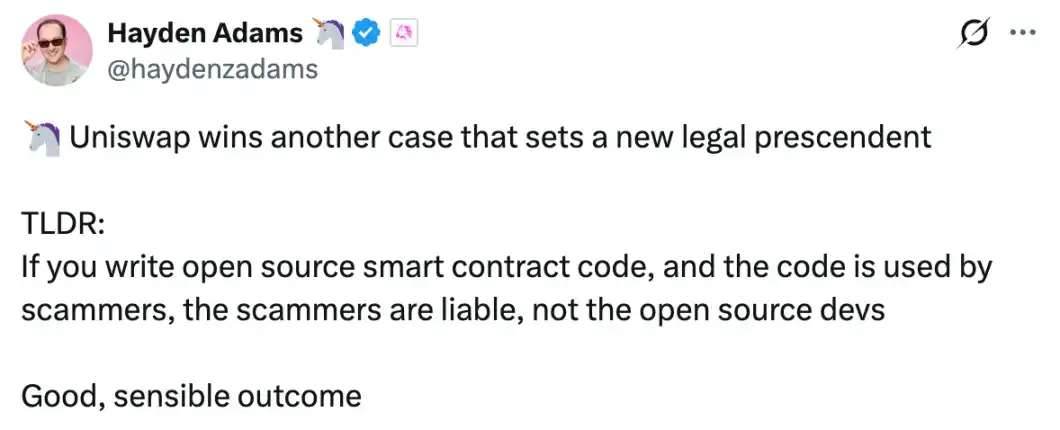
Hayden Adams also tweeted, "If you write open-source smart contract code and that code is used by scammers, the scammers are responsible, not the open-source developer. This is a reasonable and just outcome."

For Web3 developers, this is undoubtedly good news. But what is less known is that the judge who made this "just ruling" is the same person who, during the tenure of the former SEC chairman, found the developers of the mixer Tornado Cash guilty.

The Finalized Verdict

Nearly four years have passed since the class action lawsuit against Uniswap was filed and today's final resolution.

In April 2022, Uniswap users, represented by Nessa Risley, filed a class action lawsuit in court, accusing defendants including Paradigm, a16z, Uniswap, and its founder Hayden Adams of violating federal securities laws by issuing and selling unregistered securities, including UNI, in the form of tokens on Uniswap. The defendants were accused of failing to register Uniswap as an exchange or broker-dealer under applicable securities laws and failing to provide investors with registration statements for the securities they issued and sold.

This lawsuit was initiated by the law firms Kim&Serritella and Barton, representing users who traded EtherumMax, Bezoge, MatrixSamurai, Alphawolf Finance, RocketBunny, and BoomBaby.io tokens on Uniswap between April 5, 2021, and April 4, 2022.

The phrase "unregistered securities" had extraordinary destructive power for the crypto industry at the time, but this lawsuit unexpectedly quickly tilted in Uniswap's favor.

Presiding Judge Katherine Polk Failla, while agreeing that the so-called "scam tokens" were indeed securities, ruled that Uniswap did not need to be held responsible for them. Failla believed that the decentralized nature of Uniswap meant the protocol had no control over which tokens were listed on the platform or who could interact with it. "The case is more like holding the developer of a self-driving car responsible for traffic violations or bank robberies committed by third parties using the car."

Based on this, Failla dismissed the federal securities law charges in August 2023. The plaintiffs then appealed, and the Second Circuit Court of Appeals affirmed the dismissal of the federal part in 2025 but remanded the state law part for retrial.

Subsequently, the plaintiffs amended their complaint and sued again. This time, the investors who lost money accused Uniswap and other defendants of aiding and abetting fraud and misrepresentation, profiting from transactions involving scam tokens, and violating fraud laws in multiple states.

After another review by the same judge, Failla, the amended claims were dismissed again, with no further amendments allowed, bringing the case to a complete end.

The judge's reasoning this time was largely the same as before: Uniswap was not aware of the scam tokens, and even if it were, it did not provide substantial assistance. It also did not meet the definition of fraudulent behavior under any state law. Regarding unjust enrichment, Uniswap did not obtain direct benefits, and the speculative indirect benefits from such scam projects expanding the user base were too tenuous.
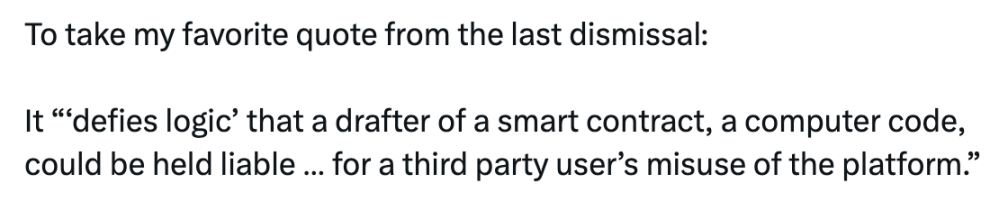
In a tweet, Brian Nistler stated, quoting a sentence from the previous ruling, that it "defies logic" to hold the drafters of smart contracts responsible for the abusive behavior of third-party users on the platform.

The Different Outcome for Tornado Cash

Facing the same judge, Roman Storm of Tornado Cash met a different fate.

Tornado Cash was first added to the sanctions list by the U.S. Treasury Department's Office of Foreign Assets Control (OFAC) on August 8, 2022, accused of helping criminals, including North Korean hackers, launder over $7 billion. Two days after being added to the sanctions list, Dutch police arrested Alexey Pertsev, one of the core developers of Tornado Cash.

On May 14, 2024, a Dutch court found Alexey Pertsev guilty of money laundering and sentenced him to 64 months in prison. The court believed that Pertsev was aware that the platform he developed and operated was used for crime but did not stop it, subjectively acquiescing to Tornado Cash being used as a money laundering tool. Alexey Pertsev is still appealing, but there have been no recent developments.

Seven months before Alexey Pertsev was found guilty, the U.S. Department of Justice sued two other developers, Roman Storm and Roman Semenov, in the Southern District of New York. Roman Storm was previously arrested in Washington State, while Roman Semenov remains at large.
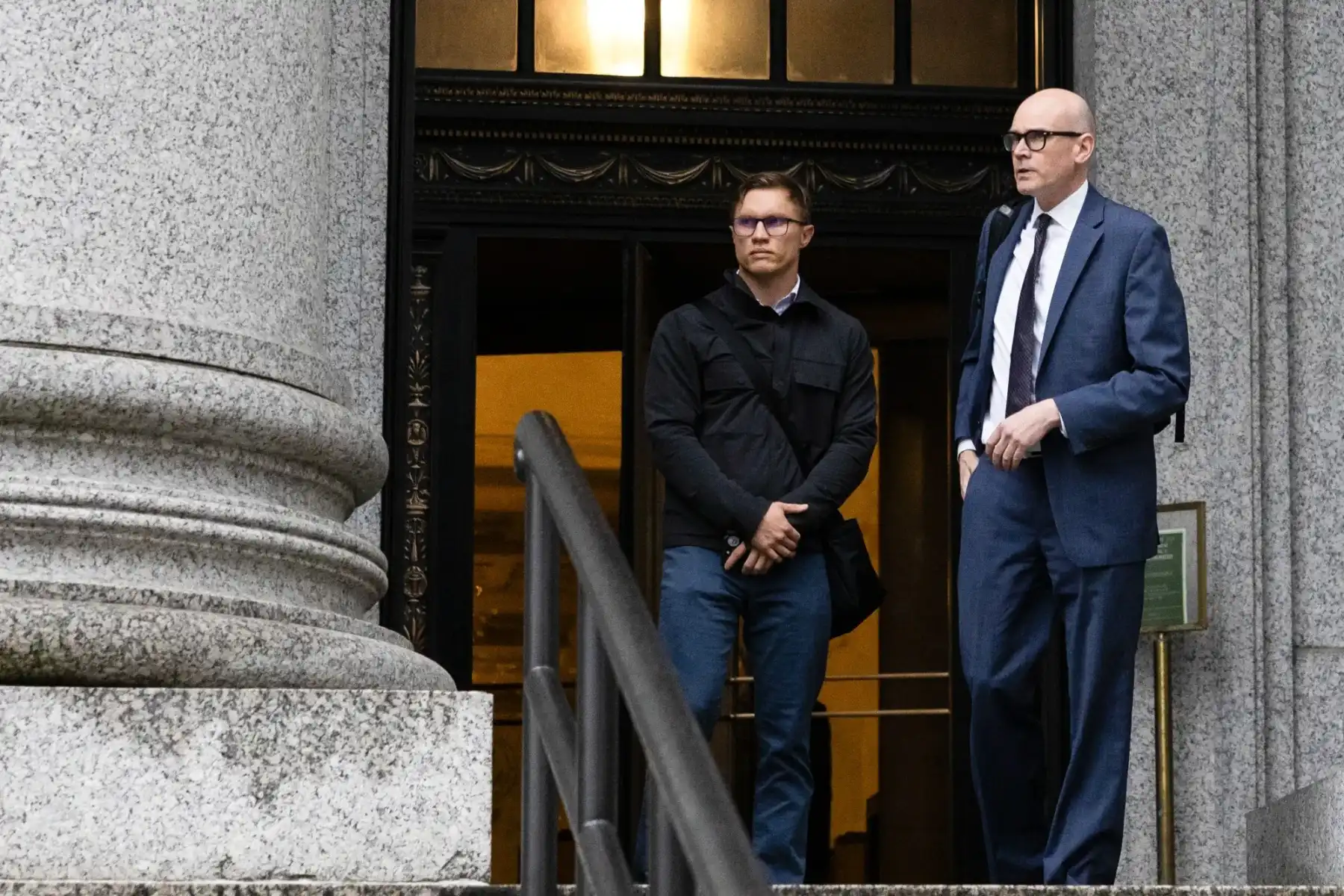
Roman Storm in court

Although an appeal later determined that OFAC's sanctions against Tornado Cash were an overreach and invalid, Roman Storm still found himself in the defendant's seat last July. After a trial presided over by Judge Katherine Polk Failla, the jury found Roman Storm guilty of "conspiracy to operate an unlicensed money transmitting business," but no formal sentencing has been announced yet.
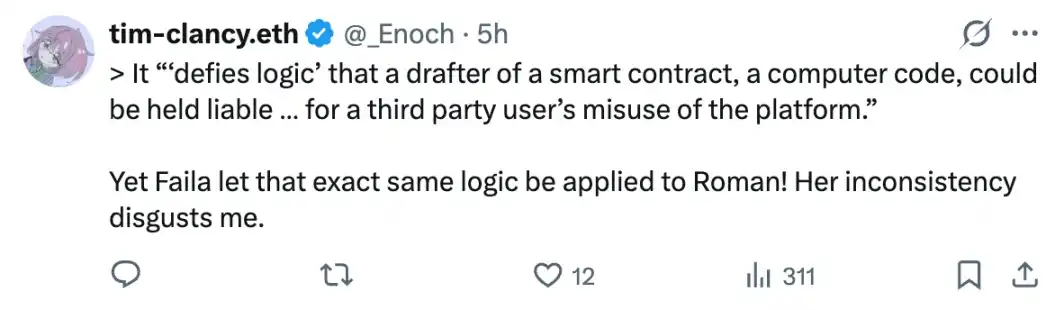
Under Brian Nistler's tweet celebrating Uniswap's victory, a comment by Sigil developer tim-clancy.eth criticizing Failla's contradictory rulings (the verdict against Roman Storm was actually made by a jury) received the most likes among all comments.

Decentralization Is Allowed, but Privacy Is Not

I am not a professional lawyer, but putting aside political factors and from a simple emotional perspective, I can roughly understand why Uniswap and Tornado Cash had different outcomes.

The core reason is that Tornado Cash's developers should have been well aware that a mixer would inevitably be used for money laundering. This clearly reveals the regulatory attitude: decentralization is acceptable, but it must be traceable. Tether once faced the same dilemma, so it later began cooperating with money laundering investigations and added freezing functionality.

Perhaps Roman Storm, behind bars, would feel unjust upon learning of today's verdict, but he should realize that even in a crypto-friendly U.S. under Trump, platforms helping North Korean state-level hackers launder money cannot be tolerated. With the current strength of Crypto, it is still not enough to对抗 national power.

Web3 practitioners sympathize with Tornado Cash's developers and cheer for Uniswap's victory. In our eyes, the two protocols are not fundamentally different; in fact, Tornado Cash is even superior in privacy protection. Uniswap's addition of front-end blocking of sanctioned addresses in 2022 once sparked some debate. Now, it seems that permissionlessness within the existing legal framework may be the only way for decentralized protocols to survive.

But that said, did Uniswap really have no responsibility at all in these scam incidents?

Strictly logically speaking, as the judge's analogy suggests, you cannot hold Mercedes responsible for a bank's losses just because a robber used a Mercedes to rob the bank. But on a commercial level, we tend to believe that giants should provide protection within their capabilities. Current security tools can already identify a large number of potential scam projects in advance. For these established projects that have benefited greatly from Web3's development, simple screening is not troublesome.

Doing their part to protect investors is not a mandatory obligation, but it is a responsibility that ordinary investors hope Uniswap and others will actively shoulder.


Questions liées

QWhat was the outcome of the class action lawsuit against Uniswap and its founder Hayden Adams?

AThe class action lawsuit was dismissed by the U.S. District Court for the Southern District of New York. The judge ruled that Uniswap and its founder were not responsible for the scam tokens traded on the platform, as the protocol's decentralized nature meant it had no control over which tokens were listed or who interacted with it.

QWho was the judge presiding over both the Uniswap case and the Tornado Cash case involving Roman Storm?

AThe judge presiding over both cases was Katherine Polk Failla of the U.S. District Court for the Southern District of New York.

QWhy was Tornado Cash developer Roman Storm found guilty, while Uniswap was not held liable?

ARoman Storm was found guilty of conspiracy to operate an unlicensed money transmitting business because Tornado Cash mixer was used for money laundering, including by North Korean hackers. The court believed the developers were aware of its illicit use. In contrast, Uniswap was deemed a neutral, decentralized protocol with no control over user actions, similar to an autonomous vehicle developer not being liable for misuse by third parties.

QWhat does the article suggest is the key difference in regulatory treatment between Uniswap and Tornado Cash?

AThe article suggests that regulatory tolerance exists for decentralized protocols like Uniswap that are transparent and compliant (e.g., blocking sanctioned addresses), but not for privacy-focused tools like Tornado Cash that enable illicit activities such as money laundering, especially on a scale involving state actors like North Korean hackers.

QWhat responsibility does the article imply Uniswap should have, despite its legal victory?

AThe article implies that while Uniswap has no legal obligation, it has a moral or commercial responsibility to use available security tools to screen and prevent scam projects on its platform, given its influence and benefits from the Web3 ecosystem, to protect ordinary investors.

Lectures associées

Sans équipe commerciale, un chiffre d'affaires de 20 millions de dollars : comment Viktor, l'employé IA, a-t-il séduit 30 000 entreprises ?

Sans équipe commerciale, le produit Viktor, un « employé IA », génère 20 millions de dollars de revenus annuels auprès de plus de 30 000 entreprises. Fondé par une équipe issue de DeepMind, Viktor se présente comme un « collègue IA de niveau 3 » capable d'exécuter des tâches de bout en bout, et non un simple assistant. Son utilisation est simplifiée : via une mention @ dans Slack ou Microsoft Teams, les employés peuvent lui demander en langage naturel d'effectuer des tâches complexes, comme générer un rapport ou réaliser un rapprochement comptable, sans avoir besoin de maîtriser l'ingénierie des prompts. Le succès repose sur un modèle de croissance tiré par le produit (PLG) et une tarification basée sur la consommation de crédits pour les tâches, réduisant les coûts d'essai. Viktor permet également une automatisation proactive, exécutant des processus comme la génération de présentations en croisant plusieurs outils. Son intégration à Teams, avec 320 millions d'utilisateurs, marque une étape vers une adoption à grande échelle, mais soulève aussi des défis majeurs : la conformité dans les grandes entreprises, les risques d'erreur dus à la boîte noire des décisions de l'IA, et la nécessité de gagner la confiance via une gouvernance robuste (journaux d'audit, permissions). L'équilibre entre efficacité automatisée et contrôle restera crucial pour son adoption dans les flux métiers essentiels.

marsbitIl y a 12 mins

Sans équipe commerciale, un chiffre d'affaires de 20 millions de dollars : comment Viktor, l'employé IA, a-t-il séduit 30 000 entreprises ?

marsbitIl y a 12 mins

Entretien avec les cofondateurs de CoreWeave, « action liée à Nvidia » : La demande d'IA semble s'intensifier chaque jour

Interview des dirigeants de CoreWeave : La demande d'IA semble « s'intensifier » quotidiennement CoreWeave, leader des services cloud de nouvelle génération (neocloud), a récemment partagé ses perspectives sur le marché de l'infrastructure IA. Ses dirigeants, Brannin McBee et Nick Robbins, soulignent que la demande ne faiblit pas ; au contraire, elle s'accentue chaque jour, portée par l'essor des agents IA, du raisonnement et des applications d'inférence en entreprise. Ils observent un changement structurel : le goulot d'étranglement ne se limite plus aux GPU. L'attention se porte désormais sur des défis d'infrastructure plus larges : la disponibilité des centres de données (powered shells), l'approvisionnement en CPU, en mémoire HBM, en stockage, ainsi que les capacités d'exécution de la chaîne logistique. CoreWeave, qui sert des clients majeurs comme OpenAI, Anthropic et Meta, constate une demande croissante pour les CPU (notamment les futurs Vera CPU de NVIDIA) et le stockage, nécessitant une refonte des conceptions de data centers. La différenciation de CoreWeave réside dans son excellence opérationnelle, sa rapidité de déploiement et ses performances validées par des tiers. Son modèle commercial, basé sur des contrats à long terme, lui permet de protéger ses marges en répercutant les coûts des composants comme la mémoire HBM. Le déploiement à grande échelle des nouvelles plates-formes comme Vera Rubin (VR) devrait suivre un calendrier similaire à celui des systèmes GB200, avec une accélération majeure attendue en 2027. En résumé, la course à l'infrastructure IA évolue d'une simple acquisition de puces vers une capacité globale à livrer des systèmes complexes de manière fiable et à grande échelle.

marsbitIl y a 32 mins

Entretien avec les cofondateurs de CoreWeave, « action liée à Nvidia » : La demande d'IA semble s'intensifier chaque jour

marsbitIl y a 32 mins

Manus : le plan de rachat se précise, les investisseurs chinois prêts à débourser 2 milliards de dollars pour racheter leurs parts, la voie vers une introduction à Hong Kong se dessine

Selon des informations rapportées par The Information, les investisseurs chinois précoces de Manus, dont Tencent, Sequoia China et ZhenFund, prévoient de racheter la société pour 20 milliards de dollars US, soit le même montant que celui payé par Meta lors de son acquisition en décembre dernier. Cette initiative fait suite à l'interdiction, en avril, de l'acquisition par Meta par les autorités chinoises de contrôle des investissements étrangers. Dans le cadre de ce rachat, Manus envisagerait de restructurer son organisation en créant une entreprise à capitaux mixtes (joint-venture) en Chine, une architecture perçue comme une préparation à une future introduction en bourse à Hong Kong. Les investisseurs chinois injecteraient des fonds en dollars. Malgré la courte période sous la tutelle de Meta, les performances de Manus ont connu une croissance significative, son taux de revenus annualisés étant passé d'environ 1 milliard de dollars à entre 4 et 5 milliards de dollars. D'un point de vue financier, cette inversion de transaction pourrait avantager les premiers investisseurs, leur permettant de reprendre des parts à un coût inférieur à la valorisation actuelle, tout en ouvrant la voie à une indépendance et une potentielle IPO. Les termes définitifs du rachat, incluant les proportions d'investissement et la structure de la joint-venture, restent en cours de négociation. Ce cas pourrait servir de référence pour les startups chinoises d'IA confrontées à des questions de conformité dans les fusions et acquisitions transfrontalières.

marsbitIl y a 42 mins

Manus : le plan de rachat se précise, les investisseurs chinois prêts à débourser 2 milliards de dollars pour racheter leurs parts, la voie vers une introduction à Hong Kong se dessine

marsbitIl y a 42 mins

STRC en décrochage de 11 %, le mécanisme perpétuel de Strategy est-il toujours opérationnel ?

Le titre préférentiel STRC de MicroStrategy est en situation de « décrochage » prolongé, affichant un écart de plus de 11% par rapport à sa valeur nominale cible de 100 dollars. Ce produit, conçu comme un titre à revenu stable autour de cette valeur, est le moteur essentiel de la « roue financière » de l'entreprise, lui permettant de lever des fonds sans diluer les actionnaires ordinaires pour acheter du Bitcoin. Cependant, ce mécanisme repose sur le maintien du prix du STRC près de 100 dollars. Malgré une augmentation du dividende à 11.5% et une fréquence de paiement accrue, la dépréciation persiste. Les causes incluent des liquidations forcées de positions à effet de levier, mais surtout une inquiétude fondamentale du marché quant à la solidité financière de MicroStrategy. Un récent rapport de JPMorgan a soulevé des questions sur la capacité de l'entreprise à honorer ses obligations de dividendes avec sa trésorerie actuelle. Bien que MicroStrategy affirme que ses réserves de Bitcoin couvriraient des décennies de paiements, la vente symbolique de 32 BTC début juin a ébranlé la confiance. Le marché craint désormais que l'entreprise ne doive vendre davantage de Bitcoin si ses capacités de financement via le STRC s'affaiblissent. En conclusion, la pression persistante sur le STRC reflète une réévaluation des risques du modèle de MicroStrategy. Si cette tendance se poursuit, elle pourrait non seulement paralyser son principal outil de levée de fonds, mais aussi transformer son rôle historique d'acheteur net majeur de Bitcoin en une source potentielle de ventes, avec des conséquences significatives pour le marché.

链捕手Il y a 48 mins

STRC en décrochage de 11 %, le mécanisme perpétuel de Strategy est-il toujours opérationnel ?

链捕手Il y a 48 mins

Les altcoins font face à la plus forte pression de vente au comptant depuis 2020, selon les données de CryptoQuant

Selon les données de CryptoQuant, les altcoins subissent actuellement leur plus forte pression de vente au comptant depuis 2020, avec un écart cumulé de volume d'achat/vente d'environ 209 milliards de dollars sur une période prolongée. Cette pression reflète une faible demande des investisseurs particuliers, une rotation vers les rendements des stablecoins et une prudence persistante en dehors du Bitcoin et de l'Ethereum. Plusieurs facteurs expliquent cette pression durable : le Bitcoin absorbe les flux institutionnels via les ETF, l'Ethereum captive l'attention, tandis que les stablecoins offrent une alternative moins risquée. De nombreux altcoins se retrouvent ainsi coincés, trop risqués pour les capitaux conservateurs mais pas assez volatils pour attirer les spéculateurs. Bien qu'une telle pression de vente extrême puisse éventuellement constituer un signal contraire en indiquant un positionnement unilatéral, aucune confirmation d'un renversement immédiat ou d'un "altseason" n'est visible. Le marché pourrait rester faible longtemps, surtout si la domination du Bitcoin persiste. Pour qu'un véritable retournement haussier s'engage, il faudrait observer un passage à une accumulation au comptant soutenue et une amélioration de la dynamique sur plusieurs secteurs d'altcoins. Pour l'instant, ces données indiquent surtout que les altcoins sont profondément en disgrâce.

bitcoinistIl y a 1 h

Les altcoins font face à la plus forte pression de vente au comptant depuis 2020, selon les données de CryptoQuant

bitcoinistIl y a 1 h

Trading

Spot
Futures
活动图片