Reflections and Confusions of a Crypto VC

marsbitPublié le 2026-04-13Dernière mise à jour le 2026-04-13

Résumé

An encrypted VC's reflection on the current crypto investment landscape, which is undergoing a significant reset. Token exits, once the primary driver of outsized returns, are being redefined in real-time, with no established valuation framework yet emerging. Key market shifts include: the rise of tokens like HYPE, which demonstrated that token prices can be backed by real, on-chain revenue, forcing a reassessment of governance tokens with weak fundamentals; a massive supply shock from meme coins (e.g., PUMP) fragmenting liquidity; and the diversion of retail speculative capital into prediction markets, stock perps, and leveraged ETFs. Major questions VCs are now grappling with: whether they are underwriting equity, tokens, or a hybrid; what constitutes best practices for on-chain value accrual beyond potentially toxic token buybacks; and whether the "crypto premium" will vanish entirely, compressing token valuations to traditional equity multiples and potentially crashing Layer 1 valuations by over 95%. The author argues the pendulum has swung too far towards quantitative DeFi metrics and that qualitative factors like culture, innovation, and security remain crucial for non-DeFi projects. The conclusion is that token return expectations have compressed significantly, pushing later-stage investors towards "Web2.5" companies with tangible revenue. Crypto VCs must now prove their value beyond capital by offering strong branding and value-add to founders to survive.

Author:Catrina

Compiled by: Jiahuan, ChainCatcher

Crypto venture capital is at a watershed moment. Over the past three cycles, token exits have been the primary driver of outsized returns, but they are now undergoing a major reset. The definition of token value is being rewritten in real-time, yet a standard industry valuation framework has yet to emerge.

What Exactly Happened?

This time, the crypto market structure has been completely upended by multiple unprecedented forces hitting simultaneously:

1. The emergence of HYPE awakened the token market, proving that token prices can have real revenue backing, with over 97% of its eight to nine-figure revenue generated on-chain.

This has thoroughly disenchanted the market with governance tokens that rely on narrative hype and lack fundamental value—think of the L1s and "governance tokens" that existed primarily to navigate the ambiguity of securities laws (which made direct revenue distribution unfeasible). HYPE almost overnight reset market expectations: revenue is now scrutinized more strictly and has become the basic ante to play.

2. Chain reaction backlash on other token projects

Before 2025, if you had on-chain revenue, you were considered a security; after HYPE, if you ask most hedge funds, they'll tell you that if you don't have on-chain revenue, you'll go to zero. This has left most projects, especially non-DeFi ones, in a dilemma, scrambling to adapt.

3. PUMP brought a staggering supply shock to the system.

The supply explosion from meme coin mania fundamentally disrupted market structure by分散 attention and liquidity. On Solana alone, the number of newly generated tokens surged from about 2-4 thousand per year to a peak of 40-50 thousand. This effectively split an already not-growing-much liquidity cake into about one-twentieth. Chasing the same alpha, the same buyer demographic has shifted its attention and capital to speculating on meme coins rather than holding altcoins.

4. Accelerated diversion of retail speculative capital.

Prediction markets, stock perps, and leveraged ETF trading are now directly competing for the same pool of capital that would have flowed into altcoins. Meanwhile, the maturation of tokenization technology enables leveraged trading of blue-chip stocks, which don't carry the same risk of going to zero as most altcoins, are much more heavily regulated, and are more transparent with less information asymmetry risk.

The result is a大幅 compression of the token lifecycle: the time from peak to trough has shortened dramatically, retail willingness to "hold" tokens has plummeted, replaced by faster capital rotation.

Big Questions Every VC is Asking Themselves and Their Peers

1. Are we underwriting equity, tokens, or a combination of both?

The biggest challenge here is that we have no new playbook for value accrual in token projects—even the most successful ones like Aave still face controversy between the DAO and equity.

2. What is the best practice for on-chain value accrual?

The most common is token buybacks, but that doesn't mean it's right. We have long been against the prevailing trend of token buybacks: it's toxic and puts founders with real revenue in a bind.

The incentive is completely wrong: stock buybacks happen after a company has finished investing in growth, while crypto buybacks are increasingly demanded immediately, driven by retail/public perception (a completely fickle and irrational thing).

You could burn $10 million that could have been reinvested for nothing, and the very next day that value could be wiped out by some random market maker getting liquidated.

Public companies buy back stock when it's undervalued. Token buybacks get front-run at every turn, so they are often executed at local highs.

Especially if you are a B2B business generating off-chain revenue, this is a fool's errand. In my view, there is absolutely no reason to do buybacks just to please retail when your revenue is under $20 million, rather than reinvesting the capital into growth.

I really like this report from fourpillars, which shows that even nine-figure buybacks did almost nothing to help projects set a long-term price floor.
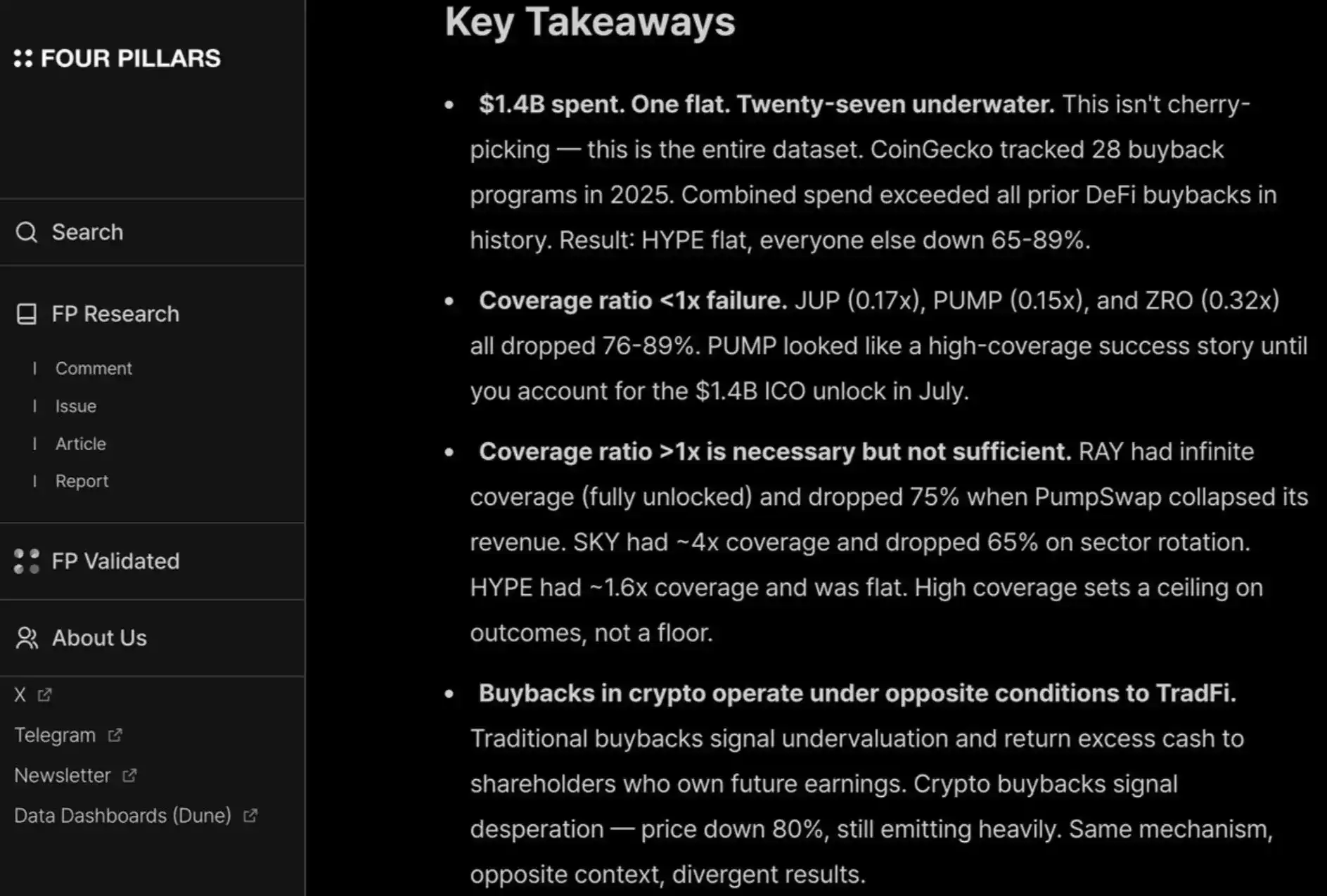
On top of that, to keep retail and hedge funds happy, you must conduct buybacks consistently and transparently, like HYPE does. Any failure to do so is punished, as seen with PUMP's P/E ratio (based on fully diluted valuation) being only 6x because the public "doesn't trust" them—despite the fact that they have verifiably burned $1.4 billion in revenue that could have gone to the treasury.

Here is further reading on "on-chain value accrual mechanisms that work without burning"

3. Will the "crypto premium" disappear entirely?

This would mean that in the future, all projects will be valued based on multiples similar to public stocks (roughly 2 to 30x revenue). Take a moment to think about what this means—if true, we would see most L1公链 prices fall further by over 95% from current levels, with exceptions like TRON, HYPE, and other revenue-generating DeFi projects. And this is even without considering token vesting.

Personally, I don't think it will be like this—HYPE set an extremely exceptional expectation, making many investors impatient with "day one revenue/user traction" for early-stage startups. For sustaining innovations like payments and DeFi companies, yes, this is a reasonable expectation.

But disruptive innovation takes time to build, launch, grow, and then see revenue scale exponentially.

In the past two cycles, we had excessive patience and blind optimism for so-called "disruptive technologies"—new L1s, esoteric concepts like Flashbots/MEV raising all the way to rounds 8-9, and now the pendulum has swung too far the other way, only willing to back DeFi projects.

The pendulum will swing back. While evaluating DeFi projects based on "quantitative" fundamentals is indeed a net positive for the industry's maturation, for non-DeFi categories, "qualitative" fundamentals also need to be considered: culture, technological innovation, disruptive concepts, security, decentralization, brand equity, and industry connectivity. And these traits are not simply reflected in TVL and on-chain buybacks.

What to Do Now?

Return expectations for token projects have been significantly compressed, while equity businesses have not seen a commensurate decline. This divergence is particularly evident in early-stage versus growth-stage projects.

Early-stage investors underwriting projects that might exit via tokens have become much more price-sensitive. At the same time, appetite for equity businesses has increased, especially given the good M&A environment. This is completely different from the 2022-2024 situation, where token exits were the preferred liquidity path, underpinned by the assumption that the token valuation premium would persist.

Later-stage investors, those with the strongest brand equity and added value in the crypto-native context, are increasingly moving away from purely "crypto-native" deals. Instead, they are pivoting to support more "Web2.5" companies, whose underwriting is anchored by revenue traction.

This puts them on unfamiliar turf, competing head-on with firms like Ribbit, Founders Fund—institutions that have deeper backgrounds in traditional fintech, stronger portfolio synergies, and better visibility into early-stage deal flow outside of crypto.

The crypto VC space is entering a period of value verification. The right to survive depends on VCs finding their own PMF (Product-Market Fit) among founders, where the "product" is a combination of capital, brand identity, and added value.

For the highest quality deals, VCs need to pitch themselves to founders to win the right to be on the cap table, especially as some of the most successful cases in recent years required almost no institutional capital (e.g., Axiom) or none at all (e.g., HYPE). If capital is the only thing a VC provides, it will almost certainly be淘汰.

Those VCs qualified to remain in the game need to be very clear about what they offer in terms of brand identity (this is what prompts the best founders to engage in the first place) and added value (which ultimately determines their right to win the deal).


Questions liées

QWhat are the main factors that have fundamentally disrupted the crypto market structure according to the article?

AThe crypto market structure has been disrupted by four main factors: 1) The emergence of HYPE, which proved token prices can be supported by real on-chain revenue, resetting market expectations. 2) The resulting backlash on other token projects, creating a dilemma for projects without on-chain revenue. 3) The massive supply shock from the memecoin frenzy (PUMP), which fragmented liquidity. 4) The accelerated diversion of retail speculative capital into alternative products like prediction markets, stock perps, and leveraged ETFs.

QWhat is the author's primary criticism of the prevalent token buyback trend in crypto?

AThe author criticizes token buybacks as being 'toxic' and creating a dilemma for founders with real revenue. The motivation is wrong: stock buybacks happen after a company has invested in growth, while crypto buybacks are demanded immediately due to fickle and irrational public/retail sentiment. They are often executed at local highs due to front-running and can be ineffective, especially for B2B businesses with off-chain revenue. The author argues there's no reason to do buybacks just to please retail instead of reinvesting in growth when revenue is under $20 million.

QDoes the author believe the 'crypto premium' will disappear entirely, leading to all projects being valued like public stocks?

ANo, the author does not believe the 'crypto premium' will disappear entirely. While they acknowledge that HYPE has set an extreme expectation making investors impatient for early revenue, they argue that disruptive innovation needs time to build and grow before seeing exponential revenue. The pendulum will swing back. For non-DeFi categories, 'qualitative' fundamentals like culture, technological innovation, disruptive concepts, security, decentralization, brand equity, and industry connectivity must also be considered, not just quantitative metrics like TVL and on-chain buybacks.

QHow has the investment landscape changed for early-stage and later-stage crypto VCs according to the reflection?

AReturn expectations for token projects have compressed significantly, while equity businesses have not seen the same level of decline. Early-stage investors have become much more price-sensitive when underwriting projects with potential token exits. Conversely, the appetite for equity businesses has increased, especially with a good M&A environment. Later-stage investors, strong in crypto-native brand equity, are increasingly moving away from pure 'crypto-native' deals and instead supporting more 'Web2.5' companies underwritten by revenue traction, putting them in direct competition with traditional fintech-focused funds.

QWhat does the author suggest is required for a crypto VC to survive and earn the right to be on a cap table in the current environment?

AThe author states that survival depends on a VC finding its own Product-Market Fit (PMF) with founders, where the 'product' is a combination of capital, brand identity, and value-add. For the best deals, VCs need to sell themselves to founders to win a place on the cap table, especially as successful projects may need little to no institutional capital. If capital is the only thing a VC provides, it will likely be eliminated. Those who remain must be very clear about what they offer in terms of brand identity (which attracts top founders) and value-add (which wins the deal).

Lectures associées

La voix la plus célèbre de « Cassandre » de Wall Street s'attaque cette fois à NVIDIA

Une récente divulgation de l’investisseur Michael Burry, connu pour avoir prédit la crise des subprimes et immortalisé dans « The Big Short », a relancé les débats sur le marché. Fin juin, il a annoncé avoir pris des positions à découvert sur plusieurs valeurs technologiques, dont Nvidia (à un prix d’entrée de 198,09 $), Tesla, Applied Materials, Caterpillar et l’ETF SOXX (semiconducteurs). Le 1er juillet, il a ajouté Micron à sa liste, avant d’augmenter fin juillet ses positions sur Nvidia, Micron et SOXX. Ses arguments portent principalement sur les pratiques comptables dans le secteur de l’IA : selon lui, la durée d’amortissement des puces (étirée à 6 ans par les géants du cloud comme Microsoft ou Google) ne reflète pas leur obsolescence rapide (2-3 ans), ce qui gonflerait artificiellement les profits. Il évoque également des risques de « financement circulaire hors bilan », où Nvidia pourrait garantir des prêts à des clients pour qu’ils achètent ses propres puces, créant ainsi une demande artificielle. Enfin, il critique les rachats d’actions de Nvidia, accusés de doper artificiellement le bénéfice par action – une affirmation que la société a contestée en soulignant des erreurs de calcul. Les réactions sont partagées. D’un côté, des voix comme Steve Eisman (autre figure de « The Big Short ») restent prudentes mais ne suivent pas la position découverte, notant la croissance soutenue des revenus et des investissements en IA. De l’autre, Jim Chanos, célèbre vendeur à découvert, partage l’inquiétude sur les écarts comptables mais préfère cibler d’autres acteurs financiers plutôt que les fabricants de puces. Historiquement, les appels de Burry ont connu des succès mitigés : corrects sur des crises structurelles (subprimes, COVID), mais souvent prématurés ou erronés sur des arguments de valorisation (Tesla, Nvidia en 2023). Aujourd’hui, les positions à découvert sur Nvidia restent marginales (environ 1,4 % des actions en circulation), même si les pertes cumulées des vendeurs à découvert sur la valeur dépassent 5 milliards de dollars. Pour les investisseurs, l’intérêt réside moins dans le suivi des positions de Burry que dans la méthodologie sous-jacente : scruter les flux de trésorerie, questionner les traitements comptables agressifs et identifier les risques structurels, surtout quand le marché semble euphorique. La question centrale n’est pas de savoir si Burry a raison cette fois, mais plutôt quels enseignements tirer de son analyse pour évaluer la solidité réelle de la bulle présumée de l’IA.

marsbitIl y a 17 mins

La voix la plus célèbre de « Cassandre » de Wall Street s'attaque cette fois à NVIDIA

marsbitIl y a 17 mins

Sélection de la semaine丨Émotions épiques sur le marché boursier, l'entrée en bourse de Changxin Tech redéfinit le paysage du stockage, Saylor vise à rétablir l'ancrage du STRC vers le 8 septembre

PANews présente un résumé hebdomadaire de contenus clés. Les marchés ont connu une volatilité significative, avec des indices boursiers sud-coréens subissant plusieurs interruptions et une chute des actions technologiques liées à l'IA. Dans ce contexte, le bitcoin apparaît comme un actif relativement stable. Le paysage technologique évolue rapidement. Le géant de la mémoire Longxin Technology a fait ses débuts en bourse avec une capitalisation importante, symbolisant une percée pour la DRAM nationale. Parallèlement, la convergence de l'IA, des agents autonomes et des besoins en calcul redéfinit les secteurs, des GPU aux infrastructures énergétiques, les entreprises de minage de bitcoin se repositionnant autour de la gestion de l'électricité. Dans le domaine crypto, l'innovation se poursuit. Les portefeuilles intelligents pour agents IA et les mécanismes de paiement programmables gagnent en importance, attirant l'attention de grandes plateformes. De nouveaux modèles économiques, comme le protocole à jeton FWA qui combine NFT et système de tirage, génèrent un fort engagement. Cependant, un décalage est observé entre la croissance des revenus des principaux protocoles et la performance de leurs jetons. Le secteur des Real World Assets (RWA) voit son volume augmenter mais peine à mobiliser ses actifs. Les perspectives macroéconomiques restent mitigées. La Réserve Fédérale américaine maintient des taux directeurs élevés, signalant une orientation durablement restrictive malgré des divisions internes. Des analystes comme Tom Lee considèrent les récentes corrections comme un assainissement nécessaire, affirmant que la logique de long terme du secteur reste intacte. Des personnalités anticipent un rôle accru du bitcoin dans le futur système monétaire. Les informations marquantes incluent : des mouvements réglementaires affectant les courtiers pour investisseurs chinois, le plan de développement technique d'Ethereum à horizon 2030, une importante migration de staking par Lido, et des performances boursières variées pour les entreprises liées à la crypto et à l'IA. Michael Saylor a également annoncé un objectif de réalignement pour le STRC autour du 8 septembre.

marsbitIl y a 24 mins

Sélection de la semaine丨Émotions épiques sur le marché boursier, l'entrée en bourse de Changxin Tech redéfinit le paysage du stockage, Saylor vise à rétablir l'ancrage du STRC vers le 8 septembre

marsbitIl y a 24 mins

Lorsque le marché commence à s'interroger sur les dépenses en capital liées à l'IA : Analyse complète des résultats du Q2 des cinq géants technologiques

À la fin juillet 2026, les résultats trimestriels d'Alphabet, Intel, Microsoft, Meta et Apple ont tous mis en évidence une croissance robuste des revenus et des bénéfices, largement portée par les investissements et la demande en IA. Cependant, les réactions des investisseurs ont divergé, soulignant un changement d'attention : le marché s'interroge désormais sur le calendrier du retour sur investissement de ces dépenses massives en capital. Alphabet a affiché une croissance record de son chiffre d'affaires et une performance cloud exceptionnelle, mais son augmentation des dépenses d'investissement, entraînant un flux de trésorerie libre négatif pour la première fois, a provoqué une chute de son cours. Intel, malgré ses meilleures ventes depuis quinze ans, a vu son rebond boursier anéanti après l'annonce d'une hausse significative de son budget d'investissement. À l'inverse, Microsoft, en abaissant ses prévisions de dépenses en capital et en promettant des flux de trésorerie positifs, a connu une forte hausse de son action. Meta, dont les dépenses ont explosé et le flux de trésorerie libre s'est effondré, a subi la plus forte vente. Enfin, Apple, malgré des résultats records, a vu son action chuter en raison de prévisions inférieures aux attentes, pointant des contraintes d'approvisionnement. En résumé, la demande en IA reste solide, mais le marché sanctionne désormais les entreprises dont les investissements massifs menacent à court terme la rentabilité et les flux de trésorerie, récompensant celles qui maîtrisent leur trajectoire financière.

Odaily星球日报Il y a 31 mins

Lorsque le marché commence à s'interroger sur les dépenses en capital liées à l'IA : Analyse complète des résultats du Q2 des cinq géants technologiques

Odaily星球日报Il y a 31 mins

a16z : De la société au DAO, DUNA pourrait devenir la prochaine forme d'organisation

L’histoire de l’organisation commerciale est une quête pour permettre à des étrangers de collaborer. Des compagnies familiales médiévales, où le risque était personnel, à l'invention de la société par actions (comme la VOC néerlandaise), qui a permis une collaboration à grande échelle avec une responsabilité limitée, chaque innovation a réduit les coûts de coordination. Aujourd’hui, les organisations autonomes décentralisées (DAO) représentent une nouvelle frontière, utilisant la blockchain pour coordonner des communautés sans gestion centralisée. Cependant, elles se heurtent à un vide juridique : sans reconnaissance légale, leurs membres pourraient encourir une responsabilité personnelle illimitée, et leur statut réglementaire reste incertain. La solution émergente est la DUNA (Association Non Incorporée Non lucrative Décentralisée). Cette nouvelle structure juridique, déjà adoptée dans quelques États américains, confère aux groupes décentralisés une personnalité juridique et une responsabilité limitée, sans exiger de hiérarchie managériale traditionnelle. Elle permet à une communauté gérée par des règles en chaîne de conclure des contrats, de détenir des actifs et d'interagir avec le système juridique. La DUNA ne résout pas tous les défis de gouvernance ou de conformité, mais elle comble une lacune cruciale en offrant une enveloppe légale native pour les réseaux internet décentralisés. Elle marque potentiellement le début d’une nouvelle ère dans la conception organisationnelle, en répondant à nouveau à l'éternel défi de la collaboration à grande échelle.

marsbitIl y a 1 h

a16z : De la société au DAO, DUNA pourrait devenir la prochaine forme d'organisation

marsbitIl y a 1 h

Rapport semestriel 2026 sur les RWA en chaîne : la valeur des actions tokenisées a doublé en un an, mais 90 % des droits sont des coquilles vides

Titre : Rapport semestriel 2026 sur les RWA en chaîne : la valeur des actions tokenisées double en un an, mais 90% des droits sont vides. La valeur des actions tokenisées distribuées en chaîne a doublé, passant de 951 millions de dollars en mars à 1,89 milliard de dollars en juillet 2026. Toutefois, cette croissance est principalement portée par quelques produits et plateformes (Ondo, xStocks, Securitize représentent 85% du marché), et masque une contradiction fondamentale. D'un côté, les produits offshore ("emballés") offrent une meilleure accessibilité et transférabilité sur différentes blockchains (Ethereum, Solana...). De l'autre, les infrastructures réglementées (comme le modèle de règlement Nasdaq) privilégient la certitude juridique et l'intégration avec les systèmes traditionnels (DTC), mais limitent la liquidité. Le marché reste fragmenté : les produits ayant la base juridique la plus solide ont peu de liquidité, tandis que les produits les plus négociés offrent des droits de propriété faibles. Aucun produit ne combine à grande échelle la propriété légale canonique, une large distribution, une liquidité institutionnelle et une découverte de prix indépendante en chaîne. Les données agrégées (18,9 milliards de dollars) peuvent être trompeuses. Elles mesurent la "valeur tokenisée distribuée" et ne correspondent pas à des flux de capitaux nets. Une part significative de la croissance provient de seulement trois instruments (SECZ, FGRS, STRCx), mêlant émissions nouvelles, conversions et variations de prix. En résumé, le paysage des RWA actions est en croissance mais immature, divisé entre commodité/accessibilité et robustesse juridique, avec une concentration élevée et une liquidité réelle limitée.

marsbitIl y a 2 h

Rapport semestriel 2026 sur les RWA en chaîne : la valeur des actions tokenisées a doublé en un an, mais 90 % des droits sont des coquilles vides

marsbitIl y a 2 h

Trading

Spot
活动图片