Range Judgment Realized, Strategy Fully Executed | Guest Analysis

marsbitPublié le 2026-01-09Dernière mise à jour le 2026-01-09

Résumé

In his weekly analysis, Cody Feng, a quantitative trading expert, reviews Bitcoin's price action from January 5 to 11. BTC movement aligned closely with his initial forecast, trading within a range of $84,000 to $94,500. The price faced strong resistance at the $93,000–$94,500 zone and later pulled back toward the mid-to-lower part of the range. A short position was executed near $94,000 based on signals from momentum and spread trading models, and the trade was closed around $90,584, capturing a profit of approximately 3.4%. The strategy emphasized pre-planned execution and disciplined risk management. Currently, Bitcoin has found support around $86,500, with technical indicators suggesting oversold conditions and a potential bounce. However, the overall structure remains a broad consolidation. A rebound toward $92,000–$93,000 is anticipated, where renewed selling pressure may emerge. A break above $94,500 would require a reassessment of the market outlook. Feng concludes that in a ranging market, executing well-defined strategies with strict risk controls is more critical than predicting directional moves.

Odaily guest market analyst Cody Feng, Master of Financial Statistics from Columbia University, has focused on quantitative trading of US stocks since college and gradually expanded to digital assets such as Bitcoin. He has built a systematic quantitative trading model and risk control system through practical experience; possesses keen data insight into market fluctuations, and is committed to continuous growth in the professional trading field, pursuing stable returns. He will delve into BTC technical, macroeconomic, and capital flow changes weekly, review and showcase practical strategies, and preview noteworthy upcoming developments for reference.
Bitcoin Mid-Week Review(01.05~01.11)

Conclusion First:

This week, Bitcoin's overall price action largely operated within the 84,000~94,500 USD oscillation range we provided at the beginning of the week. The price precisely encountered resistance in the 93,000~94,500 USD pressure zone and subsequently fell back to the middle-lower part of the range. Our core level judgments were verified by actual market performance.

In this trade, we established short positions near 94,000 USD and exited all positions near 91,000 USD, capturing approximately 3.4% profit (spot) from the range, completing a high-probability, low-drawdown profit realization in a ranging market.

I. Validation of This Week's Core Range and Key Levels

At the beginning of the week, we clearly stated that this week required close attention to the battle between bulls and bears at the upper and lower boundaries of the 84,000~94,500 USD range.

The actual movement showed that Bitcoin clearly met resistance after rebounding to the 93,000~94,500 USD pressure zone, with multiple failed attempts to break higher, subsequently leading to a pullback under pressure, validating the effectiveness of this area as a阶段性 "ceiling".

Regarding support levels, the price showed clear signs of stopping declines and stabilizing after falling to the 86,000~86,500 USD area, where buying interest began to emerge. The more critical support level at 84,000 USD has not been touched yet, and the overall structure remains within the wide-range oscillation framework.

II. Execution of Plan A (From Entry to Exit)

Based on the range oscillation judgment, our Plan A formulated at the start of the week was effectively executed.

When the price rebounded to the 93,000~94,500 USD zone showing signs of upward exhaustion, and both the (momentum, spread trading) models simultaneously issued top signals, we immediately established short positions at 93,771 USD. The market subsequently declined as expected.

When the "Spread Trading" model issued a bottom signal, we finally exited all positions at 90,584 USD, completing a full, emotion-free short trade. The entire trading process was not "hindsight analysis" but involved pre-planning, in-execution, and post-verification.

III. Operational Thoughts for the Latter Half of the Week

Bitcoin 4-Hour Chart: (Momentum Quantitative Model + Spread Trading Model)
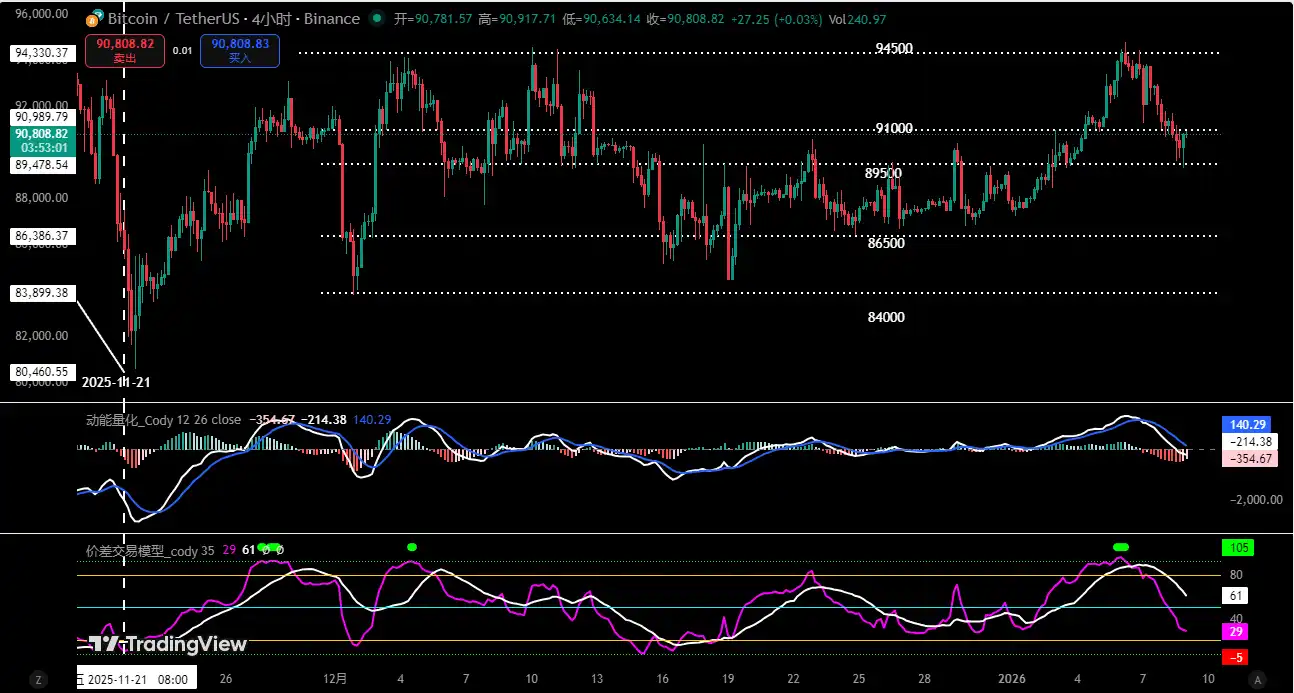
From the 4-hour technical structure (see chart above), Bitcoin has currently found effective support near 86,500 USD. Multiple technical indicators have entered oversold territory, indicating short-term selling pressure has been released. The market has a demand for a technical rebound correction (oscillatory rebound), but this is not yet sufficient to confirm a reversal of the downtrend.

Based on this, we anticipate the price may first rebound to test the 92,000~93,000 USD area. This level also coincides with the middle-upper part of the previous oscillation range and is expected to form resistance again.

For short-term operations, maintain a range-trading mindset: if the price reaches this zone and shows signs of momentum exhaustion or failed breakouts, consider building short positions on rallies; if it effectively breaks above 94,500 USD, stop loss decisively and reassess the market structure.

IV. Summary

Overall, Bitcoin continues to operate within the wide-range oscillation pattern defined at the beginning of the week: lower support provides room for rebounds, while upper resistance limits the upside. At present, rather than betting on a unilateral trend, it is more important to respect the range structure, focus on high-probability levels, and maintain strict risk control.

In ranging markets, formulating flexible response strategies and achieving stable profits is far more important than predicting direction.

Disclaimer: The above content is solely personal market opinion sharing and does not constitute any investment advice. Cryptocurrencies are highly volatile; please make independent judgments and strictly control risks.


Questions liées

QWhat was the price range for Bitcoin's consolidation as predicted by analyst Cody Feng at the beginning of the week?

AThe predicted consolidation range for Bitcoin was between $84,000 and $94,500.

QAt what price level did the analyst establish a short position and what was the profit from this trade?

AA short position was established near $94,000 and closed near $91,000, capturing a profit of approximately 3.4%.

QWhat are the two technical models mentioned that provided signals for the trade execution?

AThe two technical models mentioned are the Momentum Quant Model and the Spread Trading Model.

QAccording to the 4-hour chart analysis, what is the expected next move for Bitcoin's price and the key resistance area to watch?

AA technical rebound or震荡反弹 (oscillatory rebound) is expected to test the $92,000 to $93,000 area.

QWhat is the overarching trading philosophy emphasized for the current market conditions described in the article?

AThe philosophy is to focus on high-probability price points and strict risk control within the range-bound structure, rather than betting on a one-directional trend, as formulating flexible strategies for stable profits is more important than predicting direction.

Lectures associées

Le dernier grand acheteur d'Ethereum, jusqu'à quand pourra-t-il tenir ?

Alors que le marché des crypto-monnaies baisse, Bitcoin et Ethereum atteignent respectivement près de 60 000 $ et 1 500 $. Bitmine, le dernier acheteur majeur et persistant d'Ethereum, maintient des achats agressifs malgré des pertes latentes dépassant 10 milliards de dollars. Pour financer sa stratégie, Bitmine a émis des actions privilégiées perpétuelles rapportant 9,5% de dividendes annuels, levant environ 274 millions de dollars. Bitmine détient actuellement environ 5,66 millions d'ETH, soit plus de 90% de son objectif d'atteindre 5% de l'offre totale. Près de 85% de ses ETH sont mis en jeu (staking), générant un revenu annuel estimé entre 230 et 296 millions de dollars. Cependant, son prix d'acquisition moyen est d'environ 3 500 $, alors que l'ETH se négocie autour de 1 650 $, entraînant des pertes importantes. Le modèle de Bitmine repose sur l'utilisation des revenus du staking pour couvrir les dividendes. Pourtant, avec un rendement de staking de 3-4%, il ne pourra pas soutenir indéfiniment des dividendes de 9,5% si les émissions d'actions privilégiées augmentent. Une hausse du prix de l'ETH est donc essentielle pour la pérennité de ce modèle. Si Bitmine atteint son objectif de 5% et cesse d'acheter, la question se pose de savoir qui soutiendra le prix de l'ETH. Les ETF sur ETH connaissent des sorties de fonds nettes, et certaines institutions traditionnelles réduisent leur exposition. Les besoins d'achat institutionnels liés aux stablecoins ou aux actifs tokenisés (RWA) sont lents à se matérialiser. Les scénarios pour l'avenir d'ETH varient : une poursuite des achats de Bitmine pourrait maintenir un support, tandis qu'un ralentissement pourrait faire chuter le prix vers 1 000 $. Un scénario optimiste inclut l'inclusion dans l'indice Russell 1000 et une adoption réglementaire favorable. Finalement, la durabilité de la stratégie de Bitmine et l'émergence d'un nouvel acheteur marginal sont cruciales pour le prix d'Ethereum.

链捕手Il y a 2 h

Le dernier grand acheteur d'Ethereum, jusqu'à quand pourra-t-il tenir ?

链捕手Il y a 2 h

Les hausses de taux ne sont pas un tueur de technologies, le BPA l'est : Stratégie d'élimination des actifs faibles et de conservation des forts après le recul de la tendance IA

**Résumé de l'article** La correction brutale du 5 juin sur les marchés technologiques (NASDAQ -4,18%, indice des semi-conducteurs Philadelphie -10%) a été déclenchée par de fortes données sur l'emploi américain, ravivant les craintes de hausse des taux. Cependant, l'auteur soutient que le véritable danger pour la bulle technologique n'est pas la politique de la Fed, mais la concurrence féroce dans le secteur et l'**échec des entreprises à concrétiser leurs bénéfices (EPS)**. En s'appuyant sur des comparaisons historiques (ex: bulle Internet de 1999), l'article montre que les actions technologiques peuvent surperformer pendant les cycles de hausse des taux si leur EPS continue d'être révisé à la hausse. La phase actuelle du commerce de l'IA est décrite comme une période de **"validation et de recentrage"**, où les investisseurs doivent "conserver les actifs solides et éliminer les faibles". **Stratégie proposée :** Il ne faut pas abandonner le thème technologique, mais être sélectif. * **Conserver/Renforcer** les actifs leaders ayant une **visibilité élevée des commandes**, des marges stables, de fortes liquidités et des révisions positives de l'EPS (ex: chaîne d'approvisionnement des serveurs IA, modules optiques, circuits imprimés, packaging avancé). * **Réduire/Éviter** les actifs à forte volatilité basés sur des récits futurs sans preuve de profitabilité (ex: certaines actions quantiques, spatiales, de puces conceptuelles). L'ajustement actuel est considéré comme une opportunité ("le bus revient vous chercher") pour acquérir des actifs de qualité, à condition que les bénéfices se matérialisent. Les prochains points de contrôle seront les résultats du Q2 et les guides des entreprises technologiques.

marsbitIl y a 2 h

Les hausses de taux ne sont pas un tueur de technologies, le BPA l'est : Stratégie d'élimination des actifs faibles et de conservation des forts après le recul de la tendance IA

marsbitIl y a 2 h

La loi CLARITY rencontre un nouvel obstacle suite à l'effondrement de l'accord sur l'éthique lors des négociations au Sénat

La loi CLARITY, un projet de loi américain sur la structure du marché des crypto-monnaies, a rencontré un nouvel obstacle lors de négociations bipartites au Sénat, avec l'effondrement d'un accord préliminaire sur les questions éthiques. Après une réunion de mardi, les démocrates se sont dits déçus du retrait par les républicains d'une disposition clé qui aurait permis aux procureurs généraux des États de poursuivre le ministère de la Justice en cas de manquement à certaines exigences éthiques. En réponse, les républicains ont proposé de limiter ce pouvoir d'exécution au seul procureur général, une proposition qualifiée de volte-face par les démocrates. Un autre obstacle majeur au passage du texte réside dans les inquiétudes persistantes des groupes d'application de la loi. Ceux-ci craignent que certaines dispositions, notamment celles de la section *Blockchain Regulatory Certainty Act*, ne limitent leur capacité à enquêter et à poursuivre les activités criminelles utilisant la blockchain. Pour tenter de résoudre ce point, une réunion est prévue entre la Maison Blanche, des représentants d'associations de forces de l'ordre et des membres du Congrès. Enfin, le soutien de certains sénateurs démocrates décisifs, comme Mark Warner et Catherine Cortez Masto, est conditionné à la prise en compte satisfaisante de ces préoccupations éthiques et liées à l'application de la loi. Le groupe bipartite doit se réunir à nouveau jeudi pour tenter de sortir de l'impasse.

bitcoinistIl y a 3 h

La loi CLARITY rencontre un nouvel obstacle suite à l'effondrement de l'accord sur l'éthique lors des négociations au Sénat

bitcoinistIl y a 3 h

Trading

Spot
Futures
活动图片