Author: Changan I Biteye Content Team
Original Title: In-Depth Analysis of Predict Fun's Acquisition of Probable: The "Eastern Ambition" of BNB Prediction Market
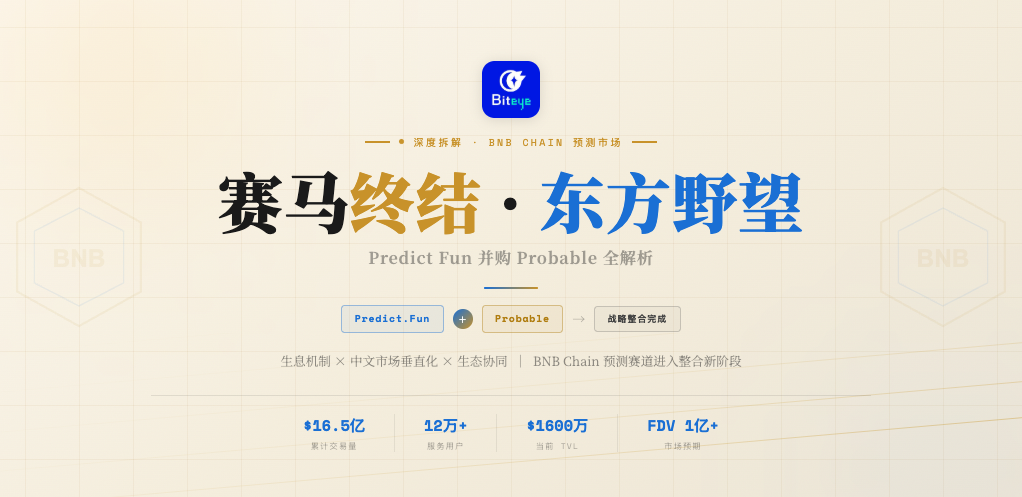
BNB Chain's prediction ecosystem has reached a major turning point: @predictdotfun has officially announced the acquisition of @0xProbable.
This is not just a simple acquisition but a strategic reshaping of the prediction track within the BNB Chain ecosystem:
-
How does it address the pain points of traditional prediction markets?
-
What opportunities and challenges will the verticalization of the Chinese market bring?
Follow this article as Biteye takes you through an in-depth analysis of Predict Fun's product logic, acquisition motives, and market impact, and answers a core question:
Is the BNB Chain prediction market still worth participating in?
I. Background Introduction of the Two Prediction Markets
Over the past few months, two platforms within the Binance ecosystem were seen as homogeneous competitors:
-
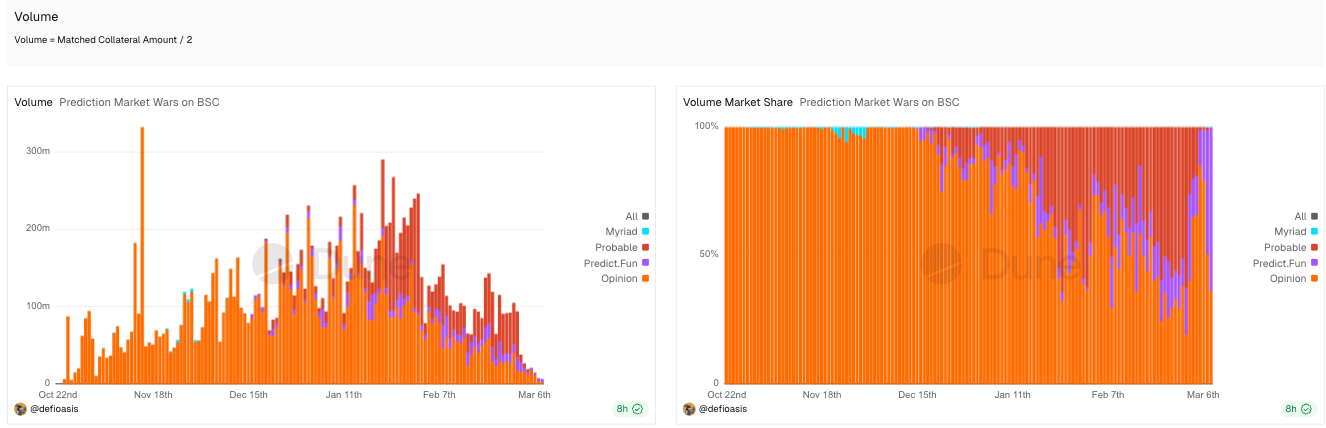
Probable: Focused on community-driven growth and zero fees, it achieved a trading volume of over $1 billion in just 36 days, with weekly average trading volume ranking among the top three globally, establishing its leading position in the Asian market.
-
Predict Fun: Processed over 3.3 million transactions within three months, with a cumulative trading volume of $1.653 billion, serving over 120,000 users.
A few days ago, Predict Fun announced the formal acquisition of Probable. Yue Xiaoyu @yuexiaoyu, former Growth Lead at Probable, has been appointed as Head of Asia-Pacific at Predict Fun, merging Probable's Chinese community resources with Predict Fun's yield-generating mechanism.
With the completion of this acquisition, the BNB Chain prediction market has transitioned from early-stage traffic competition to a new phase of liquidity and capital efficiency integration, marking the end of this race.
II. The Logic of the Merger: Capital Coordination, Breakthrough in the Chinese Market, and Ecosystem Synergy
2.1 Money No Longer Sleeps: How Does Predict Fun Allow Staked Funds to Generate Yield Simultaneously?
On platforms like Polymarket, once funds are deployed, they are locked, and users must bear the interest loss during the long settlement period.
Predict Fun, through deep integration with Venus Protocol, automatically deposits users' USDT into Venus to generate yield, rather than locking it in contracts.
Currently, out of its approximately $16 million TVL, over 60% is deployed in yield-generating strategies according to early reports. If this proportion remains unchanged, $9.6 million is now stored in Venus generating yield. This means that while users speculate on future events, their underlying assets are still generating about 3%-5% yield.
This feature is particularly suitable for users like Vitalik Buterin: choosing high-certainty events to bet on, holding until settlement, and earning dual returns from prediction and wealth management.
2.2 The Ceiling of Localization: The Potential and Challenges of the Chinese Vertical Market
Prediction markets are one of the most consensus-driven sectors in the crypto space. However, Polymarket has a clear demand mismatch in the Chinese market:
-
Chinese users are interested in prediction markets, but their primary participation method is often "farming airdrops" or "brushing interactions";
-
However, Polymarket's core markets focus heavily on Western politics and culture, posing a high learning curve for Chinese users.
An iron rule in the Meme sector: The best way to bet on a Meme is to participate in the Meme itself, not just trade pumps.
It is this demand mismatch that allowed Probable and Predict Fun to find their growth point – launching prediction events suitable for Chinese-speaking users.
Probable's marketing activities during the Spring Festival showed distinct localization characteristics:
-
Global Ambassador Program: Large-scale recruitment of Chinese-speaking KOLs through a global ambassador program, using point rewards to quickly achieve initial exposure on social media.
-
Spring Festival Event Marketing: Launching multiple markets related to the Spring Festival, e.g., Will the Spring Festival Gala produce a 'golden dog' (hit)?
Acquiring Probable is essentially acquiring a "demand conversion capability" – guiding those Chinese users who are optimistic about prediction markets but only know how to farm airdrops to become effective market participants. This is precisely a problem that Predict Fun's mechanism alone cannot solve.
Three Limitations of Localized Markets
Probable's strategy during the Spring Festival validated the explosive potential of localized operations: the trading volume for the Spring Festival prediction专场 (special session) exceeded $72 million. Although Probable's direction was correct, it also more or less encountered the dilemmas that the Chinese vertical market will face.
-
Fewer Variables in the Chinese Market
Take Probable's Spring Festival market "2026 Spring Festival Box Office Champion" as an example:
This year's Spring Festival season saw 6 films released, including "Feichi Rensheng 3" (Pegasus 3), "Jingzhe Wusheng" (Silent Awakening), "Biaoren: Fengqi Damo" (The镖人: Wind Rises in the Desert), "Boonie Bears:年年有熊" (Boonie Bears:年年有熊), "Xiongmao Jihua: Buluo Qiyu" (Panda Plan: Tribal Adventure), "Xinghe Rumeng" (Galaxy Dream).
The Spring Festival film slate is small, with only one or two films realistically competing for the box office champion. When consensus on a prediction event is highly unified, the prediction market becomes a low-yield wealth management play. This directly exposes the shortcoming of insufficient depth and breadth when relying solely on a vertical cultural market.
-
Insufficient Commercial Value
In contrast, although Polymarket has fewer Chinese markets, it demonstrates higher commercial value.
Polymarket also launched a Chinese market during the Spring Festival: "Which robot will dance on the Spring Festival Gala?"
When the editor gathered information about this market before the Gala, a trend was noticed: most information about the Gala robots was published by stock trading users, because suppliers cooperating with robot companies had炒作 (speculation) opportunities in the A-share market.
Polymarket's data directly serves investment decisions, and its user profile leans towards high-value investment groups.
The commercial value of a Chinese vertical market does not primarily depend on how local the topic is, but rather on what kind of user base the topic can attract. Markets that attract investment-oriented, decision-making users possess real commercial potential.
-
Controversy Equals Trading Volume
In prediction markets, controversy is also necessary. Controversy = divergence = trading volume.
Again, take Polymarket's "Which robot will dance on the Spring Festival Gala?" as an example: most options had trading volumes in the $20k-$30k range. However, controversy over "whether a robot on a base swaying its arms counts as dancing" directly drove GALBOT's trading volume from $60k to nearly $400k within hours.
In prediction markets, homogeneous competition has only one outcome: capital always flows to the platform with better liquidity. To break through, differentiation is the only way out. The answer given by Probable and Predict Fun is precisely to deeply cultivate the Chinese vertical market. The direction is correct – but to truly retain users, breakthroughs must be made in the following three dimensions:
-
Create Controversy: Find points of disagreement prone to information asymmetry, rather than outcomes that are obvious from the start (the controversy referred to here is not about ambiguous rules).
-
Explore Commercial Value: User participation willingness might be low for purely entertainment-oriented markets; a balance between entertainment and commerce needs to be found.
-
Incentive Misalignment Compensation: During the liquidity disadvantage period, offset users' opportunity costs through higher-intensity airdrop expectations and support.
2.3 Strong Alliance or Mutual Need? The True Driving Force Behind This Acquisition
This acquisition is not merely a simple merger of user data and trading volume; it更像 (is more like) a strategic marriage between a "yield-generating mechanism" and "localized traffic."
From an industrial logic perspective, its core driving forces are mainly reflected in three levels:
1| Resource Concentration
Avoid the internal consumption caused by homogeneous competition, integrate the user and traffic resources accumulated by Probable in the Chinese community uniformly into Predict Fun's ecosystem, forming a liquidity center with greater scale effect.
2| Product and Operation Complementarity
Predict Fun has obvious advantages in capital efficiency and underlying mechanisms, such as its yield integration with Venus. But in terms of local event design and community operation, Probable has accumulated relatively mature experience, forming a complementary relationship.
3| Building an "Eastern Front"
In the global prediction market landscape, the integration of Predict Fun and Probable is essentially creating a competitive path targeting the Asian market, forming differentiated competition with Polymarket.
To further understand the strategic considerations behind this acquisition, Biteye communicated with Yue Xiaoyu, Head of Asia-Pacific at Predict Fun.
In the interview, Yue Xiaoyu stated that the platform will continue to strengthen its localized operation strategy for different regions:
We will focus on localized operations for different countries and regions in our product strategy, by experimentally testing different categories of markets, simultaneously introducing more market makers to enhance liquidity, and reaching user needs more accurately within a compliant framework.
Regarding technology and product integration, he also clearly stated:
After Probable is acquired, users will gradually migrate to Predict Fun, and Predict Fun will be the sole entity for operation in the future. At the product and technical levels, no major adjustments will occur for now; the platform will continue with the original architecture.
When talking about the core significance of this acquisition, Yue Xiaoyu described it as "the end of the horse racing phase":
Previously, it was 'horse racing' within the Binance ecosystem, and now the race is over. After resource integration, the Binance ecosystem will focus on developing Predict Fun. Next, we will further integrate Binance ecosystem channels, through localized operations, experimenting with new product categories, and introducing more market makers, gradually forming a real scale effect.
In a sense, this merger is not only the confluence of two platforms but also marks the entry of the BNB Chain prediction market into a new development stage: from early competition to resource concentration and ecosystem synergy.
III. Probable User Migration Guide
With the acquisition completed, Predict Fun has launched a series of migration incentive policies for original Probable users. Although the official attempts to ensure a smooth transition through compensation, the points conversion has sparked considerable controversy among users.
1. Migration Incentive Strategy
-
Double Fee Refund: Predict Fun will refund twice the USDT fees paid by users on Probable.
-
Points Conversion Mechanism: Original Probable points can be converted to Predict points at different stages.
Weeks 1~6: Convert at a 1:1 ratio, totaling 600,000 Predict Fun points.
Weeks 7~10: Convert at a 1:10 ratio, totaling 4 million Predict Fun points.
2. Points Dilution Analysis
Despite offering double refunds and points conversion, by comparing the points issuance and market pricing of both, we find:
1) Disparate Issuance Ratios: Predict fun issues 10 M points weekly, while Probable issued 100 K points weekly. This means Predict Fun's points issuance volume is 100 times that of Probable. Under the 1:1 conversion ratio in weeks 1~6, users' points are diluted by 50 times.
2) Valuation Comparison: According to the pricing on Polymarket before the acquisition:
-
Probable: 69% probability for 50 M, 50% probability for 100 M
-
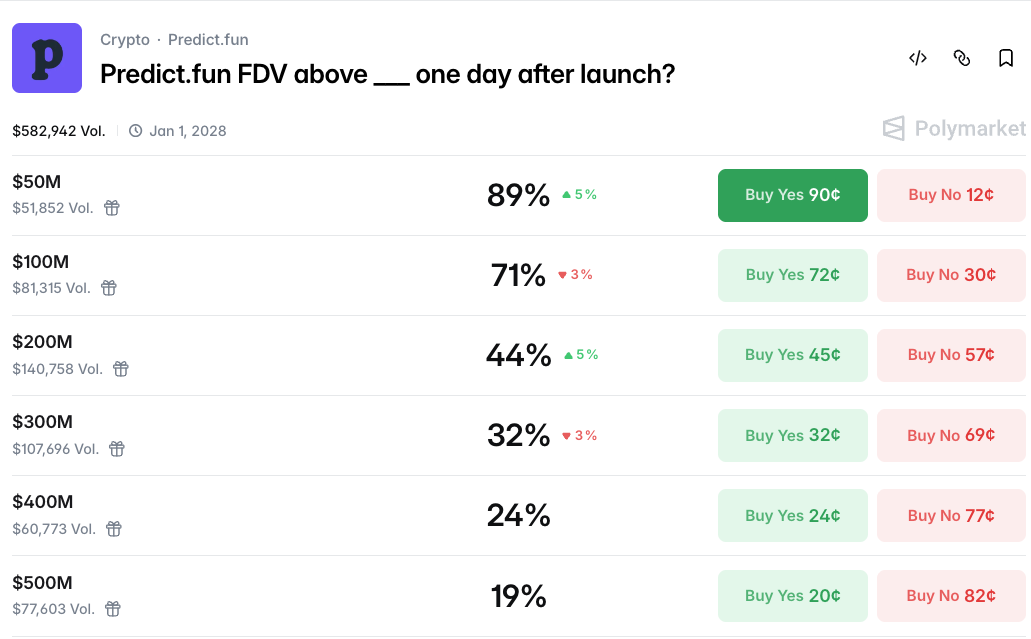
Predict fun: 91% probability for 50 M, 72% probability for 100 M, 47% probability for 200 M
Assuming Probable's post-launch valuation was 50M, and Predict fun's valuation was 100M. Although Predict fun's valuation is twice that of Probable, Predict fun's points issuance speed is 100 times that of Probable, diluting the value of users' Probable points.
3. Market Sentiment and Strategic Significance
The recent precedent of Opinion's TVL severely declining due to insufficient airdrop allocation is still fresh, making users extremely sensitive to the returns from brushing interactions and betting on airdrops. The feeling of being "diluted" after accumulating points diligently on Probable might further exacerbate distrust within the BNB Chain community.
However, this acquisition holds significant strategic importance. It integrates Probable's user resources with Predict Fun's mechanism,合力 (joining forces) to create a high-valuation leading project.
If the number one player cannot bring wealth effects, user willingness to participate in number two or three will plummet. Now that the two prediction markets have merged, Predict Fun truly possesses the strength to compete for the top spot in the sector. This might be the only chance to重塑 (reshape) the competitiveness of the BNB Chain prediction ecosystem.
IV. KOL观点汇总 (KOL Viewpoints Summary)
Yzi labs Investment Director Haley_Huang @Hui_Huangg (XHunt Rank: 30585)
Viewpoint: Highly excited and bullish on the acquisition, seeing it as excellent execution by the Predict Fun team. Emphasizes that the combination of BNB Chain's rapid retail growth, deep liquidity, and strong distribution channels will create a top-tier on-chain prediction market, ultimately aiming for mass adoption. More new markets即将推出 (are coming soon). Overall optimistic.
https://x.com/Hui_Huangg/status/2029445001558573272?s=20
Pump Pump Superman @crypto_pumpman (XHunt Rank: 3754)
Viewpoint: Believes the acquisition solidifies Predict Fun's position as second in the BNB Chain prediction market (combining Probable's impressive trading volume and Predict's high TVL),下一步 (next step) is to challenge for first. Praises YZI Labs for strong investment vision and resource integration, similar to merger cases in the Perps sector. Sees this as a turning point in the second half of the BNB Chain prediction market, actively bullish on Predict Fun's relay role (接力作用).
https://x.com/crypto_pumpman/status/2029437330998833477?s=20
郡主 (Junzhu) @0xsexybanana (XHunt Rank: 1048)
Viewpoint: The acquisition dispels her concerns about competition within the BNB Chain prediction market (previously did not participate due to poor liquidity and lack of profit effect), confirms Predict Fun's "favored son" status, will try market making. But泼冷水 (pours cold water): lowers expectations for Polymarket's airdrop (might be an ICO), believes prediction market valuations should be much lower than Perp DEX (divided by 5-10 times), suggests treating it as a profit tool rather than an airdrop farming opportunity, and adopting无损策略 (lossless strategies).
https://x.com/0xsexybanana/status/2029391862977708516?s=20
BITWU.ETH @Bitwux (XHunt Rank: 951)
Viewpoint: Positively interprets CZ's comments, sees the acquisition as a strong alliance between two robust projects, marking the end of "horse racing" in the BNB Chain prediction market. Believes prediction markets ultimately move towards concentration of liquidity, users, and platforms, with Predict Fun becoming a core ecosystem entry point (integrating technology, community, and liquidity). Possibly pushed by BSC, the格局已定 (landscape is set).
https://x.com/Bitwux/status/2029436963036803361?s=20
V. Is It Still Worth Entering Now? Three Strategies for Low-Cost Participation in Predict Fun
According to information on Polymarket, market expectations for Predict Fun are high: there is a 71% probability that Predict Fun's FDV will be above $100 million after launch, and a 44% probability it will exceed $200 million.
So how can we obtain airdrops with low cost?
-
Find High-Liquidity Markets for Trading
From the current platform order books, trading volume is the core metric measuring official support and market maker participation.
It is recommended to prioritize interacting with markets whose trading volume has exceeded one million dollars (e.g., 2026 NBA Champion, Fed March Decision, etc.). These markets, due to ample liquidity, have extremely small bid-ask spreads, significantly reducing slippage磨损 (wear and tear) from frequent trading.
-
Cost Advantage from Holding and Earning Yield
Leverage Predict Fun's integration mechanism with Venus to adopt博弈策略 (game strategies) different from other platforms.
On traditional platforms (like Polymarket), funds participating in long-cycle events (e.g., Alien existence prediction for 2027, Second Coming of Jesus in 2027) are locked for months, incurring significant loss of interest income.
Since part of the持仓资金 (position funds) on Predict Fun are deployed in Venus's yield-generating strategy, users can choose to hold positions in high-certainty event markets, as Predict Fun's long-cycle settlement markets offer a cost advantage for betting.
-
Cross-Platform Arbitrage Opportunities
With enhanced liquidity after the integration of Predict Fun and Probable, arbitrage opportunities will arise between its markets and those on other platforms.
Users can place bets on Predict Fun while simultaneously seeking opposite odds on other platforms for hedging.
The horse race has ended, but the real competition has just begun. Whether Predict Fun can convert the benefits of this integration into user retention and wealth effects will be the final answer determining the true rise of the BNB Chain prediction ecosystem.
The above strategies are for reference only. Prediction markets carry the risk of principal loss; please operate according to your own risk tolerance.
Twitter:https://twitter.com/BitpushNewsCN
Bitpush TG Discussion Group:https://t.me/BitPushCommunity
Bitpush TG Subscription: https://t.me/bitpush



















