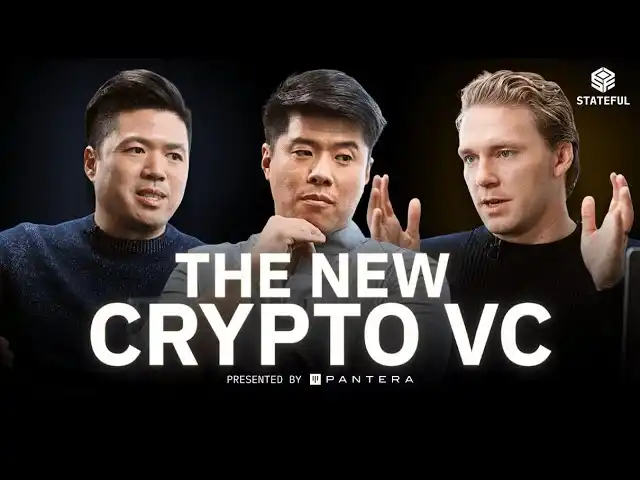
Pantera Partner: The Return of Professionalism and Rationality in Crypto VC, Where Is the Next Investment Hotspot?

marsbitPublié le 2025-12-19Dernière mise à jour le 2025-12-19

Résumé

Pantera Capital partners Paul Veradittakit and Franklin Bi discuss the current state and future trends of crypto venture capital. Despite a record $34 billion in total funding this year, deal volume has halved compared to 2021-2022, signaling a market shift toward professional, institutional capital focused on later-stage projects with rigorous due diligence. They attribute the previous "metaverse" and "altcoin" speculation frenzy to low interest rates and excess liquidity, which funded many unsustainable projects. The market is now rationalizing. Key developments include a clearer exit path via IPOs (e.g., Circle) and the emergence of Digital Asset Treasuries (DATs), which are actively managed vehicles for yield generation. DAT competition will hinge on execution and asset growth. Future investment themes include: - **Tokenization**: A multi-decade trend enabling programmable assets and new financial products, with stablecoins as a killer app. - **ZK-TLS (Zero-Knowledge TLS)**: Crucial for verifying off-chain data authenticity without exposing raw data, enabling new applications. - **Consumer/Prediction Markets**: Platforms like Polymarket offer democratized information discovery and entertainment. In a "bull or bear" segment: - **Stocks**: Divergent views on Robinhood (bullish for integration) vs. Coinbase (bullish for global institutional expansion). - **Payment Chains**: Skepticism about user lock-in vs. potential for optimized chains. - **Privacy**: Debate on whether ...

Original: Pantera Capital

Compiled & Edited: Yuliya, PANews

Recently, two partners from the leading venture capital firm Pantera Capital, Paul Veradittakit and Franklin Bi, analyzed the current state and changes in the crypto investment market in their first podcast. They reviewed the speculative wave of altcoins in recent years, analyzed this year's "fire and ice" phenomenon of record-high financing amounts but a significant drop in the number of deals, and engaged in a debate around project investment strategies and exit paths, as well as topics like DATs, tokenization, and zero-knowledge proofs. PANews has compiled and translated this blog post.

Crypto Investment Returns to Professionalism and Rationality; Team Execution and Asset Appreciation Are Key to DAT Competition

Host: Today, let's talk about the current state of crypto venture capital. Data shows that this year's total financing amount reached a record high of $34 billion, but the number of deals has nearly halved compared to 2021 and 2022, and capital is flowing more towards later-stage projects. How do you two interpret this "fire and ice" phenomenon?

Franklin: That's a great question. To understand the current situation, we need to look back at 2021 and 2022, which were the "metaverse years." Zero interest rates and massive liquidity fueled an explosion of speculative activity back then. However, the foundations of many deals were not solid; everyone was telling a story driven purely by imagination. Investors didn't have a clear judgment on how metaverse projects could actually succeed, leading to many projects that shouldn't have been funded getting money. In hindsight, we should have first asked a simple question: How is it possible to bring everyone into a fully digital metaverse world in an environment where even stablecoins don't have clear regulations? This is logically inconsistent.

Paul: Another reason is that those two years had an "altcoin bull market," and we don't have that now. The current market is primarily dominated by Bitcoin, Solana, and Ethereum. Without the altcoin frenzy, there wouldn't be as many retail investors, family offices, and small entrepreneurs rushing in to invest in a large number of early-stage projects. Current funding mainly comes from more professional crypto funds, which are more institutionalized, conduct stricter due diligence, and make more concentrated investments. This means lower frequency of deals, but the quality and amount per deal are increasing. Especially with the emergence of real use cases like stablecoins and payments, traditional fintech VCs have also entered the market, and their style is similarly focused on fewer but higher-quality investments.

Related reading: Farewell to Building on Sand, The Metamorphosis Moment of Crypto VC

Host: Indeed, everyone is now more focused on "exits," meaning how investments are realized. Circle's IPO is a milestone, as it gave venture capitalists a clear exit path.

Franklin: Exactly, Circle's IPO is highly significant. It finally completed the last chapter of the entire investment story. Before, everyone was guessing how the public market would react after a crypto company went public. Now, with examples like Circle and Figure (a company doing real-world asset tokenization), investors have a clearer picture. VCs can now clearly see that a project's path from seed round to Series A, and eventually to an IPO, is viable. They can more clearly assess the possibility of a project going from seed round to a final IPO, reducing the overall sense of risk in the field.

Paul: Yes, when I first entered the industry, I thought a Bitcoin ETF would definitely be approved within ten years, but it took over a decade. Now, the infrastructure is finally in place, creating the conditions for these massive exits. Additionally, the exit method has shifted from token generation events (TGEs) in the past two years to going public on the open market. Investing in equity and investing in tokens face completely different investors and expectations. Over the past two to three years, we've seen far more equity deals than token deals, which is also a significant reason for the decrease in the number of transactions.

Host: Besides IPOs, new tools have emerged in the market, such as "Digital Asset Treasuries" (DATs). It seems to have cooled down recently; what are your thoughts on its future?

Franklin: The emergence of DATs shows that the market's understanding of digital assets has matured. You can think of DATs as a "machine." In the past, you could buy a barrel of crude oil directly, or you could buy Exxon Mobile stock. Buying stock earns more because you are buying a "machine" that can continuously extract, refine, and create value. DATs are this "machine" in the digital asset space; they don't statically hold assets but actively manage them to create more returns. The market is now cooling down; people realize this isn't just simple hype and are starting to focus on the execution capabilities of the management team. This is a good shift, indicating the market is returning to rationality and pursuing quality.

I believe DATs are not a flash in the pan; actively managed investment tools always have their value. I even think that in the future, project foundations themselves could transform into DATs, using more professional capital market tools to manage their assets, rather than being largely inactive as many foundations are now.

Paul: I think the creation of DATs in the US might be nearing its end, but there is still significant room in regions like Asia-Pacific and Latin America. In the future, this market will undergo a round of consolidation, and only those DATs with strong team execution and the ability to continuously add value to assets will ultimately succeed.

Crypto Investment Trends: Infrastructure Needs Verification, Consumer Apps Need to Break Out

Host: Having discussed the current state, let's look to the future. Data shows that over the past year, finance, consumer, infrastructure, and AI were the most capital-attracting sectors. In your opinion, what will be the next investment hotspot?

Franklin: I'm particularly focused on two directions. The first is tokenization. Although this is already an old topic, it is a multi-decade mega-trend that is just beginning. I've been following it since 2015; it took ten years for this field to go from an idea to the current stage with real institutional and client participation. This is like the early internet era when people simply moved newspapers online. Today, we "copy and paste" assets onto the blockchain, which is great for efficiency and globalization, but the real potential lies in the fact that these assets can be "programmed" by smart contracts, thereby creating entirely new financial products and risk management models.

The second is ZK-TLS technology, or "proofs for the web." Simply put, blockchain has a "garbage in, garbage out" problem; if the data put on-chain is wrong, the blockchain's power is useless. ZK-TLS technology can verify the authenticity of off-chain data (like your bank statements, ride-hailing records) and bring it on-chain without exposing the data itself. This way, your behavioral data in apps like Robinhood and Uber can safely interact with on-chain capital markets, creating many cool new applications. Furthermore, J.P. Morgan was an early partner of the Zcash and Starkware teams, indicating that the core insights of zero-knowledge proof technology have long existed but are only now beginning to have the conditions for large-scale application. With the right infrastructure and talent joining, zero-knowledge proof technology is gradually maturing.

Paul: Let me add a few points. First, within tokenization, stablecoins are the undisputed killer app. As regulations become clearer, they are unleashing the true potential of "money over IP," making global payments extremely cheap and transparent. When I first entered the industry, my first task was to search globally for markets with real demand for cryptocurrency. We found that in places like Latin America and Southeast Asia, stablecoins are the best door opener for getting ordinary people to accept the crypto world.

Second, I am very bullish on consumer and prediction markets. From the veteran Augur to the current Polymarket, this field is exploding. It allows anyone to create a market and place bets on any topic (like company earnings, sports events). This is not only a new form of entertainment but also an efficient and democratic information discovery mechanism. The potential of prediction markets in terms of regulation, economics, and cost is gradually becoming apparent, offering the possibility to create markets on various topics, which will bring a massive influx of unprecedented information into news and trading.

Franklin: All this shows that on-chain capital markets are not just a copy of traditional markets. For example, in Latin America, many people's first investment through platforms like Bitso is Bitcoin. They might not have even bought stocks but could soon be exposed to complex financial derivatives like perpetual contracts. This "financial generational leap" means they might never use traditional Wall Street tools again because, in their view, those tools are inefficient and difficult to understand.

Bullish or Bearish? On Exchanges, Payment Chains, and the Privacy Sector

Host: Next, let's play a game called "Bullish or Bearish." First question: If you had to hold for three years, would you buy Robinhood (HOOD) or Coinbase (COIN) stock?

Franklin: I choose Robinhood. Because I don't think the market fully understands its ambition yet. Robinhood doesn't want to be just a broker; it is vertically integrating all aspects like clearing and trading, aiming to become an integrated financial technology platform that controls its own destiny. In comparison, Coinbase's vision (getting everyone on-chain) is grander, requiring 10 to 20 years, and the market will have a hard time fully digesting it within three years.

Paul: Then I must choose Coinbase. I恰恰 believe the market underestimates Coinbase's potential in institutional business and international expansion. As global regulations become clearer, Coinbase can quickly capture global markets through acquisitions and empower a large number of traditional financial institutions through a "crypto as a service" model.

Host: I also lean towards Robinhood. It has proven it can quickly launch new products and successfully monetize them.

Host: Bullish or bearish on "dedicated payment chains" built for stablecoin payments?

Paul: I'm curious, not bearish. Customizing a chain for a specific scenario (like payments), with optimizations for scalability, privacy, etc., has value. For example, the Tempo chain launched by Stripe; although it's not neutral, with Stripe's resources, it will definitely achieve considerable scale.

Franklin: I'm slightly bearish. Because in the long run, value ultimately flows to users, not to platforms trying to lock them in. Users will ultimately choose the most open and liquid place, not be locked into a specific chain. In the open crypto world, the moat effect of channels will be greatly diminished.

Host: Last question, is privacy a sector worth investing in?

Franklin: I'm bearish. I think privacy is a feature, not a product. Almost all applications will eventually need privacy features, but this feature itself is difficult to capture value alone because any technological breakthrough could be open-sourced.

Paul: I hold the opposite view. Ordinary users might not care, but at the enterprise and institutional level, privacy is a rigid demand. The investment opportunity lies not in the technology itself but in who can combine the technology with compliance, provide commercialized solutions, and make them industry standards.

Rejecting Investor "Privileges," The Public Chain War Is Not Over

Host: Let's talk about hot topics on Twitter. The first is about token lock-up periods. Some say they should be locked for four years, others say they should be unlocked immediately. What do you think?

Franklin: I actually hate this topic. Because its premise is wrong; everyone always thinks, "I invested money, so it must be valuable." But the harsh reality of venture capital is that 98% of projects will ultimately go to zero. The fundamental reason a project fails is that it has no value itself, not because its lock-up period was poorly designed.

Paul: I understand the difficulties of founders. Token price is important for incentivizing the community and subsequent financing. But from the project's perspective, a reasonable lock-up period (say, 2 to 4 years) is necessary. It gives the team enough time to develop the product, achieve goals, and prevents the token price from collapsing too early.

Host: So should the lock-up periods for founders and investors be the same?

Franklin: They must be the same. Our philosophy is "one team, one dream." If investors seek special terms for early exit, it means they never intended to walk the long road with the project from the beginning. This kind of signal is devastating to the project.

Host: Last topic: Is the "L1 public chain war" over?

Paul: I think it will continue, but not as crazily as before. There won't be as many new L1 public chains rising in the future, but the existing ones will continue to exist due to their respective communities and ecosystems.

Franklin: I think it's a good sign that everyone is now starting to focus on how L1 public chains capture value. It's too early to declare L1 dead now because technology is constantly evolving, and ways to capture value are still being explored. Just like Solana back then, everyone said it was dead, but as long as you believed it still had a breath left, you could make a lot of money. As long as there is a lot of user activity on a chain, there is always a way to capture value. Ultimately, "priority fees decide everything"; where there is competition, there is value.


Questions liées

QAccording to Pantera Capital partners, what are the key factors driving the current trend of higher funding amounts but fewer deals in crypto VC?

AThe trend is driven by a shift from the speculative 'metaverse years' of 2021-2022, fueled by zero interest rates and high liquidity, to a more professional and institutional market. Capital is now concentrated in fewer, higher-quality deals from specialized crypto funds and traditional fintech VCs who conduct stricter due diligence. The absence of an 'altcoin bull run' has also reduced the number of speculative, early-stage investments from retail and smaller investors.

QWhat significant milestone did Circle's IPO represent for the crypto venture capital industry?

ACircle's IPO was a significant milestone because it provided a clear and successful exit path for crypto venture capital investors. It demonstrated that crypto companies could successfully go public and be received well by public markets, thereby de-risking the investment lifecycle from seed to IPO and validating the entire venture model for the sector.

QHow do the partners view the future of Digital Asset Treasuries (DATs)?

AThe partners believe DATs represent a maturation of the market, acting as active 'machines' for value creation rather than passive asset holders. While the initial hype in the US may be cooling, they see a future of consolidation where DATs with strong execution and value-add teams will succeed. They also foresee potential for growth in regions like Asia-Pacific and Latin America and even suggest that project foundations could evolve into DATs for professional treasury management.

QWhat two major technological trends does Franklin Bi identify as the next big investment opportunities?

AFranklin Bi identifies tokenization and ZK-TLS (or 'proofs of networking') as major investment opportunities. He sees tokenization as a multi-decade trend enabling programmable assets and new financial products. ZK-TLS technology is crucial for verifying the authenticity of off-chain data (e.g., bank statements, ride-sharing records) and bringing it on-chain securely, enabling new applications that interact with traditional web2 data and capital markets.

QIn the 'Bull or Bear' game, what were the differing opinions on investing in privacy as a standalone sector?

AFranklin Bi was bearish, arguing that privacy is a feature rather than a product, making it difficult to capture value as it can be easily open-sourced. Paul Veradittakit was bullish, stating that while consumers may not prioritize it, privacy is a critical need for enterprises and institutions. He sees the investment opportunity not in the core technology itself, but in commercializing compliant privacy solutions that can become industry standards.

Lectures associées

Facture de l’inférence IA en flèche, Shopify et Roblox mettent en garde : les économies réalisées grâce aux licenciements ne suffiront pas à payer la facture des puces

La saison des résultats du premier trimestre 2026 révèle un paradoxe financier pour les entreprises technologiques. Alors que l'IA permet des gains de productivité et une réduction des effectifs, ses coûts opérationnels – consommation de tokens et amortissement des GPU – grèvent désormais les marges de manière significative. Shopify illustre ce dilemme. Si l'IA génère plus de 50% du code et a permis 300 nouvelles fonctionnalités sans hausse des effectifs, les coûts des LLM (notamment via l'assistant Sidekick) pèsent sur la marge de ses solutions d'abonnement, malgré une croissance explosive de son utilisation. Chez Roblox, un quart de la révision à la baisse de sa marge prévisionnelle 2026 est directement attribué aux investissements en IA. La plateforme, qui exécute 1,5 million d'inférences par seconde, envisage de facturer les futures expériences IA avancées pour compenser ces coûts. À l'échelle du secteur, l'écart est frappant : les dépenses en capital IA d'Amazon, Meta, Microsoft et Google devraient atteindre 7250 milliards de dollars en 2026 (+77%). Les économies réalisées via les licenciements sont dépassées : chez Meta, les 24 milliards de dollars d'économies annuelles prévues ne compenseraient que 12% de l'amortissement supplémentaire lié à l'IA. Les grands gagnants sont les fournisseurs de modèles et de puces (OpenAI, Nvidia...), tandis que les entreprises applicatives doivent repenser leur modèle économique. Elles ne peuvent plus simplement financer la facture de l'IA par des réductions de coûts salariaux et doivent soit intégrer ces coûts dans leur stratégie commerciale (Shopify), soit les répercuter sur l'utilisateur final (Roblox).

marsbitIl y a 4 mins

Facture de l’inférence IA en flèche, Shopify et Roblox mettent en garde : les économies réalisées grâce aux licenciements ne suffiront pas à payer la facture des puces

marsbitIl y a 4 mins

Hook Summer est-il réellement arrivé ? Sato, Lo0p et FLOOD déclenchent un nouveau récit sur Uniswap v4

Avec le léger redressement du marché, les mémecoins sur Ethereum gagnent à nouveau en popularité. Après ASTEROID, des tokens comme sato, sat1, Lo0p et FLOOD, basés sur le protocole Hook d'Uniswap v4, attirent l'attention. Leur capitalisation varie de quelques millions à des dizaines de millions de dollars, apportant une liquidité concentrée à un marché cryptographique en manque de récits. **Hook : Des contrats intelligents "plug-in" pour Uniswap v4** Hook permet aux développeurs d'injecter une logique personnalisée à des étapes clés du cycle de vie d'un pool de liquidité (initialisation, ajout/retrait de liquidités, échange, etc.), faisant de l'AMM un système programmable. **Présentation des tokens représentatifs :** * **sato** : Mécanisme de frappe et de destruction via la courbe Uniswap v4. Achat = génération de nouveaux tokens et verrouillage d'ETH en réserve. Vente = échange contre ETH depuis la réserve et destruction des tokens. Capitalisation actuelle ~28M$. * **sat1** : Présenté comme une version "optimisée" de sato, a connu un pic de spéculation avant de décliner fortement. Capitalisation actuelle ~0.8M$. * **Lo0p** : Protocole de prêt AMM intégré. Les utilisateurs peuvent acheter et verrouiller LO0P comme garantie pour emprunter de l'ETH depuis les réserves du pool, sans impact direct sur le prix spot. Capitalisation actuelle ~0.96M$. * **FLOOD** : Les réserves générées par les achats sont déposées sur Aave v3 pour générer des intérêts, lesquels restent dans le pool et influencent potentiellement le prix. Capitalisation actuelle ~1.4M$. **Impact sur l'écosystème Uniswap et UNI** Ces innovations basées sur Hook pourraient, à long terme, attirer des utilisateurs et des liquidités vers Uniswap v4, renforçant les fondamentaux du token UNI (notamment avec l'activation du "fee switch" et le burn partiel des frais). Cependant, à court terme, ces tokens expérimentaux ne sont probablement pas un moteur direct pour le prix de UNI, qui reste soumis à la volatilité générale du marché, à la régulation et à d'autres facteurs. Le TVL d'Uniswap v4 (5,95B$) est encore inférieur à celui des versions V2/V3. **Remarque importante :** Ces tokens sont des expériences technologiques précoces et peuvent comporter des risques ou des bugs inconnus. Cette information ne constitue pas un conseil en investissement.

marsbitIl y a 14 mins

Hook Summer est-il réellement arrivé ? Sato, Lo0p et FLOOD déclenchent un nouveau récit sur Uniswap v4

marsbitIl y a 14 mins

L'été des Hook est vraiment arrivé ? sato, Lo0p, FLOOD déclenchent une nouvelle narration autour d'Uniswap v4

L'été des Hooks est-il arrivé ? Les jetons sato, sat1, Lo0p et FLOOD, basés sur le protocole Hook d'Uniswap v4, suscitent un vif intérêt sur le marché. Ces jetons, avec des capitalisations allant de quelques millions à plusieurs dizaines de millions de dollars, apportent une nouvelle dynamique de liquidité concentrée. Leur mécanisme repose sur les "Hooks", des contrats intelligents modulaires qui permettent d'injecter une logique personnalisée à des étapes clés des pools de liquidités (initialisation, ajout/retrait de liquidités, swaps, etc.). Sato, le premier lancé, a atteint une capitalisation de plus de 38 millions de dollars grâce à son mécanisme de frappe et de destruction lié à une courbe. Sat1, présenté comme une version optimisée, a connu un pic avant un déclin rapide. Lo0p intègre un mécanisme de prêt dans le pool AMM, permettant d'emprunter de l'ETH contre des jetons LO0P déposés en garantie. Quant à FLOOD, il place automatiquement les réserves du pool sur Aave pour générer des rendements qui soutiennent le prix du jeton. Si cette effervescence autour des Hooks contribue au développement à long terme de l'écosystème Uniswap et pourrait bénéficier au jeton UNI via l'activation du "fee switch", son impact à court terme sur le prix de UNI reste limité. Le TVL d'Uniswap v4 (595M$) est encore inférieur à celui des versions précédentes. Odaily rappelle que ces projets sont des expérimentations techniques précoces et comportent des risques.

Odaily星球日报Il y a 24 mins

L'été des Hook est vraiment arrivé ? sato, Lo0p, FLOOD déclenchent une nouvelle narration autour d'Uniswap v4

Odaily星球日报Il y a 24 mins

Le guide de l'IA du CEO de Y-Combinator : le futur appartient à ceux qui construisent des systèmes à intérêts composés

Le PDG de Y Combinator, Garry Tan, présente une nouvelle vision de l'IA personnelle : non pas un simple chatbot, mais un système d'exploitation qui capitalise sur les intérêts composés. L'idée centrale est de passer de l'utilisation ponctuelle de modèles d'IA à la construction d'un "second cerveau" structuré et évolutif. Ce système, qu'il a développé et open-sourcé (GBrain, OpenClaw), ingère et connecte automatiquement toutes les données de sa vie professionnelle : notes de réunions, livres, emails, contacts. Chaque interaction enrichit une base de connaissances de 100 000 pages, permettant un contexte riche pour les tâches futures. La clé réside dans la "skillification" : transformer les workflows répétitifs (ex : préparer une réunion, analyser un livre) en "compétences" (skills) autonomes et réutilisables. Une méta-compétence, "Skillify", permet même de créer de nouvelles compétences automatiquement. Ainsi, le système s'améliore de lui-même, chaque correction profitant à toutes les utilisations futures. Tan détaille des cas concrets : un "miroir de livre" qui résume un ouvrage et le relie à son expérience personnelle en 40 minutes, ou une préparation de réunion qui synthétise des mois de contexte sur un interlocuteur en deux minutes. L'argument est que l'avantage concurrentiel futur appartiendra à ceux qui sauront construire de tels systèmes d'IA personnels et composés, centrés sur leur contexte unique, plutôt qu'à ceux qui se contentent d'outils centralisés. Il invite à commencer modestement par une tâche concrète, à l'itérer, puis à la transformer en compétence réutilisable pour enclencher la courbe de capitalisation.

marsbitIl y a 37 mins

Le guide de l'IA du CEO de Y-Combinator : le futur appartient à ceux qui construisent des systèmes à intérêts composés

marsbitIl y a 37 mins

Employés chinois de SK Hynix sous le choc : leur prime annuelle représente moins de 5 % de celle des employés coréens

L'article traite de l'écart important des bonus annuels entre les employés sud-coréens et chinois de SK Hynix, un géant des semi-conducteurs profitant du boom de la mémoire lié à l'IA. Alors que les médias sud-coréens spéculent sur des bonus moyens pouvant atteindre l'équivalent de plusieurs millions de yuans pour les employés en Corée du Sud, un employé chinois de SK Hynix, avec plus de 10 ans d'ancienneté, révèle que le bonus des employés en Chine représente moins de 5% de celui de leurs homologues coréens, avec un montant maximum personnel d'environ 100 000 yuans. L'article explique que les bonus en Corée du Sud sont calculés sur la base du salaire mensuel et versés une fois par an, tandis qu'en Chine, ils sont distribués deux fois par an et ajustés selon les notations de performance. De plus, les employés chinois n'auraient pas accès à des postes de direction ou à des plans d'intéressement en actions, réservés aux cadres coréens. SK Hynix a confirmé l'existence d'une règle de distribution de 10% du bénéfice opérationnel mais a tempéré les prévisions de bonus très élevées. L'entreprise anticipe une forte demande continue pour ses produits haut de gamme destinés aux clients professionnels (comme la mémoire HBM) pour les prochaines années, ce qui pourrait maintenir la pression sur les prix pour le marché grand public.

链捕手Il y a 41 mins

Employés chinois de SK Hynix sous le choc : leur prime annuelle représente moins de 5 % de celle des employés coréens

链捕手Il y a 41 mins

Trading

Spot
Futures
活动图片




