OpenAI Shuts Down Sora, Disney's $1 Billion Investment Goes Down the Drain, AI Video Market Reshuffles

marsbitPublié le 2026-03-27Dernière mise à jour le 2026-03-27

Résumé

OpenAI has officially shut down its AI video generation product Sora, including its consumer app, API, and the sora.com domain, as of March 24, 2026, just six months after its public launch. This decision also led to the cancellation of Disney’s three-year licensing agreement and a planned $1 billion investment in OpenAI. The tech community’s reaction highlighted Sora’s lack of real-world adoption, with many questioning whether the product was ever widely used. Competitors like Runway Gen-4, Kling 3.0, and Google Veo are now positioned as the main players in the AI video market. Sora’s shutdown is attributed to high operational costs—estimated at $15 million daily during peak usage—coupled with limited revenue alignment ahead of OpenAI’s expected IPO. Deepfake concerns related to Sora’s content generation features also contributed to its termination. OpenAI will retain Sora’s underlying technology for internal "world simulation" research aimed at robotics field, but no consumer-facing video products are planned. Current Sora users are advised to migrate to alternatives such as Runway, Kling, or Pika. The exit of OpenAI is expected to lead to market consolidation, potential price increases from remaining providers, and greater enterprise opportunities for competitors like Kling. Runway, in particular, may raise subscription prices due to increased demand.

Author: RoboRhythms

Compiled by: Deep Tide TechFlow

Deep Tide Guide: On March 24, 2026, OpenAI shut down Sora's App, API, and domain all at once. Disney's three-year licensing agreement and $1 billion investment subsequently collapsed.

The first reaction from the tech community was not regret, but "Did anyone actually use this thing?"—this statement speaks volumes more than any official announcement. Runway, Kling, and Google Veo are now the only real players left in the AI video space.

Full Text Below:

The product that was supposed to bring AI video generation to the masses has disappeared. OpenAI shut down Sora on March 24, 2026, taking down the standalone App, API, and sora.com, just about six months after the product's high-profile public release.

The timing is awkward. Disney signed a three-year licensing agreement in December 2025, authorizing OpenAI to use iconic characters like Mickey Mouse and Cinderella for Sora-generated content, and planned to invest $1 billion in OpenAI.

All of this is now canceled.

I think the most telling thing is the reaction from the tech community: the mainstream sentiment wasn't regret, but "Did anyone actually use this thing?" This statement reveals the product's actual trajectory more truthfully than any official announcement.

If you were using Sora or planning to build a product based on its API, here's what you need to know.

What Exactly Happened

Sora's shutdown is a complete product termination, covering the App, developer API, and the sora.com domain.

OpenAI confirmed on March 24 that the entire Sora product line would be completely shut down. This is not a pivot, a rebrand, or a merger into another product.

The App is gone, the API is being shut down, sora.com is being taken offline.
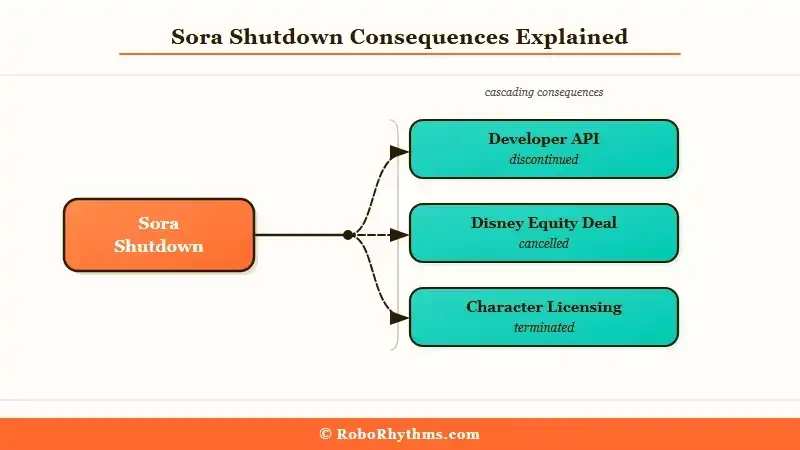
Here is everything that was terminated:

  • Sora consumer App (text-to-video)
  • Sora API (developer and enterprise access)
  • sora.com website

Disney's planned $1 billion equity investment in OpenAI

The three-year character licensing agreement with Disney announced in December 2025

The Disney angle is not a footnote. A $1 billion deal collapsing within three months of its announcement suggests the relationship had already become complicated before the shutdown was officially announced.

Both Variety and Bloomberg confirmed that the deal was directly called off due to Sora's cessation of operations.

Only one part of Sora remains: the internal research team continues to advance what OpenAI calls "world simulation" research, aimed at robotics applications.

This project has nothing to do with the video product you might have used. OpenAI explicitly positions this as infrastructure research, not a future consumer product.

This also aligns with a pattern I've reported on before. OpenAI has a history of terminating products that no longer fit its revenue roadmap, and the timing—ahead of a planned IPO—follows the same logic.

Why This Is More Serious Than It Sounds

Sora's shutdown isn't just a product failure; it's OpenAI publicly conceding an entire AI category to the competitors it once looked down upon at its launch.
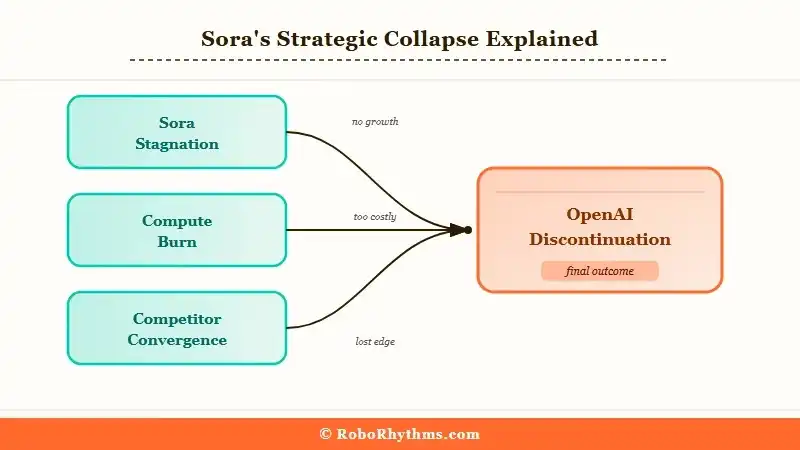
When Sora first debuted in 2024, the demos were stunning. Posts on r/singularity garnered hundreds of thousands of views, with a widespread belief that OpenAI had once again leapfrogged all competitors overnight.

Runway, Pika, and Kling were supposed to become irrelevant.

But the product stalled after its public launch. Runway Gen-4 kept iterating and shipping, Kuaishou's Kling 3.0 closed the quality gap faster than most analysts expected.

Google Veo's compute advantages were something OpenAI couldn't easily match in this non-core revenue赛道 (market).

Compute cost is the most staggering number. Analysts estimate Sora's compute cost peaked at around $15 million per day during peak usage.

For a company focused on pre-IPO financials, this was an extremely difficult expense to justify when the models that actually drive revenue (GPT-5 series, Operator API, enterprise contracts) all require more investment.

Then there was the deepfake issue. TechCrunch, in its shutdown report, called Sora "the most disturbing app on your phone," referring to the cameo feature that allowed users to insert real people into AI-generated scenes.

The backlash from this feature was significant, and in my view, the reputational drag made the shutdown decision easier than it otherwise might have been.

The industry impact is now clear: Runway, Kling, and Google Veo are the true players in AI video. The strategic uncertainty that OpenAI's presence created for every competitor has now been removed.

What This Means For You

If you were using Sora or accessing its API, you need to act immediately. The shutdown timeline is effective now.
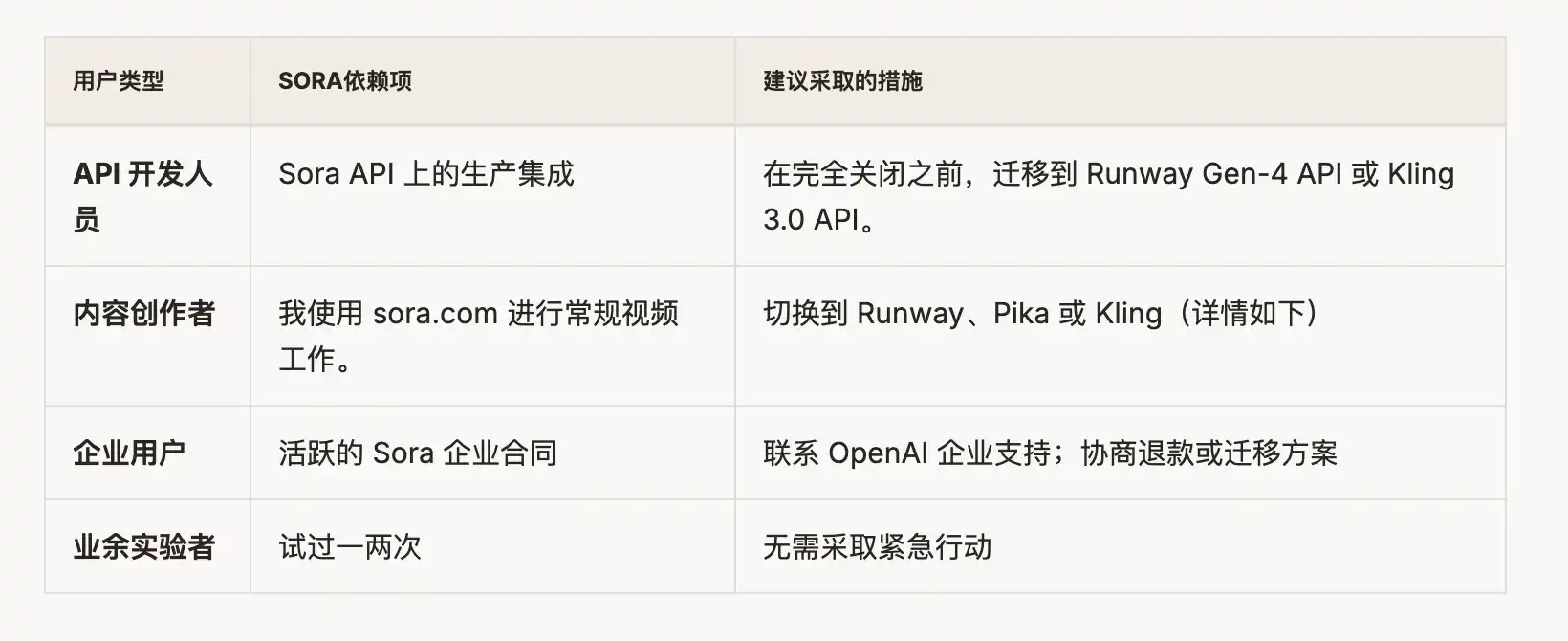
The three tools currently best positioned to absorb Sora's former user base:

Runway Gen-4—Technically closest to Sora's cinematic quality goals, with a mature API and an active developer community. Best for professional long-form video production.

Kling 3.0—Kuaishou's model has become the community's top choice for realistic motion effects and is the tool most recommended by former Sora users in migration discussions. Developer API available.

Pika 2.0—Faster, cheaper, and easier to use than the above two. Plans start around $8/month. Best for content creators prioritizing speed over cinematic quality.

If your primary use case is for virtual avatars or talking head videos, rather than purely generative scenes, the tool choice differs.

What Happens Next

The AI video market is about to consolidate, and prices will rise.

With OpenAI's exit, Runway, Kling, and Google Veo no longer operate in a market where a well-funded new entrant could颠覆 (disrupt) everyone's pricing expectations at any moment.

This changes the commercial dynamics for all remaining players.

My predictions for the next six months:

Runway will raise subscription prices. Demand will surge with the influx of Sora users, and Runway's pricing has been below what its competitive position could support. The diminished threat from OpenAI gives them clear room to reprice.

Google Veo will more aggressively push a consumer product. Google had been deliberately quiet about a public rollout for Veo; the addressable market is now clearer. Expect a more prominent consumer product before the end of 2026.

Kling will target the enterprise contracts Disney's departure leaves behind. Kuaishou has been building Kling as a professional-grade product. The OpenAI-Disney deal effectively blocked some enterprise relationships that are now reopening.

An outcome I don't see happening: OpenAI returning to AI video with a consumer product. Internal signals point to video being recast as robotics infrastructure research, and the window for re-entering the market is shorter than this company's typical development cycles.

From my experience observing every AI category, the company that wins is the one that accumulates iterations over time, not the one that released the best demo. Sora peaked at the demo; Runway has been accumulating for three years.

Frequently Asked Questions

Q: As of March 2026, is the Sora App still usable?

As of March 24, 2026, Sora has entered the shutdown process. OpenAI has not announced a specific final access date for all users, but the termination process has begun. Do not rely on its continued availability for any production environment work.

Q: What is the best alternative to Sora for API developers?

Runway Gen-4 currently has the most mature and stable developer API among AI video tools. Kling 3.0 also offers API access and is widely recommended in developer migration discussions. It's advisable to test both before fully migrating.

Q: Why did Disney cancel its $1 billion investment in OpenAI?

Disney's investment and the three-year licensing agreement were directly tied to the Sora product line, including rights to use Disney characters in AI-generated videos. With Sora's shutdown, the licensing arrangement lost its foundation. Both parties have called it off, according to Bloomberg and Variety.

Q: What will happen to the internal Sora research team at OpenAI?

The team continues to work on world simulation research for robotics. This work will not result in any consumer or developer-facing video products. OpenAI positions it as infrastructure research, not something on the product roadmap.

Q: Does this mean OpenAI is broadly scaling back consumer products?

OpenAI has made it clear that pre-IPO resources are focused on enterprise software, programming tools, and agent products. Sora's shutdown aligns directly with this direction.

Q: Is Google Veo now the best Sora alternative?

Veo is technically strong, but for developers and content creators, Runway Gen-4 and Kling 3.0 are currently more accessible and better supported. For most users needing to migrate today, Runway or Kling is the more practical choice.


Questions liées

QWhat was the main reason for OpenAI shutting down Sora according to the article?

AThe article states that Sora was shut down due to its high operational costs (estimated at $15 million daily in compute costs during peak usage) and because it did not align with OpenAI's pre-IPO focus on revenue-generating products like enterprise software, coding tools, and agent products. Additionally, reputational issues from deepfake concerns made the decision easier.

QWhich companies are now considered the main players in the AI video generation market after Sora's shutdown?

AAccording to the article, the main players in the AI video generation market after Sora's shutdown are Runway (Gen-4), Kling (3.0 by Kuaishou), and Google Veo.

QWhat was the financial and strategic impact of Sora's shutdown on Disney?

ADisney's planned $1 billion equity investment in OpenAI and a three-year character licensing deal, announced in December 2025, were both canceled as a direct result of Sora's shutdown. The deal had granted OpenAI rights to use Disney characters like Mickey Mouse and Cinderella in AI-generated content.

QWhat is the future of the internal Sora research team at OpenAI?

AThe internal Sora research team will continue its work, but it has been re-focused on 'world simulation' research for robotics applications. This is positioned as infrastructure research and will not lead to any future consumer or developer-facing video products.

QWhat does the article predict will happen to the AI video market in the next six months following Sora's exit?

AThe article predicts market consolidation and price increases. Specifically, it forecasts that Runway will raise its subscription prices, Google will more aggressively push Veo as a consumer product, and Kling will target the enterprise contracts that were previously blocked by the OpenAI-Disney deal.

Lectures associées

Le marché de la cryptographie a-t-il touché le fond ? Voici ce qu'en pensent les institutions

Le marché des cryptomonnaies a-t-il atteint son point bas ? Trois institutions financières présentent des analyses divergentes. Galaxy Digital estime que le fond n'est pas encore atteint. Sur la base de 13 indicateurs historiques (tels que la moyenne mobile sur 200 semaines et l'indice de peur et de cupidité), seuls 4 signaux sont pleinement activés. Leur analyse suggère un creux potentiel entre 30 000 et 54 000 dollars, avec un scénario neutre entre 40 000 et 46 000 dollars. NYDIG adopte une position plus nuancée. Bien que de nombreux indicateurs soient proches des niveaux de creux historiques, l'absence d'une vente de panique généralisée typique des marchés baissiers majeurs persiste. L'institution note que l'entrée des investisseurs institutionnels pourrait avoir modifié la dynamique des cycles, permettant un creux moins prononcé que par le passé. À l'inverse, la Standard Chartered affirme que le fond a été touché à environ 59 000 dollars. La banque s'appuie sur deux facteurs : une éventuelle détente diplomatique entre les États-Unis et l'Iran, et l'hypothèse que les ventes récentes dans les ETF Bitcoin étaient liées à la préparation de l'introduction en bourse anticipée de SpaceX. Elle prévoit désormais que le Bitcoin pourrait atteindre 100 000 dollars d'ici la fin de l'année. Malgré ces divergences sur le niveau exact du creux, les trois rapports s'accordent sur des points essentiels pour les investisseurs à long terme : 1. Le fond du marché devrait être atteint au cours de l'année 2024. 2. Le prix actuel est plus proche du creux que des sommets précédents. 3. Une nouvelle phase haussière (bull market) pour le Bitcoin reste attendue à l'avenir. L'article conclut que, quelle que soit la fourchette exacte du creux (entre 40 000 et 60 000 dollars), la perspective d'une remontée vers 100 000 dollars ou plus offre un potentiel de rendement significatif pour les investisseurs patients. Les fondamentaux à long terme du Bitcoin, comme l'endettement public mondial, l'inflation et l'adoption numérique, restent solides, rendant le contexte actuel plus favorable que lors des hivers cryptographiques précédents.

marsbitIl y a 7 mins

Le marché de la cryptographie a-t-il touché le fond ? Voici ce qu'en pensent les institutions

marsbitIl y a 7 mins

La "Douleur du Cœur" et la Percée de la Chaîne Industrielle Photonique Chinoise

Dans la course mondiale à l'IA, les modules optiques, qui assurent la conversion et la transmission des données entre les GPU, sont des éléments clés. Leur composant essentiel, la puce DSP haute performance, est dominé par les entreprises américaines Marvell et Broadcom, détenant plus de 90% du marché des hauts débits (800G/1.6T). Les fabricants chinois de modules optiques, leaders mondiaux de l'assemblage (comme Zhongji Innolight et Eoptolink), dépendent de ces fournisseurs pour leurs exportations vers les géants de l'IA nord-américains. Cette dépendance crée une vulnérabilité, mais une interdiction totale est improbable à court terme. Marvell et Broadcom dépendent fortement du marché chinois (environ 56% des revenus pour la région) et de la chaîne d'approvisionnement locale pour l'assemblage et les composants optiques. De plus, les puces à semi-conducteurs comme les EML laser (domaine de Lumentum) présentent un risque moindre grâce à une concurrence plus diversifiée et des progrès plus rapides dans les substituts chinois. Pour atténuer les risques, l'industrie chinoise peut : à court terme, diversifier ses fournisseurs et ses marchés ; à moyen terme, promouvoir l'adoption à grande échelle de puces DSP et optiques nationales (Huawei Hisilicon, Innochips, etc.) sur le marché intérieur ; et à long terme, accélérer la R&D sur les DSP hauts débits et les nouvelles technologies comme la photonique sur silicium et l'OPC. La solution durable réside dans l'autonomisation de la chaîne d'approvisionnement en puces de haute technologie, en s'appuyant sur la force du marché intérieur et des capacités de fabrication.

marsbitIl y a 18 mins

La "Douleur du Cœur" et la Percée de la Chaîne Industrielle Photonique Chinoise

marsbitIl y a 18 mins

Derrière les 2 000 milliards de dollars de valorisation de SpaceX : Pourquoi Musk anticipe-t-il toujours le coup suivant ?

Le 12 juin, SpaceX a fait ses débuts en bourse au NASDAQ, atteignant une capitalisation boursière de 2 000 milliards de dollars. Fondée en 2002 après qu'Elon Musk n'ait pas trouvé de fusée abordable, l'entreprise a connu trois échecs de lancement consécutifs avant sa première réussite en 2008, marquant le début de l'ère du vol spatial commercial. SpaceX a révolutionné le secteur grâce à des contrats à prix fixe de la NASA, qui l'ont incitée à réduire les coûts. L'entreprise a développé la technologie de récupération des fusées, prouvée en 2015 avec l'atterrissage du Falcon 9. Aujourd'hui, le succès financier repose sur Starlink, qui génère des bénéfices, tandis que le développement du Starship et les activités spatiales restent déficitaires. Starlink a été conçu comme un débouché majeur pour les lancements à bas coût. De même, le Starship vise désormais un nouveau marché : les centres de données spatiaux, un concept soutenu par des géants comme Google et Blue Origin. Cependant, cette "informatique spatiale" reste à un stade conceptuel, avec des défis techniques et de coûts importants, nécessitant une réduction drastique du prix de mise en orbite. En résumé, SpaceX est passé d'un client frustré à un constructeur de fusées, puis a créé sa propre demande avec Starlink, et parie maintenant sur l'informatique spatiale pour justifier son évolution et sa valorisation astronomique.

marsbitIl y a 22 mins

Derrière les 2 000 milliards de dollars de valorisation de SpaceX : Pourquoi Musk anticipe-t-il toujours le coup suivant ?

marsbitIl y a 22 mins

USDe contourne l’interdiction de rémunération du GENIUS Act : comment le dollar synthétique est-il devenu la zone grise la plus prospère de la crypto ?

L'article examine comment l'USDe, un « dollar synthétique » produit par Ethena, contourne l'interdiction de rémunération de la loi américaine GENIUS Act sur les stablecoins. Contrairement aux stablecoins classiques comme l'USDC, l'USDe ne repose pas sur des réserves fiduciaires. Il s'agit d'une stratégie delta-neutre utilisant du collatéral crypto et des positions short sur contrats perpétuels pour générer un rendement (environ 4% APY pour le sUSDe en 2026) via le financement positif et le staking. La loi GENIUS Act réglemente uniquement les « stablecoins de paiement » à réserves fiduciaires, laissant ainsi un vide juridique que l'USDe exploite. Il est ainsi devenu l'un des principaux actifs libellés en dollars dans la crypto, avec un pic de plus de 14 milliards de dollars. Les régulateurs sont divisés : l'Allemagne (BaFin) l'a interdit, le considérant comme un titre non enregistré, tandis qu'un grand gestionnaire d'actifs américain, Janus Henderson, l'a intégré à sa trésorerie. Le modèle présente des risques, notamment lors de périodes prolongées de financement négatif couplées à des liquidations, comme brièvement observé en octobre 2025. L'article conclut que le GENIUS Act, en ne définissant pas les dollars synthétiques, entretient une confusion dangereuse entre des instruments fondamentalement différents (un produit dérivé vs un compte courant numérique), et que les régulateurs devront décider s'ils encadrent cette nouvelle catégorie ou laisseront les rendements migrer hors de leur périmètre défini.

marsbitIl y a 25 mins

USDe contourne l’interdiction de rémunération du GENIUS Act : comment le dollar synthétique est-il devenu la zone grise la plus prospère de la crypto ?

marsbitIl y a 25 mins

Quand la cryptographie rencontre la Coupe du monde : CoinW et Modrić, l'art de défier les cycles

Rédaction : angelilu, Foresight News Alors que la Coupe du Monde 2026 bat son plein, l'industrie de la crypto investit massivement dans le sponsoring sportif. La vraie question n'est pas seulement la visibilité, mais l'expérimentation d'un transfert de profil utilisateur. Les passionnés de football, notamment en Europe, en Asie du Sud-Est et en Amérique latine, représentent un public cible stable mais peu familier des actifs numériques. Ils sont sensibles aux références faisant autorité, éprouvées par le temps. Le 9 avril 2026, l'échange CoinW a annoncé Luca Modrić comme son ambassadeur mondial. Ce partenariat vise à convertir la confiance de ses fans, un public mature ayant suivi sa carrière sur deux décennies, en une curiosité envers CoinW. La trajectoire de Modrić, marquée par la constance et la résilience, fait écho à la philosophie de CoinW, fondée en 2017. La plateforme a survécu aux crises sectorielles, comme celle de 2022, en privilégiant la sécurité des actifs, l'infrastructure et la conformité, gagnant ainsi le titre d'« échange le plus fiable d'Europe ». Pour CoinW, cet engagement à long terme se traduit par des produits concrets visant à abaisser les barrières d'entrée. La CoinW Academy éduque les nouveaux utilisateurs. L'écosystème intégré (CoinW, GemW, DeriW, PropW) offre un accès unifié à divers actifs. Le lancement récent de la zone TradFi permet de trader, via des contrats perpétuels, des actifs traditionnels (or, pétrole, actions comme Apple ou NVIDIA) au sein du même compte. En parallèle, pour la Coupe du Monde, CoinW a lancé la campagne « We Are The Game », facilitant l'expérience utilisateur via des partenariats (comme Alchemy Pay) pour des dépôts sans frais et un meilleur accès aux modes de paiement locaux, notamment en Amérique latine. En résumé, la stratégie sportive de CoinW (partenariats avec la LALIGA, le Championnat d'Asie de l'Est, Modrić) ne cible pas les initiés, mais la majorité silencieuse à la porte du secteur, en s'attaquant aux questions de confiance, de compréhension et d'accessibilité pour élargir son audience.

Foresight NewsIl y a 28 mins

Quand la cryptographie rencontre la Coupe du monde : CoinW et Modrić, l'art de défier les cycles

Foresight NewsIl y a 28 mins

Trading

Spot
Futures
活动图片




