Musk Posted a Recruitment Ad for SpaceX, and After Reading the Comments Section, I Understood

marsbitPublié le 2026-05-21Dernière mise à jour le 2026-05-21

Résumé

On May 20th, SpaceX filed for a landmark IPO with a $1.75 trillion valuation. Shortly after, Elon Musk posted a recruitment call on X, seeking "world-class engineers and physicists" for SpaceX. The application process was starkly simple: email with three bullet points proving "exceptional ability," with real, complex projects as a plus. Musk promised to review qualifying emails himself. The post garnered millions of views and thousands of replies, revealing a spectrum of responses. Most comments, including a highly-upvoted humorous one listing absurd "skills," merely listed credentials or experiences in a conventional, non-differentiating way. This highlighted a key insight: a traditional resume listing degrees and skills often fails to demonstrate true exceptionalism. Effective self-presentation requires "performance efficiency." A standout reply came from an OpenAI engineering lead, who simply stated "codex." This demonstrated that for those who have built significant, recognized products, the product itself becomes the ultimate resume. The article argues that in the AI era, any tangible, shareable output—a tool, research, or online project—serves as a living, self-evident credential more powerful than a list of attributes. However, a twist emerged when applicants found the provided email address non-functional, leading to speculation that the post might also serve as an IPO publicity stunt, projecting an image of aggressive talent acquisition to investors. Ultimately, t...

Author: Curry, Deep Chao TechFlow

On May 20th after US market close, SpaceX submitted its prospectus to the SEC with a valuation of $1.75 trillion, aiming to list on NASDAQ in June.

This is undoubtedly the largest IPO in history, likely surpassing Saudi Aramco's $29 billion fundraising record set six years ago.

Less than a day after the prospectus was submitted, on the afternoon of May 21st, Musk posted a recruitment message on X.

The gist was that SpaceX is hiring world-class engineers and physicists. Zero experience in AI is fine because smart people learn fast. The application method is incredibly simple:

Send an email listing three bullet points proving you have exceptional ability.
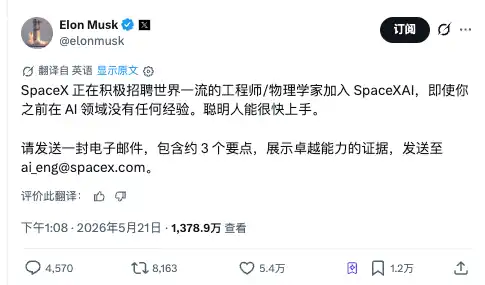
Additionally, Musk noted that having built "something very complex and actually functional" is a plus. Emails passing the basic screening will be reviewed by Musk personally. By the time I wrote this article, the post had over 13 million views and 4,500 replies.

Musk's recruitment stance seems very appealing. Degrees, companies, ten years of experience don't matter, only whether you have "exceptional ability." But upon closer thought, you realize this is actually a much harsher filter than conventional recruitment.

Do you think using 3 bullet points to explain your outstanding qualities is simple or difficult?

A conventionally formatted resume is at least one page long: positions and achievements from past jobs, alma mater, tools you know, awards won... piled together it looks full, but perhaps not a single line directly proves you are "exceptional."

Scrolling through the comments section, you'll also find the vast majority of people cannot do this.

Resumes Are Actually About "Performance Efficiency"

I scrolled through the comments section and roughly understood.

With 4,500 replies, you can probably guess the style—mostly witty one-liners. Currently, the top-rated reply is from a user named Greg who posted a so-called "resume," looking utterly absurd:
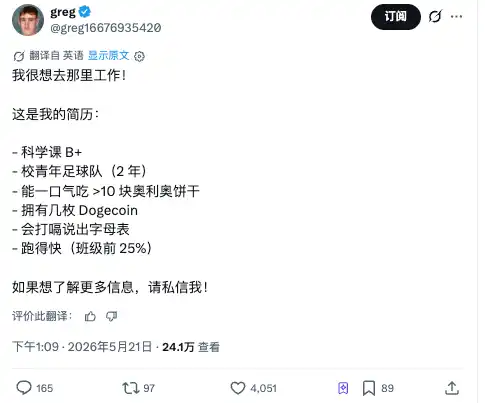
Pure self-deprecating meme is quite funny, and the answer is obviously just a joke, but it also acts as a mirror. Think carefully, the resumes I've submitted in the past seem essentially no different from this?

Replace the content of this resume: top university computer science major GPA 3.8, two years on the school basketball team, proficient in Python and Java, self-studied CFA Level 1, top fifty in school sports meet...

The format is identical, the logic is identical, only the content is less outrageous, but the essence remains listing everything you have point by point indiscriminately.

From Musk's perspective, your Python skill level versus your ability to burp the alphabet—the difference isn't actually that significant.

The comments section isn't just full of jokers. Some seriously posted their degree certificates, others threw in their child's Ivy League acceptance letter, some posted passport photos asking for work visas, and others listed paper publications and conference talks...

Compared to the jokers, these people are surely sincere about applying.

But step back and look: what they are doing is the same as that absurd joke post: listing credentials, piling up experiences, indiscriminately listing any possible shining point, hoping to create an impression of "I am excellent."

Musk asked: what have you built that is complex and useful enough. A typical interviewer in our daily lives might not be that demanding, but similarly hopes for stronger relevance in a resume.

Simply put, a resume is a performance, and performance is about efficiency. What can efficiently impress the other party most of the time is not necessarily long-winded explanations.

Product, The Better Resume

There's actually another highly upvoted comment in the section that I think perfectly satisfies the request in Musk's post: "Please use 3 bullet points to prove your excellence."

And this person even used just 1 bullet point, typing just 1 word:

codex.

Clicking into his profile, I checked—Tibo (full name Thibault Sottiaux) is an Engineering Lead at OpenAI, currently leading the Codex team. Codex is one of the most powerful AI programming tools and something developers worldwide use daily.
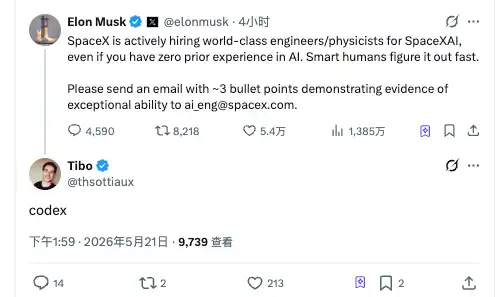
A product name is the entire resume.

The more you need to explain who you are, the less likely you are the person Musk is looking for. People who have truly built things, their name itself is evidence, the product itself is the bullet point. But you might say, he's a project lead at OpenAI, excellent enough to have the capital to reply with just one word. Ordinary people don't have that kind of confidence.

Think from another angle: Tibo can reply like that because he has something others have used, validated, that requires no self-explanation. That thing speaks for him.

Of course, elitism is not to be encouraged, but most of us aren't big shots. Yet sometimes we also just need to productize ourselves, to let the things we've done prove ourselves in a more efficient way.

Pushing this idea one layer down, it's actually unrelated to seniority.

You spent a weekend using vibe coding to build a small tool, consistently shared it and people use it—that's a kind of product; you wrote an industry research post on social media that got cited—that's also a kind of product.

These things are of course small compared to Codex, but they share a common trait: they are things you made, visible to others, requiring no explanation from you.

In the AI era, every work, every output, every tangible result you leave online that others can point to is, in a way, a living resume. It speaks for you.

You don't need to reach Codex's scale, but you should at least have something that can be pointed to.

So, the attachments in resumes today—they themselves might be the better resume.

But, Is the Recruitment Real?

The story actually has a tail end here.

In the comments section, someone, after reading Musk's post, seriously wrote an email and sent it to the address [email protected], only to find it bounced back. The system indicated the address doesn't exist...
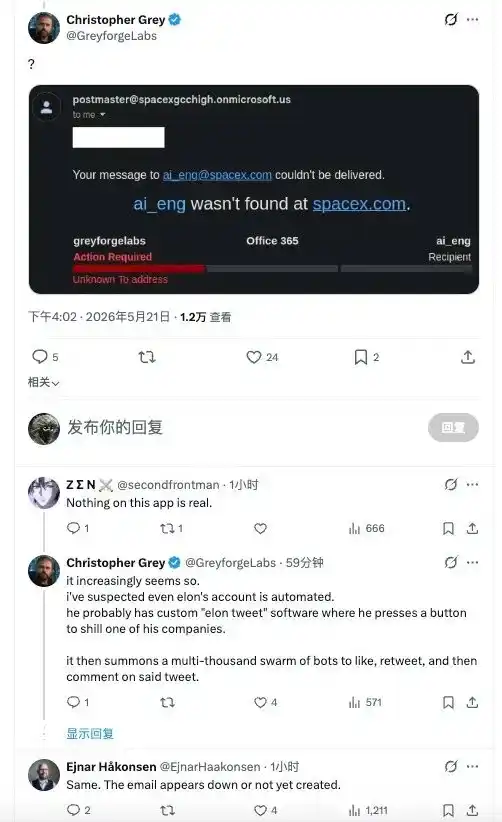
Some suspect Musk's account itself is automated, the recruitment email isn't set up yet, but the recruitment announcement went out first; others think recruiting around an IPO is part of the IPO roadshow, projecting an image of attracting top talent to strengthen the team.

Investors will certainly see Musk's post. So whether the recruitment itself is real can be set aside for now, but the posture the post conveys—"SpaceX is poaching talent"—is clear.

So, is this recruitment post actually hiring or doing a roadshow?

Perhaps the difference between the two isn't that big. In Musk's world, a single tweet can simultaneously be a job posting, an investor relations statement, and a brand advertisement. You see three bullet points; investors see "this company has the ability to attract the world's best talent."

Reading the post and the comments gives a sense of enlightenment. The witty one-liners, the one-word "Codex" self-proof, the bounced emails where applications fail—these are actually three types of roles on the same stage.

Some come to perform, some come to prove themselves, some discover the stage set seems to be made of cardboard...

In an era of scarce attention and cheap content output, finding one's own position and value remains the long-term homework we must do.


Questions liées

QAccording to the article, what was the most effective response to Elon Musk's SpaceX job posting on X, and why was it considered so powerful?

AThe most effective response was from Tibo (Thibault Sottiaux), the engineering lead of OpenAI's Codex team. He simply replied 'codex'. This was powerful because a single word referenced a globally used and complex product he led, which served as irrefutable, self-explanatory proof of his 'exceptional ability'. It demonstrated that a tangible, successful product is the ultimate resume.

QHow does the author describe the fundamental problem with most traditional resumes and the typical responses to Musk's post?

AThe author argues that traditional resumes and many responses to the post follow the same flawed logic: they provide an 'undifferentiated list' of qualifications, degrees, skills, and experiences. This is akin to the satirical resume listing skills like 'burping the alphabet'. The issue is this approach merely proves you have attributes but doesn't directly or efficiently demonstrate exceptional, practical ability to build complex things.

QWhat core piece of advice does the article offer for professionals in the AI era regarding personal branding?

AThe article advises individuals to 'productize' themselves. This means creating tangible, visible outputs—like a useful tool, a well-researched report, or any shareable project—that can act as a 'live resume'. These outputs are evidence of one's abilities that 'speak for themselves' without needing lengthy personal explanation, making them a more efficient form of proof in an attention-scarce world.

QWhat suspicion did some people have about the legitimacy of the SpaceX job posting mentioned at the end of the article?

ASome people suspected the posting might not be entirely genuine. Evidence cited includes that the provided email address (apply@spacex.com) initially bounced back as non-existent. This led to theories that the post could be automated, that the hiring process wasn't fully set up, or that it was partly a publicity move to showcase SpaceX's talent-attraction prowess to investors during its IPO roadshow.

QWhat is the 'three-act play' the author sees in the comments section of Musk's post?

AThe author sees a three-act play: 1) People 'performing' by posting humorous or generic content (like the burping resume). 2) People attempting to genuinely 'prove themselves' by listing credentials and achievements. 3) People discovering the 'stage set might be made of paper' when they find practical issues like the non-functional email address. Together, these represent different engagements with the modern challenge of proving one's value.

Lectures associées

Un sous-traitant lié à la Corée du Nord infiltré dans MetaMask pendant un mois : la véritable vulnérabilité des projets cryptos ne réside pas dans le code

Un contracteur lié à la Corée du Nord a infiltré le dépôt de code de MetaMask, le portefeuille crypto populaire, pendant environ un mois à partir du 9 mars. Bien que Consensys, la société mère, affirme qu'aucun actif n'a été volé ni aucun code malveillant déployé, l'incident révèle une vulnérabilité critique dans la gestion des sous-traitants et l'accès aux systèmes. L'individu a obtenu l'accès via un fournisseur de services tiers. Consensys a réagi en coupant l'accès, menant une enquête et notifiant les autorités. L'entreprise a depuis renforcé ses pratiques de vérification des tiers. L'événement met en lumière l'importance des contrôles d'accès opérationnels plutôt que des simples vulnérabilités de code. Un rapport cité indique qu'environ 76% des fonds volés dans la DeFi au premier semestre 2024 provenaient d'attaques au niveau opérationnel (clés, garde, signatures), et non de bugs de contrats intelligents. Les recommandations clés incluent : une vérification d'identité rigoureuse et continue, un principe de privilèges minimum pour l'accès au code, un examen indépendant de chaque modification, une surveillance des activités et une révocation rapide des accès lorsqu'ils ne sont plus nécessaires. L'incident montre que la sécurité des projets crypto dépend fortement de la gouvernance de l'accès humain aux systèmes sensibles.

marsbitIl y a 4 mins

Un sous-traitant lié à la Corée du Nord infiltré dans MetaMask pendant un mois : la véritable vulnérabilité des projets cryptos ne réside pas dans le code

marsbitIl y a 4 mins

De l'or au Bitcoin : Offre fixe + frénésie institutionnelle, une répétition des prix "explosifs" en vue ?

De l'or au Bitcoin : offre fixe et engouement institutionnel, prêts à rejouer une hausse explosive des prix ? L'article compare les trajectoires potentielles du Bitcoin et de l'or, en se focalisant sur l'impact des ETF. L'analyste Eric Balchunas de Bloomberg Intelligence établit un parallèle entre l'ETF Bitcoin et l'ETF or, lancé en 2004. Il note que les deux actifs, sans rendement intrinsèque, voient leur prix dicté par le sentiment des investisseurs. L'histoire de l'ETF or montre des cycles de hausses spectaculaires, de corrections douloureuses et de longues phases de reprise, chaque cycle établissant un plus haut historique. Le Bitcoin, après l'approbation des ETF spot début 2024, a connu un afflux massif de capitaux institutionnels, certains fonds devenant les ETF à la croissance la plus rapide. Cependant, cette adoption s'accompagne d'une volatilité accrue. Les flux entrants et sortants des grands ETF comme l'IBIT de BlackRock peuvent influencer significativement le marché. Malgré un repli important du prix en 2026, de nombreux observateurs restent optimistes sur le long terme. Ils voient dans le Bitcoin un "or numérique" bénéficiant d'une offre fixe (mécanisme de halving) et d'une adoption institutionnelle croissante. Les ETF facilitent l'accès pour les investisseurs traditionnels, amplifiant potentiellement la demande. En conclusion, si le Bitcoin devait capturer ne serait-ce qu'une fraction de la capitalisation boursière de l'or (près de 28 000 milliards de dollars), la perspective de hausse serait considérable. Ce parcours sera probablement semé d'une forte volatilité, mais l'arrivée continue de capitaux institutionnels pourrait poser les bases d'une nouvelle phase de croissance.

Foresight NewsIl y a 19 mins

De l'or au Bitcoin : Offre fixe + frénésie institutionnelle, une répétition des prix "explosifs" en vue ?

Foresight NewsIl y a 19 mins

Pourquoi les agents d'IA pour les achats peinent-ils à se généraliser ?

**Pourquoi les agents d'achat IA peinent à se généraliser ?** L'idée de confier à un agent IA un portefeuille pour qu'il achète de manière autonome semble être l'application ultime de l'IA. Cependant, ce récit confond les éléments simples et complexes de l'acte d'acheter, en plaçant à tort le paiement, l'étape la plus facile, au centre. L'achat se compose de deux actions fondamentales : la **recherche d'informations** (standardisable, déléguable à la machine) et le **jugement de valeur** (subjectif, lié aux préférences humaines). Si la recherche migre rapidement vers l'IA, le jugement de valeur ne peut être entièrement délégué. Il implique non seulement l'évaluation des options, mais surtout la **définition des besoins et des critères** (ce qui est important, les priorités), un processus itératif et subjectif qui reste de la souveraineté humaine. La limite décisive n'est pas entre produit standardisé et personnalisé, mais entre : **la corvée et le plaisir**. Pour les achats répétitifs et sans intérêt (papier, piles), une délégation totale à l'IA est pertinente. Pour les achats liés au plaisir ou à l'identité (vin, vêtements, livres), le choix *fait partie* de l'expérience. L'IA doit alors servir d'assistant de recherche, présentant une sélection restreinte, et laisser le choix final à l'humain. Le concept de "portefeuille IA" ne résout que le problème mineur du portage des fonds. Les solutions de paiement actuelles (Stripe, Mastercard Agent Pay, Google AP2) adoptent des approches d'autorisation limitée et contextuelle, sans nécessiter de confier un portefeuille complet à l'IA. Le véritable terrain d'application du portefeuille autonome pour l'IA est le **règlement automatisé entre machines (M2M)** ou les **achats professionnels standardisés (B2B)**, où les critères sont objectifs et les volumes élevés. Les vrais goulots d'étranglement pour les achats automatisés par IA sont ailleurs : 1. **Le manque de sources de données fiables** : avis falsifiés, contrefaçons. Une automatisation sûre nécessite des données vérifiables et une traçabilité des produits. 2. **L'impossibilité d'automatiser la définition des besoins humains** : C'est un processus intrinsèquement humain. Si l'IA définit nos critères à notre place, les préférences qui en résultent ne sont plus les nôtres. En conclusion, pour les plateformes de vente, l'avenir réside non pas dans la délégation totale du choix, mais dans l'optimisation des données pour faciliter la recherche par l'IA, tout en préservant et en enrichissant **l'expérience de choix** pour l'utilisateur humain, là où réside la valeur fondamentale des achats liés au plaisir.

Foresight NewsIl y a 1 h

Pourquoi les agents d'IA pour les achats peinent-ils à se généraliser ?

Foresight NewsIl y a 1 h

Après neuf mois de vente à découvert, un retournement complet, un trader célèbre prend position sur le Bitcoin autour de 64 000 dollars, la divergence haussière/baissière s'accélère sur le marché des crypto

Après neuf mois de baisse, le Bitcoin a perdu plus de 50% depuis son pic d'octobre 2025 et évolue désormais autour de 60 000 $. Cette phase baissière divise les analystes sur la question de savoir si le fond du marché a été atteint. Le trader renommé Doctor Profit, qui avait vendu à découvert avec succès cette descente, a annoncé le 19 juillet avoir clôturé toutes ses positions vendeuses. Il a initié un achat progressif de Bitcoin à partir de 64 000 $, estimant que le creux du cycle quadriennal pourrait arriver plus tôt que prévu. Son raisonnement repose sur des changements structurels : l'avancée de la régulation (CLARITY Act), la tokenisation d'actifs par des géants comme BlackRock, et l'attente de capitaux institutionnels massifs. À l'appui, l'analyste on-chain gumsays note une divergence haussière sur les graphiques hebdomadaires, persistante depuis 147 jours, une durée proche des 161 jours observés avant le creux de 2022. Cependant, le chercheur de cycles Jake Pahor oppose un argumentaire fondé sur l'histoire. En analysant les données depuis 2012, il identifie trois conditions communes à tous les fonds de marché depuis 2014 : une durée d'environ 12 mois, une peur extrême prolongée (score de risque <20), et un prix sous le "prix réalisé" (actuellement ~53 000$). Aucune de ces conditions n'est remplie dans le cycle actuel. Le marché est donc tiraillé entre ceux qui anticipent un rebond précoce, motivés par les nouvelles fondamentales, et ceux qui attendent des signaux de capitulation plus classiques avant de s'engager pleinement. La stratégie de Jake Pahor reflète cette prudence : il continue ses achats réguliers au niveau actuel mais réserve le gros de son capital pour des niveaux de panique plus extrêmes.

marsbitIl y a 1 h

Après neuf mois de vente à découvert, un retournement complet, un trader célèbre prend position sur le Bitcoin autour de 64 000 dollars, la divergence haussière/baissière s'accélère sur le marché des crypto

marsbitIl y a 1 h

Trading

Spot
活动图片