Musk Posted a Recruitment Ad for SpaceX, and After Reading the Comments Section, I Understood

marsbitPublié le 2026-05-21Dernière mise à jour le 2026-05-21

Résumé

On May 20th, SpaceX filed for a landmark IPO with a $1.75 trillion valuation. Shortly after, Elon Musk posted a recruitment call on X, seeking "world-class engineers and physicists" for SpaceX. The application process was starkly simple: email with three bullet points proving "exceptional ability," with real, complex projects as a plus. Musk promised to review qualifying emails himself. The post garnered millions of views and thousands of replies, revealing a spectrum of responses. Most comments, including a highly-upvoted humorous one listing absurd "skills," merely listed credentials or experiences in a conventional, non-differentiating way. This highlighted a key insight: a traditional resume listing degrees and skills often fails to demonstrate true exceptionalism. Effective self-presentation requires "performance efficiency." A standout reply came from an OpenAI engineering lead, who simply stated "codex." This demonstrated that for those who have built significant, recognized products, the product itself becomes the ultimate resume. The article argues that in the AI era, any tangible, shareable output—a tool, research, or online project—serves as a living, self-evident credential more powerful than a list of attributes. However, a twist emerged when applicants found the provided email address non-functional, leading to speculation that the post might also serve as an IPO publicity stunt, projecting an image of aggressive talent acquisition to investors. Ultimately, t...

Author: Curry, Deep Chao TechFlow

On May 20th after US market close, SpaceX submitted its prospectus to the SEC with a valuation of $1.75 trillion, aiming to list on NASDAQ in June.

This is undoubtedly the largest IPO in history, likely surpassing Saudi Aramco's $29 billion fundraising record set six years ago.

Less than a day after the prospectus was submitted, on the afternoon of May 21st, Musk posted a recruitment message on X.

The gist was that SpaceX is hiring world-class engineers and physicists. Zero experience in AI is fine because smart people learn fast. The application method is incredibly simple:

Send an email listing three bullet points proving you have exceptional ability.
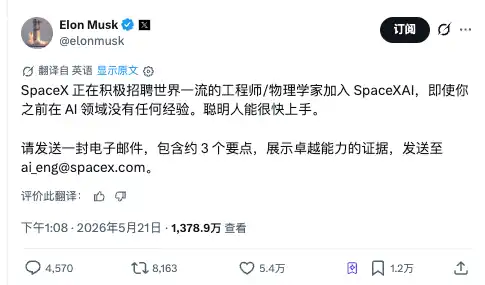
Additionally, Musk noted that having built "something very complex and actually functional" is a plus. Emails passing the basic screening will be reviewed by Musk personally. By the time I wrote this article, the post had over 13 million views and 4,500 replies.

Musk's recruitment stance seems very appealing. Degrees, companies, ten years of experience don't matter, only whether you have "exceptional ability." But upon closer thought, you realize this is actually a much harsher filter than conventional recruitment.

Do you think using 3 bullet points to explain your outstanding qualities is simple or difficult?

A conventionally formatted resume is at least one page long: positions and achievements from past jobs, alma mater, tools you know, awards won... piled together it looks full, but perhaps not a single line directly proves you are "exceptional."

Scrolling through the comments section, you'll also find the vast majority of people cannot do this.

Resumes Are Actually About "Performance Efficiency"

I scrolled through the comments section and roughly understood.

With 4,500 replies, you can probably guess the style—mostly witty one-liners. Currently, the top-rated reply is from a user named Greg who posted a so-called "resume," looking utterly absurd:
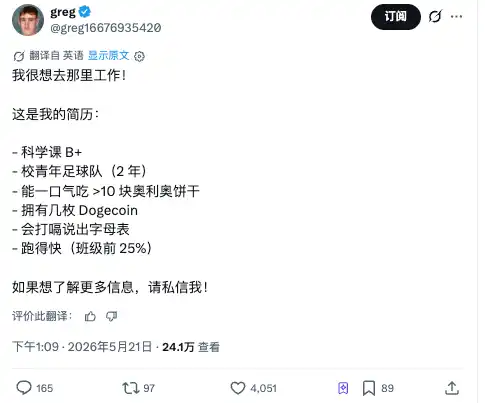
Pure self-deprecating meme is quite funny, and the answer is obviously just a joke, but it also acts as a mirror. Think carefully, the resumes I've submitted in the past seem essentially no different from this?

Replace the content of this resume: top university computer science major GPA 3.8, two years on the school basketball team, proficient in Python and Java, self-studied CFA Level 1, top fifty in school sports meet...

The format is identical, the logic is identical, only the content is less outrageous, but the essence remains listing everything you have point by point indiscriminately.

From Musk's perspective, your Python skill level versus your ability to burp the alphabet—the difference isn't actually that significant.

The comments section isn't just full of jokers. Some seriously posted their degree certificates, others threw in their child's Ivy League acceptance letter, some posted passport photos asking for work visas, and others listed paper publications and conference talks...

Compared to the jokers, these people are surely sincere about applying.

But step back and look: what they are doing is the same as that absurd joke post: listing credentials, piling up experiences, indiscriminately listing any possible shining point, hoping to create an impression of "I am excellent."

Musk asked: what have you built that is complex and useful enough. A typical interviewer in our daily lives might not be that demanding, but similarly hopes for stronger relevance in a resume.

Simply put, a resume is a performance, and performance is about efficiency. What can efficiently impress the other party most of the time is not necessarily long-winded explanations.

Product, The Better Resume

There's actually another highly upvoted comment in the section that I think perfectly satisfies the request in Musk's post: "Please use 3 bullet points to prove your excellence."

And this person even used just 1 bullet point, typing just 1 word:

codex.

Clicking into his profile, I checked—Tibo (full name Thibault Sottiaux) is an Engineering Lead at OpenAI, currently leading the Codex team. Codex is one of the most powerful AI programming tools and something developers worldwide use daily.
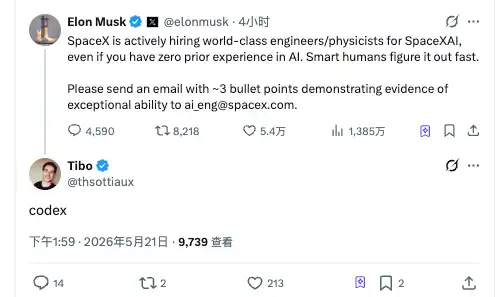
A product name is the entire resume.

The more you need to explain who you are, the less likely you are the person Musk is looking for. People who have truly built things, their name itself is evidence, the product itself is the bullet point. But you might say, he's a project lead at OpenAI, excellent enough to have the capital to reply with just one word. Ordinary people don't have that kind of confidence.

Think from another angle: Tibo can reply like that because he has something others have used, validated, that requires no self-explanation. That thing speaks for him.

Of course, elitism is not to be encouraged, but most of us aren't big shots. Yet sometimes we also just need to productize ourselves, to let the things we've done prove ourselves in a more efficient way.

Pushing this idea one layer down, it's actually unrelated to seniority.

You spent a weekend using vibe coding to build a small tool, consistently shared it and people use it—that's a kind of product; you wrote an industry research post on social media that got cited—that's also a kind of product.

These things are of course small compared to Codex, but they share a common trait: they are things you made, visible to others, requiring no explanation from you.

In the AI era, every work, every output, every tangible result you leave online that others can point to is, in a way, a living resume. It speaks for you.

You don't need to reach Codex's scale, but you should at least have something that can be pointed to.

So, the attachments in resumes today—they themselves might be the better resume.

But, Is the Recruitment Real?

The story actually has a tail end here.

In the comments section, someone, after reading Musk's post, seriously wrote an email and sent it to the address [email protected], only to find it bounced back. The system indicated the address doesn't exist...
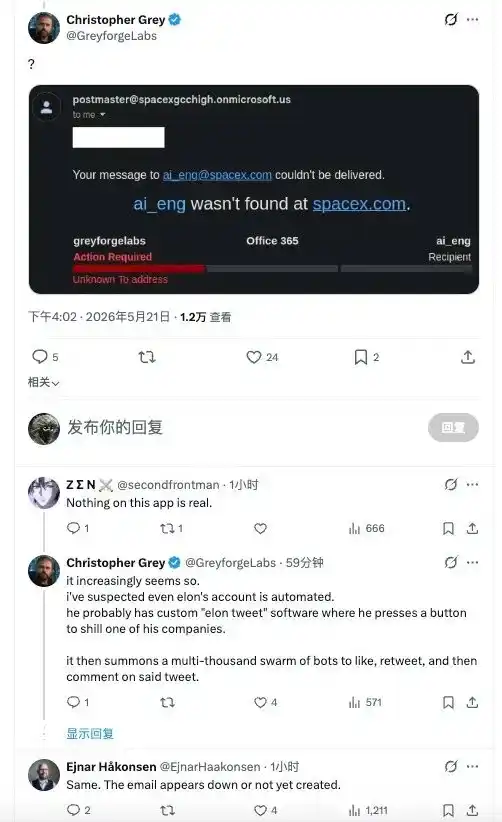
Some suspect Musk's account itself is automated, the recruitment email isn't set up yet, but the recruitment announcement went out first; others think recruiting around an IPO is part of the IPO roadshow, projecting an image of attracting top talent to strengthen the team.

Investors will certainly see Musk's post. So whether the recruitment itself is real can be set aside for now, but the posture the post conveys—"SpaceX is poaching talent"—is clear.

So, is this recruitment post actually hiring or doing a roadshow?

Perhaps the difference between the two isn't that big. In Musk's world, a single tweet can simultaneously be a job posting, an investor relations statement, and a brand advertisement. You see three bullet points; investors see "this company has the ability to attract the world's best talent."

Reading the post and the comments gives a sense of enlightenment. The witty one-liners, the one-word "Codex" self-proof, the bounced emails where applications fail—these are actually three types of roles on the same stage.

Some come to perform, some come to prove themselves, some discover the stage set seems to be made of cardboard...

In an era of scarce attention and cheap content output, finding one's own position and value remains the long-term homework we must do.


Questions liées

QAccording to the article, what was the most effective response to Elon Musk's SpaceX job posting on X, and why was it considered so powerful?

AThe most effective response was from Tibo (Thibault Sottiaux), the engineering lead of OpenAI's Codex team. He simply replied 'codex'. This was powerful because a single word referenced a globally used and complex product he led, which served as irrefutable, self-explanatory proof of his 'exceptional ability'. It demonstrated that a tangible, successful product is the ultimate resume.

QHow does the author describe the fundamental problem with most traditional resumes and the typical responses to Musk's post?

AThe author argues that traditional resumes and many responses to the post follow the same flawed logic: they provide an 'undifferentiated list' of qualifications, degrees, skills, and experiences. This is akin to the satirical resume listing skills like 'burping the alphabet'. The issue is this approach merely proves you have attributes but doesn't directly or efficiently demonstrate exceptional, practical ability to build complex things.

QWhat core piece of advice does the article offer for professionals in the AI era regarding personal branding?

AThe article advises individuals to 'productize' themselves. This means creating tangible, visible outputs—like a useful tool, a well-researched report, or any shareable project—that can act as a 'live resume'. These outputs are evidence of one's abilities that 'speak for themselves' without needing lengthy personal explanation, making them a more efficient form of proof in an attention-scarce world.

QWhat suspicion did some people have about the legitimacy of the SpaceX job posting mentioned at the end of the article?

ASome people suspected the posting might not be entirely genuine. Evidence cited includes that the provided email address ([email protected]) initially bounced back as non-existent. This led to theories that the post could be automated, that the hiring process wasn't fully set up, or that it was partly a publicity move to showcase SpaceX's talent-attraction prowess to investors during its IPO roadshow.

QWhat is the 'three-act play' the author sees in the comments section of Musk's post?

AThe author sees a three-act play: 1) People 'performing' by posting humorous or generic content (like the burping resume). 2) People attempting to genuinely 'prove themselves' by listing credentials and achievements. 3) People discovering the 'stage set might be made of paper' when they find practical issues like the non-functional email address. Together, these represent different engagements with the modern challenge of proving one's value.

Lectures associées

Avec Ozak AI maintenant au-dessus de 7 millions de dollars levés, les analystes avertissent que le stock restant de la prévente pourrait diminuer rapidement alors que les acheteurs tardifs se précipitent pour sécuriser leurs positions.

Le projet Ozak AI, un token basé sur l'intelligence artificielle, connaît un succès significatif lors de sa prévente, ayant déjà levé plus de 7 millions de dollars. Les analystes avertissent que l'allocation restante pourrait diminuer rapidement en raison d'un afflux d'investisseurs tardifs souhaitant sécuriser des tokens avant la prochaine augmentation de prix et le listing prévu sur les principales plateformes d'échange. Le prix actuel est de 0,014 $ dans la septième phase de prévente. La technologie centrale d'Ozak AI combine blockchain et IA pour offrir des outils d'analyse prédictive en temps réel, utilisant des agents spécialisés pour les prévisions de prix, le sentiment du marché et l'analyse technique. Ces fonctionnalités alimentent la demande. Le projet renforce également son écosystème via des partenariats, par exemple avec Mira pour des flux de données vérifiés. Avec une offre limitée lors des phases de prévente et une demande croissante, les analystes estiment que retarder l'achat pourrait signifier payer plus cher pour moins de tokens. Ils évoquent un prix cible de 1 $ après le listing, suggérant un potentiel de croissance important pour les premiers investisseurs.

TheNewsCryptoIl y a 32 mins

Avec Ozak AI maintenant au-dessus de 7 millions de dollars levés, les analystes avertissent que le stock restant de la prévente pourrait diminuer rapidement alors que les acheteurs tardifs se précipitent pour sécuriser leurs positions.

TheNewsCryptoIl y a 32 mins

J'ai codé une application Android avec le Google vibe coding

Résumé : Google AI Studio permet désormais de générer des applications Android fonctionnelles directement depuis une fenêtre de navigateur, à l'aide de simples instructions en langage naturel. Un rédacteur de The Verge a testé cette fonctionnalité "prompt to phone" et a créé trois applications en un après-midi : un jeu d'aventure textuel, un compteur de calories et un clone de Super Mario. Le processus est simple : l'utilisateur décrit l'application souhaitée, et Gemini, l'IA de Google, génère automatiquement le code, conçoit l'interface et tente de résoudre les bugs. L'application peut être installée sur un vrai téléphone Android en quelques minutes. Cependant, l'expérience révèle les limites actuelles de l'outil. Les applications produites sont basiques, comportent des bugs persistants, des erreurs factuelles (comme des calculs de calories incorrects) et manquent de profondeur ou de fiabilité. Par exemple, le jeu de plateforme généré crashait systématiquement, et le compteur de calories utilisait des données erronées. Bien que cet outil abaisse considérablement la barrière d'entrée pour créer un logiciel personnalisé, il souligne que le chemin entre "générer une application" et "créer une *bonne* application" reste long. La qualité, la précision, le jugement esthétique et la maintenance à long terme dépendent encore largement de l'intervention et de l'expertise humaines. Google AI Studio montre la puissance de l'IA pour le prototypage rapide, mais aussi que le "dernier kilomètre" de la qualité logicielle n'est pas encore automatisable.

marsbitIl y a 2 h

J'ai codé une application Android avec le Google vibe coding

marsbitIl y a 2 h

Pourquoi les stablecoins de devises étrangères n'ont-ils jamais vraiment décollé ?

L'article analyse les raisons pour lesquelles les stablecoins de devises étrangères (FX) n'ont pas décollé, malgré leur potentiel pour les banques numériques basées sur les stablecoins. L'auteur souligne que les géants comme Tether (USDT) et Circle (USDC) bénéficient d'un effet de réseau et d'une liquidité écrasants, avec un écart de 700 fois entre le marché des stablecoins en dollars (4000 milliards $) et celui des stablecoins FX (environ 6 milliards $). Cette faible taille entraîne des problèmes de liquidité, d'ancrage fragile, d'adoption limitée et de complexité réglementaire. La solution proposée est d'adopter une approche synthétique inspirée des contrats à terme non livrables (NDF) du marché traditionnel des changes. Au lieu de créer de nouveaux stablecoins FX, les utilisateurs conserveraient des stablecoins en dollars (USDT/USDC) en sous-jacent, tandis que leur solde serait libellé dans une devise locale via un contrat NDF "mark-to-market". Cette méthode offre plusieurs avantages : un ancrage fort via des oracles, le maintien de la liquidité et des rendements du réseau dollar, une extensibilité à de nombreuses devises et une efficacité capitalistique. Les principaux cas d'usage identifiés sont : 1) Les banques numériques et portefeuilles, pour offrir des comptes multi-devises sans quitter l'écosystème dollar ; 2) Les stratégies de carry trade sur les taux d'intérêt souverains, potentiellement plus stables et évolutives que les produits cryptos comme Ethena ; 3) Les paiements d'entreprise mondiaux, permettant aux commerçants de fixer des prix dans leur devise locale tout en réglant en stablecoins dollars. En conclusion, l'infrastructure NDF sur chaîne est présentée comme la clé pour débloquer la prochaine phase d'adoption des stablecoins à l'échelle mondiale, en permettant aux banques numériques de servir efficacement les 95% de la population mondiale qui ne comptabilise pas en dollars.

链捕手Il y a 4 h

Pourquoi les stablecoins de devises étrangères n'ont-ils jamais vraiment décollé ?

链捕手Il y a 4 h

Trading

Spot
Futures
活动图片




