Morning Post | Trump Media Group Releases Q1 Financial Report; Top Three DeFi Applications Return Nearly $100 Million in Revenue to Token Holders in 30 Days; Michael Saylor Shares Bitcoin Tracker Info Again

链捕手Publié le 2026-05-11Dernière mise à jour le 2026-05-11

Résumé

**Title: Daily Briefing | Trump Media Group Releases Q1 Report; Top 3 DeFi Apps Return Nearly $100M to Token Holders; Michael Saylor Signals Potential Bitcoin Buy** **Summary:** Key developments in the past 24 hours include: * **Economic Outlook:** Goldman Sachs has pushed back its forecast for the next two Federal Reserve interest rate cuts to December 2026 and March 2027, citing persistent inflationary pressures from energy costs. This delayed timeline is expected to tighten liquidity flow into risk assets, including cryptocurrencies. * **DeFi & Revenue:** Data from DefiLlama shows that three leading DeFi applications—Hyperliquid, Pump.fun, and EdgeX—collectively distributed $96.3 million in revenue to their token holders over the last 30 days. This trend highlights a shift in the crypto community's focus towards real protocol earnings and sustainable economic models. * **Corporate Bitcoin Moves:** Michael Saylor, founder of MicroStrategy (note: referred to as 'Strategy' in the text, likely a typographical error), has signaled potential upcoming Bitcoin purchases by posting a "Bitcoin Tracker" update, following a pattern that typically precedes the company's official disclosure of new acquisitions. * **Market Integrity:** Prediction market platform Polymarket announced updates to address platform issues, including identifying and banning clusters of accounts involved in "ghost-fill" activities and implementing measures to prevent bulk account creation. * **Regu...

Compiled by: ChainCatcher


Key Updates:

  • Trump Media Group Q1 Report: Approximately $400 Million Unrealized Loss on BTC and Other Crypto Asset Investments
  • Michael Saylor Shares Bitcoin Tracker Info Again, May Disclose Acquisition Data Next Week
  • Bank of England Governor: Stablecoin Regulation Could Trigger Tussle Between US and International Regulators
  • Data: Top Three DeFi Applications Return Nearly $100 Million in Revenue to Token Holders in 30 Days
  • Strategy CEO Clarifies Bitcoin Sale Conditions: Will Only Sell When Beneficial to Shareholders
  • Bank of England Governor: Stablecoin Regulation Could Trigger Tussle Between US and International Regulators

What significant events occurred in the past 24 hours?

Goldman Sachs Delays Fed Rate Cut Forecasts to December 2026, Citing Inflation Pressure

ChainCatcher News, Goldman Sachs has postponed its forecast for the next two Fed rate cuts to December 2026 and March 2027. The report points out that energy cost pass-through could keep core Personal Consumption Expenditures (PCE) inflation around 3% for all of 2026, above the Fed's 2% target. Previously, the International Monetary Fund (IMF) also predicted core PCE wouldn't return to 2% until early 2027 at the earliest.

Goldman Sachs US economists believe that cooling monthly data and a weakening labor market must precede rate cuts. On April 29, the Fed maintained the federal funds rate at 3.50% to 3.75%, a meeting that saw four dissenting votes, the most since 1992. According to CME FedWatch data, the market probability of rates remaining unchanged at the June 17 meeting is 93.4%. Lindsay Rosner of Goldman Sachs Asset Management previously stated that hawks might prevail at the June FOMC meeting. For the crypto market, delayed rate cuts tighten liquidity flowing into risk assets, and a stronger dollar tends to suppress crypto asset valuations.

Data: Top Three DeFi Applications Return Nearly $100 Million in Revenue to Token Holders in 30 Days

ChainCatcher News, According to DefiLlama data, three relatively active DeFi applications—Hyperliquid, EdgeX, and Pump.fun—collectively distributed $96.3 million in revenue to token holders over the past 30 days. Hyperliquid led with $50.95 million, returning all revenue directly to holders with zero incentive spending; Pump.fun returned $22.09 million to holders from its $38.81 million total revenue; EdgeX distributed $23.26 million from its $8.26 million protocol revenue, indicating it may have utilized reserves or other income sources.

Annualized data shows Hyperliquid generated $946 million in revenue over the past year, Pump.fun $481 million, and EdgeX $236 million. This trend reflects the crypto community's shift from focusing on trading volume to actual revenue. Yearn.Finance founder Andre Cronje noted that DeFi in 2026 is no longer just a speculative venue but is becoming the backend infrastructure for the on-chain economy, with a stablecoin market of $320 billion, decentralized exchange monthly spot trading volume exceeding $160 billion, and perpetual contract DEX monthly trading volume reaching $540 billion.

Michael Saylor Shares Bitcoin Tracker Info Again, May Disclose Acquisition Data Next Week

ChainCatcher News, Strategy founder Michael Saylor has again shared information related to the Bitcoin Tracker.

Based on previous patterns, Strategy has always disclosed Bitcoin acquisition information the day after such related messages are posted.

Polymarket: Identified and Banned Multiple 'Ghost-Fill' Account Clusters, Will Strengthen Ban Mechanism

ChainCatcher News, Polymarket announced the latest progress on feature updates, including the rollout of latency spam mitigation measures to ensure order placement and cancellation operations, fixing the "insufficient balance/authorization" error, with another core issue affecting limit buy orders expected to be resolved in the coming days.

Additionally, Polymarket stated it has identified and banned multiple "ghost-fill" account clusters. The relevant accounts were all created before the deposit wallet system went live. Any account exhibiting "ghost-fill" behavior will be identified and banned, and the deposit wallet system will also prevent violators from mass-creating new accounts. More updates to resolve previous legacy issues will be released in the coming week.

South Korean National Tax Service Pilots Delegating Seized Virtual Assets to Private Custodian Management for First Time

ChainCatcher News, According to News1, the South Korean National Tax Service is piloting the delegation of seized virtual assets to private crypto custody institutions for safekeeping and management for the first time, with the trial planned to run until the end of this year.

Major South Korean custody institutions such as KODA, KDAC, Hecto WalletOne, BDACS, and InfiniteBlock are preparing to participate. Although the pilot project's budget is only about $5,800, the industry believes gaining a reference case as a "South Korean National Tax Service project" holds symbolic significance.

Meme Hot List

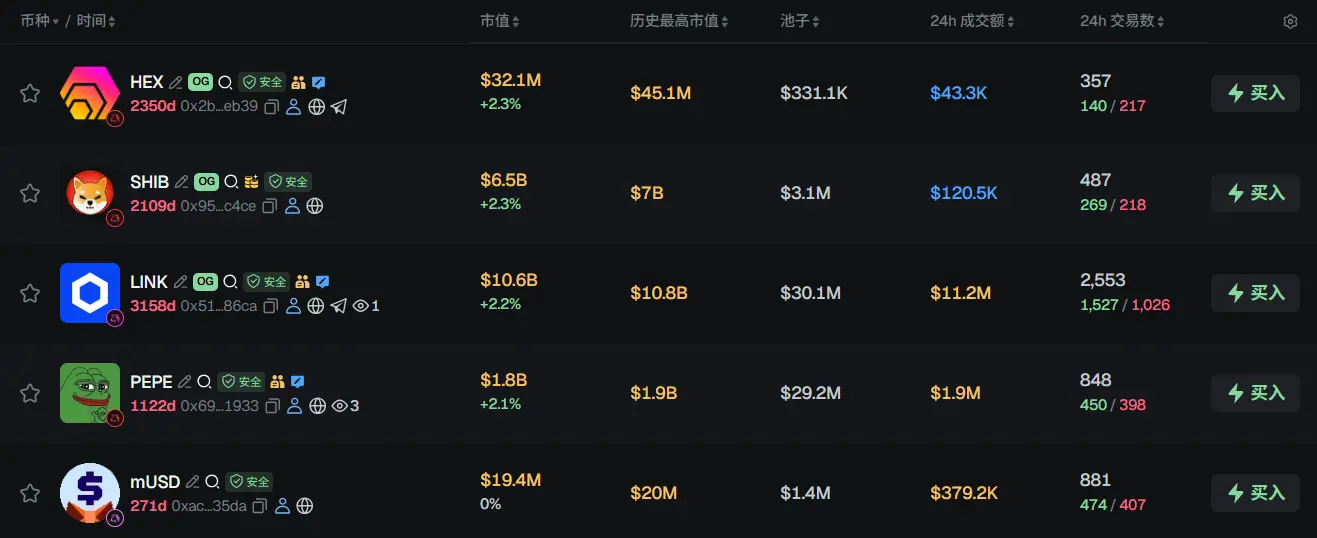
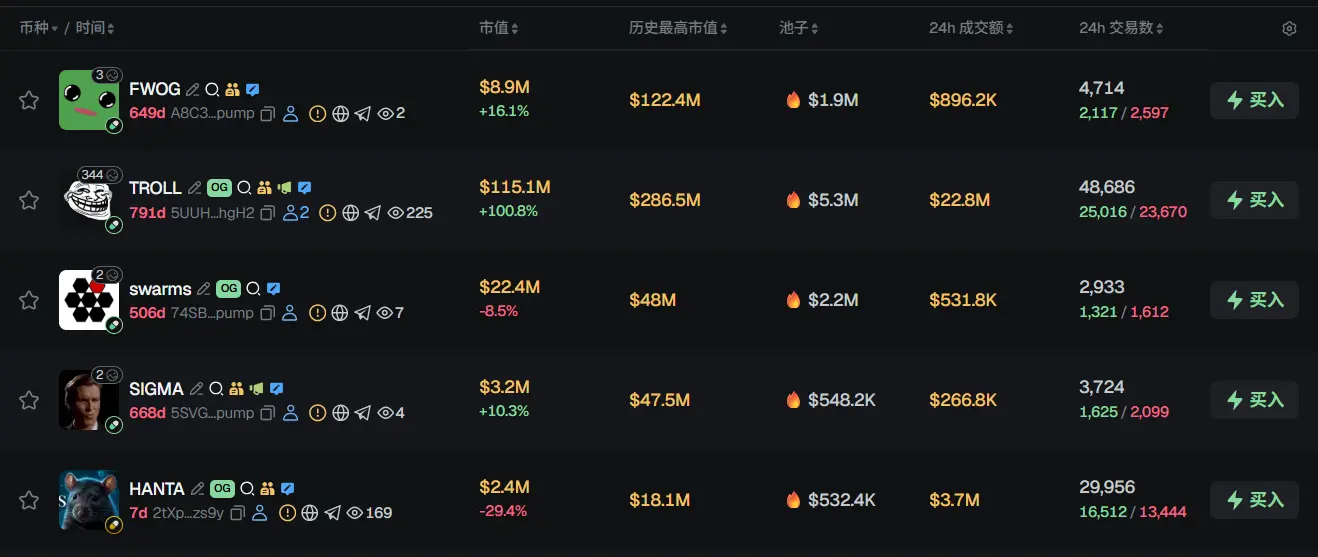
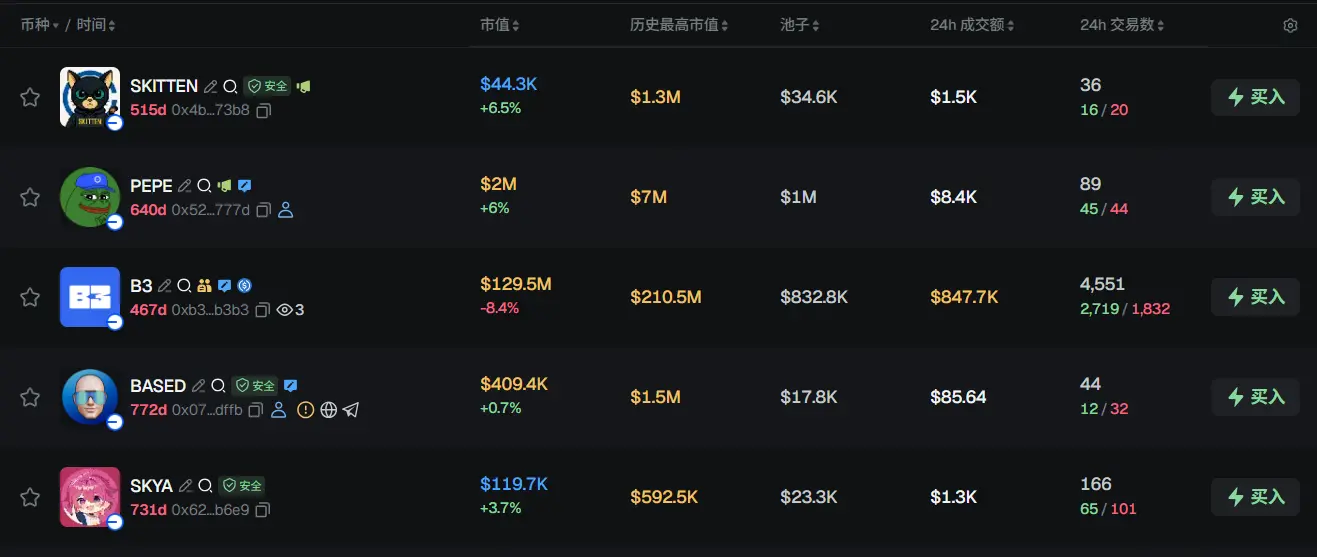
According to data from meme token tracking and analysis platform GMGN, as of 09:00 on May 11, 2026,

The top five trending ETH tokens over the past 24h are: HEX, SHIB, LINK, PEPE, mUSD
The top five trending Solana tokens over the past 24h are: FWOG, TROLL, swarms, SIGMA, HANTA
The top five trending Base tokens over the past 24h are: SKITTEN, PEPE, B3, BASED, SKYA
Which great articles are worth reading from the past 24 hours?

Questions liées

QWhat was the reported net loss on BTC and other crypto asset investments for Trump Media Group in its Q1 financial report?

ATrump Media Group reported an unrealized loss of approximately $4 billion on its BTC and other crypto asset investments in its Q1 financial report.

QAccording to the article, which three DeFi applications returned nearly $1 billion in revenue to token holders in the past 30 days?

AAccording to DefiLlama data, Hyperliquid, EdgeX, and Pump.fun returned a combined $963 million in revenue to token holders over the past 30 days.

QWhat specific event does the article suggest typically follows Michael Saylor's release of Bitcoin Tracker information, based on previous patterns?

ABased on previous patterns, following Michael Saylor's release of Bitcoin Tracker information, MicroStrategy typically discloses its bitcoin acquisition data the next day. The article suggests next week may see such a disclosure.

QWhat major reason did Goldman Sachs give for pushing back its forecast of the Federal Reserve's next two interest rate cuts to December 2026 and March 2027?

AGoldman Sachs cited persistent inflation pressure as the main reason, noting that energy cost pass-throughs could keep core PCE inflation around 3% throughout 2026, which is above the Fed's 2% target.

QWhat is a key trend highlighted by Yearn.Finance founder Andre Cronje regarding the current state of DeFi (Decentralized Finance) in 2026?

AAndre Cronje highlighted that DeFi in 2026 is no longer just a venue for speculation but is evolving into the backend infrastructure for the on-chain economy, with significant market sizes such as a $3.2 trillion stablecoin market.

Lectures associées

La répartition de la valeur des stablecoins

L'article analyse la répartition de valeur dans l'écosystème des stablecoins, en le divisant en quatre couches : 1. **Couche d'émission** : (ex. : Tether, Circle) - Émettent les stablecoins, détiennent les actifs de réserve et capturent la marge d'intérêt. 2. **Couche d'infrastructure** : (ex. : Bridge, BVNK) - Relient les stablecoins au système financier traditionnel (connexions bancaires, conformité, gestion des entrées/sorties en fiat). C'est le travail le plus complexe et essentiel pour une adoption large. 3. **Couche d'acquisition/distribution** : (ex. : Stripe, Coinbase) - Intègrent les stablecoins dans les systèmes marchands et logiciels d'entreprise. 4. **Couche applicative** : Les utilisateurs finaux. Actuellement, la couche d'émission génère les profits les plus importants. L'auteur souligne que la **couche d'infrastructure**, bien que cruciale, est souvent sous-estimée. Son rôle de "trait d'union" entre la blockchain et le monde réel (règlement, conformité, intégration aux flux de trésorerie des entreprises) est difficile mais constitue un avantage concurrentiel durable. Des acquisitions comme celle de Bridge par Stripe ou de BVNK par Mastercard montrent l'importance stratégique de ce segment. Bien que cette couche nécessite d'importants investissements initiaux et fasse face à une pression de la part des autres couches, elle pourrait acquérir un fort pouvoir de négociation une fois que les stablecoins deviendront un canal de paiement par défaut pour les entreprises.

marsbitIl y a 5 h

La répartition de la valeur des stablecoins

marsbitIl y a 5 h

Pourquoi Nvidia emprunte-t-elle 200 milliards de dollars si elle n'a pas besoin d'argent ?

Résumé de l'article : Nvidia, qui dispose d'une trésorerie abondante (flux de trésorerie libre d'environ 48,6 milliards de dollars pour son dernier trimestre), prévoit d'émettre des obligations (notes senior) pour au moins 20 milliards de dollars. Contrairement à une lecture simpliste sur un besoin de liquidités, cette opération s'analyse plutôt comme une optimisation active de la structure financière. L'entreprise profite de sa solide notation de crédit (AA) et de conditions de marché favorables pour lever des fonds à long terme (jusqu'à 30 ans) à un coût faible. Cette dette servira à financer des investissements à long cycle comme les infrastructures de datacenters IA, la R&D, les paiements anticipés à la chaîne d'approvisionnement et les investissements stratégiques. Cette approche permet à Nvidia de poursuivre son expansion dans l'écosystème IA sans diluer les actionnaires (alternative à une augmentation de capital), tout en maintenant parallèlement un retour aux actionnaires via un important programme de rachats d'actions et une augmentation du dividende. Elle reflète une évolution vers une gestion du capital plus mature, typique des grandes plateformes technologiques, et s'inscrit dans une tendance où les géants de la tech utilisent la dette pour financer le cycle d'investissements lourds de l'IA. La réussite de cette stratégie dépendra de la capacité future de Nvidia à générer des rendements supérieurs au coût de sa dette et à maintenir sa forte génération de flux de trésorerie.

marsbitIl y a 6 h

Pourquoi Nvidia emprunte-t-elle 200 milliards de dollars si elle n'a pas besoin d'argent ?

marsbitIl y a 6 h

Liberland révoque son secrétaire à la technologie après une tentative présumée de prise de contrôle de la blockchain et du site web

Le congrès de Liberland a voté le renvoi du secrétaire à la Technologie, Dorian Stern Vukotić, selon une résolution officielle de ce projet de micronation. Il est accusé d'avoir supprimé les protections multisignatures sur le compte administrateur Sudo, tenté de détourner le domaine Liberland.org, bloqué le président Vít Jedlička du vote et lancé des jetons non autorisés. Cette affaire sert d'étude de cas sur les risques de gouvernance dans la blockchain, qui dépassent les simples contrats intelligents. Elle implique le contrôle des permissions, des noms de domaine, des droits de vote et des comptes administrateurs. Ceci rappelle que pour de nombreux projets crypto, la décentralisation réelle doit être vérifiée au-delà des déclarations, car un petit nombre d'acteurs peut contrôler des fonctions clés. L'article précise que Liberland est un projet de micronation et non un État souverain largement reconnu. Pour les observateurs, il est conseillé de suivre les enregistrements sur l'explorateur blockchain, les votes ultérieurs et les éventuelles mises à jour juridiques ou liées au registre des domaines. Dans le contexte plus large, cette histoire s'inscrit dans une tendance où l'infrastructure, la sécurité et la gouvernance deviennent aussi importantes que l'évolution des prix. Elle illustre la nécessité pour les traders de comprendre les systèmes et les risques sous-jacents. Le traitement éditorial doit se baser sur les sources vérifiées, expliquer les risques pratiques et éviter les conclusions prématurées, en présentant cela comme un signal d'information à suivre.

bitcoinistIl y a 6 h

Liberland révoque son secrétaire à la technologie après une tentative présumée de prise de contrôle de la blockchain et du site web

bitcoinistIl y a 6 h

Trading

Spot
Futures
活动图片