Morgan Stanley Debuts Crypto Trading On E*Trade With Lower Fees Than Rivals

bitcoinistPublié le 2026-05-07Dernière mise à jour le 2026-05-07

Wall Street behemoth Morgan Stanley has launched its long-awaited crypto trading pilot on its E*Trade platform, aiming to challenge major established players with competitive pricing.

Morgan Stanley Debuts Crypto Trading Pilot

Baking giant Morgan Stanley has rolled out a pilot to offer direct crypto trading on its E*Trade platform, with cheaper pricing than its competition, Bloomberg reported on Wednesday.

According to the report, the bank is charging E*Trade users a 50-basis-point fee on the transaction value, placing its prices below those of other major players. For instance, Robinhood’s fees start at 95 basis points, while Coinbase and Charles Schwab’s fees start at 60 and 75 basis points, respectively.

Morgan Stanley is currently offering its crypto trading pilot to a limited number of users, but expects to give access to all of E*Trade’s 8.6 million clients later this year. Jed Finn, Morgan Stanley’s head of wealth management, said in an interview that the launch is “much bigger than trading crypto at a cheaper rate,” adding that “the strategy is disintermediating the disintermediators.”

The banking giant bought E*Trade in 2020 for $13 billion. In May 2025, it introduced plans to allow crypto trading on the platform, following the Trump administration’s efforts to make the US “the crypto capital of the world.”

People familiar with the matter told Bloomberg that executives are preparing an offering to directly convert cryptocurrencies into shares of exchange-traded products (ETPs) without selling the assets. In addition, the bank reportedly plans to add the ability to trade tokenized equities in the second half of 2026.

Morgan Stanley’s Strategic Digital Assets Push

The launch is part of Morgan Stanley’s broader push to expand in the digital assets space, an industry that until recently was off-limits to banks. Over the past few years, the Wall Street giant has been betting on the convergence of traditional finance (TradFi) and decentralized finance (DeFi).

In 2024, Morgan Stanley, which has built one of the most significant Bitcoin Exchange-Traded Fund (ETF) holdings in the US, allowed its managers to offer the funds as an investment option for its wealthy customers.

Last year, it expanded access to crypto fund investments for all clients, moving away from the previous restrictions that limited access to individuals with at least $1.5 million in assets and an aggressive risk tolerance. The shift allowed its financial advisors to present the funds to any client, including those with retirement accounts.

Notably, Morgan Stanley became the first Wall Street bank to debut a spot Bitcoin ETF in April, and made it the cheapest fund in the category. The bank also filed for spot Ethereum and Solana ETFs earlier this year, which are expected to debut this year.

In February, it joined the list of companies applying for a national trust bank charter with the Office of the Comptroller of the Currency (OCC). In its application, the bank said that the charter would be used to conduct crypto trading and staking for its investment clients, reinforcing its strategic push for the broader digital asset industry.
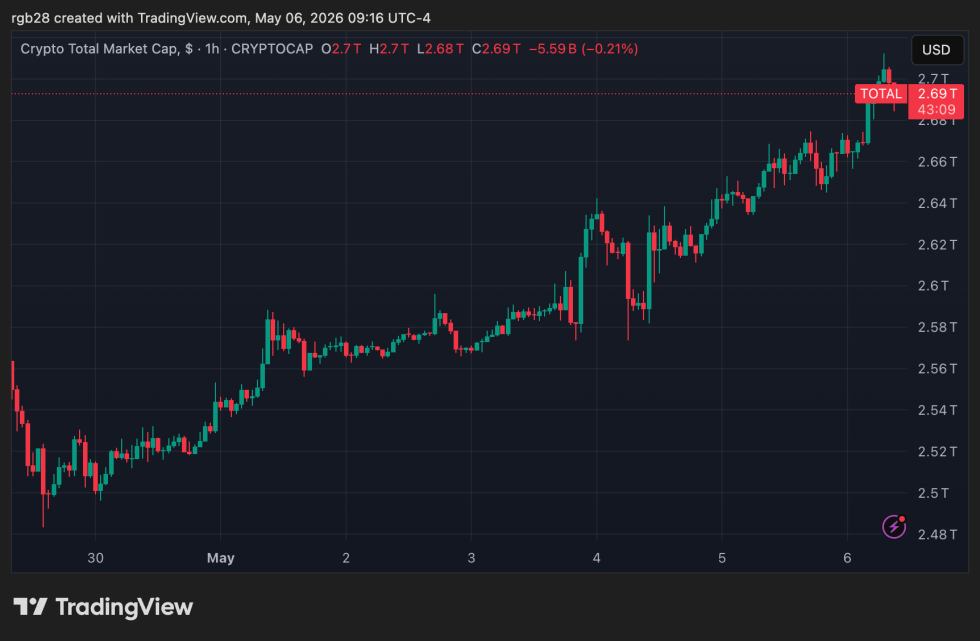
The total crypto market capitalization is at $2.69 trillion in the one-week chart. Source: TOTAL on TradingView


Lectures associées

Grayscale : « Si les propositions sont adoptées, les prix de ces deux altcoins pourraient augmenter »

Zach Pandl, responsable de la recherche chez Grayscale, estime que des modifications envisagées de la tokenomique d'Ethereum (ETH) et de Solana (SOL) pourraient ralentir considérablement la croissance de leur offre, exerçant ainsi une pression haussière sur leurs prix. Ces propositions visent à réduire le taux d'inflation annuel des jetons ETH et SOL. Un ralentissement de la création de nouveaux jetons augmenterait la rareté des actifs existants. Grayscale prévoit que, si elles sont adoptées, l'inflation annuelle de l'offre d'Ethereum pourrait tomber à environ 0,4% d'ici fin 2031, se rapprochant ainsi du Bitcoin, tandis que celle de Solana pourrait atteindre environ 1,1%. En comparaison, l'offre d'or croît d'environ 1,8% par an et l'inflation (IPC) aux États-Unis est d'environ 3,3%. Pandl note que les propositions pour Solana semblent rencontrer un soutien plus large et ont donc une probabilité de mise en œuvre plus élevée. Cependant, il souligne un compromis potentiel : une inflation réduite pourrait diminuer les récompenses pour les investisseurs pratiquant le staking, une partie importante de leurs revenus provenant de l'émission de nouveaux jetons. En conclusion, un ralentissement de l'offre pourrait profiter aux prix des deux actifs, les détenteurs de jetons sans staking étant particulièrement bien placés pour en bénéficier. Ces changements restent à l'étude et ne sont pas encore approuvés.

cryptonews.ruIl y a 1 h

Grayscale : « Si les propositions sont adoptées, les prix de ces deux altcoins pourraient augmenter »

cryptonews.ruIl y a 1 h

Les experts ont nommé les raisons de la chute du bitcoin après la baisse de l'inflation aux États-Unis

Les données favorables sur l’inflation aux États‑Unis n’ont pas réussi à soutenir le bitcoin. Selon les analystes de CryptoQuant, la principale raison est la faible demande sur le marché au comptant. Le bitcoin n’a pas réagi aux chiffres de l’inflation de juillet, publiés le 12 août, et a même légèrement baissé, passant d’environ 64 500 $ à près de 63 000 $. Pourtant, l’indice des prix à la production (PPI) était meilleur que prévu. Alors que les rendements des obligations du Trésor américain ont reculé et que les marchés actions ont progressé, le bitcoin est resté dans une fourchette de 63 000 à 64 000 $. Cette absence de réaction s’explique notamment par la faible demande au comptant : les entrées de capitaux dans les ETF américains spot de bitcoin restent limitées, et l’indice Coinbase Premium (reflétant l’écart de prix entre Coinbase et les autres grandes plateformes) est négatif depuis mai, indiquant une pression d’achat modérée de la part des investisseurs américains. Dans le même temps, le positionnement des traders sur le marché à terme reste élevé, créant un déséquilibre entre une faible liquidité, une demande spot atone et un volume important de positions à effet de levier. Les analystes estiment que dans ces conditions, même des nouvelles macroéconomiques positives pourraient ne pas déclencher de hausse. Si le prix n’évolue pas malgré un contexte favorable, les traders pourraient commencer à clôturer leurs positions longues à effet de levier, ce qui exercerait une pression supplémentaire à la baisse. Un niveau de résistance clé se situe autour de 68 700 $, coût moyen approximatif pour les détenteurs à court terme, au‑delà duquel une prise de bénéfices est possible. Pour CryptoQuant, une reprise soutenue nécessiterait : une reprise des entrées dans les ETF américains, un retour de l’indice Coinbase Premium en territoire positif, une hausse des volumes de trading au comptant et un franchissement stable des 68 700 $.

cryptonews.ruIl y a 2 h

Les experts ont nommé les raisons de la chute du bitcoin après la baisse de l'inflation aux États-Unis

cryptonews.ruIl y a 2 h

Trading

Spot
活动图片