Just Spent 250 Million to Buy Companies, Then Laid Off 30%: Polygon Is Changing Its Way of Survival

marsbitPublié le 2026-01-16Dernière mise à jour le 2026-01-16

Résumé

Polygon, a major blockchain scaling solution, has laid off approximately 30% of its workforce while simultaneously spending $250 million to acquire two companies: Coinme, a licensed crypto-fiat exchange with an extensive US ATM network, and Sequence, a wallet infrastructure and cross-chain routing provider. This strategic pivot signals a shift away from its core Layer-2 (L2) business, where it faces intense competition from dominant players like Base, and toward building a comprehensive stablecoin payment infrastructure called the "Open Money Stack." The acquisitions provide critical pieces for this new direction: Coinme offers regulatory licenses and on-ramps/off-ramps, while Sequence provides the technical backend for seamless cross-chain transactions. The goal is to target B2B clients like banks and payment providers. This move is seen as a necessary "blood change." Polygon's previous strategy, focused on enterprise adoption and NFTs, yielded limited long-term results. In the crowded L2 space, it struggled against competitors with superior user distribution, such as Base, which is integrated with Coinbase's massive user base. The new focus on stablecoin payments is a promising but highly competitive market, with giants like Stripe, PayPal also making significant investments. While Polygon CEO claims this puts them in competition with Stripe, the company is betting on an open infrastructure model versus Stripe's more closed ecosystem. The strategy carries risks. Coinme ...

Author: David, Deep Tide TechFlow

Today, I saw a piece of news: Polygon has laid off about 30% of its employees.

Although Polygon has not officially announced or responded, CEO Marc Boiron admitted to the layoffs in an interview, while stating that the total headcount would remain stable due to the addition of newly acquired teams.

On social media, some laid-off employees also posted, indirectly confirming the fact.
But just this same week, Polygon announced it spent $250 million to acquire two companies. Laying off people while spending big money—doesn't that seem a bit strange?

If it were purely a contraction, they wouldn't simultaneously spend $250 million on acquisitions. If it were an expansion, they wouldn't cut 30% of the staff. Looking at both events together, it seems more like a blood change.

They laid off people from the original business lines, freeing up positions for the teams brought in through acquisitions.

The $250 Million Purchase Was for Licenses and Payment Channels

The two acquired companies are Coinme and Sequence.

Coinme is an old company founded in 2014, providing channels for converting between fiat and cryptocurrencies, operating crypto ATMs at over 50,000 retail points in the U.S. Its most valuable asset is its licenses—it holds money transmitter licenses in 48 states. These are very hard to obtain in the U.S.; companies like PayPal and Stripe spent many years to gather them.

Sequence builds wallet infrastructure and cross-chain routing. Simply put, it allows users to avoid handling bridging, gas swapping, and other hassles themselves, enabling one-click cross-chain transfers. Its clients include Polygon, Immutable, Arbitrum, and it has a distribution partnership with Google Cloud.
The two acquisitions total $250 million. Polygon has named this suite the "Open Money Stack," positioning it as middleware for stablecoin payments, aiming to sell to B2B clients like banks, payment companies, and remittance providers.

My understanding of the logic is this:

Coinme provides compliant fiat on- and off-ramps, Sequence provides user-friendly wallets and cross-chain capabilities, and Polygon's own chain provides the settlement layer. Put together, these three pieces create a complete stablecoin payment infrastructure.

The question is, why is Polygon doing this?

On the L2 Path, Polygon Is Already Struggling

The situation in 2025 is clear: Base has won.

Coinbase's L2 grew from $3.1 billion TVL at the beginning of last year to $5.6 billion, capturing 50% of the entire L2赛道 (L2 track/race). Arbitrum held onto 30% but basically saw no growth. The remaining dozens of L2s mostly became unused after their airdrops ended.
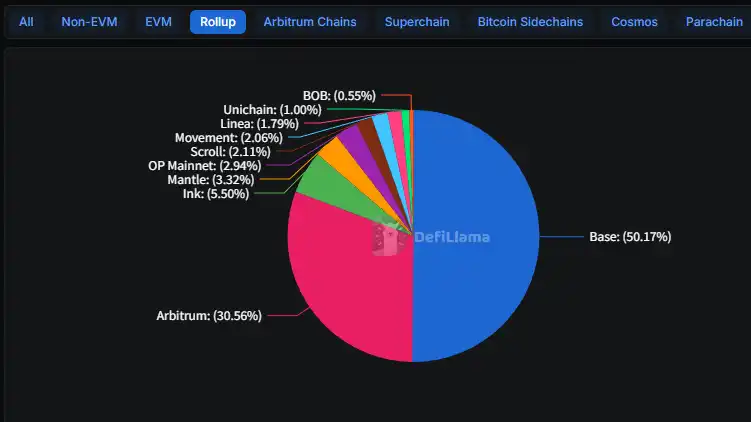
Where did Base win? Coinbase has hundreds of millions of registered users; any product feature launched naturally attracts users.

For example, deposits in the lending protocol Morpho on Base grew from $354 million at the beginning of last year to $2 billion now, primarily because it was integrated into Coinbase's App. Users can use it just by opening the App, without needing to know what an L2 or Morpho is.

Polygon doesn't have that kind of entry point. It also had layoffs in 2024, cutting 20% at that time, which was a bear market contraction—everyone was cutting staff.

This time is different; they have money on the books but still choose to lay off, indicating an active choice to change direction.

Remember before, Polygon's story was about enterprise adoption, like the Disney accelerator program, the Starbucks NFT membership plan, Meta's Instagram minting, Reddit avatars, etc.

Four years later, most of those collaborations have gone quiet. Starbucks' Odyssey program also shut down last year.

Continuing to fight Base head-on in the L2赛道 (L2 track/race), Polygon has almost no chance of winning. The technology gap can be closed, but the user entry point cannot. Rather than lingering on an unwinnable battlefield, it's better to seek new opportunities.

Stablecoin Payments Is a Good Direction, But It's Crowded

Stablecoin payments is indeed a growing market.

In 2025, the total market cap of stablecoins passed $300 billion, up 45% from the previous year. Their use is also changing, expanding from mainly moving funds between exchanges to cross-border payments, corporate treasury, payroll, and other scenarios.

But this market is already very crowded.

Stripe spent $1.1 billion last year to buy the stablecoin infrastructure company Bridge, and recently secured the issuance rights for the USDH stablecoin on Hyperliquid. PayPal's PYUSD already accounts for 7% of the stablecoin share on Solana.

Circle itself is pushing its Payments Network. JPMorgan, Wells Fargo, Bank of America, and other major banks are forming alliances to issue their own stablecoins.

Polygon founder Sandeep Nailwal said in an interview with Fortune that these acquisitions put Polygon in competition with Stripe.

Frankly, that's a bit of an overstatement.

Stripe's acquisition cost $1.1 billion; Polygon spent $250 million. Stripe has millions of merchants; Polygon's clients are mainly developers. Most importantly, Stripe has over a decade of accumulated payment licenses and banking relationships.

In a head-to-head fight, they are not opponents of the same caliber.

But Polygon might be betting on a different approach. Stripe wants to incorporate stablecoins into its closed loop, letting merchants still use Stripe, but with the settlement layer switched to stablecoins for faster and cheaper transactions.

Polygon wants to build open infrastructure, allowing any bank or payment company to build their own business on top of it.

One is vertical integration, the other is a horizontal切入 (cut-in/approach). These two models may not directly clash, but they are competing for the attention of the same group of customers.

Changing Its Way of Survival, the Road Ahead Is Uncertain

Finally, coming back to the point, layoffs in the crypto industry these past two years are not unusual.

OpenSea cut 50%, Yuga Labs, Chainalysis are all contracting. ConsenSys laid off 20% last year and again this year. Most are passive contractions; they are out of money and just trying to survive.

Polygon is different. They have money on the books, can still拿出 (take out/spend) $250 million for acquisitions, but still choose to lay off 30% of their people.

Changing blood to change its way of survival, but there are risks.

The core business of the acquired Coinme is crypto ATMs, with machines deployed at over 50,000 retail points across the U.S., allowing users to buy crypto with cash and cash out crypto.

The trouble is, this business ran into trouble last year.

California regulators fined Coinme $300,000 because its ATMs allowed users to withdraw over the limit, violating the $1,000 daily cap. Washington State was harsher, issuing a direct ban that was only lifted last December.

Polygon's CEO said Coinme's compliance situation "exceeds requirements." But regulatory penalties are black and white; pretty words don't change that.

Mapping these events back to the token, the narrative for the $POL token has also changed.

Previously, the more the chain was used, the more valuable POL became. After the acquisition, Coinme takes a commission on each transaction—this is real revenue, not token narrative. The official said they expect to achieve over $100 million annually.

If they can truly achieve this, Polygon could transform from a "protocol" into a "company," with revenue, profits, and a valuation anchor. This is a rare species in the crypto industry.

However, the speed at which traditional finance is entering is clearly accelerating, and the window for crypto-native companies is narrowing.

There's a saying in the industry: build in the bear market, harvest in the bull market.

Polygon's problem now is that it's still building, but the harvester in the bull market might no longer be it.


Questions liées

QWhy did Polygon lay off 30% of its employees while simultaneously spending $250 million on acquisitions?

APolygon is restructuring its workforce by cutting employees from its existing business lines to make room for new teams from the acquired companies, Coinme and Sequence, indicating a strategic shift rather than simple expansion or contraction.

QWhat are the key assets and roles of the two companies, Coinme and Sequence, that Polygon acquired?

ACoinme provides a fiat-to-crypto exchange channel with valuable money transmitter licenses in 48 U.S. states, while Sequence offers wallet infrastructure and cross-chain routing capabilities, together forming a complete stablecoin payment infrastructure for Polygon's new 'Open Money Stack'.

QWhat challenges is Polygon facing in the L2 (Layer 2) space that prompted this strategic shift?

APolygon is struggling to compete with dominant players like Base, which benefits from Coinbase's massive user base and integrated app features, making it difficult for Polygon to gain traction in the L2 market despite previous enterprise partnerships.

QHow does Polygon's approach to stablecoin payments differ from competitors like Stripe?

APolygon aims to provide open infrastructure for banks and payment companies to build their own services, whereas Stripe focuses on vertical integration by incorporating stablecoins into its existing closed-loop system for merchants.

QWhat risks does Polygon face with its acquisition of Coinme, and how might this affect its business model?

ACoinme has faced regulatory issues, including fines and bans for violating transaction limits, which could pose compliance risks. However, if successful, the acquisition could transition Polygon from a protocol to a company with real revenue streams, such as transaction fees from Coinme's operations.

Lectures associées

Après un stockage multiplié par 50, Sun Yuchen regarde toujours vers les dix prochaines années

La plupart des gens connaissent Sun Yuchen pour ses excentricités, comme avoir payé 30 millions pour un déjeuner avec Warren Buffett avant d'annuler pour une crise de colique néphrétique, ou avoir mangé une banane scotchée achetée 6,2 millions de dollars. Cependant, derrière ces anecdotes se cache un investisseur perspicace. Dès 2016, il recommandait aux jeunes d'investir dans le Bitcoin, NVIDIA, Tesla et Tencent plutôt que dans l'immobilier. Une stratégie qui se serait avérée extrêmement rentable, avec des rendements exponentiels sur NVIDIA et Tesla. Récemment, son soutien public au secteur du stockage (comme SanDisk) a précédé une envolée des cours. Aujourd'hui, son regard est tourné vers la prochaine décennie et les "AI physiques". Il identifie quatre axes principaux : 1. **L'intelligence incarnée (Robots)** : Des entreprises comme Unitree et Galaxy General lèvent des fonds massifs pour développer des robots humanoïdes capables de comprendre et d'agir dans le monde physique. 2. **Les drones** : Déjà déployés commercialement (livraisons, agriculture) et militairement, ils représentent la première forme d'IA ayant un impact tangible dans le monde réel. 3. **Le calcul spatial** : Au-delà de la réalité virtuelle, il s'agit de permettre à l'IA de comprendre l'espace 3D (comme avec l'Apple Vision Pro), une base cruciale pour les robots et les véhicules autonomes. 4. **L'exploration spatiale** : Sun Yuchen a lui-même effectué un vol suborbital avec Blue Origin. Il envisage la blockchain comme une infrastructure pour l'économie spatiale (droits de propriété, paiements interplanétaires). Sa logique d'investissement consiste à parier sur des tendances de fond en diversifiant sur plusieurs acteurs clés d'une même chaîne de valeur (ex: Tesla pour le "corps" des robots, NVIDIA pour le "cerveau"). En résumé, Sun Yuchen anticipe une transition profonde : après avoir révolutionné le flux de l'information, les technologies (IA, robots, drones) sont sur le point de transformer radicalement la manière dont le monde physique fonctionne et est organisé, des usines à l'espace.

marsbitIl y a 14 mins

Après un stockage multiplié par 50, Sun Yuchen regarde toujours vers les dix prochaines années

marsbitIl y a 14 mins

Le plus grand IPO de l'histoire se profile, dépassant SpaceX, 28 ans d'itération autonome de l'IA, le compte à rebours de l'explosion de l'intelligence a commencé

Anthropic, fondée en 2021, approche d'une évaluation proche de 1 000 milliards de dollars en vue d'une introduction en bourse historique qui pourrait surpasser SpaceX. Sa croissance est exponentielle : les revenus annuels récurrents (ARR) ont atteint 45 milliards de dollars en mai 2026, multipliés par 500 en cinq mois. Cette trajectoire vertigineuse est alimentée par ses produits phares, Claude Code et Cowork, qui répondent à la demande explosive d'IA pour le codage et la collaboration. Le cofondateur Jack Clark a émis une prédiction cruciale : d'ici fin 2028, il y a plus de 50% de chances que les systèmes d'IA soient capables de s'auto-améliorer de manière autonome, déclenchant une « explosion de l'intelligence ». Cette perspective de récursivité, où l'IA conçoit de meilleures versions d'elle-même, fonde en grande partie l'évaluation astronomique d'Anthropic. Parallèlement, la société s'attaque aux travaux intellectuels complexes via un partenariat de 1,5 milliard de dollars avec Goldman Sachs et Blackstone, visant à concurrencer les grands cabinets de conseil comme McKinsey. Cela teste la capacité de l'IA à remplacer le travail cognitif de haut niveau. En résumé, la course folle d'Anthropic ne valorise pas seulement une entreprise technologique, mais anticipe une transformation radicale où l'IA pourrait bientôt s'auto-perfectionner, remodelant l'économie et la société. Le compte à rebours vers 2028 est lancé.

marsbitIl y a 29 mins

Le plus grand IPO de l'histoire se profile, dépassant SpaceX, 28 ans d'itération autonome de l'IA, le compte à rebours de l'explosion de l'intelligence a commencé

marsbitIl y a 29 mins

L'opportunisme raffiné de l'ancienne CTO d'OpenAI, Murati : Celui qui donne le couteau et tend la main le premier

Les preuves et témoignages du procès Musk contre Altman ont révélé le rôle complet de Mira Murati, ancienne CTO d'OpenAI, lors du coup d'État de novembre 2023 : elle fut à la fois la force motrice derrière la poussée vers le licenciement et la première à signer pour le retour d'Altman lorsque le vent a tourné. Dès septembre 2022, Murati avait transmis à Altman une liste de plaintes, critiquant sa fixation sur les revenus et son management erratique. En 2023, elle a fourni au cofondateur Ilya Sutskever captures d'écran, historiques Slack et documents internes, alimentant un mémo de 52 pages présenté au conseil d'administration. Son témoignage a également souligné un mensonge d'Altman sur une revue de sécurité IA. Ces éléments ont "grandement poussé" le conseil à licencier Altman le 16 novembre. Murati fut nommée PDG intérimaire et informa elle-même le PDG de Microsoft, Satya Nadella. Cependant, les 78 SMS échangés avec Altman après le licenciement montrent son double jeu : tout en relayant la fermeté du conseil, elle espérait secrètement que Nadella aiderait à renverser la décision. Dès qu'elle perçut la faiblesse du conseil, elle refusa de soutenir sa déclaration et informa Microsoft de sa probable démission. Elle fut la première à signer la pétition de 750 employés exigeant la démission du conseil et le retour d'Altman. L'ancienne administratrice Helen Toner a qualifié son comportement de "non coopératif" et "très négatif", refusant d'expliquer son rôle central dans le licenciement. Comme l'a résumé Toner, "elle attendait de voir de quel côté soufflait le vent, sans réaliser qu'elle était elle-même ce vent." Tout au long de la crise, Murati n'a défendu que ses propres intérêts.

marsbitIl y a 40 mins

L'opportunisme raffiné de l'ancienne CTO d'OpenAI, Murati : Celui qui donne le couteau et tend la main le premier

marsbitIl y a 40 mins

Facture de l’inférence IA en flèche, Shopify et Roblox mettent en garde : les économies réalisées grâce aux licenciements ne suffiront pas à payer la facture des puces

La saison des résultats du premier trimestre 2026 révèle un paradoxe financier pour les entreprises technologiques. Alors que l'IA permet des gains de productivité et une réduction des effectifs, ses coûts opérationnels – consommation de tokens et amortissement des GPU – grèvent désormais les marges de manière significative. Shopify illustre ce dilemme. Si l'IA génère plus de 50% du code et a permis 300 nouvelles fonctionnalités sans hausse des effectifs, les coûts des LLM (notamment via l'assistant Sidekick) pèsent sur la marge de ses solutions d'abonnement, malgré une croissance explosive de son utilisation. Chez Roblox, un quart de la révision à la baisse de sa marge prévisionnelle 2026 est directement attribué aux investissements en IA. La plateforme, qui exécute 1,5 million d'inférences par seconde, envisage de facturer les futures expériences IA avancées pour compenser ces coûts. À l'échelle du secteur, l'écart est frappant : les dépenses en capital IA d'Amazon, Meta, Microsoft et Google devraient atteindre 7250 milliards de dollars en 2026 (+77%). Les économies réalisées via les licenciements sont dépassées : chez Meta, les 24 milliards de dollars d'économies annuelles prévues ne compenseraient que 12% de l'amortissement supplémentaire lié à l'IA. Les grands gagnants sont les fournisseurs de modèles et de puces (OpenAI, Nvidia...), tandis que les entreprises applicatives doivent repenser leur modèle économique. Elles ne peuvent plus simplement financer la facture de l'IA par des réductions de coûts salariaux et doivent soit intégrer ces coûts dans leur stratégie commerciale (Shopify), soit les répercuter sur l'utilisateur final (Roblox).

marsbitIl y a 47 mins

Facture de l’inférence IA en flèche, Shopify et Roblox mettent en garde : les économies réalisées grâce aux licenciements ne suffiront pas à payer la facture des puces

marsbitIl y a 47 mins

Trading

Spot
Futures
活动图片