Is Crypto Over? Don't Give Up, Liquidity Relief Is Coming

marsbitPublié le 2026-02-02Dernière mise à jour le 2026-02-02

Résumé

The article "Is Crypto Over? Don't Give Up, Liquidity is Coming" by Raoul Pal addresses the current downturn in the crypto market, arguing it is not a sign of the industry's demise but a temporary liquidity crisis. Pal refutes the narrative that crypto has permanently decoupled from other assets by showing that Bitcoin's price chart is nearly identical to that of the SaaS index, indicating a shared, external factor: a shortage of U.S. dollar liquidity. He explains this was caused by a combination of events, including the draining of the Reverse Repo facility, the rebuilding of the Treasury General Account (TGA) without monetary offset, and government shutdowns. This liquidity drain negatively impacted risk assets like crypto and tech stocks, while gold absorbed the marginal liquidity. The key takeaway is that this period of illiquidity is ending. The impending resolution of the U.S. government shutdown is seen as the final obstacle. Once cleared, a significant injection of liquidity is expected from sources like the easing of the SLR rule, TGA drawdowns, fiscal stimulus, and eventual rate cuts. Pal, alongside analysis from Stanley Druckenmiller, suggests the new Fed leadership under a potential Warsh chairmanship would be focused on cutting rates to keep the economy hot, aligning with a pro-growth strategy from the administration. The author admits a mistake in not prioritizing U.S. liquidity as the dominant short-term driver over global liquidity but remains highly bulli...

Original Author:Raoul Pal, CEO of Real Vision and GMI

Compiled by: CryptoLeo(@LeoAndCrypto)

This morning, Raoul Pal, CEO of Real Vision and GMI (Raoul Pal's investment bible), published an article titled "False Narratives....and Other Thoughts". Through data comparison and macro analysis, he explained the recent downturn and crisis in the crypto industry, indicating that the industry winter will soon pass, and everyone needs to be patient and not lose confidence in the industry. Odaily Planet Daily translates it as follows:

These were the insights I wrote for GMI over the weekend, hoping to give you some confidence. I would usually keep this content for GMI and Pro Macro discussions, but I know you all need this to ease your tense nerves.

Mainstream Narrative: Is Crypto Over?

The mainstream view is that Bitcoin and cryptocurrencies have crashed, this cycle is over, everything is finished, and it can't be like before. Cryptocurrencies have decoupled from other assets, this is CZ's fault, it's BlackRock's fault, etc. This is undoubtedly an attractive narrative trap, especially when mainstream coin prices are plummeting daily.

But yesterday, a GMI hedge fund client sent me a message asking if they should buy the dip in SaaS stocks, or, as everyone is saying now, if Claude Code has already killed the SaaS industry.

So I started researching SaaS, and in the process, I found conclusions that debunked both the mainstream narrative about Bitcoin and the narrative about the SaaS industry. The charts for SaaS and BTC look exactly the same?
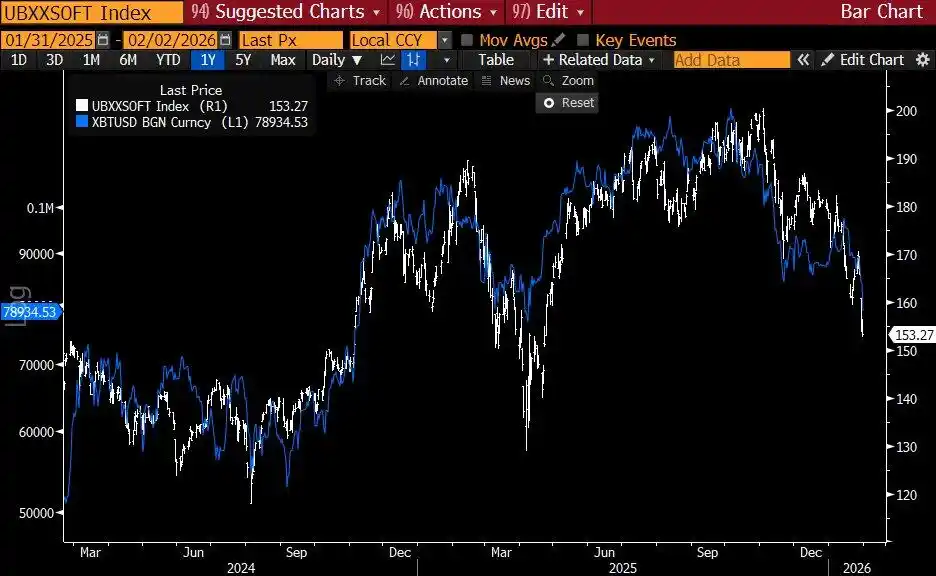
UBS SaaS Index vs. Bitcoin Trend

This indicates there is another factor that everyone is ignoring affecting this trend.

This factor is: Due to two shutdowns and issues with the US financial system's underlying mechanisms (the reverse repo mechanism's liquidity was only fully replenished in 2024), US liquidity has been constrained. Therefore, the TGA (Treasury General Account) rebuilding in July and August had no corresponding monetary offset measures, leading to a reduction in liquidity.
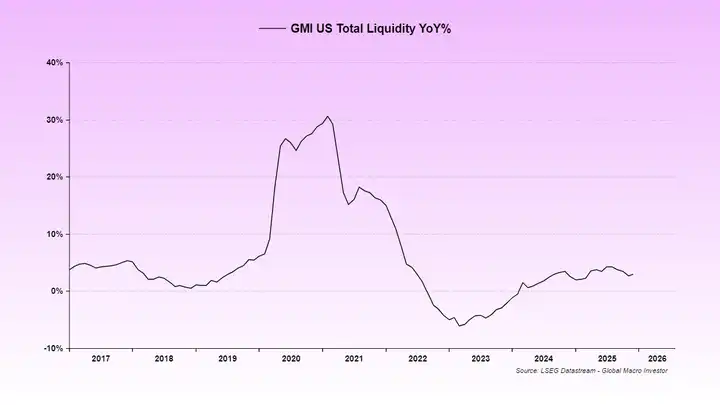
So far, the low liquidity is the reason the ISM Manufacturing Index has remained low.
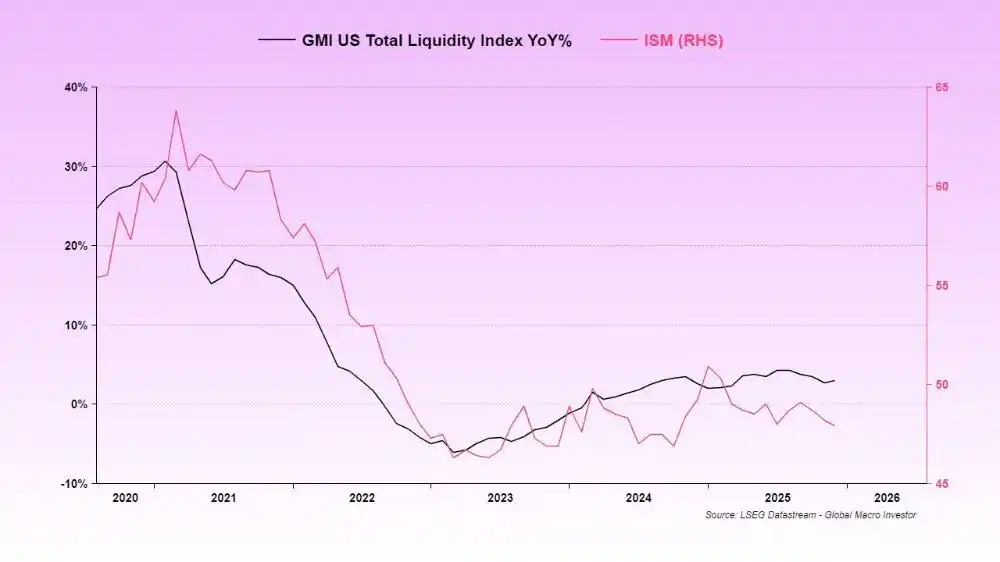
We usually use the Global Total Liquidity indicator because it has the highest long-term correlation with BTC and the Nasdaq, but at this stage, US Total Liquidity seems more important because the US is the primary provider of global liquidity.

In this cycle, the GMI Global Total Liquidity index is leading the US Total Liquidity index and is about to rebound (and thus will also drive the ISM index).
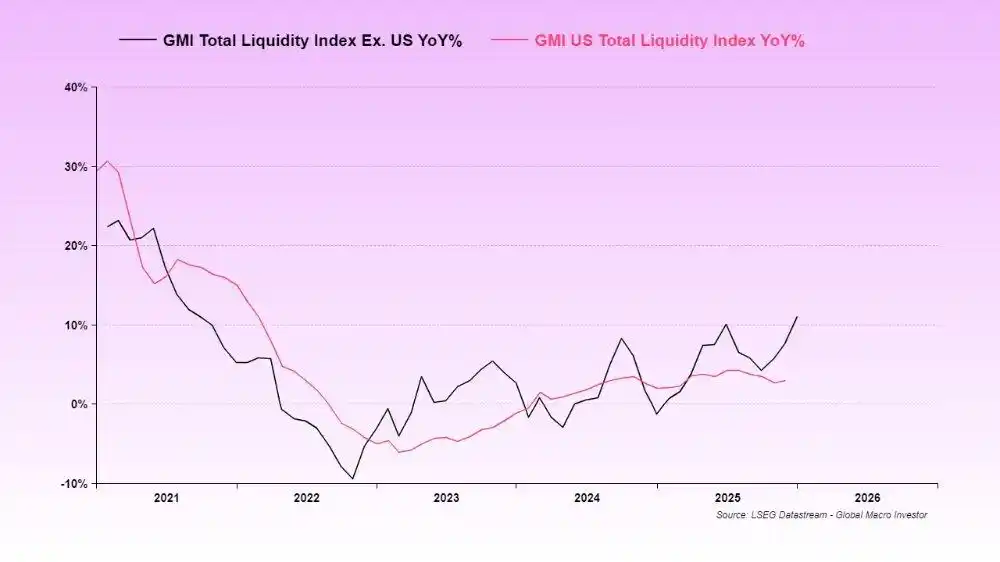
This is precisely what is impacting SaaS and BTC. Both assets are among the longest-duration assets in existence and have fallen due to the temporary withdrawal of liquidity.

The rise in gold has essentially sucked out the marginal liquidity from the system that might have flowed into the Bitcoin and SaaS markets. There isn't enough liquidity to support these assets, so high-risk assets are getting hit and falling. There's really no way around it.
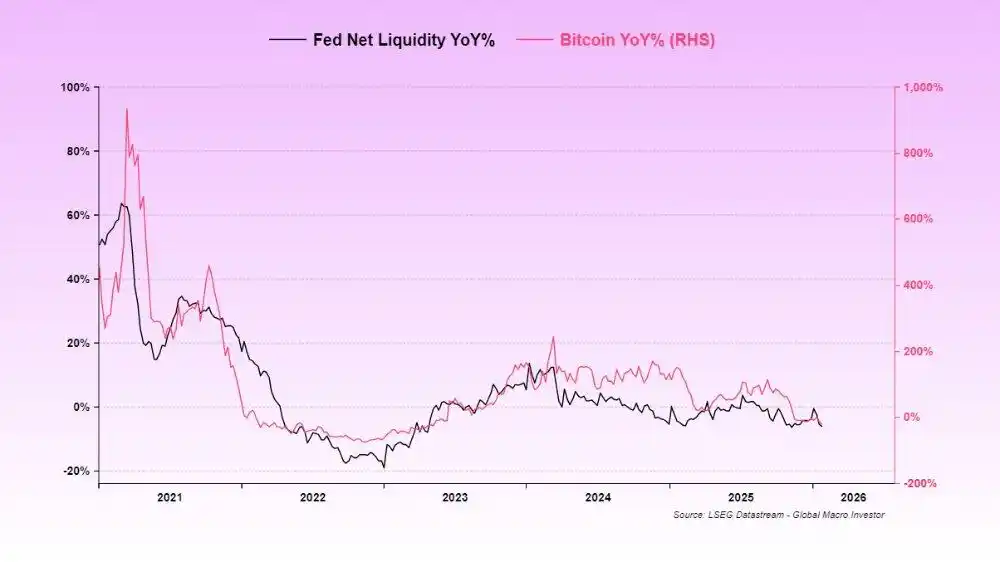
Now, the US government is facing another shutdown. The Treasury Department has taken preventive measures: after the last government shutdown, no TGA funds were used; instead, the balance was increased (i.e., further liquidity drain). This is the crisis we are facing now. It has caused violent price swings, and our beloved crypto is still lacking liquidity.

However, all signs indicate that this government shutdown will be resolved this week, which will clear the last liquidity obstacle.

Odaily Note: US House Speaker Johnson said in an interview on NBC News' "Meet the Press" on Sunday that he believes he has secured Republican support votes to ensure the shutdown of some government agencies ends by Tuesday.

I have mentioned the risk of this government shutdown many times before, but it will be over soon, and then we can continue to deal with the upcoming liquidity injection, which includes measures from eSLR, some TGA回流 (TGA回流: TGA runoff/return of funds?), fiscal stimulus, rate cuts, all related to the mid-term elections.

Odaily Note: US regulators are easing leverage ratio requirements through legislation to alleviate capital pressure on several major banks like Bank of America (BAC.US).

In a full trading cycle, time is often more important than price. Price can be hit hard, but as time passes and the cycle evolves, everything gets resolved and eventually settles.

This is why I have always emphasized "patience". Events need to unfold. Focusing solely on profit and loss ratios will only affect your mental health, not your investment portfolio.

The Fed's False Narrative

Regarding the issue of rate cuts, there is also a false narrative that Kevin Warsh is a hawk. This is complete nonsense; these statements are mainly from over 18 years ago.

Warsh's job and mission were to execute the strategies of the Greenspan era. Both Trump and Besant have said (not detailed here, but the main direction is rate cuts) to keep the economy hot, assuming that the productivity gains from AI will suppress core CPI rises (just like the 1995-2000 era).

Odaily Note: Greenspan is one of the longest-serving Chairs in Fed history. His advocated monetary policy (controlling inflation + promoting maximum employment) was highly flexible but practically prioritized fighting inflation, while also actively injecting liquidity during crises.

He doesn't like the balance sheet, but the system is reserve-constrained, so he is unlikely to change its current practices, otherwise it would destroy the credit market.

Warsh will cut rates and do nothing else. He will not interfere with Trump and Besant's actions to manage liquidity through banks. Fed Governor Milan will likely forcefully push for a full eSLR cut to accelerate this process.

If you don't believe me, believe Druck ↓
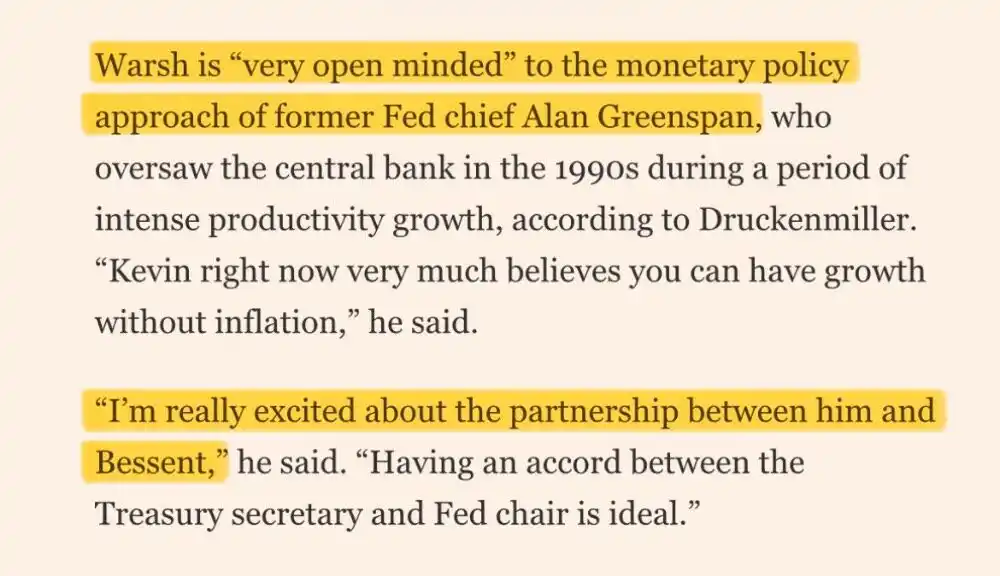
The above shows "investment guru" Stanley Druckenmiller's content on Warsh's monetary policy philosophy and his agreement with Besant upon becoming Fed Chair.

I know how difficult it is to hear optimistic narratives when the crypto market looks so dark. My SUI holdings are terrible, we don't know what or who to believe anymore. First, we have been through this many times before. When BTC falls 30%, altcoins can fall even 70%. But if they are high-quality alts, they bounce back faster too.

Mea Culpa (My Mistake)

GMI's mistake was not considering US liquidity as the current driving factor; usually, Global Total Liquidity dominates the entire cycle. But now the situation is clear, anything is possible.

The two are not unrelated. We just couldn't predict the combination of events (reverse repo draining liquidity > TGA rebuilding > government shutdown > gold rising > another shutdown), or we failed to anticipate their impact.

It's almost over, soon we can get back to normal work.

We cannot guarantee that every single link is error-free (now we have a deeper understanding), and we are still very bullish on the 2026 outlook because we understand the strategy of Trump/Besant/Warsh. These three have repeatedly told us: we just need to listen and be patient. In full-cycle investing, time is more important than price.

If you are not a cycle investor and don't have such strong risk tolerance, that's completely fine. Everyone has their own style, but Julien (GMI Head of Macro Research) and I are not good at swing trading (we don't care about intra-cycle fluctuations), but we are proven and have a track record in full-cycle investing, leading the industry for the past 21 years. (Warning: We also make mistakes, like in 2009). Now is not the time to give up. Good luck, and let's achieve greater results in 2026.

Liquidity relief is on the way!

Questions liées

QAccording to Raoul Pal, what is the main factor causing the recent downturn in both the crypto and SaaS markets?

AThe main factor is the suppression of US liquidity due to two government shutdowns and issues with the US financial system's plumbing (the reverse repo mechanism), combined with TGA (Treasury General Account) rebuilding in July and August without monetary offset measures, which drained liquidity.

QWhat does Raoul Pal predict will happen once the current US government shutdown is resolved?

AHe predicts that resolving the shutdown will clear the final liquidity hurdle, allowing for a return to normalcy and the arrival of incoming liquidity injections from measures like eSLR, TGA drawdowns, fiscal stimulus, and rate cuts.

QHow does the article describe the relationship between the performance of Bitcoin and the UBS SaaS Index?

AThe article shows that the performance of Bitcoin and the UBS SaaS Index charts are identical, indicating they are both being affected by the same factor: the withdrawal of US liquidity.

QWhat is the 'false narrative' that Raoul Pal identifies regarding the potential new Fed Chair, Kevin Warsh?

AThe false narrative is that Kevin Warsh is a hawk. Pal argues this is nonsense and that Warsh's role would be to execute a Greenspan-era strategy of keeping the economy hot, cutting rates, and not interfering with liquidity management by the administration and banks.

QWhat key investment principle does Raoul Pal emphasize for navigating the current market cycle?

AHe emphasizes that 'time is more important than price' in a full cycle investment. He advises patience, stating that events need to play out and that focusing solely on profit and loss ratios affects mental health, not the investment portfolio.

Lectures associées

Ce PDG de la Finance Choisit Solana Plutôt Que Bitcoin — Voici Pourquoi

Le PDG du secteur financier Raoul Pal a exprimé une préférence nette pour Solana par rapport au Bitcoin, lors de l'événement Consensus 2026. Sa position ne relève pas d'une simple comparaison d'actifs mais d'une conviction sur l'avenir de la cryptographie à l'ère de l'intelligence artificielle. Il estime que l'industrie se dirige vers une phase dominée par les réseaux à haute vitesse et faible coût, mieux adaptés aux activités de masse, plutôt que par le rôle de réserve de valeur du Bitcoin. Selon lui, Solana, avec son débit élevé et ses faibles frais de transaction, est idéal pour les microtransactions entre machines, les activités basées sur l'IA et les interactions DeFi rapides. Pal prédit par ailleurs que d'ici cinq ans, les agents IA représenteront 60% des utilisateurs de la finance décentralisée (DeFi), surpassant les utilisateurs humains. Cette vision d'un futur où les transactions fréquentes et automatisées seront cruciales explique son choix en faveur de Solana pour capturer les opportunités de croissance. Bien qu'il soit improbable que Solana surpasse Bitcoin en termes de taille à court terme, cette perspective s'inscrit dans un thème majeur de la conférence, centré sur la convergence entre l'IA, la DeFi et l'infrastructure institutionnelle. D'autres intervenants, comme Arthur Hayes, ont également souligné la nature distincte de la cryptographie par rapport aux systèmes traditionnels.

bitcoinistIl y a 10 h

Ce PDG de la Finance Choisit Solana Plutôt Que Bitcoin — Voici Pourquoi

bitcoinistIl y a 10 h

GensynAI : Ne laissez pas l'IA répéter les erreurs d'Internet

Au cours des derniers mois, l'essor de l'IA a attiré de nombreux talents de la cryptographie. Une question centrale émerge : la blockchain peut-elle faire partie de l'infrastructure de l'IA ? Gensyn se distingue en s'attaquant non pas aux applications, mais au cœur du développement de l'IA : **l'entraînement des modèles**. Le projet vise à organiser les ressources GPU mondiales dispersées en un réseau ouvert d'entraînement d'IA. Les développeurs peuvent soumettre des tâches, les nœuds fournissent la puissance de calcul, et le réseau vérifie les résultats avant de distribuer les incitations. L'enjeu dépasse la simple décentralisation : il s'agit de contrer la **concentration croissante des ressources de calcul** entre les mains de quelques géants, qui deviennent un goulot d'étranglement pour l'innovation. Gensyn propose ainsi une nouvelle façon d'organiser les ressources. Premièrement, il opère au niveau de l'infrastructure fondamentale, la couche la plus exigeante techniquement et en ressources. Deuxièmement, il offre un modèle de collaboration plus ouvert, permettant une meilleure utilisation des GPU inactifs et une réduction potentielle des coûts. Troisièmement, sa technologie de vérification probabiliste des résultats et de coordination des nœuds constitue un véritable avantage technique. Enfin, il répond à une demande réelle et croissante du marché, évitant le piège des récits sans utilité pratique. En somme, Gensyn incite la convergence entre la cryptographie (expertise en coordination et incitations mondiales) et l'IA (besoins massifs en ressources). Son ambition est de transformer l'entraînement de l'IA en un système plus ouvert et accessible, au-delà du contrôle exclusif des grands acteurs, posant les bases d'une infrastructure essentielle pour l'ère de l'IA.

marsbitIl y a 11 h

GensynAI : Ne laissez pas l'IA répéter les erreurs d'Internet

marsbitIl y a 11 h

Pourquoi la Chine se développe-t-elle si rapidement en IA ? La réponse se cache dans les laboratoires

L'auteur, après une visite dans des laboratoires d'IA chinois de premier plan, explore les raisons du développement rapide de l'IA en Chine. Il constate que l'écosystème chinois se distingue de celui des États-Unis par son approche organisationnelle : moins de concepts, plus de modèles concrets ; moins d'importance accordée aux vedettes individuelles, plus au travail d'équipe ; et une forte préférence pour maîtriser en interne la pile technologique plutôt que de dépendre de services externes. La culture de travail, valorisant l'humilité, l'exécution et l'ingénierie rapide, est bien adaptée à la construction de grands modèles de langage. Une grande partie des contributeurs clés sont des étudiants, intégrés directement aux équipes, apportant un regard neuf et une forte capacité d'adaptation. L'accent est mis sur l'amélioration itérative et l'optimisation plutôt que sur la recherche "de 0 à 1". Les scientifiques chinois se montrent très concentrés sur la construction technique, moins sur les débats philosophiques ou économiques autour de l'IA. L'écosystème industriel présente également des différences : une demande précoce en IA (ressemblant plus au marché du cloud qu'au SaaS), une forte influence des modèles comme Claude sur les développeurs, et une mentalité répandue de "contrôle technologique" poussant de nombreuses grandes entreprises (plateformes, hardware) à développer leurs propres modèles fondateurs, souvent en open source par pragmatisme. Le soutien gouvernemental existe mais est décentralisé, l'industrie des données est moins mature qu'en Occident, et l'accès aux puces Nvidia est une contrainte majeure. L'auteur conclut que la Chine développe sa propre voie, marquée par une culture de construction, un esprit d'écosystème collaboratif et un pragmatisme profond. Cette approche, différente de la course aux sommets menée par le capital et les "stars" aux États-Unis, fait de la compétition mondiale en IA une rivalité de capacités organisationnelles, d'écosystèmes développeurs et d'exécution industrielle. Il exprime un souhait pour une écologie open source mondiale florissante, tout en notant les défis géopolitiques actuels.

marsbitIl y a 12 h

Pourquoi la Chine se développe-t-elle si rapidement en IA ? La réponse se cache dans les laboratoires

marsbitIl y a 12 h

3 ans, 5 fois la valeur, la renaissance d'une verrerie centenaire

D'après CRU, la demande de fibre optique pour les centres de données IA a augmenté de 75,9 % sur un an, et l'écart entre l'offre et la demande s'est creusé de 6 % à 15 %. Les prix des fibres ont plus que triplé en quelques mois, révélant une capacité de production insuffisante. Cela explique les investissements massifs de NVIDIA chez Corning, ainsi que chez Lumentum et Coherent, pour un total de 45 milliards de dollars, visant à sécuriser la chaîne d'approvisionnement optique (lasers, puces photoniques, fibres). Corning, une entreprise de verrerie fondée en 1851, a vu son cours de bourse multiplié par plus de 3 en un an, atteignant une capitalisation de 160 milliards de dollars. Cette renaissance est portée par les infrastructures IA. La fibre optique est devenue le « nerf » des centres de données IA, avec une consommation 5 à 10 fois supérieure aux serveurs traditionnels. La transition du cuivre vers la lumière (interconnexions optiques, CPO) est nécessaire pour les débits élevés (au-delà de 800G) et pour réduire la consommation d'énergie. Corning se distingue par sa technologie de fibres spécialisées à très faible atténuation et haute densité, cruciales pour l'IA. Son activité "Enterprise" (centres de données), désormais plus de 40% de ses revenus en communication optique, connaît une croissance explosive, soutenue par des contrats pluriannuels avec Meta, NVIDIA et d'autres géants. Bien que ne détenant pas la plus grande part de marché mondiale de la fibre, Corning tire parti de décennies de R&D et d'un savoir-faire matériel de pointe, notamment dans le domaine émergent du CPO (Co-Packaged Optics). La pénurie et la hausse des prix profitent à tout le secteur, comme en témoignent les résultats des concurrents chinois. Le rythme de déploiement du CPO par NVIDIA et l'identité des autres grands clients non divulgués de Corning sont des catalyseurs clés pour son avenir. Des technologies disruptives comme la fibre à cœur creux pourraient également remodeler le paysage à plus long terme. Après une forte appréciation boursière, l'exécution des commandes et le respect des délais seront désormais plus importants que le récit de croissance lui-même.

marsbitIl y a 13 h

3 ans, 5 fois la valeur, la renaissance d'une verrerie centenaire

marsbitIl y a 13 h

Trading

Spot
Futures
活动图片





