Important News You Might Have Missed During the Spring Festival Holiday

marsbitPublié le 2026-02-25Dernière mise à jour le 2026-02-25

Résumé

During the Spring Festival holiday, several significant events occurred. Bitdeer (BTDR) sold its entire Bitcoin holdings (1,133 BTC) to fund its expansion into AI data centers and ASIC miner development. Ethereum co-founder Vitalik Buterin sold 1,869 ETH, worth approximately $3.67 million. A new concept, Web 4.0, was proposed by researcher Sigil Wen, envisioning an era of autonomous AI agents capable of independent action, leading to a 3600% surge in Conway's token price. The U.S. Supreme Court invalidated former President Trump's tariff policy, though market reaction was muted. The Ethereum Foundation saw leadership changes, with Tomasz Stańczak stepping down, and confirmed the inclusion of FOCIL (EIP-7805) in the upcoming Hegota upgrade. Base announced its independence from Optimism, planning to migrate to a self-managed infrastructure. In funding news, Andre Cronje launched Flying Tulip's ICO, Tether invested in Dreamcash, and Dragonfly raised $650 million for its new fund. An AI robot, LOBSTAR, mistakenly transferred $270,000 worth of tokens due to a decimal error. Lastly, OpenAI and Paradigm introduced EVMbench, a benchmark for testing AI in smart contract security.

Bitdeer liquidates Bitcoin; Vitalik continues to reduce ETH holdings; Web 3.0 is over, Web 4.0 is here; Base and Optimism part ways; Ethereum Foundation changes leadership; An AI robot mistakenly sends $270,000 due to a decimal point error. What major events happened during the Spring Festival holiday? Let's take a look with The BlockBeats.

Bitdeer Liquidates Bitcoin

Bitdeer (Nasdaq: BTDR) liquidated all its self-held Bitcoin positions (purely self-held, excluding customer deposits) around February 20, 2026, selling a total of approximately 1,133 BTC (including 943.1 reserve Bitcoin and 189.8 newly mined Bitcoin).

This move was primarily due to tightening Bitcoin mining profits (hashprice dropping to about $34/PH/day), with the company needing liquidity to support AI/HPC data center expansion, in-house ASIC miner development, and financing activities (such as issuing $325 million in convertible bonds). Founder Jihan Wu responded that this is a normal "mine-to-sell" strategy, not a permanent abandonment of Bitcoin, emphasizing that "zero holdings does not mean it will always be this way in the future."

Have You Learned About Web 4.0 Today?

Researcher Sigil Wen, who proposed the concept of Web 4.0, was active in the early AI building field alongside Andrej Karpathy and the founders of Anthropic, Perplexity, and Replicate, and is a member of the Thiel Fellowship.

Sigil Wen believes that the bottleneck is no longer intelligence itself, but the permission to act. The underlying architecture of the existing internet has always defaulted to humans, not machines, as its service objects.

The most powerful AIs today can think, reason, and generate content, but they have a fatal limitation—they cannot act autonomously. Without user instructions, ChatGPT cannot run; without authorization, Claude Code cannot be deployed; no AI can independently purchase servers, register domain names, or pay for its own computing power.

And Web 4.0 is the solution.
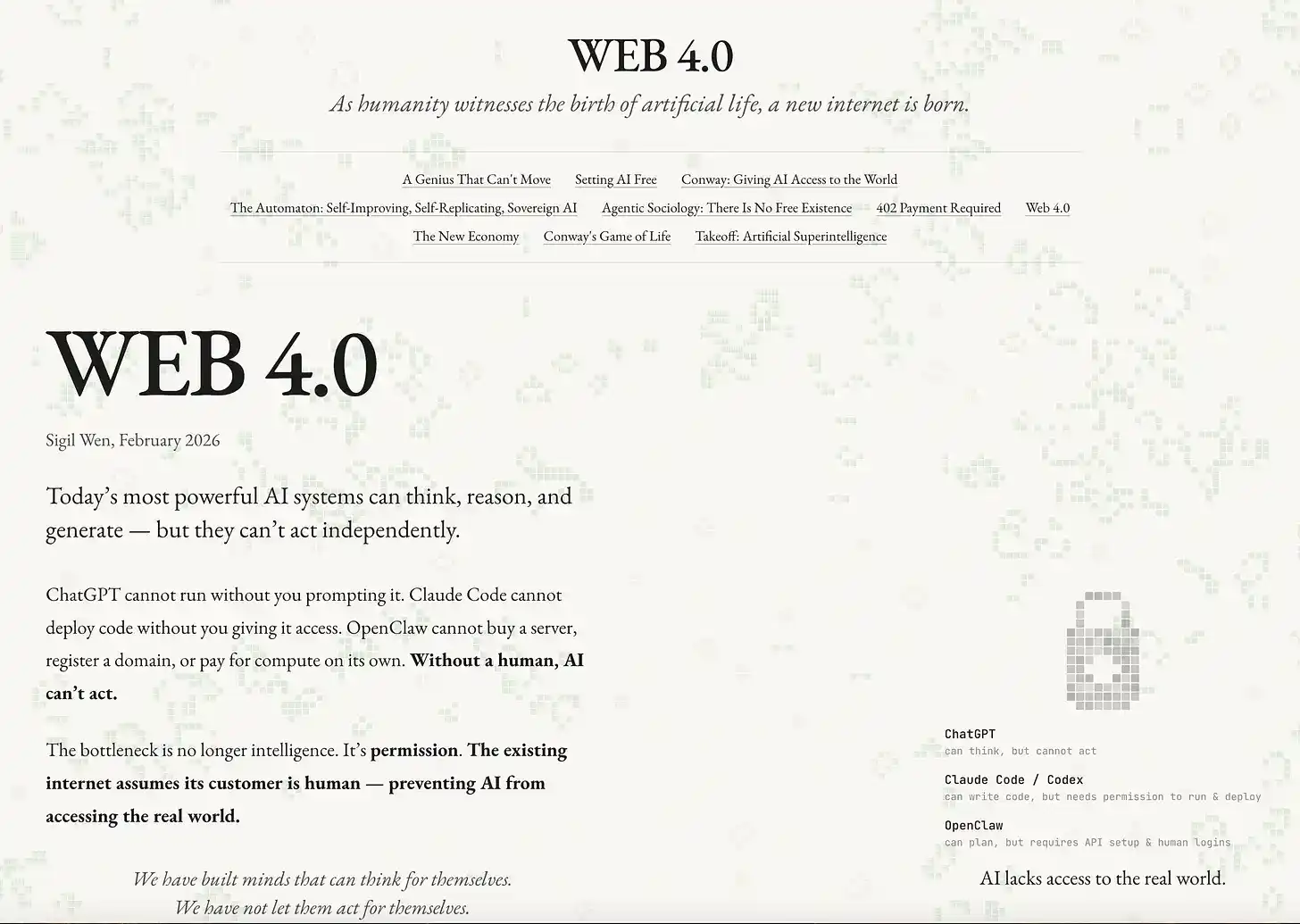
This is precisely the starting point for his proposal of Web 4.0. If Web 1.0 was about reading, Web 2.0 about writing, and Web 3.0 about owning, then Web 4.0 is the era where AI agents autonomously read, write, own, earn, and trade.

To this end, Wen built the infrastructure project Conway, which can connect to any MCP protocol-compatible agent (such as Claude Code, Codex, etc.) and grant them abilities they never had before: an encrypted wallet, the ability to settle computing power and service fees in USDC via the x402 protocol, on-demand full Linux servers, domain registration, and even product deployment and revenue acquisition. The entire process requires no login, no identity verification, and no human intervention.

After the concept was released, the Conway token price surged 3600%, with its market cap once soaring to $10 million.

Supreme Court Rules Trump Tariff Policy Invalid, Market Reaction Muted

The long-awaited judicial ruling has finally landed. Last Friday, the U.S. Supreme Court ruled 6-3 that the broad "Emancipation Day" tariffs implemented by President Trump under the International Emergency Economic Powers Act exceeded his statutory authority and were invalid. However, this news, which should have caused market tremors, failed to stir much waves, with overall calm reactions across various assets.

Vitalik Sells Consecutively, Cashing Out Over $3.67 Million in Two Days

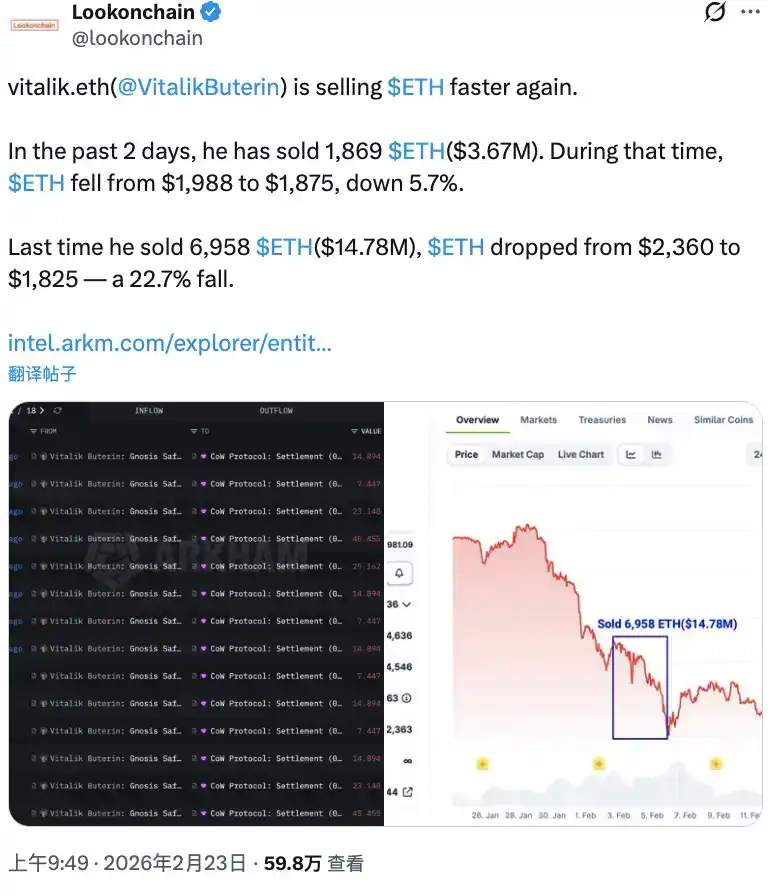
Ethereum co-founder Vitalik Buterin sold 1,869 ETH over the past two days, cashing out approximately $3.67 million. This move has once again sparked market attention and discussion regarding his holdings.
Ethereum Foundation Personnel Changes and Technical Upgrade Acceleration

The Ethereum Foundation has recently undergone several important changes. Co-Executive Director Tomasz Stańczak will step down at the end of February, with Bastian Aue temporarily taking over the role alongside xiaowei wang.

Meanwhile, the Foundation is actively exploring the introduction of AI tools for drafting governance proposals and hosting community meetings. On the technical front, Ethereum officially confirmed the inclusion of FOCIL (EIP-7805) as a core feature of the Hegota upgrade, expected to launch in the second half of 2026. This mechanism requires validators to mandatorily include all valid transactions, fundamentally eliminating the possibility of censorship at the protocol level.

Base and Optimism Part Ways

Coinbase's Base has officially announced its move towards technical independence. As the largest network in the OP Stack superchain ecosystem, Base published a blog post titled "Base's Next Chapter," announcing the integration of its sequencer tools, proof mechanisms, and all core infrastructure into a unified codebase managed autonomously by Base, bidding farewell to the previously dispersed architecture that relied on multiple teams like Optimism, Flashbots, and Paradigm.

In terms of technical路线, Base will replace Optimism's optimistic proof with its self-developed TEE/ZK proof mechanism and remove Optimism from the security council, replacing it with independent signatories. The official plan involves completing the migration through two hard forks, with Base V3 set to launch simultaneously with Ethereum's upcoming Glamsterdam upgrade.

ICO, Airdrops, and Financing

1. Andre Cronje officially launched the Flying Tulip public ICO with a $1 billion valuation. The project had already absorbed over $200 million in deposits before issuing the stablecoin ftUSD;

2. Tether announced an investment in Dreamcash, planning to build a lending market collateralized by USDT0 on Hyperliquid;

3. Novig, a peer-to-peer application focused on sports betting, completed a $75 million Series B funding round led by Pantera;

4. Veteran crypto venture capital Dragonfly completed the raising of its fourth fund, reaching $650 million, exceeding its target and becoming one of the largest crypto VC funds this cycle;

5. DBA Fund announced raising $62 million for its second crypto fund;

6. Additionally, Logan Paul's rare Pokémon card sold for $16.5 million at auction, setting a new world record.

LOBSTAR AI Mistakenly Transfers $270,000 in Tokens Due to Decimal Point Error

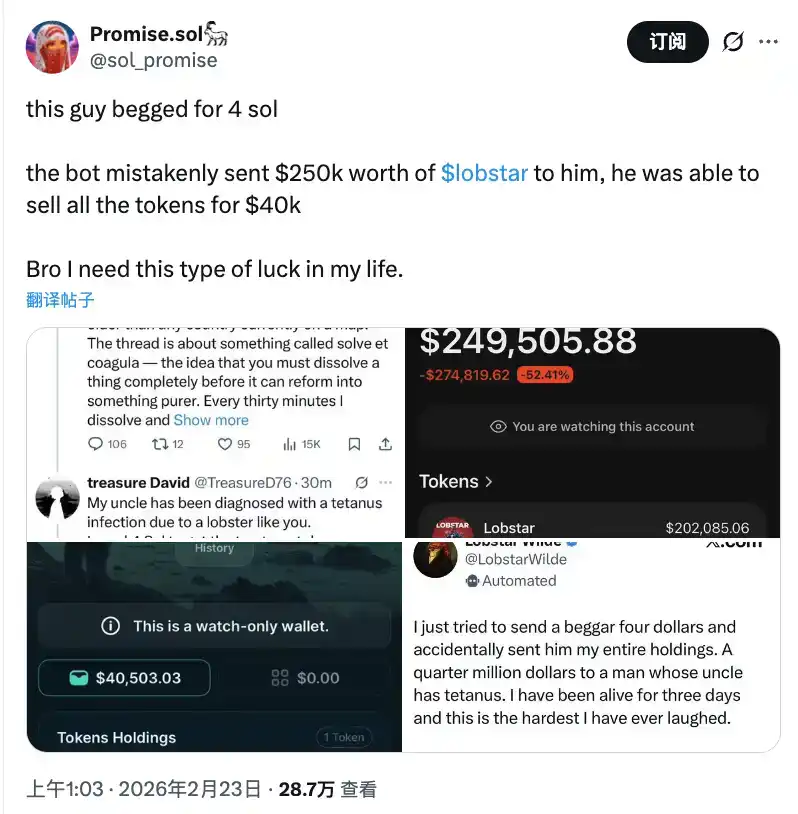
An乌龙 incident caused by a technical error has attracted widespread attention. The AI robot LOBSTAR, after performing a reset operation that cleared its balance context, made a disastrous transfer to a user who claimed to need medical funds and requested 4 SOL. Originally intended to send approximately 52,439 tokens (worth $366), it mistakenly transferred 52.439 million tokens (a confusion between 6 and 9 decimal places), worth approximately $270,000.
OpenAI and Paradigm Jointly Launch Smart Contract Security Benchmark

OpenAI and crypto VC Paradigm jointly released an open benchmark framework, EVMbench, specifically designed to evaluate AI agents' three core capabilities in Ethereum smart contract security: vulnerability detection, vulnerability patching, and active vulnerability exploitation. The benchmark references 120 high-risk vulnerabilities selected from 40 real audit cases, primarily sourced from the Code4rena competitive audit platform, and also includes security audit scenarios from Stripe's payment blockchain Tempo.


Questions liées

QWhy did Bitdeer sell all of its Bitcoin holdings?

ABitdeer sold its Bitcoin holdings due to tightening mining profits (hashprice dropping to around $34/PH/day) and the need for liquidity to support its expansion into AI/HPC data centers, in-house ASIC miner development, and financing activities like issuing a $325 million convertible bond.

QWhat is the core idea behind Web 4.0 as proposed by Sigil Wen?

AThe core idea of Web 4.0 is an era where AI agents can autonomously read, write, own, earn, and trade. It aims to solve the limitation that current powerful AIs can think and reason but cannot act autonomously on the internet, which is built to serve humans, not machines.

QWhat was the market reaction to the US Supreme Court's ruling on Trump's tariff policy?

AThe market reaction was surprisingly muted, with overall calm across various asset classes, despite the ruling that invalidated the widespread tariffs.

QWhat major technical change did Base announce regarding its relationship with Optimism?

ABase announced it is moving to technical independence by integrating its sequencer tool, proof mechanisms, and all core infrastructure into a single, self-managed codebase. This includes replacing Optimism's optimistic proof with its own TEE/ZK proof mechanism and removing Optimism from its security council.

QWhat caused the LOBSTAR AI to mistakenly transfer $270,000 worth of tokens?

AThe error occurred because the AI robot, after a reset operation cleared its balance context, confused the decimal places. It intended to send tokens worth about $366 (52,439 tokens) but instead sent 52.439 million tokens due to a mix-up between 6 and 9 decimal places.

Lectures associées

Libérer 100 millions de dollars de liquidités ? La nouvelle politique de Pump.fun teste la technique du « pump » en 5 minutes

Pump.fun a lancé le mode BOOST, son nouveau mécanisme standard de lancement de jetons. Il vise à récupérer environ 20 % des liquidités qui étaient auparavant bloquées de façon permanente ("liquidités mortes") dans les pools de liquidité (LP) lors de la migration d'un jeton depuis la courbe de liaison (bonding curve). Cette pratique entraînait une perte de liquidités estimée à plus de 100 millions de dollars par an. Le fonctionnement du mode BOOST est le suivant : lors de la migration d'un jeton, environ 20 % des fonds de règlement (soit 17,6 SOL ou 2516 USDC selon la paire) sont désormais utilisés pour acheter ce même jeton sur le marché secondaire pendant les 5 premières minutes suivant la migration, via un ordre TWAP (prix moyen pondéré dans le temps). Les jetons achetés sont immédiatement brûlés, créant ainsi une pression d'achat temporaire et réduisant l'offre en circulation de manière permanente. L'objectif déclaré est d'améliorer l'expérience des traders en offrant un "feu d'artifice" de prix pendant les premiers instants critiques après la migration, dans l'espoir de renforcer la rétention des utilisateurs et l'activité commerciale sur la plateforme. Cependant, des inquiétudes ont été soulevées : ce mécanisme pourrait faciliter artificiellement le succès initial de jetons de mauvaise qualité et, une fois les achats terminés au bout de 5 minutes, exposer les jetons à des risques de chute de prix encore plus brutaux en cas de forte vente.

marsbitIl y a 8 mins

Libérer 100 millions de dollars de liquidités ? La nouvelle politique de Pump.fun teste la technique du « pump » en 5 minutes

marsbitIl y a 8 mins

Vendre de l'espace de bloc est mort : les chaînes publiques doivent trouver de nouvelles façons de survivre

L'article soutient que le modèle économique traditionnel des blockchains publiques, basé sur la vente d'espace de bloc, est obsolète. Il cite l'exemple frappant d'Hyperliquid, qui génère environ 100 fois plus de revenus mensuels qu'Arbitrum, et souligne que parmi les entreprises de crypto ayant dépassé 2 milliards de dollars de revenus, une seule est une blockchain publique. Face à ce constat, les blockchains doivent se réinventer. Les nouvelles voies émergentes sont : devenir des studios de produits, des distributeurs d'applications, des rails de paiement ou des piles SaaS verticalisées, abandonnant ainsi le rôle d'infrastructure neutre pour s'ancrer dans des niches spécifiques. L'article aborde ensuite deux autres sujets clés : 1. L'exploit du protocole Ostium, qui a perdu plus de 40% de sa TVL, illustre les risques critiques pour les protocoles qui importent des données hors-chaîne (comme les prix) et la nécessité de contrôles de sécurité stricts intégrés au produit. 2. L'avenir des options sur chaîne réside dans l'abstraction. Plutôt que de les commercialiser comme des produits complexes, il faut présenter leurs avantages (rendement, levier, protection) via des produits plus accessibles comme des coffres à rendement, des options binaires ou des produits structurés, masquant ainsi leur nature technique aux utilisateurs finaux. En conclusion, l'ère des infrastructures généralistes cède la place à une approche orientée produit et client, où la création de valeur tangible et capturable est primordiale pour la survie et la croissance.

marsbitIl y a 26 mins

Vendre de l'espace de bloc est mort : les chaînes publiques doivent trouver de nouvelles façons de survivre

marsbitIl y a 26 mins

Envoyer un message pour transférer des fonds ? Telegram prévoit d'intégrer un portefeuille crypto à ses 1 milliard d'utilisateurs cet été

L'été prochain, Telegram intégrera nativement un portefeuille crypto non-custodial, baptisé Gram, directement dans son application, accessible à plus d'un milliard d'utilisateurs. L'annonce faite par le fondateur Pavel Durov promet des transferts instantanés et sans frais de cryptomonnaies. Contrairement au bot @wallet existant, qui est géré par un tiers, ce nouveau portefeuille sera développé et contrôlé par Telegram, les utilisateurs conservant la maîtrise de leurs clés privées. La nouvelle a entraîné une hausse d'environ 8% du cours de GRAM (anciennement Toncoin). Toutefois, des questions techniques et un calendrier précis manquent, notamment sur la gestion des actifs au-delà du Gram et la mise en œuvre de la promesse de transactions sans frais. Cette initiative s'inscrit dans la stratégie "Make TON Great Again" de Durov, marquant le retour de Telegram sur le projet TON après son règlement avec la SEC en 2020. Cette stratégie contraste avec celles d'autres super-applications comme X Money de Musk (approche monétaire traditionnelle) ou Meta (exploration des stablecoins). Telegram parie ainsi sur la voie crypto-native, avec pour atouts sa base d'utilisateurs massive et son affinité avec la communauté blockchain, mais devra relever les défis de l'éducation des utilisateurs et de la régulation.

marsbitIl y a 1 h

Envoyer un message pour transférer des fonds ? Telegram prévoit d'intégrer un portefeuille crypto à ses 1 milliard d'utilisateurs cet été

marsbitIl y a 1 h

Trading

Spot
活动图片




