Hurun Report Interview with Justin Sun: New Paradigm of Value Circulation in the Web3 Transformation Cycle

链捕手Publié le 2026-05-29Dernière mise à jour le 2026-05-29

Résumé

In an interview with *Hurun Report*, Justin Sun, founder of TRON, discussed the evolution of the Web3 industry as it transitions from early-stage exploration to large-scale adoption. He emphasized that the fundamental goal of blockchain technology is to build an open and inclusive internet of value, enabling low-cost, efficient fund transfer for anyone globally, regardless of location or access to banking. Sun highlighted stablecoins as the most mature and scalable application within Web3, noting that TRON has grown into one of the world's largest stablecoin networks, with over $86.3 billion in USDT circulation. He attributed this growth to genuine user demand in cross-border payments and daily transactions, reflecting a structural shift where blockchain's openness and efficiency are naturally supplementing traditional financial systems. Regarding strategy, Sun outlined a framework combining data-driven iteration, rapid execution, and user-centricity. He pointed to TRON's partnership with Tether for TRC-20 USDT as a key decision that leveraged market trends and network effects to build a competitive moat. He also stressed the importance of globalization, noting that success in different markets depends on deep local compliance, cultural adaptation, and partnership networks. Sun expressed strong interest in the convergence of AI and blockchain, viewing AI as a transformative force that can enhance blockchain's intelligence and user experience, while blockchain provides dece...

Against the backdrop of the Web3 industry entering a deep-water zone and the accelerated global restructuring of financial infrastructure, blockchain is transitioning from early exploration to large-scale application. As an authoritative institution with extensive influence in business and investment, an in-depth interview by the renowned magazine, Hurun Report, is regarded as a significant industry barometer. Recently, Justin Sun, founder of TRON, in an exclusive interview with Hurun Report, systematically elaborated his judgment on industry evolution and long-term value around core issues such as stablecoin payments, globalization path, and AI integration trends. His views also reflect the critical stage where Web3 infrastructure is moving from "feasibility verification" to "global adoption".
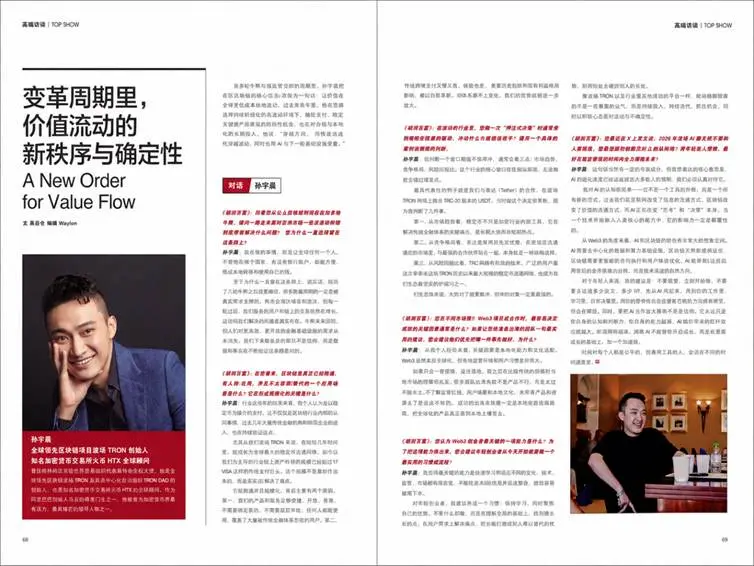
Stablecoins Building a Global Value Circulation Network, Web3 Infrastructure Enters Scaling Phase

In the interview with Hurun Report, Justin Sun summarized the core goal he has long been committed to in extremely concise terms: "To enable any person in the world, regardless of location or whether they have a bank account, to transfer and use their funds at low cost and high efficiency." This statement fundamentally reveals the value essence of blockchain technology — constructing an open and inclusive value internet.

He further pointed out that after the blockchain industry has gone through multiple bull and bear cycles, projects truly capable of weathering these cycles must be built upon real demand and practical usage. The continuous growth of on-chain user scale and transaction volume is an important basis for his judgment of industry direction. In this context, the on-chain payment system centered around stablecoins has become the most mature and capable application scenario for scaling currently.

In the Hurun Report interview, Justin Sun mentioned that TRON has rapidly developed into one of the world's largest stablecoin circulation networks, with its on-chain asset transfer volume even surpassing that of some traditional payment networks. This growth is not driven by short-term market sentiment but based on the continuous use by real users in scenarios such as cross-border transfers, value storage, and daily payments. Official data shows that the current circulation of USDT on the TRON chain has exceeded $86.3 billion, a scale reflecting strong network effects driven by real user demand.

From a structural advantage perspective, the scaling of stablecoin payments benefits from two factors: on one hand, blockchain networks possess openness and permissionless characteristics, enabling them to cover user groups difficult for the traditional financial system to reach; on the other hand, the limitations of traditional cross-border payment systems in efficiency, cost, and user experience provide significant substitution space for new-generation infrastructure. Sun believes this trend is essentially a "natural substitution" of existing financial systems by technological progress, not short-term competition.

Globalization Strategy and Technology Convergence Advance in Parallel, Building Long-term Competitive Advantage for Web3

When discussing enterprise growth and strategic decision-making, Justin Sun presented a highly systematic methodology in the Hurun Report interview. He summarized the success factors as the combination of "data-driven iteration, rapid execution, and user orientation," emphasizing that in a rapidly changing technological environment, single-dimensional capabilities can no longer support long-term competitiveness; the synergy of these three is necessary to achieve efficient trial-and-error and precise decision-making.

At the organizational level, he proposed a management framework of "clear direction, layered support, and a sense of ownership among all members" to avoid deviation and loss of control during rapid expansion. This organizational structure, emphasizing flatness and agility, is seen as an important foundation for Web3 enterprises to maintain competitiveness in highly uncertain environments.

Regarding key strategic decisions, Sun reviewed the case of TRON's partnership with Tether to launch TRC-20 USDT in the Hurun Report interview. He stated that this decision was based on a comprehensive assessment of market trends, competitive landscape, and risk-reward ratio: stablecoins represent a long-term trend in financial system evolution, top assets possess significant network effects, and the upside potential in this field far outweighs the potential risks. It has been proven that this cooperation became a crucial growth engine for the TRON ecosystem and built its core competitive moat in the stablecoin domain.

Regarding global expansion, Sun emphasized that while Web3 has inherent cross-border properties, its actual implementation remains highly dependent on local compliance and cultural adaptation. In the Hurun Report interview, he noted that different markets have significant differences in regulatory frameworks, user habits, and business environments. The success of a project often depends on the depth of understanding of these differences and the ability to build local partnership networks.

Furthermore, Justin Sun expressed a clear judgment on the development of AI technology. In the interview, he stated that AI is not merely a tool upgrade but a reconstruction of "thinking and decision-making capabilities." Its integration with blockchain in data, computing power, and intelligent execution will become a crucial direction for the next stage of technological evolution. Blockchain provides decentralized infrastructure for AI, while AI enhances the intelligence and user experience of blockchain systems; the convergence of the two holds long-term strategic value.

For industry participants and young entrepreneurs, the core advice Justin Sun gave in the Hurun Report interview is: in a highly uncertain environment, continuous learning and rapid adaptation are the most critical abilities. Simultaneously, one should focus investments based on an understanding of the overall industry landscape, building irreplaceable core strengths rather than dispersing resources across multiple tracks.

From early-stage technical verification and market exploration, gradually entering the large-scale application phase represented by stablecoins, and extending towards AI convergence and global compliant implementation. In this process, TRON is continuously advancing the implementation and evolution of the value internet through infrastructure capabilities, globalization strategy, and forward-looking technological layout.


Lectures associées

Analyse du Rapport de Goldman Sachs : Pénurie de Stockage jusqu'en 2028, Continuez d'Acheter

Le rapport de Goldman Sachs met en avant une perspective de pénurie prolongée des puces mémoire jusqu'en 2028, soutenue par une demande soutenue des serveurs d'IA, une croissance limitée de l'offre et des contrats d'approvisionnement à long terme. Cette dynamique devrait maintenir les prix élevés plus longtemps que prévu. La banque a relevé ses objectifs de cours pour Samsung Electronics et SK Hynix, et est passée à l'achat pour Kioxia, anticipant des marges bénéficiaires élevées sur plusieurs années. Au-delà du secteur de la mémoire, le rapport identifie des opportunités dans toute la chaîne d'approvisionnement matérielle de l'IA, y compris MediaTek (transition vers les ASIC), Eoptolink (modules optiques 1.6T), Biren (puces IA chinoises), Huaqin (diversification vers les centres de données) et Lenovo (cycle de renouvellement des PC IA). D'autres sociétés mentionnées incluent BYD pour sa stratégie de conduite autonome à bas coût, et des équipementiers japonais de semi-conducteurs. Le contexte macroéconomique souligne un clivage entre les économies exportatrices de technologie, bénéficiant du boom de l'IA, et les importateurs d'énergie, confrontés à des pressions inflationnistes. Pour la Chine, Goldman Sachs note des flux de capitaux passifs importants attendus vers les actions technologiques et des semi-conducteurs lors des prochains rééquilibrages d'indices. [Disclaimer : Ces informations, tirées d'un rapport de recherche tiers, ne constituent pas un conseil en investissement.]

marsbitIl y a 16 mins

Analyse du Rapport de Goldman Sachs : Pénurie de Stockage jusqu'en 2028, Continuez d'Acheter

marsbitIl y a 16 mins

Décryptage des Opérations Magistrales de Cathy Wood sur Circle

L’analyse des opérations de Cathie Wood (Ark Invest) sur Circle (CRCL) illustre une maîtrise remarquable du marché. Convaincue du potentiel à long terme des stablecoins comme infrastructure du dollar numérique, Ark a acquis 4,49 millions d’actions au prix d’introduction de 31 dollars, bénéficiant ainsi de l’envolée initiale due à une faible offre flottante et une forte demande. Lorsque le cours a explosé, porté par l’adoption du *GENIUS Act* (juin 2025), atteignant près de 299 dollars, Ark a systématiquement vendu par tranches environ 1,7 million d’actions à un prix moyen d’environ 210 dollars. Cette vente était motivée à la fois par la discipline de rééquilibrage du fonds (limite de 10% par actif) et par l’anticipation de l’arrivée massive d’actions après les levées de lock-up. Par la suite, face à la chute du titre (jusqu’à -83% depuis le sommet), aggravée par les craintes sur les taux d’intérêt et les ventes internes, Ark est revenue acheter progressivement à des prix bien inférieurs (entre environ 80 et 130 dollars). Début 2026, sa position était revenue à environ 4,5 millions d’actions. Les clés de cette réussite sont : une conviction fondamentale solide sur le modèle économique de Circle, une exécution en tranches sans chercher à timer parfaitement les sommets et les creux, et une discipline stricte de gestion des risques et des tailles de position.

marsbitIl y a 18 mins

Décryptage des Opérations Magistrales de Cathy Wood sur Circle

marsbitIl y a 18 mins

Matinée | Michael Saylor diffuse les informations du Bitcoin Tracker ; Aave publie l'enquête post-incident de l'attaque du pont Kelp rsETH ; Gravity Bridge suspend son service après avoir été attaqué

**Résumé en français :** Ces dernières 24 heures dans l'écosystème crypto ont été marquées par des développements réglementaires, des incidents de sécurité et des analyses de marché. **Réglementation et Adoption Institutionnelle :** * La société numérique **Laser Digital** a obtenu une approbation préliminaire pour créer une banque fiduciaire régulée au niveau fédéral aux États-Unis. * Le **Vietnam** envisage de permettre aux PME d'utiliser des actifs numériques comme garantie pour les prêts bancaires. * Le président de la SFC de **Hong Kong** a annoncé une forte croissance du volume des transactions sur les plateformes d'actifs virtuels agréées. **Sécurité et Incidents :** * Le pont inter-chaînes **Gravity Bridge** (Cosmos) a été attaqué et a suspendu ses services. * **Aave** a publié l'enquête post-incident sur l'attaque du pont Kelp rsETH, soulignant que la vulnérabilité provenait de l'infrastructure tierce du pont (LayerZero) et non du protocole Aave lui-même. Les mesures de protection ont été activées et les fonctions affectées sont largement restaurées. * Aux **États-Unis**, la SEC a intenté un procès contre l'auteur présumé d'une escroquerie crypto de 12,3 millions de dollars promettant des rendements élevés via un faux robot de trading IA. **Actualités du Marché et Analyses :** * **Michael Saylor** a de nouveau publié des informations sur le Bitcoin Tracker, laissant présager une nouvelle annonce d'acquisition par MicroStrategy la semaine prochaine. * Un gouverneur de la **Fed** a commenté que l'adoption massive des stablecoins pourrait amplifier la portée de la politique monétaire américaine. * Santiment note un ratio long/court record sur Bitcoin, pouvant signaler un correctif à court terme, et un sentiment "FUD" sur Ethereum qui pourrait être un signal haussier contraire. * En **Chine**, un homme a été condamné à 10 ans de prison pour le vol de 107 BTC via l'appropriation de la phrase de récupération d'un portefeuille. **Tendances Meme :** Les jetons les plus populaires sur les réseaux ETH, Solana et Base au cours des dernières 24 heures sont également listés, avec HEX, SHIB, TROLL et toby en tête de leurs catégories respectives.

链捕手Il y a 57 mins

Matinée | Michael Saylor diffuse les informations du Bitcoin Tracker ; Aave publie l'enquête post-incident de l'attaque du pont Kelp rsETH ; Gravity Bridge suspend son service après avoir été attaqué

链捕手Il y a 57 mins

Alibaba « met en rayon », ByteDance « s’entraîne »

Durant la dernière semaine de mai, deux événements consécutifs dans l'industrie de l'IA ont révélé les stratégies divergentes des géants chinois Alibaba et ByteDance. Alibaba adopte une approche d'application immédiate et de monétisation. Son modèle Qwen est intégré à Taobao pour des fonctionnalités comme l'essayage virtuel et la comparaison de prix, visant à transformer l'expérience d'achat. L'entreprise se positionne comme l'infrastructure ("eau, électricité, gaz") et la "caisse enregistreuse" de l'ère IA, avec ses services cloud alimentant de nombreux modèles locaux. Cette stratégie, soutenue par des réorganisations internes et l'initiative "AI Credit", génère déjà des revenus, comme en témoigne la croissance de 40% des revenus cloud externes. Cependant, elle suppose que les capacités des modèles de base n'évolueront pas assez vite pour rendre ses applications obsolètes. ByteDance, via son département Seed, privilégie la recherche fondamentale à long terme. Son objectif est "d'explorer les limites de l'intelligence". Son modèle de génération vidéo Seedance 2.0, salué comme le plus performant au monde, et des publications académiques ambitieuses sur les "modèles du monde" illustrent cette voie. La société, qui n'est pas cotée en bourse, peut se permettre d'engager des dépenses d'investissement massives (jusqu'à 470 milliards de yuans en 2026 selon des rapports) et d'accorder à ses chercheurs le temps de publier sans pression commerciale immédiate. Mais cette approche "laboratoire Nobel" commence à être questionnée par des signes de commercialisation sur des produits comme Doubao. L'article suggère que cette divergence stratégique tient moins à une philosophie qu'à un statut : Alibaba, société cotée, est soumis à la pression des marchés pour montrer des retours rapides, tandis que ByteDance, privée, peut investir sur le très long terme. Le jour où ByteDance envisagera une introduction en bourse, la pérennité de sa stratégie de recherche pure sera véritablement mise à l'épreuve.

marsbitIl y a 2 h

Alibaba « met en rayon », ByteDance « s’entraîne »

marsbitIl y a 2 h

Trading

Spot
Futures

Articles tendance

Comment acheter SUN

Bienvenue sur HTX.com ! Nous vous permettons d'acheter SUN (SUN) de manière simple et pratique. Suivez notre guide étape par étape pour commencer votre parcours crypto.Étape 1 : Création de votre compte HTXUtilisez votre adresse e-mail ou votre numéro de téléphone pour ouvrir un compte sur HTX gratuitement. L'inscription se fait en toute simplicité et débloque toutes les fonctionnalités.Créer mon compteÉtape 2 : Choix du mode de paiement (rubrique Acheter des cryptosCarte de crédit/débit : utilisez votre carte Visa ou Mastercard pour acheter instantanément SUN (SUN).Solde :utilisez les fonds du solde de votre compte HTX pour trader en toute simplicité.Prestataire tiers :pour accroître la commodité d'utilisation, nous avons ajouté des modes de paiement populaires tels que Google Pay et Apple Pay.P2P :tradez directement avec d'autres utilisateurs sur HTX.OTC (de gré à gré) : nous offrons des services personnalisés et des taux de change compétitifs aux traders.Étape 3 : stockage de vos SUN (SUN)Après avoir acheté vos SUN (SUN), stockez-les sur votre compte HTX. Vous pouvez également les envoyer ailleurs via un transfert sur la blockchain ou les utiliser pour trader d'autres cryptos.Étape 4 : tradez des SUN (SUN)Tradez facilement SUN (SUN) sur le marché Spot de HTX. Il vous suffit d'accéder à votre compte, de sélectionner la paire de trading, d'exécuter vos trades et de les suivre en temps réel. Nous offrons une expérience conviviale aux débutants comme aux traders chevronnés.

687 vues totalesPublié le 2024.12.12Mis à jour le 2025.03.21

Comment acheter SUN

Discussions

Bienvenue dans la Communauté HTX. Ici, vous pouvez vous tenir informé(e) des derniers développements de la plateforme et accéder à des analyses de marché professionnelles. Les opinions des utilisateurs sur le prix de SUN (SUN) sont présentées ci-dessous.

活动图片












