How Should Crypto VCs Survive? When Top Projects No Longer Need Institutional Funding

marsbitPublié le 2026-04-13Dernière mise à jour le 2026-04-13

Résumé

Cryptocurrency venture capital is at a watershed moment. Token exits, once the primary driver of outsized returns, are undergoing a major reset. The definition of token value is being rewritten in real-time, yet no standard valuation framework has emerged. Key market shifts include the rise of tokens with real, on-chain revenue (like HYPE), which exposed the weakness of governance tokens with no fundamentals; a supply shock from meme coins (e.g., PUMP) fragmenting liquidity; and competition from prediction markets, stock perps, and leveraged ETFs diverting retail speculative capital. This has compressed token lifecycles and cratered holding periods. VCs now face critical questions: Are they underwriting equity, tokens, or a hybrid? What is the best practice for on-chain value accrual beyond potentially toxic buybacks? Will the "crypto premium" vanish entirely, forcing valuations to align with public equities and crashing many Layer 1 tokens? The result is a divergence: early-stage investors are becoming more price-sensitive on token projects, while appetite for equity deals is growing. Later-stage crypto VCs are increasingly competing with traditional funds in "Web2.5" deals. To survive, crypto VCs must find their product-market fit with founders. Capital alone is no longer sufficient. Winning the best deals—from projects that may not even need institutional funding—requires providing unmatched brand value and non-capital advantages.

Author: Catrina,Partner at Portal Ventures

Compiled by: Jiahuan, ChainCatcher

Crypto venture capital is at a watershed moment. Over the past three cycles, token exits have been the primary driver of outsized returns, but they are now undergoing a major reset. The definition of token value is being rewritten in real-time, yet an industry-standard valuation framework has yet to emerge.

What Exactly Is Happening?

This time, the crypto market structure is being simultaneously impacted by multiple unprecedented forces, completely upending it:

1. The emergence of HYPE awakened the token market, proving that token prices can have real revenue backing, with over 97% of its eight to nine-figure revenue generated on-chain.

This has thoroughly disillusioned the market regarding governance tokens propped up by narratives but hollow in fundamentals—think of the L1s and "governance tokens" that primarily existed to navigate the ambiguities of securities laws (which made direct revenue distribution unfeasible). HYPE reset market expectations almost overnight: revenue is now scrutinized more strictly and has become the basic ante to play.

2. Chain Reaction and Backlash on Other Token Projects

Before 2025, if you had on-chain revenue, you were considered a security; after HYPE, if you ask most hedge funds, they'll tell you that if you don't have on-chain revenue, you'll go to zero. This has left most projects, especially non-DeFi ones, in a dilemma, scrambling to adapt.

3. PUMP Brought a Stunning Supply Shock to the System.

The explosion of supply from meme coin mania, by diverting attention and liquidity, has fundamentally disrupted the market structure. On Solana alone, the number of newly generated tokens surged from about 2-4 thousand per year to a peak of 40-50 thousand. This effectively split the not-much-grown liquidity cake into about one-twentieth. Chasing alpha, the same buyer demographic has shifted its attention and capital to speculating on meme coins rather than holding altcoins.

4. Accelerated Diversion of Retail Speculative Capital.

Prediction markets, stock perpetuals (perps), and leveraged ETF trading are now directly competing for the same pool of capital that would have flowed into altcoins. Meanwhile, the maturation of tokenization technology has made leveraged trading of blue-chip stocks possible—these stocks don't carry the risk of going to zero like most altcoins, are subject to much stricter regulation, and are more transparent with lower information asymmetry risks.

The result is a severe compression of the token lifecycle: the time from peak to trough has shortened dramatically, retail willingness to "hold" tokens has plummeted, replaced by faster capital rotation.

Some Big Questions Every VC Is Asking Themselves and Their Peers

1. Are we underwriting equity, tokens, or a combination of both?

The biggest challenge here is that we have no new playbook for value accrual in token projects—even the most successful projects like Aave still face controversy between the DAO and equity.

2. What is the best practice for on-chain value accrual?

The most common is token buybacks, but that doesn't mean it's right. We have long been against the prevailing trend of token buybacks: it is toxic and puts founders with real revenue in a bind.

The incentive is completely wrong: stock buybacks happen after a company has finished investing in growth, whereas crypto buybacks are increasingly demanded immediately, driven by retail/public perception (a completely fickle and irrational thing).

You might burn $10 million that could have been reinvested for nothing, and the very next day that value could vanish due to some random market maker getting liquidated.

Public companies buy back stock when it's undervalued. Token buybacks get front-run at every turn, so they are often executed at local highs.

Especially if you are a B2B business generating off-chain revenue, this is a futile exercise. In my opinion, when your revenue is less than $20 million, there is absolutely no reason to do buybacks just to please retail instead of reinvesting the capital into growth.

I really like this report from fourpillars, which shows that buybacks in the high nine-figures did almost nothing to help projects set a long-term price floor.
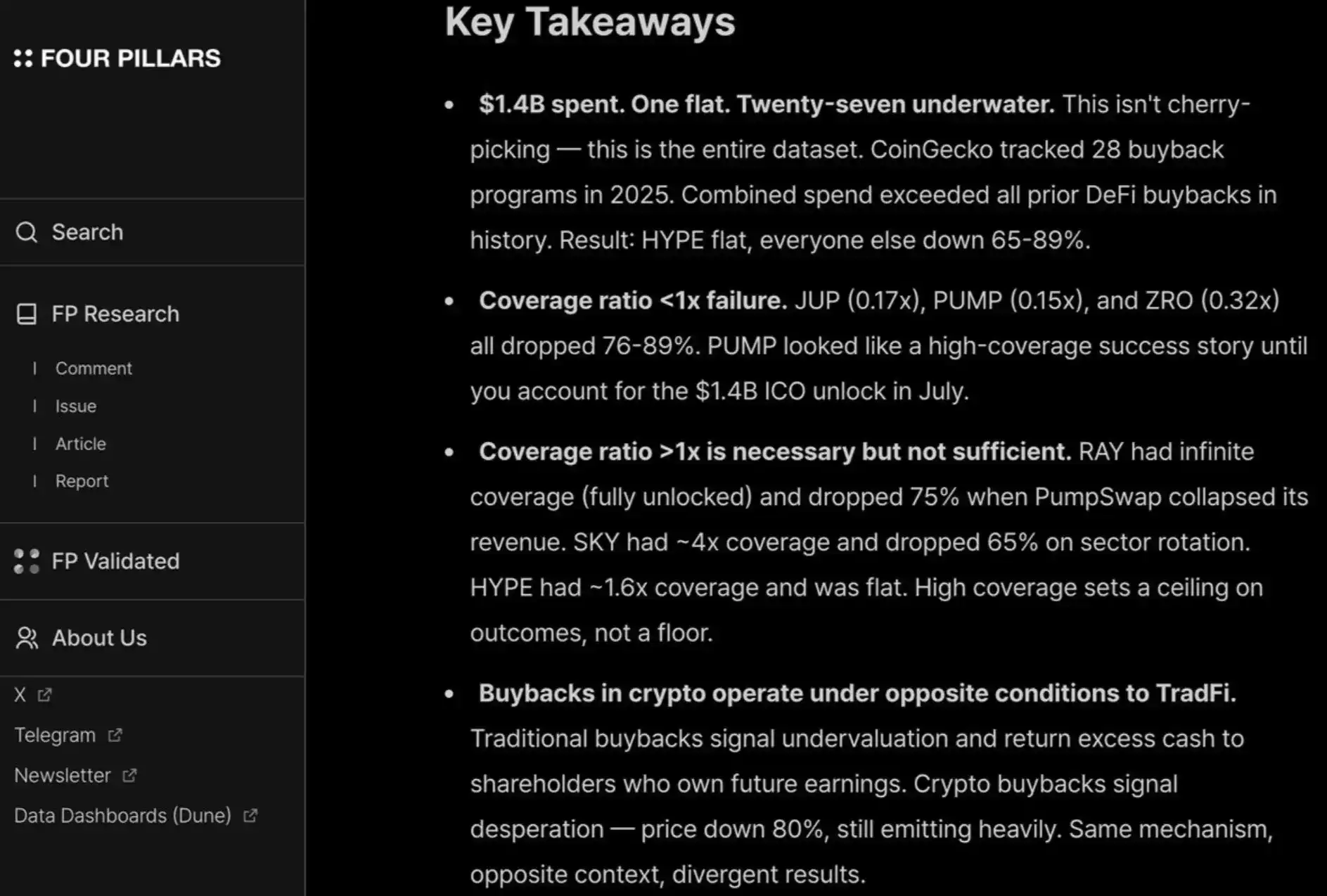
Beyond that, to keep retail and hedge funds happy, you must also conduct buybacks consistently and transparently, like HYPE does. Any failure to do so is punished, as seen with PUMP's P/E ratio (based on fully diluted valuation) being only 6x because the public "doesn't trust" them—despite the fact that they have verifiably burned $1.4 billion in revenue that could have gone to the treasury.

Here is some further reading on "on-chain value accrual mechanisms that work without burning money"

3. Will the "crypto premium" disappear entirely?

This would mean that in the future, all projects will be valued based on multiples similar to public stocks (roughly 2 to 30x revenue). Take a moment to think about what this implies—if true, we would see most L1 public chains fall more than 95% from current prices, with exceptions like TRON, HYPE, and other revenue-generating DeFi projects. And this is even without considering token vesting.
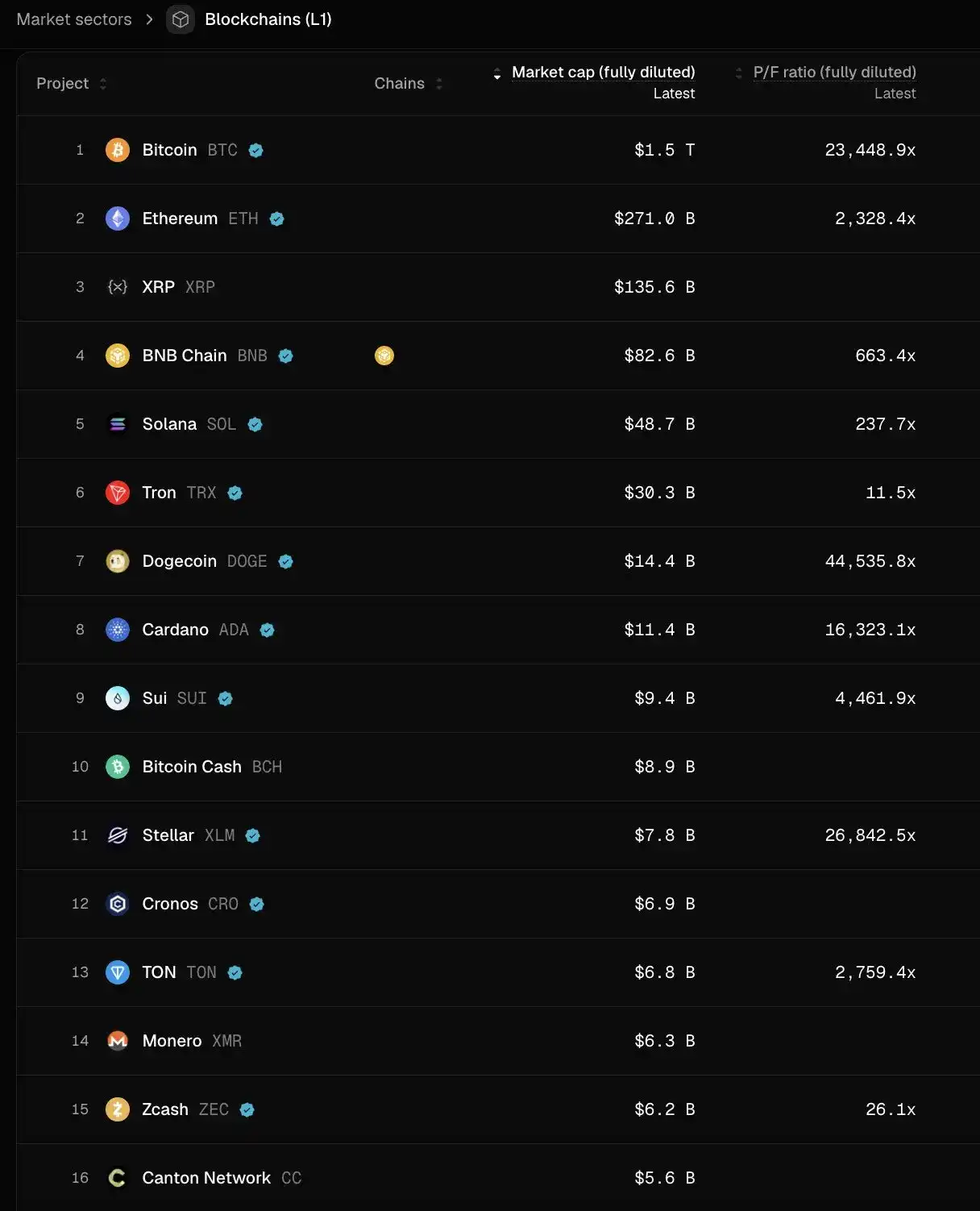
Personally, I don't think it will be like this—HYPE set an extremely exceptional expectation, making many investors impatient for "day one revenue/user traction" from early-stage startups. For sustaining innovations like payments and DeFi companies, yes, this is a reasonable expectation.

But disruptive innovation takes time to build, launch, grow, and then see revenue grow exponentially.

In the past two cycles, we had excessive patience and blind optimism for so-called "disruptive technologies"—new L1s, esoteric concepts like Flashbots/MEV raising up to Series 8-9, and now the pendulum has swung too far the other way, only willing to back DeFi projects.

The pendulum will swing back. While evaluating DeFi projects based on "quantitative" fundamentals is indeed a net positive for the industry maturity, for non-DeFi categories, "qualitative" fundamentals also need to be considered: culture, technological innovation, disruptive concepts, security, decentralization, brand equity, and industry connectivity. And these traits are not simply reflected in TVL and on-chain buybacks.

What to Do Now?

Return expectations for token projects have been significantly compressed, while equity businesses have not seen a comparable decline. This divergence is particularly evident in early-stage versus growth-stage projects.

Early-stage investors have become much more price-sensitive when underwriting projects that might exit via tokens. At the same time, appetite for equity businesses has increased, especially given the favorable M&A environment. This is completely different from the situation in 2022-2024, when token exits were the preferred liquidity path, underpinned by the assumption that the token valuation premium would persist.

Later-stage investors, those with the strongest brand equity and value-add in the crypto-native context, are increasingly moving away from purely "crypto-native" deals. Instead, they are pivoting to support more "Web2.5" companies, whose underwriting is anchored by revenue traction.

This pushes them into unfamiliar territory, competing head-on with firms like Ribbit, Founders Fund—institutions that have deeper backgrounds in traditional fintech, stronger portfolio synergies, and better visibility into early-stage deal flow outside of crypto.

The crypto VC space is entering a period of value validation. The right to survive depends on VCs finding their own PMF (Product-Market Fit) with founders, where the "product" is a combination of capital, brand alignment, and value-add.

For the highest-quality deals, VCs need to sell themselves to founders to win the right to be on the cap table, especially as some of the most successful projects in recent years have needed almost no institutional capital (e.g., Axiom) or none at all (e.g., HYPE). If capital is the only thing a VC provides, it will almost certainly be eliminated.

Those VCs qualified to remain in the game need to be very clear about what they can offer in terms of brand alignment (which is what prompts the best founders to engage in the first place) and value-add (which ultimately determines their right to win the deal).

Questions liées

QWhat are the main forces that have disrupted the crypto market structure according to the article?

AThe crypto market structure is being disrupted by multiple unprecedented forces: 1) The emergence of HYPE, which demonstrated that token prices can be supported by real on-chain revenue, resetting market expectations. 2) A chain reaction that penalizes other token projects without on-chain revenue. 3) The massive supply shock from the memecoin frenzy (e.g., PUMP), which fragments liquidity and attention. 4) The accelerated diversion of retail speculative capital into prediction markets, stock perps, and leveraged ETFs, compressing the token lifecycle.

QHow has the HYPE project changed the market's expectations for tokens?

AHYPE proved that a token's price can be backed by substantial, real on-chain revenue, with over 97% of its nine-to-ten-figure revenue generated on-chain. This has led to a 'de-memeing' of governance tokens that relied on narrative over fundamentals. It reset market expectations, making on-chain revenue a fundamental requirement for entry, and subjecting revenue to much stricter scrutiny.

QWhy does the author argue against the prevalent trend of token buybacks?

AThe author argues that token buybacks are often 'toxic' and put founders with real revenue in a difficult position. The motivation is wrong: stock buybacks occur after a company has invested in growth, whereas crypto buybacks are increasingly demanded by fickle and irrational retail/public perception for immediate action. They are often executed at local price highs due to front-running and can be rendered worthless by a random market maker's liquidation. For a B2B business with sub-$20M in revenue, it's counterproductive to buy back tokens to please retail instead of reinvesting in growth.

QWhat does the article suggest about the future of the 'crypto premium'?

AThe article suggests there is a question of whether the 'crypto premium' will disappear entirely, meaning all projects would be valued based on multiples similar to public stocks (around 2x to 30x revenue). If this happens, it would imply a further drop of over 95% for most L1 blockchains. However, the author personally believes the pendulum will swing back. While quantitative fundamentals are a net positive for DeFi, qualitative fundamentals (culture, tech innovation, disruptive concepts, security, decentralization, brand equity) must also be considered for non-DeFi categories, and these are not reflected in TVL or buybacks alone.

QHow must crypto VCs adapt to survive in the current market environment according to the article?

ATo survive, crypto VCs must find their Product-Market Fit (PMF) with founders, where their 'product' is a combination of capital, brand credibility, and value-add. For the highest-quality deals, VCs must sell themselves to founders to earn a place on the cap table, especially as top projects may no longer need institutional capital (e.g., Axiom, HYPE). If capital is the only thing a VC provides, it will likely be eliminated. Surviving VCs need to be very clear about what brand credibility they offer to attract top founders and what value-add they provide to win deals.

Lectures associées

Apple convoite l'IA embarquée, et un outsider émerge : le premier modèle cognitif voit le jour, 4B paramètres rivalisent avec GPT-5.4

Apple a mis en avant une renaissance de Siri propulsée par l’IA lors de la WWDC, tandis qu’Amazon a dû freiner l’utilisation interne de modèles volumineux en raison de coûts de calcul explosifs. Face à ce défi des “tokens”, Andrej Karpathy a suggéré de créer un “noyau cognitif” — un modèle déchargé des connaissances factuelles mais conservant des capacités de raisonnement. La société chinoise Nextie a concrétisé cette vision avec **Alpha**, un **modèle cognitif de 4B paramètres** qui, dans des tâches d’intelligence collective (débat, réflexion, vote), atteint des performances équivalentes à celles de modèles de milliers de milliards de paramètres comme GPT-5.4. Conçu pour être déployé en périphérie (sur MacBook ou robots embarqués), Alpha réduit radicalement les coûts de calcul et ouvre la voie à des agents **proactifs** capables d’agir de manière autonome, au lieu de simples réponses aux requêtes. L’équipe, issue de Microsoft XiaoIce, s’était déjà distinguée avec un petit modèle performant. Nextie se positionne sur le créneau des systèmes multi-agents, un domaine validé par des investissements récents comme celui d’OpenAI dans Isara. En résumé, ce modèle cognitif ne change pas seulement l’échelle des paramètres, mais aussi **l’équation économique** de l’IA, rendant viable une intelligence continue et proactive à faible coût.

marsbitIl y a 38 mins

Apple convoite l'IA embarquée, et un outsider émerge : le premier modèle cognitif voit le jour, 4B paramètres rivalisent avec GPT-5.4

marsbitIl y a 38 mins

Hoskinson affirme que Cardano peut surpasser Bitcoin en résolvant le problème de confiance des cryptos

Charles Hoskinson, fondateur de Cardano, affirme que la plateforme vise bien plus qu'une simple part du marché des cryptomonnaies : elle ambitionne de devenir l'infrastructure mondiale de la confiance. Lors d'un livestream, il a présenté l'objectif à long terme d'ADA comme étant la réduction de la dépendance aux tiers de confiance dans le commerce mondial, un secteur qui génère des coûts annuels de centaines de milliards de dollars. La solution proposée est la "réflexivité vérifiable", où chaque transaction ou élément porte sa propre preuve de validité, éliminant le besoin d'un intermédiaire. Hoskinson explique que les blockchains servent de couche de stockage pour ces transactions, tandis que les contrats intelligents et les preuves à connaissance nulle en permettent l'utilité. Il met en avant les atouts de Cardano pour y parvenir : le protocole Ouroboros pour une décentralisation accrue, le modèle UTXO étendu pour la détermination locale, Hydra pour la mise à l'échelle, et une approche modulaire via des chaînes partenaires comme Midnight. Le défi majeur reste la gouvernance, nécessaire pour créer un système autonome capable de survivre, même en cas de perte de confiance en son fondateur. Si Cardano réussit à construire ce système de confiance vérifiable, Hoskinson estime que sa cryptomonnaie pourrait devenir "la monnaie de la confiance mondiale" et dépasser un jour Bitcoin. Au moment de la publication, ADA s'échangeait à 0,16 dollar.

bitcoinistIl y a 40 mins

Hoskinson affirme que Cardano peut surpasser Bitcoin en résolvant le problème de confiance des cryptos

bitcoinistIl y a 40 mins

Arthur Hayes dans un nouvel article : La bulle de l'IA approche de son éclatement, le marché crypto sous pression à court terme

Arthur Hayes, cofondateur de BitMEX, analyse dans cet article les tensions géopolitiques actuelles et leurs implications sur les marchés financiers. Il estime que la hausse des prix du pétrole, liée au conflit entre les États-Unis et l'Iran autour du détroit d'Hormuz, exercera une pression inflationniste et influencera la campagne présidentielle américaine de novembre. Pour reconquérir les électeurs préoccupés par le coût de la vie, Hayes prédit que Donald Trump pourrait adopter un discours critique envers l'industrie de l'intelligence artificielle, promettant régulation et taxation. Une telle rhétorique, même tactique, pourrait provoquer un éclatement de la bulle des actions AI, d'autant plus que le secteur est déjà vulnérable à la hausse des coûts énergétiques et à l'introduction en bourse massive prévue de SpaceX, Anthropic et OpenAI. Hayes explique que la liquidité monétaire récente a été entièrement absorbée par le boom de l'IA, laissant peu de capitaux pour le bitcoin. Une correction sévère des actions AI entraînerait donc probablement une pression vendeuse sur l'ensemble des actifs risqués, y compris les cryptomonnaies. En conséquence, son fonds, Maelstrom, a vendu ses actions AI, réduit ses positions cryptos secondaires et se concentre désormais sur le pétrole et le gaz, ainsi que sur le bitcoin et l'ether en vue d'une reprise future après un éventuel krach et une nouvelle réponse monétaire accommodante des banques centrales.

marsbitIl y a 1 h

Arthur Hayes dans un nouvel article : La bulle de l'IA approche de son éclatement, le marché crypto sous pression à court terme

marsbitIl y a 1 h

Le « plan pour l'avenir » d'OpenAI : rendre l'IA bénéfique pour chaque personne dans le monde

Toutes les quelques générations, une nouvelle technologie transforme radicalement la société, à l’image de l’électricité au XXe siècle. L'électricité, initialement conçue pour simplifier la vie, a finalement ouvert de vastes possibilités, prolongé l’espérance de vie et accru la prospérité. L'IA est aujourd’hui à l’aube d’un impact similaire. Le potentiel de l’IA ne réside pas dans la technologie elle-même, mais dans ce que les gens peuvent en faire : comprendre une facture médicale, apprendre, créer une entreprise, accompagner des proches, concrétiser des idées ou faire avancer la science. OpenAI est convaincu que l’IA doit être accessible à tous, partout et selon les besoins de chacun, pour servir l’humanité et amplifier ses capacités, sans la remplacer. L’automatisation totale n’est pas un avenir souhaitable. Cette vision repose sur trois objectifs clés : construire un chercheur en IA automatisé pour accélérer la recherche (avec pour perspective qu’une part significative des travaux d’OpenAI soit menée en collaboration avec l’IA d’ici 2028) ; accélérer le progrès économique tout en veillant à une large répartition des bénéfices ; et offrir à chacun sur Terre un AGI personnel pour bénéficier de cette technologie transformatrice. Pour y parvenir, OpenAI souligne que des avancées rapides rendent le jugement humain et la coopération mondiale plus essentiels que jamais. La sécurité, l’alignement sur les valeurs humaines et une coordination internationale sont fondamentales pour gérer les risques. L’avenir doit être façonné collectivement, et non par une poignée d’entreprises. Enfin, une distribution large du pouvoir est vue comme la clé d’un futur meilleur et plus résilient. Un avenir où l’IA profite réellement à l’humanité doit être construit et partagé par de nombreuses personnes, entreprises, communautés et nations. Si elle est réalisée correctement, l’IA peut devenir une pierre angulaire pour la productivité, la créativité et la prospérité de tous.

marsbitIl y a 1 h

Le « plan pour l'avenir » d'OpenAI : rendre l'IA bénéfique pour chaque personne dans le monde

marsbitIl y a 1 h

Trading

Spot
Futures
活动图片