Google's Deep Think Dominates Eight-Language Olympiads, Autonomously Solves Four Unsolved Problems, Research Barriers Collapse

marsbitPublié le 2026-04-08Dernière mise à jour le 2026-04-08

Résumé

Google DeepMind's "Deep Think" AI system has demonstrated exceptional performance across eight languages in regional academic competitions, including mathematics and informatics Olympiads. It achieved perfect scores in Japanese and French contests, and high results in Chinese, Korean, Hindi, Vietnamese, Russian, and Portuguese exams. This multi-language capability aims to reduce linguistic barriers in scientific research, enabling non-English-speaking researchers to access advanced AI tools equally. Beyond competitions, Deep Think has solved four previously unsolved mathematical problems and contributed to breakthroughs in computer science, physics, and economics. It powers the Aletheia agent, which autonomously generates and verifies research-level mathematical solutions. Despite these achievements, the results are based on internal evaluations without third-party verification or detailed methodology disclosure. Google positions Deep Think as a "human intelligence multiplier," expanding AI's role in global scientific collaboration beyond English-dominated benchmarks.

"Deep Think has defeated/matched competitors in all competitions"!

Just now, Google DeepMind senior researcher Conglong Li posted 12 messages on the X platform, revealing an unprecedented scorecard.
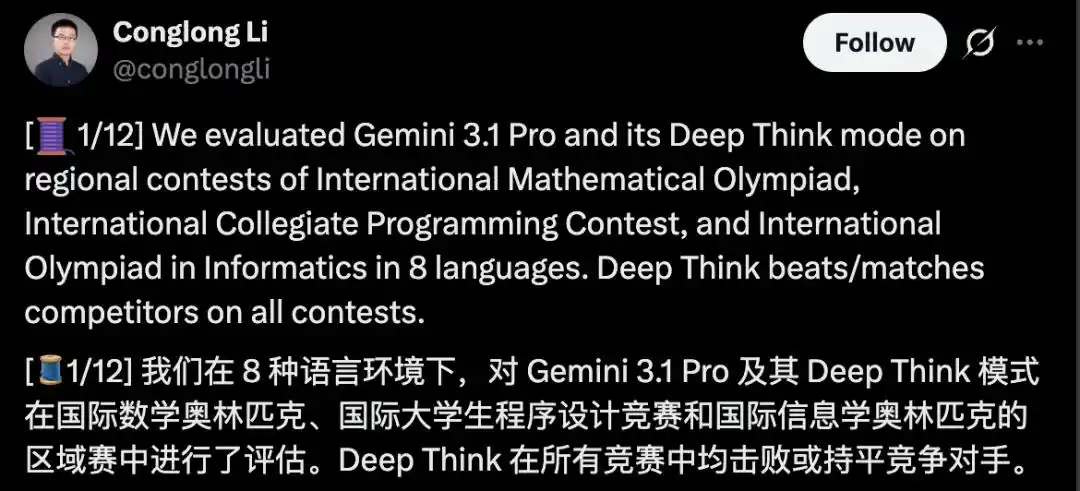
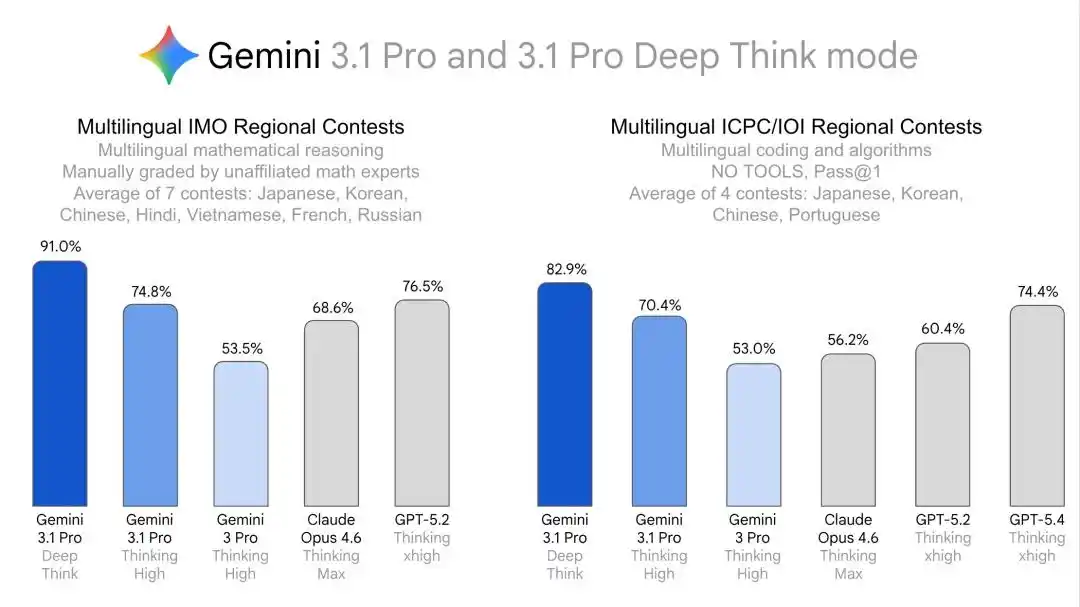
One AI, the same brain, eight exam papers in different languages, all submitted with high scores.

Such results are rare for any model.

From IMO Gold Medals to Full Coverage of Regional Competitions

Deep Think's high scores across multiple leaderboards are not a sudden breakthrough but part of a nearly year-long evolution of capabilities.

First, it topped the most rigorous reasoning competitions.

In July 2025, Gemini Deep Think achieved the gold medal standard at the International Mathematical Olympiad (IMO) for the first time, scoring 35 out of 42 points. It also achieved similarly high-level performance at the ICPC World Finals around the same time.

These two achievements have been officially announced in the DeepMind blog.

Google DeepMind subsequently included these two results in its official blog, marking Deep Think's crossing of the "world-class competition threshold" in mathematics and programming.

Next, Deep Think began moving from "world-champion-level individual breakthroughs" to "systematic validation across languages, disciplines, and scenarios."

In February 2026, Google published three blog posts.

One introduced the Gemini 3.1 Pro model itself, one detailed a major upgrade to the Deep Think specialized reasoning mode, and one from the DeepMind scientific discovery team directly positioned Deep Think as a "human intelligence multiplier."

The upgraded Deep Think delivered a series of hard metrics:

48.4% on Humanity's Last Exam (without tool assistance), 84.6% on ARC-AGI-2 (officially verified by the ARC Prize Foundation), a Codeforces competitive programming Elo rating of 3455, and gold medal-level performance on the written portions of the 2025 International Physics and Chemistry Olympiads.
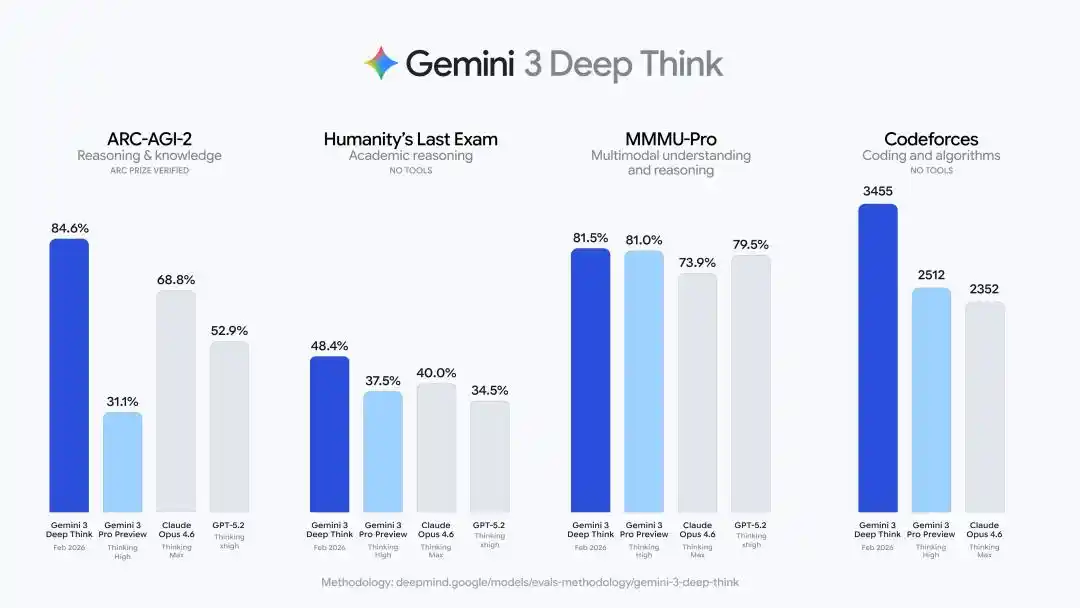
The strategy is very clear: first use world-class competitions like the IMO and ICPC to prove its powerful reasoning abilities, then use multi-language, regional competition, and cross-disciplinary Olympiad results to prove its general, deep reasoning ability that stably transfers across languages and domains.
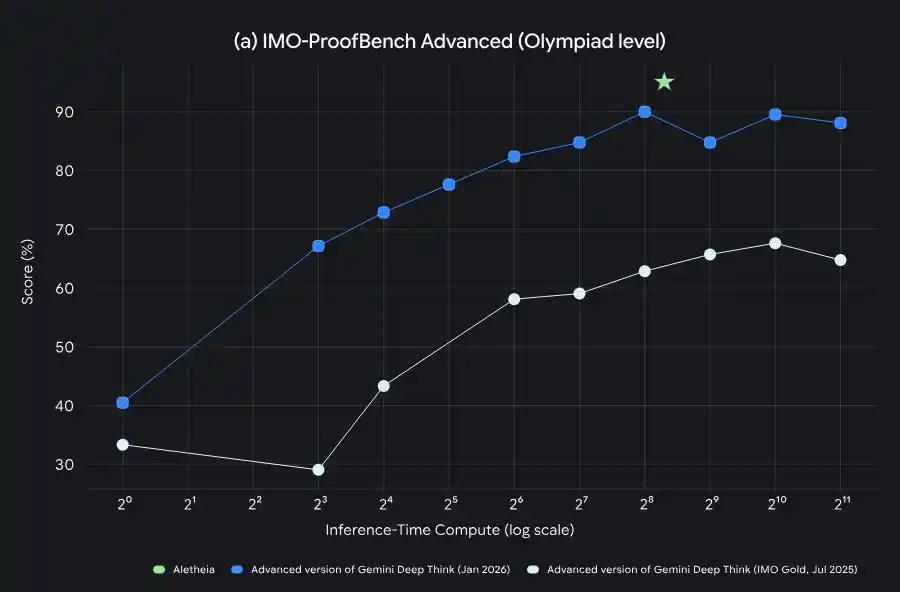
Gemini Deep Think's capability evolution from IMO gold medals to PhD-level research acceleration

A Detailed Look at the 8-Language Scorecard

Now, let's take a closer look at this scorecard.

Japanese results are the most impressive.

2025 35th Japanese Mathematical Olympiad Finals (JMO Finals), perfect score.

ICPC Asia Japan Preliminary Contest, perfect score.
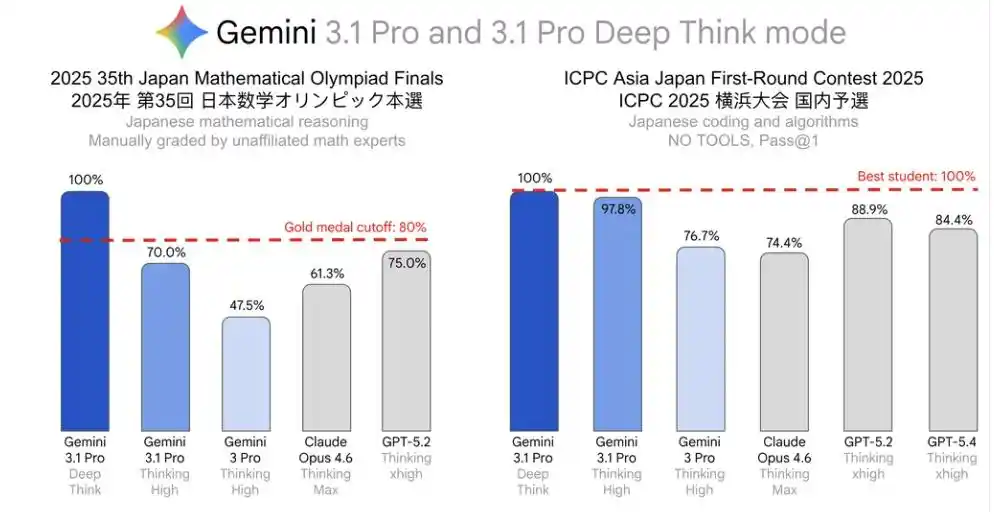
Among these, the JMO Finals score even exceeded the level corresponding to the top 80% of scores that year, meeting the official "gold medal equivalent" standard.

French results were also a perfect 100%.

The Chinese results are interesting.

At the 41st Chinese Mathematical Olympiad (CMO), Deep Think scored 86.3%, which is quite outstanding. But at the Chinese National Olympiad in Informatics (NOI), it only scored 63.3%.

The gap between 86.3% and 63.3% outlines the real boundaries of AI reasoning ability.

In math competitions, the model faces abstract deduction, proof construction, and multi-step reasoning, which happens to be Deep Think's strongest suit.

But in informatics competitions, the problem is not just "figuring it out," but also translating logic into executable code, controlling boundary conditions, considering complexity constraints, and avoiding implementation errors.

The former is closer to pure reasoning, while the latter requires "reasoning + algorithm design + engineering implementation" to be successful simultaneously.

In the other languages—Korean, Hindi, Vietnamese, Russian, Portuguese—Deep Think also achieved results that either defeated competitors or at least matched them.

Looking at Japanese, French, and Chinese together, the most unusual aspect this time is not necessarily scoring a perfect mark in any single subject, but rather that the same model, the same Deep Think reasoning system, delivered first-tier results on exam papers in multiple languages.

Is This Scorecard Reliable?

But there is a key omission:

Conglong Li did not list specific comparative data from competitors: all results come from Google evaluations. There is no independent third-party replication, no official certification from the competitions, and the evaluation methodology is completely undisclosed.

Was each problem attempted once or many times with the best score taken? How much computational power was used during reasoning? Was there any manual prompt engineering involved?

These details, which directly affect the credibility of the results, were also not mentioned.

Another easily overlooked point: these exams are all regional selection competitions, not international finals.

There is an order of magnitude difference in difficulty between regional competition problems and international finals.

The researcher explicitly stated that these results "will be included in the model card." As of publication, the model card has not been officially updated.

So, for now, this still seems like a scorecard graded by the examinee themselves, announced by themselves, and not yet stamped by the academic affairs office.

Multilingual Research Equity: The Overlooked Real Battlefield

Why did Google specifically invest effort in evaluating 8 different regional languages?

Current evaluations of AI reasoning ability are almost entirely based on English.

MATH, GSM8K, HumanEval, ARC-AGI... these are all in English.

Mathematicians, physicists, and engineers worldwide whose native language is not English must first overcome a language barrier when using AI research tools.

Google's selection of these 8 languages is not random.

Japanese, Korean, and Chinese cover East Asian research powerhouses; Hindi and Vietnamese cover emerging markets; French, Russian, and Portuguese cover Europe and South America.

Together, this represents the majority of global research output.

In its official blog, DeepMind positioned Deep Think as a "human intelligence multiplier," saying it can "handle knowledge retrieval and rigorous verification, allowing scientists to focus on conceptual depth and creative direction."

Combined with these multi-language results, the subtext of this statement is not hard to understand: this multiplier is not just for scientists who use English.

More notably is how far Deep Think has already gone in research落地 (landing/application).

DeepMind announced a mathematical research agent called Aletheia, powered by Deep Think, capable of autonomously generating, verifying, and revising solutions to research-level mathematical problems.
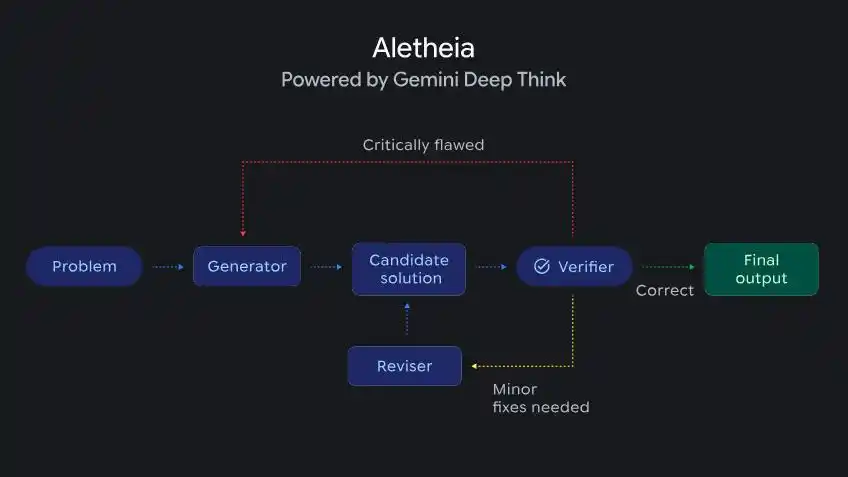
Aletheia, driven by Deep Think, capable of iterative generation, verification, and correction for research-level mathematical problems

Aletheia has already contributed to multiple research papers, one of which was completed entirely autonomously by the AI, calculating specific structural constants in arithmetic geometry.
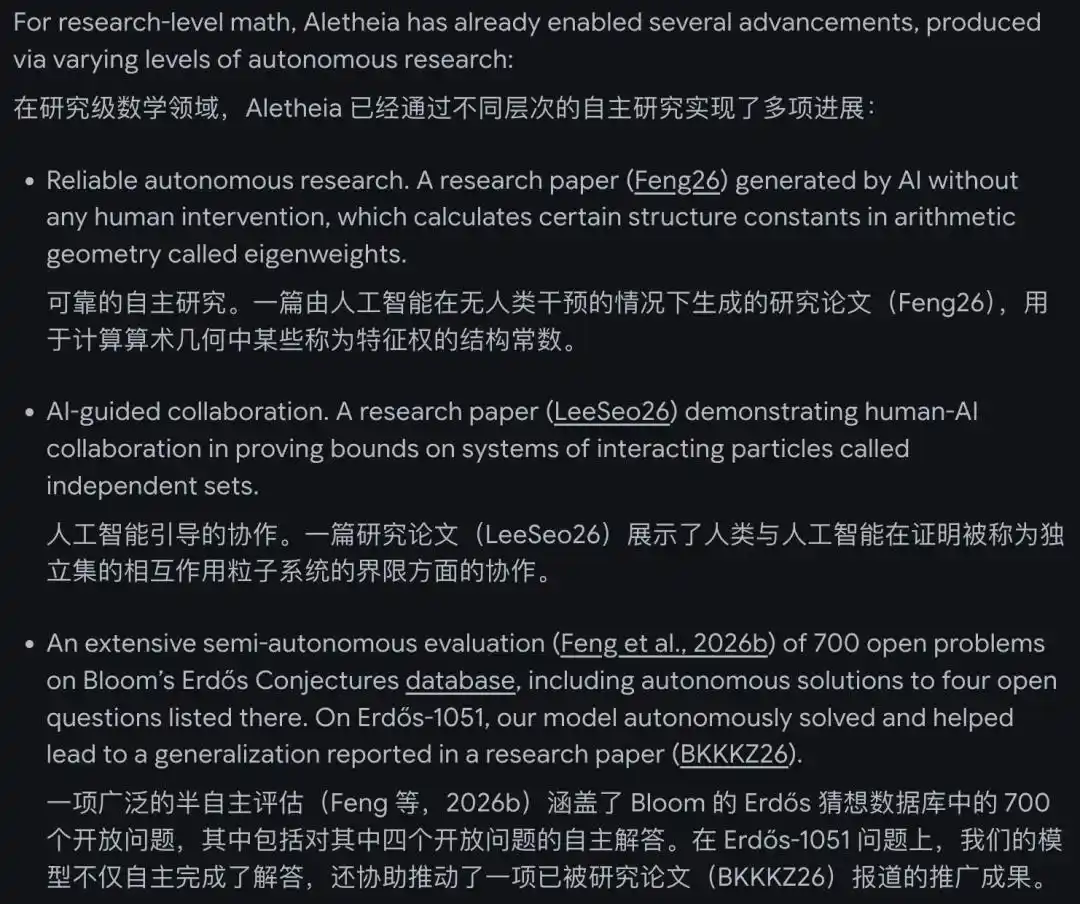
Furthermore, in a semi-autonomous evaluation of 700 open mathematical problems, it independently solved 4 previously unsolved problems.

The Gemini Deep Think mode also shows great potential in computer science, physics, economics, and other fields.

In computer science, Deep Think helped refute a conjecture that had remained open for a decade; in physics, it found a new analytical solution for gravitational radiation from cosmic strings; in economics, it extended an auction theory theorem.
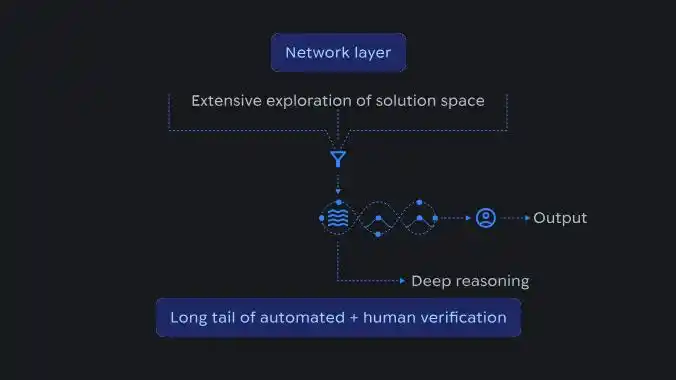
Schematic diagram of the AI reasoning process, showing how large-scale exploration of the solution space at the network layer is aggregated into structured reasoning and confirmed through automated and manual verification.

By collaborating with experts to solve 18 research challenges, the advanced version of Gemini Deep Think helped break through long-standing bottlenecks in algorithms, machine learning and combinatorial optimization, information theory, and economics.

This goes far beyond "solving competition problems."

While competitors are still competing on English benchmark leaderboards, Google has already found a new battlefield in the "AI research accelerator" field.

The most important thing about this is not the scores; the real signal behind it is: the language barrier for AI research tools is being treated as an engineering problem to be solved.

If this path succeeds, scientists conducting research in Japanese, Korean, Chinese, Hindi, and other languages will, for the first time, stand on the same starting line as native English speakers.

This time, Google has laid its cards on the table.

As for which competitors will follow suit, we believe we will see soon.

References:

https://blog.google/intl/ja-jp/company-news/technology/gemini-31-pro-gemini-31-pro-deep-think/%20

https://deepmind.google/blog/accelerating-mathematical-and-scientific-discovery-with-gemini-deep-think/%20

https://blog.google/innovation-and-ai/models-and-research/gemini-models/gemini-3-1-pro/%20

https://blog.google/innovation-and-ai/models-and-research/gemini-models/gemini-3-deep-think/

This article is from the WeChat public account "新智元" (New Zhiyuan), author: 新智元

Questions liées

QWhat is the key achievement of Google's Deep Think AI model as reported in the article?

ADeep Think achieved top-tier results in eight different language versions of academic competitions, including perfect scores in Japanese and French math and programming contests, and high performance in Chinese, Korean, Hindi, Vietnamese, Russian, and Portuguese exams.

QWhich specific world-class competitions did Deep Think first demonstrate its reasoning capabilities in?

ADeep Think first demonstrated its reasoning capabilities by reaching gold medal standards in the International Mathematical Olympiad (IMO) with a score of 35 out of 42 in July 2025, and achieving similarly high performance in the ICPC World Finals.

QWhat is the significance of Deep Think's performance across multiple languages according to the article?

AIts performance across multiple languages signifies a breakthrough in breaking down language barriers in AI research tools, potentially allowing non-English speaking scientists worldwide to access advanced AI research assistance on equal footing.

QWhat are some research breakthroughs mentioned that were achieved using Deep Think?

ADeep Think autonomously solved 4 previously unsolved mathematical problems, refuted a decade-old conjecture in computer science, found new analytical solutions for cosmic string gravitational radiation in physics, and extended an auction theory theorem in economics.

QWhat concerns does the article raise about the reliability of Deep Think's reported results?

AThe article notes that all results are from internal Google evaluations without third-party verification, official contest authentication, or disclosure of testing methods such as attempt counts, computational resources used, or potential human prompt engineering involvement.

Lectures associées

Chute de 30 % en une journée, Hayes vend soudainement, pourquoi des problèmes de sécurité ont-ils éclaté autour du ZEC ?

Le Zcash (ZEC) a connu une chute de prix de plus de 30% le 5 juin, suite à la divulgation publique d'une vulnérabilité critique dans Orchard, sa dernière couche de confidentialité. Le fondateur Zooko Wilcox a révélé qu'un défaut de contrainte mathématique dans le circuit pourrait permettre à un attaquant de créer une quantité illimitée de ZEC contrefaits au sein du bassin privé Orchard, sans pouvoir être détecté sur la chaîne. Bien qu'une mise à jour corrective d'urgence ait été déployée, Zooko a reconnu qu'il était impossible de prouver cryptographiquement si l'exploit avait déjà été utilisé avant le correctif. Cette annonce a rompu la narrative initiale de la fondation minimisant les risques et a déclenché une vente de panique. L'influenceur Arthur Hayes a notamment annoncé avoir vendu l'intégralité de ses ZEC. La vulnérabilité a été découverte par le chercheur en sécurité Taylor Hornby, qui a utilisé le modèle d'IA Anthropic Opus 4.8 pour auditer spécifiquement le circuit. Cette découverte, survenue après des années d'audits traditionnels, souligne que l'ère de l'IA réduit considérablement la fenêtre entre la découverte et l'exploitation malveillante des failles. Elle remet en question la fiabilité perçue des technologies de confidentialité et souligne la nécessité pour l'industrie d'adopter des pratiques de sécurité proactives et continues intégrant l'IA.

foresightnews_apiIl y a 18 mins

Chute de 30 % en une journée, Hayes vend soudainement, pourquoi des problèmes de sécurité ont-ils éclaté autour du ZEC ?

foresightnews_apiIl y a 18 mins

Le déclin du Bitcoin marque la métamorphose du Crypto

L'article soutient que le déclin du Bitcoin face à la barre des 70 000 dollars n'est pas un signe d'affaiblissement pour l'industrie crypto, mais plutôt une étape cruciale de sa maturation et de son émancipation. Deux changements structurels majeurs sont identifiés : d'une part, l'IA capte désormais les capitaux spéculatifs qui alimentaient auparavant le Bitcoin, tout en contribuant à un environnement macroéconomique de taux d'intérêt élevés. D'autre part, les stablecoins adossés au dollar (comme USDC) ont remplacé le Bitcoin en tant que monnaie de réserve et moyen d'échange fondamental au sein de l'écosystème. Détachée de la performance du Bitcoin, l'économie crypto se développerait vigoureusement autour de projets générant des flux de trésorerie réels, évalués sur leurs fondamentaux comme des entreprises traditionnelles. L'article cite en exemple les plateformes Hyperliquid (échange décentralisé) et Polymarket (marché de prédiction). Parallèlement, la confidentialité devient une ressource précieuse, avec la croissance de monnaies comme Zcash et l'émergence de solutions de confidentialité inter-chaînes, telle que celle portée par NEAR, qui permettrait des transferts privés sans quitter sa blockchain d'origine. En conclusion, l'ère où toutes les crypto-monnaies suivaient le cours du Bitcoin est révolue. Le nouvel écosystème s'organiserait autour des stablecoins comme monnaie de base, de jetons de projet comparables à des actions, et d'une nouvelle couche d'infrastructure inter-chaînes assurant confidentialité et interopérabilité, reléguant le Bitcoin au rang de simple actif parmi d'autres.

foresightnews_apiIl y a 22 mins

Le déclin du Bitcoin marque la métamorphose du Crypto

foresightnews_apiIl y a 22 mins

Après avoir attiré l'attention d'IBM, three a multiplié sa valeur par 50

Un message de collaboration avec IBM a propulsé le projet Solana three.ws sur le devant de la scène, faisant bondir son jeton THREE de plus de 50 fois, passant d'une capitalisation d'environ 300 000 $ à plus de 16 millions. Three.ws se présente comme la "couche d'agents 3D pour l'internet", visant à libérer les agents IA des boîtes de discussion en leur donnant un corps, une mémoire, une identité et un portefeuille numérique. Le projet permet aux développeurs de créer des personnages 3D interactifs, de les équiper de modèles de langage et de compétences, et de les intégrer facilement dans des sites web via un composant, un peu comme une vidéo YouTube. L'architecture technique repose sur quatre couches : la couche de visualisation (affichage 3D), la couche Agent (cerveau, mémoire, compétences), une couche d'identité optionnelle (passerelle numérique sur blockchain) et une couche d'intégration pour le déploiement. Les partenariats stratégiques avec AWS Marketplace et IBM sont clés pour son adoption en entreprise. AWS facilite l'achat et la facturation via les comptes existants des clients, tandis qu'IBM fournira ses technologies d'IA d'entreprise (comme les modèles Granite) et ses canaux commerciaux. L'objectif est de transformer ces agents 3D démonstratifs en services gérables et déployables pour les entreprises, au-delà du simple coup médiatique généré par l'annonce IBM.

foresightnews_apiIl y a 24 mins

Après avoir attiré l'attention d'IBM, three a multiplié sa valeur par 50

foresightnews_apiIl y a 24 mins

PDG de Lightspark : dans dix ans, le Bitcoin sera invisible comme TCP/IP, tout en supportant des milliers de milliards de transactions quotidiennes

Lightspark CEO David Marcus imagine le monde de 2036, où le Bitcoin, bien qu'invisible pour la plupart des utilisateurs, servira de fondement à des transactions quotidiennes de plusieurs billions de dollars. Similaire au protocole TCP/IP pour internet, le réseau Bitcoin deviendra une couche de règlement universelle et ouverte, permettant des paiements instantanés à travers le globe, des règlements commerciaux internationaux ou le versement de salaires, sans que les parties n'aient à y penser. Cette transition a commencé avec l'évolution des portefeuilles numériques, qui permettent désormais de détenir sans friction des stablecoins (liés à des monnaies comme le dollar) et du Bitcoin à la même adresse. La facilité d'utilisation a transformé la logique mondiale de la garde d'actifs, faisant du Bitcoin la couche d'épargne par défaut pour des milliards de personnes, attirées par sa performance à long terme et son approvisionnement fixe. Les entreprises ont suivi, intégrant progressivement le Bitcoin à leur trésorerie. Une nouvelle tendance émerge aujourd'hui : l'utilisation directe du Bitcoin pour les transactions, simplifiée lorsque les deux parties le détiennent déjà, éliminant ainsi les frais et délais de conversion. Enfin, les agents d'intelligence artificielle (IA), qui exécuteront une grande partie du commerce en 2036, accéléreront cette adoption. En optimisant la vitesse, le coût et la sécurité des règlements transfrontaliers, ils choisiront naturellement le Bitcoin comme actif de règlement privilégié pour leurs millions de transactions automatisées. Le système monétaire mondial se reconstruit ainsi à partir de sa couche protocolaire : une infrastructure ouverte, une garde autogérée par défaut, le Bitcoin comme couche de règlement fondamentale et les stablecoins comme interface. Pour l'utilisateur final, tout cela restera parfaitement simple et invisible.

foresightnews_apiIl y a 27 mins

PDG de Lightspark : dans dix ans, le Bitcoin sera invisible comme TCP/IP, tout en supportant des milliers de milliards de transactions quotidiennes

foresightnews_apiIl y a 27 mins

Trading

Spot
Futures
活动图片