Gold Returns to $4800, Where Is This Year's Peak?

Odaily星球日报Publié le 2026-04-09Dernière mise à jour le 2026-04-09

Résumé

Gold has rebounded above $4,800 per ounce amid easing U.S.-Iran tensions after six weeks of conflict. This article explores gold's potential peak in 2026, citing predictions from platforms like Polymarket, where some traders bet on prices exceeding $6,000 by year-end. Key drivers include sustained central bank purchases (notably China’s 17-month buying streak), institutional demand from entities like Tether (now a top-30 global gold holder), and retail investment, particularly in Asia. While short-term volatility persists, analysts from UBS and Goldman Sachs project gold could reach $5,200-$5,400 by mid-year and $5,900-$6,300 longer-term, supported by geopolitical uncertainty, dollar weakening, and gold’s role as a hedge in a shifting global monetary system. The outlook remains bullish despite periodic corrections.

Original | Odaily Planet Daily (@OdailyChina)

Author | Wenser (@wenser 2010)
After enduring nearly six weeks of sudden shocks from the U.S.-Iran conflict, gold has returned above $4800 for the first time in nearly a month, following news related to a U.S.-Iran ceasefire agreement.

From the gold token XAUm mentioned as early as October 2024, to the accurate prediction of gold spot prices rising above $3900 when it was at $3500 in September last year, and later to the gold token XAUT mentioned when gold rose to around $4500 in January this year, I myself began a journey of fixed investment while following gold.

On the other hand, at the macro level, against the backdrop of intensifying geopolitical conflicts, central banks around the world continue to increase their gold holdings, with the Chinese central bank making large purchases for 17 consecutive months; major investment institutions and banks are also very confident about the gold price rally.

In view of this, this article from Odaily Planet Daily will explore a question from the perspectives of recent industry dynamics and changes in the political and economic situation: What is the upper limit for gold this year?
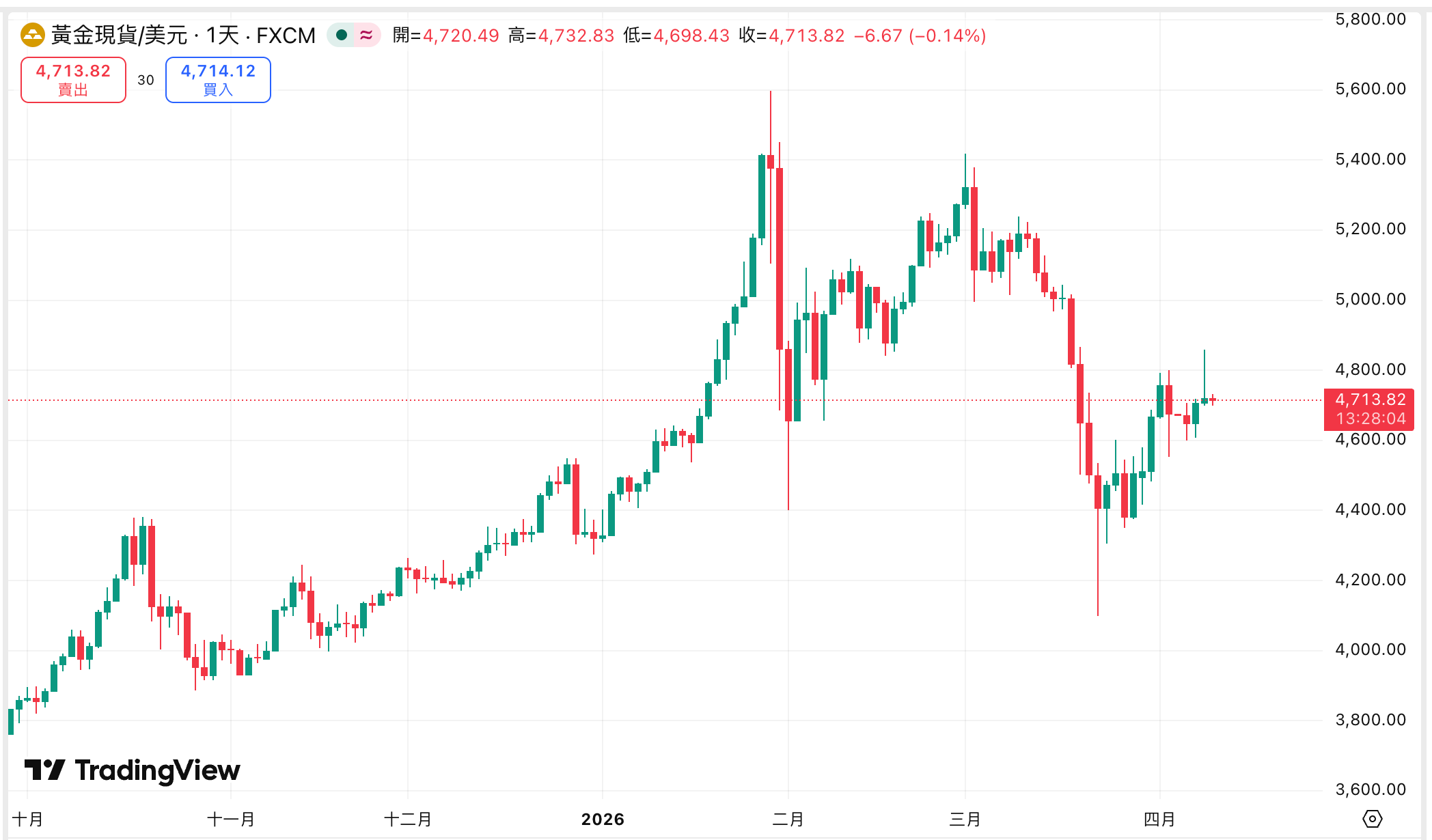
Gold price trend in the past six months

Views on gold price fluctuations in the prediction market: Price may be below $4200 before June, annual peak may exceed $6000

Since the emergence of prediction markets, thanks to factors such as real-money betting and "collective intelligence," they have become an important barometer for predicting asset prices. Currently, the annual price range for gold on Polymarket is around $3800-$6000.

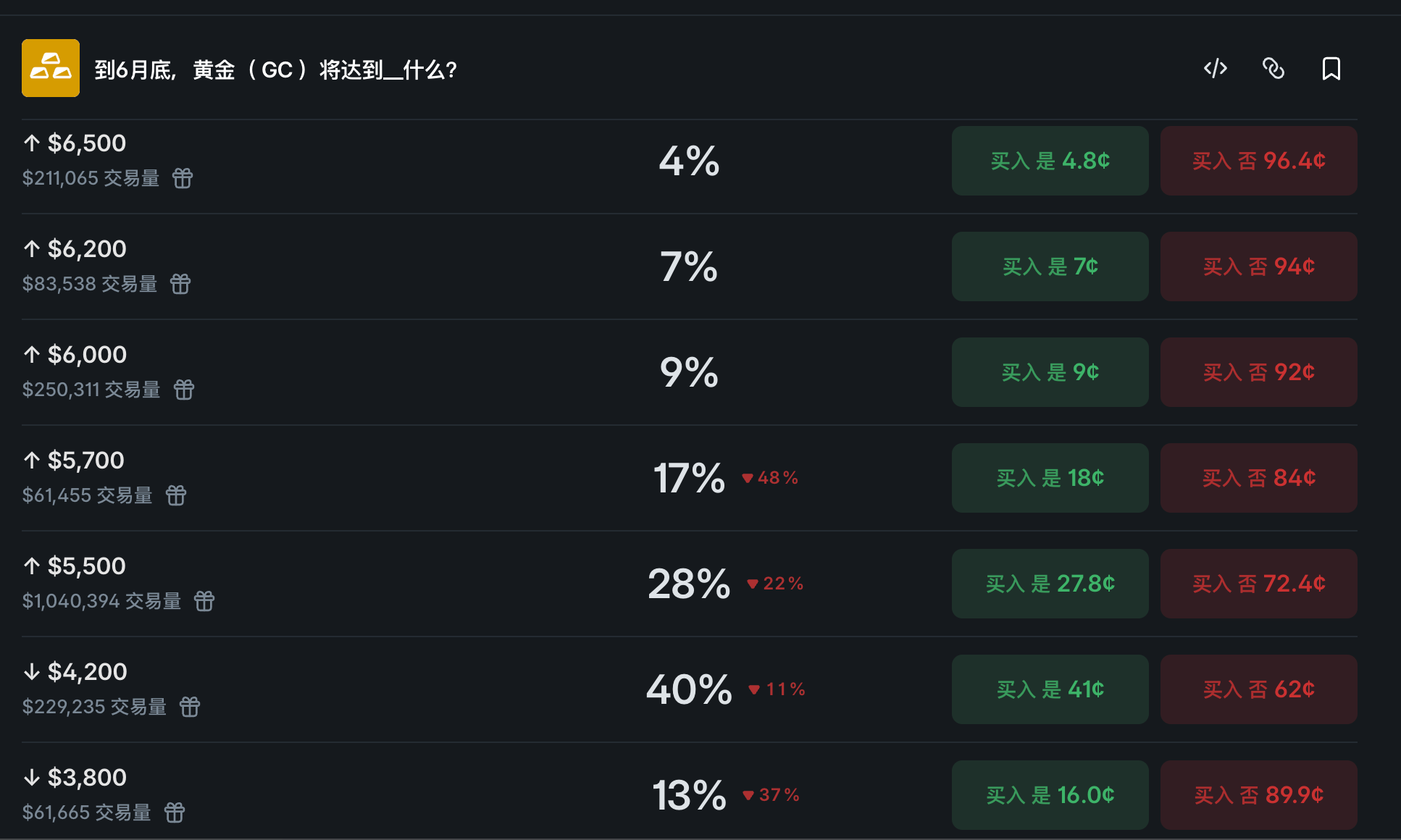
On Polymarket, the betting volume for the mid-year gold price prediction currently exceeds $3.5 million, of which:

The probability of being below $4200 is the highest, at 40%;

The probability of being above $5500 is next, at 28%;

Followed by above $5700 (probability temporarily reported at 17%) and below $3800 (probability temporarily reported at 13%).
The betting volume for the annual gold price prediction on Polymarket is currently only nearly $200,000, of which:

The probability of being above $6000 is the highest, at 46%;

The probability of being above $7000 is next, at 25%;

The probability of being above $8000 is next, at 16%.
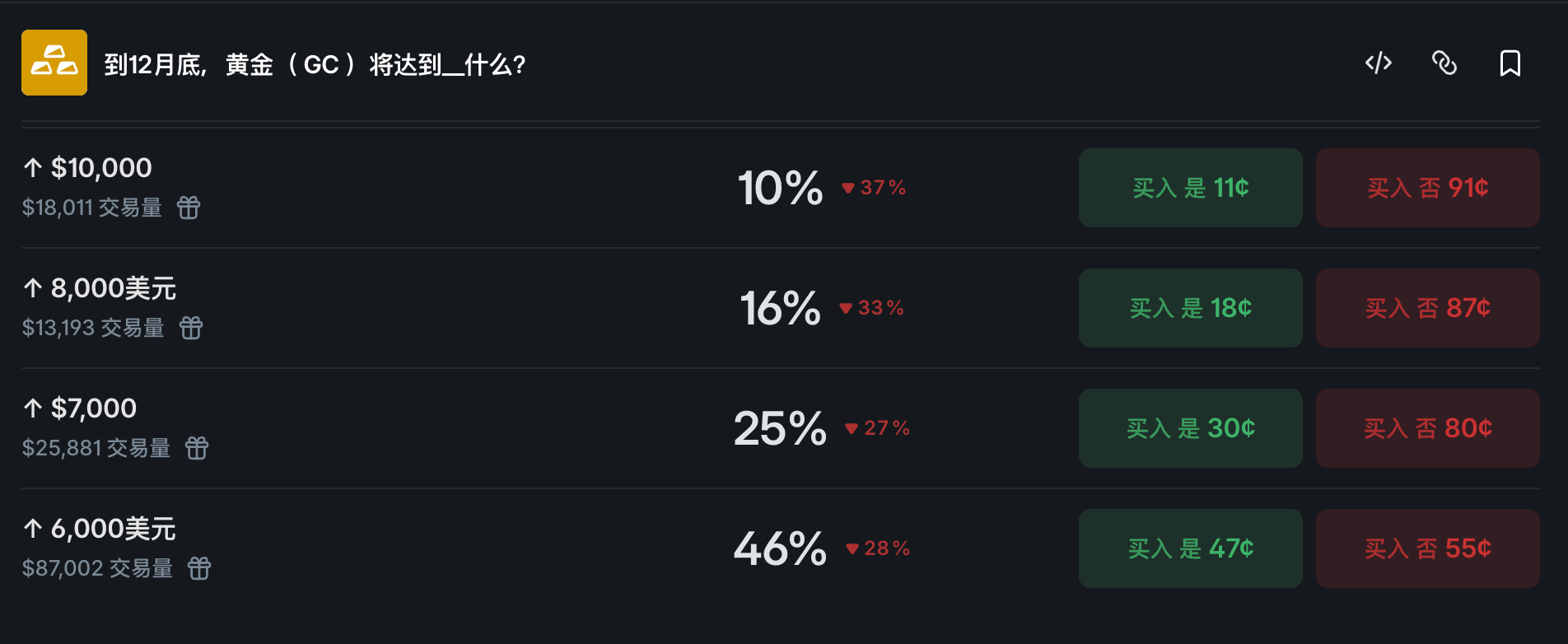
In other words, although the trading volume is relatively small, prediction market users still place the annual price above $6000, a difference of nearly 20%.

It is worth noting that the rules for gold price-related events on Polymarket use the official settlement price of the CME gold (GC) futures contract active month. Intraday trading, highest price, lowest price, bid, ask, or indicative prices are not counted.

Macro buying: Central banks continue to increase holdings, Turkish central bank exchanges gold for money

As the world's largest asset class by market value, the largest buyer of gold is naturally the central banks that control the fiat currency minting rights.

In early April, the World Gold Council released its February central bank gold buying monthly report. It pointed out that central banks net bought 19 tons of gold in February 2026, although still below the monthly average of 26 tons reported in 2025, it rebounded compared to the net purchase of 5 tons in January 2026. In addition, the report showed that some central banks maintained a continuous net buying record, with a cumulative gold purchase of 44 tons from November 2024 to February 2026, and the Czech Republic reported its 36th consecutive month of net buying. China increased its gold holdings for the 16th consecutive month (February data).

Goldman Sachs' research report at the end of March pointed out that supported by continued gold purchases by central banks and the expectation that the Federal Reserve will cut interest rates twice this year, the medium-term prospects for gold remain solid, and the gold price is expected to climb to $5400/ounce by the end of the year. UBS, at the end of March, expected the target price of gold to be $5900/ounce by early 2027.

On the 7th of this month, the Chinese central bank announced that China's gold reserves at the end of March were 74.38 million ounces (approximately 2313.48 tons), an increase of 160,000 ounces (approximately 4.98 tons) from the previous month. The figure at the end of February was 74.22 million ounces (approximately 2308.5 tons), marking the 17th consecutive month of increasing gold holdings.

On the other hand, traditional gold reserve powers have remained almost unchanged—such as the United States (approximately 8100 tons), Germany (approximately 3300 tons), Italy (approximately 2400 tons), and France (approximately 2400 tons).

As for the pressure on the fiat currency system in the Middle East due to the U.S.-Iran conflict, "the Turkish central bank sold over 120 tons of gold in the past 3 weeks, worth $20 billion." Many people only know one side of the story. In fact, most of this gold did not flow into the market but belonged to gold-currency swap futures. Simply put, the Turkish central bank only mortgaged its gold reserves to obtain U.S. dollar foreign exchange to stabilize the exchange rate of its domestic currency, the lira.

Structurally, the proportion of gold reserves to total reserves in emerging market central banks is still at a low level of just over 10%, and China is even in the single digits. This means that the room for central banks to increase holdings is far from saturated, and the strategic need for "de-dollarization" will provide rigid buying support for gold for many years to come.

Crypto buying: Stablecoin giant Tether's gold reserve scale ranks among the top 30 globally

In February, Wall Street investment bank Jefferies released a report stating that stablecoin issuer Tether continues to increase its gold holdings. As of January 31, its gold reserve scale has increased to about 148 tons, worth about $23 billion at current prices. Its holdings have exceeded those of many sovereign nations, ranking among the top 30 gold holders globally.

The report showed that Tether increased its gold holdings by about 26 tons in the fourth quarter of 2025 and continued to increase by about 6 tons in January this year. Its quarterly gold purchase scale was second only to a few central banks such as Poland and Brazil. Its current gold reserve scale has exceeded that of countries such as Australia, the UAE, Qatar, South Korea, and Greece.

The institution pointed out that the above gold is mainly used to support the dollar stablecoin USDT and the gold-pegged token XAUT (current FDV market value exceeds $3.3 billion). Since Tether is not a listed company, its disclosed data may only be the minimum level, and the actual gold holdings may be higher than the published value. Tether CEO Paolo Ardoino previously stated that the company plans to allocate about 10%–15% of its investment portfolio to physical gold.

Retail buying: High-level套牢 determines holding stability

In 2026, retail participation in gold investment has significantly increased, especially Asian funds becoming the new main force in the gold market.

In January, Asian gold ETFs saw a single-month inflow of up to $10 billion.

In addition, Chinese investors purchased 432 tons of gold bars and coins throughout 2025, a record high. The scene of queues at domestic gold stores to purchase accumulated gold, and the frequent sold-out status of accumulated gold on bank apps, reflect ordinary investors' strong recognition of gold's value preservation function.

However, the flip side of retail buying is the intensified two-way volatility of gold prices. In January, the news of Kevin Warsh being nominated as Fed chairman caused the gold price to plummet by more than 9% in a single day, the largest single-day drop in nearly 40 years; in March, the gold price once fell below $4200/ounce, and a large number of retail investors were套牢 at high levels. Combined with the action of the Chinese central bank buying heavily, it formed a sharp contrast of "retail panic selling, sovereign funds buying at lows."

As a result, a large amount of retail buying套牢 at high levels反而 means that the amount of gold sold within the year will not be too large.

Note: 套牢 (tào láo) is a Chinese term meaning to be trapped in a position (e.g., bought at a high price and now the price is lower, unable to sell without a loss). The translation uses "套牢" (tao lao) transliterated and explained as "trapped in a position" or simply "trapped" in context.

Institutional views: Gold will still hit new highs, price may be around $5200 by the end of June

At the institutional level, UBS, which has always paid much attention to the precious metals market, has frequently expressed views this year.

On January 21, UBS precious metals strategist Joni Teves said that diversification needs are the core driving force behind this round of gold price increases. Institutional investors, retail investors, and central banks are all increasing their gold holdings to cope with macro uncertainties. It is expected that the gold price will still have upward momentum in the first half of the year. If market concerns about the Fed's independence continue to heat up, the gold price is expected to hit the $5000/ounce mark in the first half of the year. Silver will benefit from the带动 of rising gold prices and its own narrowing supply-demand gap, and may challenge $100/ounce this year.

Subsequently, gold and silver both surged, with the former once rising to nearly $5600/ounce, and the latter once rising to $120/ounce.

On February 24, UBS Group said it expects the gold price to reach $6200 per ounce in the coming months because the key factors driving its strong rally over the past year remain.

Subsequently, on February 28, the U.S.-Iran conflict officially broke out, with Israel and the United States jointly attacking Iran, and regional hot war began.

On March 5, UBS Group analysts stated in a report that data since 1900 shows that for financial markets, economic risks have proven to be more significant than geopolitical risks. They said that in most cases, investors perform best if they can "see through" the noise of geopolitics.

At the end of March, UBS expected the target price of gold to be $5900/ounce by early 2027.

On April 2, UBS strategist Joni Teves预计, despite recent gold price fluctuations, the gold price will hit a new high this year, and views the recent回调 as a buying opportunity. UBS expects the average gold price in 2026 to be $5000 per ounce, and $4800 and $4250 in 2027 and 2028 respectively.

On April 7, UBS lowered its gold price expectation for the end of June to $5,200/ounce, due to cooling investor demand amid increased market volatility.

In addition, in early February, JPMorgan publicly firmly看好 gold, believing that the year-end target is up to $6300, with a remaining 34% increase.

Understanding the nature of gold: Safe-haven asset and core of the de-dollarized monetary system

Finally, let's briefly discuss the nature of gold investment.

In 1971, the United States亲手 dismantled the Bretton Woods system it had built. Subsequently, the gold price soared from $35/ounce to nearly $5000/ounce today, a cumulative increase of over 94 times in 55 years. Taking 4-5 years as an investment cycle, it has累计穿越 at least 10 bull and bear cycles.

After the outbreak of the Russia-Ukraine conflict in 2022, the economic process of "de-dollarization" suddenly accelerated, and global central banks thus started a new round of gold reserve competition, which step by step created the "super行情" of gold in the past 3 years.

Entering 2026, as the US Trump was挑拨 by Israel's Netanyahu to send troops to the Middle East (Odaily Planet Daily Note: It is rumored that Netanyahu personally lobbied before the US-Israel joint attack on Iran), although affected by AI, technology, local industrial回流 and other news and policies, the US political and economic situation will not collapse instantly, but the monetary credit system of the US dollar has already shown initial signs of decline.

In January this year,知名投行 Morgan Stanley said that the role of the US dollar in the global system is being continuously and gradually weakened, but since credible alternative currencies are still limited, in an increasingly multipolar world, gold has become the biggest challenger to the US dollar. According to Morgan Stanley's research, the international influence of the US dollar has declined on several indicators, including its share in central banks' foreign exchange reserves下滑, and its use in corporate and emerging market sovereign issuance减少. Nevertheless, the US dollar still accounts for the largest share of global reserves, indicating that there is currently no challenger of substantive significance. However, once gold is taken into account, the situation changes. The proportion of gold in central banks' held assets has risen from about 14% to 25%—28%, and this upward trend "shows no signs of slowing down." Risk premiums and hedging behavior will continue to put pressure on the US dollar while supporting gold demand.

Although in the chaos caused by the U.S.-Iran conflict in Dubai, gold's "safe-haven asset属性" was questioned due to its inconvenience to carry,但从 the current international situation, it is still the only hard currency recognized by the international community besides the US dollar.

As for Iran's guarding of the Strait of Hormuz and charging passage fees in RMB, BTC and other cryptocurrencies, it further exposed the reality of the declining credibility of the US dollar in the global economic system.

Therefore, although Bloomberg Intelligence senior market analyst Mike McGlone warned in his April metal market outlook report that gold and silver may have peaked, and the "once-in-a-generation" high may have passed. But given Trump's current首鼠两端、sometimes winning, sometimes winning political attitude, gold is still at a relative low for the year.

Based on the above multi-dimensional analysis, the trend of gold in 2026 can be summarized as a three-stage structure of "surging to the top in the first quarter, a shallow回调 in the second quarter, and bottoming out and rising in the third and fourth quarters". The core logic is still upward, but volatility will be significantly higher than in previous years.

At the current price level of $4800/ounce, gold may be in a修复性反弹 stage, and $4900 is the key resistance interval in the near term. The progress of the U.S.-Iran ceasefire talks, US CPI data, and Fed policy signals will be the most critical short-term price catalysts. If the ceasefire agreement continues and oil prices continue to fall, and rate cut expectations further heat up, the gold price is expected to challenge the $5200 mark by the end of the second quarter.

In the second half of the year, as US inflationary pressures ease with falling oil prices, the Fed's rate cut window reopens, and a weaker US dollar will provide more room for gold to rise. In addition, the unpredictable situation of the midterm elections will also provide certain political momentum for the rise of assets such as gold and BTC.

In terms of price上限, comprehensive institutional predictions and market trends, the reasonable upper limit prediction interval for the gold price in 2026 is $5400~$6000/ounce, and under optimistic conditions, it may rise to $6200-$6400/ounce.

In a nutshell, the United States is like the powerful but declining Qin Dynasty in the past, "When Qin loses its deer, all heroes chase it." At this time, among the大类 assets under heaven, if we talk about稳妥保障、保值增值, who else is there besides gold?

Recommended Reading

What's more worth paying attention to behind the gold回调: The loosening of the old system

Is Iran's talk of paying Strait passage fees with Bitcoin just hot air?

Questions liées

QAccording to the article, what is the current price of gold and what key resistance level is it approaching in the near term?

AThe current price of gold is $4800 per ounce, and it is approaching a key near-term resistance level of $4900.

QWhat are the two main drivers for gold's medium-term prospects as mentioned by Goldman Sachs in their late-March research report?

AGoldman Sachs cited continued gold purchases by central banks and the expectation that the Federal Reserve will cut interest rates twice this year as the main drivers for gold's medium-term prospects.

QWhich stablecoin issuer has a significant gold reserve that ranks among the top 30 globally, and what is the estimated size of its holdings?

AThe stablecoin issuer is Tether, and its estimated gold reserve is about 148 tons, valued at approximately $23 billion, placing it among the top 30 global holders.

QWhat overall price structure does the article predict for gold in 2026, and what is the core logic behind this prediction?

AThe article predicts a three-phase structure for gold in 2026: a peak in Q1, a shallow correction in Q2, and a bottoming-out and recovery in Q3 and Q4. The core logic is that the overall trend is still upward, but volatility will be significantly higher than in previous years.

QWhat does the article identify as the 'only hard currency' recognized by the international community besides the US dollar?

AThe article identifies gold as the only hard currency recognized by the international community besides the US dollar.

Lectures associées

Pas une hausse des prix, mais une rupture d'approvisionnement ? Le pétrole a franchi un point de non-retour

L'article soutient que le marché pétrolier mondial a dépassé un « point de rupture » critique. Le problème n'est plus la hausse des prix, mais l'émergence d'un déficit physique d'approvisionnement d'environ 11 à 13 millions de barils par jour. Ce déficit se manifestera par une baisse accélérée des stocks de pétrole brut et de produits raffinés, ou par une destruction de la demande. Même si le détroit d'Ormuz rouvre, le délai de rotation des pétroliers entraînera une réduction inévitable des stocks terrestres pendant plusieurs semaines. La baisse des taux d'utilisation des raffineries amplifiera le problème en réduisant les stocks de produits finis, déclenchant un cycle auto-renforçant de hausse des prix et des marges de raffinage. Si la fermeture du détroit persiste au-delà d'avril, le marché fera face à une pénurie physique extrême, rendant les cadres de prix traditionnels obsolètes. Le rééquilibrage ne pourra se faire que par une destruction massive de la demande, probablement via des politiques gouvernementales restrictives similaires à celles des confinements COVID. Un prix de 95 dollars le baril est insuffisant ; les signaux clés à surveiller sont l'évolution des stocks et les annonces politiques. La situation géopolitique, tendue, laisse peu de place à un compromis entre les États-Unis et l'Iran.

marsbitIl y a 1 h

Pas une hausse des prix, mais une rupture d'approvisionnement ? Le pétrole a franchi un point de non-retour

marsbitIl y a 1 h

Vous pariez sur l'actualité, les têtes de série lisent les règles : La véritable différence cognitive des pertes sur Polymarket

Sur Polymarket, la clé du succès ne réside pas seulement dans la prédiction correcte des événements, mais surtout dans une compréhension approfondie des règles qui régissent chaque marché. L'article illustre cela avec l'exemple d'un marché sur le dirigeant du Venezuela en 2026, où la définition précise des termes comme "officiellement en fonction" a déterminé le résultat, indépendamment de la situation politique réelle. Le mécanisme de règlement des différends de Polymarket, géré via UMA, est détaillé : toute personne peut soumettre une proposition de résultat (Propose) en misant 750 USDC. Si elle n'est pas contestée dans un délai de 2 heures, le marché est réglé. En cas de contestation (Dispute), les parties débattent pendant 48 heures sur Discord avant un vote des détenteurs de jetons UMA. Le vote, blindé puis public, nécessite un quorum de 5 millions de jetons et un consensus de 65% pour être valide. Cependant, ce système présente une faille fondamentale par rapport à un tribunal traditionnel : l'absence de séparation des pouvoirs. Les votants, qui sont aussi souvent des parieurs sur le marché, ont un conflit d'intérêts direct. Cela rend les discussions sur Discord sujettes à l'effet de troupeau et aux revirements de position, et les décisions manquent de transparence car les raisons du vote ne sont jamais divulguées, empêchant la création d'une jurisprudence. En conclusion, Polymarket est un système qui traduit la réalité en texte contractuel. L'avantage des "chefs de file" (车头) vient de leur capacité à anticiper l'écart entre l'événement réel et son interprétation selon les règles, exploitant les biais de prix créés par les malentendus et les émotions.

marsbitIl y a 2 h

Vous pariez sur l'actualité, les têtes de série lisent les règles : La véritable différence cognitive des pertes sur Polymarket

marsbitIl y a 2 h

Trading

Spot
Futures

Articles tendance

Qu'est ce que $S$

Comprendre SPERO : Un aperçu complet Introduction à SPERO Alors que le paysage de l'innovation continue d'évoluer, l'émergence des technologies web3 et des projets de cryptomonnaie joue un rôle central dans la façon dont se dessine l'avenir numérique. Un projet qui a attiré l'attention dans ce domaine dynamique est SPERO, désigné comme SPERO,$$s$. Cet article vise à rassembler et à présenter des informations détaillées sur SPERO, afin d'aider les passionnés et les investisseurs à comprendre ses fondations, ses objectifs et ses innovations dans les domaines du web3 et de la crypto. Qu'est-ce que SPERO,$$s$ ? SPERO,$$s$ est un projet unique dans l'espace crypto qui cherche à tirer parti des principes de décentralisation et de la technologie blockchain pour créer un écosystème qui favorise l'engagement, l'utilité et l'inclusion financière. Le projet est conçu pour faciliter les interactions entre pairs de nouvelles manières, offrant aux utilisateurs des solutions et des services financiers innovants. Au cœur de SPERO,$$s$, l'objectif est d'autonomiser les individus en fournissant des outils et des plateformes qui améliorent l'expérience utilisateur dans l'espace des cryptomonnaies. Cela inclut la possibilité de méthodes de transaction plus flexibles, la promotion d'initiatives dirigées par la communauté et la création de voies pour des opportunités financières via des applications décentralisées (dApps). La vision sous-jacente de SPERO,$$s$ tourne autour de l'inclusivité, visant à combler les lacunes au sein de la finance traditionnelle tout en exploitant les avantages de la technologie blockchain. Qui est le créateur de SPERO,$$s$ ? L'identité du créateur de SPERO,$$s$ reste quelque peu obscure, car il existe peu de ressources publiques fournissant des informations détaillées sur son ou ses fondateurs. Ce manque de transparence peut découler de l'engagement du projet envers la décentralisation—une éthique que de nombreux projets web3 partagent, privilégiant les contributions collectives plutôt que la reconnaissance individuelle. En centrant les discussions autour de la communauté et de ses objectifs collectifs, SPERO,$$s$ incarne l'essence de l'autonomisation sans désigner des individus spécifiques. Ainsi, comprendre l'éthique et la mission de SPERO reste plus important que d'identifier un créateur unique. Qui sont les investisseurs de SPERO,$$s$ ? SPERO,$$s$ est soutenu par une diversité d'investisseurs allant des capital-risqueurs aux investisseurs providentiels dédiés à favoriser l'innovation dans le secteur crypto. L'objectif de ces investisseurs s'aligne généralement avec la mission de SPERO—priorisant les projets qui promettent des avancées technologiques sociétales, l'inclusivité financière et la gouvernance décentralisée. Ces fondations d'investisseurs s'intéressent généralement à des projets qui non seulement offrent des produits innovants, mais qui contribuent également positivement à la communauté blockchain et à ses écosystèmes. Le soutien de ces investisseurs renforce SPERO,$$s$ en tant que concurrent notable dans le domaine en rapide évolution des projets crypto. Comment fonctionne SPERO,$$s$ ? SPERO,$$s$ utilise un cadre multifacette qui le distingue des projets de cryptomonnaie conventionnels. Voici quelques-unes des caractéristiques clés qui soulignent son unicité et son innovation : Gouvernance décentralisée : SPERO,$$s$ intègre des modèles de gouvernance décentralisée, permettant aux utilisateurs de participer activement aux processus de décision concernant l'avenir du projet. Cette approche favorise un sentiment de propriété et de responsabilité parmi les membres de la communauté. Utilité du token : SPERO,$$s$ utilise son propre token de cryptomonnaie, conçu pour servir diverses fonctions au sein de l'écosystème. Ces tokens permettent des transactions, des récompenses et la facilitation des services offerts sur la plateforme, améliorant ainsi l'engagement et l'utilité globaux. Architecture en couches : L'architecture technique de SPERO,$$s$ supporte la modularité et l'évolutivité, permettant une intégration fluide de fonctionnalités et d'applications supplémentaires à mesure que le projet évolue. Cette adaptabilité est primordiale pour maintenir la pertinence dans le paysage crypto en constante évolution. Engagement communautaire : Le projet met l'accent sur des initiatives dirigées par la communauté, utilisant des mécanismes qui incitent à la collaboration et aux retours d'expérience. En cultivant une communauté forte, SPERO,$$s$ peut mieux répondre aux besoins des utilisateurs et s'adapter aux tendances du marché. Accent sur l'inclusion : En proposant des frais de transaction bas et des interfaces conviviales, SPERO,$$s$ vise à attirer une base d'utilisateurs diversifiée, y compris des individus qui n'ont peut-être pas engagé auparavant dans l'espace crypto. Cet engagement envers l'inclusion s'aligne avec sa mission globale d'autonomisation par l'accessibilité. Chronologie de SPERO,$$s$ Comprendre l'histoire d'un projet fournit des aperçus cruciaux sur sa trajectoire de développement et ses jalons. Voici une chronologie suggérée cartographiant les événements significatifs dans l'évolution de SPERO,$$s$ : Phase de conceptualisation et d'idéation : Les idées initiales formant la base de SPERO,$$s$ ont été conçues, s'alignant étroitement avec les principes de décentralisation et de concentration sur la communauté au sein de l'industrie blockchain. Lancement du livre blanc du projet : Suite à la phase conceptuelle, un livre blanc complet détaillant la vision, les objectifs et l'infrastructure technologique de SPERO,$$s$ a été publié pour susciter l'intérêt et les retours de la communauté. Construction de la communauté et engagements précoces : Des efforts de sensibilisation actifs ont été entrepris pour construire une communauté d'adopteurs précoces et d'investisseurs potentiels, facilitant les discussions autour des objectifs du projet et recueillant du soutien. Événement de génération de tokens : SPERO,$$s$ a organisé un événement de génération de tokens (TGE) pour distribuer ses tokens natifs aux premiers soutiens et établir une liquidité initiale au sein de l'écosystème. Lancement de la première dApp : La première application décentralisée (dApp) associée à SPERO,$$s$ a été mise en ligne, permettant aux utilisateurs d'interagir avec les fonctionnalités principales de la plateforme. Développement continu et partenariats : Des mises à jour et des améliorations continues des offres du projet, y compris des partenariats stratégiques avec d'autres acteurs de l'espace blockchain, ont façonné SPERO,$$s$ en un acteur compétitif et évolutif sur le marché crypto. Conclusion SPERO,$$s$ se dresse comme un témoignage du potentiel du web3 et de la cryptomonnaie pour révolutionner les systèmes financiers et autonomiser les individus. Avec un engagement envers la gouvernance décentralisée, l'engagement communautaire et des fonctionnalités conçues de manière innovante, il ouvre la voie vers un paysage financier plus inclusif. Comme pour tout investissement dans l'espace crypto en rapide évolution, les investisseurs et utilisateurs potentiels sont encouragés à mener des recherches approfondies et à s'engager de manière réfléchie avec les développements en cours au sein de SPERO,$$s$. Le projet illustre l'esprit d'innovation de l'industrie crypto, invitant à une exploration plus approfondie de ses nombreuses possibilités. Bien que le parcours de SPERO,$$s$ soit encore en cours, ses principes fondamentaux pourraient en effet influencer l'avenir de nos interactions avec la technologie, la finance et entre nous dans des écosystèmes numériques interconnectés.

101 vues totalesPublié le 2024.12.17Mis à jour le 2024.12.17

Qu'est ce que $S$

Qu'est ce que AGENT S

Agent S : L'avenir de l'interaction autonome dans Web3 Introduction Dans le paysage en constante évolution de Web3 et des cryptomonnaies, les innovations redéfinissent constamment la manière dont les individus interagissent avec les plateformes numériques. Un projet pionnier, Agent S, promet de révolutionner l'interaction homme-machine grâce à son cadre agentique ouvert. En ouvrant la voie à des interactions autonomes, Agent S vise à simplifier des tâches complexes, offrant des applications transformantes dans l'intelligence artificielle (IA). Cette exploration détaillée plongera dans les subtilités du projet, ses caractéristiques uniques et les implications pour le domaine des cryptomonnaies. Qu'est-ce qu'Agent S ? Agent S se présente comme un cadre agentique ouvert révolutionnaire, spécifiquement conçu pour relever trois défis fondamentaux dans l'automatisation des tâches informatiques : Acquisition de connaissances spécifiques au domaine : Le cadre apprend intelligemment à partir de diverses sources de connaissances externes et d'expériences internes. Cette approche double lui permet de construire un riche répertoire de connaissances spécifiques au domaine, améliorant ainsi sa performance dans l'exécution des tâches. Planification sur de longs horizons de tâches : Agent S utilise une planification hiérarchique augmentée par l'expérience, une approche stratégique qui facilite la décomposition et l'exécution efficaces de tâches complexes. Cette fonctionnalité améliore considérablement sa capacité à gérer plusieurs sous-tâches de manière efficace et efficiente. Gestion d'interfaces dynamiques et non uniformes : Le projet introduit l'Interface Agent-Ordinateur (ACI), une solution innovante qui améliore l'interaction entre les agents et les utilisateurs. En utilisant des Modèles de Langage Multimodaux de Grande Taille (MLLMs), Agent S peut naviguer et manipuler sans effort diverses interfaces graphiques. Grâce à ces fonctionnalités pionnières, Agent S fournit un cadre robuste qui aborde les complexités impliquées dans l'automatisation de l'interaction humaine avec les machines, préparant le terrain pour d'innombrables applications en IA et au-delà. Qui est le créateur d'Agent S ? Bien que le concept d'Agent S soit fondamentalement innovant, des informations spécifiques sur son créateur restent insaisissables. Le créateur est actuellement inconnu, ce qui souligne soit le stade naissant du projet, soit le choix stratégique de garder les membres fondateurs sous le radar. Quoi qu'il en soit, l'accent reste mis sur les capacités et le potentiel du cadre. Qui sont les investisseurs d'Agent S ? Étant donné qu'Agent S est relativement nouveau dans l'écosystème cryptographique, des informations détaillées concernant ses investisseurs et soutiens financiers ne sont pas explicitement documentées. Le manque d'aperçus publiquement disponibles sur les fondations d'investissement ou les organisations soutenant le projet soulève des questions sur sa structure de financement et sa feuille de route de développement. Comprendre le soutien est crucial pour évaluer la durabilité du projet et son impact potentiel sur le marché. Comment fonctionne Agent S ? Au cœur d'Agent S se trouve une technologie de pointe qui lui permet de fonctionner efficacement dans divers environnements. Son modèle opérationnel est construit autour de plusieurs caractéristiques clés : Interaction homme-ordinateur semblable à l'humain : Le cadre offre une planification IA avancée, s'efforçant de rendre les interactions avec les ordinateurs plus intuitives. En imitant le comportement humain dans l'exécution des tâches, il promet d'élever l'expérience utilisateur. Mémoire narrative : Utilisée pour tirer parti des expériences de haut niveau, Agent S utilise la mémoire narrative pour suivre les historiques de tâches, améliorant ainsi ses processus de prise de décision. Mémoire épisodique : Cette fonctionnalité fournit aux utilisateurs un accompagnement étape par étape, permettant au cadre d'offrir un soutien contextuel au fur et à mesure que les tâches se déroulent. Support pour OpenACI : Avec la capacité de fonctionner localement, Agent S permet aux utilisateurs de garder le contrôle sur leurs interactions et flux de travail, s'alignant avec l'éthique décentralisée de Web3. Intégration facile avec des API externes : Sa polyvalence et sa compatibilité avec diverses plateformes IA garantissent qu'Agent S peut s'intégrer sans effort dans des écosystèmes technologiques existants, en faisant un choix attrayant pour les développeurs et les organisations. Ces fonctionnalités contribuent collectivement à la position unique d'Agent S dans l'espace crypto, alors qu'il automatise des tâches complexes en plusieurs étapes avec un minimum d'intervention humaine. À mesure que le projet évolue, ses applications potentielles dans Web3 pourraient redéfinir la manière dont les interactions numériques se déroulent. Chronologie d'Agent S Le développement et les jalons d'Agent S peuvent être encapsulés dans une chronologie qui met en évidence ses événements significatifs : 27 septembre 2024 : Le concept d'Agent S a été lancé dans un document de recherche complet intitulé “Un cadre agentique ouvert qui utilise les ordinateurs comme un humain”, présentant les bases du projet. 10 octobre 2024 : Le document de recherche a été rendu publiquement disponible sur arXiv, offrant une exploration approfondie du cadre et de son évaluation de performance basée sur le benchmark OSWorld. 12 octobre 2024 : Une présentation vidéo a été publiée, fournissant un aperçu visuel des capacités et des caractéristiques d'Agent S, engageant davantage les utilisateurs et investisseurs potentiels. Ces jalons dans la chronologie illustrent non seulement les progrès d'Agent S, mais indiquent également son engagement envers la transparence et l'engagement communautaire. Points clés sur Agent S Alors que le cadre Agent S continue d'évoluer, plusieurs attributs clés se distinguent, soulignant sa nature innovante et son potentiel : Cadre innovant : Conçu pour offrir une utilisation intuitive des ordinateurs semblable à l'interaction humaine, Agent S propose une approche nouvelle de l'automatisation des tâches. Interaction autonome : La capacité d'interagir de manière autonome avec les ordinateurs via une interface graphique signifie un bond vers des solutions informatiques plus intelligentes et efficaces. Automatisation des tâches complexes : Avec sa méthodologie robuste, il peut automatiser des tâches complexes en plusieurs étapes, rendant les processus plus rapides et moins sujets aux erreurs. Amélioration continue : Les mécanismes d'apprentissage permettent à Agent S de s'améliorer grâce à ses expériences passées, améliorant continuellement sa performance et son efficacité. Polyvalence : Son adaptabilité à travers différents environnements d'exploitation comme OSWorld et WindowsAgentArena garantit qu'il peut servir un large éventail d'applications. Alors qu'Agent S se positionne dans le paysage Web3 et crypto, son potentiel à améliorer les capacités d'interaction et à automatiser les processus représente une avancée significative dans les technologies IA. Grâce à son cadre innovant, Agent S incarne l'avenir des interactions numériques, promettant une expérience plus fluide et efficace pour les utilisateurs à travers divers secteurs. Conclusion Agent S représente un saut audacieux en avant dans le mariage de l'IA et de Web3, avec la capacité de redéfinir notre interaction avec la technologie. Bien qu'il soit encore à ses débuts, les possibilités de son application sont vastes et convaincantes. Grâce à son cadre complet abordant des défis critiques, Agent S vise à mettre les interactions autonomes au premier plan de l'expérience numérique. À mesure que nous plongeons plus profondément dans les domaines des cryptomonnaies et de la décentralisation, des projets comme Agent S joueront sans aucun doute un rôle crucial dans la façon dont la technologie et la collaboration homme-machine évolueront à l'avenir.

739 vues totalesPublié le 2025.01.14Mis à jour le 2025.01.14

Qu'est ce que AGENT S

Comment acheter S

Bienvenue sur HTX.com ! Nous vous permettons d'acheter Sonic (S) de manière simple et pratique. Suivez notre guide étape par étape pour commencer votre parcours crypto.Étape 1 : Création de votre compte HTXUtilisez votre adresse e-mail ou votre numéro de téléphone pour ouvrir un compte sur HTX gratuitement. L'inscription se fait en toute simplicité et débloque toutes les fonctionnalités.Créer mon compteÉtape 2 : Choix du mode de paiement (rubrique Acheter des cryptosCarte de crédit/débit : utilisez votre carte Visa ou Mastercard pour acheter instantanément Sonic (S).Solde :utilisez les fonds du solde de votre compte HTX pour trader en toute simplicité.Prestataire tiers :pour accroître la commodité d'utilisation, nous avons ajouté des modes de paiement populaires tels que Google Pay et Apple Pay.P2P :tradez directement avec d'autres utilisateurs sur HTX.OTC (de gré à gré) : nous offrons des services personnalisés et des taux de change compétitifs aux traders.Étape 3 : stockage de vos Sonic (S)Après avoir acheté vos Sonic (S), stockez-les sur votre compte HTX. Vous pouvez également les envoyer ailleurs via un transfert sur la blockchain ou les utiliser pour trader d'autres cryptos.Étape 4 : tradez des Sonic (S)Tradez facilement Sonic (S) sur le marché Spot de HTX. Il vous suffit d'accéder à votre compte, de sélectionner la paire de trading, d'exécuter vos trades et de les suivre en temps réel. Nous offrons une expérience conviviale aux débutants comme aux traders chevronnés.

1.3k vues totalesPublié le 2025.01.15Mis à jour le 2025.03.21

Comment acheter S

Discussions

Bienvenue dans la Communauté HTX. Ici, vous pouvez vous tenir informé(e) des derniers développements de la plateforme et accéder à des analyses de marché professionnelles. Les opinions des utilisateurs sur le prix de S (S) sont présentées ci-dessous.

活动图片