Author:zhou, ChainCatcher
2025 was a year of dramatic divergence in the global asset markets.
Geopolitical conflicts, recurring inflation,AI technology breakthroughs, and massive central bank purchases drove a strong comeback for traditional hard assets, while cryptocurrencies came under pressure in the tug-of-war between institutional expectations and macroeconomic realities.
2025 Changes in the Global Top 10 Assets: Gold Dominates, Silver Rises, Bitcoin Rallies Then Falls
According to CompaniesMarketCap data, the ranking of the global top 10 assets in2025 showed profound structural adjustments. Gold led the pack with a theoretical market cap of approximately $30 trillion, while silver's market cap approached $4 trillion, securing a spot in the top three. Tech stocks occupied the middle of the rankings, while Bitcoin's market cap was around $1.8 trillion, slipping to eighth place.
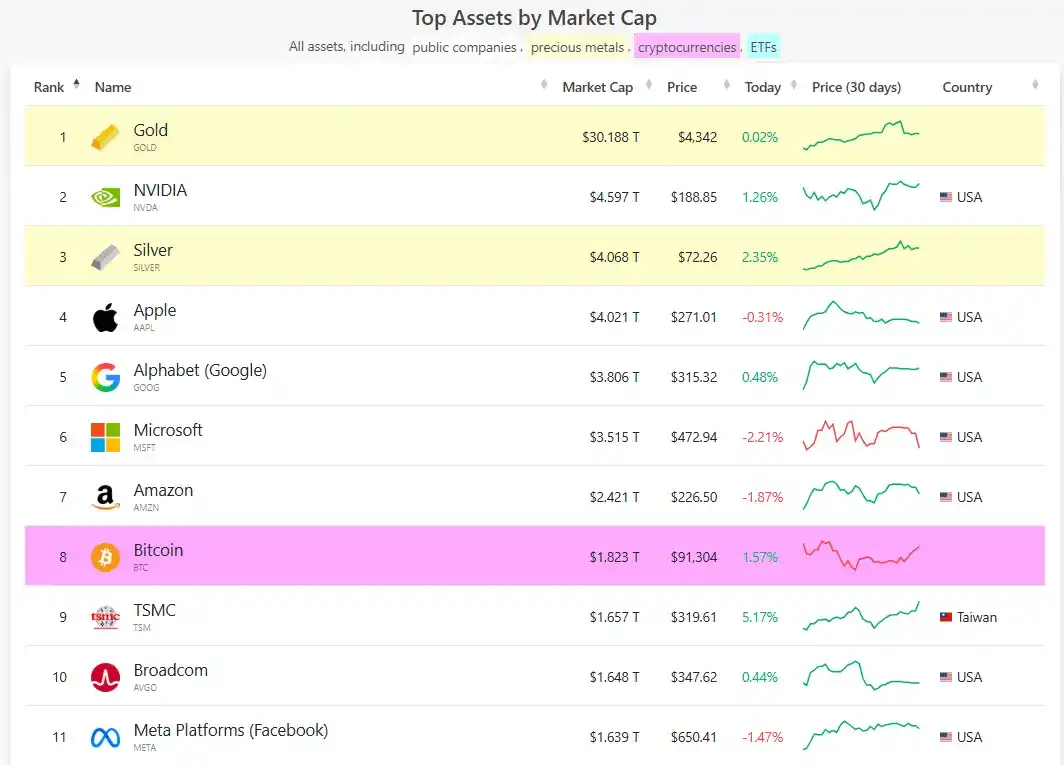
Hard Assets Gold and Silver Dominated the Year's Narrative
As the king of safe havens, the gold price soared from $2,630 at the beginning of the year to $4,310 by year-end, a gain of over65% , the largest in46 years. Driven by central bank purchases and geopolitical避险, its market cap nearly doubled and crushed the combined value of all listed companies. Silver became the year's biggest dark horse, its price surging from $29 at the start of the year to $72, a150% gain that far outpaced gold. Beyond its safe-haven属性, explosive growth in industrial demand from photovoltaics andAI computing power propelled silver from a peripheral asset强势into the global top three.
AI -Related Tech Stocks Were Strong But Entered a Digestion Phase
NVIDIA, as the chip leader, saw its market cap grow30% to $4.6 trillion, briefly surpassing the $5 trillion mark during the year. TSMC and Broadcom benefited from computing power demand, with their market caps both rising from $1 trillion to $1.6 trillion, gains of around60%. Although the AI sector overall hit record highs, the growth rate became more moderate, reflecting a more cautious market assessment of productivity realization.
Bitcoin Rallied Then Fell, Relatively Weak
Although Bitcoin briefly surged to $126,000 mid-year, with its market cap temporarily breaking into the global top five, a flash crash and volatility in the fourth quarter brought its year-end price back to around $88,000. With a negative return of approximately8% for the year, this marked the first time Bitcoin recorded a negative return in the year following a halving cycle.
Legacy Tech Giants Performed Steadily But Largely Lacked Explosiveness
Alphabet recorded a52% gain thanks to the integration of Gemini AI, its market cap rising to $3.8 trillion. The gains for Amazon, Microsoft, and Apple ranged between14% and33% . Although they maintained dominance in search, cloud computing, and consumer electronics, overall growth had significantly slowed.Meta saw its market cap increase to $1.67 trillion, driven by its Llama model and record engagement on its social platforms, fiercely competing with Broadcom for the tenth spot at year-end.
It is worth noting that in the 2025 asset ranking reshuffle, several traditional giants were squeezed out of the top ten. Among them, Eli Lilly, which had previously led due to the weight-loss drug boom, saw its gains slow due to the siphoning effect of the AI theme, falling to around 15th place. Additionally, companies like Tesla and Saudi Aramco were接近or briefly entered the top ten early in the year but fell to positions 15-20 by year-end, affected by intensified EV competition, oil price volatility, and the explosive growth of tech/precious metal assets. These changes highlight the structural shift of global capital towards AI computing infrastructure and hard asset避险demand.
Overall, the turning point in the global asset market in 2025 was the suppression of tech stocks by the market cap of hard assets. Tech stocks faced bubble concerns at historical highs, while Bitcoin experienced a shift from狂热to fatigue in its high-open, low-close performance, becoming a relative loser for the year.
Why Did Bitcoin Underperform? Narrative Shift from狂热to Fatigue
Bitcoin's performance in 2025 was typically characterized by a rise followed by a fall. At the beginning of the year, driven by pro-crypto policy expectations, massive institutionalETF inflows, and macro easing policies, its price started from the $90,000 level and reached a historical high of $126,000 in October, with its market cap briefly exceeding $2.4 trillion.
However, the situation changed急剧in the fourth quarter, with a severe flash crash pushing the price down to a low of $84,000. Bitcoin最终closed the year at around $88,000, recording a negative return of approximately8% . Compared to gold's70% and silver's over140% gains, Bitcoin's relative weakness reflected its vulnerability in a complex macro environment.
This performance was caused by multiple factors.
First, macro liquidity tightening and pressure from capital reallocation. The Fed's pace of interest rate cuts in the second half of the year fell short of expectations, coupled with the Bank of Japan maintaining its hiking stance, leading to tighter global liquidity. Capital was forced to withdraw from high-volatility assets and flow into safe-haven assets like gold and silver or productivity-oriented equity markets. Meanwhile, Bitcoin's correlation with US stocks surged from0.23 at the beginning of the year to over0.86 by year-end, gradually losing its appeal as an independent allocation asset.
Second, selling by long-term holders and leverage liquidation amplified market volatility. In 2025, the old whale group sold a record1.6 million Bitcoins, creating sustained selling pressure. The flash crash on October 10th wiped out months of gains in a very short time, triggering a chain reaction in the derivatives market.Matrixport pointed out that since the阶段性high in October 2025, nearly $30 billion in leverage corresponding to the open interest规模of BTC and ETH futures has been liquidated. Over-leveraging made it difficult for the market to quickly restore confidence after the暴跌.
Furthermore, the slowdown in institutional adoption progress further exacerbated the downward pressure. Although BitcoinETF maintained net inflows for the year, tens of billions of dollars were withdrawn in the fourth quarter. The strength of corporate acquisitions was also significantly limited. As the stock prices of some companies holding digital assets (DAT) fell, the market saw阶段性Bitcoin selling行为. The cooling of institutional sentiment directly suppressed market performance at year-end, preventing Bitcoin from continuing its past glory in 2025.
Bitcoin's Future?
Although Bitcoin recorded a negative return in 2025 and broke the traditional four-year cycle expectation, consensus at the institutional level remains optimistic. The market generally believes that this year's deep adjustment is paving the way for a more sustainable, institutionally-driven bull market in the future.
As 2026 arrives, with gradual improvement in global macro liquidity and further clarification of the regulatory environment, Bitcoin is expected to end the current period of震荡and return to a growth trajectory, potentially even challenging new historical levels.
According to summaries from various media, current public predictions show that analysts likeTom Lee, Standard Chartered, and Bernstein are generally bullish, but there are divergences.
Mainstream price targets mostly fall between $140,000 and $170,000, for example:
J.P. Morgan , based on a volatility-adjusted gold ratio model, calculated a theoretical fair value of approximately $170,000, believing Bitcoin still has significant upside potential.
Standard Chartered and Bernstein set their year-end 2026 targets at around $150,000, emphasizing structural support from ETF inflows, slowed corporate treasury adoption, and the long-term inflow of institutional capital will dominate the cycle.
Grayscale defines 2026 as the dawn of the institutional era, expecting Bitcoin to set new historical highs in the first half of the year, ending the traditional four-year cycle and shifting to a steady uptrend driven by sustained institutional demand.
Bitwise believes ETFs will absorb over 100% of the new supply, further strengthening price support, and predicts 2026 will belong to the bulls. Citi's baseline scenario is $143,000, with a bull scenario reaching $189,000.
Beyond these mainstream views, there are more激进perspectives. For example,Cardano founder Charles Hoskinson expects the Bitcoin price to reach $250,000, citing the powerful thrust from Bitcoin's fixed supply and growing institutional demand.
However, there are also significant bearish voices.Bloomberg Intelligence 's Mike McGlone is the most pessimistic, suggesting that in a deflationary macro environment, Bitcoin could fall back to $50,000 or even $10,000, particularly emphasizing the mean reversion risk faced by speculative assets.
Matrixport believes 2026 will be a year of high volatility rather than a smooth trend. Influenced by the Fed leadership transition, a疲软labor market, and election-year policy risks, the market will face密集risk event windows. The firm提醒investors to maintain flexibility and actively manage positions, precisely把握market exposure around key policy events.
Overall, although预测data shows significant divergence, mainstream institutions generally agree that 2026 will be a year of structural rebound for Bitcoin.ETF as a permanent demand engine, regulatory clarity, and accelerated corporate/institutional allocation will be the core catalysts. In the short term, the Bitcoin price may bottom out in the $80,000 to $100,000 range, but the probability of an upward breakout is significantly increasing as the macro environment turns and capital flows back.
Click to learn about open positions at ChainCatcher




















