For Web3, This Time Cai Wensheng Is Determined to Get His Hands Dirty

marsbitPublié le 2026-03-16Dernière mise à jour le 2026-03-16

Résumé

Cai Wenshou, a prominent Chinese internet entrepreneur and investor, is making a significant push into the Web3 space with a hands-on approach, moving beyond his previous role as a financial backer. Despite early successes in domains and internet companies like Meitu, his advocacy for Meitu's $100 million cryptocurrency investment in 2021 led to substantial paper losses and public criticism, eventually resulting in his departure as chairman. After stepping down, he reduced his stake in Meitu and invested personal funds into Web3 initiatives. He purchased a 25-story commercial building in Hong Kong, renamed it "CAI Tower" (representing Crypto and AI), offering free rent to Web3 and AI startups in exchange for first investment rights. He also acquired two Hong Kong-listed companies, rebranding them as CAI Holdings and LONG Investment Group, to build a Web3 and AI asset management platform. Additionally, he integrated a licensed virtual asset exchange, EXIO, into his ecosystem, creating a full-cycle support system from incubation to trading. Cai believes in the long-term potential of Web3, comparing its growth trajectory to AI's gradual rise. He remains optimistic about Bitcoin's future, predicting it could reach $1.1 million. Unlike some early crypto figures who have exited the industry, Cai is deepening his involvement, aiming to foster tangible projects and ecosystems. His commitment reflects a broader need for established leaders to drive real-world adoption and achieve a ...

Author:Zhou, ChainCatcher

If there are still any investors in the current crypto industry worth looking forward to, Cai Wensheng should be one of them.

Starting from the early domain name business, to the successive successes of 58.com, Storm Player, and Meitu, then to strongly advocating for Meitu to hoard cryptocurrencies, facing billions in floating losses and being criticized for speculative trading, stepping down as chairman, cashing out to buy buildings, and betting on Hong Kong Web3.

He is a person who has been repeatedly misunderstood by the times, yet repeatedly validated by the times.

Only this time, he decided to "get his hands dirty."

Last Time, Didn't Get a Good Result

2021 年, Cai Wensheng strongly advocated for Meitu to buy Bitcoin and Ethereum, with a total investment of about $100 million.

When buying, Cai Wensheng once said in his WeChat Moments: "Someone has to be the first to eat the crab. This should be the first Hong Kong-listed company to purchase BTC digital currency, and also the world's first listed company to use ETH Ethereum as a monetary value reserve."

However, as a Hong Kong-listed company, any major asset allocation by Meitu needed to be approved by the board of directors. Although he held over 25% of the shares at the time and, as chairman, could push for the purchase, he could not prevent the sale.

2022 年, the crypto market plummeted, and Meitu's paper losses exceeded 280 million RMB, with accusations of "speculative crypto trading" flooding in. The stock price of Meitu in Hong Kong also hit a historic low.
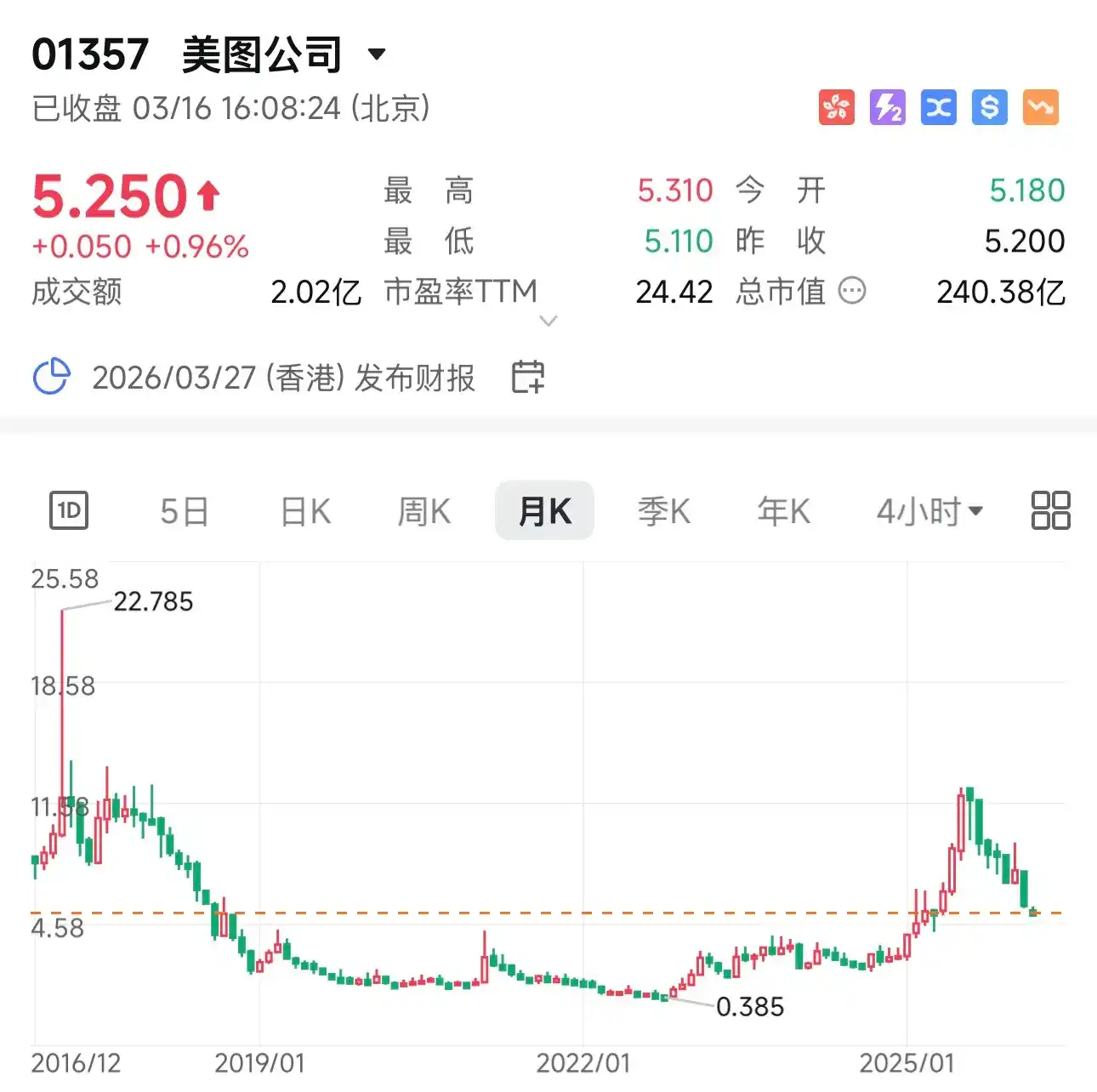

Publicly listed companies sometimes have less tolerance for floating losses than individual investors—stock price pressure, shareholder doubts, media siege—these were external pressures that anyone at the time could not withstand.

2023 年, he stepped down as chairman amid skepticism, and Wu Xinhong returned to take charge, immediately beginning to "tear off the Cai Wensheng label," with the strategic focus fully shifting to AI.

The ending of the story is quite ironic. Meitu issued an announcement in early December 2024, stating that as of that date, it had sold all its cryptocurrency, with a total cash consideration of approximately $180 million, realizing a gain of about $79.63 million, equivalent to approximately RMB 571 million.

If they had held on back then, Meitu would have been one of the first batch of DAT companies in Hong Kong.

The trend was validated, but it was no longer related to him.

Getting Involved, Getting Hands Dirty

From domain names, mobile internet, to Web3, people in each era said he was gambling.

He once said in an interview that what Web3 entrepreneurs do is often not understood, especially by traditional investors.

At the same time, he expressed firm belief in the explosion of Web3, though the timing is hard to predict, just like AI went through many years of dormancy before迎来 the ChatGPT explosion.

According to RootData显示, Cai Wensheng's Longling Capital早年 invested in the crypto exchange OKX (formerly OKCoin). In 2018, he revealed publicly that he had invested in over 10 blockchain projects, including Theta, Ontology, Zipper, etc.

<极好的, I will continue the translation from where it left off, ensuring all HTML tags are preserved and the structure is maintained.

img style="max-width:100%;overflow:hidden;" src="https://d1x7dwosqaosdj.cloudfront.net/images/2026-03/ba38047c3f24461f9b57e864d3fc5780.jpg" alt="">


This time, he simply increased his bet.

After stepping down, Cai Wensheng chose to reduce his stake in Meitu, with his shareholding比例 dropping from a peak of about 25% to less than 10%.

650 million Hong Kong dollars to buy a 25-story commercial building in Tin Hau, Hong Kong, renamed CAI Building. He specifically stated: "CAI is the abbreviation of Crypto and AI, not my surname."

It is reported that CAI Building does not charge rent, only asks for the优先 investment right in the first round of financing, no discount, no controlling stake. He publicly stated that the goal is to incubate 5 unicorns within three years.

Last November, Cai Wensheng said at Hong Kong Fintechweek that buying this building was to "set an example." Now this building is fully occupied by AI and Web3 companies.

Capital operations also followed. He successively acquired two Hong Kong-listed companies—China New Economy Investment and China Financial Leasing, renamed them CAI Holdings and LONG Investment Group respectively,打造 a Web3+AI asset management platform.

In early 2026, CAI Holdings又 acquired the equity of two early-stage projects, Forestheaven and EXIO, by issuing new shares. The seller was precisely Longling Capital, wholly owned by Cai Wensheng.

Among them, EXIO is a licensed virtual asset trading platform in Hong Kong, holding SFC Type 1 and Type 7 licenses. It is the first compliant exchange in Hong Kong with a securities background. Longling Capital was one of its early investors.

Incorporating this piece into CAI Holdings means his ecosystem extends from incubation to circulation—projects cultivated in the CAI Building can be directly listed for compliant trading on a licensed exchange.

Crypto OGs Need a Decent Victory

Among the crypto OGs we know, Cai Wensheng is not the one who has benefited the most.

The fates of early crypto OGs vary.

Some achieved financial freedom and completely faded out—Babbitt founder Chang Jia was once the most powerful spokesperson for long-termism in the crypto industry. Since 2023, he has turned to AI entrepreneurship.

Multicoin Capital co-founder Kyle Samani became famous for early bets on Solana. When leaving the圈, he publicly stated that "cryptocurrency is not as interesting as many people think."

Some stay in the圈, but their focus has shifted—Shenyu was a representative figure in the mining圈 early on. Now, content about AI tools占了大半 on his social accounts.

And those who, like Cai Wensheng, choose to stay include Xiao Feng and Feng Bo, etc.

Xiao Feng turned from traditional finance, leading HashKey on an institutionalized compliance path, operating with licenses, and connecting with traditional capital; Feng Bo布局 in a professional crypto VC manner, closer to the standard institutional investor approach.

They are同样 optimistic about this industry, but their paths are截然不同.

Cai Wensheng chose a "dirtier" path: not taking the institutional route, not making pure financial bets, personally putting down roots in Hong Kong, getting involved hands-on.

At the 2023 Hong Kong Web3 Carnival, Cai Wensheng said: "People who have worked from Web1 to Web3, this seems like a compliment, but it actually means that we have not been successful from Web1 to Web3, we have always been on the road. But many people from Web1 to Web3 are no longer here, but we are still here,说明 we are veterans. Old soldiers never die, they just fade away."

In early 2026, he predicted that Bitcoin would rise to $1.1 million, which means the total market capitalization of Bitcoin would be about $21 trillion. Previously, he publicly stated that he held about 10,000 Bitcoins. There is no news yet showing that he has exited.

Of course, the controversy has not disappeared. Continuously endorsing during a bear market, whether it is坚守 against the market or having to tell stories after being trapped, is still difficult for outsiders to distinguish.

But the ammunition from cashing out, the buildings bought, the companies acquired—these are all actions with real money.

This industry has experienced too many indecent endings. Project方 running away, whales dumping and fleeing, OGs quietly leaving the scene. What remains in the public eye are often only those news about changes in whale addresses.

This industry does not lack people who喊单, it lacks people who truly stay and get their hands dirty.

A bull market unlocking cannot solve the industry's root problems. In the end, it still relies on projects that truly succeed and ecosystems that truly land to win a decent victory for crypto OGs.


Questions liées

QWhat was the outcome of Cai Wensheng's push for Meitu to invest in Bitcoin and Ethereum in 2021?

AMeitu invested approximately $100 million in Bitcoin and Ethereum in 2021, but faced a paper loss of over 280 million RMB in 2022 due to the crypto market crash. Cai Wensheng stepped down as chairman amid criticism, and Meitu later sold all its cryptocurrency holdings in 2024 for about $180 million, realizing a profit of approximately $79.63 million.

QWhat does 'CAI' stand for in the name of the building Cai Wensheng purchased in Hong Kong?

ACAI stands for 'Crypto and AI', not Cai Wensheng's surname. The building, named CAI Mansion, is intended to incubate AI and Web3 startups.

QHow is Cai Wensheng currently involved in the Web3 and crypto industry after leaving Meitu?

ACai Wensheng is deeply involved by purchasing a 25-story commercial building in Hong Kong (CAI Mansion) to incubate Web3 and AI startups, acquiring and renaming two Hong Kong-listed companies to create Web3+AI asset management platforms, and integrating a licensed virtual asset trading platform (EXIO) into his ecosystem.

QWhat is Cai Wensheng's prediction for the future price of Bitcoin?

ACai Wensheng predicted that Bitcoin would rise to $1.1 million, which would imply a total market capitalization of approximately $21 trillion.

QWhich early blockchain projects did Cai Wensheng's Longling Capital invest in?

ALongling Capital invested in early blockchain projects including Theta, Ontology, Zipper, and the crypto exchange OKX (formerly OKCoin).

Lectures associées

Ne pas investir n'est pas un laissez-passer pour Apple

Face aux géants technologiques comme Meta et Google qui font face à des critiques pour leurs dépenses d'investissement massives dans l'IA, Apple, bien qu'en retard dans ce domaine, se distingue par sa retenue budgétaire. Cette approche lui a même permis de retrouver brièvement la première place mondiale en termes de valorisation boursière. Le rapport trimestriel (T3 2026) d'Apple affiche des performances solides, avec un chiffre d'affaires en hausse de 16,4% et un bénéfice net en progression de 27,1%. L'iPhone et le Mac sont les principaux moteurs de cette croissance, compensant les résultats plus modestes de l'iPad (en baisse) et des services (ralentissement de la croissance). Cependant, le marché réagit négativement après la publication des résultats, en raison des perspectives prudentes pour le trimestre suivant. Apple anticipe des contraintes d'approvisionnement majeures, notamment pour les puces et la mémoire, entraînant des hausses de prix sur ses produits. Contrairement à ses concurrents qui investissent des milliards dans l'infrastructure IA, Apple maintient des dépenses d'investissement (capex) faibles, privilégiant les dépenses de R&D. Malgré cela, l'entreprise n'échappe pas aux répercussions de la frénésie de l'IA, qui exacerbe les tensions sur sa chaîne d'approvisionnement. Ce rapport marque la dernière conférence téléphonique de Tim Cook en tant que PDG, avant son départ prévu en septembre. Il exprime sa confiance dans l'avenir de l'entreprise.

marsbitIl y a 14 mins

Ne pas investir n'est pas un laissez-passer pour Apple

marsbitIl y a 14 mins

PA Figure | Une infographie pour comprendre les grands événements de l'écosystème Web3 en août 2026

Août 2026 s'annonce chargé pour l'écosystème Web3, marqué par plusieurs événements clés susceptibles d'influencer les marchés. L'agenda macroéconomique sera déterminant, avec la publication des données américaines sur l'emploi (non-farm payrolls) et l'inflation (CPI) de juillet, ainsi que les comptes-rendus de la Réserve Fédérale et le symposium annuel de Jackson Hole. Sur le front réglementaire, des développements majeurs sont attendus : le Sénat américain doit dévoiler un nouveau projet de loi (*CLARITY Act*), tandis que l'interdiction des transactions cryptos de l'UE envers la Biélorussie entre en vigueur. Les marchés devront également absorber des déblocages massifs de jetons (**ENA, AVAX, CONX, ZRO, KAITO**, etc.), susceptibles de créer de la volatilité. Par ailleurs, l'industrie continuera son consolidation, avec l'arrêt ou la refonte prévus de plusieurs services comme Exchange Art, Ctrl Wallet, Zapper, NFTfi et Summer.fi, incitant les utilisateurs à gérer leurs actifs en conséquence. Du côté des entreprises, les résultats du Q2 de **SpaceX, Circle et Nvidia** seront publiés, et des levées de fonds importantes sont au programme, notamment pour la société chinoise Moonshot AI (pré-IPO). Enfin, des événements sectoriels majeurs comme **Bitcoin Asia 2026** et le **China Digital Expo 2026** se tiendront. En résumé, le mois d'août sera structuré autour des anticipations macroéconomiques, de l'évolution réglementaire, des déblocages de tokens et de la consolidation continue du secteur.

marsbitIl y a 28 mins

PA Figure | Une infographie pour comprendre les grands événements de l'écosystème Web3 en août 2026

marsbitIl y a 28 mins

La voix la plus célèbre de « Cassandre » de Wall Street s'attaque cette fois à NVIDIA

Une récente divulgation de l’investisseur Michael Burry, connu pour avoir prédit la crise des subprimes et immortalisé dans « The Big Short », a relancé les débats sur le marché. Fin juin, il a annoncé avoir pris des positions à découvert sur plusieurs valeurs technologiques, dont Nvidia (à un prix d’entrée de 198,09 $), Tesla, Applied Materials, Caterpillar et l’ETF SOXX (semiconducteurs). Le 1er juillet, il a ajouté Micron à sa liste, avant d’augmenter fin juillet ses positions sur Nvidia, Micron et SOXX. Ses arguments portent principalement sur les pratiques comptables dans le secteur de l’IA : selon lui, la durée d’amortissement des puces (étirée à 6 ans par les géants du cloud comme Microsoft ou Google) ne reflète pas leur obsolescence rapide (2-3 ans), ce qui gonflerait artificiellement les profits. Il évoque également des risques de « financement circulaire hors bilan », où Nvidia pourrait garantir des prêts à des clients pour qu’ils achètent ses propres puces, créant ainsi une demande artificielle. Enfin, il critique les rachats d’actions de Nvidia, accusés de doper artificiellement le bénéfice par action – une affirmation que la société a contestée en soulignant des erreurs de calcul. Les réactions sont partagées. D’un côté, des voix comme Steve Eisman (autre figure de « The Big Short ») restent prudentes mais ne suivent pas la position découverte, notant la croissance soutenue des revenus et des investissements en IA. De l’autre, Jim Chanos, célèbre vendeur à découvert, partage l’inquiétude sur les écarts comptables mais préfère cibler d’autres acteurs financiers plutôt que les fabricants de puces. Historiquement, les appels de Burry ont connu des succès mitigés : corrects sur des crises structurelles (subprimes, COVID), mais souvent prématurés ou erronés sur des arguments de valorisation (Tesla, Nvidia en 2023). Aujourd’hui, les positions à découvert sur Nvidia restent marginales (environ 1,4 % des actions en circulation), même si les pertes cumulées des vendeurs à découvert sur la valeur dépassent 5 milliards de dollars. Pour les investisseurs, l’intérêt réside moins dans le suivi des positions de Burry que dans la méthodologie sous-jacente : scruter les flux de trésorerie, questionner les traitements comptables agressifs et identifier les risques structurels, surtout quand le marché semble euphorique. La question centrale n’est pas de savoir si Burry a raison cette fois, mais plutôt quels enseignements tirer de son analyse pour évaluer la solidité réelle de la bulle présumée de l’IA.

marsbitIl y a 50 mins

La voix la plus célèbre de « Cassandre » de Wall Street s'attaque cette fois à NVIDIA

marsbitIl y a 50 mins

Sélection de la semaine丨Émotions épiques sur le marché boursier, l'entrée en bourse de Changxin Tech redéfinit le paysage du stockage, Saylor vise à rétablir l'ancrage du STRC vers le 8 septembre

PANews présente un résumé hebdomadaire de contenus clés. Les marchés ont connu une volatilité significative, avec des indices boursiers sud-coréens subissant plusieurs interruptions et une chute des actions technologiques liées à l'IA. Dans ce contexte, le bitcoin apparaît comme un actif relativement stable. Le paysage technologique évolue rapidement. Le géant de la mémoire Longxin Technology a fait ses débuts en bourse avec une capitalisation importante, symbolisant une percée pour la DRAM nationale. Parallèlement, la convergence de l'IA, des agents autonomes et des besoins en calcul redéfinit les secteurs, des GPU aux infrastructures énergétiques, les entreprises de minage de bitcoin se repositionnant autour de la gestion de l'électricité. Dans le domaine crypto, l'innovation se poursuit. Les portefeuilles intelligents pour agents IA et les mécanismes de paiement programmables gagnent en importance, attirant l'attention de grandes plateformes. De nouveaux modèles économiques, comme le protocole à jeton FWA qui combine NFT et système de tirage, génèrent un fort engagement. Cependant, un décalage est observé entre la croissance des revenus des principaux protocoles et la performance de leurs jetons. Le secteur des Real World Assets (RWA) voit son volume augmenter mais peine à mobiliser ses actifs. Les perspectives macroéconomiques restent mitigées. La Réserve Fédérale américaine maintient des taux directeurs élevés, signalant une orientation durablement restrictive malgré des divisions internes. Des analystes comme Tom Lee considèrent les récentes corrections comme un assainissement nécessaire, affirmant que la logique de long terme du secteur reste intacte. Des personnalités anticipent un rôle accru du bitcoin dans le futur système monétaire. Les informations marquantes incluent : des mouvements réglementaires affectant les courtiers pour investisseurs chinois, le plan de développement technique d'Ethereum à horizon 2030, une importante migration de staking par Lido, et des performances boursières variées pour les entreprises liées à la crypto et à l'IA. Michael Saylor a également annoncé un objectif de réalignement pour le STRC autour du 8 septembre.

marsbitIl y a 56 mins

Sélection de la semaine丨Émotions épiques sur le marché boursier, l'entrée en bourse de Changxin Tech redéfinit le paysage du stockage, Saylor vise à rétablir l'ancrage du STRC vers le 8 septembre

marsbitIl y a 56 mins

Lorsque le marché commence à s'interroger sur les dépenses en capital liées à l'IA : Analyse complète des résultats du Q2 des cinq géants technologiques

À la fin juillet 2026, les résultats trimestriels d'Alphabet, Intel, Microsoft, Meta et Apple ont tous mis en évidence une croissance robuste des revenus et des bénéfices, largement portée par les investissements et la demande en IA. Cependant, les réactions des investisseurs ont divergé, soulignant un changement d'attention : le marché s'interroge désormais sur le calendrier du retour sur investissement de ces dépenses massives en capital. Alphabet a affiché une croissance record de son chiffre d'affaires et une performance cloud exceptionnelle, mais son augmentation des dépenses d'investissement, entraînant un flux de trésorerie libre négatif pour la première fois, a provoqué une chute de son cours. Intel, malgré ses meilleures ventes depuis quinze ans, a vu son rebond boursier anéanti après l'annonce d'une hausse significative de son budget d'investissement. À l'inverse, Microsoft, en abaissant ses prévisions de dépenses en capital et en promettant des flux de trésorerie positifs, a connu une forte hausse de son action. Meta, dont les dépenses ont explosé et le flux de trésorerie libre s'est effondré, a subi la plus forte vente. Enfin, Apple, malgré des résultats records, a vu son action chuter en raison de prévisions inférieures aux attentes, pointant des contraintes d'approvisionnement. En résumé, la demande en IA reste solide, mais le marché sanctionne désormais les entreprises dont les investissements massifs menacent à court terme la rentabilité et les flux de trésorerie, récompensant celles qui maîtrisent leur trajectoire financière.

Odaily星球日报Il y a 1 h

Lorsque le marché commence à s'interroger sur les dépenses en capital liées à l'IA : Analyse complète des résultats du Q2 des cinq géants technologiques

Odaily星球日报Il y a 1 h

Trading

Spot
活动图片