Farewell to Building Castles: The Transformation Moment for Crypto VCs

marsbitPublié le 2025-12-18Dernière mise à jour le 2025-12-18

Résumé

The crypto VC industry is undergoing a painful but necessary transformation, marked by the collapse of once-prominent firms like Shima Capital. Its founder, Yida Gao, faced SEC charges for fraudulent fundraising and misrepresentation, leading to the fund’s shutdown. This signals a broader shift toward accountability and transparency in the sector. The era of easy profits through speculative investments and “pump-and-dump” models is ending. With declining liquidity and retail participation, many VCs face prolonged losses and difficult exits. Data shows only 2% of altcoins are in profit, highlighting severe market strain. Investors now prioritize projects with real traction and data, not just narratives. VC strategies are evolving: funding is becoming more concentrated, with larger sums flowing into fewer, later-stage deals. There’s also a growing focus on infrastructure—such as payment rails and privacy tools—rather than premature application-layer projects. Some crypto-native funds are even diversifying into AI, biotech, and other non-crypto sectors. This period of recalibration, though challenging, is pushing the industry toward sustainable growth. By building stronger foundations, the market may eventually support more resilient and valuable applications in the next cycle.

Author: Nancy, PANews

From the former "investment风向标" to the current "fear of VCs," crypto venture capital is undergoing a necessary process of demystification and clearing.

The darkest moment is also the moment of rebirth. This brutal process of defoaming is forcing the crypto market to establish healthier and more sustainable valuation logic, while also driving the industry back to rational construction and maturity.

The Fall of Star VCs: The Demystification Moment of Elite Glory

Another crypto venture capital firm has fallen. On December 17, Shima Capital was exposed to be quietly winding down its operations.

In this brutal crypto cycle, the exit of VCs is not uncommon, but Shima Capital's departure is not dignified. Unlike other VCs that died from liquidity drying up or were dragged down by poor investment portfolios, Shima Capital's downfall stemmed more from internal moral hazards and management chaos.

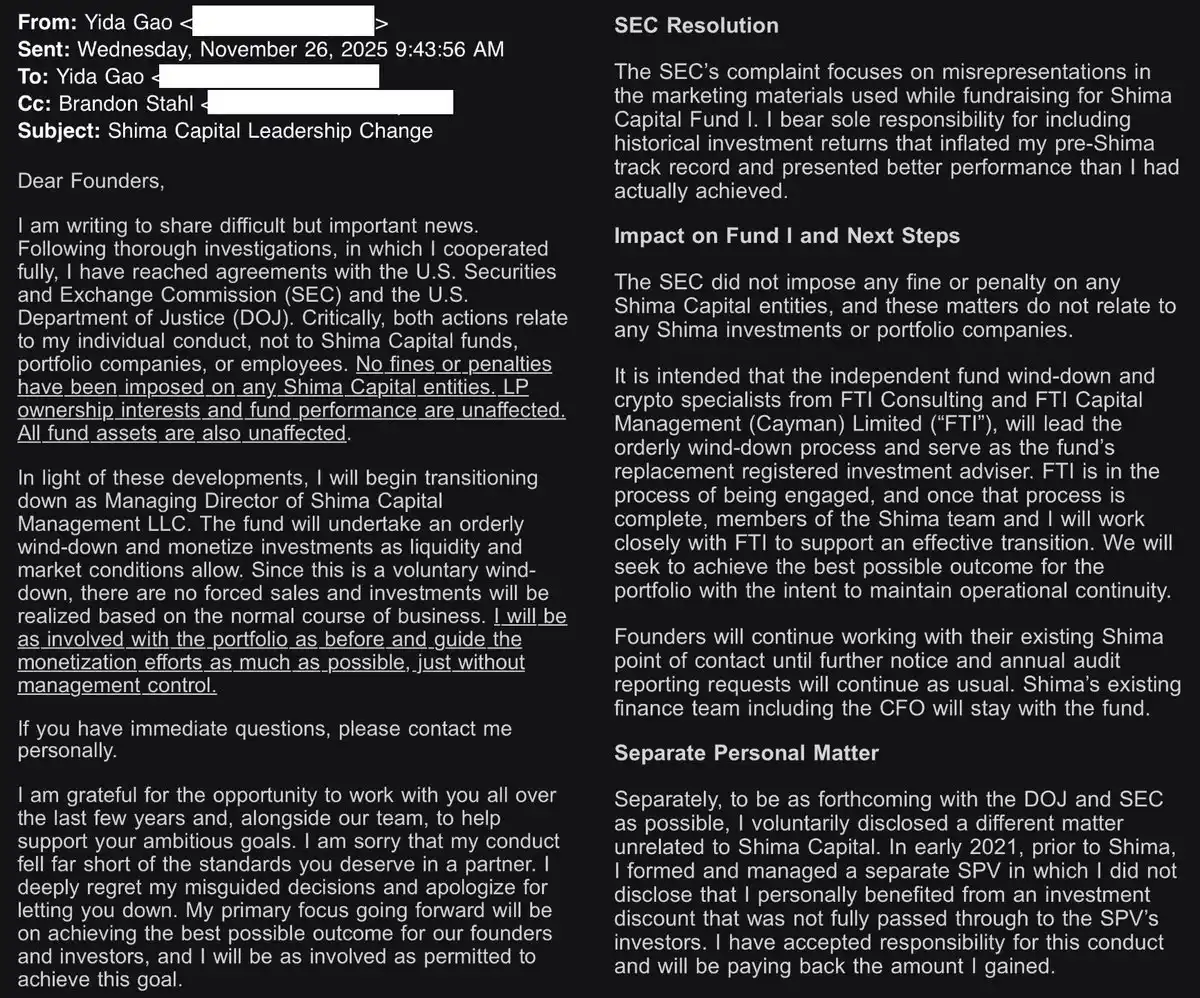
The direct trigger for this decision was the lawsuit filed by the U.S. SEC against the institution and its founder Yida Gao three weeks ago. The charges alleged that they violated multiple securities laws and illegally raised over $169.9 million from investors through fraudulent means.

Under regulatory pressure, Yida Gao quickly chose to settle with the SEC and the U.S. Department of Justice. While paying a fine of approximately $4 million, he decided to close the fund and announced his resignation from all positions, expressing deep regret for his "misleading decisions." The foundation will enter a liquidation process and will gradually liquidate assets to repay investors as the market allows.
As a once high-frequency star venture capital in the crypto field, Shima Capital's rise relied more on the founder's elite光环. American-Chinese Yida Gao was a Wall Street top student with a background from MIT. He even took over the crypto course taught by former SEC Chairman Gary Gensler at MIT. His resume also includes well-known institutions like Morgan Stanley and New Enterprise Associates.

With this background, Shima easily raised $200 million for its first fund, with backers including Dragonfly, hedge fund billionaire Bill Ackman, Animoca, OKX, Republic Capital, Digital Currency Group, and Mirana Ventures.

Holding huge funds, Shima became one of the most active hunters in the last cycle, betting on over 200 crypto projects, including hot projects like Monad, Puddy Penguins, Solv, Berachain, 1inch, Coin98, etc. Despite the vast investment portfolio, Shima and its team were evaluated by investors as young and lacking experience, not truly understanding the industry, and merely following the speculative wave of cryptocurrency.

More seriously, all this was built on lies. According to the SEC's lawsuit documents, when raising $158 million for Shima Capital Fund I, he fabricated past performance, claiming that one of his investments had achieved a 90x return, while the actual data was only 2.8x. When the lie was at risk of being exposed, he even tried to brush it off as a "typo" to investors.

Not only that, Yida Gao raised funds from investors through an SPV to purchase BitClout tokens, promising discounts and principal protection. However, in reality, although he bought the tokens at a low price, he did not offer them to investors at the original price but instead resold them to his own SPV at a markup, secretly profiting $1.9 million without disclosure.

From a long-term perspective, Shima's exit also sends a positive signal to the market: crypto wrongdoing is no longer outside the law, and the industry's transparency and ethical standards will be better improved.

Related reading: Unveiling the Founder of Shima Capital Suspected of Misappropriating Assets: From Fujian Immigrant to Wall Street Financial Elite

The Era of Easy Money is Over, VCs Enter an Evolution Period

The so-called failure of the VC model is essentially the market forcing the industry to evolve.

Currently, the assembly-line model of "VCs forming a syndicate, retail investors taking the bag" has been broken, and funds are rapidly withdrawing from air projects. For example, not long ago, Monad, with its豪华 investment lineup, still couldn't escape price difficulties after launch, which also made a group of VCs "break defense," and venture capital firms like Dragonfly engaged in fierce debates around value valuation.

The industry's rules of the game have changed. Whether it's the success of projects without VC funding (like Hyperliquid) or the community's resistance to high-valuation projects, they are actually pushing venture capital institutions out of their arrogant ivory towers. Only when the path of making quick money simply by "issuing and selling tokens" is blocked will VCs truly settle down to find projects with造血能力 that can solve practical problems.

This阵痛 is obvious. As retail investors exit leading to liquidity drying up, the traditional exit channels for VCs are blocked. Valuation adjustments not only lengthen the return cycle but also leave a large number of investments facing serious paper losses.

Not long ago, Akshat Vaidya, co-founder of Arthur Hayes' family office Maelstrom, publicly complained that the principal of his investment in a certain Pantera fund four years ago had nearly halved, while Bitcoin had risen about twofold during the same period.

Another VC confided to PANews that they were overwhelmed by exits. Even though they participated in the seed round, the current token price they hold is lower than the cost price. Even if a project is listed on a top exchange like Binance, years later they only recovered one-fifth of the principal. Many projects choose to随便 list on a small exchange to give investors an交代, but there is simply no liquidity to exit. Some projects even choose to lie flat, and when asked, the answer is always to wait for the right time.

Glassnode data shows that currently only about 2% of the altcoin supply is in a profitable state, showing an unprecedented market differentiation. During Bitcoin bull markets, it is historically uncommon for altcoins to consistently underperform.
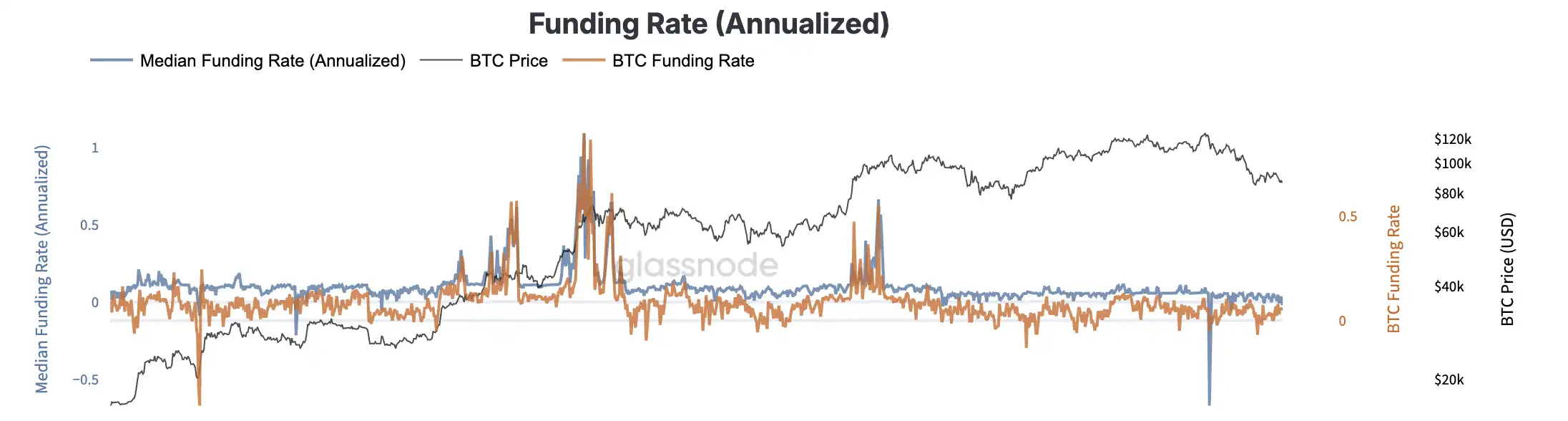
The data confirms that the era of making money with eyes closed is彻底 over.

The end of one era means the beginning of another. Rui from HashKey Ventures pointed out on social media that VCs are not afraid of熬, they are afraid of快, which is also why bear markets are more suitable for VCs. To truly succeed, one must survive until the next dead period. Unlike project parties, VCs are quite good at enduring. At the same time, most crypto VCs essentially arbitrage information asymmetry, coupled with some path dependence, earning some hard money and channel fees. More importantly, many of these people have now turned into market agents or market makers, which is essentially not much different.

Build Roads Before Buildings, Seeking Certain Opportunities

Facing the receding hot money, VCs are not all "fleeing" but are making strategic contractions and adjustments to their battle lines.

"If a project doesn't have a data dashboard, we won't invest in it." Recent participants at a Dubai crypto event revealed that VCs now pay more attention to actual business data rather than单纯 stories. Facing the bleak reality, VCs have significantly raised investment thresholds or even completely abandoned new investments.

Dovey Wan, founder of Primitive Ventures,坦言 that for investors, the ratio at which strength and luck can be exchanged (at present) is becoming increasingly苛刻, especially in the post-GPT era. This is true for all industries: choice is more important than effort, but choice is much harder than effort.

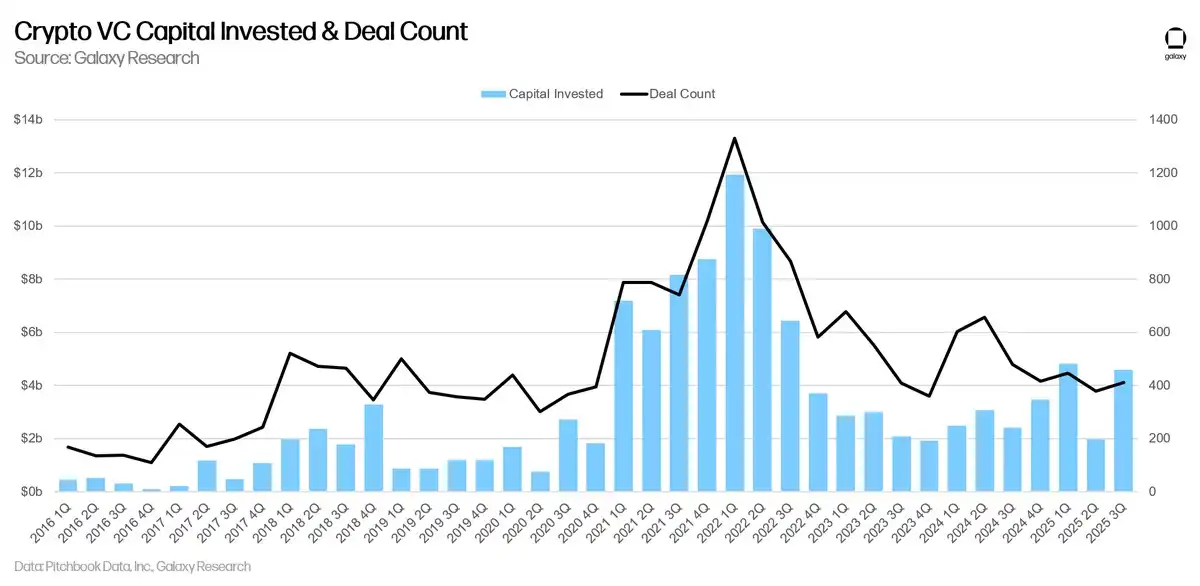
Pantera Capital revealed a positive trend in a recent video. According to its disclosure, although the total financing amount in the crypto field reached $34 billion this year, exceeding the records of 2021 and 2022, the number of transactions decreased by nearly 50%. This phenomenon has several main reasons: First, the investor structure has changed. Family offices and individual investors active during 2021-2022 have become more cautious after experiencing bear market losses, with some even choosing to exit the market. Second, the investment strategies of existing VCs have become more concentrated. These VCs prefer to put funds into a few high-quality projects rather than casting a wide net as before, because the capital, time, and resource costs required to launch new projects are higher now. On the other hand, some funds have shifted to relatively safer assets, which also explains why大量资金 is highly concentrated in Bitcoin and a few mainline assets in this cycle. Third, funds are ample but deployment节奏 has slowed. Many venture capital funds raised large amounts of money in 2021 and 2022 and are currently holding sufficient "ammunition," mainly used to support existing investment portfolios and are in no hurry to invest in new projects. From a longer-term perspective, this change is not a negative signal but rather a sign of the market maturing.

Galaxy Research's recent analysis of Q3 investment reports also pointed out that crypto VC investment额 in the quarter increased but was concentrated. Meanwhile, nearly 60% of investment funds flowed to late-stage companies, the second-highest level since Q1 2021. Compared to 2022, venture capital fundraising data also shows a significant decline in investor interest. This data also shows that VCs are more willing to heavily bet on certain opportunities.
To hedge against the risks of a single market, some crypto VCs have started to "not focus on their main business,"瞄准 markets outside of crypto-native. For example, the recent investment list of YZi Labs shows that its gaze has turned to biotech, robotics, and other圈外 sectors. Some crypto-native funds have long started investing in AI projects. Although they don't have significant pricing advantages compared to tech funds, it's an attempt at transformation.

Pantera also reflected on the investments of the last cycle. "In the last cycle, a large amount of capital flowed into speculative areas like NFTs and the metaverse. These projects tried to skip infrastructure and directly build the 'cultural top layer.' But it's like building a castle on sand: the underlying infrastructure wasn't ready, payment rails were not mature, the regulatory environment was unclear, and the user experience was far from mainstream level. The industry was too eager to seek killer apps and invested resources in the application layer where the soil wasn't ready."

Pantera believes that this crypto cycle is undergoing a necessary "correction." Now more funds are flowing into infrastructure construction, such as more efficient payment chains, more mature privacy tools, and stablecoin systems. This path is the correct sequence, and the applications of the next cycle will have the conditions to truly explode.

Lay the foundation first, then build the building.

The brutal clearing of crypto VCs at present is both a阵痛 and a reshaping.

Questions liées

QWhat led to the downfall of Shima Capital, and what does it signify for the crypto VC industry?

AShima Capital's downfall was primarily due to internal moral hazards and management chaos, including fraudulent fundraising and misrepresentation of investment returns, as charged by the SEC. This signifies a necessary cleansing and demystification in the crypto VC space, highlighting that unethical practices are no longer tolerated and promoting higher transparency and ethical standards.

QHow has the crypto VC investment strategy evolved in the current market cycle according to the article?

AVCs have shifted towards more cautious and data-driven investments, focusing on actual business metrics rather than speculative stories. They are concentrating funds on fewer high-quality projects, with increased investment in later-stage companies and infrastructure, rather than broad, early-stage bets, reflecting a move towards maturity and risk mitigation.

QWhat example does the article provide to illustrate the failure of the 'VC assembly line' model where retail investors bear the losses?

AThe article cites the example of Monad, which had a豪华 investment lineup but still faced price struggles after launch, leading to debates among VCs like Dragonfly about value valuation. This shows the breakdown of the model where VCs set up projects and retail investors end up absorbing the losses.

QAccording to Pantera Capital, what is the positive trend in the current crypto funding environment despite a drop in deal count?

APantera Capital notes that while the total crypto funding reached $34 billion, deal count dropped by nearly 50%. This is due to more concentrated investments by VCs in high-quality projects, increased costs for launching new ventures, and a shift towards safer assets like Bitcoin, indicating market maturation rather than a negative signal.

QWhat strategic shift are some crypto VCs making to hedge risks, as mentioned in the article?

ASome crypto VCs are diversifying into non-crypto native markets, such as biotech and robotics, to hedge against single-market risks. Others are investing in AI projects, attempting to transition beyond the crypto space despite lacking significant pricing advantages compared to tech funds.

Lectures associées

Les actions des entreprises d'IA se négocient comme des « mèmes cryptos », tandis que le Bitcoin reste stable – Revue de la semaine

Cette semaine, l'attention financière s'est largement détournée du Bitcoin, relativement stable autour de 64 000 $, pour se concentrer sur une volatilité extrême dans le secteur des actions liées à l'intelligence artificielle (IA). Les marchés asiatiques, notamment en Corée du Sud, ont subi des chutes sévères, en partie déclenchées par la liquidation forcée du fonds « Situational Awareness » de Leopold Aschenbrenner, entraînant des pertes massives. Le secteur des semi-conducteurs et de l'IA montre des signes de surchauffe, suscitant des débats sur un éventuel ralentissement. Dans le domaine des cryptomonnaies, l'ambiance reste difficile. Plusieurs plateformes d'échange (BitMEX, BitMart) ont annoncé leur fermeture, tandis que d'autres entreprises comme Coinbase et Uphold procèdent à des réductions de personnel. MicroStrategy continue sa stratégie d'accumulation de bitcoins et de rachat de ses propres actions. Les discussions portent également sur les risques potentiels pour des écosystèmes comme Solana si des applications populaires (Pump.fun, Trade.xyz) décidaient de lancer leur propre blockchain. Par ailleurs, une faille de sécurité majeure concernant le portefeuille matériel Coldcard a été mise en lumière, rappelant les risques du self-custody. Enfin, le projet d'IA décentralisée Bittensor (TAO) a attiré l'attention de certains investisseurs de capital-risque, mais des mises en garde sont émises contre un possible engouement spéculatif similaire à celui pour les memecoins. La semaine a été marquée par des interventions macroéconomiques, comme celle de la Japon pour soutenir le yen, et par les anticipations concernant la politique de la Fed.

cryptonews.ruIl y a 9 mins

Les actions des entreprises d'IA se négocient comme des « mèmes cryptos », tandis que le Bitcoin reste stable – Revue de la semaine

cryptonews.ruIl y a 9 mins

Coinkite critiqué pour avoir conservé les e-mails des clients après le piratage de Coldcard s'élevant à 88 millions de dollars

Coinkite, la société derrière les portefeuilles matériels Coldcard, est vivement critiquée pour avoir conservé les adresses e-mail de ses clients après la découverte d'une faille majeure. Cette vulnérabilité, liée à la génération de phrases de récupération (seed phrases) aléatoires, a permis à des pirates de voler plus de 1 000 BTC (soit plus de 88 millions de dollars) en deux jours. Pour avertir le maximum de clients potentiellement touchés, Coinkite a envoyé des e-mails d'alerte aux adresses associées aux achats effectués depuis 2019. Face aux critiques concernant la conservation de ces données, la société a invoqué sa politique publique, précisant que les e-mails sont gardés pour permettre aux clients de vérifier la suppression de leurs autres informations. Cependant, elle n'a pas défini de délai précis pour l'effacement de ces adresses. Rodolfo Novak, co-fondateur et PDG de Coinkite, a pourtant affirmé que la société ne conservait pas les informations clients et n'avait aucun moyen de contacter directement les personnes affectées, appelant à l'aide pour les atteindre. Il avait précédemment déclaré que Coinkite offrait des achats anonymes et supprimait les données après 90 jours, soulignant son sérieux en matière de sécurité comparé à ses concurrents.

cryptonews.ruIl y a 10 mins

Coinkite critiqué pour avoir conservé les e-mails des clients après le piratage de Coldcard s'élevant à 88 millions de dollars

cryptonews.ruIl y a 10 mins

Phrases de récupération : 12 mots qui vous séparent de la perte de tout

Une phrase de récupération (seed phrase), généralement composée de 12 ou 24 mots d'une liste standardisée, constitue mathématiquement le portefeuille cryptographique lui-même. Chaque mot code une partie de l'entropie générant une clé privée maîtresse unique, source de toutes les adresses. Il n'existe aucune base de données de sauvegarde centrale ni procédure de récupération de mot de passe. Posséder ces mots signifie contrôler les actifs de manière irréversible. Un vol de 292 millions de dollars survenu en janvier est exemplaire : il résulta non d'une faille technique, mais d'une ingénierie sociale incitant la victime à saisir sa phrase au mauvais endroit. Les fonds furent rapidement dispersés via des bridges et convertis. Seule une fraction minime (environ 700 000 $) put être gelée à temps, illustrant la rareté des récupérations après un vol. Bien qu'une phrase de 12 mots offre une sécurité astronomique contre les attaques par force brute (10^22 ans pour toutes les combinaisons), le risque réel est la fuite d'information. Connaître ne serait-ce que 7 ou 8 des 12 mots réduit le temps de craquage à quelques années, voire quelques heures, démontrant un effondrement soudain et non linéaire de la sécurité. La somme de contrôle intégrée au dernier mot (standard BIP39) a une fonction pratique : détecter les fautes de frappe ou de copie immédiatement, évitant la création silencieuse d'un portefeuille vide. Enfin, la perte d'accès, et non le vol, est la cause principale de disparition des bitcoins. On estime que jusqu'à 23% des BTC minés seraient définitivement inaccessibles, à cause de phrases oubliées, de sauvegardes détruites ou d'absence de plan de succession. La phrase de récupération est ainsi la preuve unique et absolue de propriété, sans mécanisme de recours. La perdre, c'est rendre les actifs qu'elle protège inexistants pour tous.

cryptonews.ruIl y a 12 mins

Phrases de récupération : 12 mots qui vous séparent de la perte de tout

cryptonews.ruIl y a 12 mins

Attention : un déblocage massif de tokens est prévu pour cette semaine sur 10 altcoins ! Voici le calendrier jour par jour et heure par heure

La semaine dernière, le marché des cryptomonnaies a subi une baisse en raison d'un incident de piratage récent et de l'influence d'événements géopolitiques. Cependant, cette semaine sera marquée par des déblocages importants de jetons pour plusieurs altcoins. Voici le calendrier des déblocages (heures UTC+3) : * **Lagrange (LGR)** : 4 août, 03h00. Valeur débloquée : 1,38 million USD (15,04% de la capitalisation). * **Briefly (PROOF)** : 5 août, 03h00. Valeur débloquée : 39,11 millions USD (119,59% de la capitalisation). * **Power Protocol (POWER)** : 5 août, 03h00. Valeur débloquée : 1,62 million USD (8,93% de la capitalisation). * **Verona (VERONA)** : 5 août, 03h00. Valeur débloquée : 1,37 million USD (12,61% de la capitalisation). * **Ethena (ENA)** : 5 août, 11h00. Valeur débloquée : 15,28 millions USD (1,80% de la capitalisation). * **Goldfinger (GF)** : 6 août, 03h00. Valeur débloquée : 11,52 millions USD (5,05% de la capitalisation). * **Infinity (INF)** : 7 août, 03h00. Valeur débloquée : 2,31 millions USD (20,30% de la capitalisation). * **Stable (STBL)** : 8 août, 03h00. Valeur débloquée : 28,75 millions USD (3,55% de la capitalisation). * **Name (NAME)** : 9 août, 03h00. Valeur débloquée : 48,47 millions USD (74,54% de la capitalisation). * **Move (MOVE)** : 9 août, 03h00. Valeur débloquée : 1,22 million USD (3,90% de la capitalisation). Ceci n'est pas une recommandation d'investissement.

cryptonews.ruIl y a 1 h

Attention : un déblocage massif de tokens est prévu pour cette semaine sur 10 altcoins ! Voici le calendrier jour par jour et heure par heure

cryptonews.ruIl y a 1 h

Trading

Spot
活动图片