Exporting to Domestic Sales: The Chinese-style Outbound Journey of an AI Short Film

marsbitPublié le 2026-05-14Dernière mise à jour le 2026-05-14

Résumé

From Export to Domestic Boom: The Chinese-Style Overseas Journey of an AI Short Film The story begins with PJ Ace, a prominent Hollywood AI filmmaker, launching a public search on X for the creator of a stunning AI-generated short film titled "Zombie Scavenger." The film, featuring a robot cowboy in a post-apocalyptic wasteland, impressed Ace with its quality, which he estimated would have cost $500,000 and six months pre-AI. The trail led back to China. The creator, Mx-Shell, is a self-described amateur from China with a photography and music background. Using ByteDance's AI video tool, Seedance 2.0, he independently produced the short in about ten days for a minimal cost. Ironically, while the film went viral overseas after Ace's endorsement, it initially gained little traction on Chinese platforms like Bilibili. This sparked a "cross-server" search. Ace posted in English on X, while Mx-Shell, who doesn't speak English, posted his QQ email in Chinese comment sections. With netizens' help, they connected. Ace extended an invitation, asking if Mx-Shell was interested in becoming a Hollywood director. The article highlights this as a case of "talent export" or "brilliance going overseas." A creator in China, using domestic AI tools and computing power, captured global attention first. This "export-to-domestic-sales" path succeeded due to China's competitive, low-cost AI video tool market and its vast pool of untapped creative talent. Mx-Shell's success underscores that AI...

Author: David, Shenchao TechFlow

Hollywood is searching the internet for a Chinese person. But the person being sought didn't even leave a usable contact method.

On the evening of May 10th, PJ Ace, the founder of the Los Angeles-based AI film studio Genre.ai, reposted an AI short film called "Zombie Sweeper" on X. PJ Ace is probably one of the most influential figures in the AI video circle, with his own content garnering over 300 million views across platforms.

His evaluation of this film was extremely high, calling it "one of the best short films I've seen in recent years."

The premise of the short film is roughly this: a robot cowboy rides an ostrich through a post-apocalyptic wasteland, battles zombies, and has a love affair with a plastic mannequin. Besides having a sufficiently cyberpunk and fantastical theme, the visuals and music also possess a blockbuster quality.

(Viewers who haven't seen it can click here to get a feel for it.)

Within a few hours of PJ's post going live, its views had already reached 5 million.
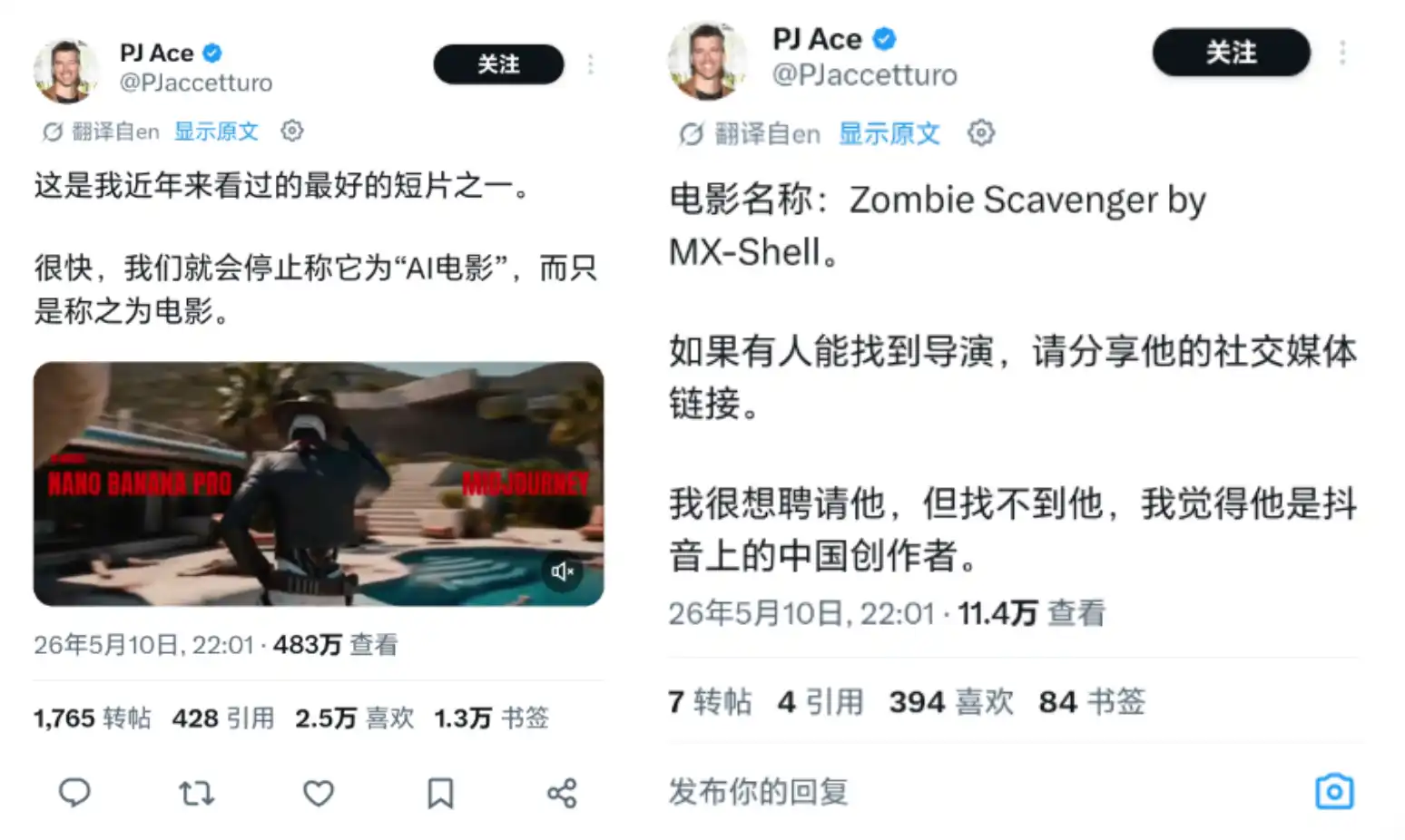
He then followed up with a search post: "I really want to hire the director of this film, but I can't find him. I think he's a Chinese creator on Douyin."

A person holding Hollywood content production resources is posting a lost-and-found notice on Twitter to find a Chinese person? The author finds this scenario even more surreal than the short film itself...

His reasoning was that before AI, something of this quality would have cost at least $500,000 and 6 months, yet this creator achieved this level with just his own efforts. So, the comments quickly turned into a search party. Some searched for the author ID 'MX-Shell', others traced clues back to Bilibili.

A large-scale cross-platform search, stretching from Hollywood to Bilibili's comment section, had just begun.

However, on the same day PJ Ace was anxiously posting missing person notices on Twitter, this short film hadn't caused much of a stir on Bilibili and Douyin, lying quietly in the information feed.

A short film made by a Chinese person using Chinese AI tools had to first circle around to the other side of the Pacific, become popular there, and then be seen by its own people. The process of this large-scale cross-platform search making its way back to China itself became an "export to domestic sales" phenomenon.

Letting the Hobby Be Seen

The person PJ Ace is looking for has labeled himself on Bilibili with five characters: Amateur Enthusiast.

The author, Mx-Shell, claims in the comments to be from Yunnan, graduated from a technical secondary school, never attended university, and never worked for any film company. The description on his Bilibili profile, 'Non-professional amateur enthusiast', seems sincerely humble rather than mere self-deprecation.

Reportedly, "Zombie Sweeper" was made by him using ByteDance's AI video tool Seedance 2.0. One person, no team, no investment, independently completed from conception to final cut, even the background music was self-produced.

The production cycle was about 10 days, with the token cost equivalent to roughly 3,000 RMB.

And then came the part the author finds most fascinating in the whole incident.

PJ Ace's search post was seen by millions on X, but Mx-Shell himself couldn't see it at all, unaware that a Hollywood director across the Pacific was looking for him.

When the news eventually made its way back to China, the comments under the video exploded, but Mx-Shell himself neither understood English nor had channels to connect with overseas media. He even posted his QQ email, asking netizens to help forward it to the other side.


Hollywood was looking for him in English on Twitter, and he was looking for Hollywood in the Bilibili comment section with a QQ email. This cross-platform conversation had a happy ending thanks to the matchmaking efforts of netizens.

Currently, PJ has already emailed him. In the letter, PJ Ace said he runs a film studio in Los Angeles, the short film got over 4 million views the day it was shared, and then asked: Are you interested in becoming a Hollywood director?

An amateur enthusiast received an olive branch extended by Hollywood. This is perhaps another wonderful and serendipitous instance of talent discovery in the AI era.

Talent Going Outbound, Export to Domestic Sales

Let's talk about why this film was quiet on Bilibili at first but exploded when posted on X.

On Bilibili, a short film labeled 'Contains AI-generated content' has to compete for the same information feed with professional animations from million-follower UP owners, gameplay streams, and popular fan-made content. Mx-Shell had only a few thousand followers at the time, no recommendation spots—a grain of sand falling into a desert.

X is a completely different world. The overseas AI creator community has developed its own ecosystem over the past two years, with key opinion leaders, consensus on evaluation, and mature dissemination networks.

PJ Ace is a core node in this ecosystem. When he saw "Zombie Sweeper," he saw the work itself; AI was just the tool. The fan base spread it through relay, igniting the content within hours.

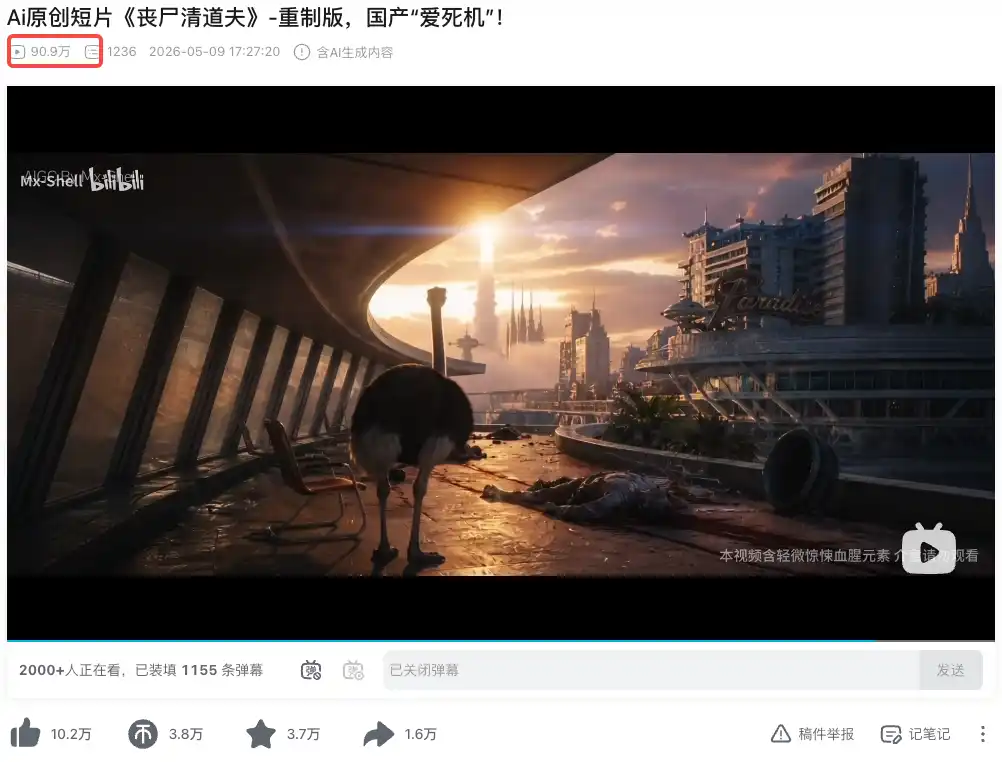
The subsequent data backflow also illustrates this point. Domestic viewers recognized its merit as well, with Bilibili garnering over 900,000 views and 100,000 likes. Content has never been the primary problem in the AI era; the problem is whether it gets delivered to the right audience.
This reminds the author of a similar phenomenon: Token outbound.

Chinese large language models sell computing power to the world via APIs. The electricity never leaves China's power grid, but value is delivered cross-border via tokens. Mx-Shell's story is the creative version of the same logic. Talent and aesthetics never left his computer, but the work, through a short film, also completed cross-border delivery. Seedance is ByteDance's, the computing power is from Chinese data centers, the creator is from Yunnan, and the first large-scale audience was across the Pacific.

If token outbound is electricity outbound, then "Zombie Sweeper" is talent outbound.

Why is this path being paved starting from China? Probably because China simultaneously possesses two things. The world's most fiercely competitive AI video tool market, where ByteDance, Alibaba, and Kuaishou are stepping on each other's toes, driving generation costs to the floor. The Seedance 2.0 used by Mx-Shell has relatively low spending costs.

And a large number of creative people who previously had no outlet—people with aesthetic sense and ideas, lacking only a handy tool.

The former gave the latter a key. Once the door was pushed open, the global market was on the other side.

AI is a Good Shovel, But You Have to Dig Yourself

The story isn't over yet.

After Mx-Shell connected with PJ Ace, he posted a lengthy article responding to the public attention. Thirteen points, each one substantial. The author thinks this text itself is worth a careful read.

He said the style of "Zombie Sweeper" is called Atom Punk, a form of retro-futurism. The creative inspiration came from Pixar's "WALL-E" and was made according to the standards of the popular Netflix series "Love, Death & Robots."

One of the creative intents was to let overseas audiences see the current level of domestic AI production.

Shot control relies on prompts, which were basically crafted by hand. Post-production was done by one person. Even the background music was original. Looking at these details together, you realize Mx-Shell is definitely not just someone who "got lucky with AI tools."

He has visual aesthetics, being a photographer by background. He has auditory aesthetics, being an independent musician. He has a sense for narrative, setting his own bar according to Love, Death & Robots standards.

AI tools gave him productivity, but the aesthetics and judgment are his own.

So, the author feels the saying "AI lets everyone make movies" is only half right. AI has indeed lowered the production barrier to the floor, but computing power can be bought; aesthetics cannot.

Anyone can use Seedance 2.0, so why was it specifically Mx-Shell who created something that made Hollywood post a search notice? The tools are equal, but the people using them are vastly different.

This leads to another interesting angle.

The investment ByteDance has put into Seedance 2.0 is unknown to the outside world, but so far, the best advertisement for this tool might have been made by a technical secondary school graduate from Yunnan.

ByteDance's marketing department couldn't have planned such a story because the story's persuasive power lies precisely in it being spontaneous, grassroots, and unexpected.

The strongest proof for a platform product is always users creating things that exceed the platform's expectations. Taobao's early benchmark stories were rural women earning millions selling local specialties; YouTube's benchmark was teenagers in bedrooms making shows better than TV. Seedance 2.0's benchmark story is more creators like Mx-Shell.

According to DataEye data, the overseas AI short drama and webtoon market size is expected to reach $650 million in 2026, a sixfold year-on-year increase. Currently, two paths are running in this market:

One is the industrial route. Domestic teams mass-produce AI short dramas—zombies, werewolves, rags-to-riches stories—packaged into genre shells familiar to Western audiences, monetized through TikTok ad buys. Reports indicate multiple works have already achieved tens of millions of views. This path competes on capital, team, and production capacity, somewhat like the short video factories of the past.

The other is the path Mx-Shell took. One person, one computer, no ad buys, no scale. The content itself is the driving force for dissemination. A few thousand RMB in token cost, less than two weeks in cycle, exchanged not for platform revenue share, but for Hollywood actively reaching out.

Both paths can succeed, but the author finds the second path more noteworthy.

Because the barrier to the first path is money. If you have money, you can do it; it doesn't have much to do with the individual creator. The barrier to the second path is the person—the aesthetics, the judgment of content. These things AI cannot give you, and money cannot buy them.

He won't be the last to walk this path.

China has a large number of creators with aesthetic sense, ideas, and a desire to express. Previously, what stood in their way was equipment, funds, teams, education. Now, these barriers are being dismantled one by one by AI tools. The only remaining question is: how to be seen?

Mx-Shell's answer was a QQ email and a group of enthusiastic netizens. The next person might have a different method.

But before a truly developed domestic ecosystem for AI creation grows, this detour of export to domestic sales will probably have to be taken a while longer.


Questions liées

QWho is looking for the Chinese creator of the AI short film 'Zombie Scavenger', and why is it significant?

APJ Ace, the founder of the Hollywood AI film studio Genre.ai, is searching for the creator because he believes the short film is one of the best he's seen in recent years. This is significant as it represents a top Hollywood professional actively seeking out and offering opportunities to an unknown, self-taught creator from China, highlighting how AI is democratizing creative recognition.

QWhat key details about the creator Mx-Shell and the film's production are mentioned in the article?

AThe creator, Mx-Shell, is a self-described amateur from Yunnan with a technical secondary school education and no formal film training or industry experience. He produced 'Zombie Scavenger' independently in about 10 days using ByteDance's AI tool Seedance 2.0, with a cost of approximately 3000 RMB (in tokens). He handled the concept, visuals, and even composed the original soundtrack himself.

QAccording to the article, what are the two different paths emerging for Chinese AI short film creators targeting the overseas market?

AThe two paths are: 1) An industrialized route, where domestic teams mass-produce AI short dramas (e.g., zombie, werewolf, revenge stories) tailored for Western audiences, relying on TikTok advertising for monetization. 2) An individual creator path, exemplified by Mx-Shell, where a single person uses AI tools to create high-quality, original content that gains traction through its own artistic merit, leading to opportunities like the one from Hollywood.

QWhy did the short film initially gain massive attention on X (Twitter) but not on Bilibili?

AOn Bilibili, the film was buried in a vast information stream competing with content from established creators. On X, it was discovered and shared by PJ Ace, a key influencer within the established overseas AI creator community. His endorsement triggered a network effect, rapidly amplifying the film's visibility to millions, demonstrating the power of niche, connected communities versus broad, saturated platforms.

QWhat does the article suggest is the 'real barrier' for creators in the AI era, and what role does AI play?

AThe article suggests that the real, lasting barrier is not access to tools or capital (which AI has dramatically lowered), but the creator's inherent aesthetic sense, judgment, and narrative ability—qualities that AI cannot provide. AI acts as a powerful 'shovel' that removes production hurdles, but the 'treasure'—the valuable, standout content—must be unearthed by the creator's own vision and taste.

Lectures associées

Le Sénat progresse vers la Loi CLARITY : L'objectif de signature en août reste d'actualité, pour l'instant

Le Sénat américain a franchi des étapes clés pour le CLARITY Act, grâce aux travaux des comités de l'agriculture et du bancaire. Le texte entre désormais dans une phase critique pour déterminer s'il pourra être adopté cette année. Les soutiens du projet de loi sur la clarté des marchés des actifs numériques reconnaissent une réelle dynamique, mais la voie reste étroite sur les plans procédural et politique, avec la nécessité de fusionner différentes versions sénatoriales. L'administration vise un passage à la Chambre des représentants début juillet. Cependant, des divergences persistent, notamment sur des garde-fous éthiques pour les responsables publics traitant des cryptomonnaies, une condition jugée "non-négociable" par certains démocrates. D'autres sénateurs démocrates réclament également des garanties sur les moyens d'application de la loi pour les autorités. Le délai de la pause parlementaire d'août est perçu par certains comme une date limite effective, au-delà de laquelle les priorités législatives risquent d'être reléguées. D'autres observateurs, plus optimistes, estiment que la volonté politique est suffisamment forte pour maintenir le texte à l'agenda du 119e Congrès, même s'un report l'année prochaine pourrait le rendre vulnérable aux changements liés aux élections de mi-mandat.

bitcoinistIl y a 43 mins

Le Sénat progresse vers la Loi CLARITY : L'objectif de signature en août reste d'actualité, pour l'instant

bitcoinistIl y a 43 mins

Les cryptomonnaies ciblent le marché américain des pensions de retraite de 49 000 milliards de dollars

L'univers de la cryptomonnaie cible désormais le colossal marché américain des retraites, évalué à 49 100 milliards de dollars. Le véhicule d'entrée privilégié est le compte de retraite individuel auto-géré (Self-Directed IRA), qui permet d'investir dans des actifs non traditionnels. IRA Financial, un acteur majeur du secteur, a lancé une plateforme intégrée permettant de négocier près de 100 cryptomonnaies tout en détenant des actions, de l'immobilier ou des métaux précieux dans un même compte, pour des frais annuels forfaitaires. Son fondateur, Adam Bergman, critique vivement les grandes institutions financières qu'il accuse d'avoir limité l'accès aux actifs alternatifs par intérêt. Un changement réglementaire récent, avec le retrait d'un avertissement prudentiel du Département du Travail et un décret présidentiel, ouvre la voie à une inclusion plus large des actifs numériques dans les plans de retraite. Cependant, les risques sont significatifs. Les comptes auto-gérés exigent une grande diligence de l'investisseur, sont exposés aux piratages (comme en a subi un IRA Financial en 2022) et une mauvaise gestion des clés privées peut entraîner la disqualification fiscale du compte. Malgré ces périls, Bergman défend l'idée que la diversification vers les actifs alternatifs est une clé de l'enrichissement à long terme. L'accès des cryptomonnaies à l'épargne-retraite grand public s'élargit, mais il requiert une évaluation minutieuse des risques et une planification professionnelle.

marsbitIl y a 53 mins

Les cryptomonnaies ciblent le marché américain des pensions de retraite de 49 000 milliards de dollars

marsbitIl y a 53 mins

Discussions sur le crypto de Reddit : Après 8 mois de course effrénée des actions technologiques, la communauté crypto commence-t-elle à « accepter son sort » ?

Une discussion sur Reddit, dans le sous-forum r/CryptoMarkets, résume l'état d'esprit actuel de la communauté crypto. Face à la performance soutenue des actions technologiques (S&P 500 +9.7%, Nasdaq +13.6% depuis début 2026), le marché des cryptomonnaies apparaît atone, avec Bitcoin en recul d'environ 20% sur la même période depuis son pic historique de fin 2025. Le débat oppose principalement deux visions. D'un côté, les partisans du cycle, arguant que Bitcoin a survécu à de multiples "morts" et que le prochain bull run arrivera inévitablement, peut-être vers 2029. De l'autre, les sceptiques estiment que le récit d'investissement s'essouffle, notant que les cryptos manquent cruellement de cas d'usage réels et pertinents comparés à la révolution de l'IA. Un troisième point de vue émerge : le vrai concurrent n'est pas un autre actif spéculatif, mais l'IA, qui capte toute l'attention et les capitaux. La principale utilité des cryptos reste la spéculation, et le paradoxe d'un actif devant être stable pour être utile mais volatile pour attirer les investisseurs est pointé du doigt. Les données objectives vont dans le sens d'un désintérêt : les ETF spot Bitcoin ont enregistré des sorties nettes record de 2,3 milliards de dollars en mai 2026, indiquant un retrait institutionnel. L'indice de Peur et Cupidité est au plus bas de l'année. La question centrale reste : quand les capitaux reviendront-ils ? La réponse majoritaire est pragmatique : dans un environnement de taux d'intérêt élevés offrant des rendements attractifs sur les actifs traditionnels, l'incitation à se tourner vers des actifs risqués comme les cryptos est faible. L'anxiété de la communauté vient moins de la disparition des cryptos que du coût d'opportunité de rester à l'écart d'autres marchés performants.

marsbitIl y a 55 mins

Discussions sur le crypto de Reddit : Après 8 mois de course effrénée des actions technologiques, la communauté crypto commence-t-elle à « accepter son sort » ?

marsbitIl y a 55 mins

Chatbot dépense de l'argent depuis trois ans, est-ce toujours la « nouvelle frontière » de l'ère de l'IA ?

Ces dernières années, le secteur de l'IA a largement parié sur le chatbot comme le futur « super point d'entrée » et la nouvelle frontière de valeur, inspiré par le succès foudroyant de ChatGPT. Cependant, après trois ans de développement et d'importants investissements, ce modèle économique montre ses limites. Les principaux acteurs comme OpenAI, malgré des centaines de millions d'utilisateurs, peinent à être rentables, chaque requête entraînant des coûts de calcul élevés. Contrairement aux produits Internet classiques, le chatbot ne bénéficie pas d'effets de réseau ou de coûts marginaux nuls. Sa croissance aggrave même ses pertes. Le modèle d'abonnement grand public rencontre des difficultés, particulièrement en Chine où les utilisateurs rechignent à payer. La publicité, considérée comme un recours, s'avère peu adaptée à l'interface conversationnelle et à l'attente d'exactitude des réponses. Parallèlement, une voie différente émerge. Anthropic, dont 85% des revenus proviennent des entreprises, a dépassé OpenAI en chiffre d'affaires. Cela révèle une demande plus forte pour des assistants capables d'exécuter des tâches (Agents) que pour de simples interfaces de dialogue. Des études confirment que la majorité des interactions visent des usages professionnels. Le chatbot, conçu pour le dialogue universel, enferme l'IA dans un échange tour par tour et passif. Son avenir semble résider dans l'évolution vers des Agents plus autonomes ou, plus radicalement, dans l'intégration de l'IA directement dans les applications existantes, les systèmes d'exploitation ou le matériel, plutôt que dans une application autonome. En conclusion, le chatbot s'avère être une forme intermédiaire, et non une fin en soi, sur la voie vers l'IA générale. La « nouvelle terre promise » de l'IA ne sera peut-être pas un dialogueur unique, mais une capacité diffuse et exécutante, intégrée partout. Il est temps d'abandonner la « vieille carte » du super point d'entrée pour en dessiner de nouvelles.

marsbitIl y a 1 h

Chatbot dépense de l'argent depuis trois ans, est-ce toujours la « nouvelle frontière » de l'ère de l'IA ?

marsbitIl y a 1 h

Trading

Spot
Futures
活动图片




