Did Maduro Really Hide $60 Billion in BTC?

marsbitPublié le 2026-01-06Dernière mise à jour le 2026-01-06

Résumé

The article investigates the unverified claim that former Venezuelan President Nicolás Maduro's regime secretly amassed a "shadow reserve" of 600,000 to 660,000 Bitcoins, valued at $60-67 billion, prior to his arrest by US forces in January 2026. This amount would rival the holdings of the largest corporate Bitcoin buyer, MicroStrategy. The report outlines three potential, yet unconfirmed, methods for accumulation: 1. **The failed Petro scheme:** The state-backed cryptocurrency, Petro, was likely a facade but established a regulatory body (Sunacrip) that potentially facilitated money laundering and a strategic pivot to holding Bitcoin. 2. **The PDVSA-Crypto scandal:** An estimated $21 billion in oil export receivables from the state oil company went missing between 2020-2023. Intelligence suggests funds may have been laundered through USDT and converted to Bitcoin via a complex, automated system. 3. **Military mining:** The regime's military commercial arm allegedly confiscated thousands of private mining rigs and operated mining facilities with heavily subsidized electricity, potentially generating tens of thousands of BTC. The article heavily emphasizes that the 600k BTC figure is based on human intelligence (HUMINT) and lacks verifiable on-chain evidence. If the reserve exists, access would likely be controlled via a multi-signature wallet by key figures like financier Alex Saab or Maduro's family. The potential market impact is significant, ranging from neutral (if t...

Author: Cathy, Baihua Blockchain

In the early hours of January 3, 2026, U.S. special forces arrested Venezuelan President Nicolás Maduro in Caracas during a military operation codenamed "Absolute Resolve."

This event sparked a major question in the crypto community: Did the Maduro regime really possess the rumored "shadow reserves"?

According to a report from the investigative agency Whale Hunting and multiple intelligence sources, a staggering rumor has been circulating in the market: the Maduro regime may hold 600,000 to 660,000 Bitcoin. If true, this would be worth a staggering $60-67 billion at market prices in early 2026.

What does this mean?

MicroStrategy (now renamed Strategy), the company known as the "Bitcoin whale," held over 670,000 BTC as of January 2026, worth approximately $61.3 billion. If the Venezuelan rumors are true, its holdings would be comparable to the world's largest corporate buyer, representing about 3% of Bitcoin's total supply (21 million coins).

But the question is: Does this fortune actually exist? And if it does, where is it hidden?

In the crypto world, there is an ironclad rule: "Not your keys, not your coins."

01 How Did the Rumor Originate?

To understand where the rumor of "600,000 BTC" came from, we first need to understand the theoretical avenues through which the Maduro regime could have accumulated Bitcoin. It must be emphasized that the following analysis is based on public reports and intelligence estimates, not proven facts.

Avenue One: The Petro Scam — Paving the Way for Crypto-fication

In February 2018, under heavy pressure from U.S. sanctions, Maduro announced the launch of the world's first "national cryptocurrency" — the Petro. The government claimed to raise $735 million on the first day, with a total fundraising target of $6 billion.

But multiple investigations showed that this ICO had serious problems from the start.

The Petro was first claimed to be based on Ethereum, then on NEM, and finally seemed to run on a private chain that didn't exist. The government claimed the Petro was backed by 5.3 billion barrels of crude oil in the Ayacucho block, but field investigations revealed dilapidated infrastructure with no mining activity whatsoever.

The so-called "financing" was likely just an internal shuffling of regime assets.

But while the Petro failed, it left a crucial byproduct: Sunacrip (National Superintendency of Crypto Assets). This agency was given the power to regulate all crypto activities, issue mining licenses, and even directly operate national mining pools. It wasn't a regulator; it was a national money laundering center.

In January 2024, Maduro officially shut down the Petro. This wasn't a failure, but a strategic pivot — from "issuer" to "holder," fully transitioning to Bitcoin and USDT, which have genuine global liquidity.

Avenue Two: The PDVSA-Crypto Scandal — $21 Billion Unaccounted For

Market rumors suggest the core source of the Maduro regime's Bitcoin reserves may have been the diversion of oil export revenues from the state-owned oil company PDVSA.

In 2019, the U.S. imposed comprehensive sanctions on PDVSA, cutting off its access to the global banking system. To survive, PDVSA initiated an "anti-blockade" strategy:

Dark Fleet: Using tankers with transponders turned off to ship crude oil to "teapot refineries" (small, non-state-owned refineries) in Asia.

Intermediary Network: Masking the origin of crude through shell companies registered in the UAE, Russia, and elsewhere. These intermediaries often had no oil trading experience; their only qualification was personal connections to the regime's core figures.

Crypto Settlements: Unable to receive dollar wire transfers, intermediaries were instructed to pay for oil in USDT (Tether).

In March 2023, Venezuela was rocked by the shocking "PDVSA-Crypto" scandal. An internal government audit revealed that approximately $21 billion in accounts receivable from oil exports between 2020 and 2023 was unaccounted for.

Where did this money go? It remains a mystery to this day.

Some intelligence analysts speculate that a portion of it may have found its way back to regime-controlled wallets via cryptocurrency. Reportedly, Sunacrip established an automated "springboard" mechanism:

  • Receive: Intermediaries send USDT to intermediate wallets controlled by Sunacrip
  • Launder: Obfuscate fund trails through mixers like Tornado Cash
  • Exchange: Convert USDT to Bitcoin at OTC desks in Russia or Eastern Europe
  • Store: Bitcoin transferred to offline-generated cold wallets, with private keys held by the highest echelons of the regime

The architects of this system were Tareck El Aissami (former Oil Minister) and Alex Saab (the regime's "financial diplomat"). El Aissami resigned in March 2023 and was arrested in April 2024 on corruption charges, facing counts of treason, money laundering, and more. The assets he controlled were likely confiscated by the Maduro family.

Saab returned to Venezuela in a prisoner swap with the U.S. in December 2023, with Maduro exchanging 10 American prisoners for this financial architect, highlighting his perceived indispensability — an importance likely stemming from his control over financial lifelines.

Avenue Three: Military Mining — "National Hashrate" from Confiscated Rigs

Beyond oil revenues, another theory suggests the Venezuelan regime may have directly produced Bitcoin by controlling the "means of production."

Venezuela has some of the world's cheapest electricity, primarily from the Guri Dam. This makes Bitcoin mining highly profitable. The Maduro government monopolized this advantage through a military commercial entity — CAMIMPEG (Military Company for Mining, Oil, and Gas).

CAMIMPEG established "Bolivarian Army Digital Asset Production Centers." These military mining farms enjoyed privileges:

  • Guaranteed Power: Priority access to electricity amid nationwide frequent blackouts
  • Security: Heavily guarded by the National Guard
  • Near-Zero Operating Costs: As electricity was effectively free (state-subsidized), marginal costs were near zero

But where did the equipment for these military farms come from? Largely from the confiscation of private miners.

Starting in 2020, Sunacrip, in conjunction with the military, launched a series of raids on private mining operations:

  • 2020: National Guard seizes 315 Antminer S9 units in Bolívar state
  • 2023: Raid on the headquarters of the "Tren de Aragua" gang in Tocorón Prison, seizing numerous miners and weapons
  • 2024: Over 2,300 Antminer S19J Pro units seized in a single operation in Maracay

According to intelligence sources, between 2020 and 2025, the government may have acquired tens of thousands of mining machines through confiscations from private farms and gang facilities. These devices were not destroyed but redeployed to CAMIMPEG-controlled facilities.

Based on the known thousands of high-performance miners, plus output from state-owned farms, this "zombie army" could have produced tens of thousands of Bitcoin over the past several years.

02 Data Sources and Skepticism Regarding the "600,000 BTC" Rumor

Key Question: Is this number credible?

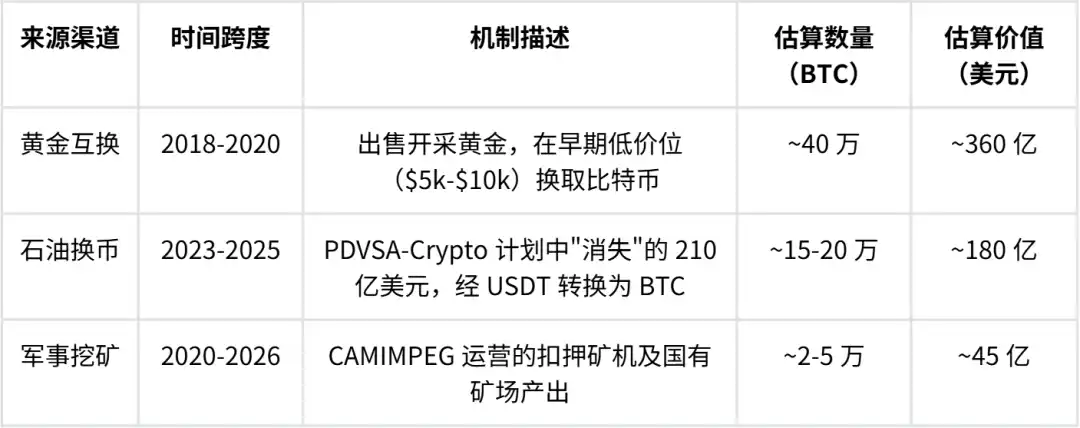
Based on intelligence reports from Chainalysis, TRM Labs, and the investigative agency "Whale Hunting," the estimated figure circulating in the market is 600,000 to 660,000 BTC. But it must be emphasized:

This figure comes solely from intelligence sources, not verifiable on-chain hard data

No public on-chain evidence supports this number

The Whale Hunting report explicitly states: "This estimate is from HUMINT (Human Intelligence), unconfirmed by blockchain analysis"

Nonetheless, the report still provided a hypothetical breakdown:
Is this rumor logically plausible?

Supporters' View:

MicroStrategy Comparison: MicroStrategy (now Strategy) held over 670,000 BTC as of January 2026. A sovereign nation theoretically has the capacity to reach a similar scale.

Funding Basis: PDVSA had $21 billion unaccounted for in 2020-2023. If 50% of that was converted to Bitcoin, it could have purchased 300,000-400,000 BTC at average prices of the time.

Skeptics' View:

  • Lack of On-Chain Evidence: If 600,000 BTC truly existed, traces should be found on the blockchain, but no one has been able to point to specific addresses.
  • Suspiciously Round Number: The figure 600,000 seems more like an estimate than an actual count and may be significantly overestimated.
  • Questionable Motive: This rumor might be used for political purposes or market manipulation.

Conclusion: In the absence of concrete blockchain evidence, this remains an unverified rumor.

03 If the Rumor is True: Who Would Hold the Private Keys?

Assuming this "shadow reserve" does exist, even Maduro's arrest does not mean the U.S. can control it.

The FBI's primary challenge would be: How to prove the existence of these Bitcoins, and how to find the private keys?

Who might hold the private keys?

If this asset exists, intelligence analysts speculate it is unlikely managed by a single account. It's more likely to use a multi-signature (Multisig) or private key sharding scheme.

Theoretical key holders might include:

  • Alex Saab: As the regime's financial architect, Saab not only understands the full picture of fund flows but likely holds the crucial seed phrases or knows the physical location of hardware wallets needed to recover the wallets. His return to Venezuela in the December 2023 prisoner swap — 10 American prisoners exchanged for this financial brain — demonstrates his irreplaceability to the regime.
  • Nicolasito (Maduro's Son): Named in indictments, Maduro's son was deeply involved in illegal gold mining and the regime's daily operations, potentially holding a backup of the family's portion of the private keys.
  • Cilia Flores (First Lady): Known as the "First Combatant," she holds a high position within the regime's inner circle. She might control physical access to some cold wallets.
  • Technocrat Layer: Former Sunacrip technicians might be responsible for maintaining the multi-signature technical infrastructure. While they might not know the full keys, their cooperation could be crucial for reconstructing wallet access.

Speculated Crypto Architecture

The most likely architecture is an M-of-N signature scheme (e.g., 3/5 or 5/7). This means signatures from 3 out of 5 core individuals would be required to move the funds.

If Maduro, Flores, and Saab were all under U.S. control, theoretically, the U.S. could compel them to cooperate in unlocking the funds. But reality is far more complex:

  • Geographic Dispersion: Cold wallets could be stored分散ly in bunkers in Caracas, safety deposit boxes in Russia, or safe houses in Cuba.
  • Dead Man's Switch: The system might include an automatic trigger mechanism. If specific actions aren't performed for a prolonged period (e.g., Maduro goes missing), funds could automatically transfer to irrecoverable addresses or be sent to allies.
  • Ideological Resistance: Even facing life imprisonment, key holders might refuse to cooperate. For them, this is not just wealth but the final weapon against "American imperialism."

04 Market Impact: The Rumor Itself is Uncertainty

Even if unverified, this rumor has become a "Sword of Damocles" hanging over the crypto market. 600,000 Bitcoin represents 3% of BTC's total supply. If real, the impact would be massive.

Three Possible Scenarios

Scenario One: Rumor is False

If thorough investigation by the FBI and blockchain analysis firms ultimately proves this "shadow reserve" does not exist or is severely overestimated, the market might breathe a sigh of relief. This means no potential selling pressure, neutral or slightly bullish for price.

Scenario Two: Rumor is True and FBI Gains Control

If the asset exists and the U.S. successfully seizes it, following procedure, these Bitcoin would enter judicial freezing, potentially locked for years. This effectively removes a huge supply from circulation, reducing market float, which is bullish for price.

This is similar to the FBI's seizure of Silk Road Bitcoin in 2013. Around 170,000 BTC were frozen and eventually auctioned in batches. But during the freeze, these coins were effectively out of circulation, objectively reducing selling pressure.

Scenario Three: Rumor is True but Keys are Lost

This is the most dangerous scenario. If the asset exists but the private keys are not controlled by the U.S., remnants of the fleeing regime might attempt to sell Bitcoin on OTC markets for escape funds, triggering panic selling.

The German government's sale of just 50,000 BTC in 2024 caused short-term market volatility. 600,000 would be catastrophic.

05 Summary

Maduro's arrest has revealed a glimpse of the Venezuelan regime's use of cryptocurrency to evade sanctions.

From the failed Petro experiment to the $21 billion PDVSA-Crypto scandal, to militarized mining facilities — these are all confirmed facts. But the rumor of a "600,000 BTC shadow reserve" still lacks concrete evidence.

What we can confirm: Venezuela did use crypto to evade sanctions, PDVSA did have $21 billion unaccounted for, and the regime did confiscate大量 mining equipment.

What we cannot confirm includes: Whether 600,000 BTC were actually accumulated, who holds the private keys (if they exist), and whether these Bitcoin will enter the market.

It does raise a尖锐 question: When decentralized technology is used to evade sanctions, how do we find the balance between freedom and order?

But until more evidence surfaces, the "$60 billion shadow reserve" remains just an unverified rumor.


Questions liées

QWhat is the core rumor surrounding Nicolás Maduro's regime and Bitcoin, as discussed in the article?

AThe core rumor is that Nicolás Maduro's regime may have secretly accumulated a 'shadow reserve' of 600,000 to 660,000 Bitcoin, valued at approximately $60-67 billion at early 2026 prices.

QAccording to the article, what were the three main theoretical pathways through which the Maduro regime could have accumulated Bitcoin?

AThe three main theoretical pathways were: 1) Profits and infrastructure from the failed 'Petro' cryptocurrency scheme. 2) Diversion of oil export revenues from the state oil company PDVSA, specifically the $21 billion in unaccounted receivables. 3) Confiscation and operation of mining equipment through military-controlled mining facilities (CAMIMPEG).

QWhat key piece of evidence casts doubt on the credibility of the '600,000 BTC' rumor?

AThe key doubt is the lack of any verifiable on-chain evidence. The number is based on human intelligence (HUMINT) estimates from sources like Whale Hunting and has not been confirmed by blockchain analysis. No specific wallet addresses have been identified to support such a large holding.

QIf the Bitcoin reserve is real, who are the speculated key holders of the private keys, and why?

AThe speculated key holders are: Alex Saab (the regime's financial architect, likely holding critical seed phrases), Nicolasito (Maduro's son, involved in illicit operations), Cilia Flores (the First Lady, with high status), and a layer of technocrats from Sunacrip (who maintained the multisig technical architecture). This suggests a distributed, multisignature wallet structure.

QWhat are the three potential market impact scenarios described if the rumor is true?

A1) The rumor is false: No impact or slightly positive as fear of a massive sell-off is removed. 2) The BTC is real and seized by the FBI: Bullish, as the coins would be frozen, reducing circulating supply. 3) The BTC is real but the private keys are lost/controlled by regime remnants: Bearish, as they could attempt a massive OTC sell-off, causing panic and a price crash.

Lectures associées

Trading

Spot
Futures

Articles tendance

Qu'est ce que BITCOIN

Comprendre HarryPotterObamaSonic10Inu (ERC-20) et sa position dans l'espace crypto Ces dernières années, le marché des cryptomonnaies a connu une augmentation de la popularité des monnaies mèmes, suscitant l'intérêt non seulement des traders, mais aussi de ceux qui recherchent un engagement communautaire et une valeur divertissante. Parmi ces jetons uniques, HarryPotterObamaSonic10Inu (ERC-20) est un projet intrigant qui mêle des références culturelles à l'univers des cryptomonnaies. Cet article explore les aspects clés de HarryPotterObamaSonic10Inu, en examinant ses mécanismes, son ethos axé sur la communauté, et son engagement avec le paysage crypto plus large. Qu'est-ce que HarryPotterObamaSonic10Inu (ERC-20) ? Comme son nom l'indique, HarryPotterObamaSonic10Inu est une monnaie mème construite sur la blockchain Ethereum, classée selon la norme ERC-20. Contrairement aux cryptomonnaies traditionnelles qui peuvent mettre l'accent sur l'utilité pratique ou le potentiel d'investissement, ce jeton prospère grâce à sa valeur divertissante et à la force de sa communauté. Le projet vise à favoriser un environnement où des utilisateurs engagés peuvent se rassembler, partager des idées et participer à des activités inspirées par divers phénomènes culturels. Une caractéristique notable de HarryPotterObamaSonic10Inu est son absence de taxe sur les transactions. Cet élément attrayant vise à encourager le trading et l'implication de la communauté, sans frais supplémentaires pouvant décourager les petits traders. L'offre totale de la monnaie est fixée à un milliard de jetons, un chiffre qui marque son intention de maintenir une circulation substantielle au sein de la communauté. Créateur de HarryPotterObamaSonic10Inu (ERC-20) Les origines de HarryPotterObamaSonic10Inu sont quelque peu obscures ; les détails concernant le créateur restent inconnus. Le développement de ce jeton ne comporte pas d'équipe identifiable ou de plan explicite, ce qui n'est pas rare dans le secteur des monnaies mèmes. Au lieu de cela, le projet a émergé de manière organique, son progrès s'appuyant fortement sur l'enthousiasme et la participation de sa communauté. Investisseurs de HarryPotterObamaSonic10Inu (ERC-20) En ce qui concerne les investissements externes et le soutien, HarryPotterObamaSonic10Inu reste également ambigu. Le jeton ne mentionne aucune fondation d'investissement connue ou un soutien organisationnel significatif. Au lieu de cela, le cœur battant du projet est sa communauté de base, qui informe sa croissance et sa durabilité par des actions collectives et un engagement dans l'espace crypto. Comment fonctionne HarryPotterObamaSonic10Inu (ERC-20) ? En tant que monnaie mème, HarryPotterObamaSonic10Inu opère principalement en dehors des cadres traditionnels qui régissent souvent la valeur des actifs. Plusieurs aspects distinctifs définissent comment le projet fonctionne : Transactions sans taxe : Sans frais de taxe sur les transactions, les utilisateurs peuvent acheter et vendre librement le jeton sans se préoccuper de frais cachés. Engagement communautaire : Le projet prospère grâce à l'interaction communautaire, exploitant les plateformes de médias sociaux pour créer du bruit et faciliter l'implication. Les discussions, le partage de contenu et l'engagement sont des éléments cruciaux qui aident à étendre sa portée et à favoriser la loyauté parmi les supporters. Pas d'utilité pratique : Il est important de noter que HarryPotterObamaSonic10Inu n'offre pas d'utilité concrète au sein de l'écosystème financier. Au contraire, il est classé comme un jeton principalement pour des activités de divertissement et communautaires. Référence culturelle : Le jeton intègre habilement des éléments de la culture populaire pour susciter l'intérêt, s'adressant à la fois aux amateurs de mèmes et aux suiveurs de crypto. HarryPotterObamaSonic10Inu illustre comment les monnaies mèmes fonctionnent différemment des projets de cryptomonnaies plus traditionnels, entrant sur le marché en tant que constructions sociales innovantes plutôt qu'actifs utilitaires. Chronologie de HarryPotterObamaSonic10Inu (ERC-20) L'histoire de HarryPotterObamaSonic10Inu est jalonnée de plusieurs étapes notables : Création : Le jeton est né d'un mème viral, captivant l'imagination de nombreux passionnés de crypto. Les dates de création spécifiques ne sont pas disponibles, soulignant son ascension organique. Listing sur les échanges : HarryPotterObamaSonic10Inu a fait son apparition sur divers échanges, permettant un accès et un trading plus faciles par la communauté. Initiatives d'engagement communautaire : Activités en cours visant à améliorer l'interaction communautaire, y compris des concours, des campagnes sur les réseaux sociaux, et la génération de contenu par des fans et des défenseurs. Plans d'expansion futurs : La feuille de route du projet comprend le lancement d'une collection NFT, de marchandises, et d'un site eCommerce lié à ses thèmes culturels, engageant davantage la communauté et tentant d'ajouter plus de dimensions à son écosystème. Points clés concernant HarryPotterObamaSonic10Inu (ERC-20) Nature axée sur la communauté : Le projet privilégie l'apport collectif et la créativité, garantissant que l'implication des utilisateurs est au cœur de son développement. Classification de monnaie mème : Il représente l'apogée de la cryptomonnaie basée sur le divertissement, se distinguant des véhicules d'investissement traditionnels. Pas d'affiliation directe avec Bitcoin : Malgré la similitude dans le nom du ticker, HarryPotterObamaSonic10Inu est distinct et n'a aucun lien avec Bitcoin ou d'autres cryptomonnaies établies. Focus sur la collaboration : HarryPotterObamaSonic10Inu est conçu pour créer un espace de collaboration et de partage d'histoires parmi ses détenteurs, offrant une voie pour la créativité et le lien communautaire. Perspectives d'avenir : L'ambition de s'étendre au-delà de son concept initial vers des NFT et des marchandises dessine un chemin pour le projet afin de potentiellement entrer dans des avenues plus grand public au sein de la culture numérique. Alors que les monnaies mèmes continuent de captiver l'imagination de la communauté des cryptomonnaies, HarryPotterObamaSonic10Inu (ERC-20) se distingue par ses liens culturels et son approche centrée sur la communauté. Bien qu'il ne corresponde pas au modèle typique d'un jeton axé sur l'utilité, son essence réside dans la joie et la camaraderie cultivées parmi ses supporters, soulignant la nature en évolution des cryptomonnaies dans un âge de plus en plus numérique. À mesure que le projet continue de se développer, il sera important de surveiller comment les dynamiques communautaires influencent sa trajectoire dans le paysage toujours changeant de la technologie blockchain.

1.3k vues totalesPublié le 2024.04.01Mis à jour le 2024.12.03

Qu'est ce que BITCOIN

Comment acheter BTC

Bienvenue sur HTX.com ! Nous vous permettons d'acheter Bitcoin (BTC) de manière simple et pratique. Suivez notre guide étape par étape pour commencer votre parcours crypto.Étape 1 : Création de votre compte HTXUtilisez votre adresse e-mail ou votre numéro de téléphone pour ouvrir un compte sur HTX gratuitement. L'inscription se fait en toute simplicité et débloque toutes les fonctionnalités.Créer mon compteÉtape 2 : Choix du mode de paiement (rubrique Acheter des cryptosCarte de crédit/débit : utilisez votre carte Visa ou Mastercard pour acheter instantanément Bitcoin (BTC).Solde :utilisez les fonds du solde de votre compte HTX pour trader en toute simplicité.Prestataire tiers :pour accroître la commodité d'utilisation, nous avons ajouté des modes de paiement populaires tels que Google Pay et Apple Pay.P2P :tradez directement avec d'autres utilisateurs sur HTX.OTC (de gré à gré) : nous offrons des services personnalisés et des taux de change compétitifs aux traders.Étape 3 : stockage de vos Bitcoin (BTC)Après avoir acheté vos Bitcoin (BTC), stockez-les sur votre compte HTX. Vous pouvez également les envoyer ailleurs via un transfert sur la blockchain ou les utiliser pour trader d'autres cryptos.Étape 4 : tradez des Bitcoin (BTC)Tradez facilement Bitcoin (BTC) sur le marché Spot de HTX. Il vous suffit d'accéder à votre compte, de sélectionner la paire de trading, d'exécuter vos trades et de les suivre en temps réel. Nous offrons une expérience conviviale aux débutants comme aux traders chevronnés.

5.0k vues totalesPublié le 2024.12.12Mis à jour le 2025.03.21

Comment acheter BTC

Qu'est ce que $BITCOIN

OR DÉMATÉRIEL ($BITCOIN) : Une Analyse Complète Introduction à OR DÉMATÉRIEL ($BITCOIN) OR DÉMATÉRIEL ($BITCOIN) est un projet basé sur la blockchain opérant sur le réseau Solana, qui vise à combiner les caractéristiques des métaux précieux traditionnels avec l'innovation des technologies décentralisées. Bien qu'il partage un nom avec Bitcoin, souvent appelé “or numérique” en raison de sa perception en tant que réserve de valeur, OR DÉMATÉRIEL est un jeton distinct conçu pour créer un écosystème unique au sein du paysage Web3. Son objectif est de se positionner comme un actif numérique alternatif viable, bien que les spécificités concernant ses applications et fonctionnalités soient encore en développement. Qu'est-ce qu'OR DÉMATÉRIEL ($BITCOIN) ? OR DÉMATÉRIEL ($BITCOIN) est un jeton de cryptomonnaie explicitement conçu pour une utilisation sur la blockchain Solana. Contrairement à Bitcoin, qui joue un rôle de stockage de valeur largement reconnu, ce jeton semble se concentrer sur des applications et caractéristiques plus larges. Les aspects notables incluent : Infrastructure Blockchain : Le jeton est construit sur la blockchain Solana, connue pour sa capacité à gérer des transactions rapides et peu coûteuses. Dynamique de l'Offre : OR DÉMATÉRIEL a une offre maximale plafonnée à 100 quadrillions de jetons (100P $BITCOIN), bien que les détails concernant son offre en circulation soient actuellement non divulgués. Utilité : Bien que les fonctionnalités précises ne soient pas explicitement décrites, il y a des indications que le jeton pourrait être utilisé pour diverses applications, impliquant potentiellement des applications décentralisées (dApps) ou des stratégies de tokenisation d'actifs. Qui est le Créateur d'OR DÉMATÉRIEL ($BITCOIN) ? À l'heure actuelle, l'identité des créateurs et de l'équipe de développement derrière OR DÉMATÉRIEL ($BITCOIN) reste inconnue. Cette situation est typique parmi de nombreux projets innovants dans l'espace blockchain, en particulier ceux alignés avec la finance décentralisée et les phénomènes de meme coin. Bien qu'une telle anonymité puisse favoriser une culture axée sur la communauté, elle intensifie les préoccupations concernant la gouvernance et la responsabilité. Qui sont les Investisseurs d'OR DÉMATÉRIEL ($BITCOIN) ? Les informations disponibles indiquent qu'OR DÉMATÉRIEL ($BITCOIN) n'a pas de bailleurs de fonds institutionnels connus ou d'investissements en capital-risque notables. Le projet semble fonctionner sur un modèle peer-to-peer axé sur le soutien et l'adoption de la communauté plutôt que sur des voies de financement traditionnelles. Son activité et sa liquidité se situent principalement sur des échanges décentralisés (DEX), tels que PumpSwap, plutôt que sur des plateformes de trading centralisées établies, soulignant davantage son approche de base. Comment fonctionne OR DÉMATÉRIEL ($BITCOIN) Les mécanismes opérationnels d'OR DÉMATÉRIEL ($BITCOIN) peuvent être élaborés en fonction de sa conception blockchain et des attributs du réseau : Mécanisme de Consensus : En s'appuyant sur le mécanisme de preuve d'historique (PoH) unique de Solana combiné à un modèle de preuve d'enjeu (PoS), le projet assure une validation efficace des transactions contribuant à la haute performance du réseau. Tokenomics : Bien que des mécanismes déflationnistes spécifiques n'aient pas été largement détaillés, l'immense offre maximale de jetons implique qu'elle pourrait répondre à des microtransactions ou à des cas d'utilisation de niche qui restent à définir. Interopérabilité : Il existe un potentiel d'intégration avec l'écosystème plus large de Solana, y compris diverses plateformes de finance décentralisée (DeFi). Cependant, les détails concernant des intégrations spécifiques restent non spécifiés. Chronologie des Événements Clés Voici une chronologie qui met en évidence des jalons significatifs concernant OR DÉMATÉRIEL ($BITCOIN) : 2023 : Le déploiement initial du jeton a lieu sur la blockchain Solana, marqué par son adresse de contrat. 2024 : OR DÉMATÉRIEL gagne en visibilité en devenant disponible à la négociation sur des échanges décentralisés comme PumpSwap, permettant aux utilisateurs de l'échanger contre SOL. 2025 : Le projet connaît une activité de trading sporadique et un intérêt potentiel pour des engagements dirigés par la communauté, bien qu'aucun partenariat notable ou avancée technique n'ait été documenté jusqu'à présent. Analyse Critique Forces Scalabilité : L'infrastructure sous-jacente de Solana prend en charge des volumes de transactions élevés, ce qui pourrait améliorer l'utilité de $BITCOIN dans divers scénarios de transaction. Accessibilité : Le potentiel faible prix de négociation par jeton pourrait attirer les investisseurs de détail, facilitant une participation plus large grâce aux opportunités de propriété fractionnée. Risques Manque de Transparence : L'absence de bailleurs de fonds, de développeurs ou de processus d'audit connus publiquement peut susciter du scepticisme quant à la durabilité et à la fiabilité du projet. Volatilité du Marché : L'activité de trading dépend fortement du comportement spéculatif, ce qui peut entraîner une volatilité des prix significative et une incertitude pour les investisseurs. Conclusion OR DÉMATÉRIEL ($BITCOIN) émerge comme un projet intrigant mais ambigu au sein de l'écosystème Solana en rapide évolution. Bien qu'il tente de tirer parti du récit de “l'or numérique”, son éloignement du rôle établi de Bitcoin en tant que réserve de valeur souligne la nécessité d'une différenciation plus claire de son utilité prévue et de sa structure de gouvernance. L'acceptation et l'adoption futures dépendront probablement de la résolution de l'opacité actuelle et de la définition plus explicite de ses stratégies opérationnelles et économiques. Remarque : Ce rapport englobe des informations synthétisées disponibles jusqu'en octobre 2023, et des développements peuvent avoir eu lieu au-delà de la période de recherche.

83 vues totalesPublié le 2025.05.13Mis à jour le 2025.05.13

Qu'est ce que $BITCOIN

Discussions

Bienvenue dans la Communauté HTX. Ici, vous pouvez vous tenir informé(e) des derniers développements de la plateforme et accéder à des analyses de marché professionnelles. Les opinions des utilisateurs sur le prix de BTC (BTC) sont présentées ci-dessous.

活动图片