Crypto Morning Report: U.S. Stocks Plunge Across the Board, HyperLend Unveils HPL Tokenomics

marsbitPublié le 2026-01-21Dernière mise à jour le 2026-01-21

Résumé

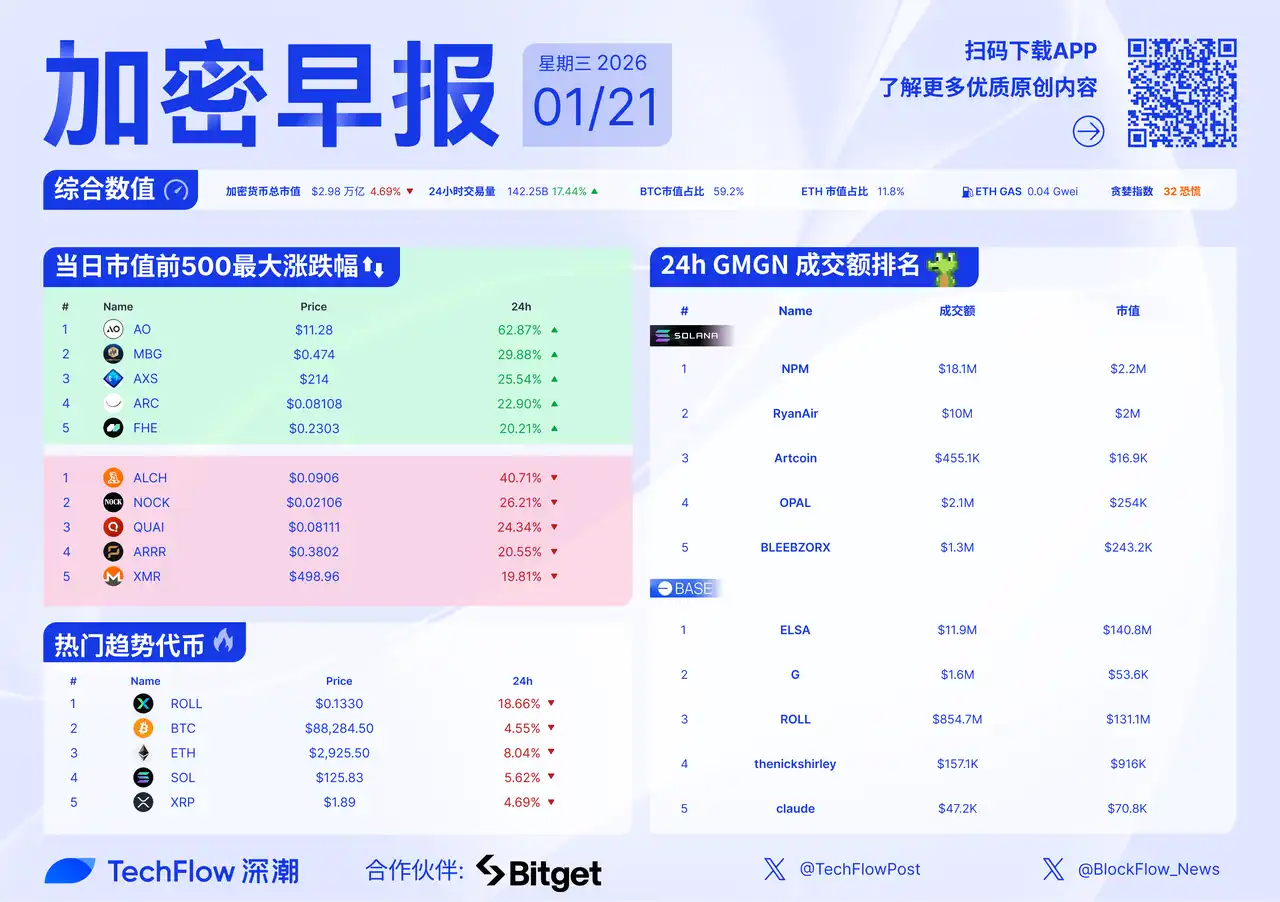
Crypto Morning Brief: U.S. stocks fell sharply across the board, with the Nasdaq and S&P 500 dropping over 2%. Chip stocks and major tech companies like Nvidia and Tesla declined 3-4%. Gold and silver hit new highs. In regulatory news, CFTC Chair announced the "Future Proof" initiative to modernize digital asset oversight. Trump Media set February 2, 2026, as the record date for its digital token distribution to shareholders. Hong Kong’s Securities and Futures Professionals Association urged a shift toward commercial application of virtual assets, following the establishment of regulatory infrastructure. HyperLend revealed its HPL tokenomics: 30.14% for ecosystem growth, 25% for genesis allocation, 22.5% to core contributors, 17.36% to strategic investors, and 5% for liquidity. Pendle introduced sPENDLE, a liquid staking token that reduces withdrawal time from years to 14 days. Ethereum’s recent network activity surge may be linked to address poisoning attacks, exploiting lower gas fees post-Dencun upgrade. Chainlink launched 24/5 U.S. stock data feeds for blockchain applications. Trend Research purchased 6,656 ETH, now holding $1.91 billion worth. Bitmine approved increasing its share issuance limit for future financing flexibility. Pump.fun established an investment division and a $3 million public hackathon. Recommended reads include discussions on AI’s impact, X’s algorithm changes, NYSE’s move to 24/7 tokenized trading, Wintermute’s market outlook...

Author: Deep Tide TechFlow

Yesterday's Market Dynamics

U.S. stock indices plummet across the board, chip stocks and gold/silver hit new highs

U.S. stock indices fell sharply, with the Nasdaq Composite dropping over 2%, the S&P 500 down about 2%+, and the Dow Jones Industrial Average declining approximately 1.7%–1.8%. Market panic sentiment rose, with the VIX fear index climbing to recent highs.

Tech/chip stocks fell broadly, with heavyweight stocks like Nvidia, Tesla, Apple, and Amazon generally under pressure, down 3%–4%+.

U.S. Treasury yields rose to multi-month highs, with significant selling pressure on U.S. bonds; the U.S. dollar index weakened.

Gold and silver prices reached new highs, with spot gold briefly surging to around $4750-4763 per ounce, and silver breaking through the $90 per ounce range.

U.S. Supreme Court issues no ruling on challenge to legality of Trump's global tariffs

The U.S. Supreme Court did not issue a ruling on the challenge to the legality of Trump's global tariffs.

CFTC Chairman launches "Future Proof" plan to upgrade cryptocurrency regulation

According to The Block, the new Chairman of the U.S. Commodity Futures Trading Commission (CFTC), Michael Selig, announced the "Future Proof" plan on January 20, aimed at modernizing the CFTC's approach to digital asset regulation. Selig wrote in a Washington Post op-ed, emphasizing that the existing regulatory framework is no longer suitable for the emerging digital asset market and calling for a "minimum effective dose" regulatory strategy.

Selig stated that if Congress passes legislation expanding the CFTC's regulatory authority, the agency is ready to take over the supervision of the digital asset market.

Trump Media announces record date for digital token program as February 2

Trump Media & Technology Group (Nasdaq, NYSE Texas: DJT) today announced that the record date for its digital token program is set for February 2, 2026. Ultimate beneficial owners and registered holders of at least one share of DJT stock as of this date will be eligible to receive tokens and related rewards. The company will partner with Crypto.com to mint and custody these digital assets.

Hong Kong Securities and Futures Professional Association: Hong Kong has completed initial virtual asset regulatory infrastructure, next step should shift focus to commercialization and application implementation

The Hong Kong government plans to announce the 2026/2027 Fiscal Budget on February 25, focusing on virtual assets and investor protection, among other areas. The Hong Kong Securities and Futures Professional Association stated that Hong Kong has completed the initial regulatory infrastructure for virtual assets, and the next step should shift focus to commercialization and application implementation. By unlocking RWA secondary market liquidity, accelerating product approvals, introducing international liquidity, and strengthening practitioner training, Hong Kong can upgrade from a market with clear regulations to a global virtual asset center with ample liquidity and widespread application, aligning with the national "15th Five-Year Plan" for financial openness and digital economy strategy.

HyperLend unveils HPL tokenomics model: Genesis allocation accounts for 25%, ecosystem growth and incentives account for 30.14%

According to a message from the official X account of digital asset lending platform HyperLend, the protocol has released its HPL token distribution plan:

Ecosystem growth and incentives account for 30.14%;

Genesis allocation accounts for 25%;

Core contributors account for 22.5%;

Strategic investors account for 17.36%;

Liquidity accounts for 5%.

Pendle launches sPENDLE liquid staking token: shortens lock-up period from years to 14 days

According to The Block, DeFi project Pendle announced the launch of the sPENDLE liquid staking token, officially replacing the previous vePENDLE multi-year locking mechanism. The new system reduces the withdrawal period from years to 14 days, while introducing transferable, composable token features to simplify user participation. Pendle revealed that the original vePENDLE system attracted only about 20% of the token supply, the lowest among similar models. The new mechanism will utilize up to 80% of protocol revenue for PENDLE buybacks and introduce an algorithmic emissions model, expected to reduce overall emissions by approximately 30%. Existing vePENDLE holders will receive a maximum 4x reward multiplier based on remaining lock-up time, which will decay linearly over two years.

Analysis: Recent surge in Ethereum network activity may be related to address poisoning attacks

According to Cointelegraph, security researcher Andrey Sergeenkov stated that Ethereum's recent record network activity may be related to a wave of address poisoning attacks exploiting low gas fees.

Since the Ethereum Fusaka network upgrade in December, transaction fees have dropped by over 60%, making such attacks more economically viable. Data shows that in the week starting January 12, the number of new Ethereum addresses reached 2.7 million, with daily transaction volume surging to over 2.5 million.

Address poisoning attacks involve scammers sending small transactions from wallets with addresses similar to legitimate ones, tricking users into copying the wrong address when transacting. Research indicates that some top "poisoners" have sent transactions to over 400,000 recipients, with 116 victims having lost over $740,000 through this method so far.

Chainlink launches 24/5 U.S. stock data service, connecting traditional stock market with blockchain

According to an official announcement, Chainlink recently launched a 24/5 U.S. stock data stream service, providing U.S. stock and ETF market data for blockchain applications, covering standard trading hours and non-standard hours. The service is already live on multiple blockchain platforms, aiming to bridge the gap between traditional stock market trading hours and blockchain operation mechanisms, creating blockchain application scenarios for the U.S. stock market.

Several trading platforms, including Lighter and BitMEX, have adopted this service for applications such as stock perpetual contracts and prediction markets. Beyond price information, this data service also includes bid/ask quotes, trading volume, and market status data, which can be used for pricing and risk management of on-chain financial products. This service represents a technological advancement in blockchain financial infrastructure.

Trend Research purchases another 6,656 Ethereum, currently holds approximately $1.91 billion worth of Ethereum

According to monitoring by Onchain Lens(@OnchainLens), Trend Research borrowed 20 million USDT and purchased 6,656 Ethereum (ETH), then deposited these Ethereum into the Aave V3 protocol.

Currently, Trend Research holds 651,310 Ethereum, worth approximately $1.91 billion.

Bitmine approved to increase cap on issuable shares to enhance future financing flexibility

According to CoinDesk, Bitmine Immersion Technologies received shareholder approval to increase the cap on the number of shares the company can issue, enhancing future financing flexibility. The company currently holds 4.203 million ETH, 193 BTC, a $22 million stake in Eightco Holdings, and nearly $1 billion in cash.

A news release from the company on Tuesday disclosed that Proposal No. 2 was passed with 81% approval at the annual shareholders' meeting on January 15, authorizing the company to increase the number of shares it can issue. This proposal does not mean the company will immediately issue more shares but raises the上限 for future issuances, providing room for subsequent financing, M&A, or supporting continued Ethereum accumulation.

Pump.fun announces establishment of investment division Pump Fund, launches $3 million "Build in Public Hackathon"

According to a disclosure on Pump.fun's official Twitter, the platform announced the establishment of the Pump.fun investment division and launched a $3 million Build in Public Hackathon. This hackathon will fund 12 projects, with each receiving a $250,000 investment at a $10 million valuation, along with guidance from Pump.fun founders.

Participating projects must issue tokens, build publicly, and hold at least 10% of the token supply. Unlike traditional hackathons, this event uses a tokenized model, letting the market rather than judges determine project value. The application deadline is February 18, 2026, with the first winners announced within 30 days.

Market Dynamics
Recommended Reading

Conversation with Wang Qiao: Crypto tokens have little appeal to me currently, went all-in on Google in 2026

This article is a transcript of an interview with Qiao Wang on a podcast, discussing 2026 investment trends, the impact of AI on startups, current market sentiment, and topics like health and time management. Qiao shares his portfolio construction, insights on AI tools, and predictions for future technology and market developments.

Deconstructing X's open-source recommendation algorithm: What content should we write to be more attractive?

This article analyzes the architecture and logic changes in X platform's latest open-source recommendation algorithm, Phoenix, covering the shift from traditional manual features to AI models and the algorithm's impact on content creators. Additionally, the article provides practical advice for creators and discusses the limitations and value of open-sourcing.

NYSE aims for 7x24 stock trading: The world is one big exchange

This article discusses the NYSE's announced plan to launch a tokenized securities platform for 24/7 trading of U.S. stocks and ETFs, with instant settlement via stablecoins. This marks further integration of traditional finance with crypto infrastructure, removing barriers of time, space, and门槛, and推动 seamless global market trading. Although crypto's technical infrastructure is being adopted, its practical application still needs further expansion.

Wintermute: Three necessary conditions for the crypto market to warm up in 2026

This article analyzes how the crypto market failed to achieve the expected broad rebound in 2025, showing extreme polarization. Top market maker Wintermute believes the traditional four-year halving cycle is失效, with market logic shifting from "seasonal rotation" to "liquidity lock-up." Although Bitcoin and Ethereum are becoming institutionalized through ETFs, altcoin lifecycles are shortening, putting overall market pressure. Market recovery in 2026 requires attention to three core variables: expansion of institutional investment scope, wealth effect from mainstream assets, and the return of retail attention from the stock market. Future market performance depends on the diffusion of liquidity and structural changes.

Stop grinding mindlessly, the best airdrops often come "unexpectedly"

This article explores how to obtain high-quality cryptocurrency airdrops through genuine on-chain interaction rather than mechanical operations. It emphasizes the importance of building on-chain reputation and contributing value, citing multiple successful retrospective airdrop cases to reveal their core logic. The article also suggests strategies to avoid "volume fatigue" and encourages users to focus on protocols they like and interact genuinely.

Questions liées

QWhat was the overall performance of the U.S. stock market as reported in the article?

AThe U.S. stock market saw a significant downturn, with the Nasdaq Composite Index falling over 2%, the S&P 500 dropping about 2%+, and the Dow Jones Industrial Average declining approximately 1.7%–1.8%.

QWhat is the 'Future Proof' plan announced by the CFTC Chairman, and what is its goal?

AThe 'Future Proof' plan, announced by CFTC Chairman Michael Selig, aims to modernize the CFTC's approach to regulating digital assets. It calls for a 'minimum effective dose' regulatory strategy, as the existing framework is no longer suitable for the emerging digital asset market.

QWhat is the new tokenomics model for HPL as announced by HyperLend?

AHyperLend's HPL token allocation is as follows: 30.14% for Ecosystem Growth and Incentives, 25% for Genesis Allocation, 22.5% for Core Contributors, 17.36% for Strategic Investors, and 5% for Liquidity.

QWhat significant change did Pendle make to its staking mechanism with the introduction of sPENDLE?

APendle replaced its vePENDLE multi-year locking mechanism with the new sPENDLE liquid staking token, which shortens the withdrawal period from several years to just 14 days and introduces a transferable, composable token to simplify user participation.

QAccording to the analysis in the article, what is a potential reason for the recent surge in Ethereum network activity?

AThe surge in Ethereum network activity may be related to a wave of 'address poisoning' attacks, which became more economically feasible after the Dencun upgrade reduced transaction fees by over 60%.

Lectures associées

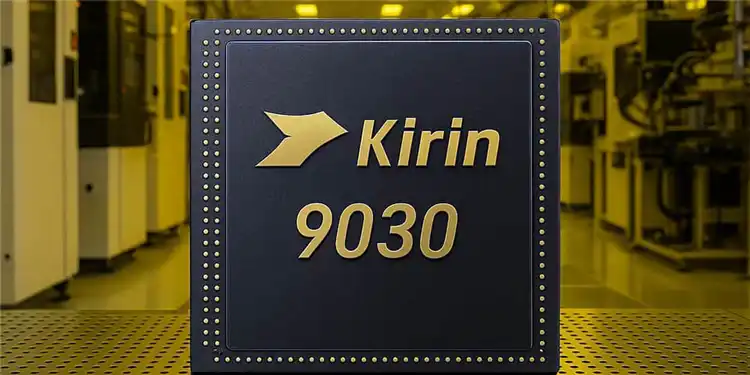
SemiAnalysis décortique le Kirin 9030 de Huawei : La finesse de gravure stagne, on plie la puce

SemiAnalysis, via son laboratoire STEEL, a publié sa première analyse de démontage publique, ciblant le Kirin 9030 Pro de Huawei (fabriqué par SMIC en procédé N+3). Le rapport révèle que le pas métallique minimum (M0 pitch) du N+3 est de 32,5 nm, plus fin que celui de l'Intel 18A. Cependant, ceci est un indicateur isolé et la densité logique globale (113,4 MTr/mm²) est similaire au N6 de TSMC, mais obtenue à un coût bien supérieur en raison de l'utilisation d'une quadruple modélisation (SAQP) avec des DUV uniquement, sans EUV. Le Kirin 9030, de taille similaire à son prédécesseur, intègre plus de cœurs CPU/GPU/NPU et de cache grâce à la densité améliorée. Ses performances GPU rattrapent environ les flagships de 2022, mais le CPU, basé sur une architecture de type Cortex-X2 (2021), accuse un retard en IPC et en fréquence dû aux limitations du procédé de fabrication. Face à ces contraintes, Huawei mise sur une nouvelle voie : l'échelle Tau et le "LogicFolding" (pliage logique). Cette approche consiste à empiler verticalement des blocs logiques pour raccourcir les interconnexions, visant à atteindre 5 GHz et une densité équivalente élevée d'ici 2031. Bien que le calcul de densité pour la 3D diffère des méthodes traditionnelles, cette direction est stratégique. En conclusion, les contrôles à l'exportation n'ont pas arrêté les progrès sino-sémiconducteurs, mais en ont changé la trajectoire et le coût. SMIC prouve qu'une densité avancée est possible sans EUV, mais à un prix élevé. Pendant ce temps, Huawei innove en conception 3D et diversifie ses chaînes d'approvisionnement (mémoire CXMT), cherchant à rendre les puces nationales "suffisantes" pour des applications clés.

marsbitIl y a 22 mins

SemiAnalysis décortique le Kirin 9030 de Huawei : La finesse de gravure stagne, on plie la puce

marsbitIl y a 22 mins

Comment le cours de SpaceX va-t-il évoluer avant le prochain déblocage pour les actionnaires ?

SpaceX, sous le symbole SPCX, a fait son entrée sur les marchés publics. Le premier jour, l'action a clôturé en hausse d'environ 19%, portant sa capitalisation à environ 2 100 milliards de dollars. Un point clé de sa dynamique actuelle est la faible liquidité initiale, les nouvelles actions émises ne représentant qu'environ 4% du total, créant une pression à la hausse due à la rareté et à l'engouement pour le récit porté par Elon Musk (Starlink, transport spatial, etc.). Cependant, le marché anticipe déjà le prochain événement important : le déblocage initial des actions détenues par les actionnaires existants et les employés. Selon le prospectus, ce processus pourrait débuter vers août 2026 (sous réserve de la publication des résultats du Q2) et se déroulera par étapes. Les positions vendeuses à bas coût pourraient alors augmenter l'offre, testant la capacité du marché à absorber ces titres à des valorisations élevées. Le prochain rapport trimestriel (Q2) est donc un catalyseur crucial. Des résultats solides pourraient soutenir la valorisation et la dynamique avant le déblocage, tandis que des résultats décevants pourraient amplifier les craintes liées à la future pression vendeuse. En résumé, la trajectoire de SPCX à court terme repose sur un équilibre entre la rareté des titres disponibles et la forte narration, susceptible de maintenir les prix. À moyen terme, l'attention se portera sur le calendrier de déblocage et la capacité des résultats fondamentaux à justifier sa valorisation alors que l'offre augmentera.

marsbitIl y a 42 mins

Comment le cours de SpaceX va-t-il évoluer avant le prochain déblocage pour les actionnaires ?

marsbitIl y a 42 mins

Validation de la structure haussière à court terme du Bitcoin, fenêtre de placement à bas prix de l'HYPE ouverte | Analyse exclusive

L'environnement de marché de cette semaine est particulièrement complexe, marqué par une forte volatilité des actifs mondiaux. L'analyse se concentre sur deux actifs : Bitcoin (BTC) et HYPE. **Bitcoin (BTC)** Le BTC, après avoir franchi le niveau de 65 000 USD, fait l'objet d'une analyse structurelle approfondie sur graphique 4 heures. Le scénario principal dépend de la confirmation ou non de cette cassure. Une reconfirmation pourrait ouvrir la voie vers la zone de résistance clé de 69 500-70 500 USD, considérée comme une opportunité pour des positions courtes à moyen terme. À l'inverse, une rechute en dessous de 65 000 USD pourrait entraîner une correction vers 60 000-62 000 USD. La stratégie opérationnelle propose deux plans (A et B) pour des positions courtes, basés soit sur un rejet à la résistance, soit sur une rupture de support, avec une gestion stricte du risque via des stops dynamiques. **HYPE** Pour HYPE, l'analyse technique sur graphique 4 heures identifie une structure de correction en quatre segments. L'attention se porte sur la zone de résistance de 62,5 à 64,57 USD. La stratégie court terme préconise une approche "d'achat sur les creux", en attendant des signaux d'achat dans les zones de support de 52-54,5 USD ou 47-49 USD, en combinaison avec des modèles quantitatifs propriétaires de l'auteur. Un exemple de transaction réussi, générant un gain d'environ 11,88%, est détaillé en utilisant ces modèles de "différence de prix" et "quantification de l'élan". **Avertissement important** L'article souligne que les marchés évoluent rapidement et que toutes les analyses et stratégies doivent être ajustées dynamiquement. Les contenus présentés sont basés sur l'analyse technique personnelle de l'auteur et ne constituent en aucun cas un conseil en investissement.

Odaily星球日报Il y a 47 mins

Validation de la structure haussière à court terme du Bitcoin, fenêtre de placement à bas prix de l'HYPE ouverte | Analyse exclusive

Odaily星球日报Il y a 47 mins

La structure de court terme favorable du Bitcoin validée, fenêtre de positionnement en HYPE à la baisse s'ouvre | Analyse invitée

L'environnement de marché de cette semaine est exceptionnellement complexe, avec des réévaluations importantes des actifs mondiaux. L'analyse se concentre sur deux actifs majeurs : le Bitcoin (BTC) et l'HYPE. Pour le **Bitcoin**, après avoir franchi le niveau de 65 000 USD, l'attention se porte sur la confirmation de cette cassure. Un maintien au-dessus pourrait ouvrir la voie vers la zone de résistance clé de 69 500-70 500 USD. En revanche, une rechute pourrait entraîner un retest du support principal entre 59 000 et 62 000 USD. Les stratégies proposées prévoient soit la construction de positions courtes sur une poussée vers la zone de résistance supérieure, soit l'ouverture de vente si le support des 65 000 USD cède. Pour l'**HYPE**, l'analyse technique identifie une structure corrective en quatre phases. Le prix, actuellement en rebond depuis la zone de support des 52 USD, fait face à une pression immédiate dans la zone 62,5-64,57 USD. La stratégie recommandée est d'attendre un repli vers les zones de support solides (52-55,5 USD ou 47-49 USD) pour envisager des positions longues légères, en évitant tout achat à la hausse. L'article inclut également un récapitulatif d'une opération de trading antérieure sur l'HYPE, ayant généré un gain d'environ 11,88%, en s'appuyant sur des signaux de modèles de trading internes. Des conseils de gestion des risques sont fournis, mettant l'accent sur la définition et le suivi dynamique des ordres de stop-loss. *Remarque : Cette analyse, présentée comme un journal de trading personnel, ne constitue pas un conseil en investissement. Les marchés financiers sont volatils et la prudence est de mise.*

marsbitIl y a 49 mins

La structure de court terme favorable du Bitcoin validée, fenêtre de positionnement en HYPE à la baisse s'ouvre | Analyse invitée

marsbitIl y a 49 mins

Trust Wallet propose désormais des actions américaines tokenisées grâce à l'intégration de bStocks

Trust Wallet, le principal portefeuille de cryptomonnaies en auto-gardede, intègre désormais bStocks, offrant à ses utilisateurs éligibles un accès direct à des actions américaines tokenisées sur la BNB Chain, 24h/24 et sans compte de courtage traditionnel. Cinq titres sont disponibles au lancement (Tesla, NVIDIA, etc.), avec d'autres à venir. Ces bStocks, adossés à des actions cotées aux États-Unis et hébergés sur BNB Chain, reproduisent les variations de prix, dividendes et fractionnements d'actions. Les détenteurs peuvent dès à présent utiliser ces actifs tokenisés au sein de l'écosystème DeFi de BNB Chain (prêt, négociation) tout en continuant de percevoir les dividendes des titres sous-jacents, le tout sans procédure de connaissance client (KYC) grâce à l'architecture en auto-garde. Le PDG de Trust Wallet, Felix Fan, y voit une étape importante pour démocratiser l'accès à ces actifs financiers traditionnels. Cette initiative s'inscrit dans la stratégie de la plateforme pour les actifs du monde réel (RWA). Un important avertissement juridique précise que les bStocks ne confèrent pas la propriété directe des actions, que leur disponibilité est soumise à des restrictions géographiques (interdits notamment aux États-Unis, au Royaume-Uni et dans l'UE) et qu'ils sont assortis de divers risques.

TheNewsCryptoIl y a 52 mins

Trust Wallet propose désormais des actions américaines tokenisées grâce à l'intégration de bStocks

TheNewsCryptoIl y a 52 mins

Trading

Spot
Futures
活动图片