Circle stock drops nearly 20% as stablecoin yield restrictions spark concern

ambcryptoPublié le 2026-03-24Dernière mise à jour le 2026-03-24

Résumé

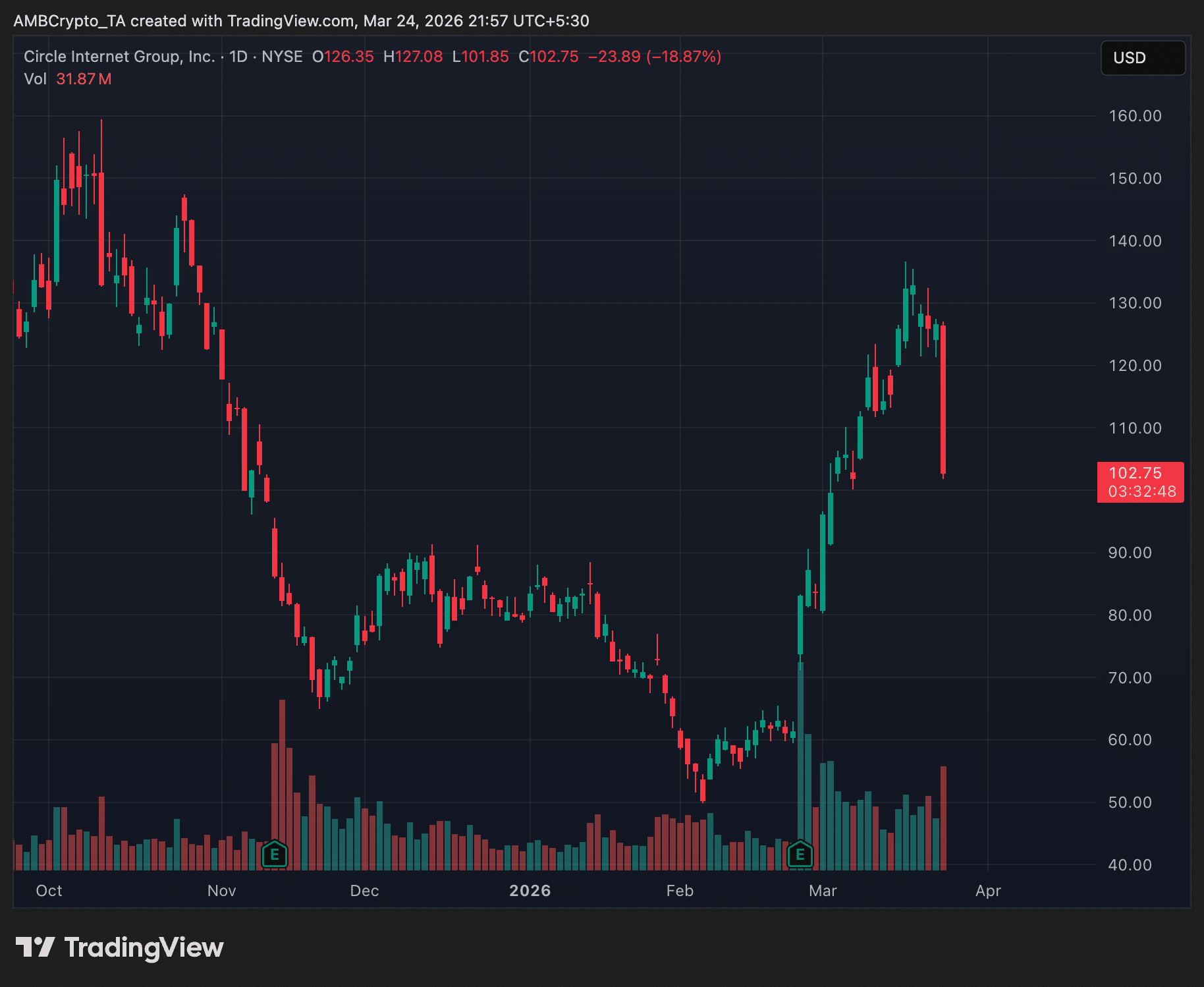
Shares of Circle Internet Group (CRCL) fell nearly 19% on March 24, dropping from an intraday high of around $127 to approximately $102. The sharp decline followed a strong rally earlier in March and was accompanied by high trading volume, indicating a shift in investor sentiment. The sell-off appears linked to emerging regulatory concerns, particularly a draft legislative proposal that could prohibit platforms from offering yield or interest-like rewards for holding stablecoins. This restriction, which targets both direct and indirect incentives, may impact Circle’s USDC stablecoin growth and user engagement. The proposal would still permit activity-based rewards but could reduce stablecoins' competitiveness against traditional financial products. The move underscores the sensitivity of crypto equities to regulatory developments.

Shares of Circle Internet Group [CRCL] fell sharply on 24 March, dropping nearly 19% in a single session as markets reacted to emerging concerns around potential restrictions on stablecoin yield and rewards.

The stock declined from an intraday high of around $127 to approximately $102, marking one of its steepest single-day losses in recent weeks. The move comes after a strong rally earlier in March, when CRCL climbed from below $60 to above $130.

Sharp reversal follows March rally

CRCL’s latest decline stands in contrast to its recent momentum, with the stock having more than doubled earlier this month before reversing course.
Source: TradingView

The sell-off was accompanied by a spike in trading volume, suggesting strong conviction behind the move rather than routine market fluctuations.

The abrupt reversal suggests a potential shift in sentiment, with investors reacting quickly to new developments in the stablecoin sector.

While no official trigger has been confirmed, the timing of the decline coincides with growing regulatory scrutiny around stablecoins.

Draft proposal targets stablecoin yield

According to a report from Eleanor Terrett, new legislative language under discussion could significantly limit how stablecoin issuers and platforms offer rewards to users.

The proposal would prohibit platforms from offering yield “directly or indirectly” for holding a stablecoin, or in any way that resembles a bank deposit. The restriction would apply broadly across exchanges, brokers, and affiliated services.

It would also ban any mechanism deemed “economically or functionally equivalent” to interest.

At the same time, the draft would allow activity-based rewards tied to user behavior, such as loyalty or promotional programs, provided they are not interpreted as interest-like incentives.

The proposal is expected to undergo further review, including feedback from banking representatives.

Implications for Circle and stablecoin issuers

For Circle, which issues the USDC stablecoin, yield restrictions could have direct implications for growth and user incentives.

Stablecoin yield and reward programs have become a key mechanism for attracting and retaining users across exchanges and platforms.

Limiting these features could reduce stablecoins’ competitiveness relative to traditional financial products and narrow revenue opportunities tied to user balances.

The uncertainty surrounding how regulators may interpret “economic equivalence” adds another layer of risk, particularly for business models that rely on flexible reward structures.


Final Summary

  • Circle’s sharp decline highlights how sensitive crypto-linked equities are to emerging regulatory risks, particularly around stablecoin incentives.
  • Growing scrutiny and industry moves toward transparency suggest a structural shift in how stablecoin issuers operate going forward.


Questions liées

QWhat caused Circle's stock (CRCL) to drop nearly 20% on March 24?

AThe sharp decline was triggered by emerging concerns and a draft legislative proposal that could restrict stablecoin issuers and platforms from offering yield or interest-like rewards to users.

QWhat was the price range of CRCL's intraday movement during the sell-off?

AThe stock dropped from an intraday high of around $127 to approximately $102.

QWhat specific activity does the new legislative proposal aim to prohibit regarding stablecoins?

AThe proposal aims to prohibit platforms from offering yield 'directly or indirectly' for holding a stablecoin, or any mechanism deemed 'economically or functionally equivalent' to interest or a bank deposit.

QHow might the proposed restrictions impact Circle and other issuers?

AThe restrictions could reduce stablecoins' competitiveness compared to traditional financial products, narrow revenue opportunities from user balances, and create uncertainty for business models relying on reward structures.

QWhat type of rewards would still be allowed under the draft proposal?

AActivity-based rewards tied to user behavior, such as loyalty or promotional programs, are allowed provided they are not interpreted as interest-like incentives.

Lectures associées

Pourquoi le Bitcoin maintient 64 000 $ après la pause restrictive de la Fed

Le Bitcoin se stabilise autour de 64 000 $ après la décision de la Fed de maintenir ses taux d'intérêt dans la fourchette 3,50-3,75 %. Bien que perçu comme une pause, le vote a révélé des divisions internes, trois membres plaidant pour une hausse, signalant une attitude globalement restrictive. Cette position limite l'appétit pour les actifs risqués comme les cryptomonnaies. Le marché a réagi avec une volatilité modérée. Les FNB spot sur Bitcoin ont enregistré un afflux net de 32,1 millions de dollars, mettant fin à une série de sorties, tandis que les FNB Ethereum ont subi des sorties. Cela indique une rotation des capitaux vers l'actif principal. Les niveaux clés à surveiller pour le Bitcoin sont le support à 63 000-63 500 $ et la résistance autour de 66 000 $. Malgré la pression macroéconomique, le marché ne montre pas de signes de capitulation. Les fondamentaux du réseau Ethereum restent solides avec une file d'attente importante pour le staking. Le report du vote sur le CLARITY Act au Sénat américain a tempéré les attentes réglementaires immédiates. Pour la fin du mois, les données macro américaines (inflation, dépenses) guideront les senteurs. Le scénario de base prévoit une consolidation du Bitcoin entre 63 000 et 66 000 $. La résilience au-dessus de 63 000 $, le maintien de l'Ethereum au-dessus de 1 860 $ et la poursuite des entrées institutionnelles seront des facteurs déterminants pour une éventuelle reprise au second semestre.

cryptonews.ruIl y a 3 h

Pourquoi le Bitcoin maintient 64 000 $ après la pause restrictive de la Fed

cryptonews.ruIl y a 3 h

Parker Lewis explique pourquoi le bitcoin reste la meilleure monnaie

Parker Lewis, un analyste bitcoin renommé, a critiqué les stratégies marketing des entreprises qui se présentent comme des trésoreries crypto. Il estime que la vente d'actions privilégiées perpétuelles, présentées comme un "crédit numérique", déforme fondamentalement la nature du bitcoin. Il souligne que le bitcoin n'a pas de rendement fiduciaire intégré et que les promesses de dividendes reposent sur un modèle risqué nécessitant un afflux constant de nouveaux investisseurs. Lewis met en garde contre les risques de ces dérivés, notant que le marché des actions privilégiées perpétuelles (1 000 milliards de dollars) est minuscule comparé au marché du crédit mondial (300 000 milliards de dollars), car les institutions évitent ces risques qu'elles transfèrent aux particuliers. Il rejette également l'idée que la volatilité du bitcoin le rende impropre à la plupart des gens. Pour lui, cette volatilité est une conséquence naturelle de l'adoption massive d'un actif à offre fixe et inélastique. Il conseille d'acheter des bitcoins directement plutôt que des actions d'entreprises comme MicroStrategy. Détourner l'attention vers ces dérivés corporatifs fait oublier la vraie menace : la dépréciation rapide des monnaies fiduciaires. Lewis illustre cela avec son "indice du ribeye", montrant une inflation annuelle de 12 à 13% sur le prix d'un steak, bien supérieure aux chiffres officiels. La stratégie la plus sûre, selon lui, reste la possession directe de bitcoin et le contrôle de ses clés privées, pour se protéger des turbulences macroéconomiques, plutôt que de courir après des rendements corporatifs douteux qui amplifient les risques systémiques.

cryptonews.ruIl y a 3 h

Parker Lewis explique pourquoi le bitcoin reste la meilleure monnaie

cryptonews.ruIl y a 3 h

Trading

Spot
活动图片




