Building the Bright Path While Secretly Crossing Chencang: Is Walsh Paving the Way for a September "Rate Cut"?

marsbitPublié le 2026-06-29Dernière mise à jour le 2026-06-29

Résumé

The title "Building the Plank Road Openly While Secretly Crossing at Chencang: Is Walsh Paving the Way for a September 'Rate Cut'?" suggests Federal Reserve Chair Kevin Walsh's hawkish stance may be a deliberate smokescreen. Academy Securities analyst Peter Tchir argues in a report that markets, currently pricing a 75% chance of a September hike, are missing a potential path to a September rate cut that Walsh himself might be quietly preparing. Tchir posits that Walsh's hawkish rhetoric aims to suppress long-term yield risks (with the 10-year Treasury yield falling recently) while creating room for a narrative shift based on upcoming data. The potential political endgame, according to this view, could be rate cuts in September and October, ahead of the midterm elections. This hinges on a political logic where the Trump administration's preference for lower rates remains unchanged. A core part of Tchir's argument involves redefining inflation metrics. He contends the Fed under Walsh may deprioritize the PCE index, criticizing its lagging components like Owners' Equivalent Rent (OER). Instead, he points to alternative, more real-time indicators like the New Tenant Repeat Rent Index (NTRR) and the Truflation daily index, which shows core inflation around 1.45%. He suggests the Fed could shift its data narrative to justify policy easing. Furthermore, Tchir downplays AI-driven inflation fears. He argues that consumer price sensitivity, evidenced by negative market reactions to ...

Original Author: Zhao Ying

Original Source: Wall Street News

Federal Reserve Chairman Kevin Walsh's hawkish posture might be nothing more than an elaborately designed smokescreen.

In a recent report, Academy Securities analyst Peter Tchir suggests that while the market has currently priced in a 75% probability of a September rate hike and expects a cumulative 1.25 hikes by year-end, it is missing the real path leading to a September rate cut—a path perhaps being quietly laid by Walsh himself.

Tchir points out that Walsh has sent a clear enough signal: suppressing tail-end risks in long-term interest rates through hawkish rhetoric (the 10-year Treasury yield has retreated from 4.46% to 4.37% this week), while reserving space for a subsequent narrative shift based on data. In his view, the end point of this series of maneuvers could be a rate cut in September, another in October, landing just in time before the midterm elections.

This judgment remains a personal opinion for now, and Tchir himself acknowledges its uncertainty. Yet his line of argument is tightly knit, covering the redefinition of inflation data, the battle for narrative control over the neutral rate, and the core premise that the White House's policy goals have never changed.

Hawkishness Just an Act? Political Logic Points to Rate Cuts

The starting point of Tchir's argument is a political-economic interpretation of Walsh's motivations.

He believes the policy objectives of the Trump administration have never fundamentally shifted. The President himself has repeatedly stated his deep understanding of real estate and the importance of low interest rates to the property market. Against this backdrop, it's difficult to imagine Trump being satisfied with his own appointed Fed chairman maintaining a persistently hawkish stance—unless this is itself a negotiated strategy.

Tchir paints a hypothetical scenario: Walsh convinces Trump that sending dovish signals now would be disastrous. Letting him appear hawkish can cap long-term yields, maintain the appearance of Fed independence, while simultaneously pushing Wall Street analysts and the media fully towards hike expectations. Then, as data gradually "cooperates," pivot to rate cuts under the "data-dependent" rationale, and conveniently blame the inflation problem on the previous Fed "using wrong data and acting too late."

He adds that Walsh's father-in-law is a major donor to Trump, a background perhaps not entirely irrelevant.

Taking Aim at Inflation Data: PCE Isn't This Fed's Yardstick

The most substantive part of Tchir's argument is his systemic questioning of the current inflation measurement framework.

He explicitly states, PCE is not the preferred inflation gauge for Walsh's Fed. He believes PCE was more of a Bernanke-era preference, and Walsh does not lose sleep over PCE data at night.

His criticism is particularly sharp regarding the measurement of housing inflation. The "Owners' Equivalent Rent" (OER) in CPI didn't peak until mid-2023, reaching about 8%; whereas Zillow's rental data hit a high near 16% as early as early 2022. He points out that the Cleveland Fed has already developed the "New Tenant Repeat Rent" (NTRR) index, whose trend closely aligns with Zillow's, yet this more realistic indicator has received almost no attention.

His conclusion: The Fed could entirely, without introducing external data, shift to using the indicators developed by the Cleveland Fed itself, thereby providing a data-based justification for rate cuts.

Truflation and "Two-Point-Something Is Good Enough"

Beyond PCE, Tchir also cites Truflation's real-time inflation data. According to his introduction, Truflation constructs a daily inflation index based on massive real-time datasets, with its core inflation rate currently around 1.45%, consistently below 1.8% since February this year.
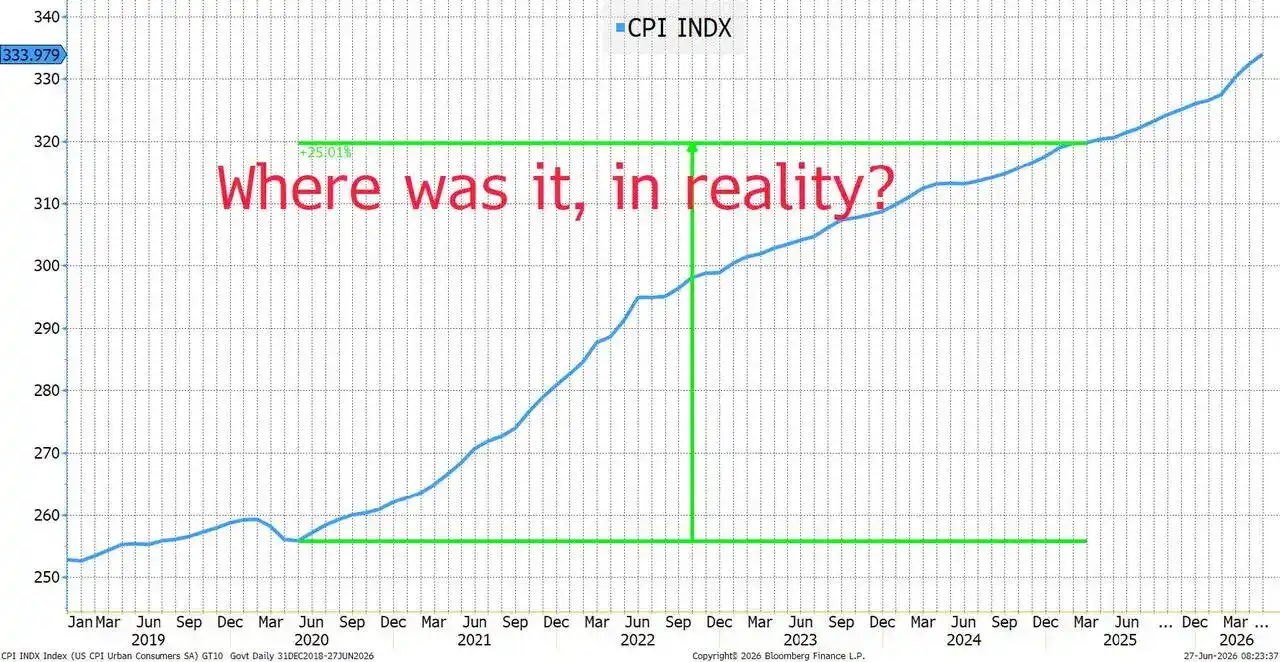
He also notes that Walsh's recent remarks hinted that the "big number" (the integer) of the inflation figure is more important than the precise value. Tchir infers from this that the market may be gradually being "conditioned"—to accept the cognitive framework that "two-point-something" is equivalent to approaching the 2% target. He marks the inflation target line on his chart as 2.9%, not the traditional 2%.

He believes that once the data narrative is switched, the technical barriers to rate cuts will significantly lower.

Tchir also mentions the work of former Fed insider Miran on the neutral rate issue. He believes that while no one in the market is discussing the neutral rate currently, this topic will resurface at an opportune moment.

His logic is: The neutral rate itself is difficult to measure precisely, with a substantial estimation range. If the new Fed leadership can argue that the previous judgment on the neutral rate was too high, then this alone could provide theoretical grounds for 50 to 100 basis points of rate cuts, while assigning blame to the "old Fed's error."

Apple Price Hikes and AI Inflation: Rate Hikes Are Aiming at the Wrong Target

Addressing market concerns about AI-driven inflation, Tchir offers a counter-interpretation.

He points out that Apple (AAPL)'s stock fell after announcing recent price hikes, a market reaction that precisely shows consumer tolerance for price increases is being questioned. If a top consumer brand like Apple struggles to have its price hikes digested by the market, the pricing power of ordinary consumer goods companies would only be weaker—contradicting the narrative of persistent inflation heating up.

He also cites feedback from a chip company: memory prices have not surged due to AI demand, with some products even cheaper than five years ago. He believes that AI and data center construction spending are indeed inflationary, but this is a completely different dimension from the affordability issues faced by ordinary consumers.

More critically, he argues that rate hikes have almost no dampening effect on AI/data center spending—those tech companies trading at 100x multiples are completely insensitive to a 50-basis-point rate move. Those truly hurt by rate hikes are ordinary borrowers with no connection to AI inflation.

Based on the above judgments, he believes the market will begin to reprice rate cut expectations, with the most certain opportunity lying in the short end of the yield curve—going long on short-term Treasuries, betting on lower front-end yields. For the long end, he maintains a neutral to slightly bullish stance, believing Treasury Secretary Bessent wants the 10-year yield back in the "3-handle," and Walsh has already removed tail-end risks for the long end through hawkish rhetoric.

In the equity space, he recommends a significant overweight in the energy sector, especially global nuclear power assets; within the Defense & Security (ProSec) theme, overweight biotech/pharmaceuticals and underweight chips. He is cautious on AI and data center valuations and warns that potential secondary issuance pressure from large tech companies could weigh on their stock prices.


Questions liées

QAccording to the article, what is the analyst Peter Tchir's main argument about Federal Reserve Chairman Kevin Walsh's hawkish stance?

APeter Tchir argues that Federal Reserve Chairman Kevin Walsh's hawkish stance might be a carefully designed smokescreen. He suggests that by making hawkish statements, Walsh aims to suppress the tail risk of long-term interest rates, while also reserving space to shift the data narrative later. Tchir believes the ultimate goal of this strategy could be to pave the way for a potential interest rate cut in September and again in October, coinciding with the timing of the midterm elections.

QWhat is Peter Tchir's key criticism regarding the current inflation measurement system used by the Fed?

APeter Tchir criticizes the Fed's reliance on the PCE index, stating that it is not the preferred inflation gauge for the current Fed leadership under Walsh. He argues that data lags, especially in housing inflation, make metrics like PCE outdated. He points to the Cleveland Fed's 'New Tenant Repeat Rent Index' (NTRR), which aligns more closely with real-time rental data from sources like Zillow, as a more accurate indicator that the Fed could switch to in order to justify rate cuts.

QWhat alternative inflation data does Peter Tchir cite to support the case for lower inflation, and what does it indicate?

APeter Tchir cites Truflation, a real-time inflation index built on massive datasets. According to his report, Truflation's core inflation rate is currently around 1.45% and has consistently stayed below 1.8% since February of this year. This data suggests that inflation is significantly lower than what the official, lagging indicators might imply.

QHow does Peter Tchir dismiss concerns about AI-driven inflation?

APeter Tchir dismisses concerns about AI-driven inflation by making two key points. First, he argues that the inflation from AI and data center construction is a different dimension from the affordability issues faced by general consumers. Second, he contends that interest rate hikes are ineffective at curbing AI/data center spending because the tech companies undertaking these investments are insensitive to small rate changes. Instead, he believes higher rates primarily hurt ordinary borrowers who are unrelated to the AI sector.

QWhat investment recommendations does Peter Tchir make based on his analysis in the report?

ABased on his analysis, Peter Tchir recommends investors re-price their expectations for rate cuts. He sees the most certain opportunity in the short end of the yield curve, suggesting going long on short-term Treasury bonds to bet on falling front-end yields. In equities, he advises a significant overweight in the energy sector (especially global nuclear power assets). Within the Defense & Security (ProSec) theme, he recommends an overweight in biotech/pharma and an underweight in semiconductors. He is cautious about the valuations of AI and data center stocks.

Lectures associées

Les retraits de Bitcoin se poursuivent : 8 ans de stockage en portefeuille froid Coldcard se sont terminés par un solde nul

Le portefeuille matériel Coldcard a été compromis, entraînant une nouvelle vague de retraits depuis les appareils vulnérables. Selon Galaxy Research, environ 1 367,05 BTC (88,6 millions de dollars) ont été dérobés à partir de 4 585 adresses. Le problème ne réside pas dans le firmware, qui a été corrigé, mais dans les phrases seed générées entre mars 2021 et les mises à jour correctives. Ces phrases, créées en raison d'une erreur de programmation ayant conduit à l'utilisation d'un générateur de nombres aléatoires logiciel (Yasmarang) au lieu du générateur matériel STM32, sont prévisibles et vulnérables à une attaque par force brute hors ligne. Les propriétaires concernés doivent impérativement générer une nouvelle phrase seed sur un firmware corrigé et transférer leurs actifs, sous peine de rester exposés. L'histoire d'un investisseur de 39 ans illustre l'impact dévastateur : après avoir accumulé 2 BTC (130 000 dollars) sur huit ans via un travail physique, en les conservant comme protection contre l'hyperinflation dans son pays, il a tout perdu en quelques minutes. Son cas montre que même les stratégies de conservation à long terme les plus prudentes ("cold storage") ne sont pas infaillibles. D'un point de vue historique, cet incident rappelle les faiblesses passées des générateurs de nombres aléatoires dans la cryptographie. Il remet en question l'idée reçue selon laquelle le stockage hors ligne garantit automatiquement une sécurité absolue. La communauté espère que le fabricant pourra aider à récupérer les fonds volés.

cryptonews.ruIl y a 15 mins

Les retraits de Bitcoin se poursuivent : 8 ans de stockage en portefeuille froid Coldcard se sont terminés par un solde nul

cryptonews.ruIl y a 15 mins

Pourquoi le Bitcoin maintient 64 000 $ après la pause restrictive de la Fed

Le Bitcoin se stabilise autour de 64 000 $ après la décision de la Fed de maintenir ses taux d'intérêt dans la fourchette 3,50-3,75 %. Bien que perçu comme une pause, le vote a révélé des divisions internes, trois membres plaidant pour une hausse, signalant une attitude globalement restrictive. Cette position limite l'appétit pour les actifs risqués comme les cryptomonnaies. Le marché a réagi avec une volatilité modérée. Les FNB spot sur Bitcoin ont enregistré un afflux net de 32,1 millions de dollars, mettant fin à une série de sorties, tandis que les FNB Ethereum ont subi des sorties. Cela indique une rotation des capitaux vers l'actif principal. Les niveaux clés à surveiller pour le Bitcoin sont le support à 63 000-63 500 $ et la résistance autour de 66 000 $. Malgré la pression macroéconomique, le marché ne montre pas de signes de capitulation. Les fondamentaux du réseau Ethereum restent solides avec une file d'attente importante pour le staking. Le report du vote sur le CLARITY Act au Sénat américain a tempéré les attentes réglementaires immédiates. Pour la fin du mois, les données macro américaines (inflation, dépenses) guideront les senteurs. Le scénario de base prévoit une consolidation du Bitcoin entre 63 000 et 66 000 $. La résilience au-dessus de 63 000 $, le maintien de l'Ethereum au-dessus de 1 860 $ et la poursuite des entrées institutionnelles seront des facteurs déterminants pour une éventuelle reprise au second semestre.

cryptonews.ruIl y a 3 h

Pourquoi le Bitcoin maintient 64 000 $ après la pause restrictive de la Fed

cryptonews.ruIl y a 3 h

Parker Lewis explique pourquoi le bitcoin reste la meilleure monnaie

Parker Lewis, un analyste bitcoin renommé, a critiqué les stratégies marketing des entreprises qui se présentent comme des trésoreries crypto. Il estime que la vente d'actions privilégiées perpétuelles, présentées comme un "crédit numérique", déforme fondamentalement la nature du bitcoin. Il souligne que le bitcoin n'a pas de rendement fiduciaire intégré et que les promesses de dividendes reposent sur un modèle risqué nécessitant un afflux constant de nouveaux investisseurs. Lewis met en garde contre les risques de ces dérivés, notant que le marché des actions privilégiées perpétuelles (1 000 milliards de dollars) est minuscule comparé au marché du crédit mondial (300 000 milliards de dollars), car les institutions évitent ces risques qu'elles transfèrent aux particuliers. Il rejette également l'idée que la volatilité du bitcoin le rende impropre à la plupart des gens. Pour lui, cette volatilité est une conséquence naturelle de l'adoption massive d'un actif à offre fixe et inélastique. Il conseille d'acheter des bitcoins directement plutôt que des actions d'entreprises comme MicroStrategy. Détourner l'attention vers ces dérivés corporatifs fait oublier la vraie menace : la dépréciation rapide des monnaies fiduciaires. Lewis illustre cela avec son "indice du ribeye", montrant une inflation annuelle de 12 à 13% sur le prix d'un steak, bien supérieure aux chiffres officiels. La stratégie la plus sûre, selon lui, reste la possession directe de bitcoin et le contrôle de ses clés privées, pour se protéger des turbulences macroéconomiques, plutôt que de courir après des rendements corporatifs douteux qui amplifient les risques systémiques.

cryptonews.ruIl y a 3 h

Parker Lewis explique pourquoi le bitcoin reste la meilleure monnaie

cryptonews.ruIl y a 3 h

Trading

Spot
活动图片




