Zhixiandao, April 18th report—Early this morning, OpenAI was hit with a series of changes including executive departures, project scaling back, and questions regarding personal conflicts of interest involving co-founder and CEO Sam Altman. This AI star company, sprinting towards an IPO, is once again facing a storm of personnel and trust issues.
On one hand, multiple executives including Sora core lead Bill Peebles and Chief Product Officer Kevin Weil have successively announced their departures, with projects like the video project Sora and the scientific research tool Prism heading towards shutdown, consolidation, or reorganization.
On the other hand, The Wall Street Journal reported that Sam Altman had previously attempted to push OpenAI to support his personally backed nuclear fusion and space projects. This move has also plunged the company, at the critical juncture of preparing for a listing with a valuation of approximately $850 billion (about RMB 5.8 trillion), into renewed questioning over conflicts of interest.
Sora Architect Departs
OpenAI's Video Division Loses Another Key Player
Early this morning, Sora project core lead Bill Peebles announced his departure on a social platform, sharing a photo of himself working alongside Sam Altman.
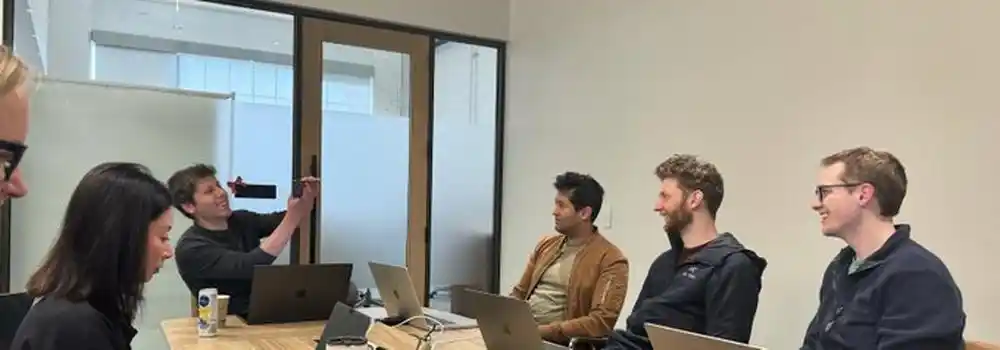
▲ Work photo of Bill Peebles (left 1) with Sam Altman (right 3) (Source: Bill Peebles)
In an open letter, Bill reviewed the development journey of Sora from scratch, calling the experience of building this project with the team the "most honorable and most like an adventure" of his career. He also thanked Sam Altman and others for fostering an inclusive research environment for the team, and stated outright that Sora "could almost certainly not have been born outside of OpenAI".
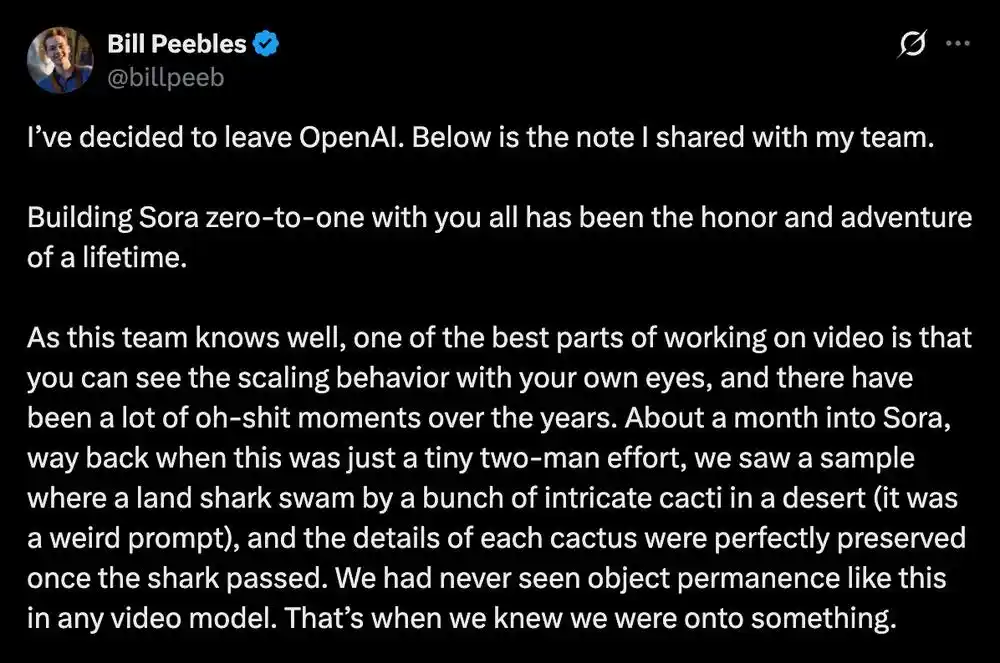
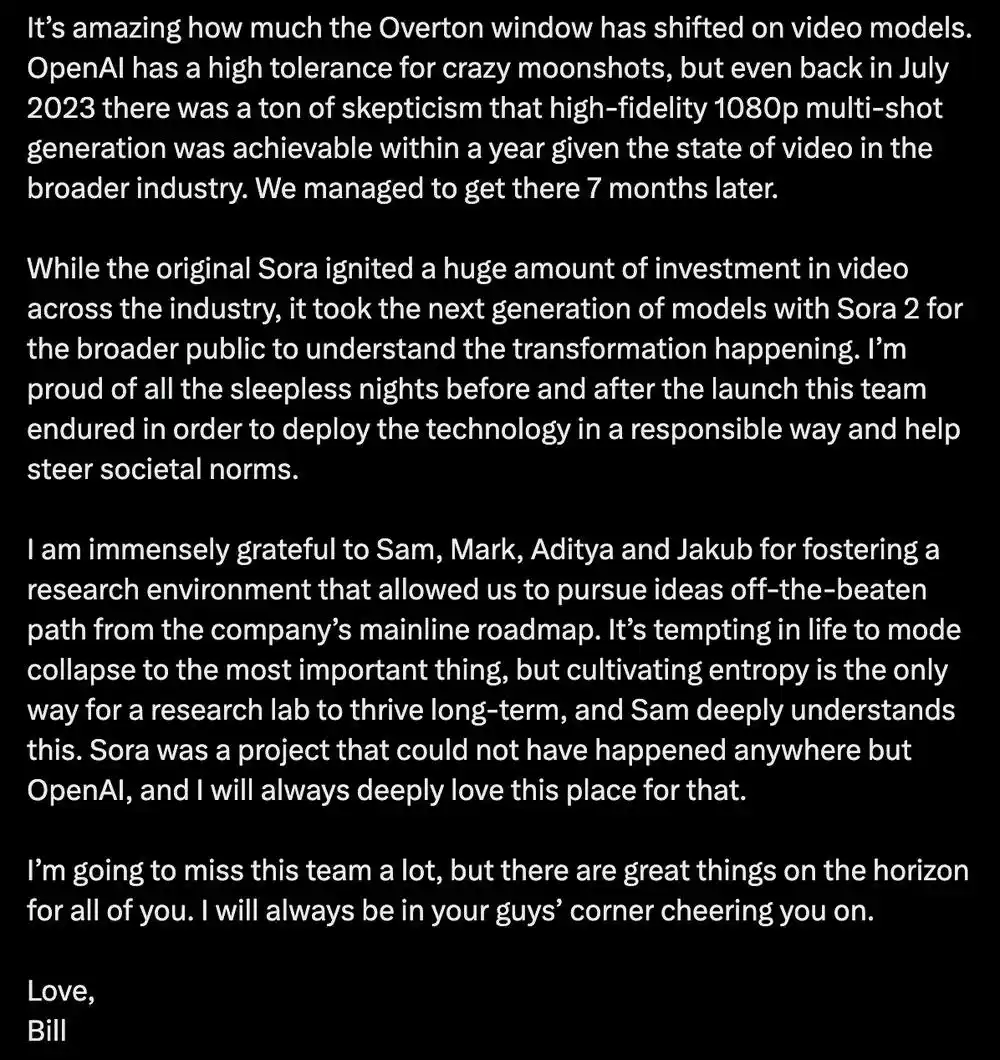
▲ Bill Peebles' resignation letter
Sam Altman later responded in the comments section, "Will miss Bill a lot", stating that his creativity pushed OpenAI and the entire industry to experience AI video in new ways, while also expressing anticipation for his next moves. Bill subsequently replied, "Thanks for everything".
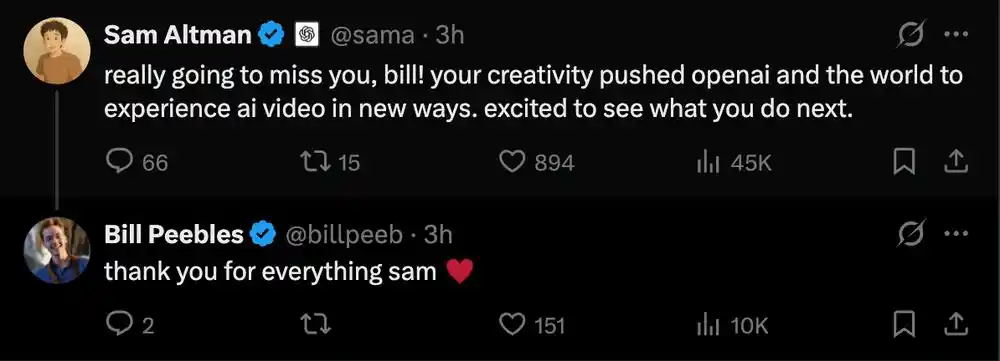
▲ Comments section interaction between Sam Altman and Bill Peebles
Chief Product Officer Departs Same Day
Prism Merged into Codex
On the same day, OpenAI Chief Product Officer, former Instagram executive Kevin Weil, also announced his departure.
He posted that with the "OpenAI for Science" initiative he led being dispersed into other research teams, today would be his last day at the company, emphasizing that accelerating scientific development would be one of the most positive outcomes on the path to AGI.
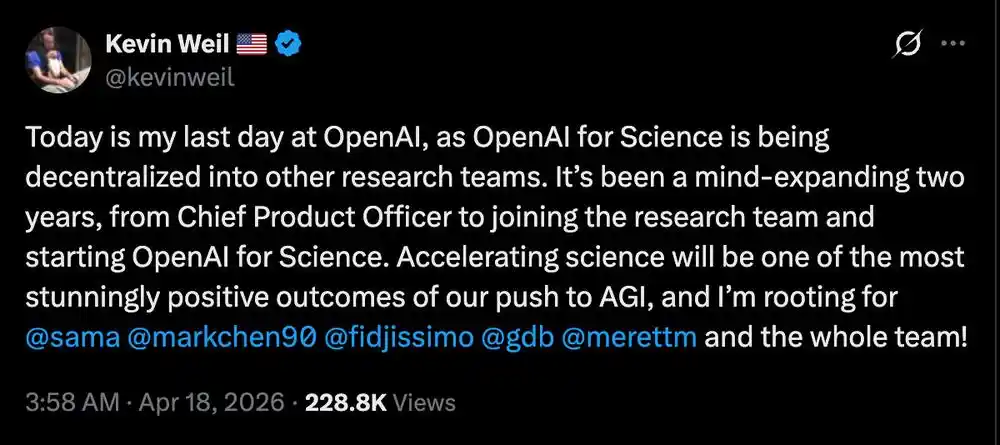
▲ Kevin Weil's resignation letter
ChatGPT product lead Nick Turley subsequently interacted in the thread, thanking Kevin Weil for his guidance and inspiration in building ChatGPT together. Kevin Weil replied that he also enjoyed the process of working together, joking "Keep making ChatGPT better, I'm a DAU (daily active user)".
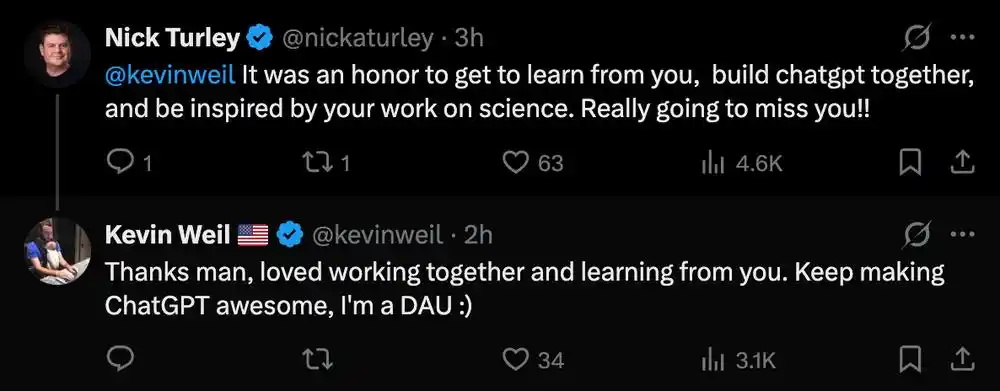
▲ Comments section interaction between Nick Turley and Kevin Weil
According to WIRED, behind Kevin Weil's departure, OpenAI is not just losing a former executive, but also undergoing a reorganization of its scientific application direction.
The report stated that OpenAI has decided to stop independently advancing Prism. Prism was a web application for researchers launched by OpenAI in January this year, originally attempting to provide scientists with AI tools better suited for scientific workflows.
Now, this product and its team of about 10 people will be merged under Thibault Sottiaux, head of Codex, with subsequent related capabilities to be integrated into the desktop version of the Codex application.
According to an OpenAI spokesperson, this change is part of the company's unified business and product strategy. More specifically, OpenAI hopes to further push Codex from a programming tool towards a "super app" direction, with Prism no longer existing as a separate product line.
Kevin Weil joined OpenAI in June 2024 and publicly announced the launch of the OpenAI for Science project in September of the same year. Now, less than two years later, the team members have been dispersed to various departments including product, research, and infrastructure.
Personnel Shake-up Extends Beyond Two
OpenAI is Accelerating Consolidation
The departure of these two individuals is only one aspect of a new round of internal contraction at OpenAI.
According to WIRED, in addition to Kevin Weil and Bill Peebles, OpenAI CTO of Enterprise Applications Srinivas Narayanan has also announced his departure, citing a desire to spend more time with family. Narayanan previously served as OpenAI's VP of Engineering and was an important executive for OpenAI's enterprise product direction.
This series of changes occurs amidst a "major reshuffle" of the executive team. Previously, AGI deployment lead Fidji Simo, who attempted to build a "super app", and Chief Marketing Officer Kate Rouch both took medical leave. President Greg Brockman temporarily took over product management, Chief Operating Officer Brad Lightcap moved to special projects, and the once industry-sensation Sora video application has currently been halted.
As Sam Altman admitted in a blog post published on April 10th, OpenAI is transitioning from "a chaotic but driven startup" to "a large platform that needs to operate in a more predictable way". He wrote that the company's development in recent years has been "extremely high-pressure, chaotic, and intense".
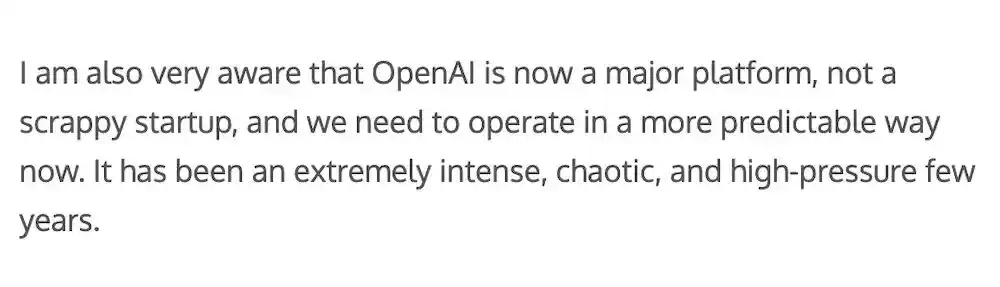
▲ Sam Altman's long response after his residence was firebombed.
Under pressure from competitor Anthropic and with an IPO planned for later this year, OpenAI is internally pushing to simplify its product lines, shifting resources from peripheral projects to areas with higher strategic priority.
In other words, Bill Peebles' departure and Prism's merger into Codex are consecutive actions in OpenAI's shift from "multiple experimental lines" to "consolidating main lines".
Turmoil on the Eve of IPO
Altman Again Embroiled in Conflict of Interest Allegations
As OpenAI accelerates its transformation, the issue of the "opacity" of Sam Altman's personal investment portfolio is being brought to the forefront.
According to The Wall Street Journal, after Sam Altman was briefly ousted and reinstated in 2023, the OpenAI board had promised to strengthen management of his potential conflicts of interest, but this issue has not truly disappeared.
Now, with OpenAI's valuation pushed to around $850 billion, questions about whether "company decisions are for OpenAI or indirectly serving Sam Altman's personal investment portfolio" have become more prominent.
The most typical case is the nuclear fusion company Helion.
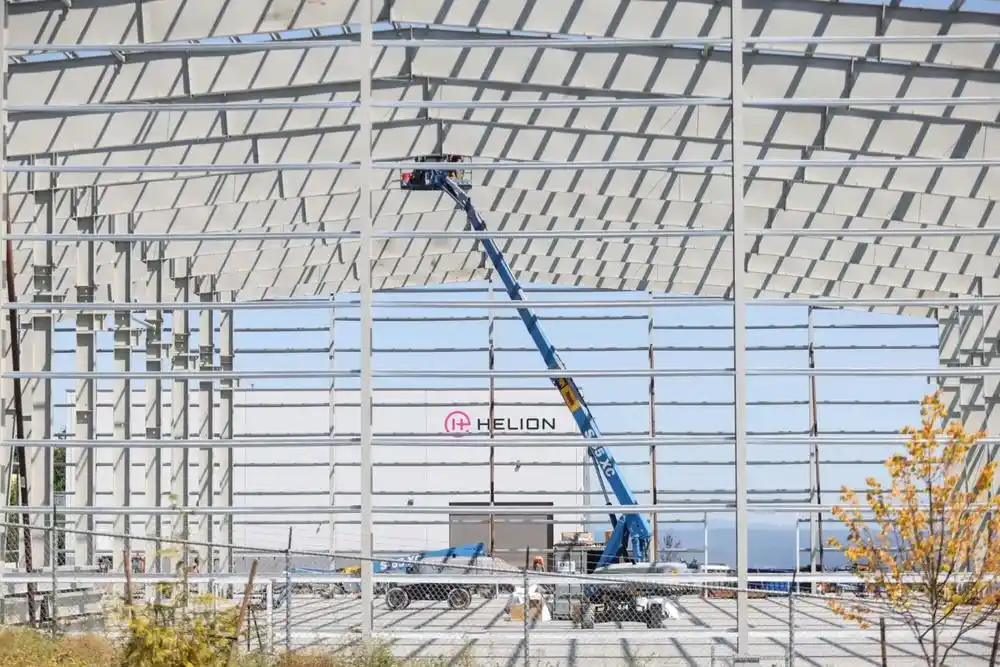
▲ Nuclear fusion company Helion
Sam Altman is a major investor in Helion, with a significant portion of his personal net worth tied to the company. Helion has experienced delays in delivering on its technology and begun facing funding pressures. Subsequently, Sam Altman pushed for OpenAI to lead a new round of financing for Helion, proposing an investment of about $500 million (approx. RMB 3.4 billion), which would have valued Helion at around $35 billion (approx. RMB 238.6 billion) under the proposed plan.
This proposal caused noticeable unease within OpenAI. Some employees believed Sam Altman was asking the company he leads to endorse an enterprise from which he directly benefits, with no immediately obvious business value for OpenAI in the transaction.
Some employees were even concerned that internal Slack discussions might become legal review material in the future, thus avoiding participation in related discussions.
OpenAI ultimately did not participate in this round of investment, but still signed an energy purchase agreement with Helion, agreeing to purchase up to 50 gigawatts of electricity by 2035, equivalent to the output of 25 Hoover Dams. Helion later used this agreement as an important endorsement in communications with investors.
With OpenAI withdrawing from the financing, Helion has now reduced its fundraising target to $250 million (approx. RMB 1.7 billion), with a valuation target lowered to $15 billion (approx. RMB 102.2 billion). Sam Altman resigned from the Helion board last month, explaining on social media that as Helion and OpenAI began exploring large-scale cooperation, it was no longer appropriate for him to sit on both boards.
Besides Helion, The Wall Street Journal also disclosed that Sam Altman had attempted to push for deeper cooperation between OpenAI and rocket company Stoke Space, even exploring having OpenAI acquire or control the company to support ideas like "space data centers".
Sam Altman himself has financial ties to Stoke through his family office, Hydrazine. Although Sam Altman publicly called the idea of "building data centers in space" "ridiculous" in India this February, the report cited informed sources stating that related cooperation discussions actually continued, with some OpenAI board members previously unaware.
Conclusion: Sora Reeled In, Prism Dismantled
What's Left on OpenAI's Main Line?
OpenAI's current situation is quite clear: it is actively compressing non-core businesses, concentrating resources on a few directions that can better support the IPO narrative and commercial returns.
The Wall Street Journal also mentioned that Fidji Simo told employees last month that Anthropic's progress should serve as a "wake-up call", and the company needs to direct more resources towards products for professional work scenarios.
Against this backdrop, some of Sam Altman's past product concepts, which were more personal in color, are gradually being scaled back. Simultaneously, his focus is quietly shifting: from product management to research, financing, and the acquisition of computing resources.
On one side, star employees announce their departures; on the other, product lines are merged. Coupled with multiple controversies on the eve of the IPO, OpenAI is transitioning from an expansion phase of "wanting to do everything" to a contraction phase of "having to succeed in a few things first".
Under the triple pressure of capital markets, competitors, and internal governance, the keyword for OpenAI's next stage is no longer all-out expansion, but concentrated firepower.
Sources: The Wall Street Journal, WIRED, Kevin Weil, Bill Peebles
This article is from the WeChat public account "Zhixiandao" (ID: zhidxcom), author: Jiang Yu