Breaking: OpenAI Loses Key Figure, Father of Sora Departs, Turmoil Continues on the Eve of IPO

marsbitPublié le 2026-04-18Dernière mise à jour le 2026-04-18

Résumé

OpenAI is undergoing significant internal turmoil ahead of its planned IPO, marked by high-profile executive departures and strategic shifts. Key figures including Sora project lead Bill Peebles and Chief Product Officer Kevin Weil have announced their exits. The company is consolidating projects, discontinuing standalone products like the research tool Prism and integrating it into Codex, while also halting the video project Sora. Simultaneously, CEO Sam Altman faces renewed allegations of conflicts of interest. Reports reveal he attempted to have OpenAI invest in his personal ventures, such as nuclear fusion company Helion and space firm Stoke Space, raising internal concerns about transparency and governance. These moves come as OpenAI, valued at around $850 billion, shifts from rapid expansion to focusing resources on core priorities like enterprise products and AGI development, under pressure from competitors and the upcoming IPO.

Zhixiandao, April 18th report—Early this morning, OpenAI was hit with a series of changes including executive departures, project scaling back, and questions regarding personal conflicts of interest involving co-founder and CEO Sam Altman. This AI star company, sprinting towards an IPO, is once again facing a storm of personnel and trust issues.

On one hand, multiple executives including Sora core lead Bill Peebles and Chief Product Officer Kevin Weil have successively announced their departures, with projects like the video project Sora and the scientific research tool Prism heading towards shutdown, consolidation, or reorganization.

On the other hand, The Wall Street Journal reported that Sam Altman had previously attempted to push OpenAI to support his personally backed nuclear fusion and space projects. This move has also plunged the company, at the critical juncture of preparing for a listing with a valuation of approximately $850 billion (about RMB 5.8 trillion), into renewed questioning over conflicts of interest.

Sora Architect Departs

OpenAI's Video Division Loses Another Key Player

Early this morning, Sora project core lead Bill Peebles announced his departure on a social platform, sharing a photo of himself working alongside Sam Altman.
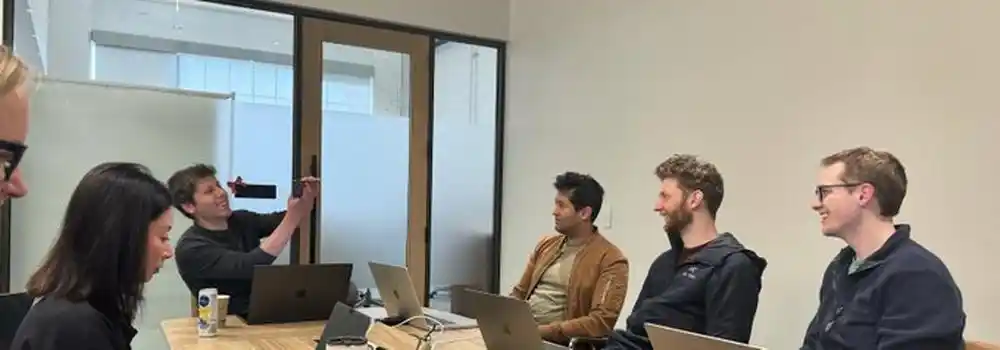
▲ Work photo of Bill Peebles (left 1) with Sam Altman (right 3) (Source: Bill Peebles)

In an open letter, Bill reviewed the development journey of Sora from scratch, calling the experience of building this project with the team the "most honorable and most like an adventure" of his career. He also thanked Sam Altman and others for fostering an inclusive research environment for the team, and stated outright that Sora "could almost certainly not have been born outside of OpenAI".
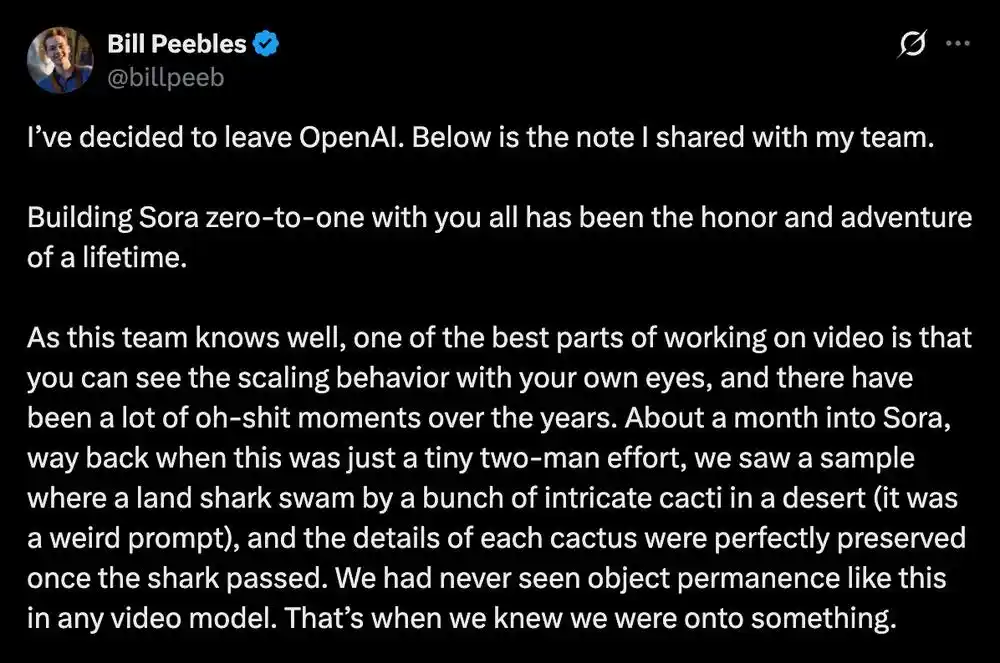
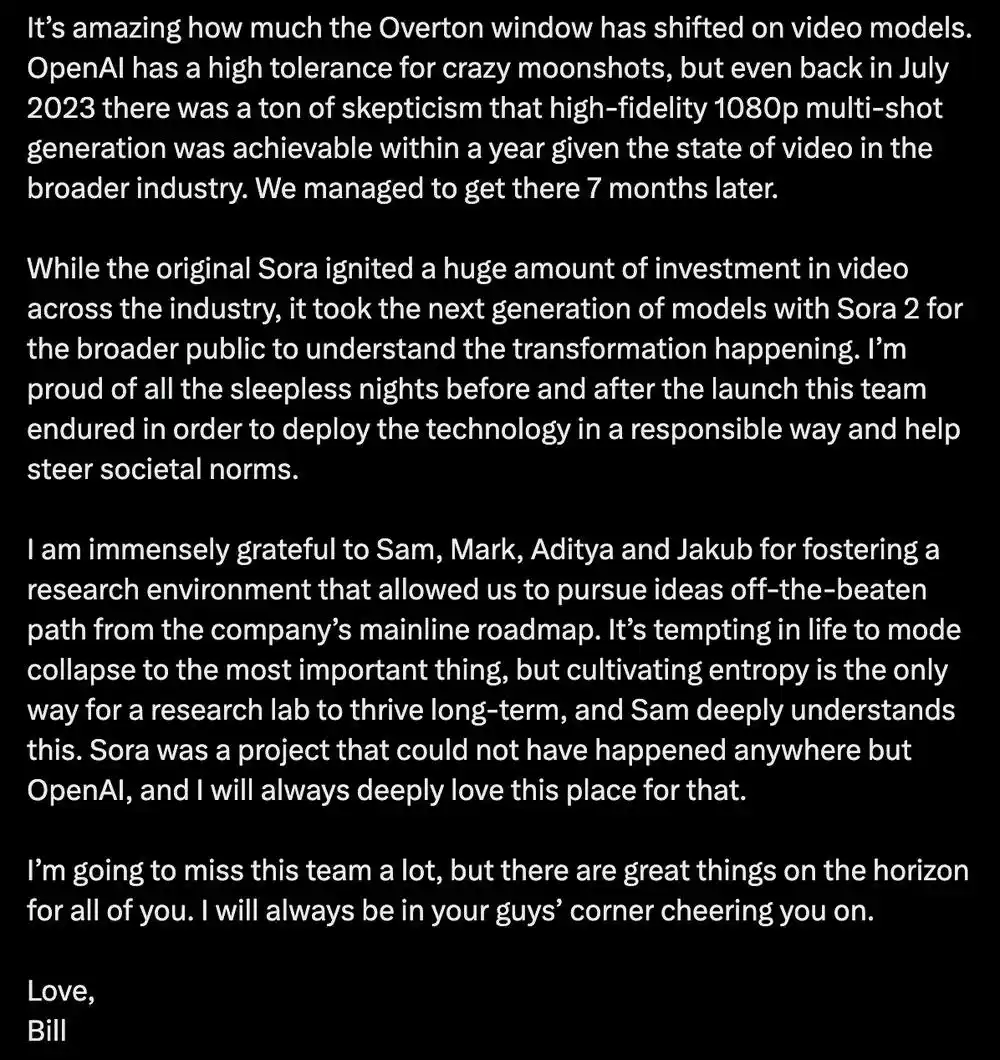
▲ Bill Peebles' resignation letter

Sam Altman later responded in the comments section, "Will miss Bill a lot", stating that his creativity pushed OpenAI and the entire industry to experience AI video in new ways, while also expressing anticipation for his next moves. Bill subsequently replied, "Thanks for everything".
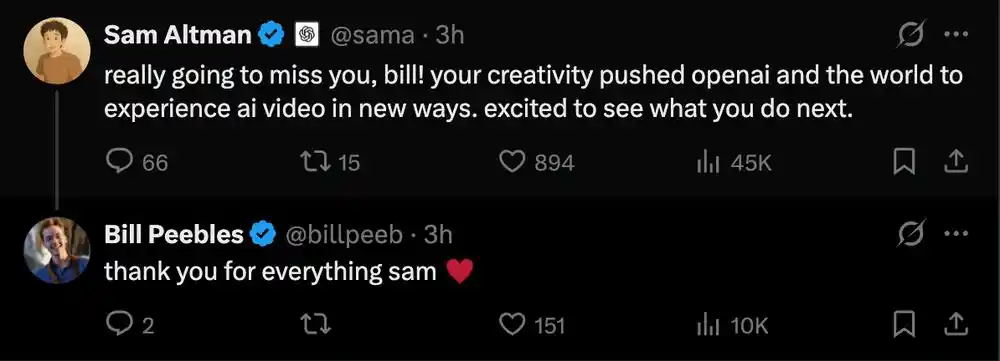
▲ Comments section interaction between Sam Altman and Bill Peebles

Chief Product Officer Departs Same Day

Prism Merged into Codex

On the same day, OpenAI Chief Product Officer, former Instagram executive Kevin Weil, also announced his departure.

He posted that with the "OpenAI for Science" initiative he led being dispersed into other research teams, today would be his last day at the company, emphasizing that accelerating scientific development would be one of the most positive outcomes on the path to AGI.
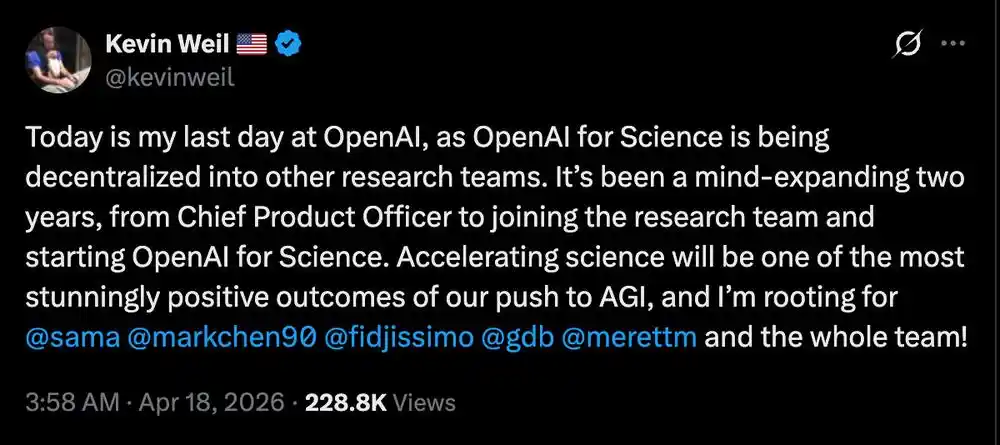
▲ Kevin Weil's resignation letter

ChatGPT product lead Nick Turley subsequently interacted in the thread, thanking Kevin Weil for his guidance and inspiration in building ChatGPT together. Kevin Weil replied that he also enjoyed the process of working together, joking "Keep making ChatGPT better, I'm a DAU (daily active user)".
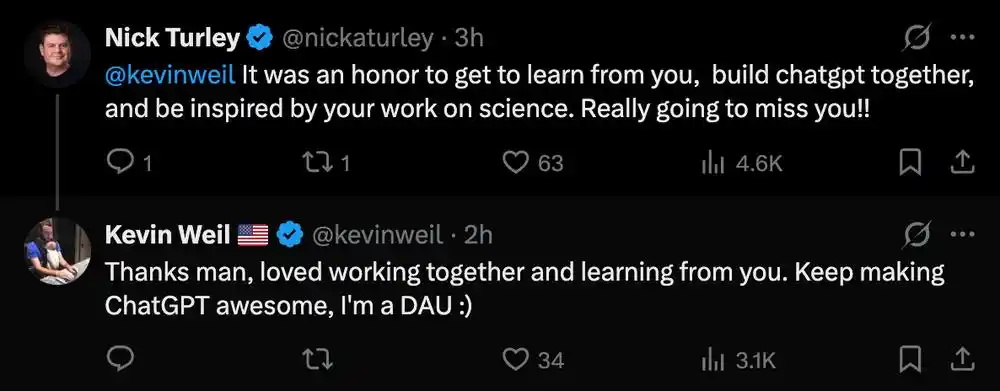
▲ Comments section interaction between Nick Turley and Kevin Weil

According to WIRED, behind Kevin Weil's departure, OpenAI is not just losing a former executive, but also undergoing a reorganization of its scientific application direction.

The report stated that OpenAI has decided to stop independently advancing Prism. Prism was a web application for researchers launched by OpenAI in January this year, originally attempting to provide scientists with AI tools better suited for scientific workflows.

Now, this product and its team of about 10 people will be merged under Thibault Sottiaux, head of Codex, with subsequent related capabilities to be integrated into the desktop version of the Codex application.

According to an OpenAI spokesperson, this change is part of the company's unified business and product strategy. More specifically, OpenAI hopes to further push Codex from a programming tool towards a "super app" direction, with Prism no longer existing as a separate product line.

Kevin Weil joined OpenAI in June 2024 and publicly announced the launch of the OpenAI for Science project in September of the same year. Now, less than two years later, the team members have been dispersed to various departments including product, research, and infrastructure.

Personnel Shake-up Extends Beyond Two

OpenAI is Accelerating Consolidation

The departure of these two individuals is only one aspect of a new round of internal contraction at OpenAI.

According to WIRED, in addition to Kevin Weil and Bill Peebles, OpenAI CTO of Enterprise Applications Srinivas Narayanan has also announced his departure, citing a desire to spend more time with family. Narayanan previously served as OpenAI's VP of Engineering and was an important executive for OpenAI's enterprise product direction.

This series of changes occurs amidst a "major reshuffle" of the executive team. Previously, AGI deployment lead Fidji Simo, who attempted to build a "super app", and Chief Marketing Officer Kate Rouch both took medical leave. President Greg Brockman temporarily took over product management, Chief Operating Officer Brad Lightcap moved to special projects, and the once industry-sensation Sora video application has currently been halted.

As Sam Altman admitted in a blog post published on April 10th, OpenAI is transitioning from "a chaotic but driven startup" to "a large platform that needs to operate in a more predictable way". He wrote that the company's development in recent years has been "extremely high-pressure, chaotic, and intense".
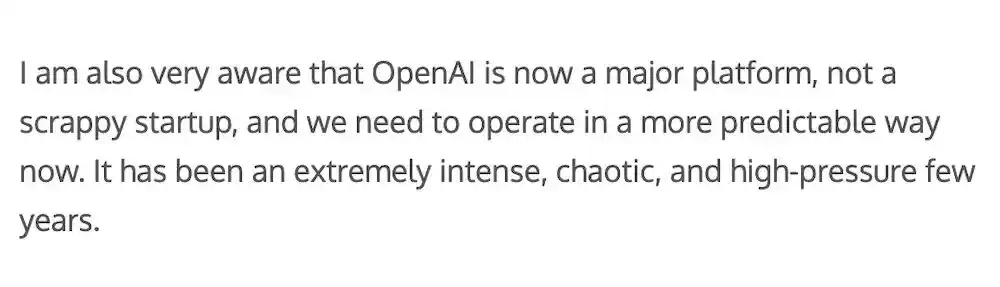
▲ Sam Altman's long response after his residence was firebombed.

Under pressure from competitor Anthropic and with an IPO planned for later this year, OpenAI is internally pushing to simplify its product lines, shifting resources from peripheral projects to areas with higher strategic priority.

In other words, Bill Peebles' departure and Prism's merger into Codex are consecutive actions in OpenAI's shift from "multiple experimental lines" to "consolidating main lines".

Turmoil on the Eve of IPO

Altman Again Embroiled in Conflict of Interest Allegations

As OpenAI accelerates its transformation, the issue of the "opacity" of Sam Altman's personal investment portfolio is being brought to the forefront.

According to The Wall Street Journal, after Sam Altman was briefly ousted and reinstated in 2023, the OpenAI board had promised to strengthen management of his potential conflicts of interest, but this issue has not truly disappeared.

Now, with OpenAI's valuation pushed to around $850 billion, questions about whether "company decisions are for OpenAI or indirectly serving Sam Altman's personal investment portfolio" have become more prominent.

The most typical case is the nuclear fusion company Helion.
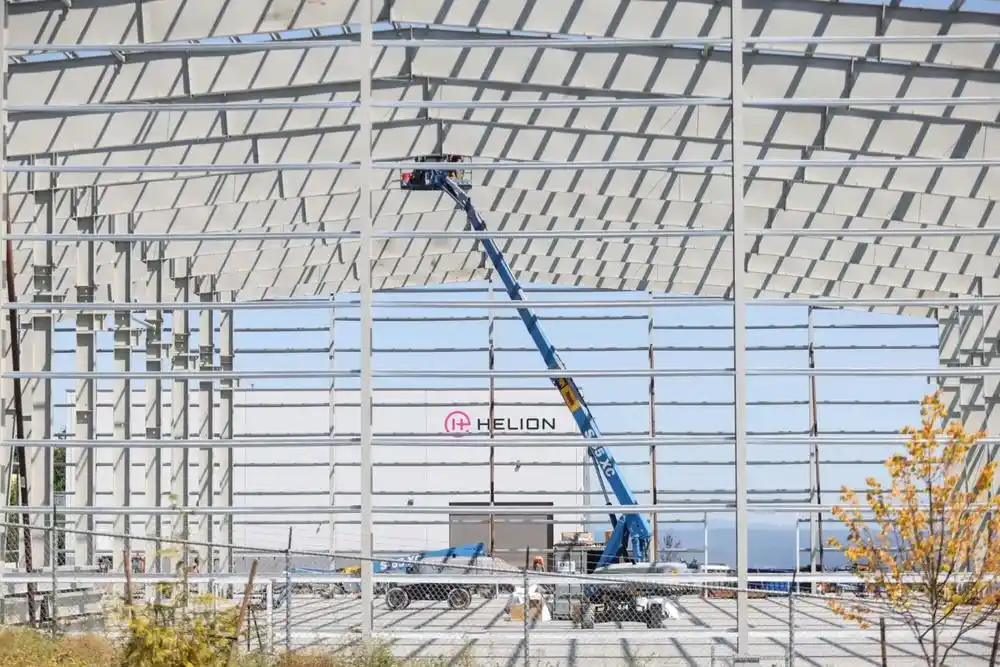
▲ Nuclear fusion company Helion

Sam Altman is a major investor in Helion, with a significant portion of his personal net worth tied to the company. Helion has experienced delays in delivering on its technology and begun facing funding pressures. Subsequently, Sam Altman pushed for OpenAI to lead a new round of financing for Helion, proposing an investment of about $500 million (approx. RMB 3.4 billion), which would have valued Helion at around $35 billion (approx. RMB 238.6 billion) under the proposed plan.

This proposal caused noticeable unease within OpenAI. Some employees believed Sam Altman was asking the company he leads to endorse an enterprise from which he directly benefits, with no immediately obvious business value for OpenAI in the transaction.

Some employees were even concerned that internal Slack discussions might become legal review material in the future, thus avoiding participation in related discussions.

OpenAI ultimately did not participate in this round of investment, but still signed an energy purchase agreement with Helion, agreeing to purchase up to 50 gigawatts of electricity by 2035, equivalent to the output of 25 Hoover Dams. Helion later used this agreement as an important endorsement in communications with investors.

With OpenAI withdrawing from the financing, Helion has now reduced its fundraising target to $250 million (approx. RMB 1.7 billion), with a valuation target lowered to $15 billion (approx. RMB 102.2 billion). Sam Altman resigned from the Helion board last month, explaining on social media that as Helion and OpenAI began exploring large-scale cooperation, it was no longer appropriate for him to sit on both boards.

Besides Helion, The Wall Street Journal also disclosed that Sam Altman had attempted to push for deeper cooperation between OpenAI and rocket company Stoke Space, even exploring having OpenAI acquire or control the company to support ideas like "space data centers".

Sam Altman himself has financial ties to Stoke through his family office, Hydrazine. Although Sam Altman publicly called the idea of "building data centers in space" "ridiculous" in India this February, the report cited informed sources stating that related cooperation discussions actually continued, with some OpenAI board members previously unaware.

Conclusion: Sora Reeled In, Prism Dismantled

What's Left on OpenAI's Main Line?

OpenAI's current situation is quite clear: it is actively compressing non-core businesses, concentrating resources on a few directions that can better support the IPO narrative and commercial returns.

The Wall Street Journal also mentioned that Fidji Simo told employees last month that Anthropic's progress should serve as a "wake-up call", and the company needs to direct more resources towards products for professional work scenarios.

Against this backdrop, some of Sam Altman's past product concepts, which were more personal in color, are gradually being scaled back. Simultaneously, his focus is quietly shifting: from product management to research, financing, and the acquisition of computing resources.

On one side, star employees announce their departures; on the other, product lines are merged. Coupled with multiple controversies on the eve of the IPO, OpenAI is transitioning from an expansion phase of "wanting to do everything" to a contraction phase of "having to succeed in a few things first".

Under the triple pressure of capital markets, competitors, and internal governance, the keyword for OpenAI's next stage is no longer all-out expansion, but concentrated firepower.

Sources: The Wall Street Journal, WIRED, Kevin Weil, Bill Peebles

This article is from the WeChat public account "Zhixiandao" (ID: zhidxcom), author: Jiang Yu

Questions liées

QWho are the key executives that recently left OpenAI, and what were their roles?

ABill Peebles, the core leader of the Sora project, and Kevin Weil, the Chief Product Officer, recently left OpenAI. Additionally, Srinivas Narayanan, the CTO of enterprise applications, also announced his departure.

QWhat projects at OpenAI are being shut down or restructured?

AThe video project Sora is being halted, and the scientific research tool Prism is being discontinued as a standalone product. The Prism team is being merged into the Codex team under Thibault Sottiaux.

QWhat personal利益冲突 issues involving Sam Altman were reported by The Wall Street Journal?

AThe Wall Street Journal reported that Sam Altman attempted to push OpenAI to invest in Helion, a nuclear fusion company he personally backed, and explored deeper cooperation or even control of Stoke Space, a rocket company, both of which involve his personal financial interests.

QWhy is OpenAI undergoing internal restructuring and project consolidation?

AOpenAI is shifting from a 'multi-line experimentation' phase to a 'mainline consolidation' strategy to focus resources on strategic priorities, streamline product lines, and prepare for its upcoming IPO, amid pressure from competitors like Anthropic.

QWhat is the current valuation of OpenAI and what challenges does it face before its IPO?

AOpenAI is valued at approximately $850 billion and faces challenges including executive departures, project restructuring, and concerns over Sam Altman's potential利益冲突, all occurring during its critical IPO preparation phase.

Lectures associées

Ce PDG de la Finance Choisit Solana Plutôt Que Bitcoin — Voici Pourquoi

Le PDG du secteur financier Raoul Pal a exprimé une préférence nette pour Solana par rapport au Bitcoin, lors de l'événement Consensus 2026. Sa position ne relève pas d'une simple comparaison d'actifs mais d'une conviction sur l'avenir de la cryptographie à l'ère de l'intelligence artificielle. Il estime que l'industrie se dirige vers une phase dominée par les réseaux à haute vitesse et faible coût, mieux adaptés aux activités de masse, plutôt que par le rôle de réserve de valeur du Bitcoin. Selon lui, Solana, avec son débit élevé et ses faibles frais de transaction, est idéal pour les microtransactions entre machines, les activités basées sur l'IA et les interactions DeFi rapides. Pal prédit par ailleurs que d'ici cinq ans, les agents IA représenteront 60% des utilisateurs de la finance décentralisée (DeFi), surpassant les utilisateurs humains. Cette vision d'un futur où les transactions fréquentes et automatisées seront cruciales explique son choix en faveur de Solana pour capturer les opportunités de croissance. Bien qu'il soit improbable que Solana surpasse Bitcoin en termes de taille à court terme, cette perspective s'inscrit dans un thème majeur de la conférence, centré sur la convergence entre l'IA, la DeFi et l'infrastructure institutionnelle. D'autres intervenants, comme Arthur Hayes, ont également souligné la nature distincte de la cryptographie par rapport aux systèmes traditionnels.

bitcoinistIl y a 8 h

Ce PDG de la Finance Choisit Solana Plutôt Que Bitcoin — Voici Pourquoi

bitcoinistIl y a 8 h

GensynAI : Ne laissez pas l'IA répéter les erreurs d'Internet

Au cours des derniers mois, l'essor de l'IA a attiré de nombreux talents de la cryptographie. Une question centrale émerge : la blockchain peut-elle faire partie de l'infrastructure de l'IA ? Gensyn se distingue en s'attaquant non pas aux applications, mais au cœur du développement de l'IA : **l'entraînement des modèles**. Le projet vise à organiser les ressources GPU mondiales dispersées en un réseau ouvert d'entraînement d'IA. Les développeurs peuvent soumettre des tâches, les nœuds fournissent la puissance de calcul, et le réseau vérifie les résultats avant de distribuer les incitations. L'enjeu dépasse la simple décentralisation : il s'agit de contrer la **concentration croissante des ressources de calcul** entre les mains de quelques géants, qui deviennent un goulot d'étranglement pour l'innovation. Gensyn propose ainsi une nouvelle façon d'organiser les ressources. Premièrement, il opère au niveau de l'infrastructure fondamentale, la couche la plus exigeante techniquement et en ressources. Deuxièmement, il offre un modèle de collaboration plus ouvert, permettant une meilleure utilisation des GPU inactifs et une réduction potentielle des coûts. Troisièmement, sa technologie de vérification probabiliste des résultats et de coordination des nœuds constitue un véritable avantage technique. Enfin, il répond à une demande réelle et croissante du marché, évitant le piège des récits sans utilité pratique. En somme, Gensyn incite la convergence entre la cryptographie (expertise en coordination et incitations mondiales) et l'IA (besoins massifs en ressources). Son ambition est de transformer l'entraînement de l'IA en un système plus ouvert et accessible, au-delà du contrôle exclusif des grands acteurs, posant les bases d'une infrastructure essentielle pour l'ère de l'IA.

marsbitIl y a 9 h

GensynAI : Ne laissez pas l'IA répéter les erreurs d'Internet

marsbitIl y a 9 h

Pourquoi la Chine se développe-t-elle si rapidement en IA ? La réponse se cache dans les laboratoires

L'auteur, après une visite dans des laboratoires d'IA chinois de premier plan, explore les raisons du développement rapide de l'IA en Chine. Il constate que l'écosystème chinois se distingue de celui des États-Unis par son approche organisationnelle : moins de concepts, plus de modèles concrets ; moins d'importance accordée aux vedettes individuelles, plus au travail d'équipe ; et une forte préférence pour maîtriser en interne la pile technologique plutôt que de dépendre de services externes. La culture de travail, valorisant l'humilité, l'exécution et l'ingénierie rapide, est bien adaptée à la construction de grands modèles de langage. Une grande partie des contributeurs clés sont des étudiants, intégrés directement aux équipes, apportant un regard neuf et une forte capacité d'adaptation. L'accent est mis sur l'amélioration itérative et l'optimisation plutôt que sur la recherche "de 0 à 1". Les scientifiques chinois se montrent très concentrés sur la construction technique, moins sur les débats philosophiques ou économiques autour de l'IA. L'écosystème industriel présente également des différences : une demande précoce en IA (ressemblant plus au marché du cloud qu'au SaaS), une forte influence des modèles comme Claude sur les développeurs, et une mentalité répandue de "contrôle technologique" poussant de nombreuses grandes entreprises (plateformes, hardware) à développer leurs propres modèles fondateurs, souvent en open source par pragmatisme. Le soutien gouvernemental existe mais est décentralisé, l'industrie des données est moins mature qu'en Occident, et l'accès aux puces Nvidia est une contrainte majeure. L'auteur conclut que la Chine développe sa propre voie, marquée par une culture de construction, un esprit d'écosystème collaboratif et un pragmatisme profond. Cette approche, différente de la course aux sommets menée par le capital et les "stars" aux États-Unis, fait de la compétition mondiale en IA une rivalité de capacités organisationnelles, d'écosystèmes développeurs et d'exécution industrielle. Il exprime un souhait pour une écologie open source mondiale florissante, tout en notant les défis géopolitiques actuels.

marsbitIl y a 10 h

Pourquoi la Chine se développe-t-elle si rapidement en IA ? La réponse se cache dans les laboratoires

marsbitIl y a 10 h

3 ans, 5 fois la valeur, la renaissance d'une verrerie centenaire

D'après CRU, la demande de fibre optique pour les centres de données IA a augmenté de 75,9 % sur un an, et l'écart entre l'offre et la demande s'est creusé de 6 % à 15 %. Les prix des fibres ont plus que triplé en quelques mois, révélant une capacité de production insuffisante. Cela explique les investissements massifs de NVIDIA chez Corning, ainsi que chez Lumentum et Coherent, pour un total de 45 milliards de dollars, visant à sécuriser la chaîne d'approvisionnement optique (lasers, puces photoniques, fibres). Corning, une entreprise de verrerie fondée en 1851, a vu son cours de bourse multiplié par plus de 3 en un an, atteignant une capitalisation de 160 milliards de dollars. Cette renaissance est portée par les infrastructures IA. La fibre optique est devenue le « nerf » des centres de données IA, avec une consommation 5 à 10 fois supérieure aux serveurs traditionnels. La transition du cuivre vers la lumière (interconnexions optiques, CPO) est nécessaire pour les débits élevés (au-delà de 800G) et pour réduire la consommation d'énergie. Corning se distingue par sa technologie de fibres spécialisées à très faible atténuation et haute densité, cruciales pour l'IA. Son activité "Enterprise" (centres de données), désormais plus de 40% de ses revenus en communication optique, connaît une croissance explosive, soutenue par des contrats pluriannuels avec Meta, NVIDIA et d'autres géants. Bien que ne détenant pas la plus grande part de marché mondiale de la fibre, Corning tire parti de décennies de R&D et d'un savoir-faire matériel de pointe, notamment dans le domaine émergent du CPO (Co-Packaged Optics). La pénurie et la hausse des prix profitent à tout le secteur, comme en témoignent les résultats des concurrents chinois. Le rythme de déploiement du CPO par NVIDIA et l'identité des autres grands clients non divulgués de Corning sont des catalyseurs clés pour son avenir. Des technologies disruptives comme la fibre à cœur creux pourraient également remodeler le paysage à plus long terme. Après une forte appréciation boursière, l'exécution des commandes et le respect des délais seront désormais plus importants que le récit de croissance lui-même.

marsbitIl y a 11 h

3 ans, 5 fois la valeur, la renaissance d'une verrerie centenaire

marsbitIl y a 11 h

Trading

Spot
Futures
活动图片





