Blockchain trial on Canton Network tests collateral reuse with tokenized US Treasurys

cointelegraphPublié le 2025-12-09Dernière mise à jour le 2025-12-09

Résumé

Digital Asset and a group of major financial institutions have successfully conducted a second round of onchain US Treasury financing trials on the Canton Network. The test introduced real-time collateral reuse using tokenized US Treasurys and expanded the use of multiple stablecoins, including USDC, to enhance onchain liquidity. This innovation bypasses traditional operational delays associated with rehypothecation. Participants included Bank of America, Citadel Securities, Cumberland DRW, Virtu Financial, Société Générale, Tradeweb, Circle, Brale, and M1X Global. The Canton Network, a blockchain built for institutional finance, continues to grow in the tokenized real-world assets (RWA) space, with over $370 billion represented onchain, leading the market significantly.

Digital Asset and a group of financial institutions have completed a second round of onchain US Treasury financing on the Canton Network, introducing real-time collateral reuse and expanding the number of stablecoins involved.

Five transactions were executed in the newest phase, building on the July pilot, which first demonstrated that US Treasurys and the USDC (USDC) stablecoin could be combined to finance and settle transactions on the blockchain.

In the latest trial, the companies used multiple stablecoins to finance positions against tokenized US Treasurys, widening the pool of onchain liquidity available for financing transactions.

The trial showed that tokenized US Treasurys could be passed between counterparties and reused as collateral in real-time, sidestepping the operational delays that typically accompany rehypothecation in traditional finance.

The effort brought together Bank of America, Citadel Securities, Cumberland DRW, Virtu Financial, Société Générale, Tradeweb, Circle, Brale and M1X Global, which are all a part of the Canton Network’s Industry Working Group.

Kelly Mathieson, chief business development officer at Digital Asset — the company behind the Canton Network — said in a statement that the test was “part of a thoughtful progression toward a new market model.”

Justin Peterson, chief technology officer of Tradeweb, added that “demonstrating real-time collateral reuse and expanded stablecoin liquidity isn’t just a technical achievement — it’s a blueprint for what the future of institutional finance can look like.”

Related: ‘We refused to do an ICO’: The truth behind Canton’s tokenomics

Canton Network expands footprint in tokenized RWAs

The Canton Network, a layer-1 blockchain built for institutional finance, has been expanding its presence across the tokenization sector this year.

On Dec. 4, its developer Digital Asset secured roughly $50 million in strategic backing from BNY, iCapital, Nasdaq and S&P Global. The new funding followed a $135 million raise earlier this year and is intended to support the network’s scaling efforts.

In October, asset manager Franklin Templeton said it would migrate its Benji Investments platform — which tokenizes shares of the firm’s flagship US money market fund — to the Canton Network.

Data from RWA.xyz also shows the Canton Network now leads the market for tokenized real-world assets by a wide margin, with more than $370 billion represented onchain, far outpacing popular networks such as Ethereum, Polygon, Solana and other public chains.
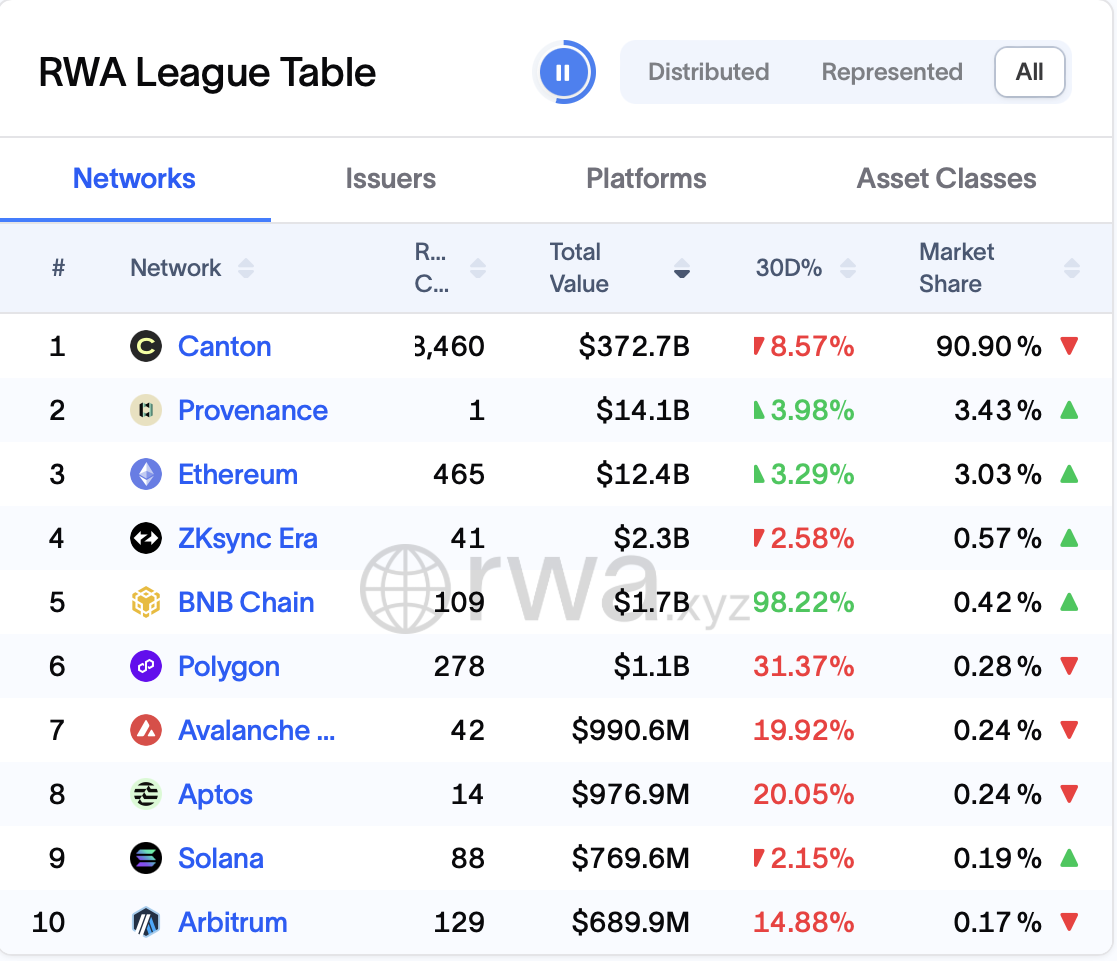
Top blockchains for RWA. Source: RWA.xyz

Magazine: 6 reasons Jack Dorsey is definitely Satoshi... and 5 reasons he’s not
Lectures associées

Le projet de loi CLARITY atteint un moment charnière : la cryptomonnaie américaine à un carrefour réglementaire

Un tournant historique pour la régulation des cryptomonnaies aux États-Unis se joue en 2026. Le « CLARITY Act », loi cruciale pour définir la structure du marché des actifs numériques, doit être approuvé par la commission bancaire du Sénat avant fin avril, sans quoi son adoption pourrait être reportée de plusieurs années. Parallèlement, le « GENIUS Act », déjà adopté, impose un cadre prudentiel aux stablecoins, favorisant une concentration du marché autour d’acteurs conformes comme USDC et USAT (la nouvelle entité de Tether pour le marché institutionnel américain), tout en comprimant la place de l’USDT. Un compromis bipartisan, mené par les sénateurs Tillis et Alsobrooks, propose d’autoriser les récompenses sur les stablecoins liées à des activités, mais d’interdire les rendements passifs purs, une question au cœur des tensions avec le secteur bancaire traditionnel. La Maison Blanche, sous Trump, pousse pour une adoption rapide, mais fait face à des défis politiques, notamment sur les conflits d’intérêts des responsables gouvernementaux. Si la loi est adoptée, elle pourrait déclencher l’entrée de billions de dollars de capitaux institutionnels (fonds de pension, assureurs) et aligner les standards américains avec le règlement européen MiCA, renforçant la compétitivité mondiale des États-Unis. Son rejet profiterait aux places financières concurrentes comme l’UE, Hong Kong ou Singapour, et retarderait considérablement l’intégration des cryptomonnaies dans le système financier traditionnel. La conformité réglementaire devient l’avantage compétitif décisif pour l’avenir.

marsbitIl y a 47 mins

Le projet de loi CLARITY atteint un moment charnière : la cryptomonnaie américaine à un carrefour réglementaire

marsbitIl y a 47 mins

Trading

Spot
Futures
活动图片