Blockchain trial on Canton Network tests collateral reuse with tokenized US Treasurys

cointelegraphPublié le 2025-12-09Dernière mise à jour le 2025-12-09

Résumé

Digital Asset and a group of major financial institutions have successfully conducted a second round of onchain US Treasury financing trials on the Canton Network. The test introduced real-time collateral reuse using tokenized US Treasurys and expanded the use of multiple stablecoins, including USDC, to enhance onchain liquidity. This innovation bypasses traditional operational delays associated with rehypothecation. Participants included Bank of America, Citadel Securities, Cumberland DRW, Virtu Financial, Société Générale, Tradeweb, Circle, Brale, and M1X Global. The Canton Network, a blockchain built for institutional finance, continues to grow in the tokenized real-world assets (RWA) space, with over $370 billion represented onchain, leading the market significantly.

Digital Asset and a group of financial institutions have completed a second round of onchain US Treasury financing on the Canton Network, introducing real-time collateral reuse and expanding the number of stablecoins involved.

Five transactions were executed in the newest phase, building on the July pilot, which first demonstrated that US Treasurys and the USDC (USDC) stablecoin could be combined to finance and settle transactions on the blockchain.

In the latest trial, the companies used multiple stablecoins to finance positions against tokenized US Treasurys, widening the pool of onchain liquidity available for financing transactions.

The trial showed that tokenized US Treasurys could be passed between counterparties and reused as collateral in real-time, sidestepping the operational delays that typically accompany rehypothecation in traditional finance.

The effort brought together Bank of America, Citadel Securities, Cumberland DRW, Virtu Financial, Société Générale, Tradeweb, Circle, Brale and M1X Global, which are all a part of the Canton Network’s Industry Working Group.

Kelly Mathieson, chief business development officer at Digital Asset — the company behind the Canton Network — said in a statement that the test was “part of a thoughtful progression toward a new market model.”

Justin Peterson, chief technology officer of Tradeweb, added that “demonstrating real-time collateral reuse and expanded stablecoin liquidity isn’t just a technical achievement — it’s a blueprint for what the future of institutional finance can look like.”

Related: ‘We refused to do an ICO’: The truth behind Canton’s tokenomics

Canton Network expands footprint in tokenized RWAs

The Canton Network, a layer-1 blockchain built for institutional finance, has been expanding its presence across the tokenization sector this year.

On Dec. 4, its developer Digital Asset secured roughly $50 million in strategic backing from BNY, iCapital, Nasdaq and S&P Global. The new funding followed a $135 million raise earlier this year and is intended to support the network’s scaling efforts.

In October, asset manager Franklin Templeton said it would migrate its Benji Investments platform — which tokenizes shares of the firm’s flagship US money market fund — to the Canton Network.

Data from RWA.xyz also shows the Canton Network now leads the market for tokenized real-world assets by a wide margin, with more than $370 billion represented onchain, far outpacing popular networks such as Ethereum, Polygon, Solana and other public chains.
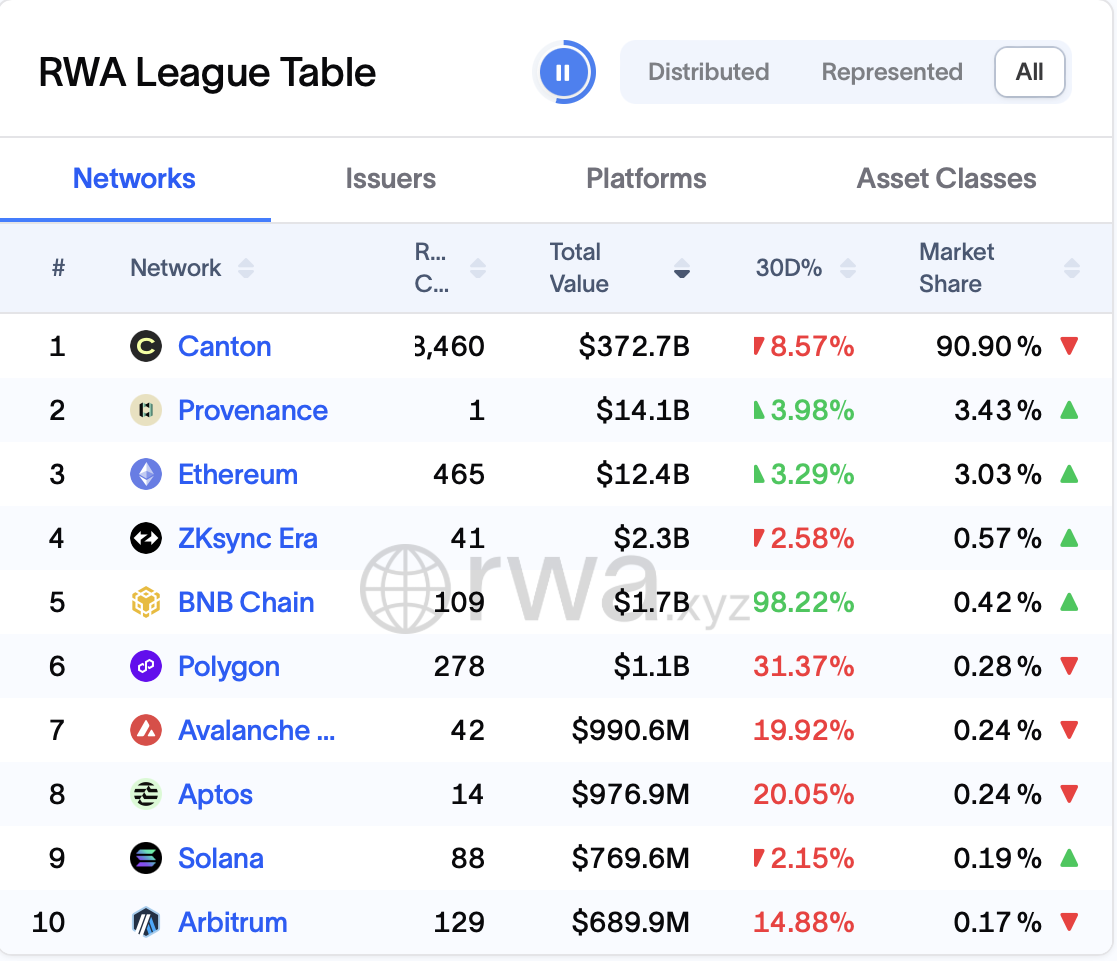
Top blockchains for RWA. Source: RWA.xyz

Magazine: 6 reasons Jack Dorsey is definitely Satoshi... and 5 reasons he’s not
Lectures associées

Google et Amazon investissent simultanément dans un concurrent, la logique commerciale la plus absurde de l'ère IA devient réalité

En l'espace de 4 jours, Amazon a annoncé un investissement supplémentaire de 25 milliards de dollars et Google jusqu'à 40 milliards de dollars dans Anthropic, une startup d'IA. Ces deux concurrents directs ont ainsi engagé plus de 65 milliards de dollars dans la même entreprise. Cet investissement massif ne relève pas d'une logique capitalistique traditionnelle, mais marque le début d'un nouveau round dans la guerre du cloud. L'enjeu pour Google et Amazon n'est pas la simple possession d'une part d'Anthropic, mais la sécurisation de contrats de pré-achat de puissance de calcul (ou "pré-vente de calcul"). Les fonds investis sont conditionnés à ce qu'Anthropic les dépense en services cloud et puces des investisseurs. Amazon a obtenu un engagement de dépense de plus de 1000 milliards de dollars sur AWS sur dix ans, et Google fournira environ 5 gigawatts de puissance de calcul. La concurrence dans le cloud a changé : les entreprises ne choisissent plus un fournisseur pour son prix ou sa stabilité, mais pour savoir "quel modèle d'IA de pointe tourne sur son cloud". Le modèle détermine le choix de la puissance de calcul. OpenAI étant déjà étroitement lié à Microsoft, Anthropic et son modèle Claude sont devenus la seule cible stratégique disponible pour Google et Amazon pour ne pas perdre des clients entreprises. Anthropic, avec un revenu annuel récurrent (ARR) de 30 milliards de dollars, est devenu un acteur infrastructurel incontournable. Cependant, cette dépendance financière et technique envers deux géants concurrents pose des défis pour son indépendance future, sa narration autour de la sécurité et sa pression pour une introduction en bourse. La situation contraste avec celle de la Chine, où des investissements comme celui d'Alibaba et Tencent dans DeepSeek (modèle open-source) suivent une logique différente, moins centrée sur un verrouillage par la puissance de calcul et plus ouverte. Le paysage de l'IA évolue ainsi vers une structure à plusieurs pôles fermés (modèles privateurs liés à un cloud spécifique), tandis que les modèles open-source offrent une alternative cruciale pour l'écosystème.

marsbitIl y a 51 mins

Google et Amazon investissent simultanément dans un concurrent, la logique commerciale la plus absurde de l'ère IA devient réalité

marsbitIl y a 51 mins

Capacité de calcul limitée : pourquoi DeepSeek-V4 est-il open source ?

Face à des contraintes de calcul, DeepSeek a choisi de rendre son modèle DeepSeek-V4 open source, tout en proposant une version Pro aux capacités avancées mais limitée en débit en raison de ressources de calcul haute performance insuffisantes. Le modèle exploite une architecture MoE (Mixture of Experts) avec 1,6T de paramètres au total mais seulement 49B activés lors de l'inférence, permettant une gestion de contexte longue (1 million de tokens). Une version Flash, avec 284B de paramètres totaux et seulement 13B activés, est conçue pour une adoption massive sur du matériel moins performant, visant ainsi les PME et développeurs. Le modèle excelle dans des tâches exigeantes comme la génération de code et le raisonnement complexe, rivalisant avec des modèles fermés leaders. DeepSeek a également collaboré avec des fabricants de puces chinoises (Huawei, Cambricon, Hygon) pour optimiser l'exécution sur du matériel local, bien que des défis persistent en termes de performance pure et d’approvisionnement. Cette stratégie intervient dans un contexte de concurrence intense sur le marché chinois des modèles de langage et de départs clés dans l’équipe R&D. DeepSeek cherche également à lever des fonds à une valorisation élevée, et cette version open source constitue une démonstration de sa résilience technologique et de son orientation pragmatique vers une IA accessible malgré les limites actuelles du calcul.

marsbitIl y a 1 h

Capacité de calcul limitée : pourquoi DeepSeek-V4 est-il open source ?

marsbitIl y a 1 h

Trading

Spot
Futures
活动图片