After Doubling, How Much More 'War Dividend' Can Circle Consume?

marsbitPublié le 2026-03-19Dernière mise à jour le 2026-03-19

Résumé

Circle, the issuer of the USDC stablecoin, has seen its stock price more than double in weeks, a surge driven by geopolitical instability rather than its core product—a dollar-pegged stablecoin. The company's primary revenue comes from interest earned on the U.S. Treasury reserves backing USDC. Rising expectations that the Federal Reserve will keep interest rates higher for longer, partly due to global conflicts, have boosted this income stream, attracting investor demand. A short squeeze following a strong Q4 2025 earnings report further accelerated the rally. However, the company faces structural challenges: a significant portion of its revenue is shared with Coinbase under a fixed agreement, impacting profitability. While Circle is expanding into payment infrastructure, AI micro-transactions, and tokenized assets, interest income remains its financial backbone. The current valuation reflects two narratives: one of Circle as a future global payments infrastructure, and another as a leveraged bet on sustained high interest rates. The key question for investors is whether they are betting on long-term utility or a macroeconomic trend that may reverse when the Fed eventually cuts rates.

There is a category of companies that actually appreciate in value when the world becomes more unstable: defense contractors, oil unions, gold miners. These are the classic examples, whose business models are fundamentally built on instability, turning such risk into pricing power.

Circle was not originally part of this category. Its token was designed to always be equivalent to 1 US dollar. Stability is the entire purpose of its product.

However, Circle's stock price has soared from $49.90 on February 5th to about $123 today, more than doubling in just five weeks. Meanwhile, the broader cryptocurrency market remains 44% below its peak levels from last October.

A company whose product is designed to pursue price stability has become one of the market's hottest trades precisely because the world has become more turbulent.

This article will explain the reasons behind this phenomenon and the discrepancy between Circle's true nature and its current market pricing.

What Exactly is Circle (Let's Get Back to Basics)

Strip away the branding, the payment narratives, and the dictionary of infrastructure references, and what you're left with is this: Circle holds U.S. Treasury bonds.

Every USDC dollar in circulation is backed by one dollar held in reserves of short-term government bonds. The interest from this debt belongs to Circle. This accounts for roughly 90% of the company's revenue in any given quarter. Once you see this, its business model isn't complex: Circle is a money market fund that issues a stablecoin.

This means Circle's income is tied to one key metric: the federal funds rate. When interest rates are high, Treasuries yield more, and Circle earns more income for every USDC in circulation. When rates fall, income contracts. Everything else is just scaling.

Here is the chain reaction that led to the 150% rebound in the stock price from its February low:
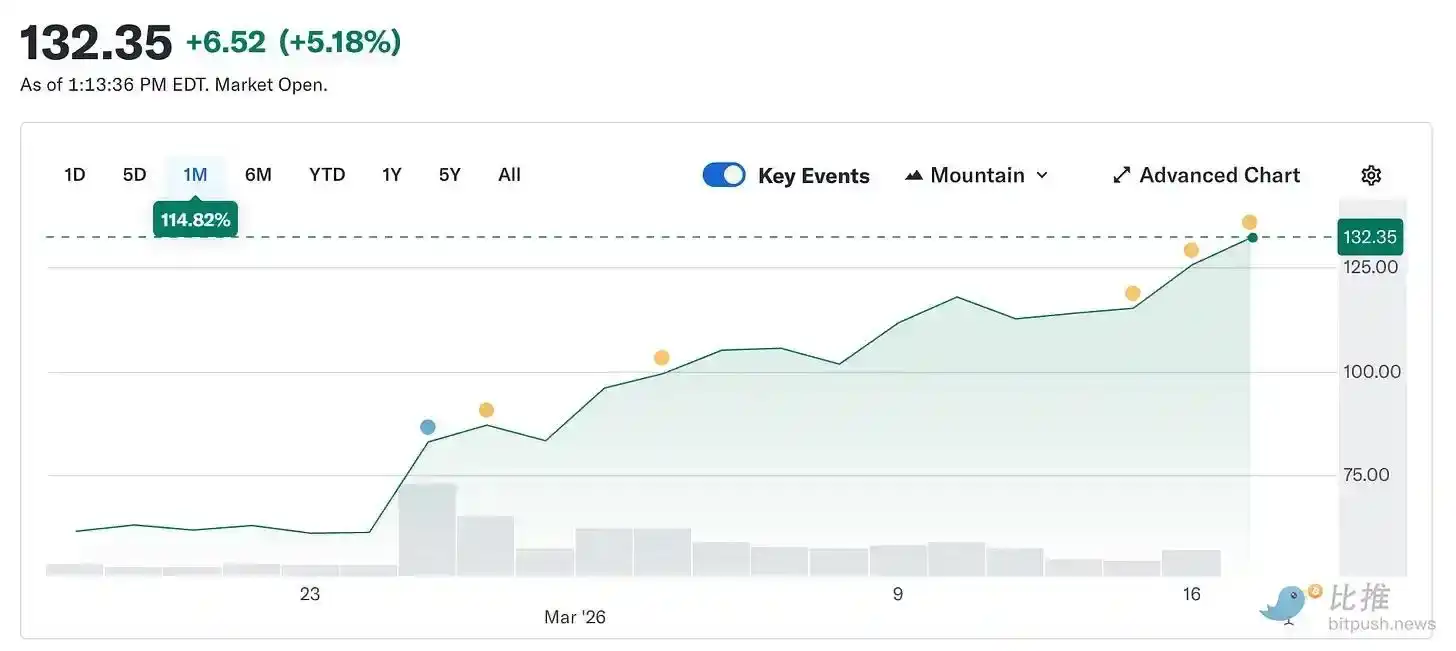
According to @finance.yahoo, the Iran conflict drove a ~35% rise since February 28th. A move to around $100 implied excessive panic, and excessive panic implied that a Fed rate cut would amplify recklessness. The decision to hold rates steady on March 18th was never really in doubt. Long before the war, CME FedWatch showed a probability of over 90% for unchanged rates.

What really changed were the expectations for rate cuts this year. Before the conflict, the market was pricing in two 25-basis-point cuts for 2026. After the conflict, this expectation shifted to one cut, prioritized for after September. The probability of no cuts at all in 2026 roughly doubled. With rates staying higher for longer, Circle's Treasury reserves continue to generate yield. More yield means more revenue, and more revenue means a higher stock price. A war broke out, and a stablecoin issuer became a beneficiary. This was a scenario that never appeared in anyone's predictive models.

Context: The bearish logic that suppressed Circle's stock price at $49 in February was essentially a bet on rate cuts.

The market was then predicting multiple Fed rate cuts in 2026, which would directly compress Circle's interest income. A rough illustration: at the current USDC supply level of $79 billion, every 25-basis-point cut would cause Circle to lose approximately $40 to $60 million in annualized revenue. Two cuts would erase nearly $100 million in top-line revenue by year-end. The war rendered this calculation obsolete overnight. Not because Circle changed, but because the macro context underpinning that bearish thesis ceased to exist.

How the Short Squeeze Began

While the interest rate story supported the stock price, the initial surge originated from positioning.

Before the Q4 earnings release on February 25th, approximately 17.8% of Circle's float was sold short. Hedge funds had built significant bearish positions. Their thesis was that rates would eventually fall, domestic income would compress, and this company's revenue wasn't defensible at the rate floor. From a fundamental perspective, this was hard to refute.

However, Circle reported Q4 earnings of $0.43 per share, versus a consensus estimate of $0.16. Revenue reached $770 million, against an expectation of $749 million. On-chain USDC transaction volume grew nearly $12 trillion quarter-over-quarter, up 247% year-over-year. Shorts covered. The stock surged 35% in a single trading session. According to 10x Research, hedge funds lost roughly $500 million on short positions that day. Subsequently, the war took the baton from the earnings report.

The Coinbase Problem

Here is a part often omitted from the updated narrative.

Circle reported a net loss of $70 million for 2025, not a profit. Q4 was strong, but the full year was not. To understand why, you need to understand its relationship with Coinbase, the most important and most underestimated fact of Circle's business.

When USDC first launched in 2018, Circle and Coinbase formed a joint consortium to manage it. This consortium was dissolved in 2023, with Circle gaining full control over USDC issuance. However, Coinbase retained a significant revenue share.

Coinbase takes 100% of the reserve yield from USDC held on its platform. For all other USDC, the yield is split 50/50 with Circle. In 2024, this arrangement directed $908 million of Circle's total $1.01 billion in distribution costs straight to Coinbase.

Roughly calculated, for every dollar of yield Circle's reserves generate, 54 cents flows to a company that neither issues the token nor handles the reserves. In early 2025, Coinbase held 22% of the total USDC supply, up from 5% in 2022. The more USDC grows on the Coinbase platform, the greater the share Circle pays out.
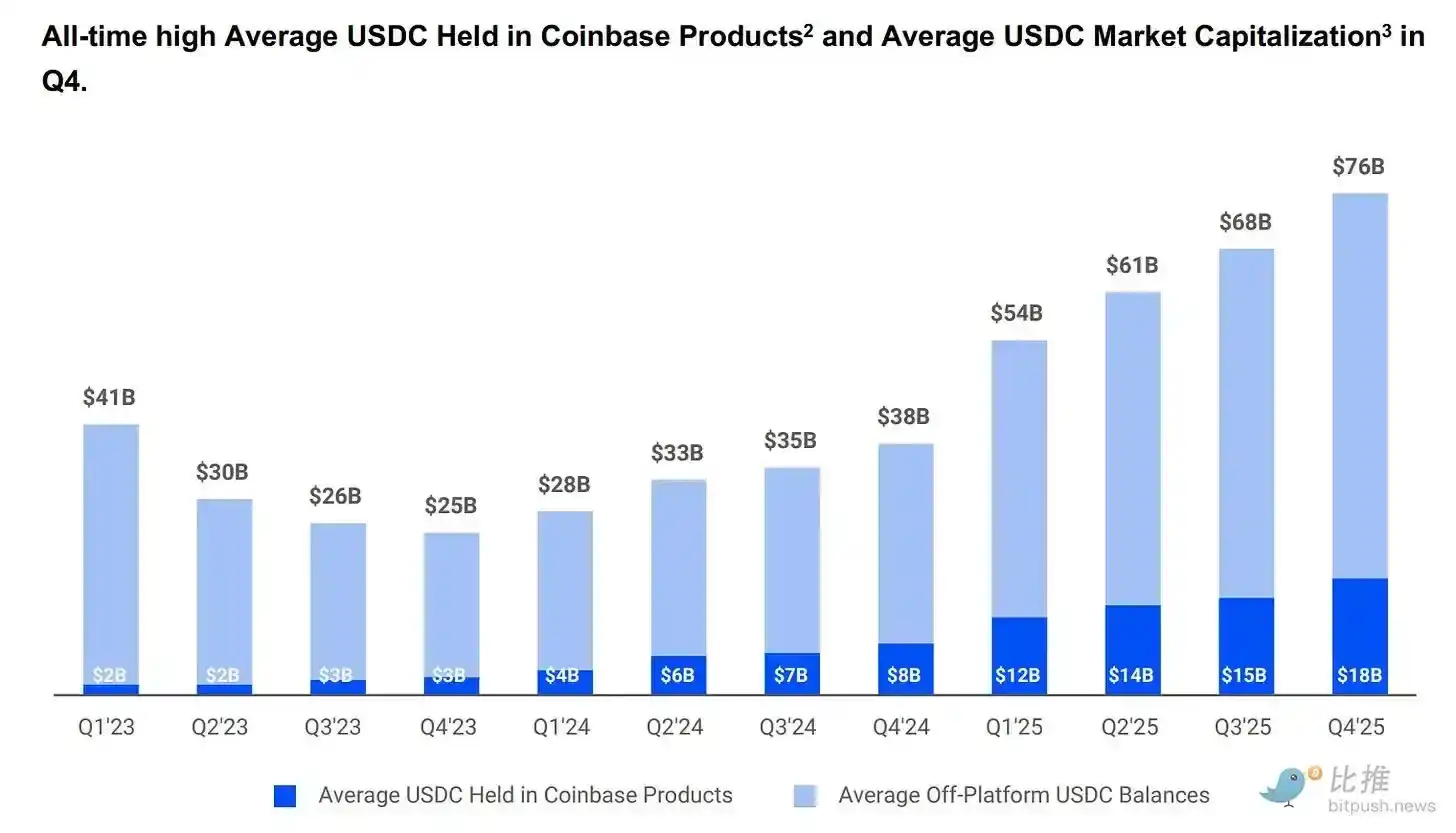
According to @q4cdn.com, the partnership automatically renews every three years, and Circle cannot unilaterally exit. Any outcome from the next renegotiation will directly impact Circle's margins. In Q4 2025, distribution costs alone were $461 million, up 52% year-over-year.

The current $70 million net loss is partly due to $424 million in stock-based compensation from IPO vesting, which makes the overall number look worse than the actual business performance. But the underlying business still faces a structural cost problem that no interest rate environment can fully solve.

The market prices Circle as infrastructure. The income statement shows it's an interest rate trade vehicle carrying expensive distribution costs. Both views can be true simultaneously. They just represent different pricing logics, and right now the market is paying for the 'best version' of both.

Why This Isn't Just a Macro Trade

USDC's supply recently reached a new all-time high of $79 billion, while the broader crypto market is down sharply, 44% from October. This divergence is worth pondering. When markets fall, speculative assets typically decline. USDC's growth suggests people are using it to move value, not just as a speculative bet.

During the Iran conflict, demand for USDC surged in the Middle East precisely because traditional banking became unreliable. When normal channels are blocked, people use it for cross-border and cross-currency transfers. This is how payment infrastructure behaves under stress: its usage increases, not decreases.

Transaction data confirms this. In February alone, USDC processed approximately $1.26 trillion in adjusted volume, compared to $514 billion for USDT. Tether (USDT)'s market cap remains $184 billion, versus USDC's $79 billion. In terms of total supply, they are not comparable. But USDC currently moves more volume than USDT.
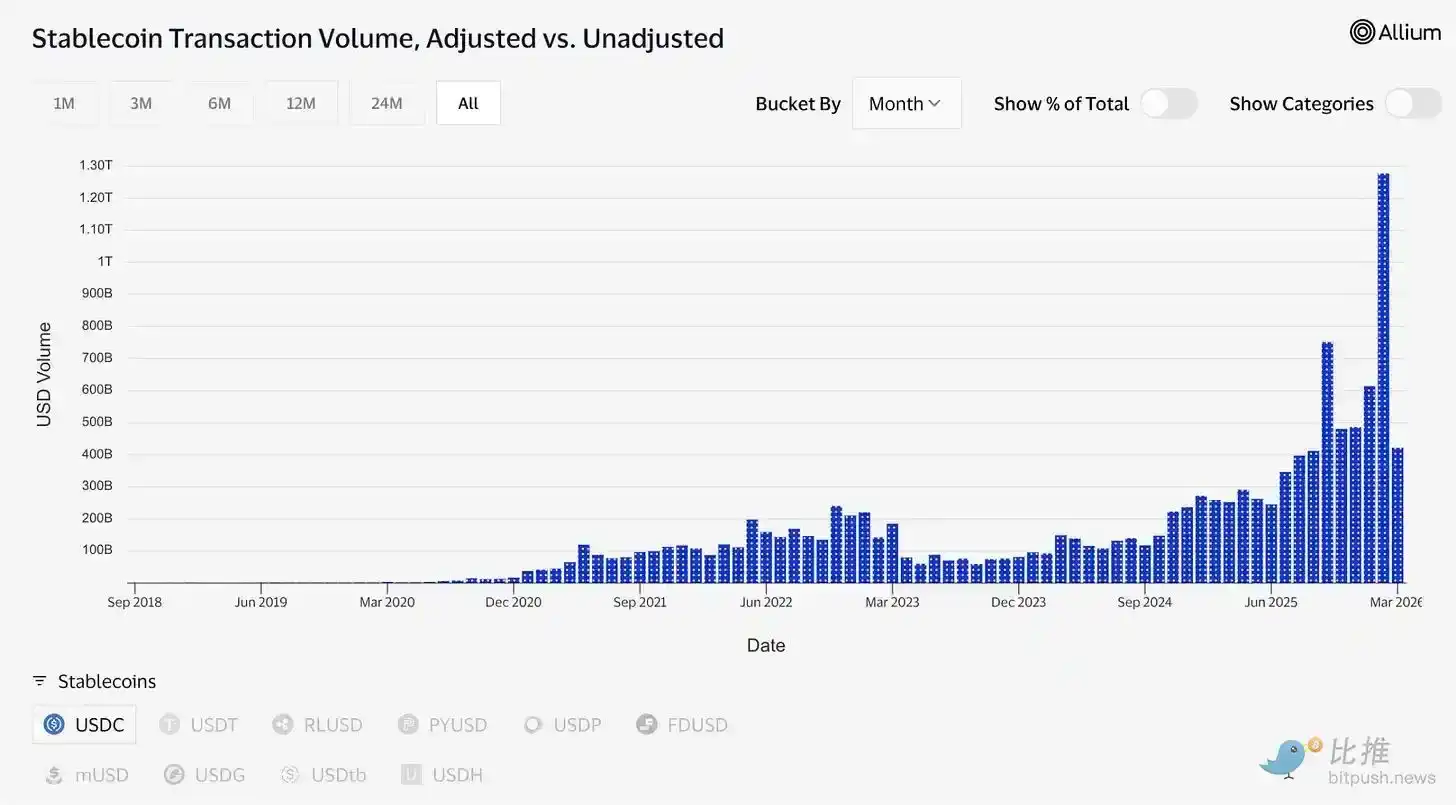
As shown by @visaonchainanalytics, "sleeping supply" is a different concept from "active settlement." The former shows where people park their dollars; the latter shows which dollar people use when they need to move value.

Druckenmiller said something relevant this week. In a Morgan Stanley interview recorded on January 30th and released on Thursday, he predicted the global payment system will run on stablecoins in 10 to 15 years, calling cryptocurrency "a solution in search of a problem."

One of the world's most trusted macro investors bifurcated the space: stablecoins are the nascent infrastructure, and everything else is still finding a reason to exist. This framework provides a bullish endorsement.

The Infrastructure Bet

Tokenized assets have grown from about $1.5 billion in early 2023 to about $26.5 billion today. Many of these products (including BlackRock's tokenized Treasury fund BUIDL, which holds over $2 billion) rely on USDC for subscriptions, redemptions, and settlement processing.

Prediction markets processed over $22 billion in volume in 2025, mostly settled in USDC (Polymarket alone). Visa currently supports stablecoin-linked cards in over 50 countries globally, with annual settlement volume of about $4.6 billion.

Circle is building the infrastructure beneath all of this. The Circle Payments Network connects 55 financial institutions, with an annualized processing volume of $5.7 billion, allowing banks and payment providers to convert USDC across borders and settle in local currency directly.

Arc is Circle's own Layer-1 blockchain, designed to fully support institutional systems. This is a settlement infrastructure that is not dependent on Ethereum or Solana. While the revenue impact from Ethereum and Solana is currently negligible, both are future-oriented strategic plays if interest rates fall.

The AI ecosystem is small in dollar terms but structurally interesting. Data released in March by Circle's Global Head of Expenditure shows that over the past 9 months, AI agents completed 140 million payments totaling $43 million. 98.6% were settled in USDC, with an average transaction size of $0.31. There are now over 400,000 AI agents with purchasing power. While the dollar amounts are still small, the trend is undeniable.

If AI agents need to pay each other for compute power, data access, and API calls with high-frequency, sub-penny transactions, they need tools that can settle instantly and send value at near-zero cost. Circle just launched Nano payments specifically for this need: supporting USDC transfers as low as $0.000001 with no gas fees, using off-chain resources and batch settlement. The testnet already supports 12 chains including Arbitrum, Base, and Ethereum mainnet.

This is the Circle the market is willing to pay $123 per share for: a company at the center of tokenized finance, AI agent commerce, cross-border payments, and prediction markets, with regulatory tailwinds from the GENIUS Act and the CLARITY Act likely to pass before summer. Bernstein has a $190 price target, Clear Street $136. Seaport Global, the most bullish on Wall Street, targets $280.

The Lingering Contradiction

Here, I want to candidly discuss a point that bulls often overlook.

Circle's profitability relies on maintaining high interest rates. This is not a permanent condition. The Fed will cut rates at some point. When that happens, the yield from the Treasury reserves backing USDC will contract, and Circle's interest income will shrink.

Circle recognizes this. It has been expanding into fees, enterprise services, the payments network, and Arc—businesses that don't rely on the interest rate environment to function. But currently, these revenue streams are small. Interest income is still the entirety.

So, you find these two logics coexisting in the same stock price, but they are not the same bet.

The infrastructure thesis posits that USDC is becoming genuine payment plumbing. The pipes are regulated, transparent, and poised to embed deeply into traditional finance, an embedding that is sticky regardless of rates. This thesis is supported by data: transaction volume digitization, integrations, Druckenmiller's framework, and Macquarie calling stablecoins the base layer of global financial infrastructure.

If this thesis is correct, Circle looks cheap in any interest rate environment because its total addressable market is the entire global payment system.

The rates trade thesis views Circle as a leveraged bet on "higher for longer" rates, with the stock price already reflecting a scenario where the Fed never cuts as expected. If this is the primary driver of the price, then every future Fed cut is a headwind, and the stock is overvalued relative to its fundamentals in a normalized rate environment.

Both views are being priced in. The war makes it difficult to discern which one the market is buying.

This is perhaps the most useful way to understand CRCL (Circle's ticker) right now. The focus isn't on whether it will hit $190, but on whether you are buying "infrastructure" or "a Treasury bill repackager that learned to tell a good story." The former is a long-term position; the latter implodes the moment Powell changes his mind.

For now, the price action keeps both possibilities alive. The dollar is doing the hard work it must. And in the gap between these two versions of the company lies its true tension—it figured out how to manufacture internet money denominated in dollars, but now must figure out how to survive the moment those dollars no longer yield 5%.


Questions liées

QWhat is the primary reason behind Circle's stock price doubling in just over five weeks, despite its product being designed for stability?

AThe primary reason is the shift in market expectations regarding Federal Reserve interest rate cuts. Geopolitical tensions, particularly the Iran conflict, led to reduced expectations of rate cuts in 2026, meaning interest rates would stay higher for longer. This benefits Circle because its main revenue source is the interest earned on the U.S. Treasury reserves backing its USDC stablecoin.

QHow does Circle's relationship with Coinbase impact its profitability?

ACoinbase receives 100% of the reserve yield from USDC held on its platform and splits the remaining yield 50/50 with Circle. In 2024, this arrangement directed $908 million of Circle's $1.01 billion total distribution costs to Coinbase. This represents a significant structural cost, meaning a large portion of the revenue generated from USDC does not go to Circle, impacting its net income.

QBeyond being a 'leveraged bet on interest rates,' what long-term growth narratives are supporting Circle's high valuation?

ALong-term growth narratives include Circle's role as infrastructure for tokenized assets (growing from $1.5B to $26.5B), AI agent micropayments (with 400,000 AI agents using USDC for sub-dollar transactions), cross-border payments via the Circle Payments Network, and the potential passage of supportive legislation like the CLARITY Act. These areas represent future revenue streams less dependent on interest rates.

QWhat data suggests that USDC is being used more for active payments and transfers rather than just as a store of value?

AIn February, USDC processed approximately $1.26 trillion in adjusted transaction volume, significantly higher than USDT's $514 billion, despite USDT having a much larger market cap ($184B vs. $79B). This indicates that USDC is used more frequently for active settlement and value transfer, especially in regions with banking instability, rather than just being held ('sleeping supply').

QWhat is the central contradiction or risk inherent in Circle investment thesis according to the article?

AThe central contradiction is that Circle's current high valuation and revenue are heavily dependent on high interest rates, which are not permanent. When the Federal Reserve eventually cuts rates, Circle's interest income will contract significantly. The market is simultaneously pricing Circle as a long-term infrastructure play and a short-term利率交易 (interest rate trade), creating a risk that the stock could fall sharply if rate cuts occur before its non-interest-dependent businesses have scaled sufficiently.

Lectures associées

Conversation de Sequoia avec Jensen Huang : Un changement massif de 60 ans dans le modèle de calcul, vous ne serez pas remplacé par l'IA, mais par "ceux qui savent bien l'utiliser" qui vous surpasseront

Source : Sequoia Capital. Compilation : Yuliya, PANews. Le monde connaît une révolution de l'IA d'une ampleur et d'une rapidité historiques. Lors d'un dialogue avec Konstantine Buhler de Sequoia, Jensen Huang, fondateur et PDG de NVIDIA, a partagé sa vision de cette transformation. Le modèle de calcul subit un changement fondamental. Pendant 60 ans, il a reposé sur le stockage et la récupération de données. Aujourd'hui, avec l'IA, tout est généré en temps réel et sur mesure en fonction du contexte. Le centre de cette révolution est l'« usine d'IA », une infrastructure de calcul massive qui produit de l'intelligence (des « tokens »), similaire à la façon dont un générateur produit de l'électricité. Huang compare cela à l'émergence d'un troisième réseau mondial, après l'énergie et les communications : un réseau d'intelligence enveloppant la planète. Pour investir dans cet écosystème, Huang décrit une structure en cinq couches : 1. **Énergie** : La base critique pour alimenter le calcul. 2. **Puces et matériel informatique** : Composants physiques comme les GPU. 3. **Infrastructure** : Terrains, bâtiments et opérations des centres de données. 4. **Couche des modèles** : Développement des grands modèles de fondation (LLMs). 5. **Couche applicative** : Start-up réinventant tous les secteurs (finance, droit, santé...). Huang réfute catégoriquement les récits alarmistes sur les suppressions d'emplois. Le vrai danger, dit-il, n'est pas d'être remplacé par l'IA, mais d'être surpassé par quelqu'un qui sait l'utiliser. Il distingue **tâche** et **emploi**. L'automatisation des tâches (comme l'analyse d'images médicales ou l'écriture de code) ne supprime pas les métiers ; au contraire, elle amplifie la productivité et la valeur des professionnels, augmentant la demande pour leurs compétences de niveau supérieur (diagnostic, résolution de problèmes, innovation). L'IA agit comme un multiplicateur de capacités, « augmentant » les compétences humaines et élevant la valeur des métiers. Pour Huang, l'IA ne crée pas de chômage, mais une hausse globale de la demande de main-d'œuvre et une opportunité de revalorisation professionnelle pour tous.

marsbitIl y a 19 mins

Conversation de Sequoia avec Jensen Huang : Un changement massif de 60 ans dans le modèle de calcul, vous ne serez pas remplacé par l'IA, mais par "ceux qui savent bien l'utiliser" qui vous surpasseront

marsbitIl y a 19 mins

« Je n’ai plus besoin de meilleurs modèles » : les réactions contrastées face à l’IA sur un post Reddit viral

Anthropic a récemment lancé Claude Fable 5, son premier modèle de niveau Mythos accessible au public. Bien qu'il affiche des performances record sur le benchmark SWE-Bench Pro, dépassant largement ses prédécesseurs, la réaction des utilisateurs sur Reddit est mitigée. Un post populaire sur r/artificial, intitulé "Claude Fable m'a fait réaliser que je n'ai pas besoin d'un meilleur modèle", résume un sentiment répandu : la fatigue face aux nouvelles versions. De nombreux utilisateurs estiment que les modèles précédents comme Opus 4.8 sont déjà "suffisants" pour leurs besoins quotidiens, évoquant un rapport coût-bénéfice défavorable, le prix de Fable 5 étant presque le double. Le principal point de critique concerne les "garde-fous" de sécurité de Fable 5. Les utilisateurs se plaignent que le modèle refuse trop fréquemment des requêtes liées à la sécurité ou à la programmation, les renvoyant vers Opus, ce qui nuit à son utilité pratique, surtout pour les abonnés payants. Cependant, une minorité d'utilisateurs aux tâches complexes (simulations physiques, code à très long contexte) font l'éloge de Fable 5, décrivant une différence de capacité "nuit et jour" pour leurs projets exigeants. Le débat soulève une question plus large : un fossé se creuse-t-il entre les modèles de pointe accessibles au public et les versions encore plus puissantes réservées aux entreprises et gouvernements ? Alors que les benchmarks montrent une progression constante, la perception des utilisateurs suggère que pour la majorité, le "suffisamment bon" pourrait être déjà atteint, laissant les gains marginaux aux seuls cas d'usage extrêmes. L'avenir de Fable 5 dépendra des ajustements d'Anthropic sur la sécurité et de l'adoption par les utilisateurs spécialisés.

marsbitIl y a 30 mins

« Je n’ai plus besoin de meilleurs modèles » : les réactions contrastées face à l’IA sur un post Reddit viral

marsbitIl y a 30 mins

Lorsque le trafic IA dépasse celui des humains, comment prouver que vous êtes réel ?

L'essor des agents IA génère désormais plus de trafic web que l'humanité, bouleversant les modèles économiques fondés sur l'attention humaine. Ces programmes, qui extraient des données sans cliquer sur des publicités ni acheter, privent les sites de revenus tout en accaparant leur contenu. Face à ce phénomène, environ 2,5 millions de sites bloquent désormais les robots d'IA. Les méthodes traditionnelles comme les CAPTCHA deviennent obsolètes face aux IA capables de les surpasser. La réponse émergente repose sur la biométrie comportementale : analyser les mouvements de souris, la cadence de frappe, les hésitations ou les erreurs de saisie – des caractéristiques humaines difficiles à reproduire pour une machine. Des entreprises comme IBM ou BioCatch développent ces systèmes, qui peuvent même détecter des fraudes en analysant les comportements. Deux approches s'opposent pour gérer cette vérification d'identité. La première, centralisée, est illustrée par Worldcoin qui scanne l'iris pour créer une preuve d'humanité unique, soulevant des inquiétudes quant à la collecte et au contrôle des données biométriques. La seconde, décentralisée, utilise des preuves à divulgation nulle de connaissance (zero-knowledge proofs), permettant de prouver son humanité sans révéler son identité. Cependant, cette dernière est vulnérable aux marchés noirs où des personnes louent leur identité. Si la solution centralisée se déploie rapidement, elle implique une surveillance biométrique permanente. La voie cryptographique, bien que perfectible, préserve la vie privée. Le choix se pose donc entre un système de surveillance efficace mais intrusif, et une alternative anonyme qui lutte contre les dérives économiques liées à la vérification d'identité.

marsbitIl y a 36 mins

Lorsque le trafic IA dépasse celui des humains, comment prouver que vous êtes réel ?

marsbitIl y a 36 mins

Carte Panoramique de l'IA Décentralisée en 2026 : Pourquoi la Blockchain est-elle l'« Antidote » Incontournable de l'IA ?

L'IA décentralisée émerge en réponse aux limites structurelles de l'IA centralisée : pénurie et coût élevé des ressources de calcul, contrôle excessivement concentré, résultats de modèles invérifiables et difficultés croissantes d'accès aux données d'entraînement. La blockchain apparaît comme une solution essentielle pour rendre l'intelligence ouverte, vérifiable et économiquement accessible. La pile technologique de l'IA décentralisée se structure en trois couches. La couche application est dominée par la finance agentielle (Agentic Finance), où des agents exécutent des actions sur chaîne à partir d'intentions en langage naturel, et par les paiements entre machines (Agentic Payments), utilisant la blockchain comme couche de règlement. La couche intermédiaire (middleware) aborde la coordination et l'identité des agents, avec des projets comme Bittensor, un réseau de sous-réseaux spécialisés fonctionnant comme des micro-économies. Enfin, la couche infrastructure fournit les ressources de base : calcul décentralisé (ex: Akash, Render), inférence vérifiable, entraînement distribué, stockage de données (ex: Filecoin) et des couches de confidentialité et de vérification (ex: Nillion, Phala Network) essentielles pour les cas d'usage sensibles. Les tendances pour 2026-2027 indiquent une croissance rapide, les agents IA devenant un moteur principal. Le calcul se transforme en une classe d'actifs, les marchés on-chain en étant la couche financière, et la tokenomics un avantage structurel pour coordonner capital, calcul et données. Bien que le domaine en soit à ses débuts et que l'adoption soit inégale, des projets comme Bittensor, NEAR ou Virtuals montrent que l'IA décentralisée évolue d'un récit spéculatif vers un nouveau modèle de coordination de l'intelligence.

marsbitIl y a 38 mins

Carte Panoramique de l'IA Décentralisée en 2026 : Pourquoi la Blockchain est-elle l'« Antidote » Incontournable de l'IA ?

marsbitIl y a 38 mins

Le partenaire de a16z Crypto : Les flux de trésorerie sont les fossés économiques

L'auteur, Jason Rosenthal d'a16z, soutient que les entreprises les plus performantes historiquement se sont bâties en se positionnant dans le "flux de trésorerie" - en facilitant la création et le transfert de valeur au sein d'un réseau et en en prélevant une partie. La cryptographie, conçue nativement pour cela, permet désormais à la valeur de circuler à la vitesse d'Internet via des stablecoins, de manière globale, continue et programmable. Les blockchains sont intrinsèquement des entreprises en réseau. Chaque transaction est réglée sur un registre partagé, et chaque nouveau participant renforce le réseau pour tous. Les jetons de réseau bien conçus alignent les incitations de tous les acteurs (utilisateurs, développeurs, validateurs) vers un seul objectif : développer le réseau, avec des récompenses proportionnelles aux contributions. Ce modèle n'est pas nouveau (ex: chemins de fer, Standard Oil, Google, AWS, Visa), mais la crypto le rend plus accessible. Il combine flux de valeur et effets de réseau pour créer des structures commerciales durables. Aujourd'hui, les services financiers traditionnels, avec leurs frais élevés (paiements, transferts, garde, etc.), représentent une cible majeure. Des entreprises comme Stripe ont montré la voie. L'opportunité pour les fondateurs crypto est de construire la version suivante : programmable, instantanée, mondiale et native du flux de trésorerie. Ce potentiel s'étend au-delà de la finance : calcul (GPU), données pour l'IA, énergie, robotique, espace, métaux rares. Ces marchés émergents, sans intermédiaires enracinés, sont des terrains ouverts. L'auteur invite les fondateurs à se demander : sont-ils déjà dans un flux de trésorerie ? Leurs revenus augmentent-ils avec la valeur générée sur leur produit ? Où les marges sont-elles les plus élevées dans leur marché cible ? L'opportunité est de saisir ces nouveaux flux et de laisser les effets de réseau s'accumuler.

marsbitIl y a 43 mins

Le partenaire de a16z Crypto : Les flux de trésorerie sont les fossés économiques

marsbitIl y a 43 mins

Trading

Spot
Futures

Articles tendance

Comment acheter WAR

Bienvenue sur HTX.com ! Nous vous permettons d'acheter WAR (WAR) de manière simple et pratique. Suivez notre guide étape par étape pour commencer votre parcours crypto.Étape 1 : Création de votre compte HTXUtilisez votre adresse e-mail ou votre numéro de téléphone pour ouvrir un compte sur HTX gratuitement. L'inscription se fait en toute simplicité et débloque toutes les fonctionnalités.Créer mon compteÉtape 2 : Choix du mode de paiement (rubrique Acheter des cryptosCarte de crédit/débit : utilisez votre carte Visa ou Mastercard pour acheter instantanément WAR (WAR).Solde :utilisez les fonds du solde de votre compte HTX pour trader en toute simplicité.Prestataire tiers :pour accroître la commodité d'utilisation, nous avons ajouté des modes de paiement populaires tels que Google Pay et Apple Pay.P2P :tradez directement avec d'autres utilisateurs sur HTX.OTC (de gré à gré) : nous offrons des services personnalisés et des taux de change compétitifs aux traders.Étape 3 : stockage de vos WAR (WAR)Après avoir acheté vos WAR (WAR), stockez-les sur votre compte HTX. Vous pouvez également les envoyer ailleurs via un transfert sur la blockchain ou les utiliser pour trader d'autres cryptos.Étape 4 : tradez des WAR (WAR)Tradez facilement WAR (WAR) sur le marché Spot de HTX. Il vous suffit d'accéder à votre compte, de sélectionner la paire de trading, d'exécuter vos trades et de les suivre en temps réel. Nous offrons une expérience conviviale aux débutants comme aux traders chevronnés.

523 vues totalesPublié le 2024.12.11Mis à jour le 2026.06.02

Comment acheter WAR

Discussions

Bienvenue dans la Communauté HTX. Ici, vous pouvez vous tenir informé(e) des derniers développements de la plateforme et accéder à des analyses de marché professionnelles. Les opinions des utilisateurs sur le prix de WAR (WAR) sont présentées ci-dessous.

活动图片