A 2.85% Minor Deviation, $27 Million in Liquidations: The Full Story of the Aave Price Oracle Incident

marsbitPublié le 2026-03-17Dernière mise à jour le 2026-03-17

Résumé

A brief 2.85% pricing deviation in wstETH collateral on Aave triggered approximately $27 million in liquidations. The incident occurred because Aave's risk oracle module (CAPO) used outdated parameters, temporarily valuing wstETH at around 1.19 ETH instead of its market price of ~1.23 ETH. This made some borrowing positions appear under-collateralized, activating the protocol's automatic liquidation system. While the event highlighted the fragility of DeFi oracle systems and how minor technical misconfigurations can lead to significant financial consequences, no bad debt was incurred by the Aave protocol itself. The core issue was not a failure of the primary price oracle or the wstETH token, but an internal configuration error within Aave's additional risk management layer. The incident underscores the critical importance of reliable oracle infrastructure and precise parameter synchronization in decentralized finance.

Written by: Cointelegraph

Compiled by: AididiaoJP, Foresight News

Key Summary

  • A brief 2.85% pricing deviation in wstETH collateral triggered approximately $27 million in liquidations on Aave. This event demonstrates that even minor technical issues in automated DeFi lending systems can lead to significant financial impacts.
  • This wave of liquidations occurred because the Aave system briefly valued wstETH at approximately 1.19 ETH, while its market value was near 1.23 ETH, causing some borrowing positions to be mistakenly judged as undercollateralized.
  • Price oracles are critical DeFi infrastructure, responsible for transmitting external market data to smart contracts to determine collateral value, assess loan health, and trigger automatic liquidations.
  • The root cause was not a failure of the price data source, but a misconfiguration of Aave's CAPO risk oracle module. Outdated smart contract parameters within this module set a temporary cap on the token's exchange rate.

DeFi protocols rely on automated logic to handle everything from collateral management to risk assessment. While this mechanism builds a truly open, permissionless financial system, it also means that minor technical problems can quickly escalate, causing severe financial turmoil.

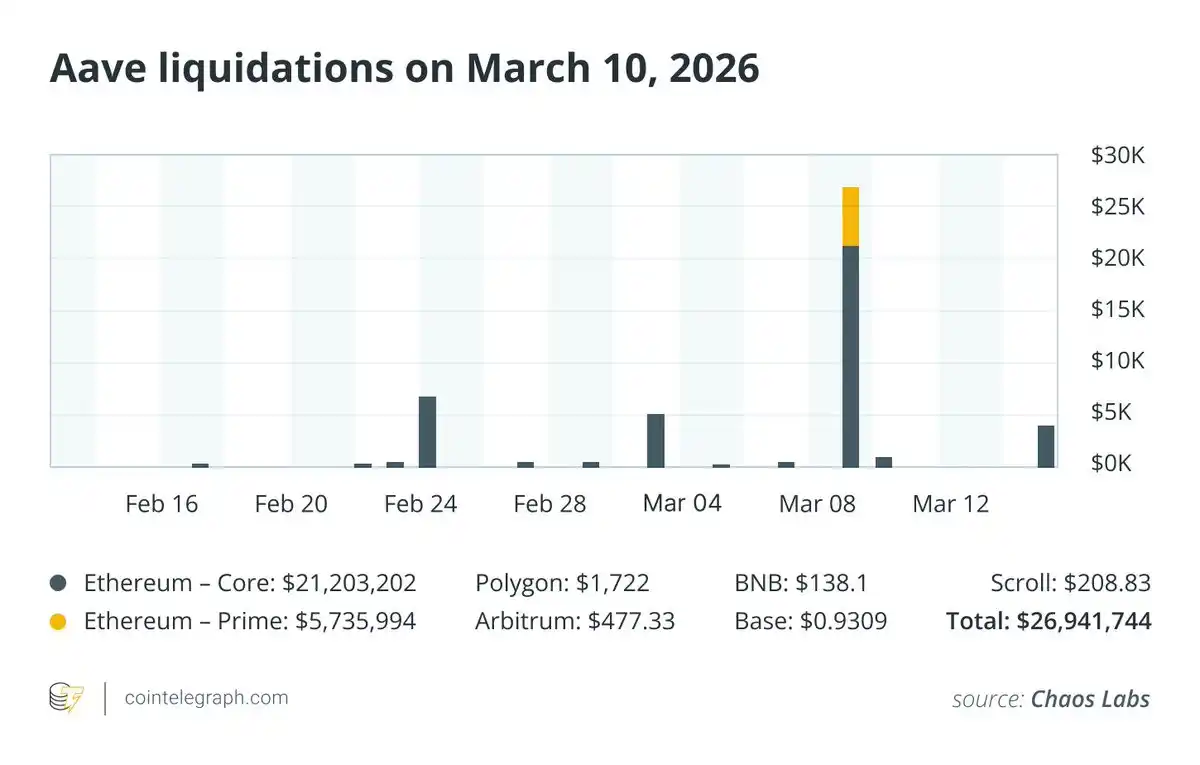
As reported by risk monitoring firm Chaos Labs, the market downturn on March 10, 2026, triggered approximately $27 million in borrower position liquidations on Aave, clearly demonstrating this fragility. Within 24 hours, user positions worth about $27 million were liquidated. Surprisingly, this event was not caused by a large-scale market sell-off but by a brief 2.85% price deviation in wrapped staked ETH (wstETH) collateral.

This event is a powerful reminder that the reliability of price oracles and a robust risk management framework are crucial for maintaining the stability of the DeFi ecosystem.

This article explains how a 2.85% pricing deviation in wstETH collateral triggered approximately $27 million in liquidations on the Aave lending protocol. It focuses on analyzing how oracle configuration, smart contract parameters, and automatic liquidation mechanisms amplified a minor pricing error in the DeFi market.

The Sudden Surge in Liquidations

When a wave of liquidations appeared on the Aave market, Chaos Labs, which closely monitors abnormal activity on lending protocols, quickly identified and reported the situation. Initially, market observers speculated that a price oracle failure might have caused the mispricing of collateral assets on the platform.

Price oracles play a key bridging role, providing external market prices for on-chain applications. In lending protocols like Aave, this price data directly determines whether a borrower's collateral is sufficient to cover their loan. Once the collateral value falls below the required safety threshold, the system automatically liquidates the position.

The core asset in this event was wstETH, a token widely used as collateral in the DeFi lending ecosystem.

Liquidation speeds on lending protocols like Aave are typically much faster than traditional margin calls. Because DeFi markets operate 24/7 through automated smart contracts, once the collateral ratio falls below the specified threshold, positions can be liquidated within seconds.

What is wstETH?

wstETH (wrapped staked Ether) is a token issued by the liquid staking protocol Lido.

When users stake Ether through Lido, they first receive stETH, a token representing their staked ETH principal and accumulated staking rewards. To enhance compatibility with various DeFi applications, stETH can be "wrapped" into wstETH.

Due to the continuous accumulation of staking rewards, the value of 1 wstETH is typically slightly higher than 1 ETH. This characteristic makes it an attractive and widely adopted type of collateral in the DeFi lending market.

The Pricing Deviation Event

During this liquidation wave, a deviation emerged between the actual market value of wstETH and the valuation used by Aave's risk system. Aave's algorithm priced wstETH at approximately 1.19 ETH, while the broader market valuation at the time was around 1.23 ETH.

The valuation difference of about 2.85% made positions collateralized with wstETH appear more undercollateralized than they actually were.

Consequently, some borrowing positions fell below the required safety threshold, triggering Aave's automatic liquidation process.
Why Price Oracles are Crucial in DeFi

Price oracles are the underlying infrastructure of DeFi. Because blockchains themselves cannot access real-world market data, they must rely on oracle services to provide external price information for assets. This price data directly impacts:

  • Valuation of collateral
  • Health of borrowing positions
  • Decision-making basis for triggering liquidations

Once a reported drop in collateral price occurs, the protocol may judge the loan as undercollateralized and automatically liquidate the relevant position.

Because this mechanism is entirely algorithm-driven, even minor pricing deviations can trigger serious chain reactions.

In the DeFi space, minor price deviations can also have huge impacts. Brief fluctuations in oracle prices or market prices, even by just a few percentage points, can trigger cascading liquidations. This risk is particularly pronounced when a large number of borrowers use highly leveraged positions collateralized by volatile cryptocurrencies.

The Real Cause: CAPO Risk Oracle Misconfiguration

In-depth investigation confirmed that Aave's main price oracle was functioning normally.

The problem actually lay in the "Correlated Asset Price Oracle" (CAPO) risk module, an additional protection layer for specific assets.

The primary function of CAPO is to set a rate cap on the value increase of yield-bearing tokens like wstETH, aiming to guard against sudden price spikes or potential oracle attack risks.

However, in this event, inconsistent configuration within the CAPO module led to the problem.

Technical Analysis of the Error

Chaos Labs disclosed that the problem stemmed from outdated parameters stored in the smart contract.

Two key parameters failed to update synchronously:

  • Reference exchange rate
  • Timestamp associated with that rate

Because these two parameters were not refreshed in sync, the CAPO calculated an allowed exchange rate cap that was temporarily lower than the actual market rate at the time.

This caused the protocol to value wstETH approximately 2.85% lower than the market price.

Aave relies on price oracles, which are data sources that provide real-time asset prices to smart contracts. If these data sources briefly reflect anomalous market prices from exchanges, the protocol automatically recalculates collateral values and may trigger liquidations.

The Chain Reaction of Liquidations

Once the collateral ratio fell below the safety threshold, Aave's automatic liquidation engine immediately activated.

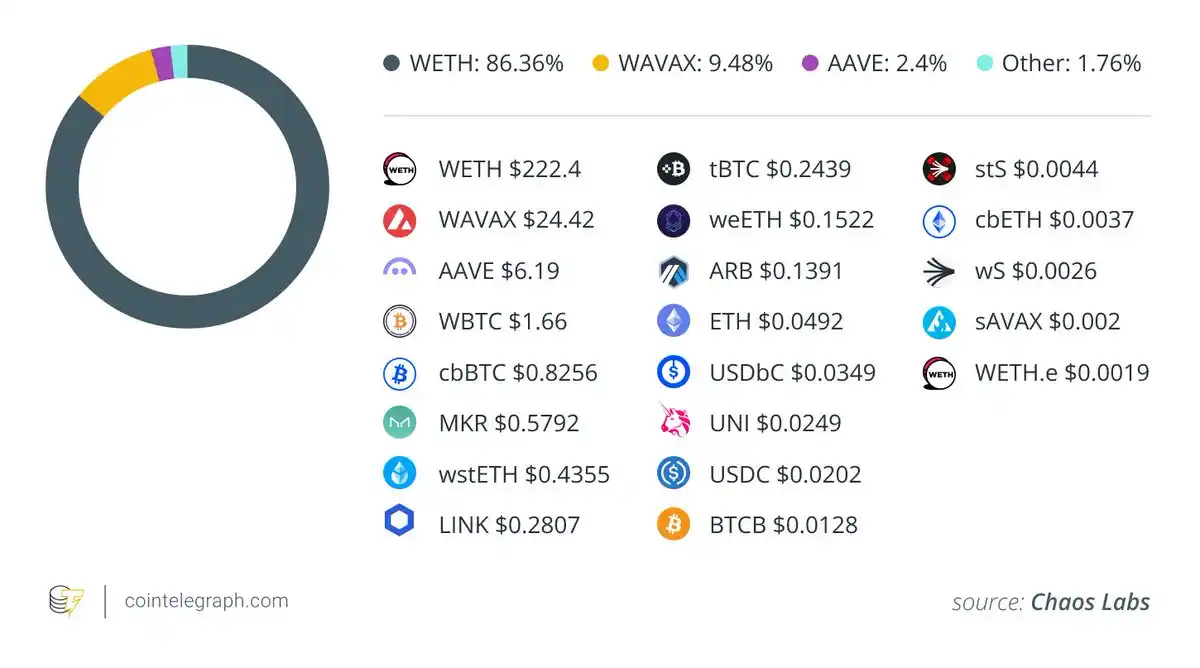
Liquidators (typically high-speed trading bots) quickly stepped in, repaying part of the borrower's debt in exchange for the corresponding collateral at a predetermined discount.

In this event, a total of approximately $27 million in borrowing positions were liquidated.

Liquidators exploited this brief price misalignment, collectively profiting about 499 ETH (including liquidation bonuses).
No Bad Debt Incurred by the Protocol

Despite the large scale of liquidations, the Aave protocol itself did not incur any bad debt. Aave founder Stani Kulechov stated, "No impact on the Aave protocol."

Chaos Labs pointed out that once positions breached the safety threshold, the platform's core risk control and liquidation mechanisms all operated as designed. Therefore, the impact of this event was limited to the relevant borrowers and did not threaten the overall solvency and stability of the Aave protocol. It was the brief, artificial depression of the collateral value that caused some borrowing positions to fall below the liquidation line.

The Aave governance layer subsequently proposed compensating affected users by utilizing recovered funds and the Decentralized Autonomous Organization (DAO) treasury. This approach reflects a new trend in DeFi governance: protocols are beginning to view such technical events as systemic infrastructure risks and tend to compensate受损 users rather than having them bear the full loss.

Another Warning on DeFi Oracle Risks

This event highlights that oracle mechanism design is both one of the most critical links in DeFi infrastructure and one of its most vulnerable weak points.

When automated mechanisms manage tens of billions of dollars in collateral value, even minor configuration errors can trigger consequences far exceeding expectations.

Similar events have occurred on other DeFi platforms. For example, one platform once briefly valued Coinbase's wrapped staked ETH (cbETH) at approximately $1 (actual value ~$2200) due to an oracle configuration error, causing widespread chaos.

These cases all indicate that maintaining reliable, accurate price data sources remains an ongoing challenge in decentralized financial systems.

wstETH and Lido Itself Are Not Responsible

Contributors related to the Lido ecosystem clearly stated that these liquidations were not caused by any failure or defect in the wstETH token itself.

The token functioned normally throughout the event, and the underlying Lido staking protocol remained fully available and unaffected.

The core of the problem lay in how the Aave lending protocol, through its own risk management configuration, processed and interpreted the price data, which deviated.

Implications for the Development of DeFi

As decentralized finance continues to develop, protocols are deploying increasingly sophisticated risk management systems to accommodate yield-bearing assets like wstETH.

These assets present unique pricing challenges because their value continuously grows with the accumulation of staking rewards.

Therefore, effective risk models must properly handle the following elements:

  • Dynamically changing exchange rates
  • Continuously accumulating staking rewards
  • Time-dependent parameter updates
  • Precise synchronization of various smart contract parameters

Even minor inconsistencies between these elements can escalate into large-scale liquidation events.


Questions liées

QWhat was the primary cause of the $27 million liquidation event on Aave, and what specific asset was involved?

AThe primary cause was a 2.85% pricing discrepancy in the wstETH (wrapped staked ETH) collateral valuation. Aave's risk oracle module, CAPO, temporarily valued wstETH at approximately 1.19 ETH, while its actual market value was around 1.23 ETH. This mispricing caused some borrowing positions to be incorrectly flagged as under-collateralized and subsequently liquidated.

QWhat is the role of a price oracle in a DeFi lending protocol like Aave?

AA price oracle is critical infrastructure that provides external market data to on-chain applications. In lending protocols, these price feeds are used to determine the value of collateral, assess the health of loans, and trigger automatic liquidations if the collateral value falls below a required safety threshold.

QWhat specific technical failure within Aave's system led to the wstETH mispricing, and what module was responsible?

AThe failure was not in the main price oracle but in the CAPO (Correlated Asset Price Oracle) risk module. The issue was caused by outdated smart contract parameters—specifically, a reference exchange rate and its associated timestamp that were not updated in sync. This configuration error caused the CAPO module to calculate a temporary cap on the wstETH exchange rate that was lower than the actual market rate.

QDespite the large-scale liquidations, what was the impact on the Aave protocol's financial health?

AThe Aave protocol itself did not incur any bad debt from this event. The core risk management and liquidation mechanisms functioned as designed once positions were deemed under-collateralized. The financial impact was limited to the affected borrowers, and the overall solvency and stability of the Aave protocol were not threatened.

QWhat does this incident reveal about the broader challenges and future development of DeFi?

AThe incident highlights that oracle reliability and robust risk management frameworks are paramount in DeFi. It demonstrates that even minor technical misconfigurations can be amplified by automated systems, leading to significant financial consequences. For future development, it underscores the need for sophisticated risk models that can accurately handle dynamic exchange rates, staking rewards, time-dependent parameter updates, and precise synchronization of all smart contract parameters, especially for yield-bearing assets like wstETH.

Lectures associées

Une "déesse de la charité" de 3 millions d'abonnés entièrement créée par IA, un orphelinat factice, un "faux philanthrope" transnational s'effondre du jour au lendemain

**[Guide] Scandale : Une influenceuse australienne prétendant aider des orphelins avec 3 millions d'abonnés a été démasquée pour avoir utilisé l'IA afin de créer de fausses images et vidéos de son oeuvre caritative.** L'ABC révèle que Lily Jay, une influenceuse australienne convertie à l'islam avec près de 3 millions d'abonnés, a orchestré une vaste escroquerie caritative en utilisant l'intelligence artificielle. Sa fondation, le "Lily Jay Foundation", prétendait construire des mosquées, distribuer de la nourriture à Gaza et gérer un orphelinat en Ouganda. Cependant, l'enquête montre que des vidéos clés, notamment celle de l'inauguration de l'orphelinat où des enfants tiennent des sucettes, étaient intégralement générées par IA, avec des incohérences typiques comme des erreurs de texte sur les vêtements. Aucune trace de l'orphelinat "Ada Nur" ou de la boulangerie à Gaza n'a pu être vérifiée sur place. Un trophée "humanitaire" présenté en mai 2026 portait le filigrane invisible d'un générateur d'images AI. Le site web de la fondation admettait discrètement ne pas être un organisme de bienfaisance enregistré, échappant ainsi aux obligations de transparence financière. Opérant depuis Chypre et le Kosovo, Lily Jay (de son vrai nom Lily Jay Hinson) mène une vie luxueuse sur ses réseaux personnels. Après les questions de l'ABC, le site a modifié son contenu pour les visiteurs australiens, supprimant les options de don et les pages compromettantes, tout en les conservant pour le public international. Les experts alertent sur la dangerosité de ces escroqueries qui exploitent la générosité et la volonté de croire en de belles histoires. À l'ère du deepfake, la défense reste un questionnement critique : est-ce vrai ?

marsbitIl y a 30 mins

Une "déesse de la charité" de 3 millions d'abonnés entièrement créée par IA, un orphelinat factice, un "faux philanthrope" transnational s'effondre du jour au lendemain

marsbitIl y a 30 mins

L2 « recalibrage » : quand L1 devient son propre Rollup, quel est le destin final d’Ethereum ?

"L2 Recalibration": When L1 Becomes Its Own Rollup, What Is Ethereum's Endgame? In recent years, the proliferation of L2s (Rollups) has solved Ethereum's scalability issues but at the cost of fragmenting liquidity, user states, and the unified chain experience. This has prompted a fundamental reevaluation of the relationship between L1 and L2 within the Ethereum community. Ethereum's roadmap is evolving. The core challenge is no longer just creating more block space, but redefining the roles of L1, L2, execution, and settlement layers in a fragmented ecosystem. L1 is actively enhancing its own scalability (increasing Gas Limit, statelessness, zkEVM). Consequently, L2s can no longer rely solely on "cheaper, faster transactions" for long-term value. Their future role shifts towards providing differentiated features (privacy, custom governance, application-specific optimizations) that L1 cannot easily offer uniformly, while still contributing extra capacity. Interoperability is key to restoring a seamless user experience. The goal is not just cross-chain bridges but enabling different execution environments to trust each other's states faster and at lower cost. Initiatives like Open Intents Frameworks and the Ethereum Interoperability Layer (EIL) aim to make cross-L2 interactions feel like single-chain transactions. Crucially, shortening Ethereum's finality time (from minutes to seconds) is a major focus, as it directly benefits cross-chain applications by reducing the trust latency for state changes. A provocative idea from researcher Barnabé Monnot suggests that as proof systems (like zkEVM) mature on mainnet, L1 itself could become a form of "its own Rollup." Here, specialized nodes would execute transactions and generate validity proofs, while validators would verify these proofs instead of re-executing everything. This blurs the traditional L1/L2 hierarchy, making "Rollup" more of a general execution-verification architecture than a strict layer. The vision is a future where multiple L2s act as specialized execution domains (for DeFi, gaming, privacy, etc.) under a shared Ethereum security, settlement, and state framework—a system that is fragmented in execution but unified in trust and liquidity. In conclusion, Ethereum's endgame is not L2s replacing L1 or being made obsolete by a scaled L1. It is an ecosystem where L2s become a spectrum of execution environments with varying features, all capable of securely interoperating and sharing Ethereum's foundational security and liquidity. The next phase is about re-integrating what was fragmented back into a coherent, user-friendly "one chain" experience.

marsbitIl y a 31 mins

L2 « recalibrage » : quand L1 devient son propre Rollup, quel est le destin final d’Ethereum ?

marsbitIl y a 31 mins

Grayscale Dépose le Premier ETF sur Worldcoin auprès de la SEC sous le Symbole GWLD

La société Grayscale Investments a déposé une demande d'enregistrement Form S-1 auprès de la SEC américaine pour créer un nouveau fonds négocié en bourse (ETF) lié à la cryptomonnaie Worldcoin, sous le ticker GWLD sur Nasdaq. Ce fonds, établi le 10 juillet, offrirait aux investisseurs américains un accès régulé à Worldcoin (WLD), alors que les citoyens américains ne sont pas éligibles aux subventions utilisateurs du projet. Le dépôt intervient alors que le WLD a atteint son plus bas historique en mai 2026, avant de connaître une hausse de plus de 8% à l'annonce de l'ETF. Le dossier de Grayscale soulève également des questions importantes sur la tokenomique de Worldcoin, notamment la concentration des tokens (les 100 plus grands portefeuilles détiennent environ 90% de l'offre en circulation) et le déblocage continu de tokens par les initiés jusqu'en 2028, ce qui exercera une pression vendeuse. De plus, l'écosystème de Worldcoin, qui utilise des dispositifs biométriques de scan oculaire (Orbs), est confronté à des défis réglementaires spécifiques dans plusieurs juridictions. Malgré un calendrier incertain (l'introduction en bourse n'est pas attendue avant fin 2026) et l'approbation de la SEC encore en suspens, cette démarche illustre la volonté de Grayscale d'étendre son offre d'investissements cryptographiques régulés et de se positionner sur le marché émergent des ETF.

TheNewsCryptoIl y a 47 mins

Grayscale Dépose le Premier ETF sur Worldcoin auprès de la SEC sous le Symbole GWLD

TheNewsCryptoIl y a 47 mins

L'Éternel Fragment de l'Argent : Les Paiements Tiers N'ont Pas de Principe Premier

L'article examine les défis de l'industrie des paiements, en prenant l'exemple de la trajectoire de Stripe et de sa récente tentative de rachat de PayPal. Il souligne que le secteur reste hautement fragmenté, avec des acteurs locaux ou spécialisés résilients, et qu'il est structurellement subordonné au système bancaire traditionnel. Stripe, ayant manqué la fenêtre d'introduction en bourse pendant la pandémie, cherche désormais à étendre son écosystème via des acquisitions (comme PayPal pour sa clientèle grand public) et en investissant dans les stablecoins (OUSD) et les infrastructures de paiement pour agents autonomes (AI). Cependant, l'auteur note que les stablecoins ne sont pas encore une pratique courante et que l'économie des agents reste naissante. La thèse centrale est que le futur modèle économique pourrait résider dans les réseaux de compensation (clearing). En obtenant des licences bancaires et en développant des blockchains dédiées (comme Tempo pour Stripe), ces entreprises pourraient capturer une partie de la valeur en améliorant l'efficacité des règlements, potentiellement en marge du système bancaire traditionnel. En conclusion, la bataille dans les paiements tiers est comparée à une guerre de tranchées sans fin, où aucun acteur ne peut éliminer tous les autres par la seule taille. L'avenir passe par la diversification et l'innovation sur les infrastructures de compensation.

marsbitIl y a 55 mins

L'Éternel Fragment de l'Argent : Les Paiements Tiers N'ont Pas de Principe Premier

marsbitIl y a 55 mins

Trading

Spot
活动图片