As reported, a senior official in the South Korean presidential office responsible for policy is facing criminal charges for the 'hasty introduction of leveraged ETFs.'
What exactly is a leveraged ETF?
You can think of it as a fund with built-in two or three times leverage. Gains double when the market rises, but losses also double when it falls, and positions can be forcibly liquidated if the drop reaches a certain point.
In this round from the frenzied surge to the steep drop in the South Korean stock market, it has been the biggest amplifier.
From its peak, the scale of Korean leveraged ETFs has evaporated by about seventy percent. Seventy percent. What's even more interesting is to look at the contrast.
On Monday, South Korean stocks suffered another major decline. On the same day, Morgan Stanley upgraded South Korean stocks to 'overweight' in a research report, with a target price of 9,000 points.
One of the reasons given is that hedge fund deleveraging is approximately three-quarters complete. On one side, a senior official faces legal trouble; on the other, an investment bank is calling for buying the dip. The fire may be out, but the accounting isn't finished.
......
The story has to start from the day the hole was dug. Monday, August 3rd.
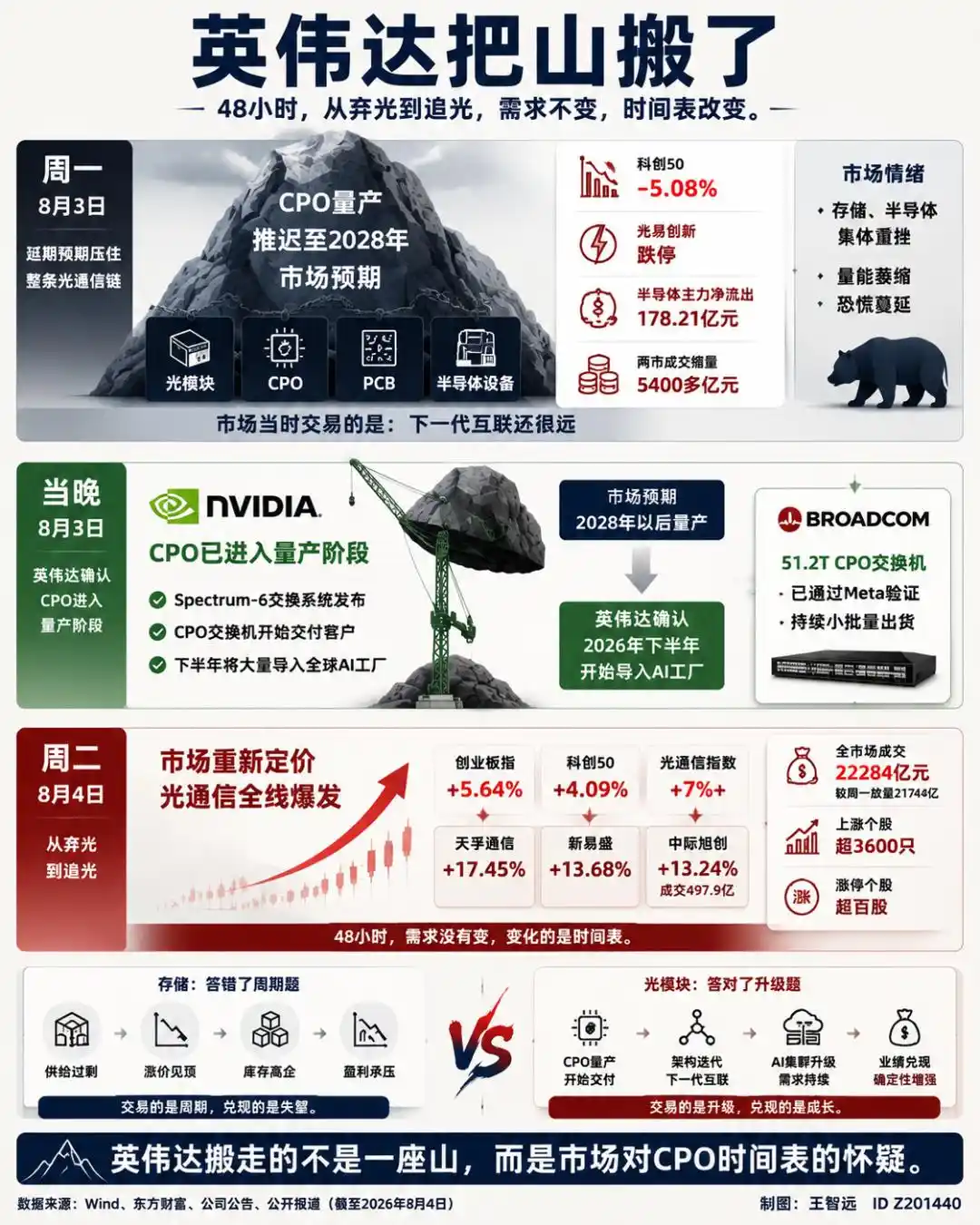
Before the opening, the Asia-Pacific markets heard the news from South Korea first. The KOSPI opened lower and continued falling, closing down 5.12% at 6,257 points.
The wheels of deleveraging were still rolling, and panic traveled northward along the semiconductor supply chain. The first stop was China's A-share STAR Market. The STAR 50 Index closed down 5.08% at 1,552.89 points, its largest single-day drop recently.
The Shanghai Composite fell 0.59%, the Shenzhen Component fell 0.96%, and the ChiNext Index fell 1.24%—all major indices were in the red.
But looking only at the indices, you'd completely misunderstand the day. Over 4,000 stocks across the market rose, with 83 hitting their daily limit-up. While the indices fell, most people's stocks went up. Blue-chips got hammered, small-caps partied—each doing their own thing.
The list of those taking a beating was also concentrated: memory and semiconductors.
The most telling case was GigaDevice. The company had just announced over the weekend a plan to buy back 1 to 2 billion RMB worth of its own shares, with an upper price limit of 750 RMB. It was a clear gesture of support.
Yet, on Monday, with 23 billion RMB in turnover, it was directly slammed down to the daily limit-down. The buyback announcement hadn't even cooled off before it ate a limit-down.
Demingli fell over 9%, FeiCheng dropped over 12%, and the STAR Semiconductor ETF fell nearly 10% in a day. According to East Money data, the semiconductor sector saw a net outflow of 17.821 billion RMB from major funds for the day, ranking first among all industries.
Trading volume also receded. The total turnover for the two markets shrank to 2 trillion RMB, over 540 billion RMB less than last Friday. This was the most intense day of selling for computing hardware in a week.
When the market closed on Monday, many people's sentiment towards the optical module sector was likely summed up in two words: It's over.
......
The turning point came that night, Eastern Time, August 3rd. U.S. stocks opened higher and closed higher. The Nasdaq rose 2.13%, the S&P 500 rose 1.48%, and the Dow Jones rose 1.32%, even hitting a new closing high.
The most dramatic was the Philadelphia Semiconductor Index, which at one point fell 3% intraday but closed in the green. SanDisk was even more exaggerated, having plunged as much as 8% intraday before reversing to close up over 6%.
Such a deep intraday V-shaped reversal usually indicates one thing: something has twisted expectations around.
That something was NVIDIA. First, some background.
CPO, Co-Packaged Optics. Simply put, it packages the optical engine and the switch chip together, seen as the ultimate solution for next-generation AI cluster interconnect.
But recently, market-circulating research reports worried that mass production of CPO would be comprehensively delayed until 2028, keeping the valuations of optical module companies pinned under this mountain.
This week, NVIDIA unveiled the Vera Rubin platform and the Spectrum-6 switch system. More crucially, Senior Vice President Shainer publicly announced at a technology forum that CPO has already entered the mass production stage, and switches developed in collaboration with the supply chain are starting to be delivered to customers, with large-scale deployment in global AI factories slated for the second half of the year.
A top executive personally stepping in to move the mountain. On another front, Broadcom's 51.2T CPO switch has passed Meta's verification and is in continuous small-batch shipment.
The 'CPO Delay Theory' has thus collapsed.
Citibank added supporting evidence: The capital expenditures of the four major U.S. cloud providers in Q2 increased by 79% year-on-year, and they slightly raised their full-year guidance. Demand visibility now extends to 2028.
NVIDIA rose nearly 3%, with its market cap reclaiming the $5 trillion level. Lumentum and Coherent rose over 9%, Kioxia's ADR rose about 14%, and Corning rose over 6%.
And so came Tuesday, August 4th, for China's A-shares.
......
The three major indices opened higher and rose throughout the day. The ChiNext Index surged 5.64%, closing at 3,488.97 points. The Shenzhen Component rose 3.25%, the STAR 50 rose 4.09%, and the Shanghai Composite rose a mere 0.33%, closing at 3,822.28 points.
Total market turnover was 2,228.4 billion RMB, a volume increase of 217.4 billion RMB compared to Monday. Over 3,600 individual stocks rose, with over a hundred hitting the daily limit-up.
The scene of returning to the spotlight deserves a closer look. The 'YiZhongTian' group soared collectively: Tianfu Communication rose 17.45%, Xinsheng rose 13.68%. Zhongji Innolight rose 13.24%, closing at 1,021.99 RMB, with a single stock turnover of 49.79 billion RMB.
49.79 billion RMB. For one stock. In one day.
The CPO concept surged to limit-up: Guangku Technology, Accelink, Cambridge Technology, over ten stocks hit limit-up. On the PCB side, over twenty stocks hit limit-up.
On the Beijing Stock Exchange, Heng Dong Guang rose 20.83%, Dingtong Technology and Xiechuang Data rose over 17%. The optical communication concept index rose over 7% for the day, leading the communications sector to top the market.
The money wasn't scattered either. On the Dragon & Tiger list (showing significant trades), the top institutional buy was Shijia Photon, at 829 million RMB.
Another coincidence worth noting: after the close, there were exactly five stocks in the A-share market priced above 1,000 RMB: Lianxun Instrument, Zhongji Innolight, Cambricon, Yuanjie Technology, plus Kweichow Moutai.
The first four charged ahead hand in hand, only the old-timer Moutai fell, down 2.25%.
The old-timers weren't just Moutai. China Merchants Bank fell 2.68%, Ping An of China fell 2.92%. Banking, baijiu (liquor), airport & shipping, and automobile manufacturing all lingered at the bottom of the decline list.
The SSE 50 fell 0.29% for the day, a difference of 593 basis points from the ChiNext's gain.
Some are chasing the light, others are moving house.
In 48 hours, from abandoning optical to chasing optical. Demand hasn't changed; what changed was the test question. The market is no longer comparing who burns the most money on AI, only recognizing who can make that money back.
The memory sector answered the cycle question wrong. This time, the optical module sector is answering the upgrade question.
......
Pull the lens back for a panoramic view. The 2.2 trillion RMB turnover wasn't evenly distributed.
The Shanghai market accounted for 1.01 trillion RMB, the Shenzhen market for 1.21 trillion RMB. Money clearly squeezed towards Shenzhen. The CSI 300 rose 1.27%, the BSE 50 rose 1.62%. All were just running along.
The Hong Kong market had two different moods these two days.
On Monday, while Japan and South Korea fell sharply, Hong Kong defied the trend and closed in the green, with the Hang Seng Index returning above 26,000 points. Who carried it? Alibaba's single stock surged over 7%, single-handedly propping it up. On Tuesday, the Hang Seng Index fell back 0.60%.
The optical communication fire did spread over there. Zhongji Innolight's H-shares rose 17%, Cambridge Technology's H-shares rose nearly 20%. Autos and domestic banks lay flat, with XPeng down over 4%, CCB and ICBC down over 3%.
The same batch of Chinese assets: A-shares charged in, Hong Kong shares are still watching from the gate.
......
There was another line today, quiet but with solid limit-ups: CXO.
After the close on August 3rd, WuXi AppTec slammed its first-half report on the table. Revenue: 28.897 billion RMB, up 38.93% year-on-year. Net profit attributable to shareholders: 11.08 billion RMB, up 29.43% year-on-year.
That's not even the impressive part. The impressive part is: The full-year revenue guidance was raised from 51.3-53.0 billion RMB directly to 58.5-60.5 billion RMB. It also announced a cash dividend of 5.1 RMB per 10 shares.
Remember a basic principle: good performance can be faked, but raising guidance upwards can't be. No one dares shout like that unless they have thick order books in hand.
The next day, the market voted directly with its feet.
On August 4th, WuXi AppTec's A-shares hit the limit-up, closing at 141.35 RMB, with a turnover of 10.5 billion RMB. Its H-shares rose 11.17%, WuXi Biologics followed with a 4.28% rise. The CRO concept was among the top gainers.
Now look at AMEC. This is interesting. Its earnings preview: first-half net profit expected to increase 282% to 311%. Impressive? Looks impressive.
Break down the accounts. 1.982 billion RMB comes from fair value changes and investment income from equity investments. That's money made from investments, unrelated to selling equipment. In the same period last year, this figure was only 168 million RMB.
And the core business? The revenue from actually selling equipment grew about 35%. The 280% growth rate—a large portion sprouted from the accounting book.
I've seen this act too many times. When a bull market comes, investment income shoots up. Whether the core business is really doing well, nobody asks anymore. The word 'performance,' just like 'limit-up,' has to be broken down to see its true color.
......
Let's look at the news front. This time, we'll cover both the weekend's and Monday's.
First, the weekend.
On August 1st, the People's Bank of China held its second-half work conference, setting the tone for continued appropriately accommodative policy. The exact wording was: 'Comprehensively utilize and adjust monetary policy tools in a timely manner, maintain abundant liquidity, and intensify efforts to expand domestic demand.'
No new phrasing. But at this juncture, it serves as a reassurance.
The same weekend, the State Council executive meeting approved four nuclear power projects, totaling eight reactor units. Public reports estimate total investment exceeding 170 billion RMB.
Thus, on Monday, nuclear power and controlled nuclear fusion became the brightest stars in the room, with over 26 stocks hitting limit-up. While semiconductors were bleeding over there, nuclear power was counting limit-ups here. That's where half of Monday's split came from.
The model world had two things this week worth looking at together.
First, on August 3rd, Alibaba released its new-generation base model Qwen3.8, with total parameters of 2.4 trillion. On the Arena leaderboard, it's second only to Anthropic's Claude series, and the full weights will be open-sourced next week.
The price is even more aggressive. The international input price is only 24% of Opus 5's. Anyway, after using it for two days, I find its cost-performance ratio much higher than Kimi's K3.
Second, on July 31st, OpenAI slashed the price of GPT-5.6 Luna by 80%. Input price per million tokens dropped from $1 to $0.2. It had only been launched for three weeks.
An 80% cut in just three weeks—savor that pressure. Behind it is the same driving force.
Reports from National Business Daily and CNBC indicate that on the API aggregation platform OpenRouter, the proportion of tokens from U.S. companies calling Chinese models has been stable above 30% weekly since February this year, even touching 46% at its peak.
In the first half of 2025, this figure was only 4.5%. The toll booths for models are being dismantled. Who benefits most? Cloud providers with computing power, customers, and distribution channels.
AI money is flowing from those who build the roads to those who collect rent on the roads.
Over in the Middle East, it's a Rashomon story.
On August 3rd, Trump said negotiations with Iran had begun. In two phases: first, opening the Strait of Hormuz, second, denuclearization. The strait would reopen by tomorrow at the latest.
The Iranian Foreign Ministry's response on the same day was: No negotiations have been held with the United States; talks are only happening with Oman.
The military advisor to Iran's Supreme Leader added: If the U.S. military deploys warships, they will be considered targets. One says talks are on, the other says they aren't. Whom do you believe?
The market chose to believe Trump.
On Monday, WTI crude oil plunged over 5%, falling back near $80 per barrel. The premium gained in July from war fears is being quickly given back. OPEC also decided to increase production by another 188,000 barrels per day in September. Gold, however, still held above $4,050.
On August 4th, domestically, there were three routine policy announcements.
The China Securities Regulatory Commission issued 10 measures for mainland-Hong Kong capital market cooperation, supporting Hong Kong-listed companies seeking listing domestically, and implementing a fast-track registration for conventional stock ETFs.
The revised 'Regulations on the Protection of Integrated Circuit Layout Designs' were announced, effective October 15th, with increased penalties for infringement.
The '15th Five-Year Plan for New Power System Construction' was issued, targeting over 40 million charging infrastructure units by 2030.
These three aren't sexy, but they're all about laying foundations.
Finally, news on money. Wind data shows that in July, stock ETFs saw a net inflow of 477.836 billion RMB, a record for a single month. The stock private fund position index also hit a 52-month high.
CICC's research report suggests that August may see the A-share market enter a repair phase following a significant correction. Money is flowing in, positions are at highs, research reports are calling for repair. Three signals, all pointing in the same direction.
......
Tonight has two shows.
One is at the White House. The Trump administration summoned OpenAI, Anthropic, Google, and Meta to review the final version of the AI regulatory framework. Reportedly, companies will have to submit information to the government before releasing new models.
The other is after the U.S. market closes. AMD and SpaceX report earnings.
Memory and optical modules have only rebounded for one day. AMD's report card will directly decide whether the semiconductor chain continues the party tomorrow or starts digging again.
First thing tomorrow morning, check the Strait of Hormuz. Trump said it would reopen by tomorrow at the latest. Iran says they never talked to you. One side is about to get slapped in the face.
Looking further ahead: August 7th, CATL's interim dividend record date, 14.11 RMB per 10 shares. August 26th, NVIDIA's earnings report—the next verification window for the entire AI industry chain.
Whether the strait opens or not, we'll know at daybreak.
Reference Sources:
[1]. A-share data sourced from Zhiyuan's proprietary market data; company data from official announcements; policy information from official releases; overseas market data, research report views, and Korean media reports.
This article is from the WeChat public account "Wang Zhiyuan" (ID: Z201440), author: Wang Zhiyuan