China's AI Computing Counterattack

marsbitPublié le 2026-03-04Dernière mise à jour le 2026-03-04

Résumé

Eight years after the ZTE crisis, China's AI industry is fighting back against U.S. chip restrictions. In 2018, ZTE nearly collapsed under U.S. sanctions but survived with heavy fines and oversight. Today, Chinese AI firms like DeepSeek are pivoting away from NVIDIA by developing domestic alternatives and optimizing algorithms to reduce reliance on foreign technology. DeepSeek’s V4 model will use entirely domestic chips, signaling a strategic shift toward computational independence. The real challenge isn’t just hardware—it’s NVIDIA’s CUDA ecosystem, which dominates global AI development with over 4.5 million developers. U.S. export controls have tightened since 2022, banning high-end chips like the A100, H100, and their downgraded versions. In response, Chinese companies are adopting technical workarounds like Mixture-of-Experts models, which activate only parts of the network during inference, slashing costs. DeepSeek’s API is up to 75x cheaper than competitors, driving rapid global adoption. By early 2026, Chinese models accounted for nearly 60% of API calls on OpenRouter. Domestic chips, such as Huawei’s Ascend series, are now capable of full-scale training, not just inference. Production lines in cities like Xinghua manufacture servers with homegrown processors, supporting major AI training projects. Meanwhile, the U.S. faces an electricity shortage as data centers consume growing power, while China benefits from greater energy capacity and lower costs. Chinese AI is...

Eight years ago, ZTE suffered a cardiac arrest.

On April 16, 2018, a ban issued by the U.S. Department of Commerce's Bureau of Industry and Security brought ZTE Corporation, the world's fourth-largest telecommunications equipment manufacturer with 80,000 employees and annual revenue exceeding 100 billion yuan, to a standstill overnight. The content of the ban was simple: for the next seven years, any American company was prohibited from selling components, goods, software, and technology to ZTE.

Without Qualcomm's chips, base station production halted. Without Google's Android authorization, there was no usable system for its phones. Twenty-three days later, ZTE issued an announcement stating that its main business activities could no longer continue.

However, ZTE ultimately survived, but at a cost of $1.4 billion.

A $1 billion fine, paid in one lump sum; a $400 million deposit, placed in an escrow account at a U.S. bank. Additionally, all senior executives were replaced, and a U.S. compliance supervision team was stationed within the company. For the full year of 2018, ZTE reported a net loss of 7 billion yuan, with revenue plummeting 21.4% year-on-year.

Yin Yimin, then chairman of ZTE, wrote in an internal letter: "We are in a complex industry that is highly dependent on the global supply chain." At the time, these words sounded like both reflection and helplessness.

Eight years later, on February 26, 2026, Chinese AI unicorn DeepSeek announced that its upcoming V4 multimodal large model would prioritize deep cooperation with domestic chip manufacturers, achieving for the first time a full-process non-NVIDIA solution from pre-training to fine-tuning.

In other words: We are not using NVIDIA anymore.

The market's first reaction to the news was skepticism. NVIDIA holds over 90% of the global AI training chip market share. Abandoning it—does that make commercial sense?

But behind DeepSeek's choice lies a question larger than commercial logic: What kind of computing independence does Chinese AI truly need?

What Exactly Is Being Strangled

Many people think the chip ban is about hardware. But what truly suffocates Chinese AI companies is something called CUDA.

CUDA, short for Compute Unified Device Architecture, is a parallel computing platform and programming model launched by NVIDIA in 2006. It allows developers to directly utilize the computing power of NVIDIA GPUs to accelerate various complex computational tasks.

Before the AI era arrived, this was just a tool for a few geeks. But when the wave of deep learning hit, CUDA became the foundation of the entire AI industry.

The training of AI large models is essentially massive matrix operations. And this is precisely what GPUs excel at.

Thanks to planning over a decade in advance, NVIDIA used CUDA to build a complete toolchain for global AI developers, spanning from underlying hardware to upper-layer applications. Today, all mainstream AI frameworks worldwide, from Google's TensorFlow to Meta's PyTorch, are deeply tied to CUDA at their core.

A PhD student in AI, from their first day of enrollment, learns, programs, and experiments in the CUDA environment. Every line of code they write reinforces NVIDIA's moat.
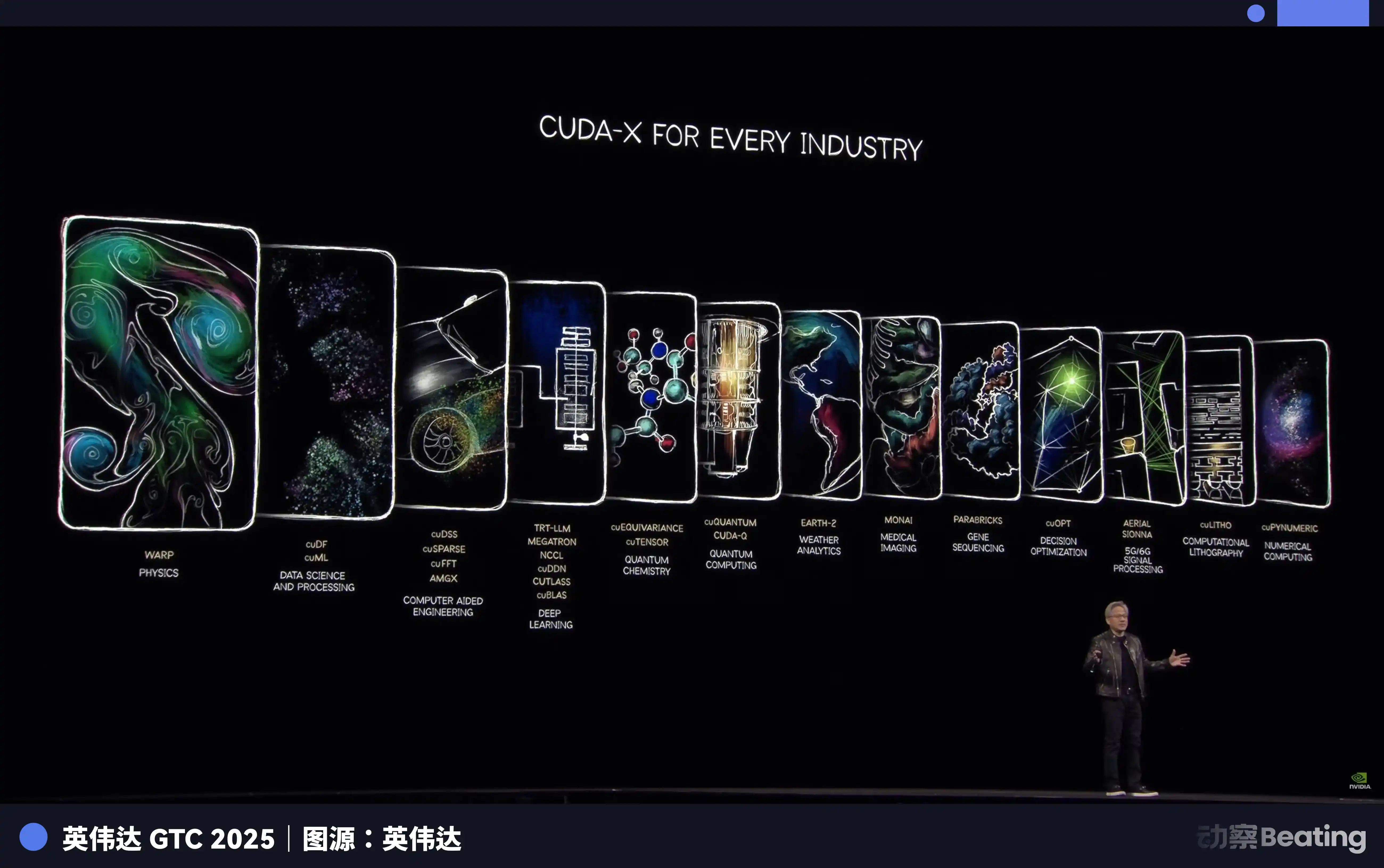
As of 2025, the CUDA ecosystem already boasts over 4.5 million developers, covers more than 3,000 GPU-accelerated applications, and is used by over 40,000 companies globally. This number means that over 90% of the world's AI developers are locked into NVIDIA's ecosystem.

The terrifying thing about CUDA is that it's a flywheel. The more developers use it, the more tools, libraries, and code are generated, making the ecosystem more prosperous; the more prosperous the ecosystem, the more it attracts additional developers. Once this flywheel starts spinning, it becomes almost impossible to stop.

The result is that NVIDIA sells you the most expensive shovel and also defines the only way to dig. Want to change shovels? Fine. But you'll have to rewrite all the experience, tools, and code accumulated over the past decade by hundreds of thousands of the smartest brains worldwide using that specific method.

Who pays for that cost?

So, when the first round of controls landed on October 7, 2022, with BIS restricting exports of NVIDIA's A100 and H100 to China, Chinese AI companies collectively felt a ZTE-like suffocation for the first time. NVIDIA subsequently launched "China-specific" A800 and H800 chips, reducing the inter-chip interconnect speed, barely maintaining supply.

But just a year later, on October 17, 2023, a second round of controls tightened further, banning A800 and H800 as well, and adding 13 Chinese companies to the Entity List. NVIDIA had to launch a further neutered version, the H20. By December 2024, the final round of controls during the Biden administration landed, strictly limiting even H20 exports.

Three rounds of controls, escalating step by step.

But this time, the story's direction is completely different from that of ZTE back then.

An Asymmetric Breakout

Under the ban, everyone thought the dream of Chinese AI large models would end there.

They were wrong. Faced with the blockade, Chinese companies did not choose a head-on confrontation but began a breakout. The first battlefield of this breakout was not in chips, but in algorithms.

From late 2024 to 2025, Chinese AI companies collectively turned to a technical direction: Mixture of Experts (MoE) models.

Simply put, this means splitting a huge model into many small experts, activating only the most relevant few when processing a task, rather than engaging the entire model.

DeepSeek's V3 is a typical example of this approach. It has 671 billion parameters, but only activates 37 billion of them during each inference, just 5.5% of the total. In terms of training cost, it used 2048 NVIDIA H800 GPUs, trained for 58 days, with a total cost of $5.576 million. In comparison, external estimates for GPT-4's training cost are around $78 million. A difference of an order of magnitude.

Extreme optimization in algorithms directly reflected in pricing. DeepSeek's API price is $0.028 to $0.28 per million input tokens, and $0.42 for output. GPT-4o's input price is $5, output $15. Claude Opus is even more expensive, $15 input, $75 output. Converted, DeepSeek is 25 to 75 times cheaper than Claude.

This price difference had a huge impact on the global developer market. In February 2026, on OpenRouter, the world's largest AI model API aggregation platform, the weekly call volume for Chinese AI models surged 127% in three weeks, surpassing the U.S. for the first time. A year earlier, Chinese models had less than 2% share on OpenRouter. A year later, it grew 421%, approaching 60%.
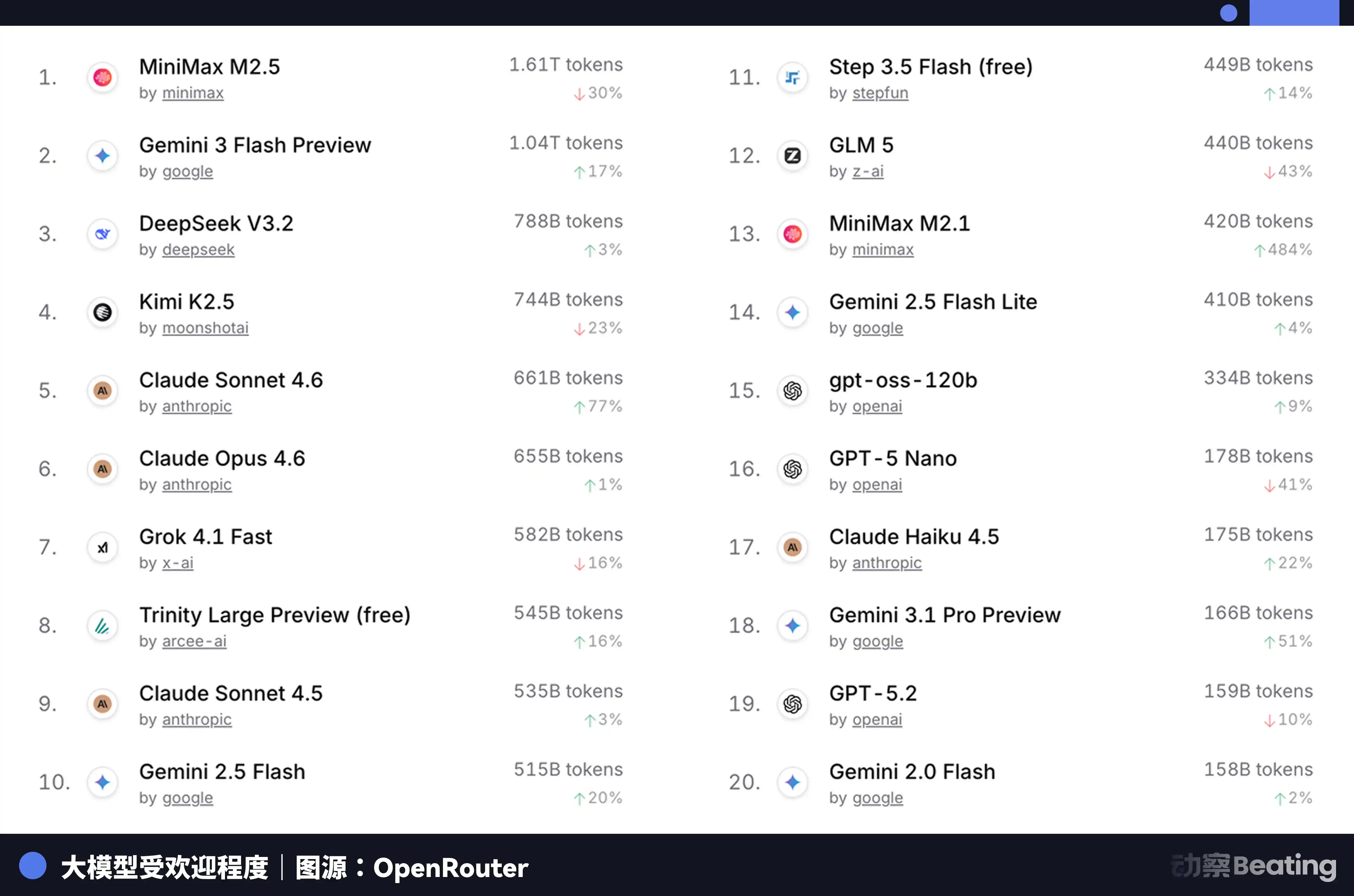
Behind this data lies a structural change that is easy to overlook. Starting in the second half of 2025, the mainstream scenario for AI applications shifted from chat to Agent. In Agent scenarios, the token consumption for a single task is 10 to 100 times that of simple chat. When token consumption grows exponentially, price becomes the decisive factor. The extreme cost-effectiveness of Chinese models恰好踩中了这个窗口 (happened to hit this window perfectly).

But the problem is, reducing inference cost does not solve the fundamental problem of training. A large model that cannot be continuously trained and iterated on new data will see its capabilities degrade rapidly. And training remains that unavoidable computing black hole.

So, where do the "shovels" for training come from?

The Backup Plan Goes Mainstream

Xinghua, Jiangsu, a small city in central Jiangsu, known for stainless steel and health food, previously had no relation to AI. But in 2025, a 148-meter-long production line for domestic computing servers was built and put into operation here, taking only 180 days from signing to production.

The core of this production line is two fully domestic chips: the Loongson 3C6000 processor and the Taichu Yuanqi T100 AI accelerator card. The Loongson 3C6000 is entirely self-developed, from instruction set to microarchitecture. Taichu Yuanqi emerged from the National Supercomputing Center in Wuxi and a Tsinghua University team, adopting a heterogeneous many-core architecture.

At full capacity, this line produces one server every 5 minutes. The total investment for this production line is 1.1 billion yuan, with an expected annual output of 100,000 units.

More importantly, clusters based on these domestic chips, comprising tens of thousands of cards, have begun undertaking real large model training tasks.

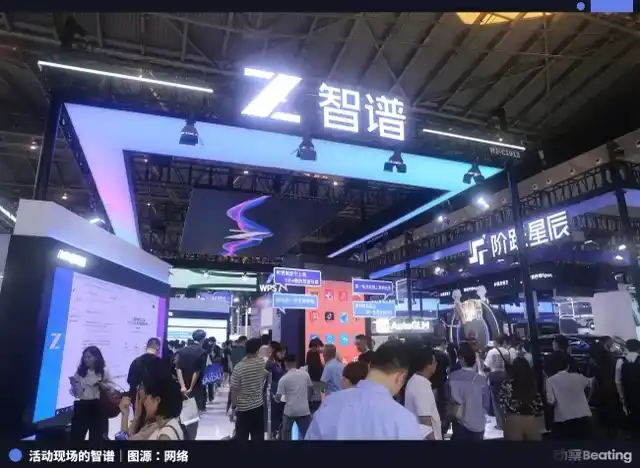
In January 2026, Zhipu AI, in collaboration with Huawei, released GLM-Image, the first SOTA image generation model fully trained from start to finish relying on domestic chips. In February, China Telecom's billion-parameter "Star" large model completed its full training process on a domestic 10,000-card computing pool in Shanghai's Lingang.
The significance of these cases is that they prove one thing: domestic chips have transitioned from "usable for inference" to "usable for training." This is a qualitative change. Inference only requires running a pre-trained model, which places relatively lower demands on the chip; training requires processing massive data, performing complex gradient calculations and parameter updates, demanding an order of magnitude higher requirements for chip computing power, interconnect bandwidth, and software ecosystem.

The core force承担这些任务 (undertaking these tasks) is Huawei's Ascend series chips. As of the end of 2025, the Ascend ecosystem had surpassed 4 million developers, with over 3,000 partners; 43 mainstream large models completed pre-training based on Ascend, and over 200 open-source models were adapted. At the MWC conference on March 2, 2026, Huawei also launched its new computing base, SuperPoD, for overseas markets.

Ascend 910B's FP16 computing power is already comparable to NVIDIA's A100. Although the gap still exists, it has gone from unusable to usable, and from usable to becoming good. Ecosystem building cannot wait until the chips are perfect; it must be rolled out on a large scale at the usable stage, using real business needs to force the iteration of chips and software. ByteDance, Tencent, and Baidu's targets for importing domestic computing servers普遍较上一年翻倍增长 (generally doubled compared to the previous year) in 2026. Data from the Ministry of Industry and Information Technology shows China's intelligent computing scale has reached 1590 EFLOPS. 2026 is becoming the first year of large-scale deployment for domestic computing.

U.S. Power Shortages and China's Overseas Expansion

In early 2026, Virginia, which carries a large amount of data center traffic globally, suspended approval for new data center construction projects. Georgia followed suit, extending the suspension until 2027. Illinois and Michigan also introduced restrictions.

According to data from the International Energy Agency, U.S. data center electricity consumption reached 183 TWh in 2024, accounting for about 4% of the nation's total electricity consumption. By 2030, this number is expected to double to 426 TWh, potentially exceeding 12%. Arm's CEO predicted that by 2030, AI data centers would consume 20% to 25% of U.S. electricity.

The U.S. power grid is already overwhelmed. The PJM grid, covering 13 eastern U.S. states, faces a 6GW capacity shortfall. By 2033, the U.S. overall faces a 175GW power capacity gap, equivalent to the electricity consumption of 130 million households. Wholesale electricity costs in data center concentrated areas are 267% higher than five years ago.

The end of computing power is energy. And on the energy dimension, the gap between China and the U.S. is even larger than in chips, just in the opposite direction.

China's annual electricity generation is 10.4 trillion kWh, while the U.S. is 4.2 trillion kWh; China's is 2.5 times that of the U.S. More crucially, residential electricity consumption in China accounts for only 15% of total electricity usage, while in the U.S. this proportion is 36%. This means China has far more industrial electricity surplus available for computing construction than the U.S.
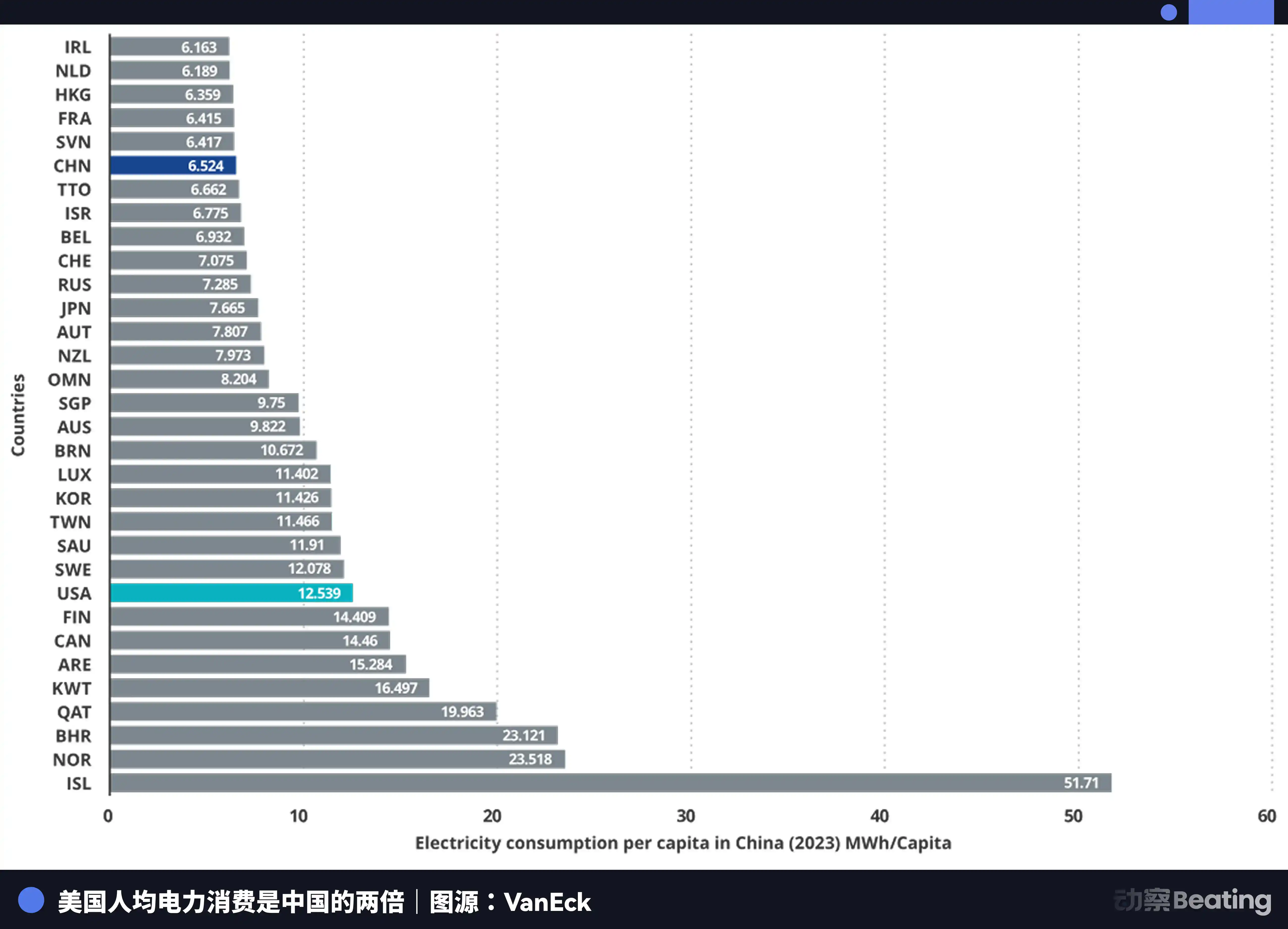
In terms of electricity prices, the price in U.S. AI company hubs is $0.12 to $0.15 per kWh, while industrial electricity prices in western China are about $0.03, only a quarter to a fifth of the U.S. price.

China's power generation growth is already 7 times that of the U.S.

Just as the U.S. worries about electricity, Chinese AI is quietly going global. But this time, what's going overseas is not products, not factories, but Tokens.

Tokens, the smallest unit of information processed by AI models, are becoming a new digital commodity. They are produced in Chinese computing factories and transmitted globally via submarine cables.

DeepSeek's user distribution data is telling: 30.7% in mainland China, 13.6% in India, 6.9% in Indonesia, 4.3% in the U.S., 3.2% in France. It supports 37 languages and is widely popular in emerging markets like Brazil. Globally, 26,000 enterprises have opened accounts, and 3,200 institutions have deployed the enterprise version.

In 2025, 58% of new AI startups included DeepSeek in their tech stack. In China, DeepSeek captured 89% market share. In other sanctioned countries, market share ranged from 40% to 60%.

This scene is reminiscent of another war about industrial autonomy forty years ago.

In Tokyo, 1986, under strong pressure from the U.S., the Japanese government signed the U.S.-Japan Semiconductor Agreement. The core clauses of the agreement were three: requiring Japan to open its semiconductor market, with U.S. chip market share in Japan必须达到 20% 以上 (must reach over 20%); strictly prohibiting Japanese semiconductors from being exported below cost; and imposing 100% punitive tariffs on $300 million worth of chips exported from Japan. Simultaneously, the U.S. vetoed Fujitsu's acquisition of Fairchild Semiconductor.

That year, the Japanese semiconductor industry was at its peak. In 1988, Japan controlled 51% of the global semiconductor market share, while the U.S. had only 36.8%. Six of the world's top ten semiconductor companies were Japanese: NEC ranked second, Toshiba third, Hitachi fifth, Fujitsu seventh, Mitsubishi eighth, and Panasonic ninth. In 1985, Intel lost $173 million in the U.S.-Japan semiconductor war,濒临破产 (on the verge of bankruptcy).

But after the agreement was signed, everything changed.

The U.S., through means like Section 301 investigations, launched a comprehensive suppression of Japanese semiconductor companies. Simultaneously, it扶持 (supported) South Korea's Samsung and Hynix to impact Japan's market with lower prices. Japan's DRAM share fell from 80% to 10%. By 2017, Japan's IC market share was only 7%. Once-invincible giants were either split up, acquired, or left the scene黯然离场 (dimly) amidst endless losses.
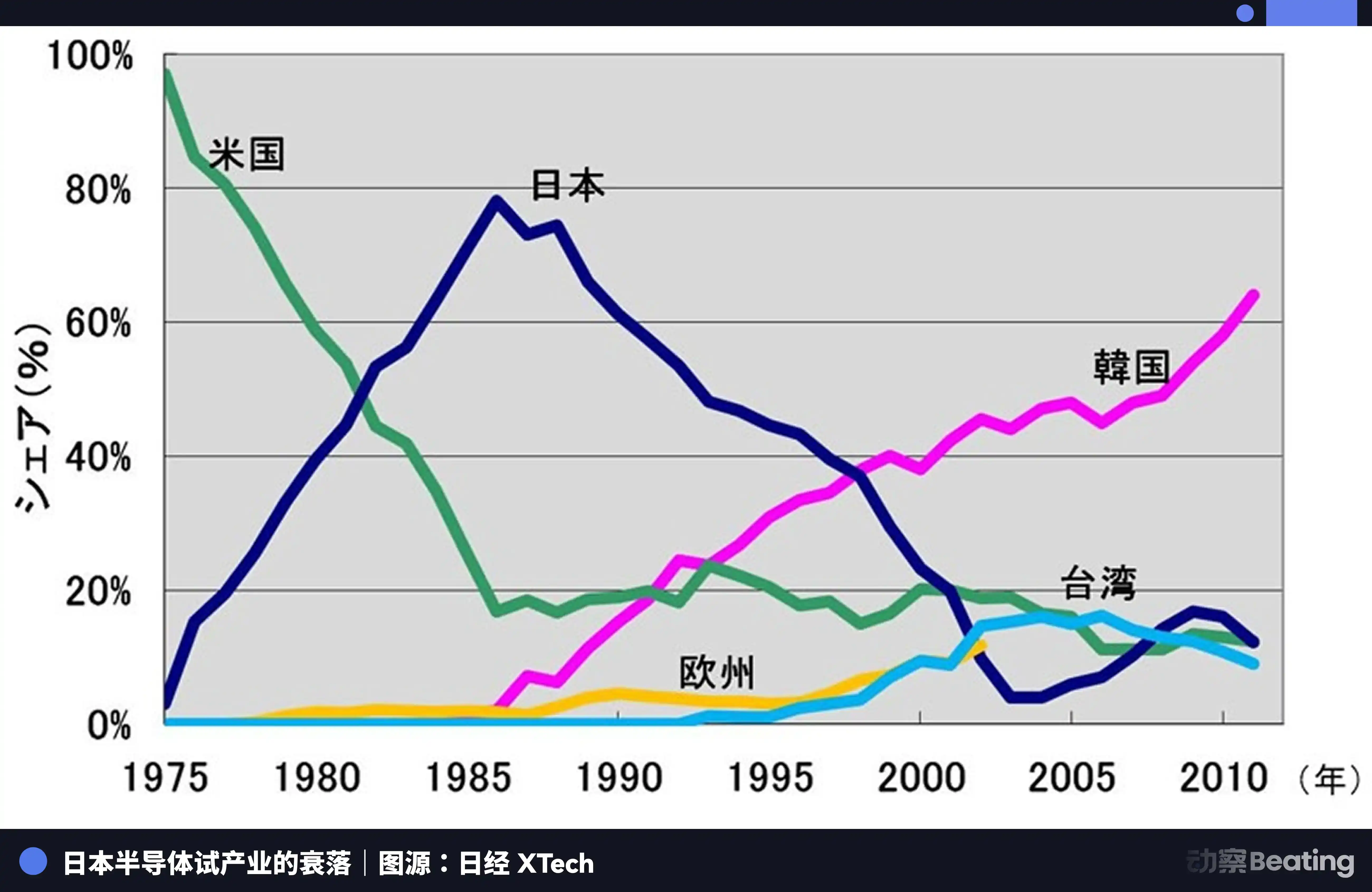
The tragedy of Japanese semiconductors was that they were content being the most excellent producer within a global division of labor system dominated by a single external force, but never thought to build an independent ecosystem of their own. When the tide went out, they found they had nothing but production itself.

Today, China's AI industry stands at a similar yet completely different crossroads.

Similar in that we同样面临着来自外部的巨大压力 (also face huge external pressure). Three rounds of chip controls, escalating step by step, the barrier of the CUDA ecosystem依然高耸 (still stands tall).

Different in that this time, we have chosen a more difficult path. From extreme optimization at the algorithm level, to the leap of domestic chips from inference to training, to the accumulation of 4 million developers in the Ascend ecosystem, to the penetration of global markets through Token exports. Every step on this path is building an independent industrial ecosystem that Japan never possessed back then.

Epilogue

On February 27, 2026, performance reports from three local AI chip companies were released on the same day.

Cambricon, revenue surged 453%, achieving full-year profitability for the first time. Moore Threads, revenue grew 243%, but with a net loss of 1 billion yuan. MetaX, revenue grew 121%, with a net loss of nearly 800 million yuan.

Half flame, half seawater.

The flame is the market's extreme hunger. The 95% void left by Jensen Huang is being filled, inch by inch, by the revenue figures of these local companies. Regardless of performance, regardless of the ecosystem, the market needs a second choice besides NVIDIA. This is a once-in-a-lifetime structural opportunity torn open by geopolitics.

The seawater is the huge cost of ecosystem building. Every cent of loss is real money paid to catch up with the CUDA ecosystem. It's R&D investment, software subsidies, the人力成本 (human cost) of engineers stationed at customer sites solving compilation issues one by one. These losses are not operational failures but the war tax that must be paid to build an independent ecosystem.

These three financial reports, more honestly than any industry report, record the true face of this computing war. It is not a triumphant victory march but a brutal battle of attrition, charging forward while bleeding.

But the form of the war has indeed changed. Eight years ago, we discussed the question of "whether we can survive." Today, we discuss the question of "what price must be paid to survive."

The price itself is progress.

Questions liées

QWhat was the core reason behind the 'choking' feeling for Chinese AI companies during the chip ban, beyond just hardware restrictions?

AThe core reason was CUDA (Compute Unified Device Architecture), NVIDIA's parallel computing platform and programming model. It formed the foundational ecosystem for AI development, binding over 90% of global AI developers. Losing access to this deeply entrenched software and toolchain ecosystem, not just the hardware, was what caused severe disruption.

QHow did Chinese AI companies like DeepSeek initially respond to the compute restrictions in a 'non-confrontational' way?

AThey focused on algorithmic breakthroughs, specifically by adopting Mixture-of-Experts (MoE) models. This approach, as seen with DeepSeek V3, used a massive number of parameters (671B) but only activated a small fraction (5.5%) for each task, drastically reducing training and inference expenses, which gave them a significant price advantage.

QWhat key milestone demonstrated that domestic Chinese chips had achieved a qualitative leap in capability?

AThe key milestone was domestic chips transitioning from being 'usable for inference' to 'capable of training' large models. This was proven by instances like Zhipu AI's GLM-Image and China Telecom's 'Xingchen' model, which were fully trained on domestic万卡 (10,000-card) clusters using chips like Huawei's Ascend.

QWhat new advantage is emerging for China's AI industry, related to a fundamental resource constraint facing the US?

AA new advantage is emerging in energy capacity and cost. The US is facing a severe electricity shortage and high costs for powering data centers, while China has 2.5 times the total electricity generation, a larger industrial power allocation, and electricity costs that are only a quarter to a fifth of those in US AI hubs.

QHow is the current Chinese AI industry's situation both similar to and different from Japan's semiconductor industry in the 1980s?

AIt is similar in facing immense external pressure and sanctions from the US. However, it is different because instead of just being a superior manufacturer within a US-led ecosystem (like Japan), China is pursuing a more difficult path of building an independent, full-stack ecosystem—from algorithms and domestic chips to software and a global developer community—which Japan never achieved.

Lectures associées

Trading

Spot
Futures

Articles tendance

Qu'est ce que $S$

Comprendre SPERO : Un aperçu complet Introduction à SPERO Alors que le paysage de l'innovation continue d'évoluer, l'émergence des technologies web3 et des projets de cryptomonnaie joue un rôle central dans la façon dont se dessine l'avenir numérique. Un projet qui a attiré l'attention dans ce domaine dynamique est SPERO, désigné comme SPERO,$$s$. Cet article vise à rassembler et à présenter des informations détaillées sur SPERO, afin d'aider les passionnés et les investisseurs à comprendre ses fondations, ses objectifs et ses innovations dans les domaines du web3 et de la crypto. Qu'est-ce que SPERO,$$s$ ? SPERO,$$s$ est un projet unique dans l'espace crypto qui cherche à tirer parti des principes de décentralisation et de la technologie blockchain pour créer un écosystème qui favorise l'engagement, l'utilité et l'inclusion financière. Le projet est conçu pour faciliter les interactions entre pairs de nouvelles manières, offrant aux utilisateurs des solutions et des services financiers innovants. Au cœur de SPERO,$$s$, l'objectif est d'autonomiser les individus en fournissant des outils et des plateformes qui améliorent l'expérience utilisateur dans l'espace des cryptomonnaies. Cela inclut la possibilité de méthodes de transaction plus flexibles, la promotion d'initiatives dirigées par la communauté et la création de voies pour des opportunités financières via des applications décentralisées (dApps). La vision sous-jacente de SPERO,$$s$ tourne autour de l'inclusivité, visant à combler les lacunes au sein de la finance traditionnelle tout en exploitant les avantages de la technologie blockchain. Qui est le créateur de SPERO,$$s$ ? L'identité du créateur de SPERO,$$s$ reste quelque peu obscure, car il existe peu de ressources publiques fournissant des informations détaillées sur son ou ses fondateurs. Ce manque de transparence peut découler de l'engagement du projet envers la décentralisation—une éthique que de nombreux projets web3 partagent, privilégiant les contributions collectives plutôt que la reconnaissance individuelle. En centrant les discussions autour de la communauté et de ses objectifs collectifs, SPERO,$$s$ incarne l'essence de l'autonomisation sans désigner des individus spécifiques. Ainsi, comprendre l'éthique et la mission de SPERO reste plus important que d'identifier un créateur unique. Qui sont les investisseurs de SPERO,$$s$ ? SPERO,$$s$ est soutenu par une diversité d'investisseurs allant des capital-risqueurs aux investisseurs providentiels dédiés à favoriser l'innovation dans le secteur crypto. L'objectif de ces investisseurs s'aligne généralement avec la mission de SPERO—priorisant les projets qui promettent des avancées technologiques sociétales, l'inclusivité financière et la gouvernance décentralisée. Ces fondations d'investisseurs s'intéressent généralement à des projets qui non seulement offrent des produits innovants, mais qui contribuent également positivement à la communauté blockchain et à ses écosystèmes. Le soutien de ces investisseurs renforce SPERO,$$s$ en tant que concurrent notable dans le domaine en rapide évolution des projets crypto. Comment fonctionne SPERO,$$s$ ? SPERO,$$s$ utilise un cadre multifacette qui le distingue des projets de cryptomonnaie conventionnels. Voici quelques-unes des caractéristiques clés qui soulignent son unicité et son innovation : Gouvernance décentralisée : SPERO,$$s$ intègre des modèles de gouvernance décentralisée, permettant aux utilisateurs de participer activement aux processus de décision concernant l'avenir du projet. Cette approche favorise un sentiment de propriété et de responsabilité parmi les membres de la communauté. Utilité du token : SPERO,$$s$ utilise son propre token de cryptomonnaie, conçu pour servir diverses fonctions au sein de l'écosystème. Ces tokens permettent des transactions, des récompenses et la facilitation des services offerts sur la plateforme, améliorant ainsi l'engagement et l'utilité globaux. Architecture en couches : L'architecture technique de SPERO,$$s$ supporte la modularité et l'évolutivité, permettant une intégration fluide de fonctionnalités et d'applications supplémentaires à mesure que le projet évolue. Cette adaptabilité est primordiale pour maintenir la pertinence dans le paysage crypto en constante évolution. Engagement communautaire : Le projet met l'accent sur des initiatives dirigées par la communauté, utilisant des mécanismes qui incitent à la collaboration et aux retours d'expérience. En cultivant une communauté forte, SPERO,$$s$ peut mieux répondre aux besoins des utilisateurs et s'adapter aux tendances du marché. Accent sur l'inclusion : En proposant des frais de transaction bas et des interfaces conviviales, SPERO,$$s$ vise à attirer une base d'utilisateurs diversifiée, y compris des individus qui n'ont peut-être pas engagé auparavant dans l'espace crypto. Cet engagement envers l'inclusion s'aligne avec sa mission globale d'autonomisation par l'accessibilité. Chronologie de SPERO,$$s$ Comprendre l'histoire d'un projet fournit des aperçus cruciaux sur sa trajectoire de développement et ses jalons. Voici une chronologie suggérée cartographiant les événements significatifs dans l'évolution de SPERO,$$s$ : Phase de conceptualisation et d'idéation : Les idées initiales formant la base de SPERO,$$s$ ont été conçues, s'alignant étroitement avec les principes de décentralisation et de concentration sur la communauté au sein de l'industrie blockchain. Lancement du livre blanc du projet : Suite à la phase conceptuelle, un livre blanc complet détaillant la vision, les objectifs et l'infrastructure technologique de SPERO,$$s$ a été publié pour susciter l'intérêt et les retours de la communauté. Construction de la communauté et engagements précoces : Des efforts de sensibilisation actifs ont été entrepris pour construire une communauté d'adopteurs précoces et d'investisseurs potentiels, facilitant les discussions autour des objectifs du projet et recueillant du soutien. Événement de génération de tokens : SPERO,$$s$ a organisé un événement de génération de tokens (TGE) pour distribuer ses tokens natifs aux premiers soutiens et établir une liquidité initiale au sein de l'écosystème. Lancement de la première dApp : La première application décentralisée (dApp) associée à SPERO,$$s$ a été mise en ligne, permettant aux utilisateurs d'interagir avec les fonctionnalités principales de la plateforme. Développement continu et partenariats : Des mises à jour et des améliorations continues des offres du projet, y compris des partenariats stratégiques avec d'autres acteurs de l'espace blockchain, ont façonné SPERO,$$s$ en un acteur compétitif et évolutif sur le marché crypto. Conclusion SPERO,$$s$ se dresse comme un témoignage du potentiel du web3 et de la cryptomonnaie pour révolutionner les systèmes financiers et autonomiser les individus. Avec un engagement envers la gouvernance décentralisée, l'engagement communautaire et des fonctionnalités conçues de manière innovante, il ouvre la voie vers un paysage financier plus inclusif. Comme pour tout investissement dans l'espace crypto en rapide évolution, les investisseurs et utilisateurs potentiels sont encouragés à mener des recherches approfondies et à s'engager de manière réfléchie avec les développements en cours au sein de SPERO,$$s$. Le projet illustre l'esprit d'innovation de l'industrie crypto, invitant à une exploration plus approfondie de ses nombreuses possibilités. Bien que le parcours de SPERO,$$s$ soit encore en cours, ses principes fondamentaux pourraient en effet influencer l'avenir de nos interactions avec la technologie, la finance et entre nous dans des écosystèmes numériques interconnectés.

101 vues totalesPublié le 2024.12.17Mis à jour le 2024.12.17

Qu'est ce que $S$

Qu'est ce que AGENT S

Agent S : L'avenir de l'interaction autonome dans Web3 Introduction Dans le paysage en constante évolution de Web3 et des cryptomonnaies, les innovations redéfinissent constamment la manière dont les individus interagissent avec les plateformes numériques. Un projet pionnier, Agent S, promet de révolutionner l'interaction homme-machine grâce à son cadre agentique ouvert. En ouvrant la voie à des interactions autonomes, Agent S vise à simplifier des tâches complexes, offrant des applications transformantes dans l'intelligence artificielle (IA). Cette exploration détaillée plongera dans les subtilités du projet, ses caractéristiques uniques et les implications pour le domaine des cryptomonnaies. Qu'est-ce qu'Agent S ? Agent S se présente comme un cadre agentique ouvert révolutionnaire, spécifiquement conçu pour relever trois défis fondamentaux dans l'automatisation des tâches informatiques : Acquisition de connaissances spécifiques au domaine : Le cadre apprend intelligemment à partir de diverses sources de connaissances externes et d'expériences internes. Cette approche double lui permet de construire un riche répertoire de connaissances spécifiques au domaine, améliorant ainsi sa performance dans l'exécution des tâches. Planification sur de longs horizons de tâches : Agent S utilise une planification hiérarchique augmentée par l'expérience, une approche stratégique qui facilite la décomposition et l'exécution efficaces de tâches complexes. Cette fonctionnalité améliore considérablement sa capacité à gérer plusieurs sous-tâches de manière efficace et efficiente. Gestion d'interfaces dynamiques et non uniformes : Le projet introduit l'Interface Agent-Ordinateur (ACI), une solution innovante qui améliore l'interaction entre les agents et les utilisateurs. En utilisant des Modèles de Langage Multimodaux de Grande Taille (MLLMs), Agent S peut naviguer et manipuler sans effort diverses interfaces graphiques. Grâce à ces fonctionnalités pionnières, Agent S fournit un cadre robuste qui aborde les complexités impliquées dans l'automatisation de l'interaction humaine avec les machines, préparant le terrain pour d'innombrables applications en IA et au-delà. Qui est le créateur d'Agent S ? Bien que le concept d'Agent S soit fondamentalement innovant, des informations spécifiques sur son créateur restent insaisissables. Le créateur est actuellement inconnu, ce qui souligne soit le stade naissant du projet, soit le choix stratégique de garder les membres fondateurs sous le radar. Quoi qu'il en soit, l'accent reste mis sur les capacités et le potentiel du cadre. Qui sont les investisseurs d'Agent S ? Étant donné qu'Agent S est relativement nouveau dans l'écosystème cryptographique, des informations détaillées concernant ses investisseurs et soutiens financiers ne sont pas explicitement documentées. Le manque d'aperçus publiquement disponibles sur les fondations d'investissement ou les organisations soutenant le projet soulève des questions sur sa structure de financement et sa feuille de route de développement. Comprendre le soutien est crucial pour évaluer la durabilité du projet et son impact potentiel sur le marché. Comment fonctionne Agent S ? Au cœur d'Agent S se trouve une technologie de pointe qui lui permet de fonctionner efficacement dans divers environnements. Son modèle opérationnel est construit autour de plusieurs caractéristiques clés : Interaction homme-ordinateur semblable à l'humain : Le cadre offre une planification IA avancée, s'efforçant de rendre les interactions avec les ordinateurs plus intuitives. En imitant le comportement humain dans l'exécution des tâches, il promet d'élever l'expérience utilisateur. Mémoire narrative : Utilisée pour tirer parti des expériences de haut niveau, Agent S utilise la mémoire narrative pour suivre les historiques de tâches, améliorant ainsi ses processus de prise de décision. Mémoire épisodique : Cette fonctionnalité fournit aux utilisateurs un accompagnement étape par étape, permettant au cadre d'offrir un soutien contextuel au fur et à mesure que les tâches se déroulent. Support pour OpenACI : Avec la capacité de fonctionner localement, Agent S permet aux utilisateurs de garder le contrôle sur leurs interactions et flux de travail, s'alignant avec l'éthique décentralisée de Web3. Intégration facile avec des API externes : Sa polyvalence et sa compatibilité avec diverses plateformes IA garantissent qu'Agent S peut s'intégrer sans effort dans des écosystèmes technologiques existants, en faisant un choix attrayant pour les développeurs et les organisations. Ces fonctionnalités contribuent collectivement à la position unique d'Agent S dans l'espace crypto, alors qu'il automatise des tâches complexes en plusieurs étapes avec un minimum d'intervention humaine. À mesure que le projet évolue, ses applications potentielles dans Web3 pourraient redéfinir la manière dont les interactions numériques se déroulent. Chronologie d'Agent S Le développement et les jalons d'Agent S peuvent être encapsulés dans une chronologie qui met en évidence ses événements significatifs : 27 septembre 2024 : Le concept d'Agent S a été lancé dans un document de recherche complet intitulé “Un cadre agentique ouvert qui utilise les ordinateurs comme un humain”, présentant les bases du projet. 10 octobre 2024 : Le document de recherche a été rendu publiquement disponible sur arXiv, offrant une exploration approfondie du cadre et de son évaluation de performance basée sur le benchmark OSWorld. 12 octobre 2024 : Une présentation vidéo a été publiée, fournissant un aperçu visuel des capacités et des caractéristiques d'Agent S, engageant davantage les utilisateurs et investisseurs potentiels. Ces jalons dans la chronologie illustrent non seulement les progrès d'Agent S, mais indiquent également son engagement envers la transparence et l'engagement communautaire. Points clés sur Agent S Alors que le cadre Agent S continue d'évoluer, plusieurs attributs clés se distinguent, soulignant sa nature innovante et son potentiel : Cadre innovant : Conçu pour offrir une utilisation intuitive des ordinateurs semblable à l'interaction humaine, Agent S propose une approche nouvelle de l'automatisation des tâches. Interaction autonome : La capacité d'interagir de manière autonome avec les ordinateurs via une interface graphique signifie un bond vers des solutions informatiques plus intelligentes et efficaces. Automatisation des tâches complexes : Avec sa méthodologie robuste, il peut automatiser des tâches complexes en plusieurs étapes, rendant les processus plus rapides et moins sujets aux erreurs. Amélioration continue : Les mécanismes d'apprentissage permettent à Agent S de s'améliorer grâce à ses expériences passées, améliorant continuellement sa performance et son efficacité. Polyvalence : Son adaptabilité à travers différents environnements d'exploitation comme OSWorld et WindowsAgentArena garantit qu'il peut servir un large éventail d'applications. Alors qu'Agent S se positionne dans le paysage Web3 et crypto, son potentiel à améliorer les capacités d'interaction et à automatiser les processus représente une avancée significative dans les technologies IA. Grâce à son cadre innovant, Agent S incarne l'avenir des interactions numériques, promettant une expérience plus fluide et efficace pour les utilisateurs à travers divers secteurs. Conclusion Agent S représente un saut audacieux en avant dans le mariage de l'IA et de Web3, avec la capacité de redéfinir notre interaction avec la technologie. Bien qu'il soit encore à ses débuts, les possibilités de son application sont vastes et convaincantes. Grâce à son cadre complet abordant des défis critiques, Agent S vise à mettre les interactions autonomes au premier plan de l'expérience numérique. À mesure que nous plongeons plus profondément dans les domaines des cryptomonnaies et de la décentralisation, des projets comme Agent S joueront sans aucun doute un rôle crucial dans la façon dont la technologie et la collaboration homme-machine évolueront à l'avenir.

491 vues totalesPublié le 2025.01.14Mis à jour le 2025.01.14

Qu'est ce que AGENT S

Comment acheter S

Bienvenue sur HTX.com ! Nous vous permettons d'acheter Sonic (S) de manière simple et pratique. Suivez notre guide étape par étape pour commencer votre parcours crypto.Étape 1 : Création de votre compte HTXUtilisez votre adresse e-mail ou votre numéro de téléphone pour ouvrir un compte sur HTX gratuitement. L'inscription se fait en toute simplicité et débloque toutes les fonctionnalités.Créer mon compteÉtape 2 : Choix du mode de paiement (rubrique Acheter des cryptosCarte de crédit/débit : utilisez votre carte Visa ou Mastercard pour acheter instantanément Sonic (S).Solde :utilisez les fonds du solde de votre compte HTX pour trader en toute simplicité.Prestataire tiers :pour accroître la commodité d'utilisation, nous avons ajouté des modes de paiement populaires tels que Google Pay et Apple Pay.P2P :tradez directement avec d'autres utilisateurs sur HTX.OTC (de gré à gré) : nous offrons des services personnalisés et des taux de change compétitifs aux traders.Étape 3 : stockage de vos Sonic (S)Après avoir acheté vos Sonic (S), stockez-les sur votre compte HTX. Vous pouvez également les envoyer ailleurs via un transfert sur la blockchain ou les utiliser pour trader d'autres cryptos.Étape 4 : tradez des Sonic (S)Tradez facilement Sonic (S) sur le marché Spot de HTX. Il vous suffit d'accéder à votre compte, de sélectionner la paire de trading, d'exécuter vos trades et de les suivre en temps réel. Nous offrons une expérience conviviale aux débutants comme aux traders chevronnés.

635 vues totalesPublié le 2025.01.15Mis à jour le 2025.03.21

Comment acheter S

Discussions

Bienvenue dans la Communauté HTX. Ici, vous pouvez vous tenir informé(e) des derniers développements de la plateforme et accéder à des analyses de marché professionnelles. Les opinions des utilisateurs sur le prix de S (S) sont présentées ci-dessous.

活动图片