Analysis of the Latest Portfolio Adjustment by the 'Version Prodigy' of US Stocks: 20% Position Possibly Invested in Anthropic, $9 Billion Short on NVIDIA, Ammunition Aimed at Power and Memory Sectors

marsbitPublié le 2026-06-18Dernière mise à jour le 2026-06-18

Résumé

Leopold Aschenbrenner, a prominent AI investor, is shifting his strategy. While maintaining a significant ~$9B short position on NVIDIA, ASML, and Oracle, he is directing capital towards deeper AI infrastructure and model assets. Key areas include power, memory, data center networking, and a reported ~20% allocation to private AI company Anthropic. The analysis suggests this is not a signal of an AI bubble bursting, but a rotation within the infrastructure stack. The focus is moving from crowded "picks and shovels" plays like semiconductors to physical bottlenecks: power supply, data center construction, and materials like copper and fiber optics for connectivity. NVIDIA's recent $25B debt raise, despite strong cash reserves, is seen as a potential sign of changing financing dynamics in the sector. The long-term conviction remains in foundational infrastructure—particularly energy—which is viewed as a essential demand driver regardless of AI cyclicality.

Compiled & Edited: Deep Tide TechFlow

Speakers: Josh Kale, Anthropic AI Marketing; Ejaaz Ahamadeen, Former Coinbase Product Manager

Podcast Source: Limitless Podcast

Original Title: Leopold Aschenbrenner says "No More Stocks!"

Broadcast Date: June 17, 2026

Key Takeaways

Considered one of the world's most aggressive AI investors, Leopold Aschenbrenner, while maintaining a nominal short position of approximately $9 billion in public markets against NVIDIA, ASML, and Oracle, is shifting capital toward deeper AI infrastructure and model assets like power, memory, data center networking, and Anthropic. The two hosts believe this does not signal an AI bubble burst, but rather a rotation signal in infrastructure trades shifting from "chip-first" to "energy, network, and physical data center construction first," especially as NVIDIA just completed a $25 billion bond financing and Anthropic's valuation has been pushed higher, amplifying the market implications of this judgment.

Highlights Summary

Leopold's Core Trading Logic

  • "The classic 'selling shovels' trade in AI has become too crowded, and Leopold's recent position changes signal exactly that."
  • "His judgment isn't that AI infrastructure has peaked, but that certain layers within the infrastructure stack, especially semiconductors and traditional hot stocks, have become overly crowded."
  • "If the question becomes where the money will flow next, there are two answers. The first, most direct one, is flowing to the next real infrastructure bottlenecks: power, memory, and data center networking. The second answer is that mysterious investment exposed just weeks ago."
  • "He's essentially always betting on highly infrastructure-oriented things, investing in both these optical companies and power-related companies."
  • "If he's cautious on NVIDIA, then money will flow to power, memory, and such places; meanwhile, he also wants to invest directly in the 'mine' itself, rather than just buying more 'shovels.' Anthropic is his most favored 'mine.'"

Signals Released by NVIDIA's Financing

  • "The question isn't whether NVIDIA will continue to make money, but why a company with extremely high profit margins and already massive cash reserves would borrow an additional $25 billion externally."
  • "If a company simultaneously conducts massive stock buybacks and drastically increases dividends in the same month while also borrowing money, it's clearly not borrowing because it needs cash. A more reasonable explanation is that it's cheap capital, and the financing model for this AI rally is undergoing a subtle shift."

The Next Wave of AI Infrastructure Dividends

  • "The real bottlenecks are no longer just GPUs, but power, memory, data center networking, and the ability to actually build these things."
  • "You can't build data centers fast enough, expand memory chip capacity sufficiently, or instantly scale up power grids and related infrastructure, no matter how much money you raise. There aren't enough people on the ground, and regulations, approvals, and procedures are hindering progress."
  • "Whoever can build data centers will take the profits."

Optical Modules, Copper, and Fiber Optics

  • "As GPU scales grow larger, copper wires get hotter, energy loss increases, and efficiency deteriorates significantly. Fiber optics will become the next upgrade direction in this scenario."
  • "In very high-bandwidth, short-distance transmission scenarios, copper is almost the only material everyone truly wants to use. Only when it becomes unsuitable, like when distances are too long or heat is too high, do you switch to fiber optics. So the market demand for a copper-fiber combination is very strong right now."
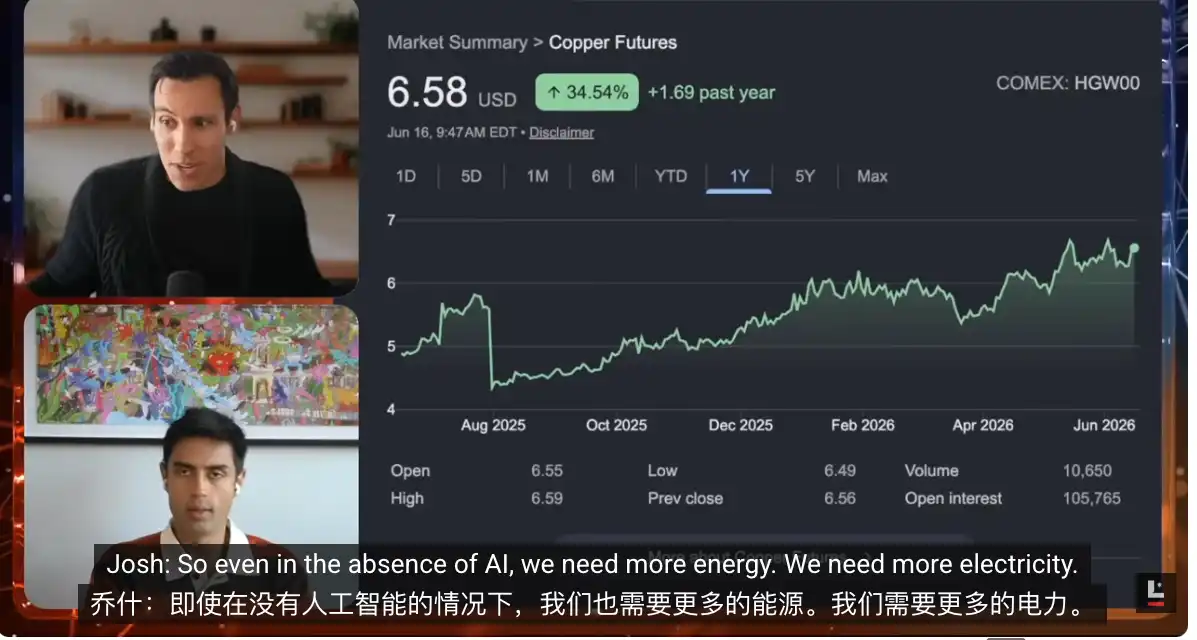
  • "Copper futures have been performing strongly lately, essentially because everyone needs it. It's the most critical foundational material for short-distance, high-bandwidth transmission, and fiber optics is the next step."
  • "Copper remains the most critical material for short-distance, high-bandwidth transmission, but once distances lengthen and heat becomes too high, a switch to fiber optics is mandatory."
  • "The next wave of money will land on those infrastructure companies that don't sound particularly sexy."

Why Energy is the Safest Bet

  • "I've always been bullish on energy because even if AI demand slows, energy itself remains a global necessity, and this demand will only increase."
  • "The single trend that will continue to rise regardless of the scenario is our demand for energy, electricity, and power. These are the companies I'm most willing to go long on."
  • "The companies I most want to follow are those that Jensen is investing in and that also intersect with Leopold's logic. So the stock I'm closest to following right now is Marvell."
  • "The best long-term positions aren't necessarily the hottest chip companies, but the power infrastructure companies that are unavoidable under any macro scenario."

Leopold's AI Investment Portfolio

Josh Kale:

Leopold Aschenbrenner, this 24-year-old specializing in AI investments, is now almost regarded by the market as the world's strongest AI investor. Rumors suggest his fund's nominal position size now exceeds $20 billion. When we looked at Ejaaz's post a month ago, the fund size was only $13.7 billion, essentially doubling every quarter.

This time we've obtained several significant new changes in his recent investment moves. Last episode we discussed his portfolio, and the most surprising point then was that he was actually shorting a company almost everyone knows: NVIDIA, the world's highest market cap, hottest AI stock. Many couldn't understand why he established a short position exceeding $9 billion against such a company.

Now we have a new clue that might explain this. NVIDIA is actually raising capital, and through debt issuance. On the surface, this seems illogical. Why would a company as massive and highly profitable as NVIDIA need an additional $25 billion in cash it just completed raising? Today, we want to discuss, in conjunction with Leopold's portfolio, why he's making so much money, what he's looking at next, and what NVIDIA's financing really means.

Ejaaz Ahamadeen:

First, some background. Leopold Aschenbrenner was a former OpenAI researcher who raised a fund about a year and a half to two years ago. The initial size wasn't large; I recall it was around $200 million. But from his latest 13F, the fund's public holdings are now valued at $13.7 billion.

Naturally, the market wants to know which positions he's holding, what his core investment logic is, and where his next big trade will land. To understand this, we must know that until about a month ago, Leopold was very bullish on the entire AI sector, especially the "selling shovels" logic, meaning GPU and upstream hardware suppliers like NVIDIA.

But about a month ago, the market discovered he wasn't that bullish on the semiconductor line. He's still bullish on real bottleneck areas like memory and power, and probably also on new-style cloud providers, but he's surprisingly not bullish on the world's most valuable company, NVIDIA. More specifically, he has a total bearish position of about $9 billion against companies seen as core AI infrastructure beneficiaries: NVIDIA, ASML, Oracle, and others.

The Logic Behind Shorting NVIDIA

Ejaaz Ahamadeen:

When this came out, many people started worrying, thinking the AI bubble might be about to burst. On the surface, NVIDIA's GPUs are still selling like hotcakes, demand shows no clear sign of weakening, so what's the real issue?

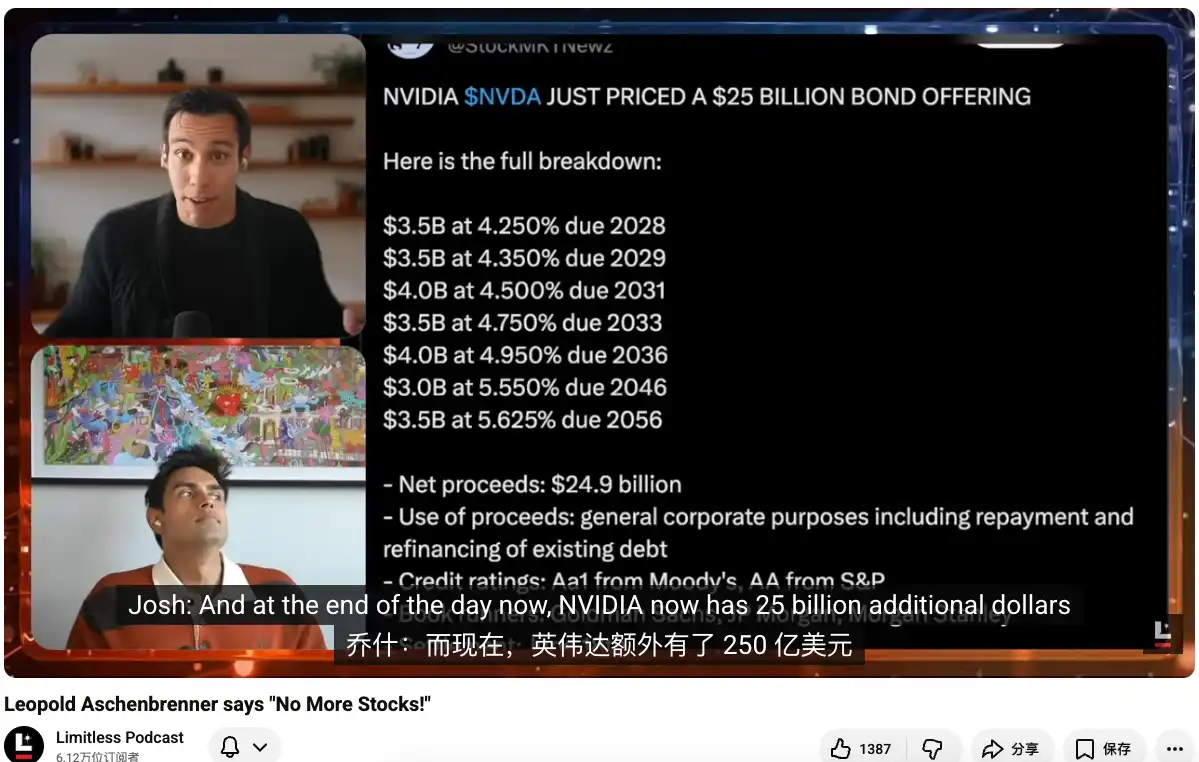
Later, we uncovered several new clues, the most important being that NVIDIA just raised $25 billion externally through a bond offering. This means it's not just using its own cash but adding external leverage. So the question arises: Why would the world's most profitable, highest-margin, strongest-cash-flow company borrow an additional $25 billion from outside?
Josh Kale:

And they initially planned to raise only $20 billion but ended up expanding to $25 billion, with subscriptions over three times oversubscribed. Last episode when discussing this portfolio, we said not to worry about a bubble yet because these companies, despite huge capital expenditures, have high enough revenues to theoretically support expansion with their own balance sheets.

But this is NVIDIA's first significant off-balance-sheet financing since 2021, instead of directly using its cash reserves. I recall it has about $12+ billion in cash on hand. Putting all this together creates a strange tension: on one side, Leopold is shorting, and on the other, NVIDIA appears to have infinite cash and profits yet still issues debt. What's really happening?

Breaking Down NVIDIA's Bond Financing

Josh Kale: Ejaaz, could you break down this deal itself? Because this isn't ordinary financing; it's a bond issuance. Essentially, NVIDIA's balance sheet now has an additional $25 billion, and the interest rates appear to be very low.

Ejaaz Ahamadeen:

I'll present both explanations. NVIDIA originally had about $13.7 billion in cash, meaning it could have simply spent its own money. So why raise external capital? The simplest analogy is buying a house. Many people choose a mortgage even if they have the full amount in cash because they can use their own capital elsewhere, and if the borrowing cost is low enough, it's more economical.

The interest rate environment hasn't been friendly in recent years, but if you're NVIDIA, one of the world's most valuable and sought-after companies, you can borrow under very favorable terms. This $25 billion bond offering has maturities ranging from 2 to 30 years and can be considered very cheap money, with rates close to US Treasury yields.

Moreover, the offering was oversubscribed by about 4 times. In other words, there was $85 billion in market demand for this $25 billion offering. NVIDIA could practically pick its investors. If we look solely at the official explanation, NVIDIA stated it's primarily for financial management, to repay and refinance some existing debt. Google did something very similar weeks ago and also in February this year. So you can certainly accept this explanation as financial optimization.

But another side is hard to ignore: Over the past month and a half, NVIDIA, Amazon, Google, and several other hyperscale cloud providers have all been adding external financing. Some through debt, others through equity sales. Leopold's view might not be entirely baseless. Could this be a sign of the bubble starting to soften, the house of cards beginning to wobble? However, if you look solely at the financial structure, it doesn't clearly point to danger yet.

Josh Kale:

I see it similarly. Shorting NVIDIA with $9 billion is a massive position. But during our research, we noticed something else: on May 18, NVIDIA's board authorized an additional $80 billion in share buybacks and increased the dividend from $0.01 to $0.25 per share, a 25x increase.

If a company simultaneously conducts massive stock buybacks and drastically increases dividends in the same month while also borrowing money, it's clearly not borrowing because it needs cash. A more reasonable explanation is that it's cheap capital, and the financing model for this AI rally is undergoing a subtle shift. Everyone wants to participate in these capital operations, and NVIDIA also realizes that raising debt is even cheaper than other financing methods, so they simply did it. At least for now, NVIDIA itself is still doing very well.

Why He Adjusted His Portfolio

Josh Kale: This leads back to another question. What exactly is Leopold thinking? Why has his judgment changed? The stock chart you showed earlier also indicates NVIDIA's recent performance hasn't been particularly strong, but it's not terrible either. It's still the world's largest company nearing a $5 trillion market cap, down only about 7% in a month, which is nothing amid the surge in other AI stocks.
Ejaaz Ahamadeen:

I don't think NVIDIA will disappear. Its GPUs, including the CPU product line launched weeks ago, I believe will perform very well. AI product demand is currently exponentially oversupplied, and the primary machine supplier capable of meeting this demand is still mainly NVIDIA.

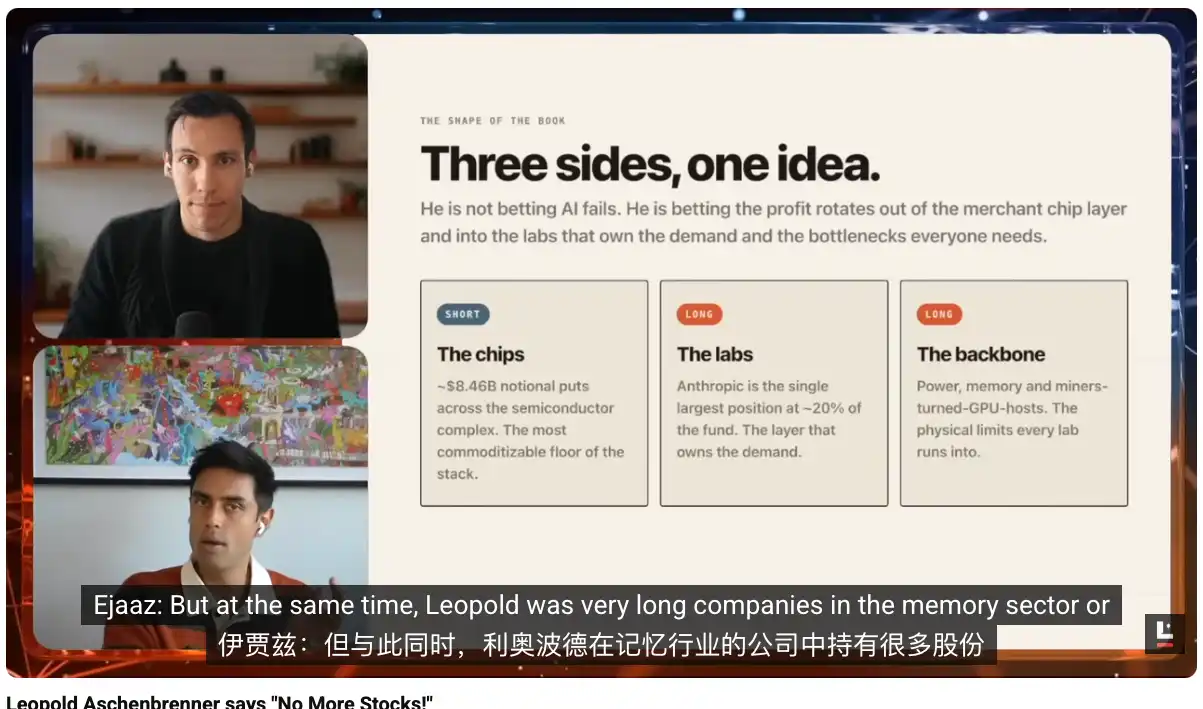
But I do believe the classic 'selling shovels' trade in AI has become too crowded, and Leopold's recent position changes signal exactly that. Looking at his recent 13F, his bearish positions are clearly skewed against the semiconductor line, like NVIDIA, ASML, Oracle, and other infrastructure-level companies.

Yet simultaneously, he holds heavy positions in memory, power, and new-style cloud directions. This indicates his judgment isn't that AI infrastructure has peaked, but that certain layers within the infrastructure stack, especially semiconductors and traditional hot stocks, have become overly crowded.

If the question becomes where the money will flow next, there are two answers. The first is most direct: flowing to the next real infrastructure bottlenecks: power, memory, data center networking. The second answer is that mysterious investment exposed just weeks ago.

The Unexpectedly Exposed Anthropic Position

Josh Kale:

This is what surprised me the most. I only learned about it from you yesterday, and my first reaction was disbelief. Could it be that Leopold's fund, 'Situational Awareness,' actually has 20% allocated to Anthropic equity? Current rumors suggest this company accounts for about one-fifth of Leopold's fund. The Wall Street Journal and several other media outlets report this, and sources very close to the transaction have confirmed it.

This became a completely unexpected card in his portfolio. Because 13F only discloses public market holdings, not private equity, and Anthropic is precisely a large chunk of non-public equity. This is also why people started understanding why outsiders estimate his portfolio valuation at $20 billion.
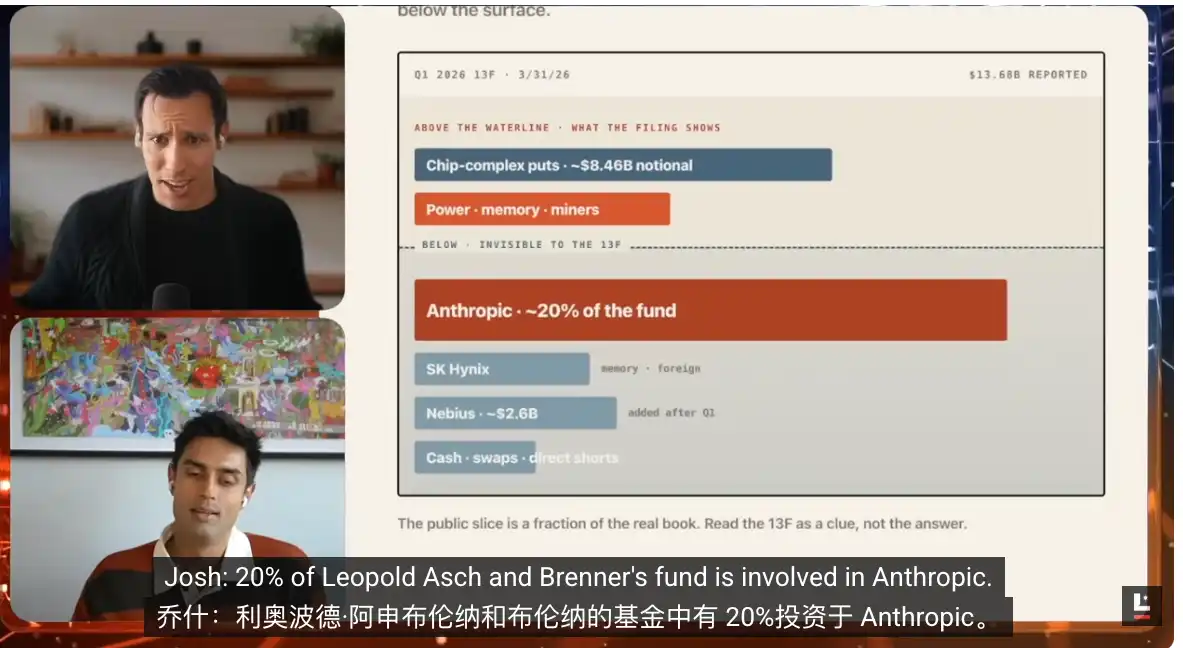
If 20% of the fund is in Anthropic, and he likely invested in early 2025, the return on Anthropic over that year has felt like seven years. This change significantly revises our understanding of his entire investment portfolio.

Ejaaz Ahamadeen:

Yes. His initial investment in Anthropic via private channels or the fund was around March 2025, when Anthropic was valued at about $60 billion. Now, according to the latest valuation round, it's been priced at $96.5 billion.

That's nearly a 15x gain. Using the calculation shown in today's episode, his latest 13F disclosed liquid portfolio value is $13.7 billion. If we add the Anthropic portion reported by the Wall Street Journal, roughly an additional $7 billion, the total fund management size reaches $20 billion.

How exaggerated is this? Bill Ackman, a top investor with three to four decades in the market, his Pershing Capital is also around $20 billion. Leopold has been in this game for only a year and a half, he's 24 years old, and has virtually no real investment experience to speak of.

Yet he's made some astonishingly accurate calls. The crazy part is he wrote it all down in advance. When he launched the fund a year and a half ago, he published a 65-page AI essay, 'Situational Awareness,' almost completely laying out the entire logic, including how capital would rotate from semiconductors and certain infrastructure layers to other bottleneck constraints. The market is now playing out along this line. It's truly remarkable.

The Next Wave of Infrastructure Rally

Ejaaz Ahamadeen:

So this also tells me where the next money will flow. If he's cautious on NVIDIA, then money will go to power, memory, and such places; meanwhile, he also wants to invest directly in the 'mine' itself, rather than just buying more 'shovels.' Anthropic is his most favored 'mine.'

Josh Kale:

This indeed looks like a new trend, and again, he's ahead of the curve. Over the past 12 months, everyone has been searching for AI's bottlenecks: rare earth metals, memory, RAM, etc., the market chased all these themes. Those judgments weren't wrong because that wave did happen.

But now, valuations for areas seen as bottlenecks are gradually rationalizing. The market has a better understanding of these companies' business models, market sizes, and future revenues, so much of the value is already priced in. In the next round, we're more concerned about where the subsequent money will continue to flow.

The direction you mentioned—land, power, server racks, physical infrastructure—seems correct. Because if we think about what's truly most important for AI, the answer increasingly seems to be physical construction capability. Look at xAI, or more accurately, SpaceX, which is now public. Its core revenue isn't rockets themselves but AI infrastructure construction.
Look at its recent deals with Anthropic and Google; the value brought surpasses the sum of Starlink, Starship, and the entire satellite business. There's clearly immense demand and value here. So the question becomes, who can actually build these things?

SpaceX is clearly one answer. Last night after-hours, its stock price reached $230, corresponding to roughly a $3.1 trillion valuation. We'll do a dedicated episode on SpaceX this week because its recent move is insane. It just completed the acquisition of Cursor, now valued at $3 trillion. Elon Musk earned more in a single day than Warren Buffett did in his entire career.

Who Will Capture the Next Round of Dividends

Josh Kale: Our concern is which companies are best at this hardware infrastructure, at developing 'machines that make machines.' Combining Leopold's direction with the broader trend, we think money will flow here next. So Ejaaz, in reality, which companies will this rotation land on?

Ejaaz Ahamadeen:

Many will be those infrastructure companies that don't sound particularly sexy. A name frequently mentioned recently is Marvell. Weeks ago at the Computex conference in Taiwan, Jensen Huang directly stated on stage that this would be the next trillion-dollar company.

And just three months before he made that statement, NVIDIA had invested $1.5 billion in Marvell. I'm starting to lose track of whether this counts as insider trading or market manipulation because after he said that, the stock rose another 70%.

I think it's easy now to directly conclude that AI infrastructure has peaked. But if you compare it to historical financial crises, like 2008, that smell of high leverage, financial engineering, and systemic manipulation hasn't fully appeared this round.

Two key differences exist. First, the products these companies make today are truly being bought by someone. Neither the dot-com bubble nor the financial crisis had such solid real demand. Second, constrained by physical laws, we can't infinitely add leverage now because the entire system is bottlenecked by human labor and construction capacity.

You can't build data centers fast enough, expand memory chip capacity sufficiently, or instantly scale up power grids and related infrastructure, no matter how much money you raise. There aren't enough people on the ground, and regulations, approvals, and procedures are hindering progress.

So I actually think this gives investors an advantage. Since you already know the hottest chip and shovel-selling trades are too crowded, then money will next flow to power, data networking (companies like Astera Labs), and other related areas. What you really need to think about is when these contracts will materialize, when these fabs will actually be built, when SpaceX rockets will launch AI satellites, even when we can start using solar power to train AI models.

The timeline determines the betting rhythm. At least that's the framework I'm using for my own investments (not investment advice). I see it this way because over the past year and a half, we've witnessed how money flowed from broad AI stocks to semiconductor and infrastructure trades.

Josh Kale:

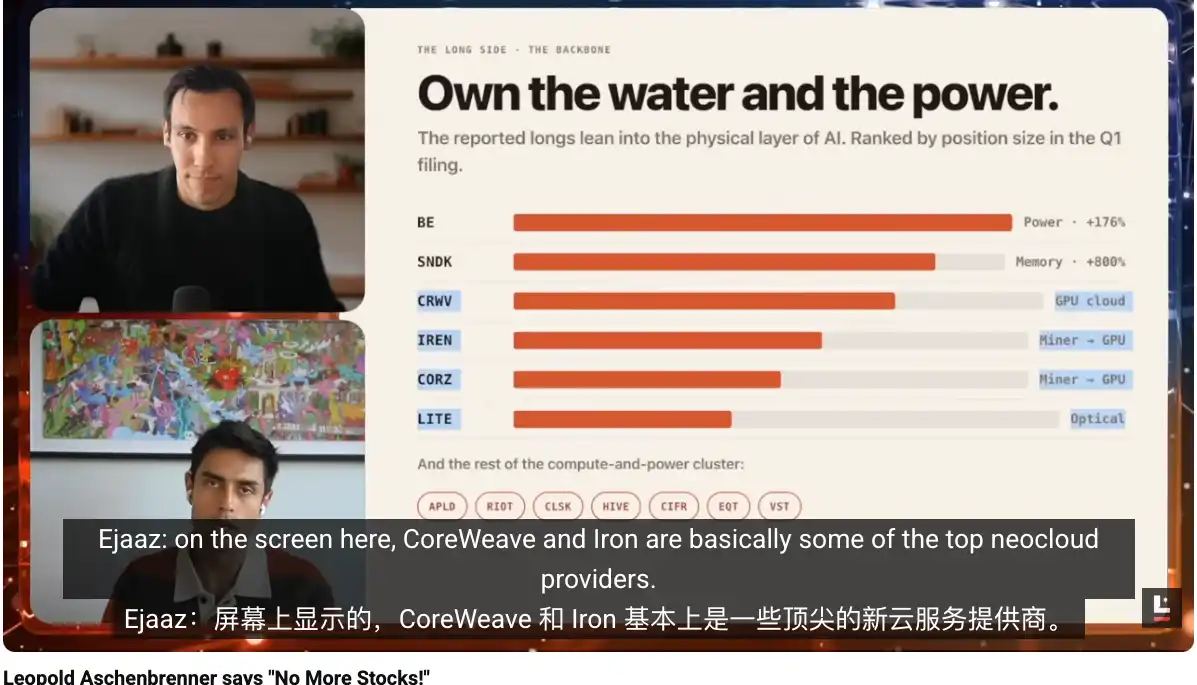
If you continue looking at this portfolio chart, you'll see this story is clearly written into his holding structure. By category, what's his largest allocation? Power and energy. Followed by memory, then cloud and GPU miners—the most tangible infrastructure.

He wants to hold new-style cloud providers like CoreWeave and also those miners who've pivoted to cloud compute. What he wants to own is this physical infrastructure because he believes this is the real bottleneck. As you mentioned, there are many finer details, like actual construction, hardware manufacturing, and data center building itself, all extremely difficult.

If we ask where the biggest bottleneck is, even permitting and approvals might be part of it. Who's solving these problems? SpaceX wants to move data centers to space; Tesla wants to use humanoid robots to solve labor issues. But both are far off. In the short to medium term, there are vast white-space opportunities, and this is precisely what Leopold is betting on.

The Advantages of Optical Modules and Fiber Optics

Josh Kale: I also want to add a detail we didn't elaborate on before. For those who want to dig deeper and find more alpha, many of his clues lie within optics and lower-level tech stacks. Ejaaz, you've been researching this lately; could you explain his thinking?

Ejaaz Ahamadeen:

If you look at the positions on his screen, CoreWeave and Iron are essentially top-tier new-style cloud service providers. Simply put, they're somewhat like Amazon Web Services, but AWS provides cloud services to internet companies, whereas these companies provide ready-made GPU infrastructure to AI companies.

They handle setting up GPUs, networking, deployment, so AI companies don't need to worry about underlying infrastructure and can directly train models and access compute. CoreWeave and Iron have been among his largest concentrated positions since he established them and have delivered the highest returns.

Notably, he still holds these two companies as major positions today. This also indicates another point: in his view, this trade is far from over. Furthermore, he privately invested in Core Scientific, a company that can help unlock CoreWeave's infrastructure supply capacity. In a sense, he added another layer of leverage to CoreWeave.

Beyond these, look at companies like Coherent and Lumentum; they are essentially fiber optic and optical connectivity suppliers. To explain in the simplest terms, semiconductors and GPUs need to communicate with each other. Traditionally, this relied heavily on copper wires. The problem is, as GPU scales grow larger, copper wires get hotter, energy loss increases, and efficiency deteriorates significantly. Fiber optics become the next upgrade direction in this scenario. It enables faster data transmission, higher cost efficiency, and allows companies providing inference and training compute to earn more. So you'll notice he's always betting on highly infrastructure-oriented things, investing in both these optical companies and power-related companies. It might not sound sexy, but in my view, this is where money is genuinely flowing now.

Josh Kale:

The copper aspect is also interesting to me because I recently realized how crucial it is for short-distance data transmission. In many high-bandwidth, short-distance transmission scenarios, copper is almost the only material everyone truly wants to use. Only when it becomes unsuitable, like when distances are too long or heat is too high, do you switch to fiber optics. So market demand for a copper-fiber combination is very strong right now, which is why observing the copper trade is interesting. Copper futures have been performing strongly lately, essentially because everyone needs it. It's the most critical foundational material for short-distance, high-bandwidth transmission, and fiber optics is the next step.

Thinking at an even more fundamental level, the materials theme has always been interesting. The most foundational layer beneath all layers is essentially what raw materials are most core for achieving intelligence. Copper is one, lithium is another, and many more. We really should do a dedicated episode on materials. Perhaps Leopold hasn't reached that layer yet, and we might spot the next rotation first.

Josh Kale:

If we go all the way down the stack, we could even look at copper mines to see how these things are made. But returning to the core judgment, I believe the next rotation indeed shifts from what seem like smaller bottlenecks to the truly hard things: hardware and large-scale data center construction.

Whoever can build data centers will take the profits. We've already seen how much money SpaceX makes due to massive data center demand. Whoever can deploy more data centers faster, provide sufficient power and GPUs, will earn the most money. This is essentially what Leopold is betting on now.

Is a Bubble Emerging?

Josh Kale: The summary is we don't think we've entered the bubble-bursting phase yet. Leopold's positions resemble rotation more than a full-scale retreat. So, should we still follow his lead?

Ejaaz Ahamadeen:

I admit, when I first saw his 13F, my initial reaction was disbelief that this guy was shorting the world's most valuable company with demand booked until 2029. But now, seeing this financing, I'm starting to think if NVIDIA continues adding external debt, or possibly even sells equity in the future, if this trend persists, then Leopold might be right again.

If that's the case, his fund could eventually surpass the world's top traders and best investment funds. He's been winning consistently; it's hard not to be impressed.

Josh Kale:

However, another important point: his life experience has almost always been about going long; he's never truly been tested by a large-scale sell-off. We mentioned Bill Ackman earlier; achieving 30x returns and surviving 30 years in the market are two different things.

If he can sustain this growth and also learn when to hit the sell button, manage risk, use hedging to protect himself, that would be even more formidable. We're already seeing glimpses of this capability. That $9 billion short position isn't $9 billion in cash directly shorting; it's achieved through options and leverage, not a one-to-one naked short. Regardless, this is very worth observing.

Energy is the Core Bet

Josh Kale: If you had to pick one stock from his entire portfolio you'd most want to buy, which would it be?

My own answer is energy stocks. I've always been bullish on energy because even if AI demand slows, energy itself remains a global necessity, and this demand will only increase. Even completely ignoring AI, we need more energy, more electricity. Companies like Bloom Energy, which can enhance power supply and delivery, excite me most because they're the most hedge-like bets. The single trend that will continue to rise regardless of the scenario is our demand for energy, electricity, and power. These are the companies I'm most willing to go long on.

Ejaaz Ahamadeen:

My answer is a bit of a cheat. The companies I most want to follow are those that Jensen is investing in and that also intersect with Leopold's logic. The stock I'm closest to following right now is Marvell. It's not a publicly disclosed holding of Leopold's, but it aligns very well with his bets on fiber optics and power, and Jensen has already invested $1.5 billion in it.
I've observed a phenomenon: whenever Jensen invests in a company through NVIDIA, whether it's Intel, CoreWeave, or others, they've basically kept rising afterward. So my current position is roughly here. I also hold some CoreWeave myself because both Jensen and Leopold are extremely bullish on it.

Josh Kale:

Marvell is up 270% over the past 6 months. This might truly be a good rule of thumb: when influential people like Jensen, or even figures with massive influence like Trump, publicly say to buy a certain stock, often you should really take a serious look.

History has repeatedly proven that such signals often have significant realization potential. Whether Intel or Marvell, these cases show that, on one hand, they indeed understand what they're talking about, and on the other, they have the ability to influence these companies' outcomes. So this rally has been truly insane.

I hope it continues. From the current perspective, it likely will. At least we're still leaning bullish, still optimistic, and will continue making judgments daily as things evolve.

Josh Kale: Any final thoughts you'd like to add regarding the update on Leopold's investment portfolio?

Ejaaz Ahamadeen:

I'd actually like to hear from those who are skeptical. If after listening to our analysis, you think we're completely wrong or have misunderstood something, please point it out directly.

Yesterday, I stared at NVIDIA's $25 billion financing news for a long time, initially looking to criticize it. But if we look solely at the financial logic, it does make sense. Why not borrow this almost risk-free cheap money? Using others' money for expansion is clearly more rational than selling your own equity because you retain more future profits.


Cryptos en tendance

Questions liées

QWhat is the core trading logic behind Leopold Aschenbrenner's recent portfolio shift, particularly his large short position on NVIDIA?

ALeopold's logic is that the classic 'shovel-selling' AI infrastructure trade, particularly in crowded areas like semiconductors (e.g., NVIDIA, ASML), is becoming overvalued and congested. He is not calling a top for AI infrastructure overall, but believes capital is rotating from these hot sectors towards the next true bottlenecks: power, memory, and data center networking. He also seeks direct exposure to the 'ore' itself (like Anthropic) rather than just the 'shovels.'

QWhat signal might NVIDIA's recent $25 billion bond issuance be sending, according to the discussion?

AThe fact that NVIDIA, a highly profitable company with massive cash reserves, is raising significant external debt suggests a potential shift in the AI funding cycle. The hosts argue it likely represents NVIDIA securing very cheap capital to fund growth, but its occurrence alongside massive stock buybacks and dividend increases raises questions. It could be a sign of financial engineering becoming more prominent, which might support Leopold's cautious stance, though it doesn't necessarily indicate immediate financial distress for NVIDIA.

QAccording to the article, what are considered the next major bottlenecks and investment opportunities in the AI infrastructure stack?

AThe next wave of bottlenecks and opportunities is seen in physical, ground-level infrastructure constraints. Key areas include: 1) Power/Energy generation and distribution, 2) Memory chip supply, 3) Data center construction and networking (especially fiber optics for longer distances/high heat, while copper remains crucial for short-range), and 4) The actual capability to build and deploy data centers at scale, which is limited by manpower, permits, and construction logistics.

QWhat is the significance of Leopold Aschenbrenner's reported ~20% investment in Anthropic?

AThis private investment in Anthropic, not visible in public 13F filings, significantly recontextualizes his portfolio. It shows he is not just betting on AI infrastructure ('shovels') but is also taking a massive, direct position in a leading AI model company ('the ore'). The investment, made around early 2025, has reportedly seen enormous appreciation, contributing heavily to the estimated growth of his fund's total assets under management to around $20 billion and demonstrating his conviction in owning foundational AI assets.

QWhy do the hosts view investments in the energy/power sector as particularly compelling within the AI thematic?

AEnergy is viewed as a core, resilient, and non-cyclical bet within the AI boom. Even if AI-specific demand were to slow, the global demand for electricity and power is a secular, one-way trend that is only increasing. Companies that enhance power generation, distribution, and efficiency (like Bloom Energy) are seen as excellent long-term holdings that benefit from the AI boom but are also insulated from it, acting as a form of hedge while capturing a fundamental growth trend.

Lectures associées

Nouveau Feu Research Institute : La zone des 60 000 dollars pour le BTC voit des achats massifs à bas prix, une vague de transferts de propriété s'empare de la « zone à fort rapport qualité-prix »

Cette semaine, le Bitcoin a réalisé un rebond après une survente importante, avec une panique extrême sur le marché des crypto-monnaies qui s’atténue. Plusieurs indicateurs montrent des signes significatifs de formation d’un plancher. Les sorties nettes des ETF spot Bitcoin se réduisent, et l’écart de prix négatif entre Coinbase et l’USDT se résorbe. Le coût d’extinction des principaux mineurs se situe entre 30 000 et 50 000 dollars, renforçant potentiellement un seuil de coût sectoriel, un signal classique de retournement de marché. Sur le terrain, les capitaux institutionnels affichent une tendance à se positionner à contre-courant. Par exemple, le groupe Xinhuo a vu le volume hebdomadaire de ses transactions de gré à gré (OTC) multiplié par plus de 8, avec un nombre d’utilisateurs actifs doublé, reflétant une forte activité d’entrées de fonds importantes. Des données on-chain révèlent que certaines entités institutionnelles, y compris des fonds associés à des sociétés cotées et des « baleines » anciennes, achètent activement autour du niveau clé de 60 000 dollars. Le Xinhuo Research Institute souligne depuis la mi-mai une fenêtre d’opportunité d’achat à « bon rapport qualité-prix », confirmant une transition des jetons de la vente panique vers la détention à long terme. Pour la suite, la libération de liquidités et les évolutions macro-politiques devraient être les principaux moteurs d’une reprise. Le succès de l’introduction en bourse de SpaceX a regonflé l’optimisme, et les liquidités immobilisées lors de cette opération sont en train d’être libérées, susceptibles de se diriger vers des actifs sous-évalués comme le Bitcoin. Sur le plan macro, le discours de Kevin Warsh lors de la réunion du FOMC le 18 sera crucial pour les anticipations de politique monétaire. De plus, l’adoption éventuelle du « CLARITY Act » d’ici fin juillet pourrait renforcer la confiance institutionnelle. Combinant ces facteurs favorables avec les caractéristiques de plancher, le Xinhuo Research Institute maintient une perspective positive pour le marché.

marsbitIl y a 2 mins

Nouveau Feu Research Institute : La zone des 60 000 dollars pour le BTC voit des achats massifs à bas prix, une vague de transferts de propriété s'empare de la « zone à fort rapport qualité-prix »

marsbitIl y a 2 mins

Démystifier le "Dieu de la recherche et de l'investissement" derrière Citrini : N°1 chronique sur Substack, un rapport fait évaporer des centaines de milliards sur le marché boursier américain

**Décryptage de Citrini : Comment un rapport de recherche a fait perdre des milliers de milliards de dollars au marché boursier américain** Citrini Research, un organisme indépendant de recherche en investissement mené par James van Geelen, domine régulièrement le classement financier de Substack. En février, son rapport "The 2028 Global Intelligence Crisis", présenté comme une expérience de pensée sur les risques de l'IA, a déclenché une vague de panique. Il a entraîné des ventes massives d'actions technologiques (logiciels, paiements, livraison), provoquant une chute brutale des indices et une évaporation de plusieurs milliards de dollars de capitalisation boursière en une journée. Le fondateur, James van Geelen, est un personnage atypique. Titulaire de doubles diplômes en biologie et psychologie de l'UCLA, ancien ambulancier et entrepreneur dans la santé, il a fondé Citrini en 2023. Son style d'investissement repose sur la "pensée du second ordre", se concentrant sur les effets indirects et les tendances de long terme comme l'IA, la géopolitique ou l'énergie. Citrini produit des analyses narratives et utilise des scénarios hypothétiques pour anticiper les changements structurels. Outre le rapport sur l'IA, Citrini s'est fait remarquer pour ses analyses précises, comme celle sur le rôle du cuivre dans l'industrie des semi-conducteurs, ou un rapport de terrain sur la situation géopolitique dans le détroit d'Ormuz. L'organisation, qui a levé 5 millions de dollars en financement, fonctionne avec une petite équipe d'une dizaine de personnes et un réseau d'analystes spécialisés. Son influence démontre le pouvoir croissant des chercheurs indépendants pour façonner les discours et mouvements des marchés financiers.

marsbitIl y a 4 mins

Démystifier le "Dieu de la recherche et de l'investissement" derrière Citrini : N°1 chronique sur Substack, un rapport fait évaporer des centaines de milliards sur le marché boursier américain

marsbitIl y a 4 mins

Rétrospective du premier trimestre 2026 d'Ethereum : L'activité sur la chaîne atteint un record, les actifs tokenisés en tête de l'industrie

L'activité sur Ethereum au premier trimestre 2026 présente un tableau contrasté. D'un côté, l'utilisation du réseau a atteint des sommets historiques : les adresses actives mensuelles (13,2 millions, +85,9% en un an) et le nombre total de transactions sur la couche 1 (200,4 millions, +81,5%) ont explosé, tirées par les bénéfices de l'élargissement du réseau (mise à niveau Blob). Le débit (TPS) a également augmenté pour atteindre 25,78. Paradoxalement, les frais de transaction sur la couche 1 se sont effondrés de 47,9% en glissement trimestriel, en raison d'une capacité de bloc accrue. D'un autre côté, les indicateurs en valeur dollar ont reculé, en phase avec un marché baissier : la valorisation diluée totale de l'ETH a chuté de 30,3%, entraînant la valeur totale verrouillée (TVL) de l'écosystème à 3162 milliards de dollars (-11%). Le volume des échanges décentralisés (1345 milliards de dollars) et les revenus totaux des frais d'application (20 milliards de dollars) ont également diminué. Le secteur des actifs tokenisés sur Ethereum confirme sa domination, avec une capitalisation totale de 2034 milliards de dollars (+42,9% sur un an). Les stablecoins (1789 milliards) restent largement majoritaires. Les fonds tokenisés (194 milliards, +73,1%) et les matières premières tokenisées (47 milliards, +325,9%) sont les catégories à la croissance la plus rapide, Ethereum détenant respectivement 73% et 84% des parts de marché sur les cinq principales blockchains. La part des actifs verrouillés en garantie (staking ratio) a progressé à 0,31, et le nombre de détenteurs d'ETH a continué d'augmenter, signe d'une adoption résiliente. Le rapport souligne qu'Ethereum sacrifie délibérément les revenus à court terme des frais pour stimuler l'adoption à long terme via un élargissement du réseau, une stratégie comparée au développement précoce d'Internet. Sa position de plateforme neutre et dominante pour le règlement des actifs tokenisés (prêts DeFi, stablecoins, fonds) en fait le choix privilégié pour les institutions financières traditionnelles, comme en témoignent les récentes initiatives de BlackRock, JPMorgan et d'un consortium de banques européennes.

Foresight NewsIl y a 5 mins

Rétrospective du premier trimestre 2026 d'Ethereum : L'activité sur la chaîne atteint un record, les actifs tokenisés en tête de l'industrie

Foresight NewsIl y a 5 mins

Démystification du "Dieu de la Recherche Investissement" derrière Citrini : Toujours en tête du classement Substack, un rapport fait perdre des centaines de milliards aux actions américaines

Révélation de la force derrière Citrini : James van Geelen, le « dieu de la recherche » qui a fait trembler Wall Street L’institution de recherche indépendante Citrini, leader sur Substack avec près de 250 000 abonnés, est dirigée par James van Geelen. Diplômé en biologie et psychologie (UCLA) et ancien secouriste, ce fondateur au parcours atypique a fondé Citrini Research en 2023. Citrini s’est fait connaître par ses analyses aux impacts retentissants. En février, son rapport « The 2028 Global Intelligence Crisis », une expérience de pensée sur les risques de l’IA, a provoqué une vente panique des actions technologiques, effaçant des centaines de milliards de dollars de valorisation boursière. En avril, un analyste s’est rendu dans le détroit d’Hormuz pour un rapport terrain contredisant plusieurs récits médiatiques. La méthode Citrini repose sur la « pensée du second ordre » : anticiper les conséquences indirectes des événements. Geelen explique : « La plupart des investisseurs regardent la balle, moi je regarde où elle va rebondir. » L’approche est narrative, basée sur des scénarios et les méga-tendances (IA, géopolitique, énergie). Le nom « Citrini » s’inspire d’une phase alchimique où le plomb commence à se transformer en or, symbolisant la détection précoce des opportunités. Avec un petit effectif et un modèle collaboratif, Citrini propose des idées d’investissement tactiques et un portefeuille modèle performant. Son influence illustre le pouvoir croissant des chercheurs indépendants dans le paysage financier.

Odaily星球日报Il y a 14 mins

Démystification du "Dieu de la Recherche Investissement" derrière Citrini : Toujours en tête du classement Substack, un rapport fait perdre des centaines de milliards aux actions américaines

Odaily星球日报Il y a 14 mins

Trading

Spot
Futures

Articles tendance

Qu'est ce que GROK AI

Grok AI : Révolutionner la technologie conversationnelle à l'ère du Web3 Introduction Dans le paysage en évolution rapide de l'intelligence artificielle, Grok AI se distingue comme un projet remarquable qui fait le lien entre les domaines de la technologie avancée et de l'interaction utilisateur. Développé par xAI, une entreprise dirigée par l'entrepreneur renommé Elon Musk, Grok AI cherche à redéfinir notre engagement avec l'intelligence artificielle. Alors que le mouvement Web3 continue de prospérer, Grok AI vise à tirer parti de la puissance de l'IA conversationnelle pour répondre à des requêtes complexes, offrant aux utilisateurs une expérience à la fois informative et divertissante. Qu'est-ce que Grok AI ? Grok AI est un chatbot IA conversationnel sophistiqué conçu pour interagir dynamiquement avec les utilisateurs. Contrairement à de nombreux systèmes d'IA traditionnels, Grok AI embrasse une gamme plus large de questions, y compris celles généralement jugées inappropriées ou en dehors des réponses standard. Les objectifs principaux du projet incluent : Raisonnement fiable : Grok AI met l'accent sur le raisonnement de bon sens pour fournir des réponses logiques basées sur une compréhension contextuelle. Surveillance évolutive : L'intégration de l'assistance par outils garantit que les interactions des utilisateurs sont à la fois surveillées et optimisées pour la qualité. Vérification formelle : La sécurité est primordiale ; Grok AI intègre des méthodes de vérification formelle pour améliorer la fiabilité de ses résultats. Compréhension à long terme : Le modèle IA excelle dans la rétention et le rappel d'une vaste histoire de conversation, facilitant des discussions significatives et conscientes du contexte. Robustesse face aux adversaires : En se concentrant sur l'amélioration de ses défenses contre les entrées manipulées ou malveillantes, Grok AI vise à maintenir l'intégrité des interactions des utilisateurs. En essence, Grok AI n'est pas seulement un dispositif de récupération d'informations ; c'est un partenaire conversationnel immersif qui encourage un dialogue dynamique. Créateur de Grok AI Le cerveau derrière Grok AI n'est autre qu'Elon Musk, une personne synonyme d'innovation dans divers domaines, y compris l'automobile, le voyage spatial et la technologie. Sous l'égide de xAI, une entreprise axée sur l'avancement de la technologie IA de manière bénéfique, la vision de Musk vise à remodeler la compréhension des interactions avec l'IA. Le leadership et l'éthique fondatrice sont profondément influencés par l'engagement de Musk à repousser les limites technologiques. Investisseurs de Grok AI Bien que les détails spécifiques concernant les investisseurs soutenant Grok AI restent limités, il est publiquement reconnu que xAI, l'incubateur du projet, est fondé et soutenu principalement par Elon Musk lui-même. Les précédentes entreprises et participations de Musk fournissent un soutien solide, renforçant encore la crédibilité et le potentiel de croissance de Grok AI. Cependant, à l'heure actuelle, les informations concernant d'autres fondations d'investissement ou organisations soutenant Grok AI ne sont pas facilement accessibles, marquant un domaine à explorer potentiellement à l'avenir. Comment fonctionne Grok AI ? Les mécanismes opérationnels de Grok AI sont aussi innovants que son cadre conceptuel. Le projet intègre plusieurs technologies de pointe qui facilitent ses fonctionnalités uniques : Infrastructure robuste : Grok AI est construit en utilisant Kubernetes pour l'orchestration de conteneurs, Rust pour la performance et la sécurité, et JAX pour le calcul numérique haute performance. Ce trio garantit que le chatbot fonctionne efficacement, évolue efficacement et sert les utilisateurs rapidement. Accès aux connaissances en temps réel : L'une des caractéristiques distinctives de Grok AI est sa capacité à puiser dans des données en temps réel via la plateforme X—anciennement connue sous le nom de Twitter. Cette capacité permet à l'IA d'accéder aux dernières informations, lui permettant de fournir des réponses et des recommandations opportunes que d'autres modèles d'IA pourraient manquer. Deux modes d'interaction : Grok AI offre aux utilisateurs un choix entre le « Mode Amusant » et le « Mode Régulier ». Le Mode Amusant permet un style d'interaction plus ludique et humoristique, tandis que le Mode Régulier se concentre sur la fourniture de réponses précises et exactes. Cette polyvalence garantit une expérience sur mesure qui répond à diverses préférences des utilisateurs. En essence, Grok AI marie performance et engagement, créant une expérience à la fois enrichissante et divertissante. Chronologie de Grok AI Le parcours de Grok AI est marqué par des jalons clés qui reflètent ses étapes de développement et de déploiement : Développement initial : La phase fondamentale de Grok AI a eu lieu sur une période d'environ deux mois, au cours de laquelle l'entraînement initial et le réglage du modèle ont été réalisés. Lancement de la version bêta de Grok-2 : Dans une avancée significative, la bêta de Grok-2 a été annoncée. Ce lancement a introduit deux versions du chatbot—Grok-2 et Grok-2 mini—chacune équipée des capacités de discussion, de codage et de raisonnement. Accès public : Après son développement bêta, Grok AI est devenu accessible aux utilisateurs de la plateforme X. Ceux ayant des comptes vérifiés par un numéro de téléphone et actifs depuis au moins sept jours peuvent accéder à une version limitée, rendant la technologie disponible pour un public plus large. Cette chronologie encapsule la croissance systématique de Grok AI depuis sa création jusqu'à son engagement public, soulignant son engagement envers l'amélioration continue et l'interaction utilisateur. Caractéristiques clés de Grok AI Grok AI englobe plusieurs caractéristiques clés qui contribuent à son identité innovante : Intégration des connaissances en temps réel : L'accès à des informations actuelles et pertinentes différencie Grok AI de nombreux modèles statiques, permettant une expérience utilisateur engageante et précise. Styles d'interaction polyvalents : En offrant des modes d'interaction distincts, Grok AI répond à des préférences variées des utilisateurs, invitant à la créativité et à la personnalisation dans la conversation avec l'IA. Infrastructure technologique avancée : L'utilisation de Kubernetes, Rust et JAX fournit au projet un cadre solide pour garantir fiabilité et performance optimale. Considération du discours éthique : L'inclusion d'une fonction de génération d'images met en avant l'esprit innovant du projet. Cependant, elle soulève également des considérations éthiques concernant le droit d'auteur et la représentation respectueuse de figures reconnaissables—une discussion en cours au sein de la communauté IA. Conclusion En tant qu'entité pionnière dans le domaine de l'IA conversationnelle, Grok AI encapsule le potentiel d'expériences utilisateur transformantes à l'ère numérique. Développé par xAI et guidé par l'approche visionnaire d'Elon Musk, Grok AI intègre des connaissances en temps réel avec des capacités d'interaction avancées. Il s'efforce de repousser les limites de ce que l'intelligence artificielle peut accomplir tout en maintenant un accent sur les considérations éthiques et la sécurité des utilisateurs. Grok AI incarne non seulement l'avancement technologique mais aussi un nouveau paradigme de conversation dans le paysage Web3, promettant d'engager les utilisateurs avec à la fois une connaissance experte et une interaction ludique. Alors que le projet continue d'évoluer, il se dresse comme un témoignage de ce que l'intersection de la technologie, de la créativité et de l'interaction humaine peut accomplir.

505 vues totalesPublié le 2024.12.26Mis à jour le 2024.12.26

Qu'est ce que GROK AI

Qu'est ce que ERC AI

Euruka Tech : Un aperçu de $erc ai et de ses ambitions dans le Web3 Introduction Dans le paysage en évolution rapide de la technologie blockchain et des applications décentralisées, de nouveaux projets émergent fréquemment, chacun avec des objectifs et des méthodologies uniques. L'un de ces projets est Euruka Tech, qui opère dans le vaste domaine des cryptomonnaies et du Web3. L'objectif principal d'Euruka Tech, en particulier de son token $erc ai, est de présenter des solutions innovantes conçues pour exploiter les capacités croissantes de la technologie décentralisée. Cet article vise à fournir un aperçu complet d'Euruka Tech, une exploration de ses objectifs, de sa fonctionnalité, de l'identité de son créateur, de ses investisseurs potentiels et de son importance dans le contexte plus large du Web3. Qu'est-ce qu'Euruka Tech, $erc ai ? Euruka Tech est caractérisé comme un projet qui tire parti des outils et des fonctionnalités offerts par l'environnement Web3, en se concentrant sur l'intégration de l'intelligence artificielle dans ses opérations. Bien que les détails spécifiques sur le cadre du projet soient quelque peu évasifs, il est conçu pour améliorer l'engagement des utilisateurs et automatiser les processus dans l'espace crypto. Le projet vise à créer un écosystème décentralisé qui facilite non seulement les transactions, mais qui intègre également des fonctionnalités prédictives grâce à l'intelligence artificielle, d'où la désignation de son token, $erc ai. L'objectif est de fournir une plateforme intuitive qui facilite des interactions plus intelligentes et un traitement efficace des transactions dans la sphère Web3 en pleine expansion. Qui est le créateur d'Euruka Tech, $erc ai ? À l'heure actuelle, les informations concernant le créateur ou l'équipe fondatrice derrière Euruka Tech restent non spécifiées et quelque peu opaques. Cette absence de données soulève des préoccupations, car la connaissance des antécédents de l'équipe est souvent essentielle pour établir la crédibilité dans le secteur de la blockchain. Par conséquent, nous avons classé cette information comme inconnue jusqu'à ce que des détails concrets soient rendus disponibles dans le domaine public. Qui sont les investisseurs d'Euruka Tech, $erc ai ? De même, l'identification des investisseurs ou des organisations de soutien pour le projet Euruka Tech n'est pas facilement fournie par les recherches disponibles. Un aspect crucial pour les parties prenantes potentielles ou les utilisateurs envisageant de s'engager avec Euruka Tech est l'assurance qui découle de partenariats financiers établis ou du soutien d'entreprises d'investissement réputées. Sans divulgations sur les affiliations d'investissement, il est difficile de tirer des conclusions complètes sur la sécurité financière ou la pérennité du projet. Conformément aux informations trouvées, cette section se trouve également au statut de inconnue. Comment fonctionne Euruka Tech, $erc ai ? Malgré le manque de spécifications techniques détaillées pour Euruka Tech, il est essentiel de considérer ses ambitions innovantes. Le projet cherche à exploiter la puissance de calcul de l'intelligence artificielle pour automatiser et améliorer l'expérience utilisateur dans l'environnement des cryptomonnaies. En intégrant l'IA avec la technologie blockchain, Euruka Tech vise à fournir des fonctionnalités telles que des transactions automatisées, des évaluations de risques et des interfaces utilisateur personnalisées. L'essence innovante d'Euruka Tech réside dans son objectif de créer une connexion fluide entre les utilisateurs et les vastes possibilités offertes par les réseaux décentralisés. Grâce à l'utilisation d'algorithmes d'apprentissage automatique et d'IA, il vise à minimiser les défis rencontrés par les utilisateurs pour la première fois et à rationaliser les expériences transactionnelles dans le cadre du Web3. Cette symbiose entre l'IA et la blockchain souligne l'importance du token $erc ai, agissant comme un pont entre les interfaces utilisateur traditionnelles et les capacités avancées des technologies décentralisées. Chronologie d'Euruka Tech, $erc ai Malheureusement, en raison des informations limitées dont nous disposons concernant Euruka Tech, nous ne sommes pas en mesure de présenter une chronologie détaillée des développements majeurs ou des étapes importantes dans le parcours du projet. Cette chronologie, généralement inestimable pour tracer l'évolution d'un projet et comprendre sa trajectoire de croissance, n'est pas actuellement disponible. À mesure que des informations sur des événements notables, des partenariats ou des ajouts fonctionnels deviennent évidentes, des mises à jour amélioreront sûrement la visibilité d'Euruka Tech dans la sphère crypto. Clarification sur d'autres projets “Eureka” Il est à noter que plusieurs projets et entreprises partagent une nomenclature similaire avec “Eureka”. Des recherches ont identifié des initiatives comme un agent IA de NVIDIA Research, qui se concentre sur l'enseignement de tâches complexes aux robots en utilisant des méthodes génératives, ainsi que Eureka Labs et Eureka AI, qui améliorent l'expérience utilisateur dans l'éducation et l'analyse du service client, respectivement. Cependant, ces projets sont distincts d'Euruka Tech et ne doivent pas être confondus avec ses objectifs ou ses fonctionnalités. Conclusion Euruka Tech, aux côtés de son token $erc ai, représente un acteur prometteur mais actuellement obscur dans le paysage du Web3. Bien que les détails concernant son créateur et ses investisseurs restent non divulgués, l'ambition centrale de combiner l'intelligence artificielle avec la technologie blockchain constitue un point d'intérêt focal. Les approches uniques du projet pour favoriser l'engagement des utilisateurs grâce à une automatisation avancée pourraient le distinguer à mesure que l'écosystème Web3 progresse. Alors que le marché des cryptomonnaies continue d'évoluer, les parties prenantes devraient garder un œil attentif sur les avancées concernant Euruka Tech, car le développement d'innovations documentées, de partenariats ou d'une feuille de route définie pourrait présenter des opportunités significatives dans un avenir proche. En l'état, nous attendons des informations plus substantielles qui pourraient révéler le potentiel d'Euruka Tech et sa position dans le paysage concurrentiel des cryptomonnaies.

528 vues totalesPublié le 2025.01.02Mis à jour le 2025.01.02

Qu'est ce que ERC AI

Qu'est ce que DUOLINGO AI

DUOLINGO AI : Intégration de l'apprentissage des langues avec l'innovation Web3 et IA À une époque où la technologie redéfinit l'éducation, l'intégration de l'intelligence artificielle (IA) et des réseaux blockchain annonce une nouvelle frontière pour l'apprentissage des langues. Entrez dans DUOLINGO AI et sa cryptomonnaie associée, $DUOLINGO AI. Ce projet aspire à fusionner la puissance éducative des principales plateformes d'apprentissage des langues avec les avantages de la technologie décentralisée Web3. Cet article explore les aspects clés de DUOLINGO AI, en examinant ses objectifs, son cadre technologique, son développement historique et son potentiel futur tout en maintenant une clarté entre la ressource éducative originale et cette initiative de cryptomonnaie indépendante. Vue d'ensemble de DUOLINGO AI Au cœur de DUOLINGO AI, l'objectif est d'établir un environnement décentralisé où les apprenants peuvent gagner des récompenses cryptographiques pour atteindre des jalons éducatifs en matière de compétence linguistique. En appliquant des contrats intelligents, le projet vise à automatiser les processus de vérification des compétences et d'attribution de jetons, en respectant les principes de Web3 qui mettent l'accent sur la transparence et la propriété des utilisateurs. Le modèle s'écarte des approches traditionnelles de l'acquisition des langues en s'appuyant fortement sur une structure de gouvernance pilotée par la communauté, permettant aux détenteurs de jetons de suggérer des améliorations au contenu des cours et à la distribution des récompenses. Parmi les objectifs notables de DUOLINGO AI, on trouve : Apprentissage ludique : Le projet intègre des réalisations basées sur la blockchain et des jetons non fongibles (NFT) pour représenter les niveaux de compétence linguistique, favorisant la motivation grâce à des récompenses numériques engageantes. Création de contenu décentralisée : Il ouvre des voies pour que les éducateurs et les passionnés de langues contribuent à leurs cours, facilitant un modèle de partage des revenus qui bénéficie à tous les contributeurs. Personnalisation alimentée par l'IA : En utilisant des modèles d'apprentissage automatique avancés, DUOLINGO AI personnalise les leçons pour s'adapter aux progrès d'apprentissage individuels, semblable aux fonctionnalités adaptatives trouvées dans les plateformes établies. Créateurs du projet et gouvernance À partir d'avril 2025, l'équipe derrière $DUOLINGO AI reste pseudonyme, une pratique fréquente dans le paysage décentralisé des cryptomonnaies. Cette anonymat est destiné à promouvoir la croissance collective et l'engagement des parties prenantes plutôt qu'à se concentrer sur des développeurs individuels. Le contrat intelligent déployé sur la blockchain Solana note l'adresse du portefeuille du développeur, ce qui signifie l'engagement envers la transparence concernant les transactions malgré l'identité inconnue des créateurs. Selon sa feuille de route, DUOLINGO AI vise à évoluer vers une Organisation Autonome Décentralisée (DAO). Cette structure de gouvernance permet aux détenteurs de jetons de voter sur des questions critiques telles que les mises en œuvre de fonctionnalités et les allocations de trésorerie. Ce modèle s'aligne avec l'éthique de l'autonomisation communautaire que l'on trouve dans diverses applications décentralisées, soulignant l'importance de la prise de décision collective. Investisseurs et partenariats stratégiques Actuellement, il n'y a pas d'investisseurs institutionnels ou de capital-risqueurs identifiables publiquement liés à $DUOLINGO AI. Au lieu de cela, la liquidité du projet provient principalement des échanges décentralisés (DEX), marquant un contraste frappant avec les stratégies de financement des entreprises de technologie éducative traditionnelles. Ce modèle de base indique une approche pilotée par la communauté, reflétant l'engagement du projet envers la décentralisation. Dans son livre blanc, DUOLINGO AI mentionne la formation de collaborations avec des “plateformes d'éducation blockchain” non spécifiées visant à enrichir ses offres de cours. Bien que des partenariats spécifiques n'aient pas encore été divulgués, ces efforts collaboratifs laissent entrevoir une stratégie visant à mélanger l'innovation blockchain avec des initiatives éducatives, élargissant l'accès et l'engagement des utilisateurs à travers diverses voies d'apprentissage. Architecture technologique Intégration de l'IA DUOLINGO AI intègre deux composants majeurs alimentés par l'IA pour améliorer ses offres éducatives : Moteur d'apprentissage adaptatif : Ce moteur sophistiqué apprend des interactions des utilisateurs, similaire aux modèles propriétaires des grandes plateformes éducatives. Il ajuste dynamiquement la difficulté des leçons pour répondre aux défis spécifiques des apprenants, renforçant les points faibles par des exercices ciblés. Agents conversationnels : En utilisant des chatbots alimentés par GPT-4, DUOLINGO AI offre une plateforme permettant aux utilisateurs de s'engager dans des conversations simulées, favorisant une expérience d'apprentissage des langues plus interactive et pratique. Infrastructure blockchain Construit sur la blockchain Solana, $DUOLINGO AI utilise un cadre technologique complet qui comprend : Contrats intelligents de vérification des compétences : Cette fonctionnalité attribue automatiquement des jetons aux utilisateurs qui réussissent des tests de compétence, renforçant la structure d'incitation pour des résultats d'apprentissage authentiques. Badges NFT : Ces jetons numériques signifient divers jalons que les apprenants atteignent, tels que la complétion d'une section de leur cours ou la maîtrise de compétences spécifiques, leur permettant d'échanger ou de montrer leurs réalisations numériquement. Gouvernance DAO : Les membres de la communauté dotés de jetons peuvent participer à la gouvernance en votant sur des propositions clés, facilitant une culture participative qui encourage l'innovation dans les offres de cours et les fonctionnalités de la plateforme. Chronologie historique 2022–2023 : Conceptualisation Les bases de DUOLINGO AI commencent avec la création d'un livre blanc, mettant en avant la synergie entre les avancées de l'IA dans l'apprentissage des langues et le potentiel décentralisé de la technologie blockchain. 2024 : Lancement Beta Un lancement beta limité introduit des offres dans des langues populaires, récompensant les premiers utilisateurs avec des incitations en jetons dans le cadre de la stratégie d'engagement communautaire du projet. 2025 : Transition vers la DAO En avril, un lancement complet sur le mainnet a lieu avec la circulation de jetons, suscitant des discussions communautaires concernant d'éventuelles expansions vers les langues asiatiques et d'autres développements de cours. Défis et orientations futures Obstacles techniques Malgré ses objectifs ambitieux, DUOLINGO AI fait face à des défis significatifs. La scalabilité reste une préoccupation constante, en particulier pour équilibrer les coûts associés au traitement de l'IA et le maintien d'un réseau décentralisé réactif. De plus, garantir la qualité de la création et de la modération de contenu au sein d'une offre décentralisée pose des complexités pour maintenir des normes éducatives. Opportunités stratégiques En regardant vers l'avenir, DUOLINGO AI a le potentiel de tirer parti de partenariats de micro-certification avec des institutions académiques, fournissant des validations vérifiées par blockchain des compétences linguistiques. De plus, une expansion inter-chaînes pourrait permettre au projet de toucher des bases d'utilisateurs plus larges et d'autres écosystèmes blockchain, améliorant son interopérabilité et sa portée. Conclusion DUOLINGO AI représente une fusion innovante de l'intelligence artificielle et de la technologie blockchain, présentant une alternative axée sur la communauté aux systèmes d'apprentissage des langues traditionnels. Bien que son développement pseudonyme et son modèle économique émergent présentent certains risques, l'engagement du projet envers l'apprentissage ludique, l'éducation personnalisée et la gouvernance décentralisée éclaire une voie à suivre pour la technologie éducative dans le domaine de Web3. Alors que l'IA continue d'avancer et que l'écosystème blockchain évolue, des initiatives comme DUOLINGO AI pourraient redéfinir la manière dont les utilisateurs s'engagent dans l'éducation linguistique, autonomisant les communautés et récompensant l'engagement grâce à des mécanismes d'apprentissage innovants.

570 vues totalesPublié le 2025.04.11Mis à jour le 2025.04.11

Qu'est ce que DUOLINGO AI

Discussions

Bienvenue dans la Communauté HTX. Ici, vous pouvez vous tenir informé(e) des derniers développements de la plateforme et accéder à des analyses de marché professionnelles. Les opinions des utilisateurs sur le prix de AI (AI) sont présentées ci-dessous.

活动图片